Capital improvement documentation for vineyard development: IRS rules
TL;DR
- Vineyard development costs, from land clearing and trellis installation to vine planting and irrigation, are capital improvements.
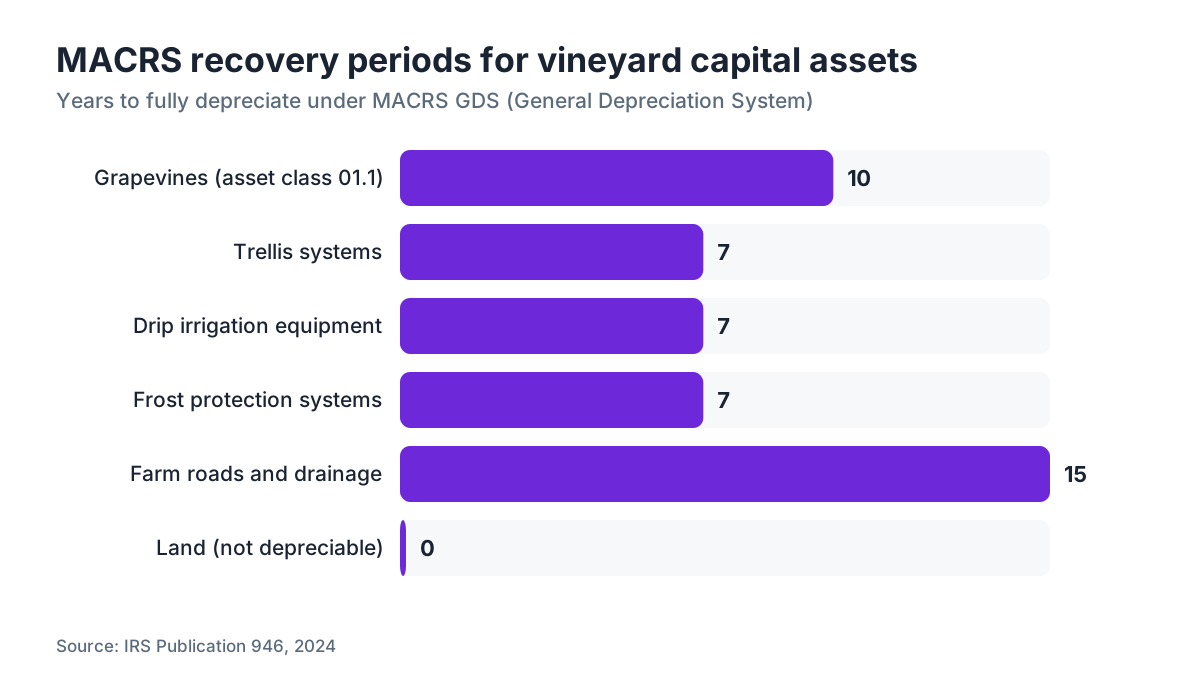
- The IRS makes you capitalize them and depreciate over time, usually a 10-year MACRS recovery period for grapevines.
- A project-by-project cost log, contractor invoices, and dated photos from day one are the difference between a clean audit and a painful one.
What counts as a capital improvement vs. a regular operating expense in a vineyard?
The IRS draws the line with a straightforward test: if the expenditure adds value, substantially extends useful life, or adapts property to a new or different use, it's a capital improvement. If it just keeps something in its current working condition, it's an ordinary and necessary business expense under IRC Section 162. [1]
For a vineyard, that distinction hits hard at tax time. Replacing a broken drip emitter is a repair. Installing a new drip irrigation system across a block you're developing is a capital improvement. Mowing cover crop between rows is an operating cost. Building a permanent cross-slope terrace to control erosion is capital. The asset has to be new, not restored.
Here's how that shakes out for common vineyard activities:
| Activity | Capital or Expense? | IRS Basis |
|---|---|---|
| Land clearing and grading for new planting | Capital | Creates new productive asset |
| Vine purchase and planting | Capital | Pre-productive period costs [2] |
| Trellis installation (posts, wire, anchors) | Capital | 7-year MACRS depreciable asset |
| Drip irrigation system, new block | Capital | 7-year MACRS depreciable asset |
| Replanting after disease loss (same block) | Expense or Capital (depends on extent) | IRC § 263(a) analysis required |
| Annual spray program | Expense | Ordinary and necessary |
| Frost protection equipment (permanent system) | Capital | 7-year MACRS |
| Cover crop seed for established block | Expense | Ordinary and necessary |
| Road improvements serving new block only | Capital | 15-year MACRS land improvement |
Replanting is the gray area most vineyard owners hit. Pull and replant a full block because of phylloxera or leafroll virus, and the IRS will likely treat it as a new capital asset, not a repair. Replace scattered missing vines in an established block, and that's usually expensed. Nobody has clean guidance on the exact threshold. The closest IRS authority is the tangible property regulations under Treas. Reg. § 1.263(a)-3, which run everything through a "betterment, restoration, or adaptation" framework. [1]
How does the IRS require you to depreciate grapevines and vineyard infrastructure?
Grapevines are 10-year MACRS property under the General Depreciation System, sitting in the IRS's Asset Class 01.1 for agriculture. [3] That's the number most vineyard operators work with. The Alternative Depreciation System runs 10 years too for grapevines, so there's no difference there, unlike with some other crops.
Trellis systems and irrigation equipment are generally 7-year MACRS property (asset class 01.1 also covers this farm equipment). Land improvements like roads and drainage that aren't part of the land value itself are 15-year MACRS property.
Grapevines go through a pre-productive period, typically 3 to 5 years from planting to first commercial crop depending on variety and training system. The IRS makes you capitalize costs incurred during that period and add them to the basis of the vines, not expense them in the year you spend the money. This is the uniform capitalization rule under IRC Section 263A, usually called UNICAP. [4] Your spray costs, irrigation water, frost protection runs, and establishment labor during the first years aren't deductible expenses. They roll into the depreciable basis of the vineyard asset.
There's an exception. Certain small agricultural businesses can elect out of UNICAP under IRC Section 263A(d). For tax years beginning in 2023 and later, the gross receipts threshold for this exception is $29 million (indexed for inflation). [4] If your operation is below that, talk to your CPA about making the election. It can change your cash flow a lot during establishment.
Section 179 expensing is available for vineyard equipment and some farm assets, but not for grapevines during the pre-productive period. Bonus depreciation under Section 168(k) has followed a phase-down: 80% for property placed in service in 2023, 60% in 2024, and 40% in 2025. [3] Those numbers come straight from the Tax Cuts and Jobs Act schedule, and they matter if you're putting in trellis or irrigation right now.
What records do you actually need to document vineyard capital improvements?
Under IRC Section 6001, you must keep records sufficient to establish the nature, amount, and business purpose of each expenditure. [5] The IRS doesn't mandate a single format. For capital improvements, that means keeping records long enough to cover the depreciable life of the asset plus the standard 3-year audit window, which often runs 13 years or more for grapevines. This is where most small vineyard operations fall short.
Here's what a solid capital improvement file looks like for a vineyard development project:
Project description document. One page describing what was done, which block or parcel it applies to (with legal description or APN), the date work started and ended, the total cost, and why it qualifies as a capital improvement. Your words, not boilerplate.
Contractor invoices and contracts. Every invoice, dated, with the vendor's name and address, itemized scope of work, and amount paid. Did the work with your own equipment and labor? Keep a time log and an equipment-use record with dates, hours, and tasks.
Proof of payment. Canceled checks, bank statements, credit card statements. Contractor payments over $600 in a year also trigger a Form 1099-NEC filing obligation, and cash paid without documentation is a problem waiting to surface.
Dated photographs. Before-and-after photos with the date embedded (use your phone's GPS-stamped camera). They cost nothing and have settled plenty of IRS disputes. Take them at the start of work, at key milestones, and at completion.
Plot map or block map. A simple diagram showing which block or parcel was improved: vineyard block ID, acre count, variety, rootstock, trellis system, row spacing. UC Davis Cooperative Extension has published standard block record templates that work well for this. [6]
Depreciation schedule. A spreadsheet or tax schedule showing the asset's placed-in-service date, cost basis, MACRS class, recovery period, and annual deduction. Your CPA maintains this. You keep a copy.
Store all of it in a folder by project, not by year. Auditors ask about a specific block or asset, not a calendar year, so organizing by the asset makes retrieval fast.
How do pre-productive period costs roll into depreciable basis?
Under UNICAP (Section 263A), every direct cost and an allocable share of indirect costs incurred during the pre-productive period gets added to the basis of the vineyard asset. [4] Direct costs are easy: vine stock purchase, planting labor, irrigation installation for the new block. Indirect costs are where it gets complicated.
Indirect costs you have to allocate to the pre-productive asset include a portion of farm overhead (equipment depreciation, repairs and maintenance on shared equipment), interest on debt used to finance the development (the avoided cost method or the traced debt method), and management labor tied to the new planting.
Here's the practical upshot. Spend $4,500 per acre on establishment (a rough figure for a California coastal vineyard; real numbers swing widely from about $3,000 to over $20,000 per acre depending on land prep, variety, trellis system, and labor market, per UC Davis cost studies), and all of it goes into your depreciable basis. You start depreciating over 10 years only after the vines reach productive status. [6]
Keep a running tally of pre-productive costs by block and by year. When the block reaches commercial production, that accumulated total becomes your cost basis. Sell the block or the farm later, and that basis reduces your taxable gain.
WSU Extension has published vineyard cost-of-production budgets for Washington state that break down pre-productive and productive-year costs in a format that maps well onto IRS capitalization categories. [7] They're not IRS documents. They're useful templates for organizing your own records.
What is the placed-in-service date for vineyard assets, and why does it matter?
The placed-in-service date is the date an asset is first ready and available for its intended use. For depreciable equipment, that's usually the date it arrives and gets installed. For grapevines, it's less obvious.
Grapevines are generally placed in service when they first reach commercial production, which the IRS reads as the first year the block produces a crop that could be sold commercially. That usually lands in year 3 or 4 after planting, depending on variety and training. [2] Before that, you're in the pre-productive capitalization zone.
Get this date right, because it starts the depreciation clock. Start depreciating a year early and you're taking deductions you aren't entitled to. Start a year late and you're leaving deductions on the table. Document the placed-in-service date with your first harvest record for that block, a dated tonnage or pick ticket, and a note in your block file.
For trellis and irrigation systems, placed-in-service is the date installation is complete and the system is ready for use, even if the vines aren't in the ground yet. A trellis built in fall of one year is placed in service that tax year, not when you plant in spring.
How do cost segregation studies apply to vineyard development?
A cost segregation study is an engineering and accounting analysis that pulls apart a larger capital project into components that can be depreciated over shorter recovery periods, moving deductions forward. They're common in commercial real estate and turning up more often in large agricultural developments.
For a vineyard, a study might split a big land development project into its parts: the land itself (not depreciable), the irrigation mainline (7-year), lateral lines and emitters (7-year), trellising (7-year), earthworks like deep ripping (arguably 15-year land improvement), and roads (15-year). Pay one contractor $800,000 for a turn-key block development and get a single invoice, and a cost segregation study can allocate that lump sum across asset classes with shorter recovery periods, front-loading your depreciation deductions.
A study runs roughly $5,000 to $15,000 for a vineyard development project of that scale. It pays off when the present-value benefit of accelerated depreciation beats the study cost, which usually needs a project of at least $500,000 to $1 million in depreciable assets. Below that, the math usually doesn't work. Have your CPA run the numbers before you commission one.
Smaller projects don't need a formal study. A well-organized set of itemized contractor invoices that break out trellis, irrigation, road work, and planting costs separately gives you the same classification flexibility at no extra cost.
What happens if you later sell or abandon a vineyard block?
Sell farmland with a developed vineyard and you're selling multiple assets at once: land, grapevines, trellis, irrigation, and any other improvements. Each has its own tax basis and its own character of gain or loss.
Land isn't depreciable, so its basis is your original purchase price plus any capitalized costs properly allocated to the land (clearing, grading before planting). Grapevines carry a basis equal to accumulated pre-productive costs plus any amounts capitalized after the placed-in-service date, reduced by depreciation taken. On sale, the difference between the price allocated to vines and the remaining depreciable basis is gain. If the depreciation was taken under MACRS, Section 1245 recapture applies, and that portion is taxed as ordinary income, not capital gain. [1]
Abandon a block (you pull vines because of an incurable virus, say) and you can generally claim a loss equal to the remaining undepreciated basis of the vines and trellis for that block. You'll need documentation that the abandonment was permanent and the assets were rendered worthless or physically discarded. Dated photos of the pulled vines, removal invoices, and a written record of the decision all back the loss claim.
Partial disposals happen when you replant part of a block. The IRS tangible property regulations let you write off the remaining basis of the old assets when they're disposed of, rather than depreciating ghost assets forever. [1] This requires that you tracked the old assets separately. One more reason to keep block-level records from day one.
How should you organize and store vineyard capital improvement records?
Paper is fine. Digital is better. Both is best.
The standard I'd aim for: a digital folder for each capital project, named with the block ID, project type, and year (like "Block-7-TrellisInstall-2024"). Inside, keep a project summary document, scanned invoices as PDFs, payment confirmations, photos, and a copy of the depreciation schedule entry. Back it up offsite, either with a cloud service or an external drive kept somewhere other than the farm office.
For field operations and spray records that feed your pre-productive cost basis, tools like VitiScribe let you log block-level activities with dates and costs, which makes the end-of-year UNICAP allocation far less painful than rebuilding it from memory and a shoebox of receipts.
Retention: keep capital improvement records for the life of the asset plus at least 7 years after you dispose of it. The IRS normally has 3 years to audit a return, but the statute of limitations extends to 6 years if the IRS believes income was understated by more than 25%, and there's no limit if fraud is alleged. [5] For a long-lived asset like a vineyard block, records from the establishment year may need to survive 20 years or more.
Cornell Cooperative Extension recommends keeping a "capital asset register" that lists every depreciable asset, its purchase date, cost, class, and current book value. [8] Not an IRS requirement. It makes tax prep faster and audits far less disruptive.
What are the common IRS audit triggers for vineyard capital improvement deductions?
Vineyard operations draw IRS scrutiny for a few recurring reasons. Start with the hobby loss rules under IRC Section 183. Show losses in 3 or more of 5 consecutive tax years and the IRS may question whether you have a genuine profit motive. [9] That doesn't directly change how you classify capital improvements, but it puts everything under a scanner, including whether you're improperly expensing items that should be capitalized.
Second, large and inconsistent deductions. Claim $200,000 in operating expenses one year against $80,000 in revenue and expect questions. Clean documentation that separates capital expenditures from operating expenses and shows a rational UNICAP allocation makes you look like a sophisticated operator, not a tax shelter.
Third, cash transactions. Paying farm labor or contractors in cash without 1099s is a red flag. Every contractor payment over $600 in a year requires a Form 1099-NEC. [5]
Fourth, basis discrepancies. Sell a vineyard with a reported basis that seems too high relative to what you paid, and the IRS will ask for documentation. Can't produce the records showing how pre-productive costs accumulated over 5 years? You lose the argument.
IRS Publication 225, the Farmer's Tax Guide, is the primary reference document for agricultural operations. It covers capitalization, depreciation, and basis tracking in detail, and it's the guide an examiner will hold you to. [10]
Are there state-level documentation requirements that overlap with federal IRS records?
Yes, and they're worth understanding because they often share the same underlying documentation.
California, for example, requires vineyard operators to maintain pesticide application records under the California Food and Agricultural Code, which feeds directly into your pre-productive period cost documentation, since spray costs are capitalized under UNICAP during establishment. [11] Those spray records, required for state compliance anyway, double as supporting documentation for your capitalized pre-productive costs.
Property tax assessors in agricultural counties often run their own capitalization analysis when you improve farmland. In California, Proposition 8 and standard assessment practices mean newly planted vineyards may get reassessed, and the county assessor's office may request documentation of improvement costs. The records you keep for IRS purposes are exactly what they want.
Water use records for new irrigation systems may also be required under state or district reporting, particularly in California's stressed water basins. Those records document the existence and installation date of the system, which supports your placed-in-service date.
The EPA Worker Protection Standard requires pesticide application records including application date, product, rate, and block or field. [12] Those records map straight onto the cost records you need for UNICAP allocation of spray costs during the pre-productive period. One good record-keeping system covers several compliance obligations at once.
To get a feel for what full-scale vineyard capital development looks like, it helps to see how established destinations like Gervasi Vineyard or Ponte Winery have built out their infrastructure.
What does a complete capital improvement file look like for a new block planting?
Here's a concrete example of what you'd assemble for a 10-acre new block planting with trellis and drip irrigation, using real cost categories.
Project file: Block 12, Cabernet Sauvignon on 110R, 10 acres, planted spring 2024
Project summary document (1 page): Block ID, APN, GPS coordinates, variety, rootstock, vine spacing, row spacing, trellis system, planting date, contractor names, total project cost, business purpose.
Land preparation: invoices for ripping ($4,200), soil amendment ($1,800), fumigation if applicable. Photographs before and after.
Vine stock: nursery invoice itemizing variety, rootstock, count, price per vine. Delivery receipt. Certificate of inspection if your state's plant quarantine rules require it.
Planting labor: contractor invoice or employee time records with dates and block ID.
Trellis installation: invoice itemizing anchor posts (count and unit price), line posts (count and unit price), wire (footage and gauge), installation labor. Kept separate from vine stock and irrigation.
Irrigation: invoice itemizing mainline (footage, pipe size), laterals, emitters, filter, pressure regulator, valve assembly, installation labor. Separate line items matter here for cost segregation.
Training and initial pruning labor (years 1-3): annual time records by block, including wage rates. These are pre-productive indirect costs under UNICAP.
Annual spray records, years 1-3: dates, products, rates, applicator, block treated. These are pre-productive direct costs under UNICAP. [12]
Placed-in-service documentation: first pick ticket or harvest record for the block, with date and tonnage, confirming commercial production status.
Depreciation schedule entry: cost basis (accumulated pre-productive costs), placed-in-service date, MACRS class (grapevines: 10-year GDS), depreciation method (200% declining balance for most farm property), annual deduction, accumulated depreciation, remaining basis.
That's the file. Keep it intact for the life of the block plus 7 years. Sell the farm or pull the block, and the file survives the asset. Tools like VitiScribe can store the block-level activity records that feed this file year by year, cutting the end-of-year reconstruction work down to almost nothing.
For a wider look at how vineyard operations structure their physical and operational assets across different scales, the vineyard overview covers what full buildouts typically include.
Frequently asked questions
How many years do you depreciate grapevines for federal income tax?
Under MACRS GDS, grapevines are in asset class 01.1 with a 10-year recovery period. The ADS life is also 10 years. Depreciation starts when the vines reach commercial production status, not when they're planted. Costs incurred during the pre-productive period accumulate in the asset's cost basis under Section 263A's UNICAP rules.
Can I deduct vineyard planting and development costs in the year I incur them?
Generally no. Planting costs are capital expenditures, and pre-productive period costs must be capitalized under IRC Section 263A (UNICAP). The exception is if your operation qualifies under the small business gross receipts exception ($29 million threshold for 2023 and later tax years), in which case you may elect out of UNICAP and potentially expense some costs. Talk to a CPA before making this election.
What MACRS recovery period applies to vineyard trellis systems?
Trellis systems and irrigation equipment are generally classified as 7-year MACRS property under asset class 01.1, which covers assets used in agriculture. They qualify for bonus depreciation (phasing down: 60% in 2024, 40% in 2025) and Section 179 expensing, unlike the vines themselves, which cannot use bonus depreciation during the pre-productive period.
Does the IRS require a specific form or format for vineyard capital improvement records?
No. The IRS requires records sufficient to establish the nature, amount, and business purpose of each capital expenditure under IRC Section 6001, but doesn't mandate a specific format. Practically, you need itemized invoices, proof of payment, a business purpose statement, dated photographs, and a depreciation schedule entry. Organized by asset or project, not by tax year.
How long do I need to keep vineyard capital improvement records?
Keep records for the full depreciable life of the asset plus at least 7 years after you dispose of it or close the depreciation schedule. For grapevines with a 10-year MACRS life, that can mean records need to last 17 years or more from planting. The IRS normally audits within 3 years of filing, but has 6 years if income is understated by more than 25%.
What is the pre-productive period for grapevines and when does it end?
The pre-productive period starts at planting and ends when the vines first reach commercial production, typically year 3 to 5 depending on variety, training system, and growing conditions. Document the end of the pre-productive period with your first commercial harvest record for that block (dated pick ticket or production report). That date is your placed-in-service date for depreciation.
Can I use Section 179 to expense vineyard development costs?
Section 179 can be used for vineyard equipment and infrastructure like irrigation and trellis, but not for grapevines during their pre-productive period. Once vines are in production and placed in service, they may qualify for Section 179, subject to the annual dollar limit ($1,160,000 for 2023, indexed for inflation) and the business taxable income limitation.
What happens to my undepreciated vineyard basis if I pull and replant a block?
Under the IRS tangible property regulations (Treas. Reg. § 1.263(a)-3), you can claim a loss on the remaining undepreciated basis of the retired assets (vines, trellis, and irrigation specific to that block) when you permanently abandon them. You need dated documentation of the removal, invoices for the pull-out work, and records showing the old assets have been physically disposed of.
How do I allocate overhead costs to a new vineyard block under UNICAP?
The simplified production method or the farm-specific simplified resale method are the most common approaches. Both allocate a portion of indirect costs (equipment depreciation, interest, management labor) to pre-productive assets based on a ratio like direct cost of the new block to total direct farm costs. Your CPA should calculate this annually during the pre-productive period and add it to the block's accumulated basis.
Do vineyard land improvement costs, like roads and drainage, depreciate differently than vines?
Yes. Land improvements like farm roads, drainage ditches, and irrigation distribution systems that aren't attached to a building are 15-year MACRS property under asset class 00.3. They're separate from the 10-year grapevines and 7-year trellis and irrigation equipment. Keeping these categories distinct in your project invoices matters for filing the correct depreciation schedule.
Are vineyard irrigation and trellis costs eligible for bonus depreciation?
Yes, trellis and irrigation equipment placed in service in a given year can use bonus depreciation. Under the TCJA phase-down, the bonus depreciation percentage is 60% for 2024 and 40% for 2025. Grapevines themselves do not qualify for bonus depreciation during the pre-productive period. Confirm current-year percentages with IRS Publication 946 or your tax advisor each year.
What records should I keep if I use my own farm labor and equipment for vineyard development?
Keep a daily labor log by employee or by the owner, showing dates worked, hours, tasks performed, and which block the work applies to. For equipment, log dates, hours of use, machine type, and task. Apply your standard hourly wage rates (or FMV for owner labor in some cases) and equipment rates. These internal cost records substitute for third-party invoices and must be contemporaneous, not reconstructed later.
How does a cost segregation study work for a vineyard, and when is it worth doing?
A cost segregation study is an engineering and accounting analysis that breaks a lump-sum development cost into shorter-lived asset classes (7-year, 15-year) to accelerate depreciation deductions. For a vineyard, it makes financial sense when the project exceeds roughly $500,000 to $1 million in depreciable assets. The study typically costs $5,000 to $15,000. Below that threshold, good itemized contractor invoices achieve the same result at no extra cost.
Does California have any additional documentation requirements for vineyard capital improvements beyond IRS rules?
California doesn't have a separate capital improvement documentation regime, but state-mandated pesticide application records (required under the California Food and Agricultural Code) and water use records for new irrigation systems directly support your federal capitalization records. State property tax assessors may also request improvement cost documentation when newly developed blocks are reassessed, and your IRS records satisfy that request.
Sources
- IRS, Tangible Property Final Regulations (Treas. Reg. § 1.263(a)-3): Expenditures that result in betterment, restoration, or adaptation of a unit of property to a new or different use must be capitalized under IRC Section 263(a); Section 1245 recapture applies to depreciable farm property on sale.
- IRS Publication 225, Farmer's Tax Guide: Grapevines have a pre-productive period; costs incurred before commercial production must be capitalized; placed-in-service date is when vines first reach commercial production.
- IRS Publication 946, How To Depreciate Property: Grapevines are 10-year MACRS GDS property; bonus depreciation phase-down schedule under TCJA: 80% (2023), 60% (2024), 40% (2025); trellis and irrigation equipment are 7-year MACRS.
- IRS, Uniform Capitalization Rules under IRC Section 263A: Pre-productive period costs must be capitalized under IRC Section 263A; small agricultural businesses under the $29 million gross receipts threshold (2023 and later) may elect out under Section 263A(d).
- IRS, Recordkeeping for Small Businesses and Self-Employed (IRC Section 6001): Taxpayers must keep records sufficient to establish the nature, amount, and business purpose of each expenditure; statute of limitations extends to 6 years for 25%+ understatement of income.
- UC Davis Agricultural Issues Center, Sample Costs to Establish and Produce Wine Grapes: UC Davis publishes vineyard establishment cost studies by region; establishment costs range broadly depending on land preparation, variety, trellis system, and labor market.
- Washington State University Extension, Vineyard Cost-of-Production Budgets: WSU Extension publishes vineyard cost-of-production budgets that break down pre-productive and productive-year costs in a format that maps onto IRS capitalization categories.
- Cornell University Cooperative Extension, Agricultural Finance and Management: Cornell recommends maintaining a capital asset register listing every depreciable asset, purchase date, cost, class, and current book value.
- IRS, Hobby Loss Rules under IRC Section 183: Under IRC Section 183, activities showing losses in 3 or more of 5 consecutive tax years may be challenged for lacking a genuine profit motive.
- IRS Publication 225, Farmer's Tax Guide (main reference): IRS Publication 225 is the primary reference for agricultural tax treatment covering capitalization, depreciation, pre-productive periods, and basis tracking for farming operations.
- California Department of Pesticide Regulation, Pesticide Use Reporting: California requires vineyard operators to maintain pesticide application records under the California Food and Agricultural Code; these records document pre-productive period spray costs for UNICAP purposes.
- EPA, Agricultural Worker Protection Standard: The EPA Worker Protection Standard requires pesticide application records including application date, product, rate, and block or field treated.
Last updated 2026-07-11