Common errors found in vineyard pesticide use reports during DPR audits

TL;DR
- California's Department of Pesticide Regulation and county agricultural commissioners find the same errors over and over in vineyard pesticide use reports: missing or wrong application times, bad acreage, unlicensed applicator signatures, wrong EPA registration numbers, and Worker Protection Standard gaps.
- Most are paperwork mistakes, not chemical misuse.
- Fines still reach $5,000 per violation per day for willful cases.
Why do DPR audits target vineyard pesticide use reports so often?
Vineyards get audited more than most farms for a plain reason. They spray a lot, they spray often, and the vines sit close to houses where neighbors file complaints. California's Department of Pesticide Regulation reported 4,724 pesticide use enforcement actions statewide in 2022, with agriculture accounting for most of those investigations [1]. Your county agricultural commissioner is usually the first person who reads your records, but DPR can step in directly on restricted-use materials or when a commissioner's finding escalates.
The audit isn't random in most counties. Commissioners pull records after an illness report, a drift complaint, an endangered species proximity flag, or because your operation crossed a volume threshold on a restricted material. Spray more than a few thousand pounds of active ingredient a year and you're already on a list somewhere.
Here's what makes this painful. Most violations in vineyard records have nothing to do with applying the wrong chemical or drifting product onto a neighbor's lawn. They're paperwork. A missing start time. The wrong county code. A blank where the wind speed goes. The chemical went on correctly, the label got followed, and you still catch a notice of violation because the record can't prove any of it.
That gap, between what actually happened in the field and what the paper says, is where auditors live.
What are the most common pesticide use report errors DPR finds in vineyards?
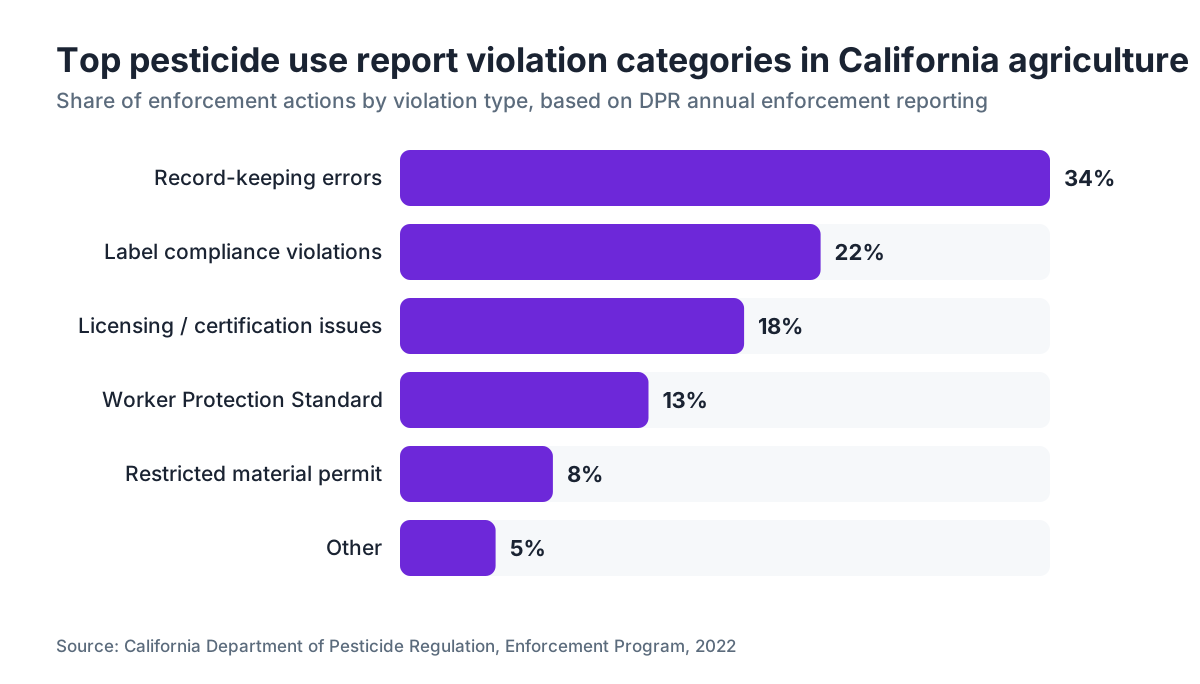
The list below comes from DPR's own enforcement summaries and county commissioner guidance [1][2]. None of it is hypothetical. Commissioners see these in roughly this order of frequency, with record-keeping errors leading every year.
| Error Type | Why It Matters | Typical Finding |
|---|---|---|
| Missing or incorrect application time (start/end) | Required by CCR Title 3, Section 6628 | Omitted on hand-written records |
| Inaccurate treated acreage | Drives restricted-material totals | Over- or under-reported |
| Wrong or missing pesticide registration number | Product identity can't be confirmed | Transcription errors from labels |
| Unlicensed or unverified applicator | Restricted-use materials require QAL or QAC | Signature missing or not on file |
| Missing wind speed and direction | Required field on the Pesticide Use Report form | Left blank most often in winter |
| Incorrect or missing adjuvant/tank-mix records | Adjuvants with a pesticide are reportable | Treated as a separate product issue |
| Wrong application method code | Affects drift and exposure modeling | "Air blast" coded as "ground spray" |
| Missing pre-harvest interval notation | Required when PHI is a label condition | Common during veraison sprays |
| No record of restricted-entry interval posting | WPS requirement, more than a label note | Often filed separately and lost |
| Late submission | Reports due to commissioner by end of the following month | Catches small operators every year |
The acreage error deserves more room. Spray a block with mixed vine spacing or interplanted rows and calculating treated acres gets genuinely tricky. DPR's guidance says you report the acres treated, not the acres owned [2]. Skip six rows out of a twelve-row block and you report half the block. Auditors compare your reported acreage against parcel maps and block records, and a pattern of mismatch reads as intentional even when it's just sloppy math.
What does California law actually require on a pesticide use report?
California Food and Agricultural Code Section 11746 requires a written pesticide use report for every application made by a licensed pest control business or anyone reporting under the commissioner's permit system [3]. The form isn't optional, and the fields aren't suggestions.
California Code of Regulations Title 3, Section 6628 spells out the mandatory data elements: operator name, address, and license or certificate number; site location including township, range, section, and county code; crop or commodity; pesticide product name, EPA registration number, and amount used; application method; date and time of application (start and end); acreage or other unit treated; and the name of the certified applicator [3]. Wind speed and direction are required inside certain setback areas or when the label demands it, but plenty of commissioners expect it on every agricultural application.
Reports are due to the county agricultural commissioner by the last day of the month after the month you applied, though many commissioners set an earlier internal deadline and some require weekly filing on restricted materials [2]. Miss the filing window and that's a violation on its own, regardless of whether the application itself was legal.
UC Davis Cooperative Extension has pointed out that hand-written field notes copied onto official forms days or weeks later cause most transcription errors, and that entering data digitally at the point of application cuts audit findings sharply [4].
How do worker protection standard gaps show up in pesticide records?
EPA's Worker Protection Standard (WPS), revised in 2015 and codified at 40 CFR Part 170, requires agricultural employers to keep records that lock together with pesticide use reports [5]. During a DPR audit, inspectors pull both sets and lay them side by side. When they don't match, both violations get written.
The WPS failures I see most in vineyard operations are missing application-specific safety data sheet records (you have to give SDSs to handlers), no central posting of application information at a designated display area, incomplete handler training records, and no written respirator fit-test records when the restricted-entry interval calls for respiratory protection.
The WPS posting has to carry the product name, EPA registration number, active ingredient, location and description of the treated area, date and time of application, and the restricted-entry interval [5]. That's nearly the same data as the use report, but it's a separate document posted for workers, not filed with the commissioner. Growers who handle both jobs at once get both right. Growers who treat them as two chores miss one.
EPA guidance states that "agricultural employers must keep records of all pesticide applications for two years" under WPS [5]. DPR also requires pesticide use records to be kept two years [3]. If an auditor asks for three-year-old records, you don't have to have them. But if you kept them, a gap in the pile looks worse than an empty pile.
What are the most common acreage calculation mistakes on vineyard spray reports?
Report only the area where the pesticide landed. That's DPR's rule, and it's where vineyards break from row crops [2]. A corn field is a rectangle. A hillside Pinot block with a creek buffer, a non-bearing block in its first year, and a wedge of cover crop is not.
Say your block map shows 8.3 acres but you skipped the end rows on a wind shift. You report something under 8.3. Auditors check that against GPS track logs if you run a precision sprayer, against fuel use, and against your material calculations. Report 8.3 acres but buy only enough product for 5 acres at the labeled rate, and someone will ask why.
Underreporting sounds safer and isn't. Restricted-use pesticide totals get tracked at the county level against your permit conditions. If your permit caps active ingredient per season and your reported acreage runs too low to explain your actual purchases, the numbers won't reconcile when the commissioner runs your reports against your dealer's sales data (which also flows to DPR).
On variable-rate or canopy-sensing sprayers, the field computer usually spits out a number that won't match the tidy "rows times length times row spacing" formula. Use the equipment report as your primary source. Then write down the methodology so an auditor can walk your math without guessing.
What applicator license errors come up most in vineyard audits?
Restricted-use pesticides need a Qualified Applicator License (QAL) or a Qualified Applicator Certificate (QAC) to buy and apply [8]. The two aren't interchangeable. A QAL covers you when you employ workers to apply pesticides commercially. A QAC covers the individual applying on property they own or manage. Many vineyard owners hold a QAC for their own work but hire a licensed pest control operator for certain treatments, and the records blur the line between the two.
Auditors flag the same handful of problems: a pesticide applied by an employee under a foreman's certificate that doesn't cover that pesticide category, a QAC on the use report that has lapsed (California renews every three years [8]), and a licensed applicator listed on paper who wasn't present or supervising the application as required.
Washington and Oregon run similar structures under their agriculture departments. WSU Extension's pesticide safety education program reports that license category mismatches are the single most common finding in its state's agricultural record reviews [6].
Use a licensed pest control operator for any application and get a copy of their license for your file. The commissioner will ask for it during an audit. "They told me they were licensed" is not a defense.
How does using the wrong EPA registration number cause audit problems?
Every registered pesticide carries a unique EPA registration number, usually a five-to-seven digit registrant number, a hyphen, then a four-to-five digit product number (264-516, for example) [9]. It's printed on the label and the SDS. DPR uses it to pull the product's registered uses, rate limits, and restricted-material status.
Get one digit wrong and the record either points at a different product or at nothing. An auditor who can't verify what went in the tank treats the whole application record as incomplete. On restricted materials, that breaks the permit condition demanding accurate records, and now it's a violation.
Most of these errors come from copying the number out of memory or off a summary sheet instead of straight from the label. Labels change. A reformulation gets a new registration number. A label amendment shifts the suffix. The label copy you printed two years back may not match the jug in your hand today.
The fix is simple and cheap. Photograph the label on each container before you mix, and file the photos by application date. If your records get questioned, you can show exactly what you used.
What happens when you miss the pesticide use report filing deadline?
Late filing is its own violation, separate from anything wrong with the spray. California requires reports filed with the county agricultural commissioner by the last day of the month after the month of application [3]. Apply in July, file by August 31. Apply in December, file by January 31.
Commissioners usually send a courtesy reminder the first time. The second time, you get a notice of violation. The fine schedule varies by county, but DPR's civil penalty regulations allow up to $5,000 per violation per day for willful violations, with smaller amounts for first-time or administrative slips [1]. A month of late records across a busy spray season adds up on paper, even if the penalty actually assessed usually lands well below that ceiling.
The quieter problem is credibility. If you're six weeks late and a drift complaint hit two weeks ago, the commissioner starts wondering whether you built that late report after the complaint came in. Timely records, even imperfect ones you clean up by amendment, beat perfect records filed late every time.
Small operators running a vineyard without dedicated office staff get caught on deadlines more than big outfits with compliance departments. Set a calendar reminder for the 15th of each month to review the prior month's records. That leaves two weeks to find and fix errors before the window shuts.
How do you correct a pesticide use report error after filing?
You can amend a filed report, and fixing it yourself before an audit beats having an auditor find it almost every time. Call your county agricultural commissioner's office and ask for their amendment process. Most counties have a written form or procedure.
The amendment should name the original report by date and product, the exact field or fields that were wrong, the correct information, and the reason for the change. Don't just refile a corrected form without telling the commissioner's office. Both versions will sit in the system, and the discrepancy reads like two separate applications.
Catch an error during the season and fix it in the same month if you can. Amendments to prior-year records draw more scrutiny than current-season corrections. And if you're amending because you underreported acreage or volume on a restricted material, expect the commissioner to ask about your permit total for that material.
For catching these before they turn into amendments, a tool built for vineyard spray records like VitiScribe is worth a look. The idea is to generate report-ready data straight from field entries instead of transcribing paper notes onto an official form a week later. Whatever system you run, the goal holds: the record gets created at application, not reconstructed after the fact.
What records do you need to keep on file to survive a DPR audit?
Think of it as three layers of paper that all have to agree with each other.
Layer one is the pesticide use report itself, the official form you file with the commissioner. Layer two is the field record that fed the report: your application log, sprayer calibration records, block maps with treated acreage marked, and any GPS or equipment data. Layer three is the supporting compliance file: applicator licenses, the pesticide labels in effect at the time of application, WPS training records, and handler safety data sheets.
An auditor who finds a clean use report usually asks to see layer two next. No layer two, or field records showing different acreage or timing than the filed report, and the investigation gets serious fast. California requires pesticide use records kept for two years [3]. WPS records carry the same two-year retention [5]. File them by application date and by block, not by product.
Cornell Cooperative Extension's pesticide safety guidance for New York vineyards recommends a "pesticide use file" holding the filed report, the product label copy, the SDS, the applicator's license copy, and equipment calibration records from within 30 days of the application [7]. That's a fair standard no matter which state you farm in.
Operations in Paso Robles wineries country and other California appellations under heavy scrutiny (dense population, active water districts) have kept escalated investigations from spiraling more than once on the strength of a well-organized file.
How can vineyard managers prevent these errors before they happen?
Prevention comes down to two habits: a consistent field recording process and a monthly review before you file.
In the field, record the data at application, not later. Write the start time when you start. Write the wind speed when you check it, not when you fill out the form at the end of the week. The numbers are accurate at the moment of application and go fuzzy every hour after. A waterproof field card with the required fields pre-printed, one card per application, costs almost nothing and kills most transcription errors.
The month-end review compares three things: your filed reports against your field cards, your field cards against your material purchases and usage, and your applicator names against current license status. A 30-minute review before you file saves eight hours of audit response later.
Want a digital workflow? VitiScribe is built for vineyard spray records and generates DPR-compliant report data from field entries. A purpose-built tool like that is the cleanest way to close the gap between field reality and filed record, which is exactly what an auditor is trying to measure.
UC Davis Cooperative Extension publishes spray record templates and training materials for California vineyard operators, including the required data fields by crop and application type [4]. They're free, they're accurate, and using them shows good faith in any enforcement situation.
What are the actual fine ranges for pesticide use report violations in California?
DPR's civil penalty schedule under California Food and Agricultural Code Section 12999 allows up to $5,000 per violation per day for willful violations of pesticide regulations [1][3]. First-time administrative violations, like a blank wind speed or a late filing, usually land in the $250 to $500 range per incident. Repeat violations of the same type climb into higher tiers.
County commissioners hold some discretion, and a documented history of good-faith compliance draws lower penalties than a pattern of not caring. An operator who self-reports an error and amends the record before an audit generally gets a warning or a token penalty. An operator whose records got reconstructed after a complaint and don't match physical evidence gets penalties at or near the maximum.
Breach a restricted-use permit condition and the penalty can also include permit suspension or revocation. Losing the ability to buy and apply restricted materials mid-season is a worse operational problem than any dollar figure.
Nobody has clean data on average assessed penalties by violation type at the county level. Each county reports aggregate enforcement numbers without per-violation breakdowns. DPR's annual enforcement reports give statewide totals but not the per-violation averages you'd need to calculate real risk exposure [1].
Frequently asked questions
How often do county agricultural commissioners audit vineyard pesticide use reports?
Audit frequency depends on your county and your operation's risk profile. High-volume restricted-material users, operations near sensitive sites, and growers with prior violations get reviewed more often. Many commissioners run a 100% desk audit of restricted-material reports, so every filed report gets a basic data check. Full field investigations happen less often and get triggered by complaints, illness reports, or statistical anomalies in your acreage or volume data.
Do I need to report pesticide applications made by a hired pest control operator?
In California, the pest control operator (PCO) files the pesticide use report for applications they make, not you. But verify they filed, because your permit and site are attached to that record. If the PCO fails to file and an auditor finds the gap in your site's records, you can get pulled into the investigation. Get written confirmation of filing from your PCO after each application.
What is the difference between a pesticide use report and a pesticide application record?
The pesticide use report is the official form filed with the county agricultural commissioner. The pesticide application record is the field documentation you keep internally. Both must agree, but they do different jobs. The use report is a regulatory submission. The application record is your operational proof of compliance. Auditors may ask for both, and any discrepancy between them is a red flag.
Are sulfur and copper applications required to be reported in California vineyards?
Yes. In California, every pesticide application under an operator identification number or pest control business license is reportable, including sulfur and copper fungicides. There's no minimum-use exemption for organic or low-toxicity materials. Some counties set specific reporting thresholds for certain products, so check with your county agricultural commissioner for local requirements.
How far back can DPR or a county commissioner look during an audit?
The two-year record retention requirement sets the practical audit window. Commissioners can review any records you were required to keep within that period. Older records, if you have them, can be subpoenaed in a formal investigation but aren't usually requested in routine audits. The two-year clock runs from the date of the application, not the date you filed.
What is the worker protection standard posting requirement for vineyard spray applications?
Under EPA's revised Worker Protection Standard (40 CFR Part 170), agricultural employers must post application information at a central location workers and handlers can reach. The posting includes product name, EPA registration number, active ingredient, treated location, application date and time, and the restricted-entry interval. It stays up until the REI expires. The record of what was posted must be kept for two years.
Can I file pesticide use reports electronically in California?
Most California counties now accept or require electronic submission. DPR's CalAgPermits and eCal platforms handle statewide reporting, and many counties have built them into their workflows [10]. Check with your specific county agricultural commissioner for current submission requirements. Electronic filing cuts transcription errors and creates a timestamped submission record, which helps if a deadline ever gets disputed.
What's the best way to track wind speed for pesticide use report compliance?
A handheld anemometer at the application site is the most defensible method. Smartphone weather apps and airport ASOS data don't substitute for on-site measurement. Many precision sprayers log wind from an onboard weather station, and that data works well for compliance if you can export and archive it. Record wind speed and direction at the start of the application and again any time conditions shift noticeably.
Does an expired pesticide label affect my use report filing?
Using a product after its registration is cancelled, or using it against the current label, is a separate and often more serious violation than a use report error. The label in effect at the time of application governs your work, not an older copy in your file. Pull and archive a current copy of the label before every application, especially for products with recent label amendments.
What should I do if I realize I've been systematically filing incorrect acreage for a full season?
Contact your county agricultural commissioner proactively, before an audit. Explain the methodology error and ask how to file amendments. Bring your block maps, application logs, and material usage records to support the correction. Self-reporting a systematic error with documentation showing it was an honest calculation mistake gets treated very differently than the same error found during an audit.
Are adjuvants and spray tank additives required on the pesticide use report?
In California, adjuvants applied in combination with a registered pesticide are generally reportable. Standalone adjuvants with no pesticide properties may not be, depending on composition. If you're adding a spreader-sticker, buffer, or surfactant to a pesticide tank mix, check DPR's adjuvant reporting guidance for your product. When in doubt, report it. Over-reporting almost always carries less risk than under-reporting.
How does DPR's enforcement data inform what errors to prioritize fixing?
DPR publishes annual enforcement reports that break down violation types statewide. The reports show which categories (record-keeping, licensing, label compliance, WPS) generate the most notices of violation. Reading the current year's report gives you a real-time picture of what commissioners are focused on. The 2022 report showed record-keeping violations as the largest single category of agricultural enforcement actions.
Sources
- California Department of Pesticide Regulation, Annual Pesticide Use Report Enforcement: DPR reported 4,724 pesticide use enforcement actions statewide in 2022; civil penalties up to $5,000 per violation per day for willful violations
- California Department of Pesticide Regulation, Pesticide Use Reporting guidance: Report the acres treated, not acres owned; reports due to commissioner within required timeframes
- California Food and Agricultural Code Sections 11746 and 12999; CCR Title 3, Section 6628: Mandatory data elements for pesticide use reports including application time, acreage, EPA registration number, and applicator license; two-year record retention requirement; QAL/QAC requirements
- University of California Agriculture and Natural Resources, Cooperative Extension: Hand-written field records transferred to official forms later introduce most transcription errors; digital entry at application reduces audit findings; free spray record templates for California vineyard operators
- U.S. EPA, Agricultural Worker Protection Standard, 40 CFR Part 170: Agricultural employers must keep records of all pesticide applications for two years; application information posting requirements including product name, EPA registration number, treated area, and REI
- Washington State University Extension, Pesticide Safety Education Program: License category mismatches are the single most common finding in Washington agricultural pesticide record reviews
- Cornell Cooperative Extension, Pesticide Safety Education Program: Recommended pesticide use file includes filed report, product label copy, SDS, applicator license copy, and equipment calibration records from within 30 days of application
- California Department of Pesticide Regulation, Qualified Applicator License and Certificate requirements: QAC covers individual applying pesticides on property they own or manage; licenses require renewal every three years in California
- U.S. EPA, Pesticide Registration: Every registered pesticide product has a unique EPA registration number in registrant-product format; number appears on label and SDS
- California Department of Pesticide Regulation, electronic pesticide use reporting: California counties accept or require electronic pesticide use report submission through statewide reporting platforms
Last updated 2026-07-11