Continuing education requirements for maintaining a QAL license in California

TL;DR
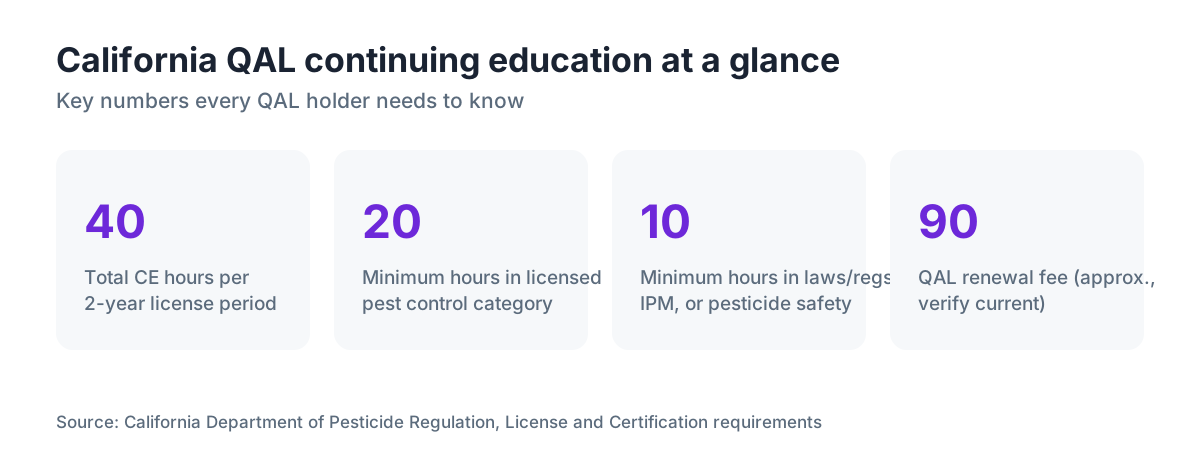
- California Qualified Applicator Licensees must complete 40 hours of approved continuing education every two-year license period.
- At least 20 hours must be in your specific pest control category, and at least 10 hours must cover laws and regulations, integrated pest management, or pesticide safety.
- The California Department of Pesticide Regulation approves the courses and audits the records.
What is a QAL license and who needs to maintain one?
A Qualified Applicator License (QAL) is the California credential you need to apply, supervise, or recommend restricted-use pesticides for hire or as part of a business operation [1]. Run a vineyard that sprays restricted materials, like most of the fungicides and insecticides common in wine grape production, and whoever is in charge of those applications almost certainly needs a QAL, or needs to be working under someone who holds one.
The California Department of Pesticide Regulation (CDPR) issues QALs in specific pest control categories. Most vineyard operators hold the Agricultural Pest Control category, sometimes paired with a Pest Control Adviser (PCA) credential. Those are two separate licenses with different CE rules. If you supervise employees making pesticide applications, the QAL is what keeps your operation legal with your county agricultural commissioner.
Here's a misread I see often. Small winery owners who farm their own grapes sometimes assume they skip the QAL because they're not spraying for hire. Wrong. Under California Food and Agricultural Code Section 11701 and the sections that follow, the license applies whenever restricted-use pesticides go out commercially, and your own commercial vineyard counts [1][8].
If this is your situation, the QAL is one layer of your vineyard compliance stack, not the whole thing.
How many CE hours does a California QAL require every renewal period?
Forty hours of approved continuing education per two-year license period [2]. Pace yourself at 20 a year if you like, but the state doesn't care how you spread the hours across the period as long as you hit 40 before your expiration date.
Within that 40-hour total, the breakdown looks like this:
| CE Requirement | Minimum Hours |
|---|---|
| Total CE per 2-year period | 40 |
| Hours in your licensed pest control category | 20 |
| Hours in laws/regs, IPM, or pesticide safety | 10 |
| Remaining flexible hours (any approved topic) | 10 |
The category requirement trips people up the most. If your QAL is in Agricultural Pest Control, at least half your hours have to come from coursework classified under that category, not general pesticide chemistry or business management [2].
The 10 hours in laws and regulations, IPM, or pesticide safety earn their keep beyond the checkbox. Rules on restricted-use pesticides, worker protection, and restricted-entry intervals change often. Those 10 hours are where you learn what changed before a county inspector asks about it.
What topics and course types count toward QAL continuing education?
CDPR approves CE across several subject categories. The ones that matter most for vineyard QAL holders are agricultural pest control methods, pesticide laws and regulations, integrated pest management, worker safety and the EPA Worker Protection Standard, and application equipment and calibration [2][3].
The Worker Protection Standard (WPS) deserves a specific mention. The 2015 revised WPS, codified at 40 CFR Part 170, added training requirements for agricultural workers and handlers, and CDPR-approved courses covering those changes count toward your pesticide safety hours [3]. UC Cooperative Extension has produced WPS training materials that CDPR has approved before, but check the current approval status before you assume a course counts [4].
Accepted formats include in-person classroom instruction, online courses from approved providers, county agricultural commissioner workshops, and sessions at industry conferences like those run by the California Association of Pest Control Advisers [9]. Self-study rarely counts unless it's specifically approved.
Here's what doesn't count. Vendor sales presentations. General business or financial management courses. Any course not on CDPR's approved provider list on the day you take it. This last one is a real trap. A supplier offers a free pesticide seminar that looks educational, but if the provider isn't CDPR-approved, those hours are worth nothing to your license [2].
Out-of-state university programs from places like Cornell occasionally offer content CA licensees can use, but approval varies year to year. Check the CDPR approved provider database before you register [6].
Where do you find CDPR-approved CE courses for agricultural pest control?
CDPR keeps a searchable database of approved CE providers and courses on its website [2]. Filter by pest control category and it shows the provider, course title, approved hours, and the exact subcategory each course satisfies. This is the authoritative source. Don't take a conference organizer's word on approval status. Go verify it in the database yourself.
The most reliable approved CE for vineyard operators comes from a handful of places:
- UC Cooperative Extension farm advisors: county advisors run field days, workshops, and seminars carrying CDPR-approved hours, and these tend to be the most useful to the work you're actually doing [4]
- California Association of Pest Control Advisers (CAPCA): the annual conference and regional events are a primary source for both QAL and PCA hours [9]
- County agricultural commissioners: many host annual pesticide safety and regulations trainings that carry CE credit
- Online providers: several private CE providers offer CDPR-approved online courses, handy for filling gaps in a specific subcategory
UC IPM (ipm.ucanr.edu) publishes extension material and occasional webinars that qualify [4]. Farm on the Central Coast near Paso Robles or the South Coast, and local advisors there often coordinate regionally relevant CE events. Your vineyard compliance calendar can track what's happening nearby.
Cost swings hard. A county ag commissioner workshop runs free to under $50. CAPCA conference registration runs several hundred dollars. Online packages covering a full 40-hour renewal from private providers generally run $150 to $400 based on current provider listings, though prices move.
What happens if you don't complete your CE hours before your QAL expires?
Your license lapses. CDPR won't grant an extension because harvest ate your calendar or you forgot to track hours. Once a QAL lapses, you cannot legally supervise restricted-use pesticide applications until it's reinstated [1].
Reinstatement means completing the CE hours you were short, paying a reinstatement fee, and sometimes reapplying rather than simply reinstating, depending on how long the license sat expired. Let it lapse more than three years and CDPR may make you retake the original licensing exam [1].
The operational hit lands faster than the paperwork. With no valid QAL on site, you're out of compliance with county pesticide use reporting, and you may be violating the EPA WPS if you're supervising handlers without a licensed supervisor present [3]. A county agricultural commissioner inspection during that window can bring fines.
CDPR mails renewal notices. Relying on the mail is a bad system. The expiration date is yours to track. Put it on your calendar the same way you track re-entry intervals.
How do you document and report CE hours to CDPR?
In most cases you don't send CE documentation to CDPR at all. You keep your certificates of completion, and CDPR may audit them. At renewal, you attest that you completed the required hours [2]. CDPR does run audits, and if you're picked and can't produce the paper, the outcome is identical to never having done the hours.
Good recordkeeping looks like this:
- Keep certificates of completion from every approved course
- Note the CE category (laws/regs, IPM, pesticide safety, or category-specific) on each certificate when it isn't already labeled
- Log the date, provider, course title, hours, and subcategory in a running spreadsheet or compliance tool
- Store copies in at least two places, and yes, a cloud backup matters here
This is exactly the kind of record where a tool like VitiScribe helps. CE tracking for licensed staff works best living in the same system as your spray records, so everything is findable the moment an auditor asks.
CDPR doesn't publish its exact audit lookback window, but general California licensing practice is that you should be able to produce records for at least one full license period. Keep your documentation four years to be safe.
Can QAL CE hours overlap with PCA continuing education requirements?
This comes up constantly from vineyard operators who hold both a QAL and a Pest Control Adviser (PCA) license, and the honest answer is: sometimes, and it's fiddly.
PCAs in California must complete 40 hours of CE per year, not per two-year period, a much heavier lift than the QAL requirement [7]. The PCA categories overlap heavily with QAL categories, and CDPR does let a single course count toward both licenses if it's approved for both and falls inside both active periods.
The cycles don't line up, though. PCA licenses renew annually. QAL licenses run two years. A course you take in year one of a QAL period can count toward that year's PCA renewal and land in your QAL 40-hour total at the same time. That's not fraud. The same hours genuinely satisfy both. What you can't do is pull PCA hours from outside your QAL period to plug a QAL gap.
Hold both licenses and the practical move is to track hours by license separately, then flag the overlaps. Most people who carry both end up with plenty of QAL hours just from keeping their PCA current.
Do the EPA Worker Protection Standard requirements add to QAL CE obligations?
No, the EPA Worker Protection Standard doesn't stack extra CE hours on top of the California QAL system. What it does is shape the training your operation has to give handlers and workers, and a QAL holder can deliver some of that training [3].
Under the revised WPS (40 CFR Part 170), agricultural employers must train workers on pesticide safety before they enter a treated area and train handlers before they perform handler tasks. EPA guidance is clear that the training has to come from a certified applicator or someone trained as a WPS trainer [3]. That's where your QAL earns its keep operationally: it's part of what qualifies you to train your field crew.
CDPR folds WPS compliance into its pesticide safety CE subcategory. Coursework on the 2015 revised requirements, restricted-entry intervals, personal protective equipment, and the Application Exclusion Zone rules all count toward QAL CE in the pesticide safety subcategory [2][3].
UC IPM and UC Cooperative Extension keep WPS-related training materials, some approved for CE credit, worth rechecking every year because the content gets updated [4]. The bonus is real: taking these courses also prepares you to train your crew, which the law requires regardless of your CE math.
What CE resources do UC Davis, WSU, and Cornell offer for vineyard QAL holders?
These three are the most credible academic sources for viticulture-specific CE, and each handles it differently.
UC Davis and UC Cooperative Extension are the most directly useful for California QAL holders. UC IPM (ipm.ucanr.edu) publishes pest management guidelines for wine grapes that sit under much of the approved CE offered through county farm advisors. Advisors in wine grape counties, including Napa, Sonoma, San Luis Obispo, and Fresno, regularly run field workshops carrying CDPR-approved hours [4]. UC Davis Plant Sciences also offers short courses for industry practitioners now and then.
Washington State University Extension has produced viticulture and pesticide safety content, some of it online. For a California QAL, the question is always whether a WSU course is CDPR-approved for California credit. Some are. Many aren't. Check the CDPR database before you spend time on a WSU online course.
Cornell Cooperative Extension runs a strong viticulture program through its CALS viticulture and enology department and offers online resources tied to the NY pest management guidelines [6]. Same caveat: CDPR approval for California QAL credit is never automatic.
The honest read is that UC Cooperative Extension is your most reliable source for California-specific, consistently CDPR-approved content. WSU and Cornell are excellent for learning, but verify approval before you count their courses toward a California license.
How do QAL renewal fees and timelines work in California?
QAL licenses run two years. The renewal fee on recent CDPR fee schedules is roughly $90, but fees move through the state budget process, so verify the current amount on CDPR's website before you submit [1]. Renewal notices go out about 60 days before expiration.
Renewing means submitting the application, paying the fee, and attesting that you completed 40 CE hours. You don't attach CE certificates unless CDPR specifically asks.
Timeline at a glance:
| Event | Timing |
|---|---|
| License period | 2 years |
| Required CE hours | 40 within the 2-year period |
| CDPR renewal notice mailed | ~60 days before expiration |
| Renewal fee (verify current) | ~$90 |
| Late/lapsed reinstatement fee | Higher than renewal; varies |
| License expired >3 years | May require re-examination |
One practical tip. Don't wait for the renewal notice to start stacking hours. Plan your CE at the start of each license period, pick which courses hit the category and subcategory minimums, and schedule them the way you'd schedule a spray.
What are the most common mistakes QAL holders make with continuing education?
The failures cluster around a few predictable problems.
Taking unapproved courses is the most common. A supplier hosts a genuinely good seminar, you take careful notes, and you walk away sure it should count. It doesn't, unless the provider held CDPR approval at the time. Verify first, always.
Missing the subcategory minimums comes second. Someone piles all 40 hours into general pest control topics and finds at renewal that they have only 6 of the 10 required hours in laws, regulations, IPM, or pesticide safety. Now they're scrambling for approved courses against a hard expiration date.
Weak recordkeeping is third. CDPR audits are random. If you can't produce documentation, the burden sits on you. A certificate you threw out is a certificate that doesn't exist in an audit.
The last one catches people off guard: the CE period ties to the license period, not a calendar year. If your license runs March 2024 to March 2026, hours you finished in January 2024, before the new period started, don't count toward that renewal. This bites hardest when you're reinstating after a lapse.
For growers juggling spray records, tank mix documentation, and worker training logs on top of CE tracking, one organized system pays off. Spreadsheet or something like VitiScribe, the point is not getting surprised at renewal time.
Frequently asked questions
How many CE hours does a California QAL license require?
California QAL licensees must complete 40 hours of CDPR-approved continuing education per two-year license period. At least 20 of those hours must be in the specific pest control category listed on the license, and at least 10 hours must come from laws and regulations, integrated pest management, or pesticide safety subcategories. The remaining 10 hours can come from any CDPR-approved topic.
What happens if my QAL license lapses because I missed the CE deadline?
If your QAL lapses, you cannot legally supervise restricted-use pesticide applications until it's reinstated. Reinstatement requires completing any missing CE hours, paying a reinstatement fee, and sometimes reapplying. If the license has been expired more than three years, CDPR may require retaking the original licensing examination. During the lapsed period, your operation is out of compliance with county pesticide use requirements.
Does the EPA Worker Protection Standard training count toward QAL CE hours?
Yes, CDPR-approved courses covering the EPA Worker Protection Standard (40 CFR Part 170) count toward the QAL pesticide safety CE subcategory. This includes coursework on restricted-entry intervals, personal protective equipment, Application Exclusion Zones, and the 2015 WPS revisions. Not every WPS training qualifies automatically; the provider must be on CDPR's approved list for California credit.
Can I use the same CE hours for both my QAL and my PCA license?
Yes, a single CDPR-approved course can count toward both a QAL and a PCA license if it's approved for both and falls within both licenses' active periods. The main thing to watch is that PCA CE runs on an annual cycle while QAL CE runs on a two-year cycle, so the same hours may satisfy different renewal periods for each license. Track both separately to avoid confusion.
Do UC Davis or UC Cooperative Extension courses count toward California QAL CE?
Many UC Cooperative Extension workshops and county farm advisor programs are CDPR-approved for QAL CE credit, particularly those on agricultural pest management, IPM, and pesticide safety. Verify each course in CDPR's approved provider database before attending. UC IPM program materials and UC Davis short courses are generally strong sources for vineyard-relevant approved content.
How do I find CDPR-approved continuing education courses for my QAL?
CDPR maintains a searchable online database of approved CE providers and courses on its website (cdpr.ca.gov). Filter by your pest control license category to see eligible courses. County agricultural commissioners, UC Cooperative Extension farm advisors, and the California Association of Pest Control Advisers (CAPCA) are consistently reliable sources of approved courses for agricultural pest control QAL holders.
What records do I need to keep for QAL continuing education in California?
You must keep certificates of completion for every approved CE course you take. CDPR does not require proactive submission of these records, but it does conduct audits, and you must produce documentation on request. Best practice is to record each course's date, provider name, title, hours, and CE subcategory in a running log, and keep records for at least four years.
How much does it cost to renew a QAL license in California?
The CDPR renewal fee for a QAL license is approximately $90 for the two-year period, though fees are subject to change through the state budget process. Verify the current fee on CDPR's website before submitting a renewal. Reinstatement after a lapse carries a higher fee. CE course costs add to the total and range from free county workshops to a few hundred dollars for private online providers.
Does a vineyard owner need a QAL if they only apply pesticides on their own property?
In California, if you apply restricted-use pesticides as part of a commercial growing operation, including on your own vineyard, you generally need a QAL or must work under one. The license requirement under California Food and Agricultural Code Section 11701 is not limited to for-hire applicators. Small vineyard operators sometimes misread this, and a county ag commissioner inspection can clarify it quickly and expensively.
Can online courses count toward QAL CE hours in California?
Yes, online courses from CDPR-approved providers count toward QAL CE hours. Several private providers offer online packages covering a full 40-hour renewal period, typically in the $150 to $400 range. The approval status of online providers changes, so verify in CDPR's approved provider database before purchasing. Not all well-known pesticide education resources, including some from out-of-state universities, are approved for California QAL credit.
How often does California require QAL license renewal?
California QAL licenses are issued for two-year periods. CDPR mails a renewal notice approximately 60 days before expiration. You renew by submitting the renewal application, paying the fee, and attesting to completion of the required 40 CE hours. Don't rely solely on the mailed notice to track your renewal date; put the expiration date in your own calendar as the authoritative reminder.
What CE subcategories must I satisfy for a QAL in agricultural pest control?
For an Agricultural Pest Control QAL, at least 20 of your 40 CE hours must be in agricultural pest control topics. At least 10 of the total 40 must come from one or more of these subcategories: laws and regulations, integrated pest management, or pesticide safety. The remaining 10 hours can be from any CDPR-approved topic. CDPR checks that all three requirements are met at once, more than the 40-hour total.
What is the difference between a QAL and a PCA license in California?
A Qualified Applicator License (QAL) authorizes the holder to apply or supervise application of restricted-use pesticides. A Pest Control Adviser (PCA) license authorizes the holder to make pesticide use recommendations. Both come from CDPR, but they have different CE requirements: QAL requires 40 hours per two-year period, while PCA requires 40 hours per year. Many vineyard managers hold both.
Are there any exemptions to the QAL CE requirement in California?
CDPR does not publish general exemptions to the 40-hour CE requirement for QAL renewal. There is no exemption for small operations, low pesticide use volume, or holding multiple licenses. If you believe your specific situation warrants an accommodation, contacting CDPR directly is the only appropriate path. Assuming an exemption applies without verification is how licenses lapse.
Sources
- California Department of Pesticide Regulation, Pesticide License and Certification: QAL license requirements, application, renewal, and reinstatement procedures under California Food and Agricultural Code Section 11701 et seq.
- California Department of Pesticide Regulation, Continuing Education for Licensed Pest Control Operators and Qualified Applicators: 40 hours of approved CE per two-year period, with 20 hours in licensed category and 10 hours in laws/regs, IPM, or pesticide safety subcategories
- U.S. EPA, Agricultural Worker Protection Standard (40 CFR Part 170): Revised WPS requirements for handler training, Application Exclusion Zones, and the role of certified applicators in conducting worker training
- UC IPM Program, University of California Agriculture and Natural Resources: UC Cooperative Extension farm advisors and UC IPM program offer CDPR-approvable CE content including pest management guidelines for wine grapes
- Cornell Cooperative Extension, Integrated Pest Management Program: Cornell CALS viticulture and enology department and NY IPM program produce pest management guidelines relevant to grape growing CE content
- California Department of Pesticide Regulation, Pest Control Adviser License: PCA licensees in California must complete 40 hours of approved CE per year, compared to QAL requirement of 40 hours per two-year period
- California Food and Agricultural Code, Division 6, Pesticides and Pest Control Operations: Statutory basis for QAL license requirement for commercial pesticide application including agricultural operations
- California Association of Pest Control Advisers (CAPCA): CAPCA annual conference and regional events are a primary source of CDPR-approved CE hours for QAL and PCA licensees in agricultural pest control
Last updated 2026-07-09