QAL vs PCA license: who can sign off on vineyard spray records

TL;DR
- In California, a Qualified Applicator License (QAL) or Qualified Applicator Certificate (QAC) authorizes the person applying restricted-use pesticides.
- A Pest Control Adviser (PCA) license is required to write or sign the recommendation that comes first.
- The applicator signs the use report.
- The PCA signs the recommendation.
- You need both roles covered, and they can't always be the same person.
What is a QAL and what does it actually authorize in a vineyard?
A Qualified Applicator License (QAL) lets you apply restricted-use pesticides (RUPs) commercially in California, including on someone else's property. The California Department of Pesticide Regulation (CDPR) issues it [1]. In a vineyard, the QAL holder is the person who can legally run spray equipment loaded with RUPs, from a sulfur dust rig to an airblast sprayer carrying a restricted fungicide.
The QAL comes in several categories. For vineyard work the relevant ones are usually Category A (agricultural pest control, plant) and sometimes Category B (agricultural pest control, vertebrate) if you're handling ground squirrels or gophers alongside your spray program. You can hold multiple categories on one license.
The Qualified Applicator Certificate (QAC) is the employee version. A QAC holder applies RUPs only under the supervision of a QAL licensee, and the QAL holder takes legal responsibility for what happens in the field. Small operations often have the vineyard manager hold the QAL and farmworkers hold QACs. That works fine as long as supervision requirements are actually met.
Neither credential lets you write pesticide use recommendations. That's a separate license, and mixing these up is where vineyard operators get sideways with county ag commissioners.
What is a PCA license and when is a PCA signature required?
A Pest Control Adviser (PCA) is licensed by CDPR to write pesticide use recommendations, under California Food and Agricultural Code Section 11400 et seq. [2]. Before you apply any restricted-use pesticide in California, you must have a written recommendation from a licensed PCA on file. That document is what the county ag commissioner reviews when they audit your spray records.
The PCA's signature covers the specific pesticide, rate, target pest, site, and timing. It's not a rubber stamp. A PCA can be held liable if they recommend a product that injures workers or creates a violation, which is why PCAs carry errors-and-omissions insurance and take continuing education seriously.
For general-use pesticides, California doesn't require a PCA recommendation, though plenty of counties and some crop insurance programs push you toward one anyway. Napa, Sonoma, Monterey, and San Luis Obispo counties sometimes layer extra requirements on top of the state baseline. Call your county ag commissioner's office and ask directly.
PCAs also have to conduct field evaluations before making recommendations and document the economic or environmental justification [3]. That field visit and written justification aren't optional, even when you've sprayed the same chemistry on the same block for ten years.
Who actually signs the spray record, the QAL or the PCA?
Here's the part that trips people up, stated plainly: the applicator signs the pesticide use report (PUR) as the person who made the application, and the PCA signs the recommendation that authorizes it. Two documents, two signatures. For restricted-use pesticides, both are required.
California's pesticide use reporting rules, under California Code of Regulations Title 3, Section 6624, require the PUR to carry the applicator's license number and, for restricted-use pesticides, reference the PCA recommendation [4]. Counties receive these records monthly (more often in some places), and they cross-check that the PCA recommendation existed before the application date, not after.
Backdating a recommendation to cover an application that already happened is a serious violation. It has led to license suspensions and civil penalties. If you sprayed something and then realized you didn't have a current recommendation, report it accurately and call your county ag commissioner before they find it on their own.
One person can hold both a QAL and a PCA. That's common among independent crop consultants and some estate operations. Even so, the recommendation and the PUR still need to exist as separate documents, in the correct order.
How do QAL and PCA requirements compare side by side?
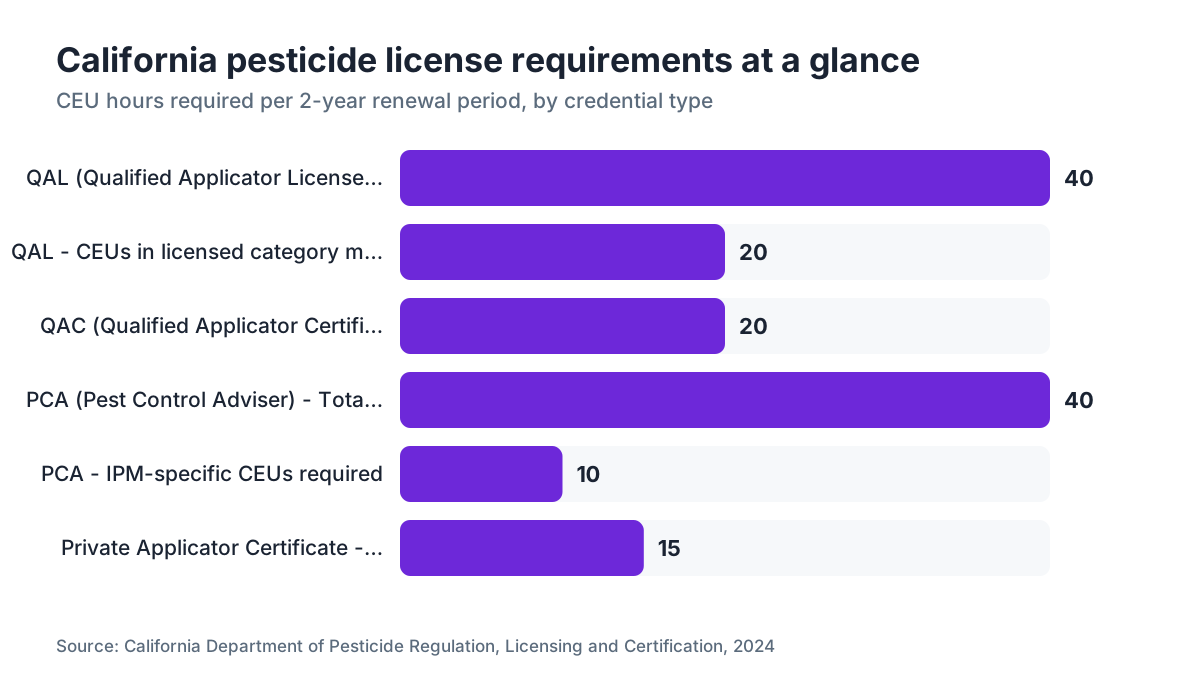
The table below covers the core differences for California vineyard operations. Other states run analogous systems (Oregon uses Licensed Pesticide Applicator and Pesticide Consultant credentials; Washington uses Commercial and Private Applicator licenses), but California is the reference point here because it's the most stringent and the best documented.
| Credential | Issuing Authority | What It Authorizes | Who Signs | CEU Requirement (per 2-yr renewal) |
|---|---|---|---|---|
| QAL (Qualified Applicator License) | CDPR | Applying restricted-use pesticides commercially | Applicator signs PUR | 40 hours [1] |
| QAC (Qualified Applicator Certificate) | CDPR | Applying RUPs under QAL supervision | Signs PUR under supervision | 20 hours [1] |
| PCA (Pest Control Adviser License) | CDPR | Writing pesticide use recommendations | Signs recommendation | 40 hours, including 10 hrs IPM [2] |
| Private Applicator Cert | County Ag Commissioner | Applying RUPs on land you own/rent for your own crops | Signs PUR | 15 hours [1] |
A Private Applicator Certificate (PAC) is a cheaper, simpler option for owner-operators who apply only on their own property. If you own a vineyard, spray only your own blocks, and provide no service to anyone else, a PAC may cover the applicator side. You'd still need a PCA recommendation for RUPs.
Exam and license fees change periodically. As of 2024, CDPR's QAL exam fee was $285 and the license fee was $260 for a two-year term; the PCA exam fee was $285 and the license fee was $460 for two years [1]. Confirm current fees at cdpr.ca.gov before you budget.
Can one person hold both a QAL and a PCA license at the same time?
Yes, and many people do. A PCA who also holds a QAL can write the recommendation and then apply the product, or supervise QAC holders doing so. You see this a lot on smaller estate operations where the farm manager has worked through both licensing tracks.
The real constraint is time. PCAs carry a fiduciary-like duty to make independent recommendations. When a PCA is also the primary spray operator for a single vineyard, that independence isn't compromised in any obvious way. But if you're a PCA writing recommendations for multiple clients and also selling pesticide products, California's conflict-of-interest rules under Food and Agricultural Code Section 11435 come into play [2].
The paperwork rules don't relax for dual-licensees. The recommendation still has to predate the application, and the PUR still has to reference the recommendation. Use your PCA credential on the recommendation and your QAL credential on the PUR. Sloppy record-keeping by dual-licensees is a common audit finding, precisely because they assume they can cut corners.
What spray records are vineyard operators required to keep and for how long?
California requires pesticide use reports (PURs) to reach the county agricultural commissioner within seven days of the end of each month you applied pesticides [4]. You keep your own copies for three years. The county keeps theirs for five. CDPR maintains a statewide database of all reported pesticide use, and it's publicly searchable [10].
Each PUR entry needs the operator's name and license number, the site description (down to the section or parcel level), the target pest, the product name and EPA registration number, the application date, the amount applied, the acreage treated, and the application method. Miss any one field and it's a recordable violation, even when the application itself was completely legal.
The written PCA recommendation stays on file for the same three-year period. Some commissioners ask to see these during routine inspections; others pull them only when a complaint triggers an investigation. Either way, keep them organized and reachable.
Worker protection adds another layer. The EPA Worker Protection Standard (WPS) requires specific pesticide safety information to be posted at a central location, and it requires application and hazard records to be accessible to workers and their designated representatives, with a 30-year retention window for handler exposure records [5]. That 30-year number catches many operators off guard. It applies to records of applications where handlers may have been exposed, more than to general spray records. EPA enforces the WPS at the federal level, but it runs through state lead agencies, which in California is CDPR.
Keeping all of this straight by hand is genuinely hard. A digital system like VitiScribe, or even a well-built spreadsheet, has to capture every mandatory field and flag when submissions are due.
What happens if you apply restricted-use pesticides without a valid PCA recommendation on file?
You get a notice of violation and probably a civil penalty. California's penalty schedule is tiered. A first paperwork infraction, like a missing recommendation, usually draws a notice of violation and a required correction. Repeat violations or ones involving actual harm move to civil penalties, which CDPR can assess at up to $5,000 per violation per day under Food and Agricultural Code Section 12999 [2].
County ag commissioners handle front-line enforcement. They run the inspections, review submitted PURs, and issue the notices. CDPR escalates cases involving pattern violations, criminal conduct, or incidents causing injury or drift complaints.
Civil penalties aren't the only exposure. Applying an RUP without the proper license or recommendation can trigger suspension or revocation proceedings against the applicator's QAL and, if a PCA was involved in any way, that PCA's license too. These are administrative hearings that can run for months, and you may operate under restrictions while they play out.
There's a quieter risk too. If you sell grapes to a winery with a supplier compliance program (and most big buyers have one), a CDPR violation or a positive residue test from an improperly applied product can kill the contract. That financial hit can dwarf any regulatory penalty.
How do QAL and PCA requirements differ for organic vineyards?
Organic certification doesn't erase pesticide licensing. This surprises newer organic growers. Approved organic materials like copper sulfate, sulfur, spinosad, and Bacillus thuringiensis are regulated under FIFRA just like synthetic products, and some carry restricted-use status.
Copper sulfate at high rates can land in the restricted-use category depending on formulation and concentration. Spinosad products carry EPA restrictions tied to aquatic invertebrate exposure. If your product is on the restricted-use list, you need a PCA recommendation and the right applicator license, organic certification or not.
For general-use organic materials, California doesn't require a PCA recommendation. You still have to report pesticide use for any product with a California registration, which covers most organically approved pesticides. The reporting exemption is narrow: a few specified low-risk substances, plus pesticides applied in small volumes below set thresholds.
UC Davis Agriculture and Natural Resources publishes solid extension guidance on organic pest management and the regulatory overlay for California vineyards [6]. WSU Extension covers the same ground for Washington organic grape growers, whose documentation requirements run through the Washington State Department of Agriculture [7].
How do other major wine states handle applicator and adviser licensing?
California's two-track QAL/PCA system is the one most operators know, but it isn't universal. Here's how the other major wine grape states set it up.
Washington's Department of Agriculture (WSDA) licenses commercial pesticide applicators and requires a separate private applicator license for owner-operators. Washington has no exact PCA equivalent. Written recommendations are required for certain pesticides, but the consulting license structure is less formal than California's [7].
Oregon's Department of Agriculture issues Licensed Pesticide Applicator credentials plus a separate Pesticide Consultant license. The consultant license is required to provide recommendations for compensation, close in concept to California's PCA but with different exam and CEU rules [8].
New York has a Commercial Pesticide Applicator license and the Certified Crop Adviser (CCA) program, though the CCA is an industry credential through the American Society of Agronomy, not a state regulatory license. New York's recommendation requirements are less prescriptive than California's for most agricultural applications [9].
If you farm properties in more than one state, and some growers straddle California and Oregon, you need separate credentials and separate compliance workflows for each. There's no reciprocity between state applicator or adviser licenses.
How do you stay current with continuing education requirements for QAL and PCA renewal?
QAL renewal in California takes 40 continuing education units (CEUs) per two-year period, with at least 20 hours in the specific application categories you're licensed in. PCA renewal also takes 40 CEUs per two-year period, but 10 of those hours have to be integrated pest management (IPM) topics [2]. Miss the total or the required subcategory and you can't renew.
CDPR-approved providers include UC Cooperative Extension (the farm advisor network), the Pest Control Operators of California, the Western Crop Protection Association, and various community college programs. UC Cooperative Extension advisors in most wine grape counties run annual pest management updates that count toward CEUs, and these are usually the most useful training you can get, not generic webinars.
Cornell's viticulture extension program puts out updated spray scheduling and resistance management guidance every year, which parallels what a good CEU course covers [9]. WSU's viticulture extension publishes current practices for Pacific Northwest applicators [7].
Self-study options exist, but they're capped in how many CEUs they can contribute. Hands-on field courses and classroom training still fill most renewal portfolios. Budget for two to four courses a year if you hold both a QAL and a PCA. The content overlap between the two programs is partial, not complete.
Tracking CEU credits across providers is one of those tasks that slips until renewal week. Log each training in a spreadsheet or a field management system as you take it, and skip the end-of-cycle scramble.
How do you set up a compliant spray record system for a small vineyard operation?
A minimum viable system for a small vineyard (under 50 acres, one or two applicators) has to do four things: capture every required PUR field at the moment of application, link each application to its PCA recommendation, generate a monthly summary for county submission, and retain records in an accessible format for three years (or 30 years for WPS handler exposure records).
Paper can technically do all of this. Plenty of small operations run on binders with pre-printed PUR forms, organized by block and date. The failure mode is human error: skipped fields, illegible entries, missing recommendation cross-references, and forms that live in the tractor cab and never reach the office. County commissioners see this constantly.
Spreadsheet templates from UC Cooperative Extension are a step up. They won't calculate submission deadlines or flag missing fields, but they're structured and searchable. UC Davis's integrated pest management program has published record-keeping resources and templates that match California requirements [6].
Digital field platforms go further by enforcing required fields at entry, auto-filling license numbers and EPA registration numbers, and generating county-formatted reports. VitiScribe is built for vineyard operations and handles the PCA recommendation link and PUR generation in one workflow, which is the single biggest source of audit findings in manual systems.
Whatever you use, the PCA recommendation has to be in the system before the application record, with a timestamp that proves the sequence. That's easy in a digital system and genuinely hard on paper once the season gets busy.
What does the EPA Worker Protection Standard require from vineyard spray record-keeping?
The EPA's Worker Protection Standard (WPS), revised in 2015 and codified at 40 CFR Part 170, requires agricultural employers to keep records of pesticide applications that workers or handlers may be exposed to [5]. The retention window for handler exposure records is 30 years, a number most vineyard operators never hear until an OSHA or EPA inspection surfaces it.
For each application, the WPS requires this information posted at a central location and available to workers: product name, EPA registration number, active ingredient(s), location and description of the treated area, application date, and the restricted-entry interval (REI). Workers have to be able to reach this without asking a supervisor, and it must be up within 24 hours of the application.
EPA guidance states that workers and handlers "have a right to receive specific information about pesticides they may be exposed to" [5]. That's a legal right, not a courtesy. Records that aren't accessible are a WPS violation on their own, independent of any CDPR reporting violation. Two agencies can cite you for the same underlying paperwork failure.
The WPS also requires handler training, the pesticide safety training for anyone who handles pesticides, to be documented and retained. This overlaps with QAL supervision: a QAC holder applying pesticides under a QAL also needs WPS handler training documentation on file. The two systems run parallel, not redundant.
Frequently asked questions
Do I need a PCA recommendation for every pesticide application in my vineyard, or just for restricted-use products?
In California, a written PCA recommendation is legally required before applying any restricted-use pesticide. For general-use pesticides, state law doesn't require it, though some counties and buyer contracts effectively do. Check your specific county's rules, because several wine grape counties have local requirements that extend PCA recommendations beyond the state baseline.
Can a vineyard owner sign their own spray records with a private applicator certificate instead of a QAL?
Yes. If you're applying pesticides only on land you own or rent exclusively for your own production, a Private Applicator Certificate covers the applicator side. You still need a PCA recommendation for restricted-use pesticides. The PAC is cheaper and easier to get than a QAL, but it doesn't let you apply on anyone else's property or provide any commercial pest control service.
How long does it take to get a QAL or PCA license in California?
Both require passing a CDPR-administered exam. Study time varies, but most applicants report 40 to 80 hours of prep for each exam. After passing, the license usually issues within a few weeks of submitting the application and fees. CDPR schedules exams regularly at testing centers around the state. Budget three to six months from starting to study to holding an active license.
What happens to my spray records if my PCA changes mid-season?
Recommendations from the departing PCA stay valid for the period they covered. Any application after the relationship ends needs a new recommendation from a newly designated PCA before the application date. There's no grace period. Line up your replacement PCA and get updated recommendations in place before the transition, not after. County ag commissioners see mid-season PCA gaps regularly, and they're a common audit finding.
Are electronic spray records legally accepted by California county agricultural commissioners?
Yes. CDPR and county ag commissioners accept electronic pesticide use reports, and many counties now encourage or require electronic submission through CDPR's online system. Electronic records must carry all the same required fields as paper. Electronic PCA recommendations are valid too, as long as they're signed (electronic signatures count) and time-stamped before the application date they authorize.
Does a winery that farms its own estate vineyard need the same QAL and PCA setup as an independent vineyard operation?
Yes. Pesticide licensing applies to the farming operation regardless of who owns it. If the winery's estate crew applies restricted-use pesticides, someone in that crew needs QAL authority (or a PAC if the land is purely owner-operated). And a licensed PCA has to write recommendations before those applications. Winery ownership creates no exemption from agricultural pesticide regulations.
Can a QAL holder supervise multiple QAC holders across different vineyard blocks at the same time?
For agricultural pest control plant work, supervision rules let a QAL holder oversee multiple workers across a site as long as the QAL is available and in contact. Some operations require supervision to be immediate and direct. The QAL cannot supervise workers in different counties at the same time. Check CDPR's supervision guidance for your specific license category, since requirements vary by category.
What's the difference between a CCA (Certified Crop Adviser) and a PCA in terms of signing spray records?
A CCA is an industry credential from the American Society of Agronomy, not a state regulatory license. In California, a CCA credential alone does not authorize you to write or sign pesticide use recommendations. You need a California PCA license for that. Many people hold both, but it's the PCA license that carries legal signing authority for spray records in California.
How do restricted-entry intervals on spray records connect to QAL and PCA requirements?
The REI comes from the product label and must appear on both the PCA recommendation and the pesticide use report. The QAL-licensed applicator enforces the REI in the field, which means posting the treated area and keeping workers out during the interval. The PCA recommendation should note the REI for the recommended product. Failing to enforce an REI is a WPS violation that can also implicate the QAL holder.
Do QAL and PCA requirements apply to pesticide applications made by a labor contractor working in my vineyard?
Yes, and this is a real liability point. If a labor contractor applies restricted-use pesticides in your vineyard, the crew must include someone with appropriate QAL authority, and a valid PCA recommendation must exist before the application. As the property operator, you can be cited for a contractor's violations on your site. Confirm the contractor's license credentials and get written documentation before any RUP application.
Is the 30-year WPS record retention requirement really enforced, and does it apply to every spray application?
The 30-year retention rule under 40 CFR Part 170 applies to records of applications where handlers were potentially exposed, not to every spray record. In practice, if crew members work near or with pesticide applications (as nearly all vineyard operations do), most applications fall under it. EPA enforcement has historically focused on active violations rather than decades-old records, but the legal obligation exists regardless.
What CEU courses are most useful for QAL and PCA renewal in wine grape regions?
UC Cooperative Extension advisors in wine grape counties (Napa, Sonoma, San Luis Obispo, Monterey, Santa Barbara) run annual winter pest management updates that are practical and CDPR-approved. Western Crop Protection Association annual meetings offer approved CEUs with California viticulture content. For PCA renewal, make sure IPM-specific courses are in the mix, since 10 of the 40 required CEUs must be IPM topics.
What's the cost difference between getting a QAL versus a PCA license in California?
As of 2024, both QAL and PCA exam fees are $285 through CDPR. The two-year license fee is about $260 for a QAL and $460 for a PCA. Prep costs (study materials, courses) add $100 to $500 depending on your path. If you hold both, you pay renewal fees separately for each. Confirm current fees at cdpr.ca.gov, since CDPR adjusts them periodically.
Can I use the same PCA recommendation for multiple vineyard blocks if the application conditions are identical?
One recommendation can cover multiple blocks or parcels as long as all conditions match each block: same pest, same crop stage, same product and rate, same timing, same site conditions. The recommendation has to identify every covered block by location. If one block differs in any meaningful way, it needs its own recommendation. When in doubt, ask your PCA to specify each block. It takes minutes and protects you in an audit.
Sources
- California Department of Pesticide Regulation, Licensing and Certification: QAL requires 40 CEUs per 2-year renewal; QAC requires 20; exam and license fees as stated; license category descriptions
- California Food and Agricultural Code, Section 11400 et seq. (PCA licensing) and Section 12999 (civil penalties), via CDPR: PCA license required to write pesticide use recommendations; PCA CEU requirements include 10 hrs IPM; civil penalties up to $5,000 per violation per day; conflict-of-interest provisions under FAC 11435
- California Department of Pesticide Regulation, Pest Control Adviser Requirements: PCAs required to conduct field evaluations and document economic or environmental justification before making recommendations
- California Code of Regulations Title 3, Section 6624, Pesticide Use Reporting: PURs must identify the applicator license number and reference the PCA recommendation for restricted-use pesticides; submission within seven days of end of each month; three-year retention requirement
- U.S. EPA, Worker Protection Standard, 40 CFR Part 170: WPS requires 30-year retention of handler exposure records; workers have the right to request pesticide application and SDS information; application records must be posted within 24 hours; quoted language on worker rights
- University of California Agriculture and Natural Resources, Integrated Pest Management Program: UC ANR publishes extension guidance on organic pest management and pesticide record-keeping templates aligned with California requirements
- Washington State University Extension, Viticulture and Enology: WSU Extension publishes current best practices for Pacific Northwest pesticide applicators and viticulture pest management; Washington licensing structure under WSDA
- Oregon Department of Agriculture, Pesticides Program: Oregon issues Licensed Pesticide Applicator credentials and a separate Pesticide Consultant license required to provide recommendations for compensation
- Cornell University Extension, Viticulture and Enology: Cornell Extension publishes updated spray scheduling and resistance management guidance for vineyard operators annually; New York applicator licensing structure
- CDPR Statewide Pesticide Use Reporting Database: CDPR maintains publicly searchable statewide database of all reported pesticide use; county retains PURs for five years
Last updated 2026-07-09