Copper application rates for downy mildew in organic vineyards

TL;DR
- Organic vineyards can use copper for downy mildew, but rates are tightly regulated.
- The EU caps elemental copper at 4 kg/ha/year (about 3.6 lb/acre/year).
- US National Organic Program rules defer to your certifier, and most cap elemental copper between 3.6 and 8 lb/acre/year.
- Timing beats rate: early, low-dose sprays ahead of infection periods outperform high-rate rescue sprays every time.
What makes copper effective against downy mildew in the first place?
Copper kills downy mildew spores on contact. It does not cure an infection that's already inside the leaf. That one fact drives every decision you'll make about how much to spray and when.
Downy mildew (Plasmopara viticola) is one of the most destructive pathogens organic vineyards face. It spreads through airborne sporangia and needs free moisture on leaf surfaces to germinate, which is why wetter, cooler climates and dense canopies see the worst outbreaks. Copper ions denature fungal enzymes and disrupt cell membranes before infection takes hold. Miss that window and the spray does nothing.
Copper has zero systemic activity. Once Plasmopara viticola has penetrated tissue, a copper spray does nothing to stop that colony. What it does is leave a toxic ionic film on waxy leaf surfaces that kills sporangia before they germinate. Rain washes it off. New growth dilutes coverage. UV light degrades the deposit over days. That's why reapplication intervals and post-rain timing decide whether your program works.
The chemistry is pH- and formulation-dependent. Copper hydroxide, copper sulfate (Bordeaux mixture), copper oxychloride, and copper octanoate each release copper ions at different rates and hold to leaves differently [1]. Bordeaux mixture (copper sulfate plus hydrated lime) is the oldest formulation and still widely used. Fixed coppers like copper hydroxide cling to leaf surfaces longer and work at lower elemental copper rates per application.
What are the legal copper rate limits for certified organic vineyards in the US?
The USDA National Organic Program sets no numeric pounds-per-acre cap for copper. Your certifier does, and the numbers vary. Most US certifiers land somewhere between 3.6 and 8 lb elemental copper per acre per year. Check your certifier's copper policy before you spray anything.
The NOP lists copper-based materials as allowed for plant disease control under 7 CFR 205.601(i)(2). The rule permits them only when they don't contaminate crops, soil, or water [2]. That's the whole federal standard. The actual ceiling comes from your accredited certifier.
In practice, most USDA-accredited certifiers follow something close to the older industry number of 8 lb elemental copper per acre per year as an outer limit. Several have adopted tighter standards aligned with the EU's 4 kg/ha/year (roughly 3.6 lb/acre/year) rule, especially for operations that export. Oregon Tilth and CCOF, two of the biggest certifiers in US wine country, track cumulative copper loadings in their recordkeeping requirements. Read your own certifier's materials list and copper policy document, because the two you use aren't guaranteed to match.
The EU regulation is the clearest published number anywhere. Commission Regulation (EU) 2018/1981 caps elemental copper at 4 kg/ha/year, averaged over a 7-year rolling period, with a single-year maximum of 6 kg/ha (about 5.4 lb/acre) [3]. It replaced the older 6 kg/ha/year cap because of copper building up in vineyard soils. Many US certifiers reference this framework even though it isn't binding here.
State pesticide registration is a separate layer. Even if your certifier allows a product, it must be registered in your state for the crop and site. In California, copper fungicides need registration with the state before use, and some formulations carry added county-level restrictions [4].
How much elemental copper is actually in common organic formulations?
The label almost never states "elemental copper," so you do the conversion yourself. Every organic compliance program tracks elemental copper, not pounds of product. Get this math wrong and you'll blow past your certifier's limit without knowing it.
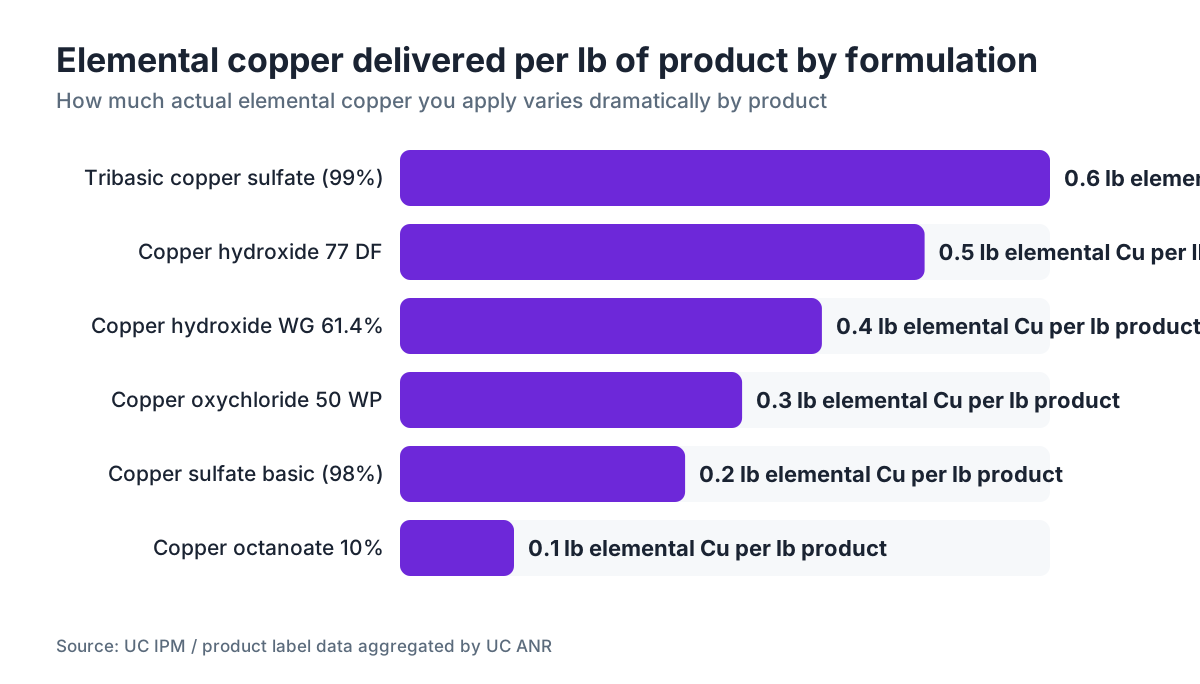
Here's a working reference table for the common formulations:
| Formulation | Typical % elemental Cu | Elemental Cu per lb product |
|---|---|---|
| Copper sulfate (basic, 98%) | 25% | 0.25 lb |
| Bordeaux mixture (8-8-100) | ~8% Cu in mix | varies by prep |
| Copper hydroxide (77 DF) | 46.1% | 0.46 lb |
| Copper hydroxide (WG 61.4%) | 36.9% | 0.37 lb |
| Copper octanoate (10%) | 10% | 0.10 lb |
| Copper oxychloride (50 WP) | 30% | 0.30 lb |
| Tribasic copper sulfate (99%) | 57% | 0.57 lb |
Say you spray 2 lb/acre of copper hydroxide 77 DF. That's 0.92 lb elemental copper per acre per application. Four applications in a wet season puts you at 3.68 lb elemental copper, right at the EU's 3.6 lb/acre/year target. Run six and you're over.
UC IPM guidelines recommend tracking cumulative elemental copper on both a per-season and multi-year basis as part of an integrated disease management record [5]. Skip that log after each spray and you're flying blind on compliance.
What application rates do university extension programs actually recommend?
Nobody at the major extension programs recommends going above 2 lb elemental copper per acre per application, and most put the working range at 0.5 to 1.5 lb. UC Davis, Cornell, and Washington State have all published copper spray programs for downy mildew, and their advice has moved toward lower rates and sharper timing over the past decade [5][6][7].
UC IPM recommends starting copper at early bud development (EL stage 4 to 5) in high-risk years, at 0.5 to 1.5 lb elemental copper per acre per application, adjusted for formulation and rainfall since the last spray. Their guidelines put it plainly: lower rates applied more often and timed to infection periods often outperform high single-dose applications [5]. A 0.5 lb/acre spray at the right moment before a forecasted rain beats a 2 lb/acre spray three days after infection has already happened.
Cornell's extension program for the Finger Lakes and Hudson Valley leans on disease forecasting, particularly the NEWA (Network for Environment and Weather Applications) system, to time copper to real infection risk instead of a calendar [6]. Cornell's organic recommendation typically runs 0.75 to 1.0 lb elemental copper per acre per application, aiming to stay under 4 kg/ha for the season even in wet years.
WSU guidance for the Pacific Northwest notes Bordeaux mixture remains a regional standard, with mixing rates calculated to deliver 1 to 2 lb elemental copper per acre early season, then stepping down to 0.5 to 1 lb once canopy closes and the copper budget gets tight [7]. WSU also flags that copper applied at high rates right after harvest adds meaningfully to soil accumulation, worth tracking on its own.
The honest picture across all three: start low, spray to the weather, and treat 2 lb/acre as a hard ceiling you rarely touch.
When should you spray copper for downy mildew, and how often?
Spray before infection, not after. Copper protects surfaces that haven't been infected yet, and by the time you see oil spots on leaves, you're about 10 days behind the real infection event. That lag is where most organic growers lose the fight.
Plasmopara viticola needs 2 to 4 hours of free moisture above 50 degrees F for primary infection, then 4 to 12 days of incubation depending on temperature before symptoms show [5]. So the spore that lands during Tuesday's rain doesn't announce itself until the following week.
A practical spray calendar for a high-risk site: start at early shoot growth (2 to 4 inch shoots). Reapply after every 0.5 to 1 inch of rain, or every 10 to 14 days in dry stretches, through the critical window from shoot emergence to veraison. After veraison, risk drops as the canopy opens and berries stop being susceptible, so most programs cut or drop copper in the last 6 to 8 weeks before harvest.
Get a weather station in the vineyard and run a downy mildew risk model. The UC IPM guidelines reference the Goidanich infection model [5], and NEWA offers equivalent tools for eastern growers [6]. These models score infection risk by temperature and leaf wetness hours, so you spray when the pathogen is actually trying to establish rather than on a date you picked in advance.
Rainfast periods vary by formulation. Copper hydroxide labels typically list 1 to 2 hours to rain-fastness. Bordeaux mixture with enough lime can be faster. Even so, a 0.5-inch rain cuts the effective deposit, and most programs call for reapplication after any significant rain if 7 or more days have passed since the last spray.
How does copper accumulate in vineyard soils, and why does it matter?
Copper never breaks down. It accumulates with every spray, binds to organic matter and clay, and after decades of use can reach concentrations that damage soil life and stunt young vines. Some Bordeaux-region vineyards with long organic histories have measured soil copper above 150 mg/kg, well past the EU soil quality threshold of 100 mg/kg [3].
This is the slow-moving problem that's put some European wine regions in a bind. The metal collects in the top 10 cm of soil, exactly where roots and soil organisms live.
For US growers there's no federal soil copper limit for farmland, but EPA lists copper as a priority pollutant in water, and runoff from sloped vineyards can carry it into nearby waterways. California's North Coast Regional Water Quality Control Board has flagged copper in some vineyard discharge monitoring as a concern.
The effect on your own ground: high soil copper suppresses earthworm populations, knocks back beneficial soil fungi including mycorrhizae, and stunts root growth in vines replanted into heavily treated soils. French INRAE trials have found earthworm biomass cut by roughly half at soil copper above 60 mg/kg, though the dose-response varies by species and soil type.
What you do about it: keep a multi-year copper log (many certifiers now require one), drop to lower rates when disease pressure is moderate, and use materials like potassium bicarbonate on low-pressure days so your copper budget goes to the high-risk events. That isn't a replacement plan. Copper is still the backbone of organic downy mildew control. But a program averaging 2 lb elemental copper per acre per year accumulates far less over 20 years than one averaging 5 lb.
What other organic materials work alongside copper for downy mildew?
Copper is the most reliable option in the organic toolkit, and nothing else matches it against Plasmopara viticola. But the best programs use copper strategically instead of as the every-spray default, and a few other materials help stretch the budget.
Potassium bicarbonate (KHCO3) has documented efficacy against powdery mildew and some activity against downy mildew, though it's weaker on Plasmopara than on the powdery mildew pathogen. It degrades fast and leaves no soil residue, which makes it a decent fill-in spray during moderate-risk stretches. Armicarb and Kaligreen are OMRI-listed and registered in most states [9].
Bordeaux mixture at reduced rates has long been used in European programs to improve adhesion and slow copper ion release, sometimes letting lower total copper deliver similar coverage. A 4-4-100 Bordeaux (4 lb copper sulfate, 4 lb hydrated lime per 100 gallons) delivers roughly 1 lb elemental copper per acre at standard spray volumes, which fits a budget-conscious program well.
Phosphonate-based resistance inducers are worth knowing about but need a careful regulatory look. Some phosphonate materials (phosphorous acid salts) are not permitted under USDA NOP because they act as a plant nutrient source, which creates a compliance gray zone. Ask your certifier before using any phosphonate product.
Copper octanoate (copper soap) products like Cueva are OMRI-listed and work at low elemental copper rates per application (typically 0.09 to 0.18 lb per acre), which makes them handy late season when you're near your annual budget [9]. They're less rain-fast than fixed coppers and need more frequent reapplication, so the extra passes can eat up the copper you saved.
For growers tracking records across multiple blocks and formulations, VitiScribe logs elemental copper per block by date and adds up your running seasonal and multi-year totals, which certifiers increasingly want to see at audit.
What are the EPA Worker Protection Standard requirements for copper fungicide applications?
The EPA Worker Protection Standard (WPS) covers every agricultural pesticide application, including copper fungicides in organic programs. The revised WPS has been in effect since January 2017, and it sets specific rules vineyard operators have to follow [8].
Copper fungicides carry signal words from Caution (copper octanoate) to Warning (many copper hydroxide products). The signal word sets the PPE on the label, and the label is the law. Most copper hydroxide labels require long sleeves, long pants, shoes plus socks, chemical-resistant gloves, and protective eyewear. Some formulations require a respirator for mixing and loading.
WPS requires that workers and handlers get pesticide safety training, that application-specific information be posted at a central location on the farm, and that restricted-entry intervals (REIs) be observed. Most copper fungicides carry a 24- to 48-hour REI. Copper sulfate products can run 48 hours, which shapes harvest timing in late-season programs.
WPS also requires keeping pesticide application records for at least 2 years, including the product name, EPA registration number, crop treated, application date, location, total amount applied, and the name of the handler [8]. Organic certifiers want the same records and usually more (the elemental copper calculation, the block map, the basis for the spray decision). Keep one unified record that satisfies both and you've saved yourself a headache.
How do you calculate the right spray volume and concentration for your equipment?
Rate recommendations come in product per acre, but your spray volume in gallons per acre sets the concentration you mix. Most vineyard airblast sprayers run 50 to 100 gallons per acre; dilute-air rigs run higher. The label gives you the rate range. Your job is to dial the tank concentration so you hit the target active ingredient at your calibrated output.
A worked example. You want 1.0 lb elemental copper per acre from copper hydroxide 77 DF (46.1% elemental copper). You need 1.0 / 0.461 = 2.17 lb of product per acre. Your sprayer delivers 75 gallons per acre. Mix rate = 2.17 lb / 75 gal = 0.029 lb per gallon, about 0.46 oz per gallon. Filling a 300-gallon tank, add 2.17 x 4 = 8.7 lb of product.
Calibrate your sprayer every season. Output per acre drifts as nozzles wear, and being 20% off on gallons per acre means you're 20% off on your copper delivery. UC IPM and WSU extension both publish sprayer calibration guides for vineyard airblast equipment [5][7].
One note for newer growers: most copper products mix at slightly basic pH and can have compatibility issues with tank-mix partners. Read the compatibility section of every label before mixing. Copper can antagonize some sulfur formulations if tank conditions are off, though Bordeaux mixture combines the two on purpose through the right prep order.
What records do organic certifiers actually require for copper applications?
The USDA NOP requires certified operations to keep records demonstrating compliance for 5 years [2]. For copper specifically, certifiers increasingly want more than what you sprayed and when. They want the calculated elemental copper per acre per event and the running seasonal total.
Each spray record should include the date and time, the block or field ID, the product name and EPA registration number, the label rate applied, total product used, the calculated elemental copper per acre, the spray volume in gallons per acre, the disease target, and weather at application (temperature, wind speed, relative humidity). If a forecasting model drove the spray decision, note that. It shows an integrated approach and reads well at audit.
Many certifiers ask for a multi-year copper log during renewal inspections, especially in regions where soil copper accumulation has been flagged. Some now ask growers to submit a signed statement estimating cumulative elemental copper applied over the past 5 to 7 years. If you haven't been logging it, rebuilding that number from old spray records is miserable. Start the habit now.
Digital recordkeeping makes this much easier. VitiScribe tracks spray events by block, calculates running elemental copper totals from the formulation data, and generates certifier-ready reports. A well-kept spreadsheet or paper log works fine too. The information matters more than the medium.
What happens if you exceed the allowed copper rate? Are there real penalties?
Exceed your certifier's copper limit and the likely first outcome is a corrective action notice, especially if you self-reported or it surfaced during an audit of your spray records. Repeated violations or a failure to disclose can lead to suspension or revocation of your organic certificate, which means you can't market the fruit as organic. Where the organic premium is real, that hurts.
State pesticide law is a separate issue. Applying a product above the label rate violates FIFRA (the Federal Insecticide, Fungicide, and Rodenticide Act), organic or not. California's Department of Pesticide Regulation and equivalent agencies elsewhere can issue civil penalties for over-label applications. Fines start at a few hundred dollars per violation and can reach $5,000 or more for repeat or knowing violations [4].
Water quality is the third layer. If copper runoff from your vineyard turns up in a receiving water body, you could face enforcement under the Clean Water Act through your state's NPDES program. It's rare for individual vineyard operators but not unheard of in California wine regions, where some surface water programs sample regularly.
The practical move: stay well inside your annual limit instead of pushing against it. Running at 80% of your certifier's cap leaves a buffer for the wet year when you need one or two extra applications.
Frequently asked questions
What is the maximum copper rate allowed for certified organic vineyards in the US?
The USDA NOP sets no specific numeric cap; your certifier does. Most US certifiers allow between 3.6 and 8 lb elemental copper per acre per year. Many use the EU's 4 kg/ha/year (about 3.6 lb/acre/year) as a benchmark. Check your certifier's specific material policy, since CCOF, Oregon Tilth, and other major certifiers each publish their own copper limits.
How do I convert copper product label rates to elemental copper?
Multiply the pounds of product applied per acre by the percentage of elemental copper on the label. Copper hydroxide 77 DF is 46.1% elemental copper, so 2 lb of product delivers 0.92 lb elemental copper per acre. Copper sulfate basic is 25%, so 4 lb of product delivers 1.0 lb elemental copper. Always track the elemental copper number, not product volume, for compliance.
How often should you apply copper for downy mildew in a wet season?
Typically every 7 to 14 days during the high-risk window from shoot emergence through veraison, with reapplication after any rain over 0.5 inches if more than 7 days have passed since the last spray. A very wet year can mean 8 to 10 applications. At 0.75 to 1.0 lb elemental copper per application, that's 6 to 10 lb total, so start low per event and track your budget carefully.
Does copper work after downy mildew infection has already started?
No. Copper is a contact protectant only. It has no systemic or curative activity against Plasmopara viticola. Once the pathogen has penetrated leaf tissue, copper sprays will not stop that infection cycle. Pre-infection timing, applying before forecasted wet periods, is the foundation of any effective organic downy mildew program.
What is Bordeaux mixture and is it still worth using in organic vineyards?
Bordeaux mixture is copper sulfate plus hydrated lime dissolved in water, the oldest copper fungicide formulation, first developed in French vineyards in the 1880s. It's still worth using. The lime improves adhesion and slows copper ion release, often giving longer residual protection than some modern fixed coppers. An 8-8-100 Bordeaux delivers roughly 2 lb elemental copper per acre at standard dilution; a 4-4-100 delivers about 1 lb.
What is the restricted-entry interval (REI) for copper fungicides?
Most copper fungicide labels carry a 24- to 48-hour REI under EPA Worker Protection Standard rules. Copper sulfate products commonly list 48 hours. Copper octanoate (soap-based) products like Cueva typically carry a 4-hour REI. Always check the specific product label, since the label is legally binding and REIs vary by formulation and signal word.
Can copper accumulate to harmful levels in vineyard soils?
Yes, and it's a documented problem in vineyards with long treatment histories. Copper doesn't degrade; it binds to soil particles and accumulates. EU soil quality guidelines flag concentrations above 100 mg/kg as potentially harmful to soil organisms. High copper suppresses earthworm populations and mycorrhizal fungi. Keeping annual rates low and tracking multi-year totals is the main mitigation available to organic growers.
What are alternatives to copper for downy mildew in organic programs?
Potassium bicarbonate (OMRI-listed products like Armicarb) gives some downy mildew suppression and helps extend the interval between copper applications in moderate-risk periods. Copper octanoate at low rates (0.09 to 0.18 lb elemental copper per acre) works for late-season budget conservation. No material is as consistently effective as copper against Plasmopara viticola in certified organic production.
Do organic certifiers require multi-year copper records?
Increasingly, yes. The USDA NOP requires records for 5 years, and many certifiers now ask for a multi-year copper log during renewal audits, particularly in regions with soil accumulation concerns. Some ask for a signed summary of cumulative elemental copper applied over the past 5 to 7 years. Building this log from the start of your organic program is much easier than reconstructing it later.
How does disease forecasting help reduce copper use in organic vineyards?
Forecasting models like NEWA (Cornell) and the UC IPM infection risk models score downy mildew risk by temperature and leaf wetness hours. Using a model lets you spray only when actual infection risk is elevated rather than on a fixed calendar, which typically cuts total applications by 2 to 4 per season in an average year. Fewer applications mean less cumulative copper and lower per-acre costs.
Is copper sulfate the same as Bordeaux mixture for organic purposes?
No. Copper sulfate (basic or pentahydrate) is one ingredient in Bordeaux mixture, but Bordeaux also includes hydrated lime (calcium hydroxide) mixed in specific ratios. Plain copper sulfate applied without lime is more phytotoxic and releases ions faster. Bordeaux mixture's lime component buffers the release and improves coverage. Both are OMRI-listed and allowed under USDA NOP, but they have different application characteristics and label requirements.
What pesticide records do I need to keep for copper applications under the EPA Worker Protection Standard?
WPS requires application records for at least 2 years, including product name, EPA registration number, crop and location treated, application date, total amount applied, and the name of the handler who applied it. Organic certifiers typically want the same data plus elemental copper calculations and the reason for the spray decision. Keeping one combined record satisfies both requirements at once.
Can you spray copper right before harvest in an organic vineyard?
Most copper products have a pre-harvest interval (PHI) of 0 days, meaning you can technically apply up to harvest. But copper deposits on fruit can affect fermentation by suppressing native yeast populations, which matters for natural and minimal-intervention winemaking. Most programs stop copper 4 to 6 weeks before harvest unless late-season disease pressure is severe. Always check the specific label for PHI.
Sources
- UC ANR, Copper-Based Pesticides Overview (UC IPM): Copper hydroxide, copper sulfate, copper oxychloride, and copper octanoate release copper ions at different rates and have different rain-fastness profiles
- USDA NOP, 7 CFR 205.601 Allowed Materials for Crop Production: NOP lists copper-based materials as allowed for plant disease control and requires records demonstrating compliance be maintained for 5 years
- European Commission, Regulation (EU) 2018/1981 on copper compounds: EU caps elemental copper at 4 kg/ha/year averaged over 7 years, with a single-year maximum of 6 kg/ha, replacing the previous 6 kg/ha/year cap
- California Department of Pesticide Regulation, FIFRA enforcement and pesticide registration: Copper fungicides must be registered before use in California; over-label applications violate FIFRA and can result in civil penalties
- UC IPM, Grape Pest Management Guidelines (Downy Mildew): UC IPM recommends 0.5 to 1.5 lb elemental copper per acre per application, starting at early bud development, and notes that lower rates applied more frequently and timed to infection periods often outperform high single-dose applications
- Cornell University, NEWA Disease Forecasting Network: Cornell's organic program recommendation runs 0.75 to 1.0 lb elemental copper per acre per application, with spray timing based on NEWA infection risk scoring
- Pacific Northwest Plant Disease Management Handbook (WSU, OSU, UI Extension): WSU recommends 1 to 2 lb elemental copper per acre in early season, stepping down to 0.5 to 1 lb per acre once canopy closes
- US EPA, Agricultural Worker Protection Standard: The revised WPS effective January 2017 requires pesticide safety training, REI observance, and application records kept at least 2 years including product name, EPA registration number, crop, date, amount, and handler
- OMRI (Organic Materials Review Institute), Product List: Copper octanoate products like Cueva and potassium bicarbonate products like Armicarb and Kaligreen are OMRI-listed and allowed under USDA NOP
- USDA Agricultural Marketing Service, National Organic Program: NOP requires certified operations to maintain compliance records for 5 years
- Cornell University Grapes and Wine, Organic and Low-Input Grape Production: Cornell's Finger Lakes and Hudson Valley guidance recommends using disease forecasting tools to time copper sprays to actual infection risk rather than fixed calendar schedules
Last updated 2026-07-11