How to document copper fungicide rates within NOP copper limits

TL;DR
- The USDA National Organic Program limits copper fungicides to 6 pounds of elemental copper per acre per year, measured across the calendar year.
- To stay compliant, convert every product's label rate to elemental copper, add it to a running per-acre total after each spray, and keep those records for five years.
- Miss the math and you can lose organic certification on that fruit.
What is the NOP copper limit for vineyards?
The USDA National Organic Program caps copper at 6 pounds of elemental copper per acre per year for crop production. That number lives in 7 CFR 205.601(i)(2), which restricts copper materials to plant disease control and states they are "restricted to not more than 6 pounds of copper per acre per year." [1] The clock runs on the calendar, January 1 through December 31, no matter when your spray season starts.
The ceiling is not per application. It is not per product either. It is elemental copper, summed across every copper product you spray all year. Bordeaux mix, copper hydroxide, copper sulfate, copper octanoate, copper oxide, tribasic copper sulfate, all of it drops into the same 6-pound bucket. Spray two different copper products in one season and you add them together.
Here is where growers get caught. The 6 lb figure is elemental copper, not the weight of formulated product you pour from the jug. A product labeled 53.8% copper hydroxide does not put 53.8% elemental copper on the vine per pound of product. The elemental fraction is lower, and the conversion is on you. Every section below shows how to run it.
How do you convert copper product labels to elemental copper pounds?
Every registered copper fungicide label carries a "metallic copper equivalent" (MCE), or it lists the percentage of elemental copper directly. That figure is your conversion factor. Multiply the pounds of product applied per acre by the MCE fraction and you have pounds of elemental copper per acre.
The formula is short:
Elemental Cu (lbs/acre) = Product applied (lbs/acre) × MCE (%)
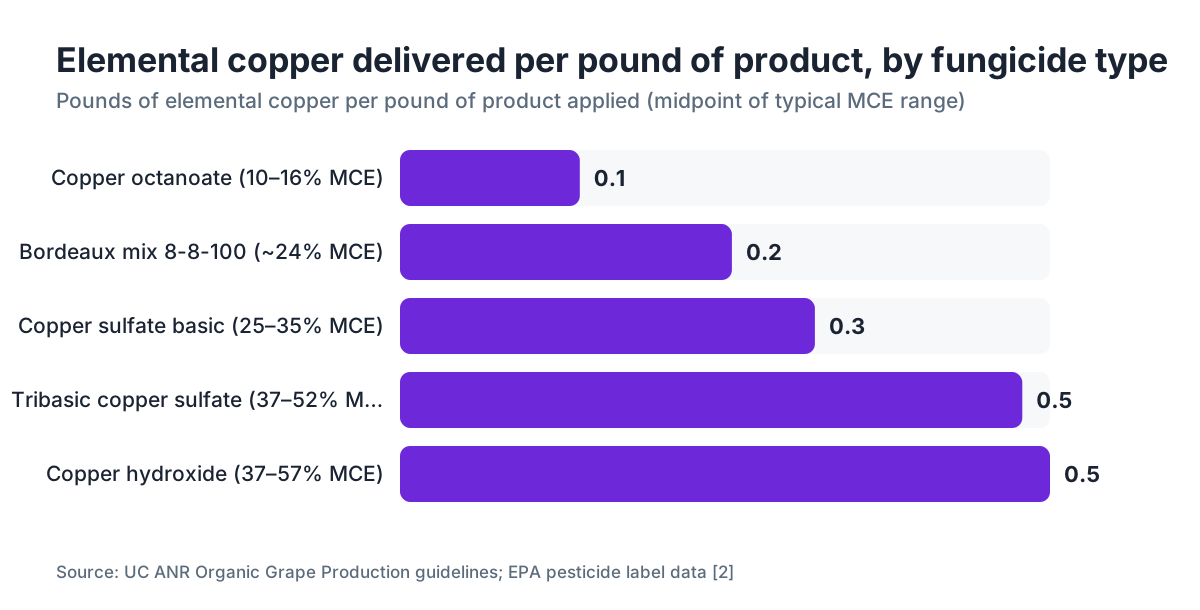
Here is a quick reference for the copper products most common in organic vineyards [2][3]:
| Product type | Typical MCE range | Notes |
|---|---|---|
| Copper sulfate (basic) | 25 to 35% | CuSO4·3Cu(OH)2, varies by manufacturer |
| Copper hydroxide | 37 to 57% | Read your specific label; varies widely |
| Copper octanoate | 10 to 16% | Lower MCE means lower elemental load per spray |
| Tribasic copper sulfate | 37 to 52% | Similar to hydroxide |
| Bordeaux mix (8-8-100) | ~24% elemental of total copper salt weight | Mix ratio changes the effective MCE |
Run the numbers. Say you apply 2 lbs of a copper hydroxide product per acre and the label reads 53.8% metallic copper equivalent. That is 2 × 0.538 = 1.076 lbs elemental copper per acre for that spray. Do it for every application and keep the total climbing.
WSU Extension recommends tracking elemental copper through the season instead of waiting for year end, because once you hit 6 lbs there is no legal way to apply more until January 1. [3] Catching the ceiling early is the only way to shift to sulfur or biological options while disease pressure is still high.
If a label does not state MCE outright, find the copper line in the guaranteed analysis. Federal pesticide labeling law requires that information to appear. If it is missing or reads ambiguously, call the manufacturer or your certifier before you spray.
What records does a certified organic vineyard have to keep for copper applications?
Your certifier wants records for every activity in your organic system plan, and spray records get the hardest look. At a minimum, each copper application record has to capture [4][5]:
- Date of application
- Product name (with the EPA registration number from the label)
- Manufacturer
- Rate applied (product lbs or oz per acre, or per 100 gallons with dilution ratio)
- Total acres treated in that application
- Total product used in that application
- Calculated elemental copper applied per acre that day
- Running cumulative elemental copper per acre for the calendar year
- Target pest or disease (powdery mildew, downy mildew, botrytis, etc.)
- Applicator name
- Equipment used and calibration date
The National Organic Program requires you to keep these records for at least five years. [4] Most certifiers ask for three consecutive years at every inspection, so keeping a clean five years is just normal practice. Gaps raise flags in an audit even when the applications were plainly within limits.
Certifiers also want your records to line up with your Organic System Plan. List copper hydroxide as an approved input in your OSP, then log copper sulfate instead, and that mismatch can trigger a Notice of Noncompliance even if your elemental total is fine.
One habit pays off every year: file the product label, or a copy, next to the spray record for that product. Labels change. If anyone ever questions the MCE you used in a calculation, the label from that day settles it.
What does a compliant copper spray log actually look like?
A compliant log is simple. It just has to be consistent and math-checked. Here is a single-block vineyard entry in plain table form:
| Date | Block | Acres | Product | EPA Reg # | Rate (lbs/acre product) | MCE% | Elemental Cu (lbs/acre) | YTD Elemental Cu (lbs/acre) |
|---|---|---|---|---|---|---|---|---|
| 2025-04-10 | Block A | 4.2 | Kocide 3000 | 352-844 | 1.5 | 46.1% | 0.69 | 0.69 |
| 2025-05-22 | Block A | 4.2 | Kocide 3000 | 352-844 | 1.5 | 46.1% | 0.69 | 1.38 |
| 2025-06-14 | Block A | 4.2 | Kocide 3000 | 352-844 | 2.0 | 46.1% | 0.92 | 2.30 |
The YTD Elemental Cu column keeps you legal. It resets to zero on January 1 every year. If that column crosses 5.5 lbs/acre before late summer, you have a real decision to make: burn the last 0.5 lbs or switch products.
Multi-block vineyards need a separate running total per block. The NOP limit is per acre, so a big block with diluted sprays and a small block with concentrated ones get tracked on their own. Never average them. That math falls apart in an audit.
Some growers keep this in a spreadsheet. Others use paper field books, and some run field record platforms. VitiScribe, for one, is built around this exact running-total tracking for spray compliance. Whatever you use, the YTD column is non-negotiable.
How do certifiers actually audit copper records during inspection?
Certifiers auditing copper do three things. They verify product approval, so every product you used must sit on your approved inputs list and have been checked against the National List before use. They cross-check purchase receipts against application records: buy 50 lbs of copper hydroxide, log only 30, and you have an unexplained 20 lbs. And they redo the elemental copper math themselves, block by block, calendar year by calendar year.
That purchase-receipt cross-check catches people who shave reported rates to stay under the ceiling. The math runs both directions. Total product purchased should roughly match total product logged, and a wide gap is a red flag.
Timing patterns get attention too. Several applications packed into a short window, with no documented disease pressure or scouting notes, invites the question of whether the rate limit is real or just written down to look right. Pair your spray records with scouting notes, weather data (wet periods and leaf wetness hours that feed downy mildew), and disease threshold guidance from UC and Cornell, and your spray decisions read as justified. [6][7]
Find cumulative copper above 6 lbs/acre in any calendar year and the standard result is a Notice of Noncompliance. What follows depends on your certifier and whether it is a first offense, ranging from a corrective action plan to certificate suspension. USDA AMS publishes guidance on how certifiers handle copper exceedances, and enforcement has trended stricter since 2018, not looser. [4]
Does the 6 lb NOP copper limit apply to wine grapes specifically, or all crops?
The 6 lb/acre/year ceiling in 7 CFR 205.601(i)(2) covers all crop production under NOP certification. [1] There is no carve-out for wine grapes, table grapes, or any other perennial fruit. Vineyards get the same limit as apples, hops, and blueberries.
That matters because organic wine grape growers in maritime and high-humidity regions (Willamette Valley, Finger Lakes, Sonoma Coast, New York's North Fork) often eat heavier downy mildew pressure than growers in dry continental climates. Heavier pressure does not buy you more copper. You work inside 6 lbs no matter what the vintage's weather does.
So spray timing carries as much weight as product choice. Cornell's integrated pest management program recommends applying copper ahead of infection periods based on the Goidanich or Ullrich-Schrodter models, which means fewer total sprays when timed right instead of calendar spraying every 10 to 14 days. [7] Fewer sprays leaves more elemental copper in reserve if late-season pressure shows up.
In high-pressure years, many certified organic growers split their copper budget. Heavier rates early when shoots are most susceptible, then lighter rates or non-copper options like phosphorous acid (check NOP status with your certifier) or copper-tolerant biologicals later. A documented strategy like that also reads well in an audit because it shows intent, not reflex.
Can you carry unused copper allocation over to the next year?
No. The 6 lb/acre/year limit is a strict annual budget. Unused pounds vanish at year end. Use only 3.2 lbs/acre in 2024 and you still open 2025 at zero with a fresh 6 lb ceiling.
This trips up growers coming from conventional programs, where multi-year phosphorus or sulfur budgets sometimes exist. The NOP copper rule has no carryover provision. [1]
The reverse hurts more. Going over 6 lbs in one year is not forgiven by staying under in earlier years. Each calendar year stands alone.
What spray record format satisfies both NOP and EPA Worker Protection Standard requirements?
EPA's Worker Protection Standard (WPS) under 40 CFR Part 170 sets its own recordkeeping for pesticide applications on farms, separate from NOP but overlapping. [8] Organic operations carry both sets of rules at once, and one record built to cover both saves real time.
WPS requires you to keep application records for two years. NOP requires five, so design for five and you clear both. Required WPS fields include product name, EPA registration number, active ingredient, amount applied, location and description of the treated area, and date of application. [8] WPS also requires you to give workers the information they need before entering treated areas, including restricted entry intervals (REIs).
Most copper fungicides carry REIs of 24 to 48 hours. Kocide 3000 runs a 48-hour REI. That REI has to appear in your records and reach workers before they set foot in the block. Keep it in your spray log next to the rate and the elemental copper calculation, and one document handles both jobs.
A combined NOP/WPS record template has these columns at minimum: date, block, acres, product name, EPA reg #, active ingredient, MCE%, rate applied, elemental Cu per acre, YTD elemental Cu, REI, application end time, applicator, equipment. Print or export it and file it. If you run a digital system, confirm it can produce a printed or PDF report on demand, because some inspectors want paper in the field.
UC Cooperative Extension has published field record templates that cover most of this for small and mid-size operations. [6] Worth downloading even if you customize them later.
How do you handle copper applied through multiple products in the same season?
This is where record errors bloom. Plenty of organic vineyards run a primary copper fungicide (copper hydroxide, say), add a Bordeaux mix in one block, then use copper octanoate as a contact material elsewhere in the program. Each product has its own MCE. You figure elemental copper from each one separately, then add every result to the same running total.
Here is a full season laid out:
| Application | Product | Rate (lbs/acre) | MCE | Elemental Cu (lbs/acre) |
|---|---|---|---|---|
| April 15 | Copper hydroxide 77% | 1.5 | 53.8% | 0.81 |
| May 20 | Copper hydroxide 77% | 1.5 | 53.8% | 0.81 |
| June 10 | Copper octanoate | 2.0 | 10.0% | 0.20 |
| July 8 | Tribasic copper sulfate | 2.0 | 37.0% | 0.74 |
| Season total | 2.56 |
That season lands well under 6 lbs. Add two more copper hydroxide sprays at 1.5 lbs/acre, though, and you are at 4.18 lbs, which starts to squeeze your late-season options.
Keep one master YTD column that adds every application, whatever the product. Do not run separate totals per product and try to reconcile them in December. That approach lets errors hide between columns.
Running multiple crews or operators? The person entering data has to understand that any copper product counts toward the same 6 lb limit if it hits the crop, including materials sold as "nutritional" copper or as copper-based bactericides. Read the EPA registration number and active ingredient. Ignore the marketing language.
What happens to your certification if you exceed the NOP copper limit?
Going over 6 lbs elemental copper per acre in a calendar year violates the National List, which means any fruit harvested from that acreage that year cannot be sold or labeled organic. [1][4] That is the core cost: you lose the organic price premium on the affected fruit.
Beyond the crop, the procedural fallout depends on how the exceedance surfaces. Catch it yourself and self-report, and most certifiers treat it more gently than if an auditor digs it out of records review. Self-reporting usually brings a corrective action plan, added monitoring, and a written review of how it happened.
If the certifier finds it and you stayed quiet, the common result is a Notice of Noncompliance. You get a chance to respond with corrective actions. If the certifier is not satisfied, they can issue a Proposed Suspension, which starts a formal review under 7 CFR 205.660 through 205.664. [4]
Full suspension or revocation over a single copper exceedance is rare, especially when the overage is small (0.1 to 0.5 lbs). It is not impossible if the certifier decides records were manipulated or sees a pattern of noncompliance. The USDA AMS annual summary of enforcement actions is public and documents cases where suspension followed repeated copper violations.
So do the math before each application, not after. YTD total at 5.4 lbs and you are eyeing another 1.0 lb/acre spray? You will blow the limit. Decide in the field, not in December over the paperwork.
Are there alternative fungicides to copper that organic vineyards can use when the budget runs low?
Yes, and late-season programs in wet years lean on them. The NOP National List in 7 CFR 205.601 and 205.603 allows several non-copper options for plant disease control. [1][9]
Sulfur is the workhorse alternative and has no use-rate ceiling like copper's 6 lb limit under NOP, though you still document it. Sulfur handles powdery mildew well and does almost nothing against downy mildew, so the swap is disease-specific.
Phosphorous acid (potassium phosphite) is NOP-allowed under certain conditions, and its status has drawn debate. Under the current National List, phosphorous acid is allowed for disease control, but certifiers sometimes require pre-approval. Confirm with yours before using it as a copper substitute.
Biological products based on Bacillus subtilis (like Serenade), Bacillus amyloliquefaciens, Trichoderma species, and Reynoutria sachalinensis (Regalia) are NOP-compliant and carry no copper load. Their efficacy against downy mildew runs well below copper under high pressure, which is the honest limitation. Nobody has a clean head-to-head trial showing biologicals matching copper on downy mildew in a wet Finger Lakes year. Use them inside a program, not as a straight swap.
WSU Extension's organic viticulture guidance recommends using copper at disease-critical windows (early shoot through bloom) and rotating to alternatives post-veraison, when downy mildew risk usually drops. [3] That saves the copper budget for the stretch where it earns its keep.
How should digital record systems handle running copper totals across applications?
A digital system built for NOP copper compliance has to do a few things generic farm software often skips.
It needs to store the metallic copper equivalent for every product in its database and auto-calculate elemental copper at entry. Manual MCE entry works, but it opens a calculation error on every single application. A pre-loaded product database closes that door.
It needs to total by block and calendar year, more than by application event. The question "what is my YTD elemental copper in Block C today" should answer in two clicks, not a spreadsheet dig.
It needs an alert threshold. Set a warning at 5 lbs/acre and you keep about 1 lb of headroom before the legal ceiling, enough for one or two more applications and enough runway to plan a pivot to alternatives.
And it needs audit-ready export. When your certifier asks for three years of spray records, you should produce a clean PDF or CSV in minutes. If your system cannot show EPA registration numbers, MCE%, elemental Cu per application, and YTD totals in one view, it is not doing the compliance job.
VitiScribe is built on this structure: per-block running totals, pre-loaded MCE data, and exportable reports formatted for NOP audit review. A well-kept spreadsheet with the right columns does the same job if you stay disciplined. The tool matters less than the habit of updating it within 24 hours of every spray.
On a vineyard of any size, the one thing you cannot skip is keeping records current. A log three weeks behind is a compliance liability, not an asset.
Frequently asked questions
Does the 6 lb NOP copper limit reset every calendar year or every 12 months from certification date?
It resets every calendar year, January 1 through December 31, regardless of your certification anniversary. 7 CFR 205.601(i)(2) uses the phrase "per year" and USDA AMS guidance reads that as the calendar year. Your certifier may confirm this in your OSP, but calendar year is the standard interpretation. Unused copper does not carry over into the next year.
What is the metallic copper equivalent for Bordeaux mix and how do I calculate it?
Bordeaux mix MCE depends on the mixing ratio. A standard 8-8-100 mix (8 lbs copper sulfate, 8 lbs hydrated lime, 100 gallons water) uses copper sulfate pentahydrate at about 25% elemental copper by weight. Calculate elemental copper from the pounds of copper sulfate you actually dissolve, not the total spray volume. Your certifier or supplier can confirm the MCE for your specific formulation.
Do I need to count copper applied as a dormant spray toward the current year's limit?
Yes, if it goes on in the current calendar year. A dormant copper spray in February counts toward that year's January-December budget. A dormant spray in December counts toward that December's year. Keep the calendar boundary clear in your records and make sure early-season dormant applications are already in the YTD total before you spray again in spring.
Can I use a copper-based bactericide and a copper fungicide in the same season without double-counting?
No. Every copper-containing product applied to an organic crop counts toward the 6 lb/acre/year ceiling, whether it is labeled a fungicide, bactericide, or nutritional product. The NOP restricts copper by elemental load, not by intended use. Calculate the elemental copper in every product you apply and add it all to the same running total.
How do I document copper applications across multiple vineyard blocks with different acreages?
Track each block on its own. The 6 lb limit is per acre, so a 10-acre block and a 2-acre block carry independent YTD totals. Apply the MCE math to the per-acre rate for each block based on that block's actual acreage. Never average across blocks. A certifier auditing a multi-block operation calculates per-acre totals for each block independently.
What if I lose my spray records? Can I reconstruct them from purchase invoices?
Invoices show what you bought, not what you applied or at what rate. Certifiers require contemporaneous application records, made at or near the time of application. Records rebuilt from invoices are generally not accepted as primary compliance documentation under NOP. Treat a records gap as a potential noncompliance issue and contact your certifier right away to discuss corrective actions.
Does copper applied to the irrigation system or soil count toward the crop limit?
Copper applied as a fungicide directly to the canopy is what 7 CFR 205.601(i)(2) addresses. Copper used for irrigation system maintenance or as a soil amendment falls under different sections of the National List. But if a soil- or water-applied product contacts the canopy, it likely counts. Discuss any non-foliar copper use with your certifier and document the application either way.
How far back do NOP spray records need to go for a new certification application?
The NOP requires a three-year transition period for fields to become certified, and your certifier will usually ask for records covering that full period plus the most recent year. The five-year retention rule means a newly certified operation should hold at least five years of records from transition forward. Applying for initial certification, document everything from the start of transition even if your certifier only asks for a subset.
Is there a reporting form USDA requires for copper usage, or is it just internal records?
There is no USDA form for copper usage reporting. You keep internal application records, and your certifier reviews them during annual inspections and whenever an audit is triggered. USDA's accredited certifiers are the enforcement layer, not a direct federal reporting channel. Your records must be available on demand to your certifier, but you do not file them with USDA unless a formal enforcement proceeding requires submission.
What is the EPA Worker Protection Standard REI for common copper fungicides, and does it have to appear in my spray log?
Most copper fungicides carry REIs of 24 to 48 hours under EPA's Worker Protection Standard at 40 CFR Part 170. Kocide 3000 runs a 48-hour REI. Yes, the REI and application end time belong in your spray log so you can show workers were kept out of treated areas for the required interval. It satisfies WPS and doubles as good NOP record practice.
Can a vineyard in conversion (not yet certified) use more than 6 lbs copper per year during the transition?
During the three-year transition, operations are not yet certified organic, so the NOP rate limit does not legally apply to pre-certification years. But your certifier reviews transition-period records, and many want to see responsible copper management during transition as proof of compliance intent. Using far more than the 6 lb ceiling during transition can complicate your certification application. Check with your specific certifier.
Where can I find university extension resources on NOP copper compliance for vineyards?
UC Agriculture and Natural Resources (ucanr.edu) publishes organic viticulture guidelines including copper rate tracking. Cornell Cooperative Extension and the Cornell Pest Management Guidelines for Grapes cover disease threshold-based copper timing. Washington State University Extension (extension.wsu.edu) has organic grape production guides on copper budget management. All three are free online and updated periodically, though publication dates vary by guide.
Sources
- USDA Electronic Code of Federal Regulations, 7 CFR 205.601 (crop production practice standard, National List): NOP restricts copper-based materials to 'not more than 6 pounds of copper per acre per year' under 7 CFR 205.601(i)(2)
- UC Agriculture and Natural Resources, Organic Grape Production guidelines: Metallic copper equivalent percentages for common copper fungicide formulations used in organic vineyards
- Washington State University Extension, Organic Grape Production in Washington State: WSU recommends tracking elemental copper through the season and rotating to alternatives when the budget runs low
- USDA AMS, National Organic Program regulations and guidance: NOP requires certified operations to retain records for at least five years; exceedances lead to notices of noncompliance under 7 CFR 205.660 through 205.664
- USDA National Organic Program Handbook (organic system plan and recordkeeping guidance): Organic system plans must document all inputs, and application records must be kept contemporaneously and available for certifier inspection
- UC Cooperative Extension, organic viticulture and wine grape resources: UC Cooperative Extension provides field record templates covering spray application data for NOP compliance
- Cornell Cooperative Extension, Pest Management Guidelines for Grapes: Cornell IPM recommends copper timing ahead of infection periods using the Goidanich or Ullrich-Schrodter models rather than calendar spraying
- EPA Worker Protection Standard, 40 CFR Part 170: WPS requires pesticide application records including product name, EPA registration number, active ingredient, amount applied, location, and date, retained for two years
- USDA National Organic Program, National List of Allowed and Prohibited Substances: The National List governs which copper and non-copper fungicide materials are allowed in certified organic crop production
Last updated 2026-07-09