County agriculture commissioner inspection of vineyard spray records

TL;DR
- A California county agriculture commissioner can inspect any commercial vineyard's pesticide records during normal business hours, no warrant, no notice.
- State law requires growers to keep spray records at least three years and file monthly use reports.
- Inspectors check applicator licenses, label compliance, restricted-material permits, and worker safety records.
- Missing or falsified records draw civil penalties up to $5,000 per violation.
What authority does the county agriculture commissioner actually have over your spray records?
A county agricultural commissioner can walk onto your vineyard during business hours and demand your spray records on the spot. No warrant. No phone call first. The California Food and Agricultural Code, Sections 11501 through 11503, gives commissioners the power to inspect pesticide use records, application equipment, and permit conditions at any time during normal business hours [1]. This is a statutory right of entry, not a polite request.
Other states grant similar power through their own agriculture departments. Washington's State Department of Agriculture runs pesticide record inspections under RCW Chapter 15.58 [2]. New York's Department of Environmental Conservation enforces pesticide recordkeeping under Environmental Conservation Law Article 33 [3]. The agency name changes state to state. The inspection authority is real everywhere commercial pesticides get applied.
For California vineyards, the CAC is the enforcement arm for everything pesticide-related at the county level. They issue restricted material permits, receive your monthly pesticide use reports (PURs), and cross-reference what you reported against what you actually sprayed. A mismatch is a problem.
The commissioner doesn't need a warrant because the law treats commercial farms differently from private homes. An inspector shows up at your vineyard office or packinghouse, asks for spray records, and you hand them over. Refusing the inspection is a violation by itself.
What records are inspectors looking for when they visit a vineyard?
Inspectors want the full application record for every spray you've made, plus the permits, labels, and worker safety documents that back it up. California's Pesticide Use Reporting system sets the required fields, and an inspector will check that your on-site records carry all of them [4].
- Date and time of application
- Name and license number of the applicator (or qualified applicator)
- Precise location (township, range, section, or legal description)
- Commodity treated (for example, wine grapes)
- Acres treated
- Pest targeted
- Product name and EPA registration number
- Amount of product applied and dilution rate
- Application method (ground, air, chemigation)
- Any restricted entry interval (REI) posted or in effect
Beyond those fields, inspectors usually pull related documents in the same visit: the restricted material permit for any permit-required product, the current label for each product (the label is the law under FIFRA), and worker protection standard records including safety training logs, application notifications to workers, and decontamination supply documentation [5][6].
If you use a licensed pest control adviser (PCA), the written recommendation for each application belongs in the file too. California requires a written PCA recommendation before you apply any restricted material [1]. Missing recommendations are one of the most common findings in vineyard inspections.
Inspectors also confirm the product was registered for the use site and the pest. Spraying a product on grapes that isn't labeled for grapes, or above the label's maximum rate, is a federal FIFRA violation stacked on top of a state one.
How long do you need to keep vineyard spray records?
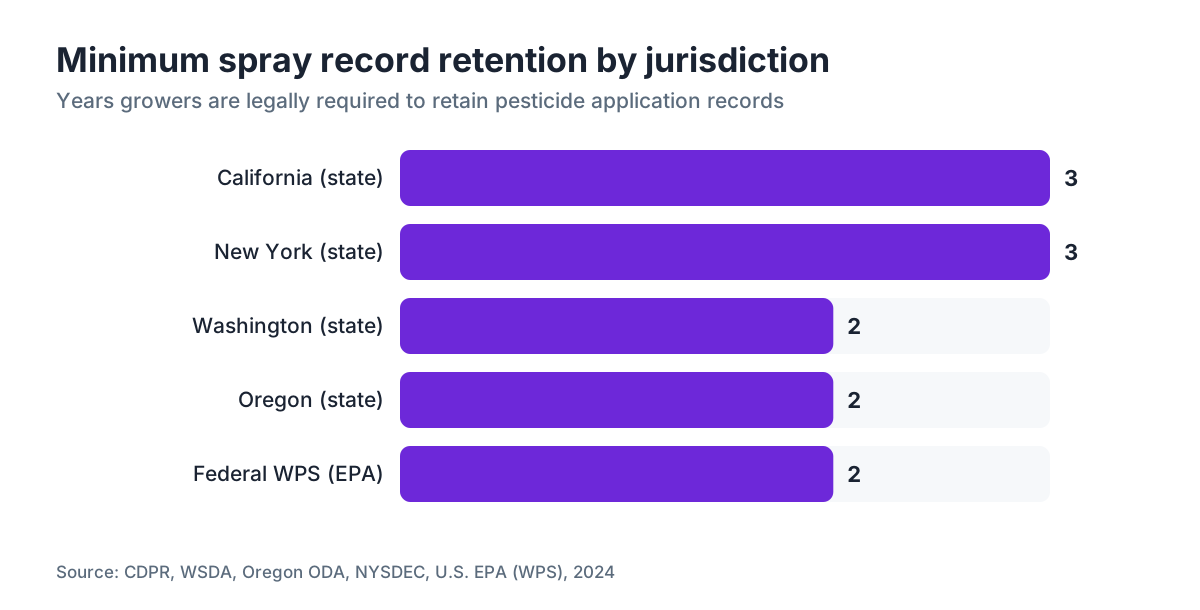
California requires pesticide use records to be kept a minimum of three years [4]. Every spray record from the past 36 months has to be accessible and complete. Not buried on a hard drive that takes 45 minutes to search. Accessible.
The EPA's Worker Protection Standard (40 CFR Part 170) adds its own clock: application-specific information provided to workers has to be kept for two years [6]. Those records overlap with your spray logs, so the practical rule is simple. Keep everything three years.
Some states differ. Check your own state's requirement instead of assuming the federal floor covers you.
| Jurisdiction | Minimum spray record retention | Governing authority |
|---|---|---|
| California | 3 years | Cal. Food & Ag. Code §12981 |
| Washington | 2 years | WAC 16-228-1250 |
| New York | 3 years | 6 NYCRR Part 325 |
| Oregon | 2 years | OAR 603-057-0400 |
| Federal (WPS) | 2 years | 40 CFR §170.309 |
When inspectors find a gap inside the retention window, they treat it as non-compliance even if the applications were done right. You can't prove what you didn't write down.
How does the monthly pesticide use report (PUR) submission process work?
Every grower or licensed applicator who sprays a pesticide on a commercial crop files a monthly report with the county agricultural commissioner's office [4]. The deadline is the last working day of the month after the application month. Spray in May, report by the last working day of June. California's PUR system is the most detailed pesticide tracking program in the country.
You report at the section level of the Public Land Survey System, one square mile. The report pulls straight from your on-site spray log: product, rate, acres, applicator license number, pest targeted. CDPR aggregates all county reports into the statewide PUR database, which is public [4].
Here's where inspections get sharp. An inspector can pull your submitted PURs from the state database and run them line by line against your field logs. Applied something and didn't report it? Reported a different rate than you used? That discrepancy is visible. Some growers under-report applications or leave out restricted materials they used without a permit. Inspectors know exactly what to hunt for.
Small vineyards sometimes assume the PUR requirement has an acreage floor. It doesn't. Apply a pesticide to a commercial crop in California and you report it. Full stop.
Organic doesn't get you out of it either. Non-synthetic pesticides still need PUR reporting if they're registered products. Copper sulfate, sulfur, and spinosad all get reported.
What triggers a county ag commissioner inspection in the first place?
Inspections come from four main places: routine rotation, complaints, ownership changes, and prior violations. Many CAC offices run scheduled compliance programs that visit a share of commercial operations each year. Farm in California wine country long enough and you'll get inspected with no warning and no complaint behind it.
Complaints drive a big share of the rest. Neighbors, workers, or adjacent property owners can file over spray drift, odor, or worker safety, and the commissioner has to investigate. Drift complaints get fast response because they involve possible injury to people or crops off your property.
Ownership changes are another trigger. When a vineyard sells, the new operator often draws a CAC visit to confirm permits and records are in order. Organic transition applications invite scrutiny too, because the inspector has to verify no prohibited materials went down during the transition window.
Violations breed follow-ups. If the commissioner found recordkeeping gaps on a visit two years back and you signed a compliance agreement, expect them again. They track your compliance history and use it.
Pesticide illness reports also pull an inspection. If a worker or neighbor reports a possible exposure, CDPR and the CAC coordinate an investigation that will absolutely include your spray records for the relevant dates.
What happens if you fail a vineyard spray record inspection?
Outcomes run from an informal fix-it notice to civil penalties to criminal referral, depending on what the inspector finds and your track record. Small administrative slips sit at one end. Falsification sits at the other.
For a minor error (a missing application time, a wrong section number on one report), the inspector may issue a Notice of Correction with a short window to fix the records. That's the best case.
For serious findings, California Food and Agricultural Code Section 12999 allows civil penalties up to $5,000 per violation [1]. Each missing report, each application made without a required restricted material permit, each use of an unregistered product can count separately. They stack. A small vineyard with three months of missing PURs and two applications under an expired permit could realistically face $20,000 to $30,000 before any negotiation.
Falsifying records is a different animal. That's a criminal offense under California law and under FIFRA at the federal level. Nobody lands there by accident. But if an inspector suspects records were altered (inconsistent handwriting, application dates that don't line up with employee time records, products on the spray log that were never bought in the volume implied), they escalate.
Worker protection violations found alongside spray record problems compound the exposure. EPA can assess separate civil penalties for WPS violations, up to $10,516 per violation under the current penalty inflation adjustment [6].
If you're in California, UC ANR's cooperative extension has published pesticide compliance guidance worth reading before an inspection, not after [7].
Do worker protection standard records get inspected at the same time?
Yes, almost always. The WPS and the state pesticide use reporting system are separate legal frameworks, but inspectors routinely pull both because they meet at the spray record level.
The EPA's revised Worker Protection Standard (effective January 2, 2017) requires agricultural employers to keep the following accessible at the establishment [6]:
- Central posting of required WPS information (emergency contacts, nearest medical facility)
- A record of pesticide applications in effect during the previous 30 days, available to workers on request
- Worker safety training records with name, date, and training method
- Documentation that decontamination supplies were available
EPA guidance on the WPS is blunt about timing: handlers must be given application-specific information before the application begins. So if a worker was inside a treated area during the REI, you need to show that REI notifications went up on time and that workers were trained. A spray log showing a Monday morning application plus worker time records putting the same crew in that block Monday afternoon is a very bad pair of documents to hand an inspector.
Using a labor contractor doesn't move the liability. For WPS purposes the employer of record is you, the agricultural employer, not the contractor. You can't delegate that. Know what your labor contractor documents and get copies.
How should you organize spray records before an inspection?
Organize by year, then month, then block, and close out each application record the same day it's made. The most common inspection problem isn't illegal spraying. It's records that are disorganized, incomplete, or stored in a way that makes it impossible to prove you did things right.
Each application event should be one document, paper or digital, with every required field filled in before the applicator leaves the block. Don't let spray logs ride around in the tractor cab for two weeks. Process them the day of.
Keep a separate folder for restricted material permits. File each permit when you get it. When it expires, move it to an archive folder instead of tossing it, because you may need to show a prior permit was in effect for a past application.
Keep PCA recommendations in the same system. The recommendation has to come before the application. If your PCA emails them, print or save them with the date received, not the application date.
For digital recordkeeping, tools like VitiScribe let you log applications from the field on a phone, auto-fill label data, and generate the monthly PUR in the format the CAC expects. That matters when you're running 50 to 200 acres across multiple owners or leases. Every hour spent retyping paper field logs into a county form is an hour where transcription errors creep in.
Backup matters. Digital-only records need an export or a printout on file. An inspector won't wait while you restore from a failed drive.
WSU Extension publishes a pesticide recordkeeping guide for Washington growers that works as an organizational template even if you're in another state [8].
What is a restricted materials permit and why do inspectors focus on it?
A restricted material (RM) permit is a county-issued permit you need before you can buy or apply any pesticide California designates as a restricted material [1]. The county agricultural commissioner issues them, and they're site-specific, applicator-specific, and often pest-specific.
Several common viticultural chemicals are restricted materials in California: chlorpyrifos (now banned in most uses), methyl bromide, and various fumigants. Certain fungicides and rodenticides are restricted too. The list shifts as CDPR reviews products.
Inspectors zero in on restricted materials for two reasons. First, applying one without a valid permit is a direct violation with automatic penalty exposure. Second, RM applications require a written PCA recommendation, so they leave a paper trail that's easy to audit. If your PUR shows chlorpyrifos in a given month, the inspector can immediately check whether a permit was in effect and a PCA recommendation exists. Either one missing is a finding.
The permit spells out conditions: timing windows, required buffer zones, applicator PPE, sometimes weather limits. Applying outside those conditions (spraying when wind exceeds the permit limit, say) is a violation even if the permit itself was valid.
Renew RM permits early. They're issued annually in California. Applying under an expired permit gets treated the same as applying with no permit at all.
Can a vineyard owner be cited for a contract applicator's recordkeeping failures?
Yes, in some circumstances, and the law here is clearer than most growers think. Under California law, the licensed pest control operator (PCO) or qualified applicator who actually makes the application is primarily responsible for completing and keeping the application record [1]. The CAC will go after the applicator's license first.
But as the grower and permit holder, you carry independent obligations. Your name is on the restricted material permit. The monthly PUR submission is your job as the permittee. If a contract applicator sprays your vineyard and never files the PUR, you're the one the commissioner comes to.
So the practical move is simple. Get a copy of every application record from your contract applicator before the end of the month the application happened in. Don't just trust that they filed the PUR. Review the copy, confirm it matches what you authorized, keep it in your own files, then cross-check the submission confirmation.
Some contract PCOs are excellent at documentation. Some aren't. You find out which kind you hired when the inspector shows up, and that's the worst possible time to learn it.
What does an inspection actually look like in the field?
Most routine inspections open with the inspector showing credentials and asking for your most recent spray records and current restricted material permits. The initial document review usually runs 30 to 90 minutes depending on how many applications you've made and how well your records are organized.
If something looks off during that review (a date gap, a missing permit, a reported product that doesn't match quantities purchased), the inspector asks follow-up questions. They're trained to spot inconsistencies. Answer honestly. If you made a recordkeeping error, say so. Trying to talk your way around an obvious gap rarely helps the outcome.
Inspectors sometimes add a field component: checking REI signage where it's required, confirming application equipment has calibration records, or checking storage for proper labeling and containment.
They'll leave you a copy of any Notice of Inspection or Notice of Violation before they go. Read it closely. It lists the specific code sections alleged to be violated and gives a deadline for response or correction. Blow that deadline and you've got a separate problem.
If you disagree with a finding, you can appeal through the CAC office and then to CDPR. Don't try to negotiate violations informally with the inspector on site. Put any dispute in writing through the formal process. UC ANR's extension resources document pesticide compliance and the appeal path for California growers [7].
How should a vineyard manager prepare for a routine inspection before it happens?
Run a self-audit once a year and you'll catch most problems before they become violations. Work this checklist.
First, pull every PUR submission confirmation from the past three years and confirm you have a matching on-site spray log for each one. Then run it the other direction: pull every on-site spray log and confirm a PUR went in for it.
Second, check your restricted material permits. Any expired? Any applications in your records from a period when the relevant permit wasn't in effect?
Third, check applicator license numbers on your spray records. Licenses expire. If someone applied pesticides in your vineyard on an expired license, that's a violation even if everything else was clean.
Fourth, review your WPS documentation: training records, application posting logs, REI records.
Fifth, pull your PCA recommendations and confirm a written recommendation precedes each restricted material application.
This takes half a day if your records are organized. It takes a week if they aren't. Cornell Cooperative Extension's integrated pest management program publishes recordkeeping templates that work for this kind of audit [9].
The best time to find a gap is during your own audit. The second-best time is when an inspector points it out. There is no good third option.
Recordkeeping software that timestamps applications and flags missing fields before you close the record earns its keep here. VitiScribe was built for vineyard operations and generates California-format PURs straight from field log entries, which shrinks the gap between application and submission.
Frequently asked questions
Does the county ag commissioner give advance notice before inspecting spray records?
No. California Food and Agricultural Code Section 11501 lets the commissioner inspect during normal business hours with no advance notice. Most other states have equivalent provisions. Routine compliance inspections can be unannounced, and complaint-triggered ones almost always are. The practical answer: keep your records current and organized all the time, not only when you think someone's coming.
What is the fine for missing pesticide use reports in California?
California Food and Agricultural Code Section 12999 allows civil penalties up to $5,000 per violation. Each missing monthly report can count as a separate violation. A grower with six months of missing PURs could face up to $30,000 before any other findings. First-time administrative errors with a clean history usually settle at lower negotiated amounts, but there's no statutory cap on how many violations can be assessed.
Who is required to file pesticide use reports in California, the grower or the applicator?
Both can carry an obligation, depending on who made the application. If a licensed pest control operator applies under their own license on your behalf, the PCO files the PUR. If you or your employees apply under your own qualified applicator license or certificate, you file. Restricted material permit holders also have independent reporting obligations. When in doubt, confirm in writing with your PCO who files for each application.
Do organic vineyards need to keep spray records and file PURs?
Yes. Organic certification doesn't exempt a vineyard from pesticide use reporting. Any registered pesticide applied to a commercial crop in California gets reported, including copper fungicides, sulfur, spinosad, and other materials allowed under the National Organic Program. The record requirements (applicator, date, product, acres, pest target) match conventional production. Your organic certifier will also want these records during annual audits.
How long does California require vineyard spray records to be kept?
California Food and Agricultural Code Section 12981 requires pesticide use records to be kept a minimum of three years. The EPA's Worker Protection Standard separately requires two years of WPS application records. Since the three-year state requirement is longer, keeping everything at least three years satisfies both. Some growers keep seven years by default to cover potential litigation windows, which is reasonable but more than the law requires.
What is a restricted material permit and which vineyards need one?
A restricted materials permit is issued by the county agricultural commissioner and required before you buy or apply any California-designated restricted material pesticide. Any vineyard that applies RM-classified products, regardless of size, needs a site-specific permit for each product and location. The permit sets conditions of use. Applying without a valid permit is a direct violation. Common viticultural fumigants and some rodenticides are restricted materials.
Can a neighbor or farmworker complaint trigger a spray record inspection?
Yes. Complaints are one of the most common triggers for non-routine CAC inspections. A neighbor reporting drift or odor, or a worker reporting a possible pesticide exposure, obligates the commissioner to investigate. That investigation includes reviewing your spray records for the relevant dates, checking REI compliance, and confirming what products were applied at what rates. Complaint investigations tend to be faster and more document-heavy than routine visits.
Are licensed pest control advisers required for all vineyard pesticide applications?
In California, a written PCA recommendation is required before applying any restricted material pesticide. For non-restricted materials, PCA recommendations aren't legally required, though many vineyard managers use PCAs for all spray decisions anyway. When inspectors examine spray records, they look for PCA recommendations as supporting documentation for each restricted material application. Missing recommendations are a common inspection finding.
What worker protection standard records does a vineyard need to show an inspector?
Under 40 CFR Part 170, agricultural employers must keep safety training records (worker name, training date, method), documentation that application-specific pesticide information was made available to workers, records that REI postings were made, and confirmation that decontamination supplies were provided. The WPS requires these be accessible at the establishment. EPA can assess separate civil penalties up to $10,516 per WPS violation during inspections.
What is the monthly deadline for submitting pesticide use reports in California?
The California PUR deadline is the last working day of the month after the application month. Applications made in July must be reported by the last working day of August. Missing the monthly deadline is a recordkeeping violation even if the underlying applications were done correctly. The county agricultural commissioner's office receives the reports and forwards them to CDPR, which maintains the statewide PUR database.
Can a vineyard owner be penalized for mistakes made by a contract spray applicator?
Yes, in some circumstances. The licensed PCO bears primary responsibility for application records, but the grower as permit holder has independent obligations for PUR submission and restricted material permit compliance. If a contract applicator never files PURs for work done on your property, you can be cited as the permittee. The safest approach: require copies of all application records from contractors within the reporting month and confirm PUR submissions were made.
What happens if spray records are found to be falsified during an inspection?
Falsifying pesticide records is a criminal offense under California Food and Agricultural Code Section 12999.5 and potentially under FIFRA at the federal level. Inspectors look for signs of alteration: inconsistencies between spray records and purchase records, handwriting anomalies, application dates that don't match worker time logs. Penalties escalate from administrative to criminal, and the applicator's license is at risk of suspension or revocation.
Do Washington and other wine states have equivalent spray record inspection requirements?
Yes. Washington's State Department of Agriculture enforces pesticide recordkeeping under RCW Chapter 15.58 and WAC 16-228, with a two-year minimum retention requirement. Oregon requires two years under OAR 603-057. New York enforces three-year retention under ECL Article 33. Every commercial wine grape state has some version of this requirement, though the forms, submission schedules, and restricted material lists vary a lot.
Sources
- California Department of Food and Agriculture: California Food and Agricultural Code Sections 11501-11503 grant county agricultural commissioners authority to inspect pesticide use records without advance notice; Section 12999 establishes civil penalties up to $5,000 per violation; Section 12981 requires PCA written recommendation before restricted material applications.
- Washington State Department of Agriculture, Pesticides: WSDA enforces pesticide recordkeeping requirements for commercial applicators under RCW Chapter 15.58 and WAC 16-228, with a two-year minimum record retention requirement.
- New York State Department of Environmental Conservation: New York enforces pesticide recordkeeping under Environmental Conservation Law Article 33 with a three-year retention requirement under 6 NYCRR Part 325.
- California Department of Pesticide Regulation, Pesticide Use Reporting: California's PUR system requires monthly reporting of all pesticide applications to commercial crops by the last working day of the following month; records must be retained for three years; CDPR maintains the public statewide PUR database.
- U.S. EPA, Federal Insecticide, Fungicide, and Rodenticide Act (FIFRA): Under FIFRA, the pesticide label is a legally binding document; using a product on an unregistered site or at an above-label rate is a federal violation. EPA may assess civil and criminal penalties for FIFRA violations.
- U.S. EPA, Agricultural Worker Protection Standard (40 CFR Part 170): The revised WPS (effective January 2, 2017) requires agricultural employers to retain WPS application records for two years, post central information, provide REI notification, document worker safety training, and maintain decontamination supplies. EPA civil penalties for WPS violations can reach $10,516 per violation under current inflation adjustments.
- University of California Agriculture and Natural Resources (UC ANR) Cooperative Extension: UC ANR Cooperative Extension publishes guidance on pesticide compliance requirements and the CAC appeal process for California growers.
- Washington State University Extension: WSU Extension provides pesticide recordkeeping guides and organizational templates applicable to Pacific Northwest vineyards.
- Cornell Cooperative Extension, Integrated Pest Management: Cornell Cooperative Extension's IPM program includes recordkeeping templates and pre-audit checklists applicable to commercial grape production.
- Oregon Department of Agriculture: Oregon requires a two-year minimum pesticide record retention period for commercial applicators under OAR 603-057-0400.
- California Department of Pesticide Regulation, Laws and Regulations: California Food and Agricultural Code Section 12999.5 makes falsification of pesticide records a criminal offense. Section 12981 specifies the three-year record retention requirement.
Last updated 2026-07-11