How to export spray records from vineyard software for county submission

TL;DR
- Most vineyard software exports spray records as CSV or PDF.
- County agricultural commissioners want the pesticide product name, EPA registration number, application date, acres treated, target pest, and applicator license number.
- California pesticide use reports are due within seven days after the end of the application month under Food and Agriculture Code Section 12979.
- Export menus differ by platform.
- The required data fields do not.
What information does a county spray record submission actually require?
Know exactly what your county ag commissioner needs before you touch the export button. California's required fields are the benchmark most people reference, and they live in the California Code of Regulations, Title 3, Section 6624 [1]. The record has to carry the operator's name and address, the site location (usually a pesticide use permit site ID or APN), the commodity, the pesticide product name as printed on the label, the EPA registration number, the application date, the acres planted, the acres treated, the amount of product used, the target pest, the application method, the applicator name, and the applicator's license number when a QAL or QAC signs off.
Some counties want more. Napa County ties submissions to a grower's permit number in the county pesticide use permit system. Ask your county before you assume the state minimum clears the bar.
The federal Worker Protection Standard under 40 CFR Part 170 also requires application and hazard information be kept for two years after the application [2]. Your county submission and your WPS record share most fields, so one clean export often covers both jobs when the data is complete.
Here's the field that trips people up. The EPA registration number appears on the label as a hyphenated number, say 62719-305, and it has to match the label exactly. If your software's product database holds an outdated number, or a generic entry with no number at all, fix it before you export. A county can bounce a submission over one wrong registration number.
What file format do county ag commissioners actually accept?
This varies more than it should. California's county ag commissioners run pesticide use reporting through CalAgPermits, a state system administered by CDFA, and most counties now take electronic submission through it [3]. You can key data directly into the web interface, and some counties also take a pipe-delimited flat file or CSV upload for bulk submissions. A handful of rural counties still accept PDF by fax or mail, but that path is fading.
Washington State runs reporting through the WSDA Pesticide Management Division, and its portal takes CSV uploads against a defined column schema [4]. Oregon uses its own Pesticide Use Reporting System through ODA. None of these three states share a format, so farming across state lines means juggling multiple export templates.
For most small and mid-size vineyards on Agrian, Granular, or a vineyard-specific platform, the working answer is short. Export to CSV, open it, check the column headers against what your county portal expects, and upload. When the portal rejects a file, the error message usually names the field that broke.
| Format | California CalAgPermits | Washington WSDA | Oregon ODA |
|---|---|---|---|
| CSV upload | Yes (some counties) | Yes | Yes |
| Direct web entry | Yes | Yes | Yes |
| PDF/paper | Yes (still accepted) | Limited | Limited |
| XML/EDI | No | No | No |
| Excel (.xlsx) | No | No | No |
Never submit a raw Excel file. Convert it to CSV first. County systems choke on Excel formatting, and you get no confirmation the data parsed the way you meant it to.
What are the deadlines for submitting spray records to the county?
California's deadline is firm. Pesticide use reports go to the county agricultural commissioner within ten days of the end of the month in which the application was made, per California Code of Regulations Title 3 Section 6626 [1]. Spray on July 15, and the report is due by August 10. Miss the window and you invite a notice of violation.
CDFA's Pesticide Use Enforcement Program Standards Compendium notes that late or missing reports rank among the most common violations found during compliance inspections [3]. Administrative fines start around a few hundred dollars for a first violation and climb into the thousands for repeat offenders. For licensed pest control advisers, a pattern of violations can trigger license review.
Washington requires monthly reporting by the 25th of the following month for most agricultural applications [4]. Oregon's deadlines depend on applicator type and whether you hold a public or private license, so check with ODA directly.
Build a weekly habit instead of a month-end scramble. Export every week, spot-check the fields, and stage the file for upload. A data error you made two weeks ago is still fresh enough to fix before the clock runs out.
Using a spray contractor changes who files, not whether it gets filed. In California the licensed pest control operator who made the application usually carries the reporting duty, but you still have to hand them accurate site and acreage data. A lot of grower-contractor fights come down to exactly that handoff.
How do you actually export spray records from common vineyard software?
The steps differ by platform. The logic never does: filter by date range, pick the fields your county requires, and export to CSV or PDF.
Agrian: open Reports, then Pesticide Use Reports. Set your date range, choose the ranch or block level, and run the California PUR export template if you farm in CA. That template is pre-mapped to CDFA field requirements. Download as CSV.
Granular (part of Corteva): go to the Spray Log module, filter by operation and date, and hit Export. Granular gives you a CSV with selectable columns. Verify the EPA registration number column is populated by hand, because incomplete product records in Granular sometimes leave it blank.
Farm Works and other AgX-based platforms: both support a PUR report export. In Farm Works, that's Reports, then Environmental, then Pesticide Use Report. The output is a flat CSV.
Vineyard-specific platforms organize spray records at the block level and let you export by date range with the county-required fields validated before the file leaves the system. That validation step is what cuts the rejection rate from missing registration numbers or permit IDs.
No dedicated PUR export in your software? Export everything to CSV, open it in a spreadsheet, and match your columns to the county's required schema by hand. It's tedious but workable for a small operation running under ten applications a month. Past that, you're burning real time you won't get back.
How do you verify your export data is complete before submitting?
Open the CSV in a spreadsheet and scan the required columns for blank cells. The fields most often left empty are the EPA registration number, the applicator license number, and the acres-treated versus acres-planted split. Two minutes here saves a rejected upload later.
UC Cooperative Extension publishes guidance on pesticide record-keeping for California growers that includes a field-by-field checklist [5]. Print it and tape it near whoever reviews the export. Cornell's Integrated Pest Management program recommends the same pre-submission review step as standard practice [6].
A few checks worth running every single time.
Confirm the product name in your record matches the current label name. Products get reformulated and renamed, and your software might still hold an old trade name. The county matches on EPA registration number, not product name, but a mismatch invites questions in an audit.
Confirm acres treated is less than or equal to acres planted. More treated acres than planted acres in a block flags instantly in automated review.
Check that the application date is not in the future. Sounds obvious. Batch data entry produces this error more than you'd think.
If you submit for multiple growers or blocks under one permit, make sure each row carries the correct site ID. Merged data from multiple blocks is the number-one source of site ID errors in exported files.
What happens if you submit a spray record with errors?
The county office either rejects the submission with an error code or flags it for follow-up. In California, CalAgPermits returns field-level errors on a failed upload, which is genuinely useful. Paper and emailed submissions just sit in a queue and may go unread until an inspector pulls the file.
Fixing a submission after the fact means filing an amended record. In California you submit a corrected PUR carrying the same application date, marked as an amendment. Keep a clear paper trail of what changed and why. Amendments are auditable, and you want to show the error was honest and fixed fast.
Food and Agriculture Code Section 12979 sets the enforcement structure, and county commissioners have discretion to issue a written warning for a first minor violation, especially for small growers with clean records. Don't plan around that discretion, but it exists.
WSU Extension's pesticide record-keeping resources note that incomplete records usually come from workflow gaps, someone applying a product and not logging it the same day, rather than intent to hide anything [7]. The fix is procedural. The person doing the application records it before leaving the block, not at the end of the week.
Do you need to keep copies of submitted spray records, and for how long?
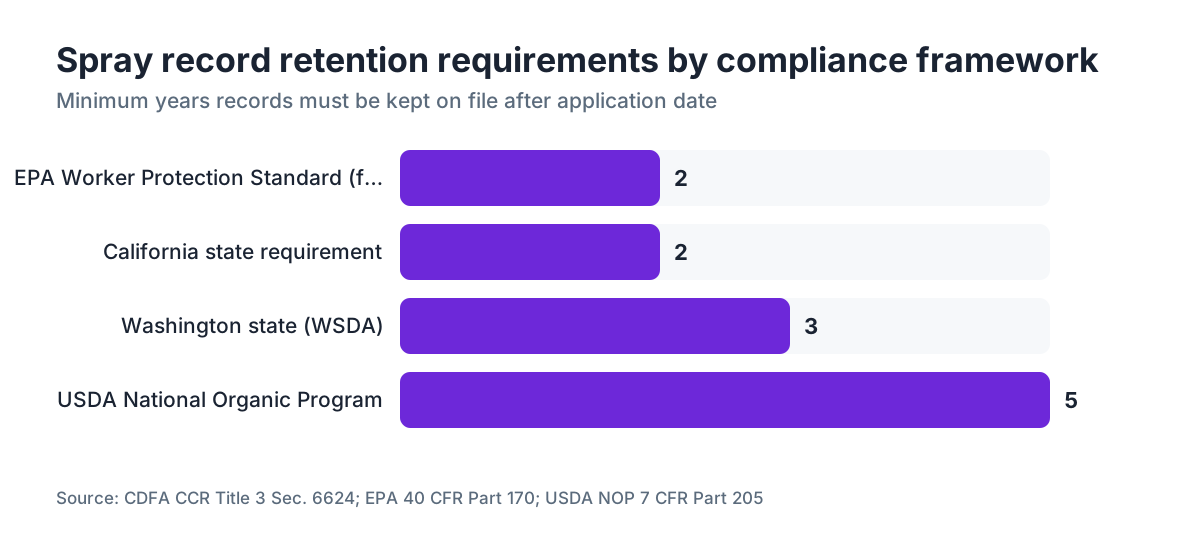
Yes. California requires growers to keep pesticide use records for two years from the date of application under CCR Title 3 Section 6624 [1]. The federal WPS requirement under 40 CFR Part 170 also sets a two-year window and requires that application records stay accessible to workers and handlers for review [2]. The two lines up cleanly for most California vineyards.
Store your records in at least two places. The county holds your submitted record, but you need your own copy to answer an audit or an employee hazard information request. Cloud backup of exported files with date-stamped filenames does the job. A folder like /SprayRecords/2024/July/ holding the county submission CSV and a PDF of the submission confirmation covers you.
Certified organic vineyards face a longer clock. The National Organic Program under 7 CFR Part 205 requires all input records, including spray records for approved materials, be kept for five years [8]. That's the longest retention most vineyards will meet, and it applies even to organic-approved inputs like copper and sulfur, which still generate EPA-registered product records.
If you're under a third-party audit (SIP Certified, CCOF, Lodi Rules), your auditor will want spray records for the prior growing season at minimum. Clean, organized exports turn audit prep from a week into an afternoon.
How do you handle spray records for a custom crush or contract farming arrangement?
This is where responsibility gets genuinely murky, and it pays to settle it in the contract before the season starts.
In California, the reporting duty falls on the grower of record for that property, or on the licensed pest control applicator when a PCA directed the applications and an LCO made them. In a custom crush deal where the winery neither owns nor leases the vineyard, the vineyard owner is usually the grower of record and carries the reporting duty. The winery takes the grapes but has no reporting obligation unless it also controlled the farming.
In contract farming, where a management company runs someone else's vineyard, that company is often named grower of record on the pesticide use permit. Read your permit, not your gut, on this one.
For export purposes, this means whoever holds the reporting duty needs the software that holds the complete application records. If the farm manager logs sprays in their system and the vineyard owner is the permit holder, you need a process: the manager exports and hands off records to the owner for submission, or the owner grants submission authority to the manager.
Some county ag commissioners allow an authorized agent to submit for the permit holder. Get that authorization in writing with the county before the first submission of the season.
Managing vineyards across several properties with different ownership, the way a lot of Paso Robles and Central Coast operators do, argues for a platform that supports multi-entity records and per-entity exports. It saves the real headaches at month-end.
What are the WPS record-keeping requirements that overlap with county spray records?
The EPA's Worker Protection Standard, revised in 2015 and updated in 2017, requires agricultural employers to keep records tied to pesticide applications whenever workers or handlers may be on the treated site [2]. Under 40 CFR Part 170, employers must record the product name, EPA registration number, active ingredients, location and description of the treated area, date and time of application, and the restricted-entry interval.
EPA guidance states that pesticide application information must be kept for two years and displayed or made accessible to workers and handlers. That overlaps with your county PUR fields on nearly every data point.
The practical payoff: if your county export carries all the WPS-required fields, one exported record covers both compliance jobs. Most platforms map the fields identically. The one field WPS wants that county PURs don't always prompt for is the restricted-entry interval (REI) duration. Get it into your spray record database entry even when it isn't a required submission field, because a worker asking for exposure information has the right to see it.
WSU Extension's pesticide safety resources and UC's Worker Protection Standard guidance both stress that the REI has to be posted at the field during the restricted period, and the record of which REI applied to which product and application has to be retrievable [5][7].
How do you set up your vineyard software to make future exports faster and more accurate?
Most of the friction in exporting spray records comes from a sloppy setup, not from the export step. Fix the setup once and the export drops to a five-minute task.
Start with your product library. Every pesticide in your software should carry the EPA registration number, the SLN number if it applies, the REI, the PHI, and the signal word from the label. If your platform can import a product list from a state database (California's DPR maintains one), use it instead of typing products in by hand. Manual entry is where the errors breed.
Map your blocks correctly next. Your software's block IDs should match your county pesticide use permit site IDs. When they don't, every export needs a manual translation step. Get your site ID list from the county before planting season and enter those IDs in your software as the canonical location identifiers.
Build out applicator profiles fully. Every person who applies pesticides needs a license number, license type, and expiration date in the system. Some platforms warn you when a license is about to lapse. That's worth having.
Record applications the day they happen. This is the single biggest driver of export accuracy. An application logged three days later runs a higher risk of a wrong date, wrong block, or missing product detail. The person holding the spray gun is also the best source of what actually went on the vines.
Purpose-built vineyard platforms are designed around this workflow: mobile field entry at the moment of application, product data auto-populated from a compliant library, and county-ready export templates reviewed before they leave the system. Purpose-built or general farm management, the setup discipline matters more than the logo on the app.
What if your county doesn't accept electronic submissions yet?
Some smaller California counties, and plenty in other states, still want paper or take only faxed or emailed PDF reports. Less common than five years ago. Not gone.
If that's you, export to PDF from your software, confirm the PDF shows every required field clearly, and submit per the county's instructions. Keep the email confirmation or the fax confirmation page. Paper submissions produce no system receipt, so your retained copy and proof of delivery are your only evidence of timely filing.
Call your county ag commissioner at the start of each season to ask whether the submission process changed. Several California counties have come onto CalAgPermits in the last two years, and if yours did, move from paper to electronic right away. Electronic submission hands you a timestamp, a confirmation number, and a searchable record if a dispute ever comes up.
Frequently asked questions
Can I submit spray records to the county as a PDF instead of CSV?
In California, most counties on the CalAgPermits system prefer electronic data entry or CSV upload, though PDF and paper submissions still fly in many counties. Check with your specific county agricultural commissioner. Electronic submission is safer because it gives you a confirmation number and timestamp. If you do send PDF, keep the submission confirmation and a dated copy of exactly what you sent.
What happens if I miss the county spray record deadline?
In California, pesticide use reports are due within ten days after the end of the application month. Missing that can bring a notice of violation under the Food and Agriculture Code. First offenses often draw a written warning for minor lapses at the county's discretion, but repeat or serious violations carry fines from a few hundred to several thousand dollars. File late rather than not at all, and document why it slipped.
Do I need to report spray records for sulfur and copper since they're organic-approved?
Yes. In California, every pesticide application, including sulfur and copper fungicides, requires a pesticide use permit and must be reported to the county ag commissioner. These products stay regulated under the state pesticide use reporting system. If you're CCOF or NOP certified, those records also need to be kept for five years under the National Organic Program rule at 7 CFR Part 205.
What is the EPA registration number and where do I find it on the label?
The EPA registration number is a hyphenated number printed on every federally registered pesticide label, for example 62719-305. It uniquely identifies the product formulation. Look for it in a box or near the bottom of the front label panel, usually marked 'EPA Reg. No.' Your county submission needs the exact number. If your software's product record lacks it, look it up in EPA's pesticide product label system at epa.gov.
Who is responsible for submitting spray records when a licensed pest control applicator does the spraying?
In California, the licensed pest control operator who made the application files the pesticide use report when they work under their own license. If a grower's own employee made the application using grower-purchased materials, the grower of record (permit holder) files. Confirm which applies in writing with your contractor before the season starts, so you avoid both double-filing and gaps.
How long do vineyard spray records have to be kept on file?
California requires pesticide use records to be kept for two years from the date of application, matching the federal Worker Protection Standard's two-year window. Organic-certified vineyards must keep all input records for five years under the National Organic Program. Keep records in at least two locations, one of them an offsite or cloud backup, in case of fire or equipment loss.
What fields does my vineyard software export need to include for a valid county submission?
Required fields under California CCR Title 3 Section 6624 include operator name and address, site location (permit site ID), commodity, product name as labeled, EPA registration number, application date, acres planted, acres treated, amount of product applied, application method, target pest, and applicator name and license number. Some counties want extra fields like the grower's permit number. Verify your county's requirements each season.
Can I export spray records for multiple blocks or ranches in one file?
Yes, and for larger operations that's the way to do it. Most vineyard software allows multi-block or multi-ranch exports filtered by date range. Each row in the CSV should carry the correct site ID for that block. The most common error in multi-block exports is rows with the wrong site ID because software block names don't match the county's registered site IDs. Map those correctly in setup before you export.
Does my spray record export satisfy WPS record-keeping requirements too?
Usually yes, if it includes the product name, EPA registration number, active ingredients, treated location, application date and time, and the restricted-entry interval. The EPA's Worker Protection Standard at 40 CFR Part 170 requires these fields be kept for two years and made available to workers on request. Confirm your export includes the REI field, since county PUR forms don't always prompt for it but WPS requires it.
What should I do if my vineyard software doesn't have a county-formatted export template?
Export the fullest data set available, usually a complete spray log, to CSV. Open it in a spreadsheet, find the county's required columns in the commissioner's current submission guide, and rearrange or rename columns to match. Save that column mapping as a reusable template. It's a one-time setup task. If you're doing it monthly, weigh whether your platform should support a real compliance export or whether switching makes sense.
What is CalAgPermits and do I have to use it?
CalAgPermits is the California Department of Food and Agriculture's online system for pesticide use reporting. Whether you must use it depends on your county. Many California counties now require electronic submission through CalAgPermits or accept bulk CSV uploads tied to it. Some rural counties still take paper. Contact your county agricultural commissioner each year to confirm the submission method they currently require.
Can a farm manager or agronomist submit spray records on behalf of the vineyard owner?
Yes, with county authorization. Most county ag commissioners let a grower designate an authorized agent to submit pesticide use reports on their behalf. This has to be set up in writing with the county before submission. The permit holder stays legally responsible for accuracy and timeliness. Get the authorization on file before the first spray of the season, not after a deadline slips.
Are there differences in spray record export requirements between California, Washington, and Oregon?
Yes, big ones. California requires submission to the county ag commissioner within ten days of month-end through CalAgPermits or county-specific formats. Washington requires monthly reporting to WSDA by the 25th of the following month through the Pesticide Management Division portal with CSV upload. Oregon uses ODA's system with deadlines and fields that vary by license type. Each state has its own upload schema. Never assume a California template works elsewhere without checking.
Sources
- California Code of Regulations, Title 3, Sections 6624 and 6626, CDFA Pesticide Use Reporting: California requires pesticide use reports within ten days of the end of the application month (Section 6626); records must be retained two years (Section 6624); required fields include EPA registration number, acres treated, applicator license number, and target pest.
- EPA, Worker Protection Standard, 40 CFR Part 170: The WPS requires that pesticide application records including REI, EPA registration number, and treated area be maintained for two years and made available to workers on request.
- CDFA, Pesticide Use Enforcement Program Standards Compendium: Late or missing pesticide use reports are among the most common violations found during compliance inspections in California.
- Washington State Department of Agriculture, Pesticide Management Division: Washington requires monthly pesticide application reporting to WSDA by the 25th of the following month, submitted through the Pesticide Management Division portal with CSV upload against a defined column schema.
- UC Cooperative Extension (UC Agriculture and Natural Resources), Pesticide Record-Keeping for California Growers: UC Cooperative Extension publishes a field-by-field checklist for pesticide use report completeness for California growers.
- Cornell University Integrated Pest Management Program: Cornell's Integrated Pest Management program recommends a pre-submission review step for pesticide application records as standard practice.
- WSU Extension, Pesticide Record-Keeping and WPS Resources: WSU Extension notes that incomplete records are more often caused by workflow gaps (delayed entry) than intentional omission, and recommends same-day recording of all applications.
- USDA National Organic Program, 7 CFR Part 205, Record-Keeping Requirements: The National Organic Program requires certified operations to retain all input and application records for five years.
- EPA, Pesticide Product and Label System: EPA maintains a searchable database of registered pesticide products and EPA registration numbers through its pesticide registration program.
- CDFA, CalAgPermits Electronic Pesticide Use Reporting System: CalAgPermits is California's official online system for electronic pesticide use report submission; accepted formats include direct web entry and CSV upload depending on county.
Last updated 2026-07-11