Cover crop water competition management in drip irrigated vineyards
TL;DR
- In drip irrigated vineyards, cover crops fight vines for the exact water the drip line delivers.
- Right species, early termination, and a 10 to 30% irrigation buffer keep that competition from stressing your vines.
- Shallow-rooted annuals that die back before late May cause the least trouble.
- Perennial grasses in the vine row almost always have to go.
Why does cover crop water competition matter so much in drip irrigated vineyards?
Drip is precise, and precision cuts both ways. You deposit water in a defined wet bulb, often only 18 to 36 inches wide and 24 to 48 inches deep, and every root in that zone drinks from it [10]. In a flood or furrow vineyard, cover crops pull from a much wider soil column, so the losses spread out and dilute. Under drip, the fight is concentrated in a small space.
UC research has repeatedly found that cover crops in the vine row under drip can drop vine predawn leaf water potential by 0.1 to 0.3 MPa during the growing season, which is real stress for winegrapes [1]. That's the difference between well-irrigated and early deficit stress, and you never touched the controller.
Here's the irony. Cover crops earn their keep: less erosion, more soil organic matter, less compaction from tractor passes, and nitrogen fixation in some cases. You're not trying to kill them off entirely. You're deciding where they root and when they transpire. Get the timing and placement wrong and you've made one of the most common irrigation mistakes in California and Pacific Northwest vineyards.
How much water can a cover crop actually take from your vines?
The real numbers vary more than you'd like, and no single figure covers every situation. The most useful work comes from UC Cooperative Extension trials in Napa, San Joaquin, and Paso Robles, which measured cover crop evapotranspiration at 0.5 to 2.5 acre-inches per month during spring active growth, depending on species and canopy density [2]. Perennial ryegrass at full cover sits near the top. Small burndown cereals like annual rye or mustard sit near the bottom.
A study in the American Journal of Enology and Viticulture found that mid-row cover crops in a drip irrigated Cabernet Sauvignon block forced growers to apply 15 to 22% more water to hold vine water status equal to clean cultivation [3]. That's manageable if you plan for it. If you don't, your vines run dry while the soil moisture sensor looks fine, because the sensor reads the cover crop's draw, not the vine's.
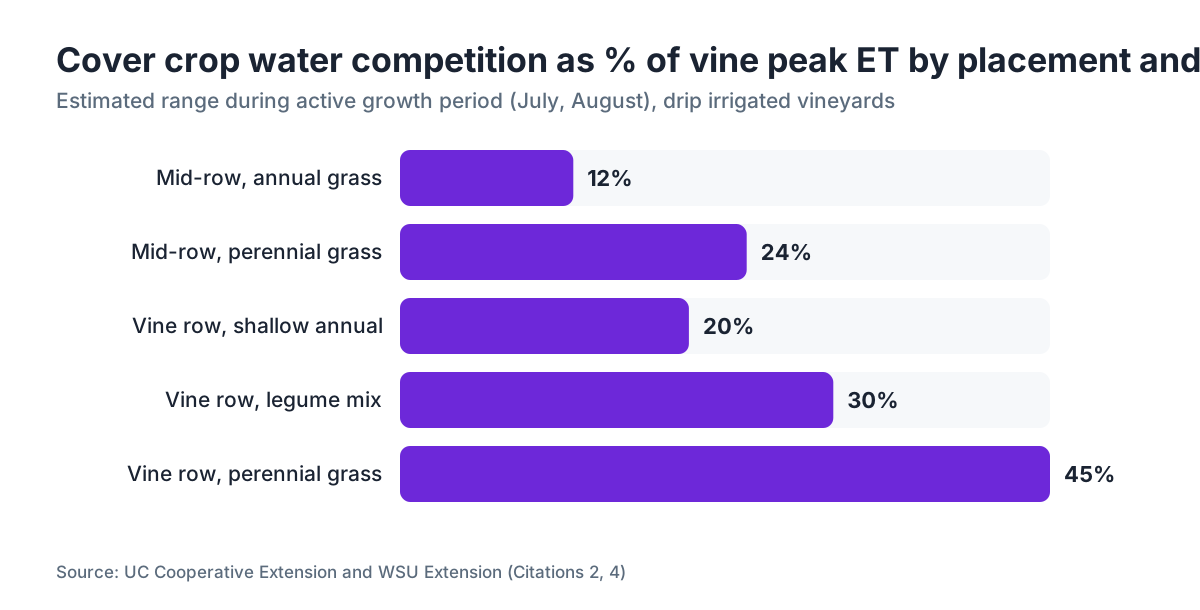
Vine-row cover crops are the real hazard. WSU Extension data from Washington's Columbia Valley puts vine-row cover crop water use at 30 to 60% of the vine's own peak demand in July and August [4]. At that level you either add serious drip run time or you watch mid-season stress cut into berry development.
| Cover crop placement | Estimated water competition (as % of vine peak ET) | Source |
|---|---|---|
| Mid-row, annual grass | 8 to 15% | UC Cooperative Extension [2] |
| Mid-row, perennial grass | 18 to 30% | UC Cooperative Extension [2] |
| Vine row, shallow annual | 15 to 25% | WSU Extension [4] |
| Vine row, perennial grass | 30 to 60% | WSU Extension [4] |
| Vine row, legume mix | 20 to 40% | USDA NRCS practice guides [5] |
Which cover crop species compete least with drip-irrigated vines?
Two things decide it: how deep the roots go, and when the plant transpires hardest. You want species that grow through winter and early spring, while vines are dormant or just pushing, and that you can terminate (or that self-terminate) before vine demand climbs in late May and June.
Annual cereals are the standard low-competition pick. Cereal rye (Secale cereale), annual ryegrass (Lolium multiflorum), and barley mature and dry down naturally by late April to early June in most California wine regions, which lines up with the vine's demand window [2]. Their roots are fibrous but shallow under most drip setups, usually staying in the top 12 to 18 inches, at the edge of or outside the core wet bulb.
Legumes are a different animal. Clovers and vetches run deeper tap roots and keep transpiring into May. Bell bean and fava reach 24 to 36 inches down. They fix nitrogen, which is genuinely useful, but they need earlier termination than cereals if you care about vine water status.
Perennial grasses are the high-competition option, no way around it. Tall fescue, orchardgrass, and perennial ryegrass root 36 to 60 inches deep and transpire all season unless you keep after them. UC recommends against perennial grasses in the vine row under drip, full stop [1]. In the mid-row, with deficit irrigation management and some supplemental mid-row water, they can work, but the management load is heavy.
Brassicas like mustard and arugula grow fast, bolt, and self-terminate, and they're low competition if you let them run their course. They're a reasonable option across the Coast Ranges and Sierra Foothills.
When should you terminate a cover crop to avoid vine water stress?
Earlier than most people do it. That's the honest answer.
Standard guidance from UC Cooperative Extension and most PCA recommendations is to terminate cover crops before vine water demand passes roughly 0.5 inches per day, which in the California Coast Ranges and Central Valley hits by late April to mid-May depending on year and site [2]. In plain terms, you want the cover crop dead, dry, and no longer transpiring by the time shoots reach 6 to 8 inches.
Why that mark? At 6 to 8 inch shoots, vine stomata are running at high conductance, new leaf area piles on fast, and the drip system starts moving real water. A living cover crop at that point competes at the worst possible time.
Mowing rarely finishes the job in one pass. Perennials and legumes regrow from crown or root. Plan two mows 10 to 14 days apart, or a mow followed by a burndown herbicide. If you want a no-spray program, mowing low and often works, but it costs labor.
In the Pacific Northwest, WSU Extension puts the termination window about 2 to 3 weeks later than California, roughly early to mid-May for the Columbia Valley, because the season is compressed and winter moisture hangs on longer [4]. Same principle: terminate before vine demand peaks.
Stress symptoms lag behind the competition. Mid-day leaf water potential below -1.0 MPa and predawn below -0.4 MPa are the thresholds most irrigation consultants use to confirm stress, and by the time you read those numbers, you're already behind.
How do you adjust drip irrigation to offset cover crop water use?
You have two levers: more run time or more frequency. For active cover crops in spring, more frequency (shorter runs, more often) usually beats longer runs, because it holds the wet bulb closer to field capacity and shrinks the window when the cover crop pulls the bulb down before the next event.
The 15 to 22% extra water figure from the AJEV study is a fair starting offset for mid-row annual cover crops during active growth [3]. Vine-row cover crops may need 25 to 40% more. These are rough numbers. Your real figure hangs on cover density, species, ambient ET, and emitter placement.
Pressure-compensating emitters are standard for a reason: they hold output steady across elevation changes and long laterals [10]. On older tubing with non-compensating emitters, competition bites harder at the uphill end of rows, where pressure drops and output falls.
Capacitance soil moisture sensors, placed at 12 and 24 inches inside the drip wet bulb, are the most reliable way to measure competition. If the 24-inch sensor draws down much faster during cover crop growth than it does after termination, that gap is your offset number. Cornell Cooperative Extension's guide to vineyard irrigation recommends two sensor depths as a minimum for this kind of diagnostic work [6].
A pressure chamber (Scholander pressure bomb) on basal leaves at predawn is the gold standard for vine water status. Weekly readings through the cover crop growth period tell you whether your offset is working. Aim to hold predawn at or above -0.3 MPa for most standard winegrape production, or whatever target your winemaker set for the wine style [1].
Should you use different cover crop strategies in the vine row vs. the mid-row?
Yes, and this is the single most useful split you can make on the ranch.
Mid-row cover crops are relatively safe under drip because the wet bulb sits centered under the vine. Mid-row plants root into soil the drip line isn't charging, so they draw on stored soil moisture and rainfall instead of your irrigation. That's a workable trade for most of the season, especially in regions with real spring rain.
The vine row is a different problem. Emitters usually sit 12 to 18 inches from the trunk, and the wet bulb spreads laterally under the row. Anything rooting into that zone taps your irrigated water directly. That's why most serious drip vineyard managers keep a clean strip right under the vine row, typically 24 to 36 inches wide, held with herbicide or under-vine cultivation.
Some operations have tried shallow-rooted, low-transpiration groundcovers in the vine row. Creeping thyme (Thymus serpyllum) and a few similar species have been tested in California and European vineyards with mixed results. The roots are genuinely shallow, but these plantings need active management or aggressive species move in and take over.
For the mid-row, plant an annual mix. UC recommends a cereal-legume blend: roughly 50 pounds per acre of cereal rye with 20 to 30 pounds of bell bean or vetch [1]. You get nitrogen fixation, good biomass for organic matter, and a termination window you can actually hit.
One note on block layout. Interior mid-block rows that see no foot or tractor traffic can carry denser cover. Border rows next to headlands catch extra competition from unmanaged cover on the headland itself, so keep those clean.
How do you handle cover crop water competition during drought years or water restrictions?
This is where the decision gets real. In a drought year, or when your allocation is capped, carrying a cover crop through May is a genuine risk, more than an inefficiency.
USDA Natural Resources Conservation Service practice guidance for cover crops in semi-arid irrigated systems recommends terminating all vine-row and mid-row cover crops by mid-April in years when water supply is projected below 70% of normal [5]. That's earlier than standard. You give up some nitrogen fixation and biomass to protect vine water status.
The other play is to carry the cover crop but cut vine-row irrigation hard and accept mild, controlled stress in April and May. Some winemakers want exactly that. Controlled early-season water stress can slow vegetative shoot growth and tighten fruit-to-leaf ratios in vigorous varieties like Cabernet Sauvignon and Chardonnay. But you have to run it on purpose and track pressure bomb readings. This is not the same as forgetting to terminate.
On recycled or reclaimed water under a hard cap, the math turns brutal. If your allocation limits seasonal application to 12 acre-inches and your ET model says vines need 10, you have almost no room for cover crop competition. Terminate early, keep the vine row clean, let the mid-row dry down on its own.
Reclaimed water in vineyards carries its own rules under California's Title 22 and similar state frameworks, which set application methods and separation distances. That's a separate compliance topic, but it touches cover crop management, because reclaimed water often goes through drip specifically to hold the required soil contact limits.
What records should you keep for cover crop water management and spray applications?
If you terminate cover crops with herbicides, California law (and the law in most western grape states) requires a pesticide application record for every treatment. That means product name, EPA registration number, rate, date, applicator license number, target vegetation, and field ID. In California, those records go to the County Agricultural Commissioner within 30 days, and production agricultural pesticide use reporting is mandatory under Food and Agricultural Code section 12979 and Title 3 of the California Code of Regulations [7]. Confirm your county's exact submission timing, since agricultural commissioners set reporting procedures locally.
Herbicide applications for cover crop termination fall under the EPA Worker Protection Standard (WPS) if you have agricultural workers in the area. Reentry intervals (REIs) on common burndown products range from 12 hours (most glyphosate formulations) to 24 hours (some contact herbicides). The WPS requires posting the REI at the site and notifying workers [8].
Beyond what the law demands, tracking cover crop termination dates next to vine water status (pressure bomb readings) and irrigation run times gives you year-over-year data to sharpen your timing. A plain spreadsheet works. Once you're running multiple blocks with different species and termination schedules, a per-block field log earns its keep at season's end, when you're setting next year's plan.
This is the kind of record where a vineyard operations platform helps. VitiScribe lets you log termination dates, herbicide applications, and irrigation events in one place, so you can pull a block's cover crop and water history side by side instead of hunting through three notebooks.
Irrigation records, while not universally mandated, are often required by third-party sustainability programs including the California Sustainable Winegrowing Alliance (CSWA) and Lodi Rules. Both ask for annual irrigation totals by block as part of audit documentation [9].
Can cover crops actually improve water use efficiency in some situations?
Yes, and it's worth saying plainly: the goal was never to eliminate cover crops. Managed right, they improve soil structure in ways that raise water holding capacity over time, which trims irrigation demand in the long run.
The soil organic matter gain from long-term cover cropping is measurable. UC research has shown vineyards with 5 or more years of continuous mid-row cover cropping ran 0.3 to 0.8 percentage points higher in organic matter than clean-cultivated controls, which works out to roughly 0.5 to 1.0 additional inches of plant-available water per foot of soil depth [1]. That's a modest but real cut in irrigation need.
Cover crops also slow soil evaporation off the inter-row surface. Bare soil in a California summer can lose 0.1 to 0.2 inches per day to direct evaporation on hot days. A dry cover crop mulch on the surface knocks that toward zero. Once terminated and lying flat, the cover isn't competing anymore, and it's cutting soil water loss.
In clay-heavy soils, cover crop root channels improve macroporosity and infiltration. Drip water that would have ponded or run laterally across a compacted clean-cultivated mid-row moves into the profile faster with root channels present. The effect shows up strongest in heavy clay loams around Napa and Sonoma, where tractor compaction runs deep.
The net picture: annual cover crops, terminated on time, in the mid-row, with a clean vine row, come out net-positive for water use efficiency once you count long-term soil improvement. Perennial cover crops in the vine row under active drip come out net-negative.
How do you monitor whether your cover crop termination timing actually worked?
The pressure chamber is your verification tool. Measure predawn leaf water potential on basal leaves once a week from budbreak through veraison and you get a direct read on vine water status that doesn't care what cover crop you planted or how you irrigate. If predawn readings climb (get more negative) during cover crop active growth, then level off or improve after termination, you've confirmed the competition and verified the fix.
Soil moisture sensors at two depths (12 and 24 inches, in the drip wet bulb) show you the drawdown rate before and after termination. Drawdown should be noticeably faster during active cover crop growth. After termination, it should track vine ET more predictably.
Visual monitoring counts too. The shift from green, actively transpiring cover to yellow, dry, fully-dead vegetation takes 10 to 21 days after termination, depending on method. Mowed cereal rye browns out in about 10 to 14 days in warm weather. A cover still showing green with new leaf growth after mowing hasn't terminated. Plan a second pass.
If you use remote sensing, normalized difference vegetation index (NDVI) imagery from drone or satellite shows cover crop greenness clearly. NDVI scores above 0.4 in the vine row after your target termination date are a red flag. Several UC Cooperative Extension counties publish guidance on using free Sentinel-2 satellite imagery for exactly this [2].
Track termination dates by block every year, plus the dominant species present. After two or three seasons you'll see which blocks run late (usually volunteer perennials or poor drainage stretching the growth period) and which terminate clean.
What do Pacific Northwest and Cornell guidelines say compared to California recommendations?
The core principles hold across extension programs: terminate before vine demand peaks, keep vine rows clean under drip, budget for the competition. The timing and species shift with climate.
WSU Extension's recommendations for Washington and Oregon irrigated vineyards lean toward later termination windows than California, generally early May for the Columbia Valley, with earlier termination in unusually dry springs [4]. They also weigh frost risk more heavily: living cover crops in Washington can raise radiant frost risk in spring, one more reason to manage their growth timing.
Cornell Cooperative Extension's guidelines for New York vineyards spend less energy on water competition, mostly because the region relies less on drip and gets more natural rain. Their cover crop guidance focuses on disease management (cover crops can raise humidity and splash inoculum in humid climates) more than water [6]. Their irrigation monitoring protocols, though, the two-depth sensor approach and the pressure bomb schedule, are the most detailed of any extension program, and they apply anywhere.
All three programs agree on one point the data makes clear: perennial grasses in the vine row don't mix with standard drip irrigation in irrigated regions. Cornell's own framing from its Vineyard IPM material is worth quoting: the strip directly under the trellis needs vegetation management that minimizes competition during the critical root establishment and water uptake period [6].
If you farm in multiple states, check each state's cover crop and pesticide rules before termination season. The base agronomy stays consistent, but application windows and pesticide registration details vary.
Frequently asked questions
How far from the drip emitter should I keep cover crops?
UC Cooperative Extension recommends a clean, vegetation-free strip at least 24 to 36 inches wide centered on the vine row, which covers the core of the drip wet bulb. If your emitters sit more than 12 inches from the trunk, widen the clean strip to match. The point is to keep actively transpiring vegetation out of the irrigated soil volume where vine roots concentrate.
Can I use cover crops in the vine row if I also have drip?
Technically yes, but it takes tight management. Shallow-rooted, early-terminating species like small burndown cereals can work if you terminate by the 6-to-8 inch shoot stage. Perennial grasses in the vine row under drip almost never justify the complexity. Most growers who try vine-row cover crops under drip end up reverting to under-vine herbicide or mechanical cultivation strips.
What's the cheapest way to terminate a cover crop without herbicide?
Flail mowing set very low (1 to 2 inches), then a second pass 10 to 14 days later, handles most annuals. Rollers or roller-crimpers work well on cereal grasses at or after heading, because they break the stem without cutting and the plant can't recover. Roller-crimping is weaker on broadleaves and legumes. Two mechanical passes run roughly $40 to $80 per acre in custom hire, depending on region.
Does drip irrigation actually encourage deeper cover crop rooting?
It can, because drip keeps a specific soil zone moist through dry stretches when shallow moisture is gone. Roots follow water. If your emitters wet soil to 36 inches, vigorous perennial cover crops chase that moisture down. Annual cereals are less aggressive, but the effect is real. Keeping vine-row soil dry by trimming drip run time during the cover crop growth period reduces it.
How does cover crop water competition differ in clay vs. sandy soils?
In sandy soils the drip wet bulb is narrower and deeper and dries faster between events, so cover crop competition hits harder and quicker with less stored water to buffer it. In clay the bulb is wider and holds more water, so competition is more tolerable but harder to spot, since the soil looks moist even under heavy draw. Pressure bomb readings are your best diagnostic in both.
Is there a nitrogen credit from cover crops that offsets the cost of extra irrigation?
Legume cover crops fix 40 to 150 pounds of nitrogen per acre depending on species, stand density, and termination timing, per USDA NRCS data. At $0.50 to $0.70 per pound of fertilizer nitrogen equivalent, that's $20 to $105 per acre in value. Whether it offsets 15 to 22% more irrigation depends on water cost. At $150 per acre-foot, adding one acre-foot costs $150, which likely exceeds the nitrogen credit in dry years.
What are the signs that my cover crop is causing vine water stress?
Predawn leaf water potential below -0.4 MPa while cover crops are actively growing but vines otherwise look healthy is the clearest sign. Afternoon shoot tip wilting in mild temperatures (below 85 degrees F) is another. Tendrils curling and browning early in spring can also flag stress. Soil moisture sensors drawing down faster than ET models predict during cover crop growth confirm competition rather than heat or wind.
Do I need to keep pesticide records for herbicide cover crop termination?
Yes, in California and most western states. California requires pesticide use records and reporting to the County Agricultural Commissioner, including product name, EPA registration number, rate, date, field ID, and applicator license. The EPA Worker Protection Standard also applies when workers are present, requiring REI posting and worker notification. Confirm your county's submission timing and your state's specific requirements, since details vary.
Can I use soil moisture sensors to detect cover crop competition?
Yes, and it's one of the most practical sensor uses in drip vineyards. Place capacitance sensors at 12 and 24 inches inside the drip wet bulb. During active cover crop growth, drawdown between irrigation events runs faster than your vine ET model predicts. After termination, the drawdown rate returns to vine-ET-predicted levels. The gap between those two rates is your quantified competition signal.
How often should I run pressure bomb checks during cover crop season?
Weekly predawn readings from budbreak through termination, then dropping to every 10 to 14 days after termination, is the standard recommendation from UC and most irrigation consultants. Take readings on basal leaves from at least 5 vines per block, at least 30 minutes before sunrise. The goal is to catch rising stress early enough to respond, either with early termination or an irrigation adjustment, before the vine shows visual symptoms.
What sustainability certifications require cover crop documentation?
The California Sustainable Winegrowing Alliance (CSWA) and Lodi Rules both require annual reporting on cover crop practices, including species, management methods, and termination dates. Demeter biodynamic certification has specific cover crop requirements tied to biodiversity and soil management. Fish Friendly Farming requires evidence of soil cover and erosion control. These programs support cover crop use but expect documentation of practices that protect water resources.
Are there cover crop species that are actually beneficial to keep alive during vine active growth?
A few very shallow-rooted, low-water-use groundcovers have been tested. Low-growing native or Mediterranean grasses like Brachypodium distachyon and some sedges can persist at low competition if soil moisture stays consistently high. These are experimental and region-specific. In standard production practice, most extension programs recommend against carrying any actively transpiring cover in the vine row past 8-to-12 inch shoot growth under drip.
How does cover crop water competition interact with regulated deficit irrigation (RDI)?
RDI creates mild vine water stress at set growth stages to control vigor and improve fruit quality. Cover crop competition during an RDI window is a problem because you lose control of the stress signal: you can't separate your deliberate deficit from the competition. If you run RDI, keep the vine row clean and terminate mid-row cover before the RDI window opens, so your pressure bomb readings reflect only vine-controlled stress.
Sources
- UC Agriculture and Natural Resources, Cover Crop Management in Vineyards: UC research found cover crops in the vine row under drip can reduce vine predawn leaf water potential by 0.1 to 0.3 MPa; recommends against perennial grasses in the vine row under drip; 5+ years of mid-row cover cropping raised organic matter 0.3 to 0.8 percentage points
- UC Cooperative Extension, Vineyard Cover Crop Management, Napa and Sonoma County: Cover crop ET measured at 0.5 to 2.5 acre-inches per month during spring growth; termination recommended before vine demand reaches 0.5 inches per day; cereal-legume blend of 50 lb/acre cereal rye plus 20-30 lb vetch recommended for mid-row
- American Journal of Enology and Viticulture, cover crop water use study in drip Cabernet Sauvignon: Mid-row cover crops in drip irrigated Cabernet Sauvignon required 15 to 22% more water to maintain equivalent vine water status compared to clean cultivation
- Washington State University Extension, Irrigated Vineyard Management, Columbia Valley: Vine-row perennial grass cover crops use 30 to 60% of vine peak water demand in July and August; termination window for Columbia Valley is early to mid-May
- Cornell Cooperative Extension, Vineyard Irrigation Management and IPM Guide: Two-depth sensor placement (12 and 24 inches) recommended for irrigation monitoring; vine-row vegetation must be managed to minimize competition during critical water uptake period
- California Department of Pesticide Regulation, pesticide use reporting requirements: California requires pesticide use records and reporting to the County Agricultural Commissioner, including product name, EPA registration number, rate, date, field ID, and applicator license
- EPA Worker Protection Standard for Agricultural Pesticides: WPS requires reentry interval posting at application site and worker notification; glyphosate REI is 12 hours for most formulations
- California Sustainable Winegrowing Alliance, Program Requirements and Audit Documentation: CSWA requires annual irrigation totals by block and documentation of cover crop management practices as part of certification audit
- UC Cooperative Extension, Drip Irrigation Management in California Vineyards: Drip wet bulb typically 18 to 36 inches wide and 24 to 48 inches deep; pressure-compensating emitters maintain consistent output across elevation changes
Last updated 2026-07-11