All-in-one workforce management system for orchards and vineyards

TL;DR
- An all-in-one workforce management system for orchards and vineyards combines employee scheduling, time tracking, payroll, pesticide application records, and EPA Worker Protection Standard compliance into a single platform.
- For most operations running 5 to 50 seasonal workers, the right system cuts administrative hours by 30 to 60 percent and reduces compliance gaps that can cost $1,000 or more per WPS violation.
What does an all-in-one workforce management system actually include for farm operations?
The phrase gets thrown around loosely, so let's be specific. A true all-in-one system for orchards and vineyards has to cover at least five functional areas without requiring you to export a spreadsheet between them: employee onboarding and I-9/E-Verify documentation, time and attendance tracking tied to specific blocks or work activities, payroll processing that handles piece-rate and hourly pay in the same run, pesticide safety training records and WPS compliance documentation, and spray or application records that satisfy both state department of agriculture requirements and federal EPA standards.
Most vendors call themselves "all-in-one" when they actually do two or three of those things well and patch the rest together through integrations. That's fine if the integrations are tight and the data flows without manual re-entry. It's a problem when your spray log lives in one app, your crew hours live in another, and your accountant gets a third export every week. The seams are where the errors happen.
The agricultural workforce adds complexity that generic HR software doesn't handle well. Piece-rate wages for picking or pruning, H-2A worker documentation, multiple crew supervisors working the same block on the same day, block-level labor cost tracking, and pesticide restricted entry interval (REI) enforcement all need farm-specific logic. Generic platforms built for restaurants or retail break down fast when a vineyard manager tries to use them [1][2].
For a vineyard running seasonal crews, the compliance layer is what separates a workable system from a liability. You need records that can survive an inspection from your state ag department, an EPA audit, or a wage-and-hour review from the Department of Labor, sometimes all three in the same year.
What are the EPA Worker Protection Standard requirements that a workforce system must support?
The EPA's Worker Protection Standard (WPS), revised in 2015 and codified at 40 CFR Part 170, sets the floor for pesticide safety in agricultural operations [3]. The WPS covers four areas a workforce management system needs to document: pesticide safety training, application-specific information (the pesticide product, location, application date, REI), access to labeling and safety data sheets, and emergency assistance procedures.
Under the 2015 rule, workers must receive WPS pesticide safety training before they enter a pesticide-treated area, or within the first five days of the season if they won't enter treated areas during that window. Training records must be kept for two years and include the worker's printed name and signature, the date of training, and who provided the training [3]. A workforce system that can attach a digital signature to a training record, timestamp it, and store it for two years does the heavy lifting here.
The EPA states that "agricultural employers must provide workers and handlers with information about each pesticide application, including the product name, EPA registration number, active ingredient(s), location and description of the treated area, date(s) and times the application starts and ends, and the REI" [3]. That's a specific list, and every one of those fields needs to show up in your spray record. If your workforce system and your spray record system don't share data, someone is re-typing that information and someone is eventually getting it wrong.
REI enforcement is where the rubber meets the road. If a worker enters a treated block before the REI expires, you have a WPS violation. The civil penalty for a single violation can reach $19,386 under the current Federal Civil Penalties Inflation Adjustment Act schedule, though most first-time violations end in lower penalties with a compliance agreement [4]. A system that flags crew assignments against active REIs is not a nice-to-have. It's the difference between catching the problem in the software and catching it after an inspector does.
Cornell's Farmworker Program and UC Davis's Agricultural Safety and Health program both maintain WPS guidance for vineyard and orchard managers [5][6]. Washington State University Extension also publishes annual pesticide applicator training materials calibrated to tree fruit and wine grape operations [7].
How does scheduling work differently for vineyards and orchards than for other businesses?
Agricultural scheduling has three features no standard scheduling app handles out of the box: block-level assignment, REI-aware crew routing, and season-driven labor spikes that make a restaurant's Saturday dinner rush look mild.
Block-level assignment means you're more than scheduling a worker for a shift. You're scheduling them to Block 7A, Cabernet Sauvignon, trellis wire repair, 6:00 to 10:00 AM. That granularity matters because your labor cost tracking, your pesticide compliance, and your audit trail all depend on knowing exactly where each person was and what they were doing. Systems that only track "crew A, day shift" leave you reconstructing that from handwritten notes when you need it.
REI-aware crew routing means the system should refuse or warn before it lets you schedule a crew into a block under an active restricted entry interval. The 2015 WPS rule requires that treated areas be clearly identified and that workers not enter during the REI [3]. Doing that manually across 20 or 30 blocks on a busy spray week is exactly the kind of task a computer should be doing instead of a tired farm manager.
Seasonal spikes in orchard and vineyard operations are extreme. A 200-acre apple orchard might go from 8 permanent employees in January to 80 pickers in September. Harvest in a Paso Robles winery appellation can compress 60 percent of the year's labor cost into six weeks. Your system has to onboard, schedule, pay, and offboard a lot of people very fast without dropping compliance documentation. H-2A visa workers add a layer of federal contract compliance on top of that.
What payroll features does a vineyard or orchard workforce system need to handle correctly?
Piece-rate pay is the single biggest payroll complexity in agricultural operations. California requires that piece-rate workers be paid separately for rest periods and recovery periods at no less than the average hourly rate for productive time, above the state minimum wage [8]. That calculation has to happen automatically in your payroll system, because doing it by hand across 40 pickers every week is where errors compound into back-pay liability.
H-2A workers must be paid the Adverse Effect Wage Rate (AEWR) set annually by the Department of Labor, which varies by state and is always higher than the federal minimum wage [9]. In 2024, AEWRs ranged from roughly $14 to $20 per hour depending on the state, based on USDA Farm Labor Survey data [9]. Your payroll system needs to know which workers are on H-2A status and apply the correct wage floor automatically.
Multi-state operations add another layer. A vineyard with properties in Napa and Paso Robles, or an orchard that moves crews between Washington and Oregon, has to track state-specific overtime rules, tax withholding, and wage requirements at the same time. Washington state, for one, has daily overtime rules for agricultural workers that differ from federal FLSA standards.
Payroll integration with QuickBooks, Xero, or farm-specific accounting systems like AgriBalance matters because your accountant isn't going to switch platforms just because you did. Look for systems that export a clean general ledger file with labor costs coded by block, cost center, or crop, more than a payroll summary.
How do you compare the main workforce management platforms built for agriculture?
There's no independent study that runs a clean head-to-head of ag-specific workforce platforms with verified numbers, so I'll describe the landscape honestly and flag what to look for rather than ranking products.
The market has three tiers. Purpose-built agricultural platforms (AgSquared, Sievert, and a handful of others) are built from the ground up for farm operations, with block management, piece-rate payroll, and WPS documentation already in place. They tend to cost more per month and run smaller support teams, but the agricultural logic is there. Generic HR platforms with agricultural add-ons (ADP TotalSource's farm edition, or Gusto with third-party integrations) are cheaper and have more mature payroll engines, but the compliance and block-tracking features are bolted on and need configuration. Spray-record-only platforms paired with a separate HR system is the DIY approach most small operations use now, and it works until it doesn't, usually when an inspector asks for records that live in two different systems.
The table below describes the functional coverage you should evaluate across any platform you're considering.
| Feature area | What to look for | Red flag |
|---|---|---|
| Block/field assignment | Workers assigned to named blocks per shift | Only tracks crew-level assignments |
| REI enforcement | Automated flag or block when scheduling into active REI | REI tracked separately from scheduling |
| WPS training records | Digital signature, date, trainer name, 2-year retention | Paper log stored externally |
| Piece-rate payroll | Separate pay line for rest periods per state law | Piece-rate only, no rest period calc |
| H-2A wage compliance | AEWR by state, auto-updated annually | Manual wage entry |
| Spray/application records | EPA-required fields built into record form | Free-text notes only |
| Payroll export | GL export coded by block or crop | Payroll summary only |
| Mobile access | Offline-capable for areas without cell coverage | Requires live internet connection |
For spray record-keeping specifically, tools built for vineyard compliance, like VitiScribe, are worth evaluating alongside the broader HR platforms because spray records and workforce records need to talk to each other for REI enforcement to work.
A few things nobody tells you in the sales demo. Mobile performance in areas with spotty cell coverage matters enormously in the field. Ask specifically whether the app works offline and syncs when connectivity returns. And ask what happens to your data if you cancel the subscription. You need export access to your own records, full stop.
What does implementation actually cost and how long does it take?
Pricing in this space is all over the map and mostly opaque. Here's the honest picture based on publicly available information and what vendors typically disclose.
Per-employee monthly fees for agricultural workforce platforms tend to run between $4 and $15 per active employee per month for the core HR and scheduling layer. Payroll processing adds another $4 to $12 per employee per pay run, or a flat monthly fee in the $50 to $150 range for smaller operations [10]. Spray record modules, if separate, often run $50 to $150 per month as a standalone subscription.
Setup and implementation costs are where the surprises happen. A platform that promises "get started in a day" is usually describing solo operators with simple operations. A vineyard with 15 blocks, three crew supervisors, two crop types, and H-2A workers should expect to spend 20 to 40 hours on setup: entering block maps, configuring pay rules, uploading existing employee records, and training supervisors. If the vendor charges for implementation support, that can add $500 to $3,000 to the first-year cost.
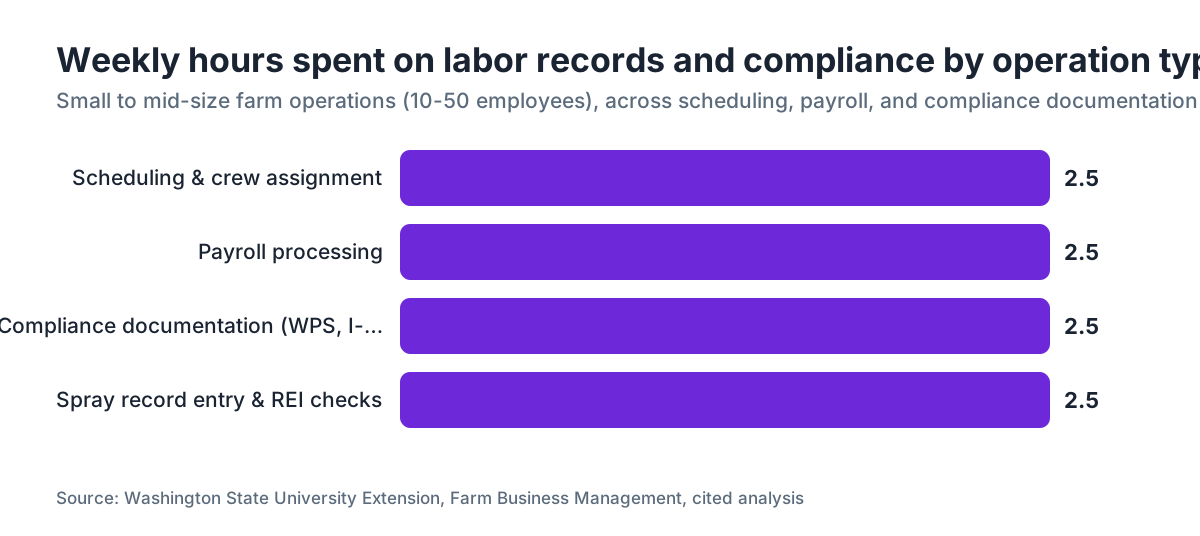
Return on that investment is harder to quantify because it depends on how much time you're currently spending on manual records. The closest published figure I've found comes from a Washington State University Extension analysis of farm record-keeping time, which found that small to mid-size farm operations (10 to 50 employees) spent an average of 6 to 10 hours per week on labor records, payroll, and compliance documentation across systems [7]. At $25 per hour for a manager's time, that's $7,800 to $13,000 a year in administrative labor. A system that cuts that in half pays for itself in most pricing tiers within the first year.
Nobody has clean controlled-trial data on this for vineyards specifically. The WSU figures are the closest published benchmark I can point to.
How do I-9, E-Verify, and H-2A documentation fit into a workforce system?
Every employee hired in the United States, including agricultural workers, needs a completed Form I-9 within three days of their first day of work [11]. E-Verify is federal law for H-2A employers and any employer with federal contracts, and many states have added their own E-Verify mandates. A workforce system that handles I-9 collection digitally and integrates with E-Verify saves real time during harvest onboarding when you're bringing on 20 people in a week.
H-2A documentation goes beyond I-9. The employer must retain a copy of the job order, the worker's contract, wage statements, and housing records, and must keep those records for three years [9]. If your workforce system can attach documents to employee profiles and tag them by document type with expiration dates, that's the setup you want. Expiration date alerts matter because H-2A workers' authorization dates are fixed to the job order, and employing a worker past their authorized end date is a serious violation.
One practical note. The Department of Labor's Wage and Hour Division audits H-2A employers at a higher rate than the general agricultural workforce, so your records need to be airtight and retrievable quickly. An inspector who asks for all wage records for a specific worker over a 90-day window should get a clean export in under five minutes, not a stack of binders.
What mobile and offline capabilities do field supervisors actually need?
Field supervisors in orchards and vineyards are not sitting at a desk. They're walking rows in the morning before cell service is reliable, recording spray applications at the end of a block where there's no WiFi, and signing off on crew timesheets at the equipment shed with a bad signal. Any system that requires a live internet connection for every action is going to generate workarounds, and workarounds generate data quality problems.
Offline capability with reliable sync is the minimum. The supervisor should be able to clock workers in and out, record a pesticide application with all required fields, and flag a block-entry event all while offline. When the device reconnects, those records should sync automatically without the supervisor doing anything extra.
Camera integration matters more than you might expect. The ability to photograph a pesticide label, a damaged trellis, or a worker's identification document from the same app that records the work activity creates a single audit trail that's much easier to defend in an inspection. Some platforms support this natively. Others make you attach photos from the device's camera roll, which is less reliable.
GPS stamping of field entries helps with block-level verification, but it raises a practical question: do your supervisors have devices with GPS enabled? If you're equipping your own supervisors with tablets or phones, that's straightforward. If workers are using their own devices, you have privacy and BYOD policy questions to answer before you turn on location tracking.
How should spray records and workforce records be connected in the same system?
This is the integration that matters most for compliance, and the one most systems get wrong. Here's why they have to connect. A pesticide application creates an REI that determines who can enter a block and when. Your scheduling system needs to know about that REI before it lets a supervisor put a crew in that block. If spray records and scheduling live in separate systems, the connection only happens if someone manually checks the spray log before building the schedule. That check gets skipped when things are busy. That's when workers enter treated areas during an REI.
The ideal setup records a spray application (product, block, application start and end time, REI duration) and then automatically marks that block as restricted until the REI expires, showing a warning to anyone trying to assign workers there. That logic exists in a handful of purpose-built agricultural platforms and is the main thing worth asking about in any software demo.
For vineyard operations in particular, fungicide programs during heavy disease pressure can mean multiple applications in the same block across a few weeks. The REI math gets complicated when you're looking at a block sprayed with a 24-hour REI product on Tuesday and a 4-hour REI product on Thursday. Your system should handle that correctly, not make you calculate by hand which restriction is still active.
VitiScribe keeps spray records and field activity logs in the same environment so REI data can inform operational decisions without a manual bridge between systems. That kind of tight integration is what separates a compliance tool from a filing cabinet.
What training and certification records should a vineyard workforce system track?
WPS pesticide safety training is the most regulated, but it's not the only one. A well-designed system should track several kinds of records.
WPS pesticide safety training: required before a worker enters a treated area or within the first 5 days of employment, records kept 2 years [3]. The 2015 WPS rule raised the required training frequency to every year rather than every 5 years.
Pesticide handler certification: licensed pesticide applicators in most states must renew their licenses on a cycle of 3 to 5 years and accumulate continuing education credits. California, Washington, Oregon, and New York all run their own applicator licensing programs with different renewal requirements [7].
Forklift and equipment certification: OSHA 29 CFR 1910.178 requires that powered industrial truck operators be trained and evaluated before they operate equipment, and re-evaluated at least every 3 years [12].
First aid and CPR certification for field supervisors: not always legally required, but WPS requires that a supervisor who handles pesticides be trained in first aid, and many state programs echo that.
Certification tracking with expiration date alerts is the feature to look for. You want a dashboard that shows you, at a glance, which workers have certifications expiring in the next 30 or 60 days, so you can schedule refresher training before you have a compliance gap rather than after.
Cornell's Agricultural Workforce Development program has published training frameworks for tree fruit and grape operations in the Northeast that work well as a checklist against your current system's training record fields [5].
How do small operations (under 20 workers) justify the cost of a full workforce system?
The honest answer is that some don't, and that's fine. A 10-acre vineyard with 4 permanent workers and 8 seasonal pickers might genuinely be better served by a good spray record app, a simple time clock, and a payroll processor like Gusto or Square Payroll than by a full agricultural workforce platform. The overhead of maintaining a complex system with features you don't need can cost more in time than it saves.
The cost-justification threshold, based on the WSU record-keeping time estimates, tends to hit around 15 to 20 regular seasonal workers [7]. Below that, the manual overhead is manageable and a full platform may be overkill. Above that, the scheduling complexity and compliance documentation burden grows fast enough that the software pays for itself.
The calculation changes if you're using H-2A workers. The documentation requirements for H-2A are heavy enough that a dedicated system pays off at a lower headcount, probably around 8 to 10 H-2A workers.
What I'd actually do for a small operation: start with the compliance layer (spray records and WPS documentation) because that's where the financial exposure is largest, then add time tracking and payroll integration once those are working. Adding everything at once is how you end up with a system that's half-configured and used by nobody.
For context on the scale of wine grape growing, USDA's 2022 Census of Agriculture reported roughly 11,500 farms growing grapes in the United States, with a median farm size of 16 acres, which puts most operations squarely in the range where a targeted platform makes more sense than a sprawling one [13].
What questions should you ask a vendor before buying?
Most software demos show you the best-case workflow. These are the questions that surface the real limitations.
Does the system work offline, and how does it sync? Ask them to show you exactly how a field supervisor records a spray application with no cell service, and what happens when the device reconnects.
How does the system handle piece-rate pay with California rest period calculations? If the salesperson hesitates or says "it's configurable," that usually means you'll configure it yourself or it doesn't actually do it.
What happens to my records if I cancel? You need to export your full data set (all employee records, all spray records, all training logs) in a standard format (CSV or PDF at minimum). Some vendors make this easy. Others make it expensive or slow.
Is the REI enforcement built into scheduling, or is it a separate module I have to buy? And does it update automatically when I enter an application, or do I have to manually flag the block?
How often are AEWR rates updated for H-2A workers? This should happen automatically when the Department of Labor publishes new rates, not require a support ticket.
What's the mobile app's minimum iOS and Android version requirement? If you're giving iPads to supervisors who don't update their software, compatibility matters.
Who owns the block map data I enter? This is your intellectual property, and you should be clear on the data ownership terms in the contract.
For a look at how technology fits field operations at different scales of winery and vineyard production, resort-integrated properties like Gervasi Vineyard show the range of operational complexity this software has to handle.
Frequently asked questions
What is the minimum number of employees that makes an all-in-one workforce system worth the cost for a vineyard?
Most operations find the economics work out around 15 to 20 regular seasonal employees. Below that, simpler tools (a payroll processor plus a spray record app) often cover the same ground at lower cost and less setup time. The threshold drops to around 8 to 10 if you're using H-2A workers, because their documentation requirements are heavy enough to justify the platform at a smaller headcount.
Does an all-in-one system actually satisfy EPA Worker Protection Standard record-keeping requirements?
A good one does, but you have to verify that it captures all required fields: product name, EPA registration number, active ingredients, treated area description, application start and end times, and the restricted entry interval. The EPA requires those records to be available to workers and handlers on request. A system that stores free-text notes instead of structured fields is a liability, not an asset, in an inspection.
Can I use a general HR platform like Gusto or ADP for vineyard workforce management?
For payroll and basic HR, yes. For block-level scheduling, REI enforcement, spray records, and piece-rate rest period calculations, no. General platforms don't have agricultural compliance logic built in. Most vineyard managers who use Gusto or ADP also run a separate spray record system and a scheduling tool, which means manual data transfer between systems and the errors that come with it.
How long do I need to keep pesticide application records and WPS training records?
The EPA's Worker Protection Standard requires WPS pesticide safety training records to be kept for two years from the date of training. Pesticide application records retention varies by state, but most state departments of agriculture require records for two to three years. California, for example, requires pesticide use reports to be retained for three years under the California Food and Agricultural Code.
What is a restricted entry interval and how should my workforce system enforce it?
A restricted entry interval (REI) is the period after a pesticide application during which workers cannot enter the treated area without specific protective equipment. REIs range from 4 hours to several days depending on the product. Your workforce system should automatically mark a block as restricted when an application is recorded and prevent or warn against scheduling crew there until the REI expires. Manual tracking across multiple blocks and applications is where violations happen.
Do I need separate systems for spray records and employee management, or can one system do both?
Some purpose-built agricultural platforms handle both in one environment, which is the preferred setup because it lets REI enforcement work automatically. Many operations run two separate systems with varying degrees of integration. The key question is whether your scheduling system can see active REIs from your spray records in real time. If it can't, you're relying on manual checks that get skipped when things are busy.
What H-2A documentation does a workforce management system need to support?
At minimum: I-9 storage, E-Verify integration, Adverse Effect Wage Rate tracking by state with annual updates, job order attachment per worker, wage statement generation, and housing record attachment. The Department of Labor requires H-2A employers to retain records for three years. Expiration date alerts tied to each worker's authorization end date are essential because employing a worker past their authorized date is a serious federal violation.
How does piece-rate payroll work in agricultural workforce systems and what can go wrong?
Piece-rate pay compensates workers per unit harvested rather than per hour. California law requires that rest periods and recovery periods for piece-rate workers be paid separately at no less than the average hourly rate for productive time. Systems that calculate only the piece-rate total without a separate rest period line will generate underpayment. This is one of the most common wage-and-hour violations in California agriculture and has produced class-action settlements in the tens of millions of dollars.
Can vineyard workforce management software track pesticide applicator license expiration dates?
The better agricultural platforms include certification tracking with expiration alerts, and pesticide applicator licenses should be one of the tracked credentials. Most state-licensed applicator programs require renewal every three to five years with continuing education credits. A system that gives you a 30 or 60 day alert before expiration lets you schedule refresher training proactively instead of discovering a lapsed license during an audit.
What offline capabilities should I require in a mobile workforce app for field use?
The app needs to function without a live internet connection for at minimum: clocking workers in and out by block, recording pesticide applications with all required EPA fields, and viewing current REI restrictions. Data should sync automatically when connectivity resumes without manual action. Camera integration for document or label photos, GPS block verification, and digital signature capture for training records are worth having if they work offline too.
How does workforce management software integrate with farm accounting systems?
The standard integration is a general ledger export that codes labor costs by block, crop, or cost center so they land correctly in QuickBooks, Xero, or a farm-specific accounting system like AgriBalance. Some platforms offer direct API connections. Others produce a formatted CSV or IIF file. The important thing is that labor costs are coded granularly enough for your accountant to analyze by block or activity, more than as a payroll total.
What does WSU Extension recommend for farm labor record-keeping?
Washington State University Extension's farm management publications recommend keeping records that track labor by enterprise or field activity, capture all wage types separately (hourly, piece-rate, overtime), and store pesticide safety training documentation in the same accessible location as application records. Their Small Farm Financial Records series provides a framework that maps well to what a digital workforce system should capture, though the publications predate many current software options.
Are there university extension resources specifically for vineyard workforce compliance?
Yes. UC Davis's Agricultural Safety and Health program publishes WPS compliance guides calibrated to California grape and tree fruit operations. Cornell's Farmworker Program covers Northeast grape and apple operations with specific guidance on I-9, WPS, and wage-and-hour compliance. Washington State University Extension publishes annual pesticide applicator training materials for wine grapes and tree fruit. All three are worth bookmarking and checking annually as requirements change.
What civil penalties apply for Worker Protection Standard violations?
The EPA can assess civil penalties up to $19,386 per violation under the current Federal Civil Penalties Inflation Adjustment Act schedule. Most first-time violations end in lower penalties combined with a compliance agreement and a corrective action plan rather than the maximum fine. Willful violations or those resulting in worker injury can bring penalties at or above the statutory maximum and may trigger criminal referral.
Sources
- UC Davis Agricultural Safety and Health Program: Agricultural workforce compliance requires farm-specific logic including block-level labor tracking and pesticide compliance documentation not found in generic HR platforms.
- Cornell Farmworker Program, Cornell University: Northeast vineyard and orchard operations face I-9, WPS, and wage-and-hour compliance requirements requiring specialized documentation systems.
- EPA, Worker Protection Standard for Agricultural Pesticides, 40 CFR Part 170: The EPA WPS requires annual pesticide safety training, two-year record retention, and application-specific information including product name, EPA registration number, REI, and treated area description.
- EPA, Civil Penalty Amounts Under Federal Civil Penalties Inflation Adjustment Act: Civil penalties for WPS violations can reach $19,386 per violation under the current Federal Civil Penalties Inflation Adjustment Act schedule.
- Cornell Agricultural Workforce Development Program: Cornell's Agricultural Workforce Development program publishes workforce training frameworks for tree fruit and grape operations in the Northeast.
- UC Davis Agricultural Safety and Health Program: UC Davis publishes WPS compliance guides calibrated to California grape and tree fruit operations.
- Washington State University Extension, Farm Business Management: A WSU Extension analysis found small to mid-size farm operations spend an average of 6 to 10 hours per week on labor records, payroll, and compliance documentation across systems.
- California Labor Code Section 226.2, Piece-Rate Compensation: California law requires piece-rate workers to be paid separately for rest periods and recovery periods at no less than the average hourly rate for productive time.
- U.S. Department of Labor, Wage and Hour Division, H-2A Program: H-2A Adverse Effect Wage Rates in 2024 ranged from approximately $14 to $20 per hour depending on state, based on USDA Farm Labor Survey data.
- USDA Economic Research Service, Farm Labor Overview: Software payroll processing for small agricultural operations typically runs $4 to $12 per employee per pay run or a flat monthly fee in the $50 to $150 range.
- USCIS, I-9 Central, Form I-9 Requirements: Every employee hired in the United States requires a completed Form I-9 within three days of their first day of work.
- OSHA, Powered Industrial Trucks Standard, 29 CFR 1910.178: OSHA requires powered industrial truck operators to be trained and evaluated before operating equipment, with re-evaluation at least every three years.
- USDA National Agricultural Statistics Service, 2022 Census of Agriculture: The 2022 Census of Agriculture reported approximately 11,500 farms growing grapes in the United States with a median farm size of 16 acres.
Last updated 2026-07-10