Crown gall disease in grapevines: causes, spread, and control
TL;DR
- Crown gall is caused by the soil bacterium Agrobacterium vitis.
- It enters vines through freeze wounds or pruning cuts, triggering uncontrolled tumor growth at the graft union or cordons.
- There is no cure once a vine is infected.
- Management focuses on planting clean stock, avoiding cold injury, and removing infected wood.
- Losses in severely affected blocks can exceed 50% of yield.
What is crown gall disease in grapevines?
Crown gall is a bacterial disease caused by Agrobacterium vitis, a soil-dwelling pathogen that transfers a piece of its own DNA directly into grapevine cells. That transferred DNA, called T-DNA, hijacks the vine's growth machinery and forces it to produce uncontrolled cell masses: the galls you see bulging at the base of trunks, along cordons, or at the graft union. The disease is not cosmetic. Those galls disrupt water and nutrient flow through the vine's vascular system and, in bad cases, effectively girdle the plant.
Grapevine gall disease is distinct from the crown gall found on many other crops because A. vitis is host-specific to Vitis species. A related species, Agrobacterium tumefaciens (also called Rhizobium radiobacter), attacks many kinds of plants, but A. vitis persists specifically in grapevine tissue and infested soil long after vines are removed [1]. That persistence is what makes vineyard rotation and replanting so difficult.
The disease is widespread in every major wine region. UC Davis plant pathologists have documented it throughout California, Cornell has tracked it extensively in the Finger Lakes and Hudson Valley, and Washington State University extension covers it as one of the primary disease concerns in the Columbia Basin, where hard freezes are common [2]. Farm in a region with cold winters, and crown gall is something you will meet.
How does Agrobacterium vitis infect and spread in a vineyard?
Infection needs two things: the pathogen present in soil or planting material, and a wound. The wound is the entry point. Freeze injury is by far the most common trigger in cold climates. When cambium tissue dies during a hard freeze, the vine attempts to callus over the damaged zone, and if A. vitis is present, it colonizes that callus tissue and injects its T-DNA [3]. The result shows up weeks to months later as soft, spongy galls that harden and turn dark over time.
Pruning cuts, grafting wounds, mechanical damage from cultivation equipment, and nematode feeding sites all open the door too. This is why galls appear most often at or just above the soil line (the graft union, which is the most vulnerable wound site) and at major pruning scars on cordons.
Spread happens several ways. Infected planting stock is the single biggest vector for long-distance movement. A vine can carry A. vitis systemically, meaning the bacteria live inside the xylem and are distributed throughout the plant, without showing visible galls. That latent infection ships undetected to new sites. Locally, the pathogen moves through soil water, contaminated pruning tools, and possibly through root-to-root contact in heavy soils. Wind and rain can carry bacterial cells from wet, weeping galls to nearby wounds during the growing season, though this is a secondary spread pathway compared to infected material [1].
One piece of data worth knowing: WSU research found that A. vitis can survive in vineyard soil for at least three years after infected vines are removed, and some studies suggest survival up to several years longer in heavy clay soils with high organic matter [3]. Plan your rotation windows accordingly.
What does crown gall look like, and when do symptoms appear?
Fresh galls are soft, whitish, and roughly spherical. They look a little like a cauliflower head in miniature. Over weeks they grow, turn green or brown, harden, and can reach the size of a softball or larger on an established trunk. Old galls crack, rot, and become entry points for secondary pathogens.
Symptoms typically show up in spring, about four to eight weeks after a significant freeze event. You'll see delayed budbreak in affected vines, weak shoot growth, yellowing leaves, and then, if you look closely at the trunk and lower cordons, the swellings themselves. On young vines, particularly in their first or second year, a large gall at the graft union can kill the vine outright before the season ends.
On mature vines, the picture is messier. An established vine with a strong root system can produce new growth from below the gall even while the gall disrupts vascular flow above it. You get survivors that look stunted and unthrifty for years rather than vines that die cleanly. Yield losses in those vines are real but hard to quantify vine-by-vine because the neighboring healthy vines compensate partially. Block-level losses in heavily infected vineyards following a cold winter have been documented at 30 to 60 percent of normal yield [4].
Do not confuse crown gall with Phytophthora crown rot, black foot disease, or normal grafting callus. If you're unsure, send a sample to your state's plant diagnostic lab. UC Davis, Cornell, and WSU all run plant disease clinics that can confirm A. vitis by culture or PCR [2].
Which grapevine varieties and rootstocks are most susceptible?
No Vitis vinifera variety is immune. Susceptibility to severe galling tracks a variety's cold-hardiness more than any intrinsic bacterial resistance, because cold injury is the main entry point.
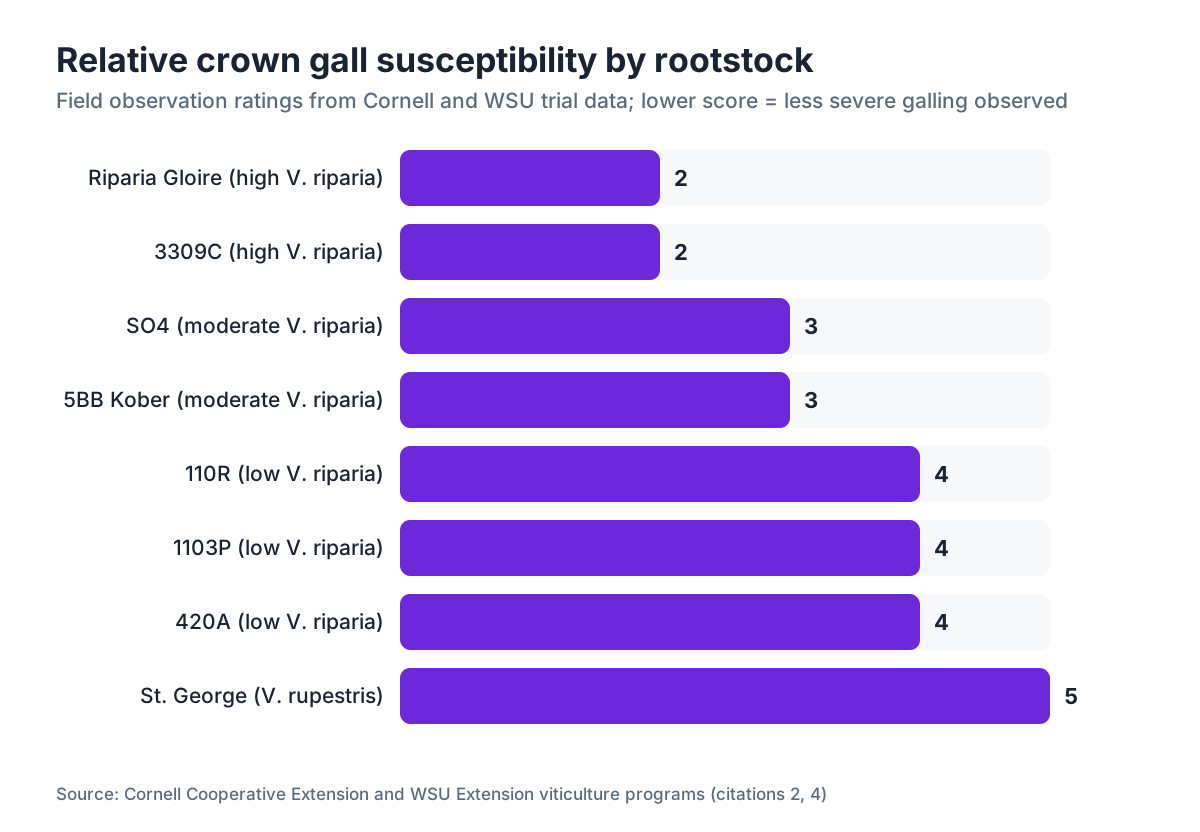
Rootstocks matter more than scion variety for the survival of infected vines. Some rootstocks express fewer galls or show slower disease progression. Cornell research and WSU trial data suggest that rootstocks with Vitis riparia parentage, such as 3309C and Riparia Gloire, tend to show less severe galling than rootstocks with V. rupestris parentage like St. George (110R and 1103P are intermediate) [4]. But this is relative, not absolute protection. All commercial rootstocks can be infected and can harbor latent A. vitis.
Hybrid varieties bred for cold climates, like Marquette, Frontenac, and La Crescent, are grown specifically because they tolerate temperatures where vinifera would suffer severe freeze injury. Less freeze damage means fewer wound sites, which means less crown gall incidence in practice, even though the plants themselves have no true resistance to the bacterium.
| Rootstock | V. riparia parentage | Crown gall susceptibility (relative) |
|---|---|---|
| Riparia Gloire | High | Lower |
| 3309C | High | Lower |
| SO4 | Moderate | Intermediate |
| 5BB Kober | Moderate | Intermediate |
| 110R | Low | Higher |
| 1103P | Low | Higher |
| 420A | Low | Higher |
| St. George | Low | Higher |
Sources: Cornell Cooperative Extension, WSU Extension viticulture [2][4]. These ratings reflect general field observations and trial data, not controlled inoculation studies with controlled freeze events. Your local conditions will shift the picture.
How do you manage crown gall in an existing vineyard?
There is no chemical cure. Once A. vitis is in a vine, it stays there. Management is about limiting new infections, slowing the disease's impact on productivity, and making replanting decisions early enough to matter.
For established infected vines, the standard practice is to cut the trunk below the lowest visible gall during dormant pruning, leaving at least 15 to 20 cm of healthy wood, and train a new sucker or side shoot as a replacement trunk. This is called trunk renewal, and it works well if the infection is limited to the above-ground portion of the vine and hasn't moved into the rootstock. If galls are present on or below the graft union, trunk renewal is only a temporary fix. Those vines should be flagged for removal within a planting cycle [1].
Freezing temperatures are the disease's accomplice, so anything that reduces cold injury reduces new gall formation. Practices that help include mounding soil over the graft union before hard freezes (buries the most vulnerable wound site), delaying fall irrigation to harden canes before dormancy, choosing cold-hardy varieties or rootstocks for cold sites, and avoiding late-season nitrogen applications that keep vines growing into fall [3].
Pruning tool sanitation is standard but its effectiveness against A. vitis specifically is debated. The bacterium moves systemically in infected vines, so a surface-wiped pruning blade is less of a vector than the infected wood you're already cutting. That said, wiping blades with 70 percent isopropyl alcohol or a 0.5 percent sodium hypochlorite solution between vines (or at least between blocks) is a low-cost insurance step and is consistent with good sanitation practice under the EPA Worker Protection Standard [5].
For large infected blocks, the honest calculus is economic. Figure out your replacement cost per acre, your projected yield loss per year from infected vines, and the infection percentage in the block. Most advisors recommend whole-block removal once more than 20 to 25 percent of vines show active galls, because by that point the economic drag from reduced yields, the cost of filling individual gaps, and the disease pressure in the soil make piecemeal management a losing game.
Keeping accurate records of infection location, severity, and trend over time is the only way to make that call with confidence. Tools like VitiScribe can help you track block-level disease observations and tie them to pruning and replanting decisions over multiple seasons, so you're not relying on memory or paper notebooks when you need to present data to a lender or farm advisor.
Does biocontrol work against crown gall in vineyards?
The most studied biocontrol agent for crown gall is Agrobacterium radiobacter strain K84, sold commercially under names like Galltrol and Nogall. Strain K84 works by producing a bacteriocin called agrocin 84 that kills closely related Agrobacterium strains before they can infect plant tissue. It's applied as a root dip or soil drench at transplanting.
Here's the honest answer on K84: it works reasonably well against A. tumefaciens (the broad-host species), but its efficacy against A. vitis is limited and inconsistent. The mechanism relies on the target strain being sensitive to agrocin 84, and many A. vitis strains are not [1][2]. UC Davis extension notes that K84 should not be considered reliable protection against grapevine crown gall caused by A. vitis specifically.
A modified strain, K1026, was developed to reduce the risk of resistance gene transfer and is sold as Nogall in Australia. Similar limitations apply to its activity against A. vitis.
Research into other biocontrol approaches, including plant resistance inducers and competitive exclusion with non-pathogenic Agrobacterium strains, is ongoing. WSU and Cornell both have active programs in this area. Right now none of them are ready for commercial recommendation at the scale and reliability level a grower needs [3][4]. The practical upshot: biocontrol is not a substitute for planting certified clean stock and managing freeze risk.
How do you prevent crown gall when planting a new vineyard?
Start with certified, disease-indexed planting material. In California, the Foundation Plant Services program at UC Davis maintains nuclear stock for certified grape varieties and rootstocks that are tested for A. vitis along with other major pathogens [6]. Similar certification programs exist through Cornell for New York materials and through state nursery inspection programs elsewhere. Planting material outside these programs, including cuttings from your own infected block or informal exchanges with neighboring growers, is the fastest way to introduce A. vitis to a clean site.
Before planting on a site with a history of crown gall, wait at least three to four years after vine removal before replanting. Some advisors recommend five or more years in heavy soils. This does not eliminate A. vitis from the soil but reduces populations significantly. There is no fumigation treatment proven to eradicate A. vitis from commercial vineyard soils at a practical scale; Telone (1,3-dichloropropene) and other fumigants registered for nematode control have variable and inconsistent effects on Agrobacterium [7].
Site selection matters. Frost pockets, low-lying areas with poor air drainage, and north-facing slopes in cold-climate regions all carry higher freeze-injury risk and therefore higher crown gall risk. If you're evaluating a new site, look at temperature records for the past 15 to 20 years and note any years with temperatures below the hardiness threshold for your intended varieties.
At planting, keep graft unions above soil level in well-drained sites (to reduce contact with infested soil) or mound soil over them before the first winter in cold sites (to insulate against freeze). These two recommendations seem contradictory, and they are: the right call depends on your climate and drainage. In a freeze-prone region with good drainage, mounding wins. In a warm region where Phytophthora is the bigger soil-borne threat, keeping unions above grade makes more sense.
What do UC Davis, Cornell, and WSU recommend specifically?
These three extension programs are the primary published resources in North America for crown gall management, and their recommendations converge on most points with a few regional differences worth knowing.
UC Davis / Foundation Plant Services: Their emphasis is on clean stock and the state certification program. The UC Davis Integrated Pest Management guidelines recommend trunk renewal as the primary management tool for established infections and note that there are no pesticides registered specifically for crown gall control in California vineyards [1][6]. They also maintain the most detailed public documentation of A. vitis host specificity.
Cornell Cooperative Extension: Cornell's focus is shaped by the cold-climate reality of New York viticulture. Their publications emphasize freeze avoidance as the central management strategy, cover rootstock selection in detail, and include practical guidance on training systems that facilitate trunk renewal (bilateral cordon and single Guyot systems are easier to renew than high-cordon systems) [4]. Cornell's plant disease diagnostic clinic is a practical resource for growers in the Northeast needing confirmation.
WSU Extension: WSU covers both the Columbia Basin's extreme freeze events and the warmer Yakima Valley and Walla Walla sub-AVAs where the disease is less severe. Their viticulture team has published on the soil persistence of A. vitis and on the interaction between irrigation management and freeze hardiness, which is directly relevant to crown gall prevention [3]. WSU's pest management guide for grapes is updated periodically and is freely available online.
All three programs agree: there is no registered, effective bactericide or fungicide that cures or reliably prevents crown gall once a vineyard site is infested. Management is cultural, not chemical.
Are there any EPA-registered treatments for crown gall in grapes?
Growers ask this constantly and deserve a straight answer. As of 2025, there are no EPA-registered pesticides labeled specifically for crown gall control in grapes that have demonstrated consistent efficacy against A. vitis under field conditions [7].
Copper-based bactericides are registered for use in vineyards for other bacterial diseases (like Xanthomonas-related diseases), and some growers apply them around pruning wounds under the assumption it may reduce infection. The research base for this practice against A. vitis is thin. Copper applications are not off-label in themselves if the product label allows application to grapes, but making an efficacy claim that copper controls crown gall would overstate the evidence.
The EPA Worker Protection Standard (40 CFR Part 170) applies to any pesticide application in the vineyard, including copper bactericides and any fumigants used pre-plant [5]. Workers must receive WPS training, have access to central display of pesticide information, and be provided personal protective equipment as specified on the product label. Keeping records of all pesticide applications, including any pre-plant fumigation on crown gall-infested sites, is both a WPS requirement and good practice for your own decision-making. See how field records connect to compliance in our article on vineyard operations.
The honest summary: save your money on unproven chemical treatments for crown gall. Spend it on certified clean planting stock instead.
What is the economic impact of crown gall on a vineyard block?
Hard numbers on economic losses from crown gall are difficult to find because the disease interacts with weather events (one severe freeze can spike incidence from 5 percent to 40 percent of vines in a single winter), variety, training system, and management history. The available estimates are still sobering.
A Cornell Cooperative Extension analysis cited yield losses ranging from 30 to more than 60 percent in severely affected Finger Lakes blocks following harsh winters [4]. UC Davis extension references losses sufficient to justify whole-block removal at high infection levels [1]. Replanting costs in California vineyards ran roughly $30,000 to $60,000 per acre in 2022 to 2024 depending on trellis systems, variety, and irrigation infrastructure, based on UC Cooperative Extension farm budget data [8].
The indirect costs are real too. Infected vines require more intensive pruning labor (trunk renewal), leave gaps that reduce per-acre yield even when the vine isn't dead, and create chronic disease pressure in the soil that affects future plantings. Where land values are high and replanting is expensive, growers get tempted to limp along with infected blocks for too many years. The math rarely supports that choice past the 25-to-30-percent infection threshold.
One number worth keeping in mind: UC Cooperative Extension data suggest that a fully productive vinifera acre in California might generate $3,000 to $8,000 in gross revenue depending on variety and contract price [8]. A block running 40 percent infection with a corresponding 40 percent yield loss is losing $1,200 to $3,200 per acre per year, every year, while continuing to feed inoculum to the rest of the vineyard.
Can crown gall spread from grapevines to other crops?
A. vitis is largely host-specific to Vitis species. It does not spread efficiently to orchard trees, row crops, or vegetable gardens next to infected vineyards. This is one meaningful difference from A. tumefaciens, which infects many kinds of dicotyledonous plants including stone fruits, roses, and woody ornamentals [1].
That said, 'largely host-specific' is not the same as 'completely host-specific.' Under some conditions, A. vitis strains can infect other plant species in laboratory settings, but this is not an agronomically significant pathway under normal field conditions. Growers rotating to tree fruits or other perennials after an infected vineyard do not need to treat the rotation as a serious A. vitis risk to those crops.
The concern runs the other direction, though. If you're replanting to grapes after a block that had crown gall, the soil population of A. vitis from the old vines is the problem. The rotation crops don't clean up the soil; they just fail to build up more A. vitis. That waiting period is about pathogen decline, not host range.
How do you confirm a crown gall diagnosis and when should you call a lab?
Visual diagnosis in the field is usually enough for a confident working diagnosis when you have characteristic galls on trunk or cordon wood in a region and season consistent with recent freeze injury. But there are situations where a lab confirmation is worth the time and cost.
Call a diagnostic lab when: the galls are in an unusual location (on leaves, young green shoots, or below the soil line in a region without freeze history); you're seeing disease in a block of newly planted certified stock (important to document for insurance or supplier claims); you're planning a significant capital decision like whole-block removal and want documentation; or you're seeing gall-like growths and want to rule out Phytophthora crown rot, Botryosphaeria canker, or nutrient disorder swellings.
UC Davis's plant pathology lab, Cornell's plant disease diagnostic clinic, and WSU's plant and insect diagnostic lab all accept vine samples and can run both culture-based isolation and PCR confirmation for A. vitis [2][3][6]. Sample submission guides are on each lab's website. Generally you'll want to submit about 20 to 30 cm of affected wood with the gall attached, in a paper bag (not plastic, which accelerates rot), shipped overnight or second-day to arrive before a weekend.
Diagnostic fees are typically $30 to $100 per sample depending on the tests requested. Cheap for the peace of mind before a major replanting decision. Using a record-keeping system like VitiScribe to log the sample submission date, lab result, and block location gives you a clean data trail if you ever need to reference it for a replanting grant application or an insurance claim.
Frequently asked questions
Can you cure crown gall in an infected grapevine?
No. Once Agrobacterium vitis has transferred its T-DNA into vine cells, there is no treatment that removes the infection from the plant. You can remove visible galls by pruning below them and train replacement trunks, but the bacterium lives systemically in infected vines. Management is about limiting new wound sites and slowing disease progression, not curing existing infections. Vines with galls at or below the graft union should be scheduled for removal.
What temperature causes the freeze injury that triggers crown gall?
The threshold varies by variety, vine age, and how well the vine was hardened before dormancy. Most V. vinifera cambium tissue begins dying at temperatures around -15°C to -20°C (5°F to -4°F), and severe galling events in the Finger Lakes and Columbia Basin typically follow winters with multi-night cold snaps in that range or below. Cold-hardy hybrids can withstand -25°C to -30°C before significant cambium injury. Rapid temperature drops after mild falls are especially damaging.
Does disinfecting pruning tools prevent crown gall spread?
It helps but is not the primary control. A. vitis moves systemically inside infected vines, so pruning through an infected vine and then into a healthy one is a real transmission risk. Wiping blades with 70 percent isopropyl alcohol or a 0.5 percent bleach solution between vines is a low-cost step that reduces (not eliminates) this risk. Tool sanitation is more critical for canker diseases than for crown gall, but it's good practice either way.
How long does Agrobacterium vitis survive in vineyard soil?
WSU research documents A. vitis survival in vineyard soil for at least three years after infected vines are removed. Some studies suggest longer survival in heavy clay soils with high organic matter. Most extension programs recommend a minimum three-to-four-year fallow or rotation to non-host crops before replanting to grapes on an infested site, with five or more years in heavier soils where the pathogen persists longer.
Is crown gall in grapes the same disease as crown gall on fruit trees?
No. Grapevine crown gall is caused by Agrobacterium vitis, a species largely specific to Vitis. Crown gall on stone fruits, roses, and other woody plants is usually caused by A. tumefaciens (Rhizobium radiobacter), which has a broad host range. The disease mechanism (T-DNA transfer causing tumor growth) is the same, but the pathogens are different species with different host ranges. A. vitis does not efficiently infect fruit trees, and A. tumefaciens does not efficiently infect grapevines.
What is the best rootstock to use in a vineyard with a history of crown gall?
No rootstock is immune, but rootstocks with strong Vitis riparia parentage, such as 3309C and Riparia Gloire, tend to show less severe galling in field observations compared to high-V. rupestris rootstocks like 110R or 1103P. Cornell and WSU extension data support this general pattern. Rootstock choice should be weighed against other site factors (soil depth, nematode pressure, drought tolerance) rather than selected for crown gall resistance alone.
When should you remove and replant an infected block rather than managing in place?
Most farm advisors put the replanting threshold at 20 to 25 percent of vines showing active galls, particularly if the trend is worsening after each cold winter. Above that level, the annual yield loss, the cost of trunk renewal labor, the soil inoculum pressure on neighboring blocks, and the compounding effect of gaps all typically outweigh the cost of replanting. Do the math on your specific block: gross revenue per acre times projected yield loss, compared against your all-in replanting cost per acre amortized over vine life.
Does organic certification change how you manage crown gall?
Not substantially, because the primary management tools are already cultural: certified clean planting stock, freeze avoidance practices, trunk renewal, and site selection. No effective synthetic chemical treatment exists anyway. Copper-based bactericides are permitted under USDA National Organic Program rules with some restrictions, but copper's efficacy against A. vitis is unproven. Certified organic growers managing crown gall are essentially using the same playbook as conventional growers.
Can you propagate cuttings from vines that had crown gall removed?
No. Even if visible galls have been removed and the vine looks healthy, A. vitis lives systemically in infected vines and can be present in cuttings that show no symptoms. Propagating from any vine with a history of crown gall means you are almost certainly distributing infected material. Always propagate from certified, tested nuclear stock from a program like UC Davis Foundation Plant Services or a state-certified equivalent.
What records should you keep for crown gall management?
At minimum, record the location of every confirmed-infected vine (block, row, vine number), the date you first observed galls, the severity score (gall size and graft-union involvement), any trunk renewal actions taken, and soil fumigation or biocontrol applications with dates and rates. These records support replanting decisions, insurance documentation, and compliance with any state pesticide use reporting requirements. Map the data spatially if possible so you can track whether infection is spreading or stabilizing.
Is there a resistant grapevine variety being developed?
True genetic resistance to A. vitis in commercial grapevine varieties does not yet exist. Research programs at Cornell, UC Davis, and several European institutions have screened wild Vitis species and identified some with reduced susceptibility, but none of those traits have been successfully bred into commercial wine grape varieties without unacceptable trade-offs in fruit quality. Cold-hardy hybrids reduce crown gall incidence indirectly by tolerating lower temperatures without freeze injury, which is the main wound pathway.
How do you write up crown gall observations in a vineyard scouting report?
Record the date, block identifier, number of vines scouted, number with visible galls, gall location (trunk base, cordon, below graft union), estimated gall size (small under 2 cm, medium 2 to 5 cm, large over 5 cm), and whether graft union is affected. Note any recent freeze events in the seasonal context. A standardized form repeated annually in the same block lets you calculate year-over-year infection rate trends, which is the data you need for replanting decisions.
Sources
- UC Davis IPM Program, Crown Gall of Grape: A. vitis persists in vineyard soil after vine removal; no pesticides registered in California specifically for crown gall control in grapes; trunk renewal is the primary management tool for established infections
- Cornell Cooperative Extension, Viticulture and Enology: Crown gall documented throughout Finger Lakes and Hudson Valley; K84 biocontrol has limited efficacy against A. vitis; Cornell plant disease diagnostic clinic accepts vine samples
- Washington State University Extension, Grape Crown Gall: A. vitis survives at least three years in vineyard soil after vine removal; irrigation management interacts with freeze hardiness and crown gall risk; soil persistence longer in heavy clay soils
- Cornell Cooperative Extension, Cold Hardy Grape Varieties and Rootstocks for Crown Gall Management: Yield losses of 30 to more than 60 percent documented in severely affected Finger Lakes blocks following harsh winters; Riparia Gloire and 3309C show lower crown gall susceptibility than V. rupestris rootstocks
- EPA, Worker Protection Standard 40 CFR Part 170: Worker Protection Standard requires WPS training, central display of pesticide information, and PPE for all pesticide applications in vineyards including copper bactericides and fumigants
- UC Davis Foundation Plant Services, Certified Grapevine Program: Foundation Plant Services maintains nuclear stock tested for A. vitis and other major pathogens; provides certified clean planting material for California and beyond
- EPA, Registered Pesticide Products Database: No EPA-registered pesticides are labeled specifically for crown gall control in grapes with demonstrated consistent efficacy against A. vitis under field conditions as of 2025
- UC Cooperative Extension, Sample Costs to Establish and Produce Winegrapes: Replanting costs in California vineyards approximately $30,000 to $60,000 per acre (2022 to 2024); gross revenue per productive vinifera acre estimated at $3,000 to $8,000 depending on variety and contract
- USDA Agricultural Research Service, Agrobacterium vitis Biology and Control: A. vitis is host-specific to Vitis species; T-DNA transfer mechanism forces uncontrolled cell division producing galls; bacterium is distributed systemically in infected vines
- National Sustainable Agriculture Information Service (ATTRA), Organic Grape Production: Copper-based bactericides permitted under USDA NOP with restrictions; primary crown gall management tools are cultural for both organic and conventional growers
Last updated 2026-07-09