Black foot disease in grapevines: causes, symptoms, and control
TL;DR
- Black foot disease is a soilborne fungal complex, mainly Ilyonectria and Dactylonectria species, that rots the roots and crown of young grapevines, usually killing them within one to three seasons of planting.
- There is no curative treatment once a vine is infected.
- Prevention through clean nursery stock, soil fumigation, and good drainage is the only reliable defense.
What is black foot disease in grapevines?
Black foot disease is a root and crown rot that attacks young grapevines, typically in the first three years after planting. The name comes from the black, necrotic discoloration you see on the lower trunk and root base when you cut into infected wood. It's one of the most destructive young-vine diseases anywhere, reported in nearly every major wine region from California to South Africa to New Zealand [1].
The disease is caused by a complex of closely related fungi in the genera Ilyonectria and Dactylonectria, which largely replaced the older taxonomic name Cylindrocarpon [2]. The most commonly identified species include Ilyonectria liriodendri, Ilyonectria destructans, and Dactylonectria macrodidyma, though the exact species mix varies by region and the science on this taxonomy is still moving [2].
These fungi colonize the root system and basal trunk, blocking water and nutrient flow. A vine that should be establishing hard instead stalls, weakens, and often dies before it produces a real crop. Losing 20-30% of a new planting to black foot, after you've spent real money on site prep and certified plant material, hurts.
What are the symptoms of black foot disease?
Above ground, black foot looks like several other problems, which is part of what makes it frustrating. Infected vines show stunted shoot growth, small pale leaves, early leaf drop in summer, and poor berry set. The vine just never takes off the way healthy vines in the same row do. In severe cases, entire canes die back mid-season, or the vine never pushes growth in spring at all [3].
The diagnostic symptoms are below the soil line. Pull up a suspect vine and look at the lower trunk and roots. You'll see dark brown to black discoloration of the bark and underlying wood, often with sunken, necrotic lesions on the roots. Cross-section the wood just above the root zone and you'll typically find a dark ring or wedge of stained vascular tissue. That's the blocked plumbing. Healthy wood at the same cut looks creamy white to light tan [3].
In wet soils or rainy springs, you may see orange to salmon-colored spore masses on the surface of infected root tissue. Those are the sporodochia of the Ilyonectria/Dactylonectria fungi, and while they're small, they're a useful field confirmation when you spot them [1].
Here's the trouble. Similar visual symptoms show up with Phytophthora root rot, Pythium species, armillaria root rot, and even nutritional deficiencies or waterlogging stress. You can make a reasonable field call based on the combination of young-vine age, poor growth, and black crown discoloration, but laboratory confirmation through culture or PCR is the only way to be certain of the specific pathogen [4].
What causes black foot disease and how does it spread?
The Ilyonectria and Dactylonectria pathogens live in soil and in infected plant material. They spread by three main routes, and each one matters for management.
Infested nursery wood is the primary way the disease gets into a new vineyard. The fungi colonize grapevine cuttings and rootstock during propagation. Heat treatments and fungicide dips at the nursery reduce but don't eliminate this risk. A study of commercial nursery material across several wine regions found a meaningful percentage of apparently healthy planting stock already carrying Cylindrocarpon/Ilyonectria inoculum [5]. Buying certified, clean-plant material from a reputable nursery lowers the risk. It's not a guarantee.
Infested soil in a replant site is the second major source. Replant a block that previously had diseased vines and the pathogens can persist in old root debris for years, possibly decades. The fungi are not aggressive saprophytes, but they don't need to be. Infected root fragments left in the ground keep the inoculum load high until they fully decompose [1].
The third route is water. In poorly drained soils, irrigation or rainfall moves spores through the profile and from plant to plant. Waterlogged conditions also stress vine roots, making them far more susceptible than roots in well-drained, aerobic soil [3].
Stress runs through the whole black foot literature as the common thread. Vines planted in compacted soils, in heavy clay with poor drainage, in sites that swing hard between wet and dry, or in blocks where fumigation was uneven all show higher disease incidence. The fungi are opportunists. They take advantage of compromised host tissue [4].
How common is black foot disease and how much damage does it cause?
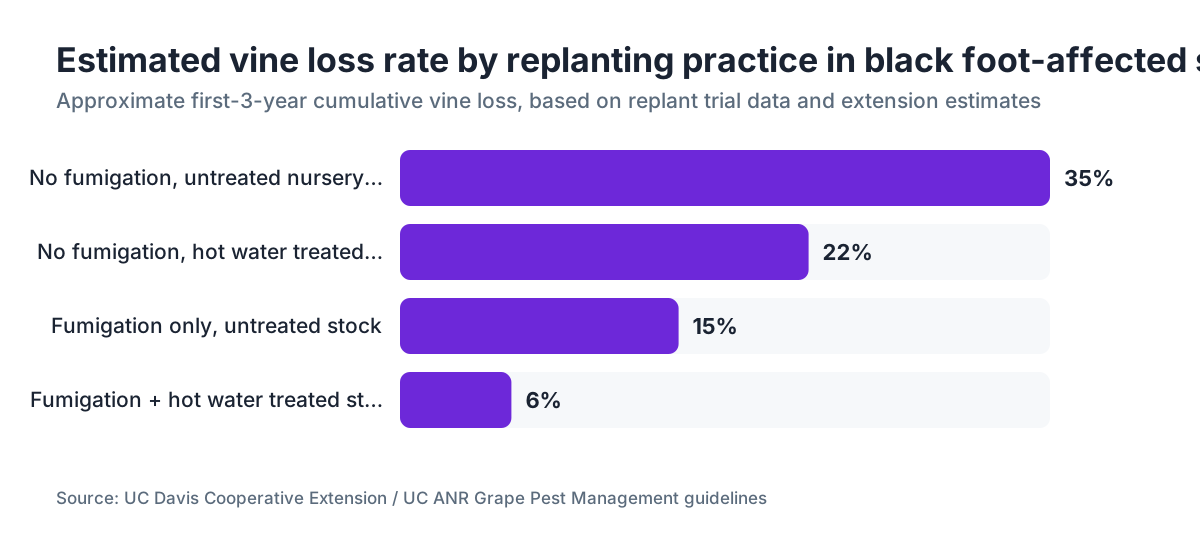
Nobody has great global incidence data on this. Regional surveys give the clearest picture. A survey published in Plant Disease found Cylindrocarpon (now Ilyonectria/Dactylonectria) species in declining vineyards across multiple California wine regions [6]. Research from New Zealand documented the pathogen in the majority of young-vine decline cases examined there [5]. South African studies have reported vine losses in replanted blocks above 30% where no fumigation was used [1].
In practical terms, growers who replant on old vineyard ground without fumigation and soil prep routinely see 10-40% vine loss in the first three years, across a range of climates and varieties. The cost compounds fast once you add up the dead vines, the replacement vines and labor, and the lost production from a block that's now a patchwork of different-aged plants.
Black foot doesn't kill every vine it infects right away. Some vines linger for years with suppressed growth before finally collapsing. Those chronic cases are arguably worse from a production standpoint. They hold space, drink irrigation water and nutrients, and produce essentially nothing.
How is black foot disease diagnosed accurately?
Field observation gets you most of the way there in a replant situation with young declining vines, but laboratory confirmation is the standard when you need certainty. Send root and crown tissue samples (with the black discoloration clearly present, not dried-out dead material) to a plant pathology diagnostic lab. UC Davis, Cornell, and Washington State University all run diagnostic lab services for growers [7][8][9].
The lab will typically culture the pathogen on selective media, identify it by conidial shape and size, and increasingly use PCR-based molecular methods for species-level identification. PCR is faster and more sensitive, especially when fungal populations in the tissue are low [4].
Soil assays are possible too, and useful before you replant. A soil bioassay or DNA-based soil test gives you a rough sense of the inoculum load in a site before you commit planting stock to the ground. These tests don't predict disease incidence with precision, but a strong positive signal on old vineyard ground with a decline history is a solid argument for fumigation [1].
Don't skip the lab step if you're making major management decisions. Call it black foot when the real problem is Phytophthora or armillaria and you'll spend money on the wrong response.
What treatments or fungicides work against black foot disease?
There are no registered, reliably effective curative treatments for established vines with black foot. Once the root system and crown are colonized, the vine is on borrowed time. That's one of the blunter realities of this disease.
At the nursery level, hot water treatment of cuttings and rootstock at 50°C (122°F) for 30 minutes before planting has been shown in research trials to reduce Ilyonectria propagule loads on planting material [5]. Some nurseries now offer hot water treated stock as a matter of course. Ask for it by name. Done correctly, the treatment doesn't harm vine viability, though the temperature window is narrow.
Fungicide dips of planting material in thiram, thiophanate-methyl, or other registered compounds have shown variable efficacy in trials. The California Department of Pesticide Regulation maintains the list of materials with current label registrations for use on grapevine rootstock [10]. Labels matter here. Application at the nursery before sale is a different thing from application in the field.
For soil fumigation before replanting, options registered in California and other western states include methyl bromide (still available under Quarantine and Pre-Shipment exemptions in some cases, but heavily restricted), chloropicrin, metam sodium/potassium, and 1,3-dichloropropene. Efficacy against Ilyonectria specifically is decent, not perfect. Fumigants work better against some soilborne pathogens than others, and they don't sterilize the soil. Fumigation in California typically runs $2,000-$5,000 per acre depending on product, application method, and soil conditions, per recent estimates from UC Cooperative Extension advisors [6].
Biocontrol is an active research area. Trichoderma-based soil amendments have shown some suppressive activity in greenhouse trials, but field results are inconsistent enough that I wouldn't lean on them as a primary strategy in a high-risk replant. Use them as part of a broader soil health program if you like, but not as a substitute for the hard decisions around fumigation and nursery material quality.
How do you prevent black foot disease in new plantings?
Prevention is the entire game. Every grape pathologist and extension viticulturist says the same thing, because it's true.
Start with clean planting material. Buy from nurseries in the California Department of Food and Agriculture's Grapevine Registration and Certification program, or the equivalent state or national program where you are [11]. Ask specifically whether your order has been hot water treated. Keep a record of your source nursery, variety, rootstock, and lot number for every vine you plant. That paper trail matters if you hit a disease problem and need to make a warranty or quality claim, and it's good practice for the compliance records most growers have to keep anyway.
Test the site before planting. On old vineyard ground, take representative soil samples from multiple spots, especially where previous vine losses clustered. Submit them for nematode, Phytophthora, and Ilyonectria DNA assays. If the site has a history of young-vine decline, treat fumigation as a near-certainty, not an option.
Fix the drainage. This one gets underplayed in most disease guides. Soils that stay wet for long stretches create the anaerobic, stressed-root conditions the black foot complex exploits. Install tile drainage, mound-plant in heavy soils, use raised beds if the economics justify it. Deep ripping before planting opens compaction layers and improves aeration and drainage at the same time [3].
Delay planting into fumigated ground long enough for the residues to dissipate fully. Metam sodium and chloropicrin in particular can injure vine roots if concentrations haven't dropped enough. The label specifies re-entry intervals, but those are worker safety minimums, not planting-timing recommendations. Waiting 4-6 weeks after fumigation in cool weather is conservative, not wasteful [10].
Records of your inputs, nursery lots, fumigation dates, and vine survival rates by block are the data that tells you whether your prevention program is actually working. Tools like VitiScribe can hold those spray records, nursery lot data, and block-level vine counts in one place, so you can see patterns across seasons instead of digging through paper files when something goes wrong.
Remove infected vine material thoroughly when you lose plants. Don't leave old root crowns rotting in the ground and shedding inoculum. Rogue out infected vines with as much root material as you can, let the hole dry out, and replant only after you've taken corrective steps [3].
Does rootstock choice affect susceptibility to black foot disease?
Here's where the honest answer is that the data is incomplete. Researchers have screened commercial rootstocks for differential susceptibility to Ilyonectria species, and there are differences, but no commercially available rootstock is fully resistant [2].
Some studies have found rootstocks with Vitis berlandieri parentage, including 110R and 140Ru, show somewhat less severe disease development in inoculated greenhouse trials than rootstocks with heavy V. riparia content [5]. But greenhouse inoculation trials don't always translate to the field, where inoculum load, soil type, drainage, and the specific Ilyonectria species complex present all interact.
The practical takeaway is short. Don't pick your rootstock mainly on black foot susceptibility. Pick it for the right agronomic reasons (nematode resistance, drought adaptation, vigor management), then do the hard prevention work around nursery stock quality and soil prep. Rootstock is no substitute for that.
What should you do when replanting a block with a history of young-vine decline?
Replanting is where growers either fix their mistakes or repeat them. A block that had 25% vine loss in the first planting will lose as much or more in the second if nothing changes.
First, diagnose the previous losses properly if you haven't already. Confirm black foot, and rule out Phytophthora, armillaria, nematodes, or Petri disease (Phaeoacremonium/Phaeomoniella), which can look similar and often coexist [4]. The replanting strategy changes depending on what you're actually dealing with.
For confirmed black foot or a mixed soilborne fungal problem: do a full vine removal including as much root material as you practically can, rip the soil to at least 24-30 inches to break up compacted layers and expose root debris to drying, let the ground summer-fallow for one full season if timing allows, then fumigate before replanting. That sequence is aggressive and it takes time. The loss rate on a skipped-step approach tends to justify the investment.
For a block where only a share of vines are lost, the question of fill-planting versus complete block renovation is real. Fill-planting keeps cash flowing, but it puts new vines into potentially infested soil with no fumigation protection. UC Davis Cooperative Extension guidance generally recommends against fill-planting into black foot-affected sites without individual-hole soil treatment, which is labor intensive and of limited efficacy compared to full block fumigation [6].
Document everything through this process. Your replanting inputs, fumigation records, new nursery lot numbers, and vine survival monitoring across the first three seasons are records you want. If you're making a nursery warranty claim, those records are your case. If you're working with a PCA (Pest Control Adviser) to adjust your treatment program, they need this history.
What are the worker safety and regulatory requirements for black foot disease treatments?
Most of the materials used to manage soilborne pathogens including black foot are restricted-use pesticides (RUPs) in California and other states. That means only a licensed applicator, or someone working directly under a licensed Pest Control Operator, can apply them. This covers chloropicrin, 1,3-dichloropropene, and metam sodium formulations [10].
The EPA Worker Protection Standard (WPS) applies to all agricultural pesticide applications, including soil fumigants. Under WPS (40 CFR Part 170), workers must get safety training, have access to pesticide safety information at a central location, and stay out of treated areas during restricted entry intervals (REIs). Fumigants carry some of the longest REIs of any agricultural pesticide, and some require respiratory protection for early-entry activities even after the REI expires [12].
California layers on more through the California Department of Pesticide Regulation. Fumigation in California requires a written permit from the County Agricultural Commissioner, a fumigation management plan, and in many cases air monitoring depending on the product and its proximity to schools, residences, or sensitive sites [10]. The California Code of Regulations Title 3 governs these requirements.
For the fungicide dips used on nursery stock (thiram, thiophanate-methyl), always check that the material has a current registration for use on grapevines in your state and that you're applying it in a manner consistent with the label. The label is the law under FIFRA. Make sure your spray records include the EPA registration number, application rate, REI observed, and the applicator's license number if a PCA or PCO was involved. That's the record-keeping baseline that protects you in a DPR audit.
What's the current research on black foot disease management?
The taxonomy of the pathogens has been the biggest shift in the past 15 years. The reclassification from Cylindrocarpon to Ilyonectria and Dactylonectria, done mainly through molecular phylogenetic work in the early 2010s, matters for applied management because different species show different temperature optima, different sensitivities to treatments, and different geographic ranges [2].
Research groups at UC Davis, Cornell's Department of Plant Pathology, and Washington State University are all active in the wood and root disease space [7][8][9]. Current work includes better PCR-based detection tools for soil and plant material, evaluation of biological control agents (Trichoderma and Bacillus-based products in particular), and screening of rootstock germplasm under controlled inoculation.
The hot water treatment protocol has the strongest support in the peer-reviewed literature as a pre-planting intervention. A 2020 study in Plant Disease confirmed that standard hot water treatment at 50°C for 30 minutes reduced Ilyonectria liriodendri incidence significantly against untreated controls, without cutting into vine viability [5]. That's the cleanest cost-to-benefit comparison in the literature right now.
Nobody has a silver bullet coming in the near term. The basic biology of soilborne fungi with persistent inoculum in old root debris is just hard to beat with chemical or biological tools alone. The management recommendations from UC Davis, WSU, and Cornell all land on the same prevention-first framework they've held for 20 years, because that framework still reflects what actually works in commercial vineyards [6][7][8].
Frequently asked questions
Can black foot disease spread from vine to vine through the soil?
Yes, but slowly compared to water-splash pathogens. Ilyonectria and Dactylonectria species spread mainly through infected planting material and through infested soil and root debris. In the field, movement tends to be localized, following water flow through poorly drained areas. You'll often see clusters of symptomatic vines in low spots or compacted zones rather than uniform spread through a block.
How long does black foot inoculum persist in the soil after removing infected vines?
The honest answer is a long time, though exact persistence data is limited. The fungi survive in infected root fragments and colonized organic matter. Fragments decompose over years to decades depending on soil temperature, moisture, and microbial activity. Some researchers suggest inoculum can stay viable for 10-plus years in old root debris. That's why simply pulling infected vines and replanting without fumigation or a fallow period rarely works.
Is black foot the same disease as Petri disease or esca?
No. They're all wood and root diseases of grapevines, but caused by different pathogens. Black foot is caused by Ilyonectria and Dactylonectria species and mainly attacks the roots and basal crown. Petri disease is caused by Phaeoacremonium minimum and Phaeomoniella chlamydospora, affecting the vascular system of young vines. Esca is a complex disease of older vines with different pathogens. All three can occur in the same vineyard, and occasionally in the same vine.
What does the black discoloration inside a vine's wood actually mean?
The dark staining in the vascular tissue reflects fungal colonization and the vine's own defensive response, a process called tylosis where the vine walls off infected vessels with gum and cellular deposits. Those blocked vessels can't move water or nutrients, which is why infected vines collapse under summer heat and drought stress. The darker the staining and the higher up the trunk it runs, the more advanced the infection.
Can I save a vine that has early symptoms of black foot?
Unlikely in most practical situations. Once symptoms show above ground, infection of the root and crown is usually substantial. There's no registered systemic fungicide that clears Ilyonectria from already-infected wood. Some growers try mounding soil against the trunk to encourage scion rooting above the graft union, which can bypass a diseased root system if the vine is scion-rooted, but that's a workaround, not a cure, and success is highly variable.
Do organic vineyards have more black foot disease problems?
Organic vineyards can't use most synthetic soil fumigants, which does limit their pre-plant options. That said, organic practices that prioritize soil health, drainage, and compost may build suppressive soil microbial communities over time. Hot water treatment of planting material is fully compatible with organic certification and should be the first line of defense. The data on organic systems specifically is thin. Most black foot trials have run in conventionally managed soils.
How do I submit a plant sample for black foot disease diagnosis?
UC Davis, Cornell, and Washington State University all run plant disease diagnostic labs that accept commercial grower samples. Collect symptomatic root and basal crown tissue showing the black discoloration, keep it cool but not frozen, and submit it with a completed form describing site history, vine age, and symptoms. Turnaround is typically 1-3 weeks. University lab contacts are listed on their respective plant pathology department pages.
What's the cost of fumigation for black foot prevention, and is it worth it?
Fumigation in California typically costs $2,000-$5,000 per acre depending on product and application method, based on UC Cooperative Extension estimates. Weighed against losing 20-40% of a new planting (vines, labor, and three or more years of lost production), the math usually favors fumigation on old vineyard ground with a decline history. On first-plant ground with no disease history, the calculus is less clear.
Does hot water treatment of vine cuttings damage the plant material?
Done correctly at 50°C for 30 minutes, hot water treatment doesn't meaningfully reduce cutting viability. Research published in Plant Disease confirmed this. The temperature window is narrow: below 48°C efficacy drops sharply, and above 52°C vine damage climbs. Commercial nurseries using calibrated equipment manage this reliably. DIY attempts without accurate temperature control are risky and not recommended.
Are there any cover crops or soil amendments that suppress black foot disease?
There's some evidence that adding organic matter and building a diverse soil microbiome can reduce the severity of soilborne fungal diseases generally, and Trichoderma-based soil amendments have shown suppressive effects in greenhouse trials for black foot specifically. But field-scale results are inconsistent. Think of cover crops and compost as contributing to overall soil health, not as targeted black foot controls. They won't substitute for fumigation in a high-inoculum replant.
Does black foot disease affect older established vines?
Black foot mainly damages vines in their first one to three years of establishment. Older vines with mature, extensive root systems are much less vulnerable, not because they're immune but because the pathogen's impact on a large root mass is proportionally smaller and the vine has multiple alternative root pathways. The disease is fundamentally a young-vine problem. Decline in older vines is more likely to be esca, armillaria, or trunk diseases.
What records should I keep for black foot disease prevention and treatments?
At minimum, document: nursery source and lot numbers for all planting material, whether hot water treatment was applied, fumigation product and rate with application date and the applicator's license number, REI dates observed, and vine survival counts by block at the end of each of the first three seasons. If a PCA wrote a recommendation for a restricted-use fumigant, keep a copy. These records support warranty claims and protect you in any DPR or WPS compliance review.
Sources
- Plant Pathology, Agrios GN (Elsevier), cited via UC Davis Plant Pathology Department overview of soilborne vine diseases: Black foot disease reported in virtually every major wine region; inoculum persists in infected root debris for extended periods
- Cabral A et al., Persoonia (2012), Ilyonectria and Dactylonectria taxonomy; Fungal Biology and MycoKeys taxonomy references: Reclassification of Cylindrocarpon into Ilyonectria and Dactylonectria genera based on molecular phylogenetics; species include I. liriodendri, I. destructans, D. macrodidyma
- UC Davis Cooperative Extension, Grape Pest Management guidelines, black foot and root disease section: Diagnostic symptoms below soil line; waterlogged conditions increase susceptibility; removal of infected material recommended
- Cornell University Plant Disease Diagnostic Clinic, Department of Plant Pathology: Laboratory culture and PCR methods for accurate identification; importance of ruling out Phytophthora and armillaria in young-vine decline
- Bleach CM et al., Plant Disease (2006/2020 follow-on trials), hot water treatment efficacy against Cylindrocarpon/Ilyonectria: Hot water treatment at 50°C for 30 minutes significantly reduced Ilyonectria liriodendri incidence without reducing cutting viability
- UC ANR / UC Cooperative Extension, Grape Pest Management guidelines and replant recommendations: Cylindrocarpon/Ilyonectria species found in declining vineyards across multiple California regions; fumigation cost estimates and fill-planting guidance
- UC Davis Department of Plant Pathology, grapevine trunk and root disease research programs: Active research on soilborne grapevine pathogens including Ilyonectria and Dactylonectria species
- Cornell University Department of Plant Pathology and Plant-Microbe Biology: Active research and diagnostic services on grapevine wood and root diseases
- Washington State University Plant Pest Diagnostic Clinic: Diagnostic lab services for grapevine root and trunk disease in the Pacific Northwest
- California Department of Pesticide Regulation, restricted-use pesticide registrations and fumigation permit requirements: Chloropicrin, 1,3-D, and metam sodium are restricted-use pesticides requiring County Ag Commissioner permit and fumigation management plan in California
- California Department of Food and Agriculture, Grapevine Registration and Certification Program: CDFA Grapevine Registration and Certification program provides certified, tested planting material to reduce soilborne and systemic pathogen introduction
- US EPA, Agricultural Worker Protection Standard (40 CFR Part 170): WPS requires worker safety training, access to pesticide safety information, and exclusion from treated areas during restricted entry intervals
Last updated 2026-07-09