Esca disease in grapevines: causes, symptoms, and management
TL;DR
- Esca is a fungal trunk disease complex driven mainly by Phaeomoniella chlamydospora, Phaeoacremonium minimum, and Fomitiporia mediterranea.
- It rots the wood inside grapevines, produces tiger-stripe leaf symptoms and sudden vine collapse, and has no registered chemical cure.
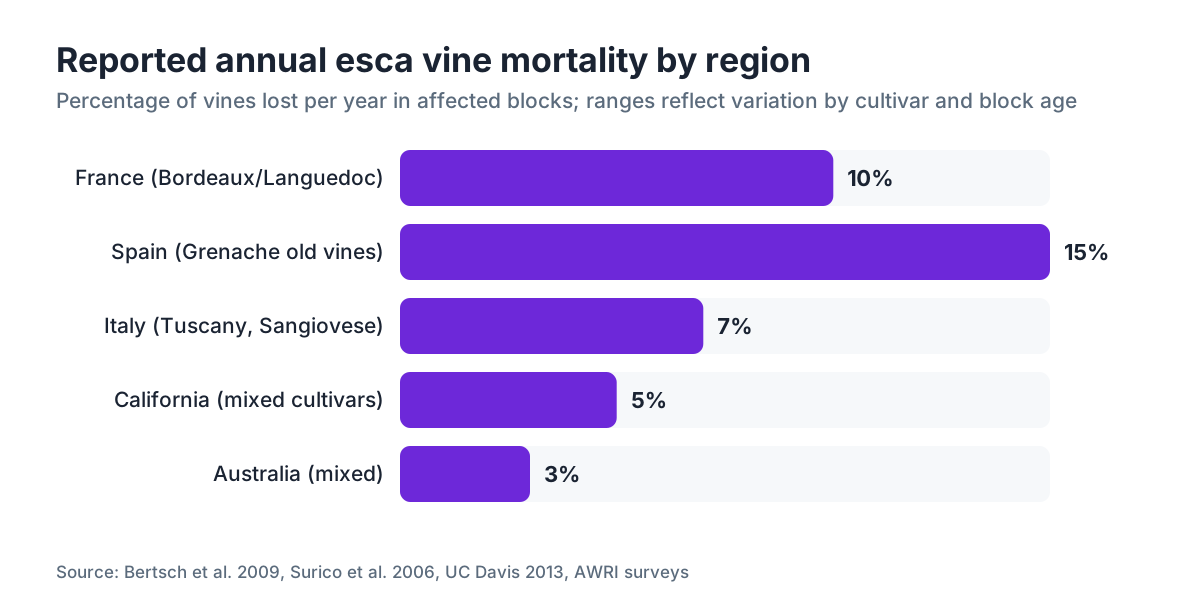
- Annual losses in badly affected blocks reach 10 to 15 percent of vines.
- Pruning hygiene and wound protection are the only reliable defenses.
What exactly is esca disease in grapevines?
Esca is not one pathogen. It's a disease complex, meaning several fungi work together to rot the internal wood of a grapevine, and researchers are still sorting out which organisms drive the worst outcomes. European growers have described the condition for at least two thousand years. Modern work has pinned the main culprits as three fungi: Phaeomoniella chlamydospora (Pch), Phaeoacremonium minimum (formerly Pm aleophilum), and Fomitiporia mediterranea (Fmed). Pch and Pm hit young vines early and cause what's classified as Petri disease. Fmed, a wood-rotting basidiomycete, moves in on older vines and drives the chronic or apoplectic phase most growers recognize as esca proper. [1]
The split between Petri disease and esca matters in the field. Petri disease attacks nursery material and vines under five years old. Classic esca shows up in vines older than eight to ten years, once there's enough accumulated wood mass for Fmed to colonize. Growers often use "esca" as the umbrella term for the whole trunk disease complex. That's fine for daily work, but young vine decline and mature vine collapse run on different clocks, and knowing that changes what you look for.
Esca sits inside a larger group called grapevine trunk diseases (GTDs), which also includes Botryosphaeria dieback, Eutypa dieback, and black foot disease. Together these cost California's wine grape industry an estimated $260 million a year according to a UC Davis assessment, and esca is one of the meaner members of the group. [2] Manage a mature vineyard long enough and trunk diseases are already present in some share of your vines, diagnosed or not.
What do esca symptoms look like in the vineyard?
There are two faces of esca, and both can turn up in the same block, even the same vine, in one season. One is slow. One is sudden.
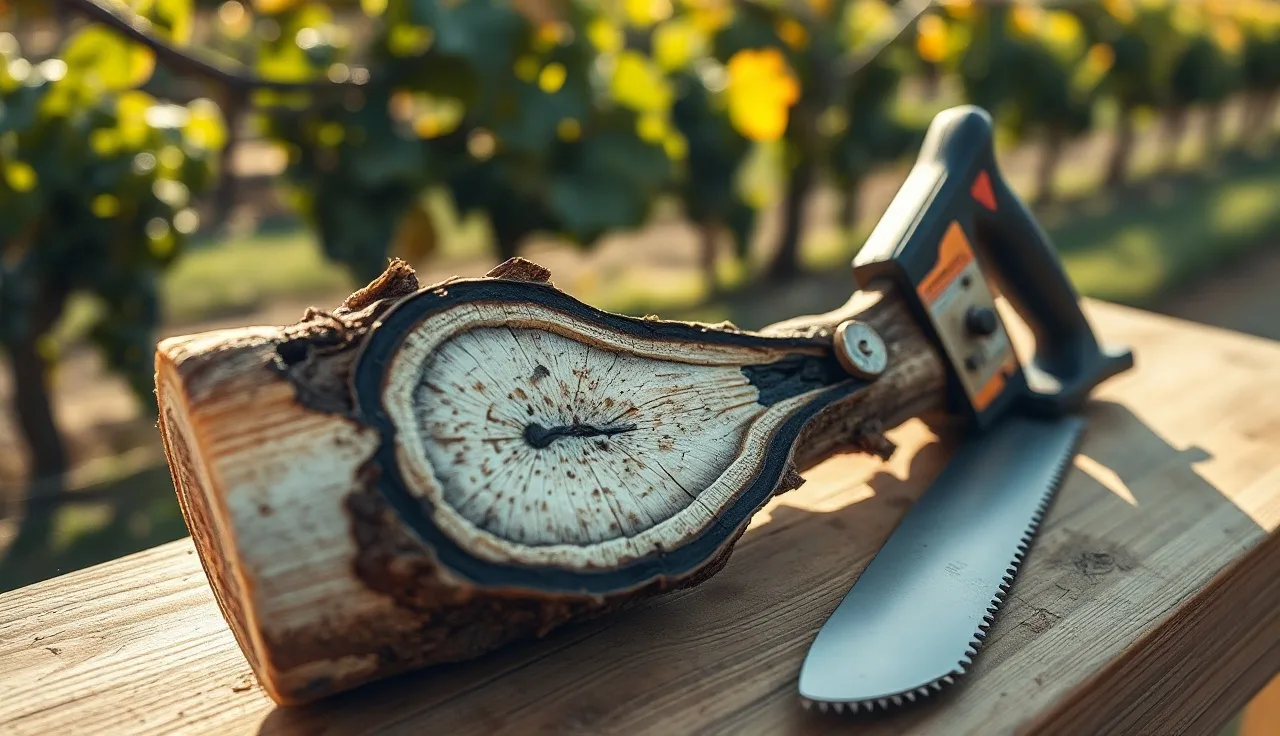
The chronic form produces the famous tiger-stripe pattern on leaves: interveinal chlorosis followed by necrosis, the dead tissue edged in yellow or red depending on cultivar, working from the leaf margins inward. Berries on affected canes can develop dark spots or shrivel. A vine may look wrecked one season and partly recover the next. That back-and-forth can drag on for years while the wood inside keeps failing. Cut a cross-section of the cane or cordon and you'll find dark streaking in the xylem, sometimes a central white spongy rot ringed by a darker margin. That rot is classic Fmed. [1]
The apoplectic form is a shock the first time you see it. A vine that looked fine in May is wilted and brown by July, as if drought-struck or girdled, and it does not come back. The whole canopy collapses within days to a few weeks, usually after a stretch of heat stress or high transpiration demand. Apoplectic esca runs more common in hot dry climates and in older vines with heavy colonization of the trunk and cordons. Nobody has fully explained why some vines flip from chronic to apoplectic. The working idea is that accumulated wood damage crosses a threshold where the vascular system can't move water fast enough during peak demand. [3]
A leaf symptom alone does not confirm esca. You have to cut into wood. In a cross-section of an affected cordon or trunk, look for dark xylem streaking (the Pch/Pm signature), central spongy white rot with a dark border (the Fmed signature), and in bad cases a dry powdery interior. Leaf symptoms mimic other problems: nutrient deficiency, leafroll virus, herbicide drift. Sending wood to a plant pathology lab for fungal isolation is the definitive answer, and UC Davis Plant Pathology runs diagnostic services for California growers. [2]
How does esca spread from vine to vine?
Pruning wounds are the main door in. Fresh cuts expose xylem, and spores of Pch, Pm, and their partners are in vineyard air, on dirty pruning tools, and in the soil. Infection lands most readily when you cut during wet or cool weather, because callus formation is slow and spore germination is more likely. Trials in France and Spain found that pruning cuts stay open to infection for days to several weeks, depending on temperature and humidity. [4]
Fmed grows fruiting bodies (conks or brackets) on heavily rotted wood, and these release basidiospores that ride wind or rain splash. This is a secondary route and usually matters less for initial infection than tool-borne spores at pruning time. It does explain why a badly rotted vine becomes an inoculum source for its neighbors.
Nursery propagation material is a long-standing vector. Pch turned up in symptomless cuttings from commercial nurseries in study after study through the 1990s and 2000s, which means growers planted infected material blind. Nursery certification and hot-water treatment of dormant cuttings (50 degrees C for 30 minutes) have cut this source down but not out. [5] Replanting a block? Asking your nursery about disease testing and hot-water treatment isn't paranoia. It's basic diligence.
Which grape varieties are most susceptible to esca?
Susceptibility varies, but no common Vitis vinifera cultivar is immune. In European trials, Chardonnay, Sauvignon Blanc, Grenache, and Cabernet Franc tend to show higher rates of symptom expression. Sangiovese blocks in Tuscany have been hit hard and supplied much of the foundational Italian research on esca epidemiology. [6]
In California, Zinfandel, Cabernet Sauvignon, and Chardonnay blocks get reported with esca-associated symptoms often, though side-by-side cultivar comparisons under matched conditions are thin in the American literature. Here's the honest answer: cultivar matters less than vine age, pruning practice, wound management history, and whether the block went in with infected nursery stock.
Rootstock is a related open question. Some work suggests certain rootstocks may shift colonization rates, but no rootstock is sold as esca-resistant, and Cornell's viticulture extension team has flagged the lack of solid rootstock trial data as a gap in the literature. [7] For planning purposes, treat every vinifera block as susceptible, whatever the variety or rootstock.
Is there a cure or registered fungicide for esca?
No. That's the short answer, and growers need to sit with it early.
No fungicide is registered in the United States specifically for esca, and no spray applied to canopy or soil has shown steady curative activity against established wood infections. The pathogens live inside the wood, shielded from contact sprays. Some European countries once had sodium arsenite, which suppressed esca symptoms when painted on trunks, but the EU banned it in 2003 over toxicity, and it was never registered here. [6]
What does help is biological and physical wound protection at pruning. Several Trichoderma-based products (Vinevax, Trichoseal, and others, depending on region and registration) are labeled for wound protection in grapes. They work by colonizing the wound and crowding out fungal pathogens before those establish. Efficacy trials show mixed but generally positive results, best when application lands within 24 hours of the cut. Check current EPA registrations and your state label before buying, because availability shifts. [8]
Painting wounds with sealants containing boric acid or commercial fungicidal pastes has also been studied. The data is mixed. A 2018 review in Plant Disease concluded, in the authors' words, that "no single strategy has proven fully effective" for grapevine trunk diseases, and that integrated approaches combining pruning hygiene, wound protection, and canopy management beat any single tactic. [3] That's the honest state of the science.
What pruning practices reduce esca infection risk?
Timing and technique are the two levers you actually control. Both matter, and neither costs much.
Timing first. Pruning later in dormancy, closer to bud swell, shrinks the infection window. Sap pressure at bud swell helps flush spores out of fresh wounds, and warmer temperatures speed callus formation. The tradeoff is labor scheduling, frost risk if late pruning delays growth, and less flexibility in big operations. Some French growers run a double-pruning system: a rough first cut early in dormancy, a final cut near bud swell. French trials show fewer new infections under that system, though U.S. adoption is still limited. [4]
Technique next. The angle and placement of cuts change how well wounds heal. Leaving a short stub (a "defense zone" stub) instead of cutting flush to the cordon gives the vine living tissue to callus around and cuts the exposed dead wood area. This runs against the clean-cut look some growers prefer, but the plant pathology case for it holds up.
Tool sanitation belongs on the list too. Wiping shears between vines with 70 percent ethanol or a 10 percent bleach solution (sodium hypochlorite) breaks tool-to-vine transmission. Bleach corrodes metal and demands more upkeep, so ethanol or commercial quaternary ammonium products are more workable for all-day field use. When you use registered disinfectants in the vineyard, the EPA Worker Protection Standard (WPS), 40 CFR Part 170, governs pesticide handling and labeling for agricultural workers. [8]
Records pay off here. Track which vines show symptoms, which rows got pruned on which dates, which crews used which tools. A spreadsheet works. Platforms like VitiScribe exist to centralize that field history and spray or treatment documentation in one place, which makes compliance and pattern-finding faster later.
Can you save an infected vine, and when should you remove it?
Sometimes. It comes down to how far the disease has traveled in the wood.
For vines showing chronic foliar symptoms but no heavy rot in the main trunk, retraining works. You cut back into clean wood below the infected zone, remove every visibly infected cordon and arm, and train new shoots from the trunk or a sucker to rebuild the cordon system. The literature calls this remedial surgery, and it can add years of production if the trunk wood below the cut is clean. WSU Extension's viticulture team has published practical guidance on retraining for trunk disease. [9]
For apoplectic vines, or vines where the trunk shows central rot reaching the base, pull and replant. Keeping a fully rotted vine in the block costs you its production and hands ongoing inoculum to its neighbors. Replanting also forces the question of certified nursery stock and whether hot-water-treated material is available from your supplier.
There's no universal threshold for pulling a vine. A common practitioner rule: if the cross-section at the graft union or lower trunk shows rot covering more than half the area, the vine won't produce economically for long and retraining probably isn't worth it. That's a field judgment, not a published standard, but it's the kind of thing experienced growers pass down.
How much economic damage does esca cause in vineyards?
The numbers are bad, and they get worse as vines age.
A UC Davis economic analysis put the cost of grapevine trunk diseases to California's wine grape industry at roughly $260 million a year, counting yield loss, vine replacement, and management labor. [2] Esca and Botryosphaeria dieback take the largest share of that figure in mature vineyards.
In hard-hit European regions, documented annual vine mortality from esca runs 1 to 15 percent depending on region, cultivar, and vine age, with some old-vine Grenache blocks in Spain landing at the high end. [6] French surveys in the 2000s found esca-related mortality among the leading reasons growers replant in Bordeaux and Languedoc.
Run the math for a California grower. New block establishment now costs roughly $25,000 to $50,000 per acre, and that range swings hard by region and training system. Losing 5 to 10 percent of vines to removal and replant within 15 years is a real hit, especially since replanted vines need 3 to 5 years to reach full production.
That math shapes wound-protection decisions. Trichoderma-based protectants run roughly $30 to $80 per acre per application depending on product and coverage, small money against the cost of losing vines early. Efficacy isn't guaranteed, and no biocontrol product will paper over sloppy pruning.
What do UC Davis, Cornell, and WSU extension say about esca management?
The three main American viticulture extension programs land in close agreement, with regional twists. Prevention over rescue is the shared message.
UC Davis (through UC Cooperative Extension and the UC IPM program) pushes integrated management: later pruning, wound protection with registered biocontrol products, sound vine nutrition to support healing, and removal of severely affected vines. Their UC IPM guidelines for grape name Phaeomoniella chlamydospora and Phaeoacremonium spp. as key pathogens and advise applying wound protectants within 24 hours of pruning when risk is high. [2]
Cornell Cooperative Extension covers trunk diseases with attention to the northeastern U.S., where Eutypa dieback often outranks esca but the same pruning hygiene applies. Cornell notes that the relative weight of individual trunk disease pathogens shifts by region, and that diagnosis before management is worth the effort. [7]
WSU Extension's viticulture program addresses trunk diseases in the Pacific Northwest, where cool wet springs pile on infection pressure during the pruning window. Their guidance calls out double pruning as a risk-reduction move and lays out retraining protocols for infected vines. [9]
All three agree on the core point. Prevention beats remediation by a wide margin, and there are no good rescue options once the wood is heavily colonized.
How should you monitor and document esca in your vineyard records?
Systematic monitoring is underused in most operations, and it's one of the few tools that costs nothing but time.
Walk your blocks during veraison in late summer and flag vines showing tiger-stripe or apoplectic symptoms. Record the row and vine position, the symptom type, and the severity. Even a simple tally by block and year builds a trend line. See 2 percent symptomatic vines one year and 7 percent three years later, and you have an early warning that something is accelerating, whether a pruning change, an inoculum source, or a crew hygiene gap.
If you apply any wound protectant with a pre-harvest interval (PHI) requirement, dated application records by block are a legal obligation under EPA WPS and your state department of agriculture rules, not optional paperwork. [8] Those same records tell you which blocks got wound protection and which didn't, which makes it easier to line up protection decisions against disease progression over time.
Running multiple blocks, or working with a management company handling records across sites? Centralizing esca symptom data alongside pruning date logs and product application records in one system saves a lot of reconstruction later. VitiScribe is built for that kind of joined-up field and compliance recordkeeping, so if your records live in disconnected spreadsheets, it's worth a look.
Photograph cross-sections from removed vines. A photo library keyed to GPS coordinates gives you visual proof of disease progression that numbers alone miss.
Are there any promising new research directions for esca control?
A few. None are ready for the field yet, but they're worth tracking.
Endophyte-based biocontrol is active work. Scientists are studying beneficial fungi that live naturally inside grapevine wood and may suppress esca pathogens. INRAE in France has published on endophytic communities and their tie to esca susceptibility, testing the idea that vineyards with more diverse endophytes may hold some natural check on pathogen establishment. [6] This links to bigger questions about soil health and the vine microbiome that are genuinely interesting but not yet firm enough to act on.
Host resistance breeding moves slowly. Programs have found some Vitis species with apparent resistance mechanisms, but crossing those into commercially acceptable cultivars while keeping fruit quality takes decades. Don't wait on an esca-resistant Chardonnay.
Elicitor treatments, where you apply compounds that prime the vine's own defenses, have shown some promise in greenhouse trials for cutting pathogen establishment in wounds. Silicon-based compounds and some plant defense activators are under study. Early field results are mixed and not yet enough to recommend.
The most practical near-term development is better diagnostics: faster PCR-based testing that confirms esca pathogens in wood within days instead of the weeks culture methods need. Several university plant pathology labs are working on it. Once rapid diagnostics get cheap and available, growers will be able to map infection within blocks far more precisely than they can today. [5]
Frequently asked questions
Can esca disease kill a grapevine in one season?
Yes, in the apoplectic form. A vine with heavy prior wood colonization can collapse and die within days to weeks during a hot, high-demand stretch. The canopy wilts, browns, and does not recover. This is more common in vines over ten years old with significant internal trunk rot. Vines showing only chronic tiger-stripe symptoms can persist several more seasons, though their wood keeps degrading.
Is esca the same as black measles in California grapes?
Essentially yes. Black measles is the traditional California name for the syndrome European researchers call esca. Both describe the same fungal complex involving Phaeomoniella chlamydospora, Phaeoacremonium minimum, and Fomitiporia mediterranea. The dark berry spots that look like measles gave the California name its origin. UC Davis uses both terms, with esca now more common in academic literature.
How do I tell esca apart from Eutypa dieback?
Both are trunk diseases that cause leaf symptoms and wood dieback, but the patterns differ. Eutypa produces a stunted-shoot symptom in spring, with small cupped leaves on one arm while the rest of the vine looks normal. Esca more often shows tiger-stripe interveinal chlorosis across a larger part of the canopy in summer. Cross-sectioning settles it: Eutypa shows a wedge of dead wood in the arm, while esca shows central white rot with dark margins.
What temperature kills esca fungi in pruning wounds?
Hot-water treatment of dormant cuttings at 50 degrees C (122 degrees F) for 30 minutes is the nursery standard for reducing Phaeomoniella chlamydospora and Phaeoacremonium minimum. That's not practical for established vines in the field. For tool sanitation, 70 percent ethanol handles surface decontamination, though it does not sterilize the whole pruning wound on the vine.
Does late pruning really reduce esca infection?
The evidence supports it. French studies showed pruning closer to bud swell reduced new infections versus early-winter pruning, because warmer temperatures speed callusing and sap flow helps flush wound surfaces. The tradeoff is logistical: late pruning compresses the labor window and can collide with frost protection timing. A double-pruning approach (rough early cut, final cut near bud swell) captures some benefit without fully squeezing the schedule.
Can I use copper fungicides to prevent esca infections in pruning wounds?
Copper products are not reliably effective against esca pathogens in pruning wounds and are not labeled for this use in most U.S. states. The fungi that cause esca are not the mildew fungi copper addresses. Trichoderma-based biological wound protectants are the better-evidenced option, applied within 24 hours of pruning. Always check current EPA registration and your state label before applying anything.
How long after pruning are wounds susceptible to esca infection?
Susceptibility windows shift with temperature and humidity. In cool wet conditions (below 15 degrees C), wounds can stay susceptible two to eight weeks. In warmer drier conditions, callus forms faster and the window may close within one to two weeks. That's why pruning during wet winters and leaving wounds unprotected is high risk, and why applying wound protectants right after pruning beats applying them days later.
Should I remove symptomatic vines or try to retrain them?
It depends how far the wood damage has gone. If the trunk below the graft union is still structurally sound and less than about half the cross-section is rotted, retraining by cutting back to clean wood and building a new cordon is reasonable. If the trunk is extensively rotted, removal and replanting with certified clean nursery stock is more practical. Making that call means cutting into the wood, more than reading foliar symptoms.
Is esca worse in irrigated versus dry-farmed vineyards?
Nobody has clean comparative data on this exact question. The general thinking is that vine stress of any kind, water stress included, raises the odds of apoplectic expression in vines already colonized. On the other side, over-irrigation and poor drainage favor root diseases that weaken vines and open them to trunk disease. Moderate, well-managed irrigation is probably neutral to slightly better than chronic water stress for esca severity.
Do organic vineyards have more esca because they can't use synthetic fungicides?
Not necessarily, because no synthetic fungicide is registered or effective for esca in established vines anyway. The available tools (pruning timing, wound protection with biologicals, retraining) are largely the same for organic and conventional operations. Trichoderma-based wound protectants are generally allowed under USDA National Organic Program standards, though you should confirm specific products with your certifier.
Can I get esca from contaminated soil when replanting?
The trunk disease fungi tied to esca are mainly wood inhabitants, not soil pathogens the way Armillaria or black foot disease fungi are. Infected wood debris left in the soil after removing a diseased vine can harbor the fungi for a while, so grind stumps thoroughly and clear debris before replanting. The bigger replanting risk is nursery stock already infected during propagation, which is why certified and hot-water-treated material matters.
How do I submit a vine for esca diagnosis at a lab?
Collect a section of symptomatic wood, usually a 6 to 12 inch piece of an arm or cordon showing internal discoloration, sealed in a plastic bag with minimal excess moisture. Most university plant pathology labs (UC Davis, Cornell, WSU) accept mailed samples with a submission form. Culture-based identification typically takes two to four weeks. PCR-based testing, where available, returns results faster. Fees run roughly $20 to $100 per sample depending on lab and test method.
Does esca affect the flavor of grapes from symptomatic vines?
Grapes from apoplectic vines are a total loss and don't get harvested. On chronically symptomatic vines, affected berries can show dark spots and shriveling. The common practice is to avoid harvesting obviously diseased clusters. Some growers in hard-hit blocks sort in the vineyard at harvest and leave symptomatic fruit behind. Published data on how subclinical infection affects must chemistry or wine quality without visible berry symptoms is limited.
Sources
- Mugnai L, Graniti A, Surico G (1999) - Esca (Black Measles) and brown wood-streaking: two old and elusive diseases of grapevines. Plant Disease 83(5):404-418: Esca is caused by a complex of fungi including Phaeomoniella chlamydospora, Phaeoacremonium minimum, and Fomitiporia mediterranea; Petri disease and esca proper have distinct epidemiologies by vine age
- UC IPM - Grape Pest Management Guidelines, University of California Agriculture and Natural Resources: UC IPM identifies Phaeomoniella chlamydospora and Phaeoacremonium spp. as key esca pathogens and recommends wound protectant application within 24 hours of pruning; UC Davis assessed trunk diseases cost California wine grape industry approximately $260 million annually
- Gramaje D, Urbez-Torres JR, Sosnowski MR (2018) - Managing grapevine trunk diseases with respect to etiology and epidemiology. Plant Disease 102(1):12-39: "No single strategy has proven fully effective" for managing grapevine trunk diseases; integrated approaches combining pruning hygiene, wound protection, and canopy management outperform any single tactic; apoplectic esca linked to vascular system threshold collapse under heat stress
- Lecomte P, Darrieutort G, Liminana JM, et al. (2012) - New insights into Esca of grapevine: the development of foliar symptoms and their association with trunk pathogen distribution. Phytopathology: Double pruning (rough first cut early dormancy, final cut near bud swell) reduces new infections; pruning wound susceptibility window is days to weeks depending on temperature and humidity
- Gramaje D, Armengol J (2011) - Fungal trunk pathogens in the grapevine propagation process: potential inoculum sources, detection, identification, and management strategies. Plant Disease 95(9):1040-1055: Pch found in symptomless cuttings from commercial nurseries; hot-water treatment at 50 degrees C for 30 minutes reduces nursery transmission; PCR-based diagnostics are in development for faster detection
- Bertsch C, Ramírez-Suero M, Magnin-Robert M, et al. (2009) - Grapevine trunk diseases: complex and still poorly understood. Plant Pathology 58(3):393-406: Sodium arsenite banned in EU in 2003; annual vine mortality from esca in severely affected blocks up to 15% in Spanish Grenache old vines; Sangiovese vineyards in Tuscany heavily affected; endophyte communities may influence susceptibility
- Cornell Cooperative Extension - Viticulture and Enology, Cornell University: Cornell notes lack of definitive rootstock trial data for esca resistance as a gap in the literature; trunk disease pathogen relative importance shifts by region
- EPA Worker Protection Standard - 40 CFR Part 170, U.S. Environmental Protection Agency: EPA WPS governs pesticide handling and labeling requirements for agricultural workers; application records by block are a legal obligation under WPS
- WSU Extension - Viticulture and Enology Program, Washington State University: WSU recommends double pruning as a risk-reduction strategy in Pacific Northwest conditions; WSU provides retraining protocols for esca-infected vines
- Surico G, Mugnai L, Marchi G (2006) - Older and more recent observations on esca: a critical overview. Phytopathologia Mediterranea 45:S68-S86: Esca described in European viticulture for at least two thousand years; Italian Sangiovese vineyards among most severely affected; esca vine mortality 3-10% in Tuscan blocks surveyed
Last updated 2026-07-09