Disease resistant grapevines: what growers need to know
TL;DR
- Disease-resistant grapevines (often called FREI, interspecific hybrids, or disease-tolerant varieties) carry genes from wild Vitis species that slow or stop powdery mildew, downy mildew, and black rot.
- Growers typically cut fungicide applications by 50 to 90 percent.
- Trade-offs are real: wine quality varies, market acceptance is uneven, and the best variety depends heavily on your region and target market.
What are disease-resistant grapevines and how do they work?
Disease-resistant grapevines are varieties bred to carry genetic resistance to one or more of the fungal pathogens that cost conventional Vitis vinifera growers enormous amounts of time and money every season. The resistance comes primarily from non-vinifera Vitis species, most often Vitis rupestris, Vitis rotundifolia, Vitis amurensis, and various wild North American species, crossed into breeding programs that try to retain vinifera-like fruit character while adding durable disease tolerance.
The term most European breeders now use is PIWI, from the German Pilzwiderstandsfähige (fungus-resistant). In North American extension literature you'll more often see the terms interspecific hybrids, French-American hybrids, or simply disease-tolerant varieties. The resistance mechanisms are not all the same. Some varieties carry specific resistance genes (R-genes) that trigger a hypersensitive cell-death response when pathogen spores attempt to penetrate leaf tissue. Others have physical barriers like tighter waxy cuticles or thicker cell walls. A few rely on constitutive production of stilbenes and other phenolic compounds that are toxic to fungal hyphae. Cornell's breeding program documented these mechanisms in detail for varieties like Arandell and Aromella [1].
The distinction between "resistant" and "immune" matters. No commercial grapevine variety is completely immune to all the major pathogens. Ratings from breeding programs at Cornell, UC Davis, and the Julius Kühn-Institut in Germany typically use a 1-to-9 scale, where 1 is fully susceptible and 9 is fully immune. Most commercially released varieties land in the 5-to-8 range for their target diseases, which still translates to a dramatic reduction in spray programs compared to Cabernet Sauvignon or Chardonnay in humid climates [2].
Resistance is also not static. Populations of Plasmopara viticola (downy mildew) and Erysiphe necator (powdery mildew) evolve, and there are documented cases in Europe of specific R-genes being overcome by new pathogen races. This is why the best modern varieties are bred with stacked resistance, meaning multiple independent resistance loci rather than a single gene. The INRAE programs in France and the Geilweilerhof research station in Germany both now require stacked resistance as a precondition for variety release [3].
Which diseases do resistant varieties actually protect against?
The big three pathogens in most North American and European wine regions are powdery mildew, downy mildew, and black rot. Most disease-resistant breeding programs have prioritized these three, and the best current varieties show meaningful resistance to all of them.
Powdery mildew (Erysiphe necator) is the single most costly disease to manage in vinifera production. University of California Cooperative Extension estimated the cost of powdery mildew management in California at roughly $200 to $450 per acre per season in materials and labor as of 2020, depending on disease pressure and spray timing [4]. Resistant varieties with high powdery mildew scores can reduce or eliminate those applications entirely in lower-pressure years.
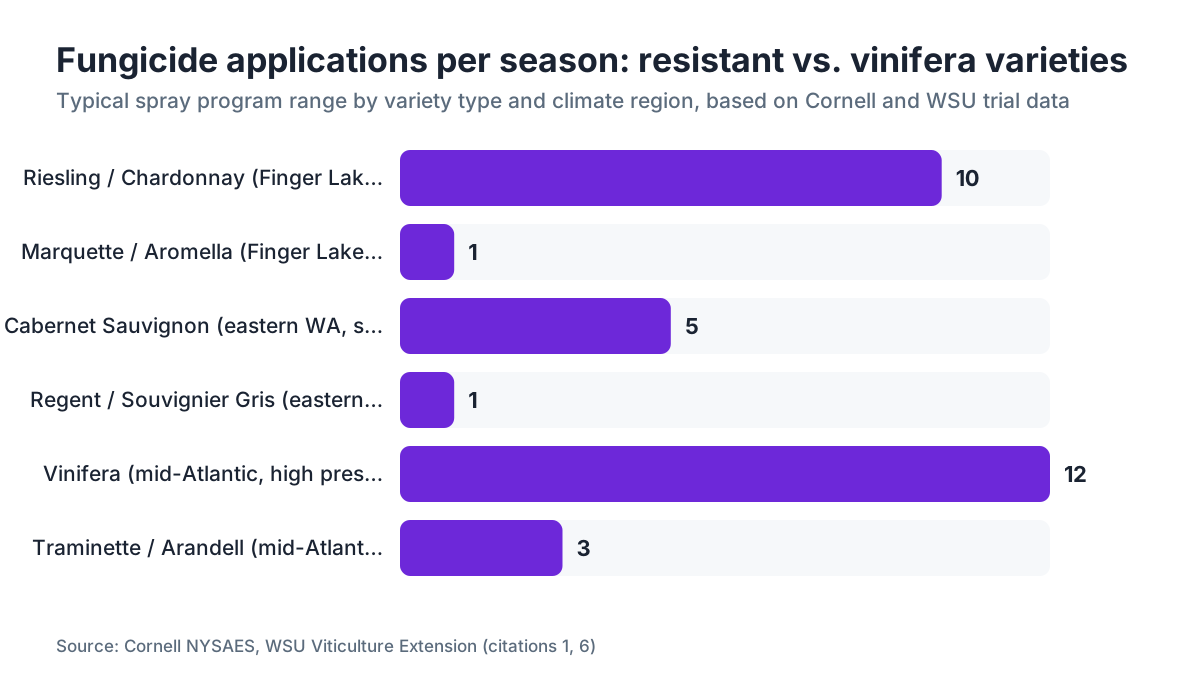
Downy mildew (Plasmopara viticola) is the dominant threat in humid eastern and Midwestern climates. Cornell's viticulture program at the New York State Agricultural Experiment Station has shown that varieties like Marquette, La Crescent, and Frontenac can be grown with zero to two fungicide applications per season in New York conditions, compared to eight to fourteen applications for Riesling or Chardonnay in the same environment [1].
Black rot (Guignardia bidwellii) is often overlooked in favor of the mildews but can devastate crops in warm, wet springs. Resistance to black rot is less common in released varieties than mildew resistance, so growers in the mid-Atlantic and Southeast should check black rot ratings specifically before selecting a variety.
Botrytis cinerea (bunch rot) is the fourth major target, but genetic resistance to Botrytis is harder to breed for and tends to correlate with berry skin thickness and cluster architecture rather than specific R-genes. Many disease-resistant varieties happen to have looser clusters and thicker skins, which helps, but Botrytis ratings for most PIWI varieties are modest at best.
Flavescence dorée and Pierce's disease are bacterial or phytoplasma diseases rather than fungal, and genetic resistance to these is a separate breeding challenge. Muscadine-derived material offers some Pierce's disease tolerance, and UC Davis has active breeding work on PD-resistant Vitis vinifera using a resistance locus from Vitis arizonica [5]. These programs are promising but most releases are still years away from wide commercial availability.
How many fungicide sprays can you actually cut?
The honest answer: it depends heavily on your climate, your specific disease pressure, and which diseases the variety is actually rated for. But the numbers from well-run trials are striking.
Cornell's long-running trial data show that Marquette, Frontenac, and La Crescent grown in the Finger Lakes region required an average of 0 to 2 fungicide sprays per season for mildew diseases, compared to 8 to 12 for Riesling grown in the same blocks [1]. That's a reduction of 80 to 100 percent for the fungal spray program.
In Germany, the official DLG (Deutsche Landwirtschafts-Gesellschaft) trials for PIWI varieties like Regent, Johanniter, and Cabernet Blanc consistently show a 60 to 80 percent reduction in fungicide applications versus conventional vinifera varieties in the same sites [3].
Washington State University extension data from their Inland Northwest trials are more modest, reflecting drier conditions where even vinifera doesn't require heavy spray programs. In eastern Washington's semi-arid climate, a grower might be spraying vinifera 4 to 6 times; resistant varieties there might need 1 to 2 applications in a wet year, but the absolute savings are smaller than in humid eastern states [6].
For a vineyard in Virginia, the Carolinas, or anywhere east of the Mississippi that sees regular summer rainfall, the math is compelling. If you're making 10 to 14 spray passes per season on vinifera at $15 to $40 per acre per pass in materials alone, cutting to 2 to 4 passes saves real money and real labor hours. The EPA's Worker Protection Standard requirements for restricted-use fungicides mean that every spray application also carries re-entry interval management costs and record-keeping obligations [7]. Fewer sprays means less compliance burden.
One number to keep in mind: the spray reduction is rarely zero in the eastern United States, even for the best-rated varieties. Cornell extension recommends that growers treat any year with high disease pressure as a year to apply at least one protective spray on even the most resistant varieties, because "resistance" means the disease establishes and spreads slowly, not that a single infection event can't occur [1].
What are the best disease-resistant varieties for different regions?
There's no single answer here because the breeding programs have different goals, and climate fit matters as much as disease resistance ratings.
Cold-climate eastern United States and Canada. The University of Minnesota breeding program has released the "Frontenac" series (Frontenac, Frontenac Gris, Frontenac Blanc) along with Marquette, all with excellent cold hardiness down to about minus 28 to minus 32 degrees Celsius (minus 18 to minus 25 Fahrenheit) and strong resistance to downy mildew and black rot. Marquette in particular has earned a serious reputation for wine quality, with phenolic structure closer to Pinot Noir than any other cold-hardy hybrid [8]. La Crescent is the go-to white for the upper Midwest and northern Appalachia.
Cornell has released Arandell (red), Aromella (white), and several others through its New York State Agricultural Experiment Station program. These are bred specifically for the humid Northeast and show very high ratings for both powdery and downy mildew.
Mid-Atlantic and Southeast. This is where disease pressure is highest and the hardest region to manage. Traminette has been a workhorse white since its release from the University of Illinois in 1996, with moderate mildew resistance and good wine character. Norton/Cynthiana (though technically not a modern hybrid, it's native Vitis aestivalis) has durable downy mildew resistance. For the Southeast, Blanc du Bois has been the most widely planted disease-resistant white, with strong Pierce's disease tolerance [5].
Pacific Northwest and California. These are drier climates where vinifera already grows with fewer applications, so the case for disease-resistant varieties is weaker on spray-reduction grounds alone. That said, UC Davis and WSU have ongoing trials. Regent has been tested at WSU with decent results for red wine quality, and there's commercial interest in PIWI whites for Oregon's Willamette Valley, where fall rains and Botrytis pressure are real issues [6].
Europe. Soreli, Souvignier Gris, Cabernet Blanc, Muscaris, Johanniter, and Monarch are among the most widely planted modern PIWIs. France officially added several PIWI varieties including Floréal, Voltis, and Artaban to its official catalog in 2018, the first step toward appellation-level acceptance [3].
| Variety | Region fit | Mildew resistance | Cold hardiness (°C) | Primary wine type |
|---|---|---|---|---|
| Marquette | Upper Midwest, Northeast | High | -32 | Red |
| Frontenac | Upper Midwest | High | -32 | Red |
| Frontenac Blanc | Upper Midwest | High | -30 | White |
| La Crescent | Upper Midwest, Northeast | Moderate-High | -28 | White |
| Traminette | Mid-Atlantic, Midwest | Moderate | -20 | White |
| Arandell | Northeast | Very High | -20 | Red |
| Regent | Mid-Atlantic, Pacific NW | High | -22 | Red |
| Souvignier Gris | Mid-Atlantic, PNW | Very High | -22 | White |
| Blanc du Bois | Southeast | Moderate (PD tolerant) | -10 | White |
| Muscaris | Mid-Atlantic, PNW | Very High | -22 | White |
What are the real trade-offs in wine quality and market acceptance?
This is the question most extension articles dance around. Let's be direct.
The best modern varieties, particularly Marquette, Souvignier Gris, and Muscaris, make genuinely good wine. Blind tastings have placed well-made Marquettes competitively with entry-level Pinot Noirs. But the top-tier PIWI wines are still exceptions, and plenty of commercial disease-resistant varieties make wine that tastes different from what most consumers expect from a red or white wine. The fox-grape character common in older American hybrids is mostly absent from the best modern releases, but it's not absent from all of them.
Foxy or "labrusca" flavor compounds (primarily methyl anthranilate) are actually lowest in many of the cold-hardy Minnesota series and the European PIWIs, which have more vinifera ancestry. If you're evaluating a variety you haven't tasted before, get samples before you plant. University extension programs often have tasting events at field days.
Market acceptance is the bigger commercial problem in most U.S. regions. Appellation rules in New York, Virginia, California, and the major AVAs are built around Vitis vinifera. A wine labeled "Virginia Vinifera" requires 100 percent vinifera fruit. Hybrid-based wines can carry AVA designations in most cases but cannot carry vinifera-specific appellation designations. For a winery selling primarily through a tasting room or direct-to-consumer, this may not matter much. For a winery trying to place wine in on-premise accounts or with distributors who have vinifera-centric portfolios, it's a real limitation.
The European situation is moving faster. France's 2018 addition of PIWI varieties to its national catalog was followed by appellation experiments in Bordeaux and Burgundy regions. Switzerland and Germany have more progressive frameworks, and Swiss producers have had commercial success with Souvignier Gris and Divico in export markets [3].
For growers selling fruit rather than making wine, the conversation is even harder. Most established wineries buying Chardonnay or Merlot by the ton are not currently buying Marquette or Traminette at similar prices. That may change, and in some regions it already has, but don't plant disease-resistant varieties for custom crush markets without confirming your buyer first.
How do spray program costs compare between vinifera and resistant varieties?
The cost comparison depends on your region's disease pressure more than anything else, but here's a framework grounded in published numbers.
UC Davis Cooperative Extension's 2020 sample cost studies for wine grape production in the North Coast put disease management (fungicides, application labor, equipment cost allocation) at approximately $400 to $650 per acre per season for varieties like Cabernet Sauvignon and Chardonnay in Napa and Sonoma [4]. In the San Joaquin Valley those numbers drop to roughly $150 to $250 per acre because disease pressure is lower.
Cornell's enterprise budgets for Finger Lakes vinifera production show fungicide materials and application labor totaling $300 to $500 per acre annually for powdery and downy mildew management on Riesling and Chardonnay [1]. An equivalent operation growing Marquette or Aromella might spend $50 to $120 per acre, based on 1 to 3 spray applications instead of 8 to 12.
That's a savings of $250 to $400 per acre per year in materials and labor in a humid eastern climate. On a 10-acre block, that's $2,500 to $4,000 per year. Over a 20-year vineyard life, even discounted, that's a very large number.
The off-setting cost is establishment. Because disease-resistant varieties are often newer releases with limited propagation availability, vine costs can run $6 to $9 per vine compared to $4 to $6 for standard vinifera clonal material from established nurseries. On a 1,000-vine-per-acre planting, that difference is $2,000 to $3,000 at planting, which pays back in 1 to 2 seasons of spray savings in high-pressure climates.
Keeping accurate spray records is non-negotiable either way. EPA's Worker Protection Standard (40 CFR Part 170) requires handlers to maintain records of pesticide applications including product name, EPA registration number, application date, rate, and the restricted-entry interval for every application [7]. Growers cutting their spray program from 12 to 2 applications still need compliant records for those 2 applications. A field operations platform like VitiScribe can make that record-keeping fast enough that it actually gets done after every application rather than reconstructed at the end of the season.
What do university breeding programs recommend for trial plantings?
The consistent advice from Cornell, University of Minnesota, and WSU extension is to start small, plant multiple varieties side by side, and manage them the same way you'd manage your best vinifera block before you start cutting the spray program.
Cornell's viticulture extension team recommends a minimum trial block of 50 to 100 vines per variety to get meaningful production and wine quality data across at least three vintages before making large-scale planting decisions [1]. The first-year vine behavior doesn't predict mature vine performance well enough to draw conclusions.
University of Minnesota's Viticulture Extension specifically cautions growers against immediately dropping all fungicide applications in the first two to three years after planting, even with high-rated varieties. Young vines haven't expressed their full canopy resistance, and root system stress can suppress the phenolic pathways that contribute to mildew resistance [8].
WSU's extension program in Prosser has published variety trial data for the Pacific Northwest through their viticulture program, and they emphasize that disease-resistant ratings from eastern or European trials don't always translate to the PNW's specific pathogen populations. Local trial data matters [6].
For growers in states with active hybrid programs, the state grape societies often maintain trial plots and can provide regional data. Virginia Tech, Penn State, and the University of Missouri all maintain active research vineyards with disease-resistant variety trials. These are worth visiting before you commit to a planting.
One practical step that pays off: request the official disease resistance scores from the breeding program that released the variety, more than the marketing materials from the nursery. Cornell's variety pages and the University of Minnesota's variety release documents include numerical ratings across multiple disease categories. Those numbers are far more useful than phrases like "good disease resistance" in a nursery catalog.
How does planting disease-resistant varieties affect your spray record obligations?
Fewer sprays doesn't mean no records. It means fewer records, which is actually easier to manage correctly.
The EPA's Worker Protection Standard (40 CFR Part 170) applies to all agricultural pesticide applications regardless of how many you make per season [7]. If you apply a fungicide to your disease-resistant block, even once, you need a complete application record: product name, EPA registration number, active ingredient, amount applied, location treated, date, applicator, and the product's restricted-entry interval. The REI requirement also means you must post field notification or provide direct notification to workers before they enter a treated field during the REI period, even for low-toxicity contact fungicides.
State pesticide regulations add requirements on top of federal ones in most states. California's Department of Pesticide Regulation requires a Pesticide Use Report for every pesticide application to agricultural land, filed with the county agricultural commissioner within 7 days of application [9]. New York, Washington, and most other major wine states have similar reporting requirements.
For growers with organic certification or seeking certification, the spray record matters enormously because it's the primary evidence your certifier reviews. USDA National Organic Program rules prohibit synthetic fungicides, so disease-resistant varieties aren't just an agronomic preference for organic operations, they're often the practical path to managing disease pressure within NOP constraints [10]. A well-documented spray history showing minimal or zero synthetic fungicide use is a meaningful asset in the certification process.
The record-keeping burden, even for two applications per season rather than twelve, is the same per application. The forms are the same, the REI posting requirements are the same, and the county or state reporting deadlines are the same. What changes is the total volume of paperwork, not the per-application complexity.
Are disease-resistant varieties eligible for organic certification?
Yes, and for growers in humid climates, they're often the only practical path to viable organic production.
USDA National Organic Program regulations (7 CFR Part 205) prohibit synthetic fungicides. The allowed materials list includes copper-based products, sulfur, and several biological fungicides like Bacillus subtilis and Bacillus amyloliquefaciens strains, but copper and sulfur applied at rates that actually control downy mildew and powdery mildew on Chardonnay or Merlot in the eastern United States can cause phytotoxicity, accumulate to toxic levels in soil, and still not provide adequate protection in wet years [10].
Organic vinifera production in the eastern half of the country is genuinely difficult and has a high failure rate in bad disease years. Disease-resistant varieties change that equation. A grower in New York or Virginia growing Marquette or Aromella can often manage with two or three sulfur applications per season, which is well within NOP compliance and well below phytotoxicity thresholds.
The variety itself doesn't affect NOP eligibility. Organic certification is about inputs and practices, not genetics. Disease-resistant varieties are conventional plants (not GMOs), so there's no regulatory complexity on the variety side. What matters is your spray program, soil amendments, and documentation.
For growers pursuing Demeter biodynamic certification in addition to NOP organic, the calculation is similar but Demeter has its own approved materials list, which is stricter than NOP on copper rates and prohibits many synthetic adjuvants [10]. Disease-resistant varieties give biodynamic growers more flexibility in managing disease without high copper loadings.
What is genetic stacking and why does it matter for long-term disease resistance durability?
Genetic stacking is the practice of breeding varieties that carry multiple independent resistance loci for the same pathogen. It's the reason the newest generation of PIWI varieties is more commercially viable than the older French-American hybrids like Seyval Blanc or Vidal Blanc, which carried single-gene resistance that has eroded over decades as pathogen populations evolved.
The analogy plant pathologists use is antibiotic resistance in medicine. A pathogen population exposed to a single resistance gene has selection pressure to evolve around it. A pathogen population that would need to simultaneously overcome three independent resistance mechanisms faces a much higher evolutionary barrier. The European PIWI breeding community has largely settled on requiring at least two independent resistance loci per disease, and the best current varieties have three for powdery mildew and two for downy mildew [3].
The Julius Kühn-Institut in Germany has documented at least five distinct races of Plasmopara viticola capable of overcoming the Rpv1 resistance locus that was present in earlier varieties like Regent and Johanniter. In German vineyards with continuous Regent planting, breakdown of Rpv1-based resistance has been observed [3]. The newer varieties like Donauriesling and Monarch carry Rpv3 and Rpv10 stacked with Rpv1, providing multiple barriers.
For growers making long-term planting decisions, the lesson is to ask more than "is this variety disease-resistant" but "how many resistance loci does it carry, and what is the breeding program's durability data?" Cornell's variety release documents include this information. The University of Minnesota's breeding program publication for Marquette specifies the genetic background and resistance mechanisms [8]. This level of information isn't always on the nursery's website, but it's available from the breeding institution and worth requesting.
This is also why monoculture planting of a single resistant variety across all your acres is riskier than diversifying across two or three varieties with different resistance genetics. If a new pathogen race emerges that overcomes your variety's specific resistance profile, diversity provides a buffer.
How do you evaluate a disease-resistant variety before committing to a large planting?
The evaluation process has four steps, and skipping any of them leads to expensive mistakes.
First, check the official resistance ratings from the breeding institution, not the nursery catalog. Look for numerical ratings on the standard 1-to-9 scale for powdery mildew, downy mildew, black rot, and Botrytis separately. A variety can be highly rated for powdery mildew and poorly rated for black rot. Cornell's variety pages, the University of Minnesota's variety release bulletins, and the VCR (Vitis catalogue des ressources) database for European varieties all publish these ratings [1][8].
Second, find trial data from your specific region or the closest comparable climate. Resistance ratings from Swiss trials don't always predict performance in Georgia. State extension programs, state grape societies, and USDA's National Clonal Germplasm Repository at UC Davis maintain trial data that is geographically specific.
Third, taste the wine before you plant the grapes. Many state extension programs hold variety tastings at annual conferences. The Eastern Winery Exposition, the American Wine Society conference, and state grower meetings often include tasting sessions. You need to know whether the wine from this variety fits your market and your winemaking style, because resistance ratings have no bearing on that question.
Fourth, plant a small trial block and manage it at full intensity for the first two to three seasons before you start drawing down the spray program. You want to understand the variety's canopy behavior, shoot growth rate, cluster set, and harvest timing before you scale up. The vineyard management fundamentals don't change just because the variety is more disease-tolerant.
For growers thinking through how to track and document multi-variety trial blocks, VitiScribe lets you log spray events, disease observations, and harvest data by block, which makes year-over-year variety comparisons much easier than trying to reconstruct from handwritten field notes.
What's the regulatory and labeling situation for wines made from resistant varieties?
The TTB (Alcohol and Tobacco Tax and Trade Bureau) regulates wine labeling in the United States, and the rules treat hybrid grape wines differently from vinifera wines in some specific ways.
For AVA designations, the rule is straightforward: 85 percent of the wine must come from grapes grown in the named AVA, regardless of variety [11]. A Marquette grown in the Finger Lakes AVA qualifies the wine for the Finger Lakes designation. Hybrid and interspecific varieties are not excluded from AVA-designation wines.
For variety labeling, 75 percent of the wine must consist of the named variety. Most disease-resistant varieties are registered with the TTB's approved variety list. If you're using a newly released variety, check the TTB's official list before releasing a variety-labeled wine. Some newer releases are not yet approved.
The complication comes with appellation-controlled wines in states that have their own tiered designations, like New York's "New York State" or "Grown in New York" designations, and with estate wine claims. These have variety-specific requirements in some cases. Virginia's "Virginia Vinifera" appellation designation by definition excludes hybrids, but Virginia wines using hybrid grapes can still carry the Virginia or relevant AVA designation.
In Europe, the appellation inclusion of PIWI varieties is moving quickly. France added Floréal, Voltis, Artaban, Vidoc, and Souvignier Gris to its national variety catalog in 2018, opening the door for their eventual inclusion in appellation regulations at the AOC level in specific regions [3]. Germany and Austria already allow several PIWI varieties in Qualitätswein designations in some wine regions. The regulatory picture in Europe is region-specific and changing, so growers with European market ambitions should verify current rules directly with the relevant wine authority.
Frequently asked questions
What is the difference between disease-resistant and disease-tolerant grapevines?
"Resistant" usually means the variety carries specific genetic mechanisms that actively slow or stop pathogen infection. "Tolerant" means the vine can sustain infection without severe crop loss or vine death. In practice, most extension programs use the terms interchangeably for commercial varieties, but the distinction matters because a tolerant variety can still harbor and spread inoculum even when it doesn't show symptoms itself.
Are disease-resistant grapevines GMOs?
No. All commercially available disease-resistant grapevine varieties are bred through conventional hybridization or marker-assisted selection, not genetic modification. The resistance genes come from other Vitis species crossed into the breeding line over multiple generations. There are some experimental GMO grapevines in research settings, but none are approved for commercial planting in the United States or Europe.
Can disease-resistant varieties still get powdery mildew?
Yes, they can. No commercially released variety is fully immune. High-rated varieties slow pathogen establishment dramatically, meaning infection requires more spore exposure, spreads more slowly, and causes less crop damage. In high-pressure years or with new pathogen races, even well-rated varieties can show infection, which is why extension programs recommend at least minimal protective applications during high-risk windows, particularly around bloom.
What disease-resistant varieties work best in Virginia and the mid-Atlantic?
Traminette, Vidal Blanc, and Norton are established performers in the mid-Atlantic. Newer Cornell releases like Arandell and Aromella show high resistance ratings suitable for Virginia's humid summers. Regent and Souvignier Gris are worth trialing. Virginia Tech's AHS AREC research vineyard has multi-year data on several of these varieties in the specific disease pressure environment of the mid-Atlantic.
How long does it take to see the spray reduction benefits after planting?
Young vines in years one and two typically need a full conventional spray program regardless of variety, because the resistance mechanisms are not fully expressed until the vine matures and because young vine loss is expensive. Most growers start drawing down fungicide applications in year three and reach their minimum spray program by year four or five, once the canopy has developed and disease resistance is reliably expressed.
Do disease-resistant varieties need different pruning or trellising than vinifera?
The basics are the same: good airflow and light penetration reduce disease pressure for any variety. Some cold-hardy hybrids from Minnesota tend toward more vigorous shoot growth than high-quality vinifera, which means canopy management is actually more important, not less. High-wire cordon or Scott-Henry trellis systems work well for these varieties. Consult the University of Minnesota extension guidelines for variety-specific recommendations.
Which disease-resistant varieties make the best red wine for retail sales?
Marquette consistently gets the best feedback in blind tastings among cold-climate reds. In warmer regions, Regent and Cabernet Cantor have earned good reviews in European markets. Arandell from Cornell is newer but promising. Wine quality varies enormously by winemaker and vintage, so tasting examples from multiple producers before making a planting decision is the most reliable way to evaluate fit for your target market.
Are there disease-resistant varieties suited for sparkling wine?
Yes. Several European PIWIs, particularly Muscaris and Souvignier Gris, have the natural acidity and neutral flavor profile that suits sparkling wine production. La Crescent in the upper Midwest has been used for sparkling base wines by several Minnesota and Wisconsin producers. The key factor is achieving harvest at lower sugar levels, which is manageable with early-ripening disease-resistant varieties.
What does the EPA Worker Protection Standard require when I do spray resistant varieties?
The EPA WPS (40 CFR Part 170) requires a complete application record for every pesticide applied, including EPA registration number, active ingredient, rate, date, and restricted-entry interval. Even if you spray only once or twice per season, you must post or directly notify workers about REI periods before they enter treated areas. The number of applications doesn't change the per-application requirements.
How do I find the disease resistance ratings for a specific variety?
Start with the breeding institution. Cornell's variety pages list numerical ratings for their releases. The University of Minnesota publishes variety release bulletins with disease scores. For European varieties, the Julius Kühn-Institut in Germany and the INRAE in France publish variety trial data. The VitisGen2 database, coordinated through Cornell, also aggregates resistance data across multiple North American programs.
Do disease-resistant grapevines cost more to plant?
Usually yes, by $2 to $4 per vine for newer releases with limited propagation supply. On a standard 1,000-vine-per-acre planting, that's $2,000 to $4,000 more at establishment. In humid eastern climates where spray costs run $300 to $500 per acre per year on vinifera, the payback period from spray savings alone is typically one to three seasons.
Can disease-resistant varieties qualify for USDA organic certification?
Yes. Organic certification under USDA NOP (7 CFR Part 205) is about inputs, not variety genetics. Disease-resistant varieties are conventional non-GMO plants, so there's no certification barrier. In humid climates they're often the practical key to organic production, allowing growers to manage disease with sulfur or copper alone rather than synthetic fungicides, which NOP prohibits.
What university programs have the best research on disease-resistant grapevines in the United States?
Cornell's viticulture program at the New York State Agricultural Experiment Station in Geneva, NY is the leading North American research center, with the longest-running variety trials. University of Minnesota's Horticultural Research Center in Chaska has produced the most widely planted cold-hardy releases. Washington State University's Viticulture and Enology program covers the Pacific Northwest. UC Davis leads on Pierce's disease-resistant breeding for California.
Will planting disease-resistant varieties affect my crop insurance options?
USDA Risk Management Agency crop insurance policies for grapes cover specific varieties, and coverage options for hybrid and disease-resistant varieties have expanded but are not universal. Check with your crop insurance agent and the RMA's Actuarial Data Master file for your county before planting new varieties at commercial scale. Some newer releases may not yet have established coverage or price elections.
Sources
- Cornell NYSAES Viticulture Program, variety trial and spray reduction data: Marquette, Frontenac, and La Crescent required 0-2 fungicide sprays per season vs 8-12 for Riesling in Finger Lakes trials; Cornell recommends 50-100 vine trial blocks over 3 vintages before scaling
- UC Davis Department of Viticulture and Enology: Disease resistance rating scale of 1-to-9 used by major breeding programs; most commercial releases score 5-8
- Julius Kühn-Institut, Federal Research Centre for Cultivated Plants, Germany, PIWI variety and resistance locus documentation: Stacked resistance (multiple R-loci) now required for German PIWI variety release; Rpv1 breakdown documented in Regent; France added Floréal, Voltis, Artaban, Vidoc, Souvignier Gris to national catalog in 2018
- UC Cooperative Extension, Sample Costs to Establish a Vineyard and Produce Wine Grapes, North Coast 2020: Disease management costs estimated at $400-$650 per acre per season for Cabernet Sauvignon/Chardonnay in Napa and Sonoma; $150-$250 in San Joaquin Valley
- UC Davis Department of Viticulture and Enology, Pierce's disease-resistant breeding using Vitis arizonica locus: UC Davis breeding PD-resistant Vitis vinifera using a resistance locus from Vitis arizonica; Blanc du Bois offers Pierce's disease tolerance in the Southeast
- Washington State University Viticulture and Enology Program, Pacific Northwest variety trials: Semi-arid eastern Washington vinifera sprayed 4-6 times per season; resistant varieties need 1-2 applications in wet years; local trial data required for PNW pathogen populations
- EPA Worker Protection Standard, 40 CFR Part 170: WPS requires handlers to maintain records of pesticide applications including product name, EPA registration number, application date, rate, location, applicator, and restricted-entry interval for every application
- University of Minnesota Horticultural Research Center, Marquette variety release bulletin: Marquette cold hardy to -32°C, high downy mildew resistance, phenolic structure closer to Pinot Noir than other cold-hardy hybrids; young vine resistance not fully expressed in years 1-2
- California Department of Pesticide Regulation, Pesticide Use Reporting: California requires Pesticide Use Report for every agricultural application filed with county agricultural commissioner within 7 days of application
- USDA National Organic Program, 7 CFR Part 205: NOP prohibits synthetic fungicides; allowed materials include copper, sulfur, Bacillus-based biologicals; disease-resistant varieties are non-GMO conventional plants fully compatible with organic certification
Last updated 2026-07-09