Xylella fastidiosa causes Pierce's disease in grapevines: a field guide

TL;DR
- Xylella fastidiosa is a xylem-inhabiting bacterium spread by sharpshooter leafhoppers.
- It causes Pierce's disease, which blocks water and nutrient flow in grapevines, killing them within one to five years.
- There is no cure.
- Management relies on removing infected vines, controlling vectors, and avoiding replanting in high-pressure zones until vector populations drop.
What is Xylella fastidiosa and how does it cause Pierce's disease?
Xylella fastidiosa is a gram-negative, xylem-limited bacterium that lives only inside the water-conducting vessels of plant hosts. It doesn't just slow a vine down. It colonizes the xylem, forms biofilm-like aggregates, and physically plugs the vessels with bacterial cells and the tyloses the plant itself produces in response. The result is hydraulic failure. Water and dissolved minerals can't reach shoots and leaves fast enough, and the vine dies from the inside out. [1]
Pierce's disease (PD) is the specific syndrome this bacterium causes in Vitis vinifera and most hybrid wine grapes. It was first described scientifically in California in 1892 by Newton Pierce, though growers had been losing vines to it for decades before that. The disease has no cure, and no resistant commercial wine grape variety exists that also produces acceptable fruit quality. [2]
The bacterium has dozens of plant hosts, including many common weeds and riparian plants (willows, mugwort, blackberries) that act as reservoir populations for both the pathogen and its insect vectors. That's why vineyards near streams, drainage ditches, and wild vegetation corridors face higher pressure.
Which insects spread Xylella fastidiosa to grapevines?
The main vectors are sharpshooter leafhoppers and spittlebugs, insects that feed on xylem sap. Because X. fastidiosa lives in the xylem, any xylem-feeding insect that moves between plants can carry it. The bacterium has no latent period in the insect, meaning a bug can pick up and transmit the pathogen in the same feeding bout. [1]
In California, the glassy-winged sharpshooter (Homalodisca vitripennis) is the most damaging vector. It's large, highly mobile, feeds on many host species, and moves the pathogen efficiently across vineyard blocks and into areas that previously had low disease pressure. The blue-green sharpshooter (Graphocephala atropunctata) is a native vector that has caused PD losses in California vineyards for over a century, but it tends to stay close to riparian corridors. The glassy-winged sharpshooter, first detected in southern California in the mid-1990s and now established widely across the state, changed the risk profile dramatically. [3]
In the southeastern United States, the smoke tree sharpshooter and the three-cornered alfalfa hopper are among local vector species. Texas and the Gulf Coast states have had endemic PD pressure for a very long time, limiting viable wine grape production in many counties. [4]
| Vector | Native to US? | Geographic Range | Mobility | PD Risk Level |
|---|---|---|---|---|
| Blue-green sharpshooter | Yes | Pacific Coast | Low-moderate | Moderate (riparian zones) |
| Glassy-winged sharpshooter | No (invasive) | Southern US, CA | High | High |
| Smoke tree sharpshooter | Yes | Southwest US | Moderate | Moderate |
| Green sharpshooter | Yes | Eastern/Central US | Low | Low-moderate |
| Spittlebugs (various) | Yes | Widespread | Low | Low |
What are the symptoms of Pierce's disease in grapevines?
Symptoms show up in summer and get worse as the season runs on. The first thing most growers notice is "scalding," where leaf margins turn tan or brown but the tissue just inside the margin stays green for a while, giving the leaf a scorched look. This can pass for heat stress or water deficit, which is exactly why early diagnosis gets missed. [2]
A few weeks later, the leaves drop but leave their petioles attached to the cane. That's a distinctive sign. Healthy senescent leaves drop cleanly. PD-infected leaves detach from the blade and leave the petiole stub behind. You'll see these dried, spiky petioles all over an infected cane by late summer. [2]
Canes on infected vines fail to mature normally. Where healthy wood turns brown and lignified, PD-infected canes produce irregular patches of green, immature tissue surrounded by lignified sections. Growers call this "green islands" or "matchstick canes." Those patches won't survive winter in cold climates.
Fruit shrivels, clusters lag behind healthy vines in ripening, and eventually the whole vine declines. A vine infected early in the season can show symptoms that same year. One infected late may show nothing until the following spring, when it either fails to push buds or pushes weak, stunted growth. Vines in warm climates rarely survive more than one to two years after obvious symptoms appear. In cooler climates with cold winters that kill the bacterium in peripheral tissue, some vines persist longer before dying. [2]
How do you diagnose Pierce's disease accurately in the field?
Visual symptoms are a starting point, not a diagnosis. Petiole retention and the scorched leaf margin pattern point toward PD, but magnesium deficiency, potassium deficiency, and even some rootstock incompatibilities produce similar leaf scorch. You need a lab confirmation before you pull vines.
The standard diagnostic tools are the enzyme-linked immunosorbent assay (ELISA) and polymerase chain reaction (PCR). Both target X. fastidiosa specifically. ELISA tests come as commercial lateral-flow strip tests that labs and some farm advisors use in the field. PCR is more sensitive and more reliable for confirming borderline samples. The UC Cooperative Extension and the California Department of Food and Agriculture have used both extensively for survey work. [5]
Sample collection matters a lot. Collect cane tissue from symptomatic shoots in mid-to-late summer, not spring. The bacterium concentrates in the cane nodes and petioles. Sending leafy tissue from spring growth often yields false negatives because bacterial populations are low early in the season.
If you suspect PD in a new or unusual location, contact your county agricultural commissioner. In California, X. fastidiosa detection in certain contexts triggers reporting requirements under county and state quarantine programs, particularly for the glassy-winged sharpshooter. [3]
Which grape growing regions face the highest Pierce's disease risk?
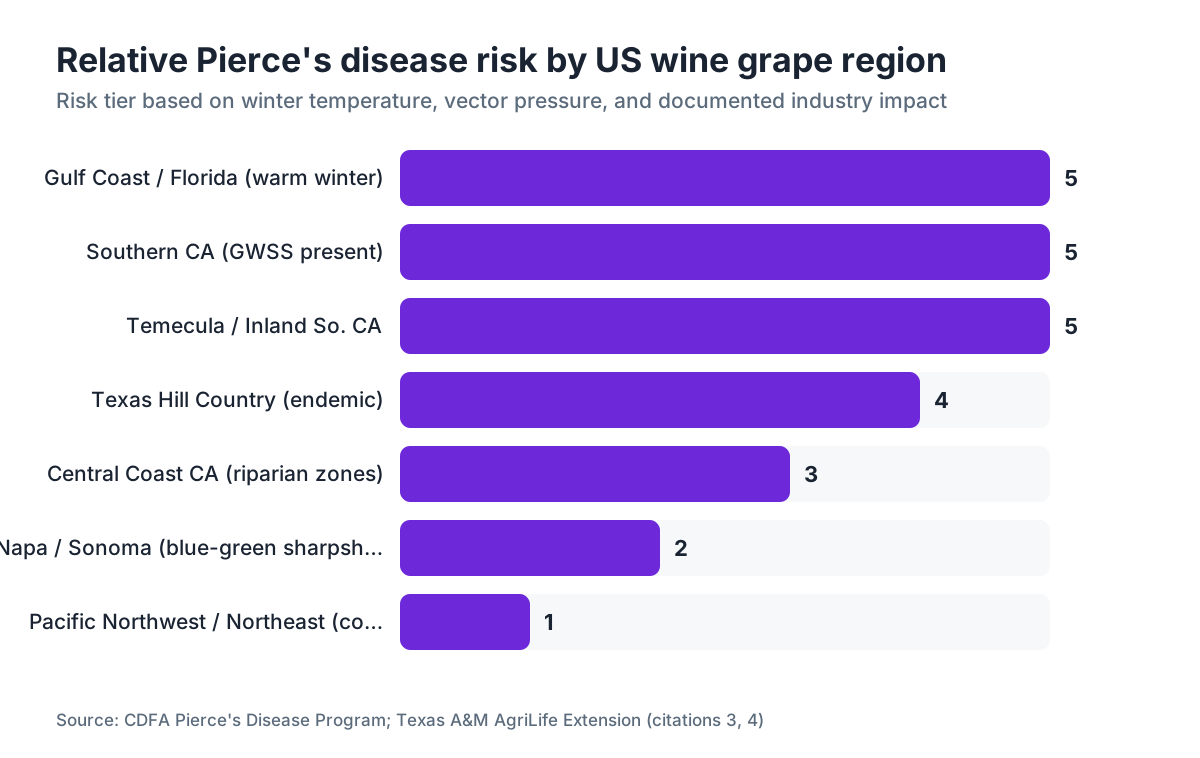
Any region where winters are warm enough that X. fastidiosa survives in vine tissue year-round is high-risk. The bacterium needs temperatures below about 32°F for extended periods to be killed back in the vine, so cold winters are essentially a natural check on the disease. This is why PD devastates vineyards in coastal southern California, the Gulf Coast states, Florida, and much of the Southeast, while it's far less of a sustained threat in higher-elevation or northern wine regions. [4]
The Temecula Valley in southern California had catastrophic losses in the late 1990s and early 2000s after the glassy-winged sharpshooter established there. Estimates at the time put industry losses in the tens of millions of dollars and prompted California to establish the Statewide Pierce's Disease/Glassy-Winged Sharpshooter Board. [3]
The Paso Robles wineries region sits in a risk zone where warm, dry summers and riparian corridors along Salinas River tributaries create localized PD pressure. Growers there watch sharpshooter populations closely each season.
Texas wine country around the Hill Country AVA has dealt with endemic PD pressure for decades, which is one reason the Texas High Plains and elevated sites near Fredericksburg have historically been more viable for European varieties. Some southeastern states essentially cannot grow V. vinifera sustainably in low-elevation, warm zones without accepting a very short vine lifespan. [4]
What management strategies actually reduce Pierce's disease losses?
There is no treatment that cures an infected vine. Management is about slowing the spread and protecting healthy vines. That means attacking the problem on two fronts: vector control and source reduction.
Vector control focuses on killing or repelling sharpshooters before they transmit X. fastidiosa. In California's glassy-winged sharpshooter management program, kaolin clay applications create a physical barrier that reduces sharpshooter feeding. Pyrethroid insecticides applied at vineyard borders and on adjacent host plants (especially citrus and ornamentals near vineyards) knock down adult populations. The Statewide PD Board has funded research showing that early-season border treatments, timed to adult sharpshooter movement into vineyards in spring, work better than whole-vineyard sprays later in summer. [3]
Source reduction means removing infected vines promptly. A vine with PD is a bacterial reservoir that vectors can acquire from and spread further into your block. Pulling symptomatic vines within the same season you identify them cuts inoculum. This is hard to convince people to do when a vine is still alive and carrying fruit, but it's the right call.
Riparian buffer management is underused. Mowing, disking, or chemically managing vegetation along drainage ditches and stream banks next to vineyards reduces the reservoir plant populations that both harbor X. fastidiosa and sustain sharpshooter populations during periods when vines are dormant. University of California Cooperative Extension (UCCE) farm advisors in high-risk counties can help map the highest-risk corridors near your property. [5]
Biological control of the glassy-winged sharpshooter using the egg parasitoid Gonatocerus ashmeadi has shown promise in California research, but it hasn't wiped out the vector. It cuts populations somewhat. Think of it as one layer, not a solution.
For growers in persistently high-pressure zones, variety selection matters even though no V. vinifera wine grape is immune. Some rootstock-variety combinations may last longer before succumbing, giving you more harvest years before you have to replant. UC Davis research has worked to introgress PD resistance from native Vitis species (especially V. arizonica), and some resistant varieties have been released for table grapes, though commercial wine grape releases with acceptable quality are still limited. [6]
Are there pesticides registered for Pierce's disease vector control, and what does compliance require?
Yes, several insecticide classes are registered for sharpshooter control in California and other states. Pyrethroids (bifenthrin, cyfluthrin), neonicotinoids (imidacloprid, thiamethoxam applied as soil drenches or foliar), and kaolin clay are among the tools growers use. Neonicotinoid soil applications take several weeks to move systemically through the vine, so timing relative to bloom and pollinator activity matters for both efficacy and compliance. [7]
The EPA Worker Protection Standard (WPS) applies to all pesticide applications in agricultural settings. Under 40 CFR Part 170, workers must receive pesticide safety training, have access to specific pesticide labeling information, and observe restricted-entry intervals (REIs) after applications. For many pyrethroids used for sharpshooter control, the REI is 12 hours. Always check the specific product label, because that label is the legal document. [8]
California has extra requirements. Pesticide applications must be reported to county agricultural commissioners via the Pesticide Use Report (PUR) system. California's Department of Pesticide Regulation (DPR) maintains the registered pesticide database, and any PD-related application in a quarantine area may carry additional reporting or notification requirements. [9]
Record-keeping is where a lot of small operations get caught short. You need to document the product, EPA registration number, application date, target pest, rate, acreage treated, and applicator. Tools like VitiScribe keep those spray records organized and exportable for commissioner inspections, which matters a lot in high-scrutiny quarantine zones.
If you're in a glassy-winged sharpshooter quarantine county in California, movement of plant material (including nursery stock and cut plant parts) out of quarantine zones is restricted. Know your county's status before you move cuttings or buy vines from nurseries in affected areas. [3]
What does current research say about Pierce's disease-resistant grape varieties?
This is the most active area of PD science right now. UC Davis has been breeding PD-resistant grapes since the 1990s, using wild Vitis species that carry natural resistance to X. fastidiosa, particularly V. arizonica from the desert Southwest. The resistance mechanism involves the plant restricting bacterial movement through the xylem rather than killing the bacterium outright. [6]
The UC Davis breeding program has released several resistant varieties, including "Ambulo Blanc," "Errante Noir," and a few others, but these are aimed mainly at table grape or raisin markets. Wine quality from first-generation resistant varieties has been the sticking point. Flavor compounds, acidity balance, and tannin structure haven't matched what winemakers need for premium production. Second- and third-generation breeding crosses are working to pair acceptable sensory profiles with resistance, and some experimental wine varieties look more promising, but none had reached commercial release as of 2024. [6]
The USDA's Agricultural Research Service (ARS) has added to this work, particularly through its national clonal repository at Davis and through collaborations with Texas A&M AgriLife Extension, which has tested varieties under high-pressure field conditions in Texas. [10]
Genetic transformation approaches, where resistance genes go directly into existing commercial varieties, have also been researched. These would let you take a Cabernet Sauvignon and give it PD resistance without decades of backcrossing. Regulatory hurdles for commercializing genetically modified grapevines are steep, and consumer acceptance in wine markets adds another layer of uncertainty. Nobody has a clear timeline for when this would reach the market.
How does Pierce's disease compare to other serious grapevine diseases in terms of economic impact?
PD sits in a different category from most other grapevine diseases because there's no treatment and no cure. You can manage downy mildew, powdery mildew, and even leafroll virus to varying degrees. With PD in a high-pressure zone, you're managing vine death rate, not vine health.
The California Department of Food and Agriculture estimated that by 2000, PD-related losses plus management costs had cost the California wine and table grape industries over $56 million per year, a figure that includes lost production, vine removal and replanting, and vector management costs. The actual figure today, accounting for inflation and expanded acreage, is likely higher, though current year-by-year data is scattered across county PUR records and commodity reports rather than one central report. [3]
In Temecula, the losses in the early 2000s were severe enough that some vineyards were abandoned or converted to other crops. The South Coast Winery region of California sits squarely in territory where glassy-winged sharpshooter pressure and PD remain ongoing management concerns, not historical footnotes.
For comparison, powdery mildew control costs California growers roughly $30-50 per acre per application across multiple sprays per season, but the vines survive and can be managed. PD in a high-pressure block might mean losing 10-30% of your vines per year, with replanting costs running $15,000 to $30,000 per acre depending on site prep, trellis work, irrigation installation, and plant material. Losing mature, producing vines is a completely different economic hit than managing a foliar disease. [11]
What records should vineyard managers keep related to Pierce's disease monitoring and management?
Good records do two jobs: they help you track disease spread across years, and they protect you during regulatory inspections. In California quarantine zones especially, documentation of your vector management program, scouting records, and pesticide applications can matter for compliance.
At minimum, record: sharpshooter scouting observations (date, block, trap counts or visual counts), any laboratory diagnostics with results and dates, vine removal records (date, block, number of vines pulled, GPS coordinates if possible), and all pesticide applications with the full WPS-required fields. [8]
Many managers keep a simple field notebook, which is fine, but paper records don't aggregate well when your county commissioner wants to see three years of spray records for a specific block. Digital records that link spray applications to blocks and GPS polygons make that retrieval instant. VitiScribe is built for vineyard operations and handles spray records in formats that match California PUR reporting requirements, which saves real time at the end of each quarter.
For monitoring sharpshooters specifically, yellow sticky traps placed at vineyard borders (especially near riparian areas) give you early warning of adult movement into your vineyard in spring. Record trap counts weekly during the high-risk period (typically March through June in California's Central Coast). A sudden spike in trap counts is your signal to apply border treatments before transmission events happen. UCCE farm advisors can help you read counts in your specific region. [5]
What should growers do if they find Pierce's disease in a new block for the first time?
Confirm the diagnosis first. Visual symptoms alone aren't enough to pull vines or trigger reporting. Send samples to a diagnostic lab, either your state's land-grant university plant disease clinic or a private accredited lab. The UC Davis Plant Pathology lab and Cornell's Plant Disease Diagnostic Clinic both handle these samples. [12]
While you're waiting for results, map the symptomatic vines precisely. Walk every row, mark which vines show petiole retention and leaf scorch, and record row and vine number. You want a baseline map so you can compare next season and understand whether the disease is spreading, how fast, and in which direction. That directional information tells you where vectors are entering.
If the diagnosis is confirmed: notify your county agricultural commissioner, especially in California or any state with active PD or GWSS programs. Check whether your property is already in a designated quarantine zone, because that affects what you can do with plant material. Contact your local UCCE farm advisor. They can help you develop a management plan and connect you with available cost-share programs for vector management. Some California counties have run programs that partially offset the cost of sharpshooter management in PD-affected areas. [3]
Plan for vine removal in the same growing season if possible. Don't wait until dormancy to pull symptomatic vines. You lose a full season of vector transmission time. And start border spray programs immediately if you're in GWSS territory, targeting the most likely vector entry points based on your vegetation map.
Frequently asked questions
Can a grapevine recover from Pierce's disease on its own?
Rarely, and only partially. In very cold climates, a hard winter can kill X. fastidiosa in the upper parts of the vine, and a vine may appear to recover the following season. This is called "winter curing" and it happens occasionally in regions with consistent temperatures below 32°F for extended periods. But the vine usually re-infects from surviving bacterial populations in the rootstock, and symptoms return. In warm climates there is essentially no natural recovery.
How long does it take for Pierce's disease to kill a grapevine?
In warm climates with high glassy-winged sharpshooter pressure, a vine infected early in the season can die within one to two years. In cooler climates where cold winters partially suppress the bacterium, vines may survive three to five years after infection while declining progressively. Infection late in the season may not kill the vine that year, but it almost always resumes spreading the following spring once temperatures warm.
Is Pierce's disease only a problem in California?
No. Pierce's disease occurs across the southeastern United States, Texas, parts of the Gulf Coast, and in localized areas of other warm-winter states. Texas, Florida, Georgia, and neighboring states have had endemic PD pressure for over a century, which is a major reason V. vinifera wine production is limited or challenging in those regions. California's problem became acute after the glassy-winged sharpshooter established there in the late 1990s.
What's the difference between Pierce's disease and powdery mildew or bunch rot?
Powdery mildew and bunch rot are fungal diseases that respond to fungicide programs. An infected vine can be managed and saved. Pierce's disease is bacterial, has no chemical cure, and kills the vine over time. Symptom-wise, PD causes leaf margin scorch and petiole retention (the leaf drops but leaves the petiole stub). Powdery mildew shows white powdery growth on leaf surfaces and berries. They look nothing alike up close.
Can I replant in a block where Pierce's disease killed my vines?
Yes, the soil itself isn't infected. X. fastidiosa doesn't persist in soil; it lives only in plant hosts and insect vectors. The decision to replant depends on whether you've reduced vector pressure and removed infected reservoir plants nearby. If the riparian corridor that sustained the sharpshooter population is still there and unmanaged, you'll likely lose the replanted vines too. Address the vector source before you replant.
Do all sharpshooter leafhoppers carry Xylella fastidiosa?
No. A sharpshooter needs to feed on an infected plant first to acquire X. fastidiosa, and not every individual in a sharpshooter population carries the bacterium at any given time. Infection rates in sharpshooter populations vary by location and season. What makes sharpshooters dangerous is that they're efficient transmitters once infected and they move between many plant species, picking up and depositing the bacterium across a wide area.
What university extension programs have the best Pierce's disease resources?
UC Cooperative Extension and UC Davis are the most extensive sources, given California's history with the glassy-winged sharpshooter crisis. UC Davis Plant Pathology and the UCCE county farm advisors in Napa, Sonoma, Riverside, and San Diego counties have published detailed management guides. Texas A&M AgriLife Extension covers PD under Gulf Coast and Hill Country conditions. Cornell's viticulture program has resources relevant to eastern US vector species.
Are there any organic options for controlling sharpshooters that spread Pierce's disease?
Kaolin clay (Surround WP) is OMRI-listed and can reduce sharpshooter feeding when applied as a physical barrier. It's not a kill product; it deters feeding. The egg parasitoid Gonatocerus ashmeadi is a biological option available commercially in California. It reduces glassy-winged sharpshooter populations but doesn't eliminate them. Organic programs in high-pressure zones are harder to make work because the most effective knockdown insecticides (pyrethroids, neonicotinoids) aren't organically approved.
How do I know if my vineyard is in a glassy-winged sharpshooter quarantine zone?
California's CDFA maintains the current quarantine boundaries, which change as new detections occur. Check the CDFA Pest and Damage Record database or contact your county agricultural commissioner directly. County commissioners are the enforcement contact point and can tell you exactly what movement restrictions and reporting requirements apply to your property. Don't rely on outdated maps; quarantine boundaries have shifted repeatedly over the past two decades.
What are the symptoms of Pierce's disease in early spring versus late summer?
Early spring symptoms are hard to see. Infected vines may push buds late or weakly, or some buds may fail entirely. By mid-to-late summer the classic symptoms appear: marginal leaf scorch, petiole retention after leaf drop, and irregular cane lignification (green islands). The late-summer presentation is more diagnostic. Early-season inspection is mainly useful for spotting vines that failed to push or showed stunted growth compared to their neighbors.
Does Pierce's disease affect all Vitis species equally?
No. Vitis vinifera (European wine grapes) is highly susceptible and typically dies within a few years of infection. Many American native species like Vitis arizonica and Vitis rupestris show varying degrees of tolerance or resistance. Muscadine grapes (Vitis rotundifolia) are notably tolerant of Pierce's disease, which is one reason they can be grown in the southeastern US where European varieties fail. These differences in host resistance drive the UC Davis breeding program.
Can the glassy-winged sharpshooter spread to my vineyard from my neighbor's citrus trees?
Yes. Citrus is one of the preferred host plants for the glassy-winged sharpshooter, and ornamental and agricultural citrus next to vineyards is a documented source of adult sharpshooters moving into vines. This is why California's GWSS management program has historically included sharpshooter treatment requirements for citrus nurseries and groves in quarantine counties. If you have citrus neighbors, talk to your county advisor about border treatment timing.
What does the EPA Worker Protection Standard require for Pierce's disease insecticide applications?
The WPS (40 CFR Part 170) requires that all agricultural workers and handlers receive pesticide safety training before working in treated areas, that they have access to product labeling and safety data sheets, and that restricted-entry intervals are observed. For sharpshooter control products, REIs range from 4 hours to 24 hours depending on the product. Employers must post application information at a central location and provide decontamination supplies at the application site.
Sources
- USDA Agricultural Research Service, Xylella fastidiosa overview: X. fastidiosa is a xylem-limited bacterium that colonizes plant water-conducting vessels, forms aggregates, and causes hydraulic failure in infected hosts.
- UC Davis Plant Pathology, Pierce's Disease of Grapevines: Pierce's disease symptoms include marginal leaf scorch, petiole retention after leaf drop, and irregular cane lignification; there is no cure.
- California Department of Food and Agriculture, Pierce's Disease / Glassy-Winged Sharpshooter Program: California established the Statewide Pierce's Disease/Glassy-Winged Sharpshooter Board after GWSS establishment in the late 1990s caused losses estimated over $56 million per year to the state's grape industry.
- Texas A&M AgriLife Extension, Pierce's Disease of Grapes: Pierce's disease occurs across the southeastern US and Texas, severely limiting V. vinifera production in warm-winter, low-elevation zones.
- UC Cooperative Extension, Integrated Pest Management for Pierce's Disease: ELISA and PCR are standard diagnostic tools for confirming X. fastidiosa; sample collection from symptomatic mid-to-late summer cane tissue is recommended for accurate results.
- UC Davis Department of Viticulture and Enology, Pierce's Disease Resistant Grape Breeding: UC Davis has been breeding PD-resistant grapes using Vitis arizonica since the 1990s; released resistant varieties to date have targeted table or raisin markets rather than premium wine production.
- UC IPM Pest Management Guidelines: Grape, Leafhoppers and Sharpshooters: Pyrethroids, neonicotinoids (soil drench and foliar), and kaolin clay are registered for sharpshooter control in California vineyards; neonicotinoid soil applications require several weeks to move systemically.
- US EPA, Worker Protection Standard (40 CFR Part 170): The EPA Worker Protection Standard requires pesticide safety training, access to labeling, and observation of restricted-entry intervals for all agricultural workers and handlers.
- California Department of Pesticide Regulation, Pesticide Use Reporting: California requires all agricultural pesticide applications to be reported to county agricultural commissioners via the Pesticide Use Report system.
- USDA Agricultural Research Service, National Clonal Germplasm Repository, Davis CA: USDA ARS has contributed to PD-resistant grape breeding research and maintains the national clonal grapevine repository at Davis, California.
- UC Cooperative Extension, Cost of Production Studies for Wine Grapes: Vineyard establishment costs in California range from approximately $15,000 to $30,000 per acre depending on site preparation, trellis, irrigation, and plant material.
- Cornell University Plant Disease Diagnostic Clinic: Cornell's Plant Disease Diagnostic Clinic processes samples for X. fastidiosa and other grapevine pathogens serving northeastern US growers.
Last updated 2026-07-09