Downy mildew infection period calculation using temperature and moisture

TL;DR
- Grape downy mildew (Plasmopara viticola) infection needs three things to line up: temperatures above 10°C (50°F), at least 10mm of rainfall, and 10 or more continuous hours of leaf wetness.
- That 10/10/10 rule opens primary infection season.
- Secondary cycles need 6+ hours of wetness at 15-25°C.
- Track your local degree-day accumulation and moisture windows, and you know when to spray.
What is the 10/10/10 rule for downy mildew infection?
The 10/10/10 rule is the first thing every grape grower should memorize. It describes the minimum conditions for the season's first primary infection by Plasmopara viticola, the water mold that causes grape downy mildew.
Three thresholds. Soil temperature at or above 10°C (50°F) at a depth of about 10 cm, at least 10 mm (roughly 0.4 inches) of cumulative rainfall since budbreak, and 10 or more continuous hours of leaf wetness. All three have to hit within the same event or a closely overlapping window. Miss one and primary infection doesn't happen from that weather event.
This framework goes back decades. Goidanich (1959) laid out the original thresholds, and extension programs at Cornell and UC Davis later built them into their guidance [1][2]. It's not a perfect model. It is a field heuristic that holds up across most North American wine regions.
Here's what growers get wrong: they watch rainfall totals and ignore soil temperature until May. If your spring is cold and your soil hasn't cracked 10°C yet, a heavy rain won't trigger primary infection. Flip it around and a warm early spring with even a modest rain can bring all three together faster than you'd expect, especially in regions like Paso Robles or California's central coast, where vineyards see early warm spells.
How do you calculate downy mildew infection periods step by step?
Calculating infection periods isn't hard once you know what data you need and where to get it. Work through it in five steps.
Step 1: Confirm you're past budbreak and have picked up at least 10 mm of rain since then. If you use a weather station or a state agricultural network (California Department of Food and Agriculture's network, or Cornell's NEWA), a cumulative rainfall query gives you this in seconds [3].
Step 2: Check soil temperature. A soil thermometer at 10 cm depth works fine. Soil temperature lags air temperature by days to weeks depending on soil type and cover crop, so don't assume air temp equals soil temp.
Step 3: Track leaf wetness duration. This is where most growers fall short. A leaf wetness sensor mounted directly in the vine canopy beats modeled estimates from relative humidity and air temperature every time. Put the sensor at mid-canopy height, where disease pressure is greatest. Wetness events under 6 hours rarely cause meaningful secondary infection. Events over 10 hours during primary season are high-risk [1].
Step 4: Apply the temperature-duration matrix for secondary infections. Once primary season opens, judge every rain or heavy dew event on temperature and wetness hours rather than the 10/10/10 thresholds. At 15°C you need roughly 12 hours of wetness. At 20-25°C, the sweet spot for Plasmopara viticola, 6 hours can be enough. Above 30°C, infection is suppressed even with plenty of moisture [2].
Step 5: Turn your local conditions into a spray decision. The infection period calculation tells you when infection is possible, not whether it already happened. Protectant fungicides have to go on before a wetness event. After an unprotected infection event, you're down to curative options with a shrinking window, usually 24-48 hours post-infection for most DMI or QoI fungicides [4].
What temperature range does Plasmopara viticola need to sporulate and infect?
Plasmopara viticola works across a wider range than many growers realize, but it has a clear sweet spot.
Sporulation, the release of sporangia, needs free water on the leaf surface, darkness or low light, and temperatures between 13°C and 28°C. It runs fastest between 18°C and 22°C [2]. That's why early-morning dew events, the ones that linger past sunrise, are so dangerous. The pathogen sporulates overnight and the spores are ready to germinate the moment free water shows up.
Germination of sporangia and zoospore release happens between 5°C and 21°C. Above 21°C, sporangia germinate directly instead of releasing zoospores, which is less efficient and slightly less infectious. The absolute floor for infection sits around 5°C, though at that temperature you need extremely long wetness periods (24+ hours) and infection rates stay very low [5].
Oospores, the overwintering sexual spores behind primary infection, germinate best between 10°C and 15°C. That range overlaps the spring soil-warming window, which is exactly why the 10/10/10 rule sets 10°C as its temperature threshold.
What this means in the field: temperatures between 15°C and 25°C with any sustained leaf wetness are your highest-risk window. If the forecast shows overnight lows staying in that range with rain or heavy dew, that's when your spray program has to be airtight.
How many hours of leaf wetness are actually required for infection?
The honest answer: it depends on temperature, and the relationship is nonlinear.
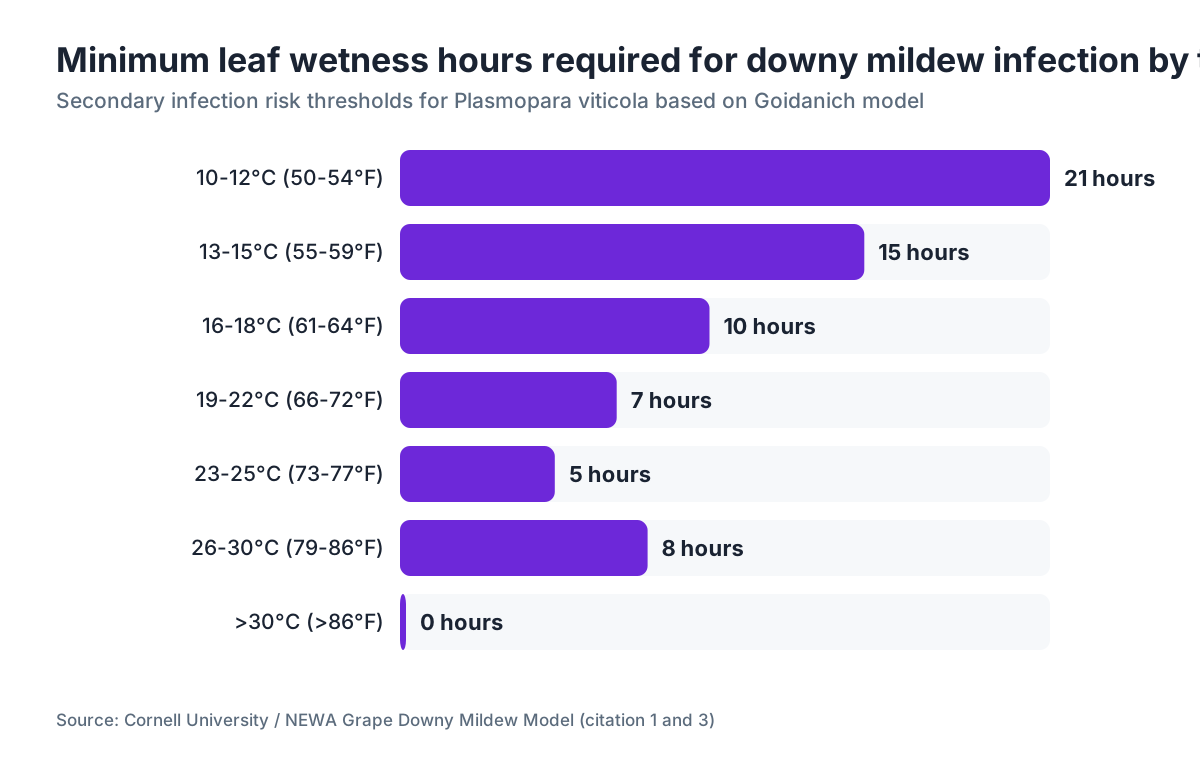
At 15°C, most published research (and the models UC Davis and Cornell recommend) puts the number at roughly 10-12 hours of continuous leaf wetness for meaningful primary infection risk [1][2]. At 20°C, that drops to around 6 hours. At 25°C, some studies show infection possible in as few as 4 hours, though field conditions rarely deliver ideal-temperature, long-wetness combinations at that temperature because warm days dry canopies faster.
Wetness duration drives spray timing. A grower who sees 5 hours of rain at 18°C and skips a spray is taking a real but modest risk. The same grower who ignores a 10-hour overnight dew event at 20°C has almost certainly had an unprotected infection event.
The table below shows approximate minimum wetness durations at key temperatures for secondary infection risk, based on the Goidanich model as interpreted by Cornell extension [1]:
| Temperature (°C) | Min. wetness for infection risk | Risk level |
|---|---|---|
| 10-12 | 18-24 hours | Low |
| 13-15 | 12-18 hours | Low-moderate |
| 16-18 | 8-12 hours | Moderate |
| 19-22 | 6-8 hours | High |
| 23-25 | 4-6 hours | High |
| 26-30 | 6-10 hours | Moderate (slowing) |
| >30 | Infection suppressed | Very low |
Nothing replaces an actual leaf wetness sensor. Models built on relative humidity consistently underestimate wetness duration in dense canopies.
What disease models and forecasting tools actually work in the field?
Several validated models exist, and growers in different regions get different tools. Here's what's real and available.
The PLASMO model, developed in Italy and widely cited in European viticulture research, is one of the more mechanistic options. It models oospore maturation using degree-day accumulation, then tracks infection events with temperature and leaf wetness data. It's accurate, but it wants hourly weather inputs that not every grower has [5].
For North American growers, Cornell's Network for Environment and Weather Applications (NEWA) is probably the most accessible validated tool. It runs the Grape Downy Mildew model (built on Goidanich's original work) using weather station data and puts out daily infection risk. You pick your nearest NEWA station or connect your own, and it tells you when infection periods have occurred [3]. It's free and maintained by Cornell Cooperative Extension.
UC Davis and the UC Agriculture and Natural Resources (UC ANR) system publish the UC IPM Pest Management Guidelines for grapevine, with temperature and wetness thresholds calibrated to California conditions. These aren't an automated model, but they hand you the decision criteria to run your own calculations [2].
WSU's Decision Aid System (WSU-DAS) covers multiple pathogens, downy mildew included, for Pacific Northwest growers [6]. It pulls from local weather station networks and is calibrated for the cooler, wetter conditions of Washington and Oregon vineyards.
Logging weather data manually or from a simple station? A spreadsheet tracking daily minimum and maximum temperature, rainfall, and estimated wetness hours is genuinely workable. It's not elegant. It beats nothing. Tools like VitiScribe let you attach weather-based spray triggers to your field records, so you can look back at any event and see what conditions came before it, which matters a lot for compliance documentation.
Compliance isn't an afterthought here. EPA's Worker Protection Standard (WPS) and most state pesticide rules require you to document spray application dates, rates, and justification for fungicide applications [7]. A weather log that shows the infection period calculation is your justification.
How does degree-day accumulation predict the start of primary infection season?
Degree-day (DD) accumulation predicts when oospores in overwintered leaf debris have matured enough to release zoospores during the first rain event. It gives you a biological clock instead of a calendar date.
The base temperature for Plasmopara viticola oospore maturation is 8°C. You start counting degree-days from January 1 in most North American models, using DD = ((daily max temp + daily min temp) / 2) minus 8. Days where the average falls below 8°C add zero.
Cornell's NEWA model flags primary infection risk when accumulated degree-days pass a threshold AND the 10 mm rainfall criterion is met. The exact DD threshold shifts a little by model version, but most implementations use the 10/10/10 rule as a gate before any degree-day calculation even counts [1][3].
Here's how it plays out. A cool, late spring can push primary infection risk out to late May even in a warm region. A warm February and March can bring primary risk on by mid-April in places like the Willamette Valley or Napa. Watching degree-day accumulation from January gives you two to three weeks of warning to get your spray program ready.
One trap: degree-day accumulation for Plasmopara viticola maturation isn't the same calculation used for most insect pests, where base 10°C or 50°F is common. Use the wrong base temperature and you get garbage predictions. Confirm your model's base temp before you trust its output.
What's the incubation period after infection, and how does it affect spray timing?
After a successful infection event, symptoms don't show up right away. The incubation period, from infection to visible oil spots on leaves, runs from about 5 days at 25°C to 12-18 days at 12-15°C [2][5].
That lag sets your scouting calendar and your curative spray window. If you had an unprotected infection event on a Tuesday night, you have roughly 24-48 hours to apply a curative fungicide (a DMI or strobilurin with post-infection activity) before the infection moves past the point where those products work well [4]. By day four or five, you're no longer treating the infection. You're protecting healthy tissue against the sporulation that's about to start.
Visible sporulation on the lower leaf surface, the classic white downy growth that names the disease, shows up after the full incubation period. Once you see it, that tissue is already firing millions of sporangia into the next wetness event. The cycle runs fast.
Scout hard 7-10 days after any high-risk infection period. Check the undersides of leaves, especially basal leaves and clusters. Catching oil spots early gives you time to adjust your program before a sporulation event sets the season back.
Incubation also tells you how soon you can judge whether a spray worked. Apply a protectant before an infection event, see no symptoms after 14 days at warm temperatures, and that's a fair signal of efficacy. Shorter intervals in cool weather don't tell you much.
How do you track and record infection periods for spray compliance records?
Spray application records are a legal requirement under EPA WPS and nearly every state's pesticide law, and they should capture more than date, product, and rate [7]. A complete record for downy mildew management documents the infection period data that drove the spray decision.
At minimum, log this for each spray event: application date and time, product name and EPA registration number, rate applied per acre, growth stage at application (the BBCH scale is most useful), weather at application (temperature, wind speed, relative humidity), and the infection period trigger, meaning the wetness event, rainfall amount, temperature range, and duration that prompted the spray.
Using a disease model like NEWA or WSU-DAS? Print or save the model output for that date and attach it to your record. That output is your documented justification. It shows an auditor you were making a science-based decision, not spraying on a calendar.
EPA WPS requires pesticide application records be kept for at least two years and be available for inspection [7]. California's Department of Pesticide Regulation (CDPR) requires licensed pest control advisors to keep application records, and many counties require monthly pesticide use reports [8]. Check your state's requirements, because they vary a lot.
For growers running multiple blocks with different varietals and disease pressure histories, VitiScribe can connect infection period calculations directly to your spray log, so compliance documentation becomes a byproduct of normal record-keeping instead of extra work.
One practical note. Keep your weather records separate from your spray records but cross-referenced by date. If you ever face a pesticide use complaint or an audit, the weather data that explains why you sprayed on a given day is your clearest defense.
Which grapevine growth stages are most susceptible to downy mildew infection?
Susceptibility swings hard across the season, and knowing the critical windows lets you concentrate spray pressure where it counts.
Flowers and newly formed berries, from pre-bloom through about 4 weeks after fruit set (roughly BBCH 55-75), are the most susceptible tissues. An infection during bloom that slips past you can wreck the entire cluster. UC Davis extension is blunt that the bloom-to-early-berry period is when you cannot afford an unprotected infection event [2].
Leaf susceptibility peaks on young, expanding leaves. Leaves more than about 25-30 days old build some physical resistance as the cuticle thickens, though they never go fully resistant. Basal leaves, the oldest, are generally less vulnerable than shoot-tip leaves.
Past BBCH 79, when berries are roughly pea-sized and skins are toughening, cluster susceptibility drops sharply. Most extension guidelines say you can back off spray frequency after berry closure, especially if weather is trending drier and warmer [1][2]. That's not a reason to stop scouting. Late-season downy mildew on leaves can defoliate vines and weaken next year's canes.
Growth stage also shapes your fungicide options. Certain FRAC group fungicides work better on young tissue. Copper-based materials show up more at or after berry closure, when the risk of phytotoxicity on fruit is lower. Always check the product label for growth stage restrictions before you spray.
How does canopy management affect infection period risk?
Canopy architecture changes how fast a wetness event dries and how long free water sits on leaf surfaces. Dense, unmanaged canopies can stretch effective wetness duration by two to four hours compared to well-hedged, shoot-positioned vines, based on measurements published in New Zealand viticultural research [9].
Shoot positioning is the single highest-leverage canopy practice for downy mildew. Position shoots uniformly and airflow through the canopy jumps, so leaves dry faster after rain or dew. That directly shortens the wetness duration component of your infection period calculation.
Leaf removal around the cluster zone, usually done at BBCH 57-65 in most training systems, opens the fruiting zone to sunlight and airflow. It cuts infection risk on clusters, and it makes spray penetration far better, so your fungicide actually reaches the tissue that needs protecting.
Cover crop management matters too. Dense, tall cover crops slow air movement near the vine base and raise humidity in the lower canopy. Mowing or rolling cover crops before major rain events is a simple practice that shortens your effective wetness window.
None of this eliminates infection risk. A 12-hour rain event at 22°C creates infection conditions in even the most open canopy. But these practices compress the marginal events, the 4-6 hour dew events that might or might not cross your threshold, into the non-infectious range. That can save you two to three sprays a season.
What fungicides work best for different stages of the infection period?
Fungicide timing relative to the infection event decides which products fit and how well they'll work.
Protectant fungicides (copper, mancozeb, folpet) have to be on the vine before the wetness event starts. They kill sporangia before penetration. Copper compounds are OMRI-listed for organic programs and have been used in viticulture since the late 19th century, though repeated use has raised soil copper accumulation concerns in many regions [2][4].
Systemic fungicides with kick-back (curative) activity, mainly DMIs (FRAC group 3, e.g., myclobutanil, tebuconazole) and carboxylic acid amides (FRAC group 40, e.g., mandipropamid, dimethomorph), can go on within 24-48 hours post-infection and still halt disease development. That curative window shrinks fast above 20°C because the pathogen develops faster [4].
Resistance management is serious, and the USDA and Fungicide Resistance Action Committee guidelines are clear: no more than two consecutive applications of any single FRAC group, and rotate to unrelated modes of action [4][10]. Phosphonate fungicides (fosetyl-Al, phosphorous acid) show up in rotation and carry both protective and systemic activity, though resistance has been documented in some European populations.
Label rates matter. Cutting rates to stretch a spray budget is a common mistake that speeds up resistance and leaves protection gaps. The label rate is the legal rate and the efficacy rate. Going below it on a registered product is a federal pesticide law violation under FIFRA [7].
How is downy mildew infection risk different in dry vs. humid climates?
Same pathogen, very different management math depending on where your vineyard sits.
In humid regions (eastern US, Pacific Northwest, parts of Chile and South Africa), leaf wetness events are frequent and long. Growers there often run a calendar-plus-infection-period approach: base spray intervals of 7-10 days, tightened to 5-7 days during active infection periods. Cornell's extension guidelines are calibrated for exactly this [1].
In drier wine regions (California's Central Valley, parts of Spain and Australia), moisture is the limiting factor, not temperature. Long dry stretches can break the disease cycle entirely, and growers may go weeks without a meaningful infection risk event even at peak season. Irrigation matters here. Overhead irrigation or late-evening drip events that wet foliage can build artificial infection windows in otherwise low-risk conditions.
Coastal California, from Mendocino down through Santa Barbara, sits in a strange middle ground. Fog and marine layer can hold sustained leaf wetness without rain, sometimes 8-10 hours overnight. The 10 mm rainfall threshold of the 10/10/10 rule doesn't apply to fog-driven wetness, so primary infection season can start on oospore maturity and dew alone once winter cumulative rainfall conditions are met [2].
Mountain vineyards at higher elevations often see overnight temperatures drop below the infection threshold even in summer, which cuts secondary cycle risk. But warm days followed by cool, wet nights can create temperature inversions that pool moisture in specific blocks, usually on the valley floor or in drainage areas.
How do you interpret a disease model output to make an actual spray decision?
Model output tells you infection risk. It doesn't tell you whether to spray. That step takes judgment, and here's how experienced growers make it.
First, look at the severity of the infection period the model flagged. Most models put out a severity index (sometimes called a Mills Period equivalent, borrowed from apple scab modeling). A low-severity event at low inoculum pressure early in the season might not warrant a spray. A high-severity event at bloom with visible sporulation nearby is a different story.
Second, weigh your spray interval and residue life. Most protectant fungicides give 7-10 days of protection under low to moderate disease pressure, less in heavy rain that washes product off. If you sprayed 5 days ago with good coverage and the event was borderline, you may still be covered. If it's been 9 days and the event was high-severity, spray.
Third, check the forecast for the next 5-7 days. A high-risk event followed immediately by 10 more days of similar weather is a different animal than a one-day event before a week-long dry stretch. Your curative window matters most when you're chasing a past event. Your protectant timing matters most when you're looking forward.
Fourth, be honest about your coverage. Model output assumes fungicide coverage actually happened. If you had application issues (equipment trouble, wind, missed rows), knock down your confidence in your protection level.
Nobody has clean data on how often growers read model outputs correctly versus falling back on calendar sprays. The closest published comparison, from a Cornell/NYS IPM study, found model-guided programs averaged 1.6 fewer sprays per season than calendar programs with no meaningful yield loss difference. The models work when you follow them consistently [3].
Frequently asked questions
What is the 10/10/10 rule for grape downy mildew?
The 10/10/10 rule says primary infection by Plasmopara viticola needs three simultaneous conditions: soil temperature at or above 10°C at 10 cm depth, at least 10 mm of cumulative rainfall since budbreak, and 10 or more consecutive hours of leaf wetness. All three must occur together. It's a field heuristic from Goidanich's original research, used in Cornell and UC Davis extension programs.
What temperature is too cold for downy mildew infection?
Infection becomes very unlikely below 5°C even with prolonged leaf wetness. Sporulation and zoospore release need at least 5°C, and germination rates stay extremely low below 10°C. In practice, if your overnight minimum drops below 8-10°C consistently, infection risk for that event is low. The pathogen overwinters as oospores in soil and leaf debris, but it doesn't actively infect tissue during cold conditions.
Can dew alone trigger a downy mildew infection period without rain?
Yes. Dew can build infection conditions for secondary cycles if it lasts long enough at the right temperature. The 10 mm rainfall threshold applies specifically to primary infection triggered by oospore germination. Secondary infection by sporangia only needs free moisture on leaf surfaces, whatever the source. Coastal fog zones are especially prone to secondary infection events driven entirely by overnight dew and marine layer.
How long does downy mildew take to show symptoms after infection?
Incubation takes 5 to 18 days depending on temperature. At 25°C, oil spots may appear in as few as 5 days. At 12-15°C, it can take 14-18 days. This lag is why post-infection curative sprays have to go on within 24-48 hours of a known infection event. Wait until symptoms are visible and you're past the curative window entirely.
What is the best free tool to track downy mildew infection periods?
Cornell's Network for Environment and Weather Applications (NEWA, at newa.cornell.edu) is free, peer-validated, and covers most eastern US states plus some western stations. It runs a Grape Downy Mildew model on local weather station data and outputs infection risk daily. WSU's Decision Aid System covers Pacific Northwest growers. Both beat manual calculation for most small to mid-sized operations.
How do I document infection periods for pesticide application records?
Log the wetness duration, rainfall amount, temperature range, and model output (if you use one) for any infection event that drives a spray decision. The EPA Worker Protection Standard requires application records kept for at least two years. In California, monthly use reports are required in many counties. Cross-referencing your spray log with dated weather data gives you a defensible paper trail for any compliance inspection.
Does downy mildew infect grapes at temperatures above 30°C?
Infection is strongly suppressed above 30°C. High temperatures disrupt zoospore release and germination. Sporulation essentially stops above 28°C. But short high-temperature days followed by cooler nights with dew can still create infection conditions if the nighttime temperature drops back into the 15-25°C range before dawn. Don't assume a hot day means you're safe if nights cool off fast.
How does a dense canopy affect my infection period calculation?
Dense, unmanaged canopies can stretch effective leaf wetness by two to four hours compared to open, shoot-positioned canopies, based on published New Zealand viticultural research. So the same rain that produces a non-infectious 5-hour wetness period in a well-managed vine can produce an infectious 7-8 hour period in a dense canopy. Shoot positioning and cluster-zone leaf removal are your highest-leverage practices for shortening infection period length.
When in the season does downy mildew risk peak?
Risk peaks from pre-bloom through 4 weeks after fruit set, roughly BBCH 55-75. Flowers and young berries are the most susceptible tissues. A single unprotected infection event during bloom can destroy the entire cluster. Leaf susceptibility also peaks during rapid spring shoot growth. Risk falls off after berry closure as skin thickness increases and temperatures generally warm and dry.
What's the difference between primary and secondary downy mildew infection?
Primary infection comes from oospores in overwintered leaf debris germinating with spring rain and warmth, governed by the 10/10/10 thresholds. Secondary infection comes from sporangia produced on infected leaf tissue, released into new moisture events. Secondary cycles can repeat every 5-14 days through the growing season as long as wetness and temperature stay favorable. Secondary cycles cause most of the season's crop damage.
How often should I spray fungicides if there are repeated infection periods?
Protectant fungicides need reapplication every 7-10 days under active infection conditions, and after any significant rain event (more than 1-1.5 inches) that washes residue off. During bloom through early berry set, most extension programs recommend tightening to 5-7 day intervals regardless of weather, because a missed event costs too much. Adjust based on disease pressure history, varietal susceptibility, and what your models show.
Are some grape varieties more susceptible to downy mildew than others?
Yes, significantly. Vitis vinifera varieties are generally highly susceptible. Among common ones, Chardonnay, Merlot, and Muscat rank more susceptible; Cabernet Sauvignon and Sangiovese show moderate susceptibility. American hybrids and some interspecific crosses (like those from the INRAE breeding programs in France) carry real downy mildew resistance. Check your variety's susceptibility rating from your state's extension service before you finalize a spray program.
What does FRAC group rotation mean for downy mildew fungicides?
FRAC (Fungicide Resistance Action Committee) groups classify fungicides by mode of action. For downy mildew, key groups include FRAC 4 (phenylamides, e.g., mefenoxam), FRAC 40 (carboxylic acid amides, e.g., mandipropamid), and FRAC 3 (DMIs). Never apply more than two consecutive sprays from the same FRAC group. Resistance to mefenoxam (FRAC 4) is already widespread in many regions. Rotate groups every spray and include multi-site protectants like copper or mancozeb.
Sources
- Cornell University, New York State IPM Program, Grape Disease Management Guidelines: The Goidanich 10/10/10 rule for primary infection thresholds and the NEWA Grape Downy Mildew model methodology and leaf wetness duration thresholds by temperature
- UC Agriculture and Natural Resources, UC IPM Pest Management Guidelines: Grape, Downy Mildew: Temperature and wetness thresholds for Plasmopara viticola infection, incubation periods by temperature, growth stage susceptibility from pre-bloom through berry closure, and California coastal fog conditions
- Cornell University, Network for Environment and Weather Applications (NEWA): NEWA Grape Downy Mildew model uses degree-day accumulation from January 1 with base 8°C and 10/10/10 thresholds; IPM study found model-guided programs averaged 1.6 fewer sprays per season than calendar programs
- UC Agriculture and Natural Resources, Fungicide Resistance Management in Grapevines: Curative window for DMI and QoI fungicides is 24-48 hours post-infection; FRAC group rotation requirements; at-label rate requirement for efficacy and resistance management
- Goidanich, G. (1959), as reviewed in Bulit, J. and Lafon, R., Compendium of Grape Diseases, American Phytopathological Society: Original thresholds for Plasmopara viticola oospore maturation, zoospore release temperature range 5-21°C, and incubation periods from 5 days at 25°C to 18 days at 12°C
- Washington State University Extension, WSU Decision Aid System (DAS): WSU-DAS integrates Pacific Northwest weather station data for downy mildew and other pathogen infection period modeling calibrated to cooler, wetter conditions
- U.S. Environmental Protection Agency, Worker Protection Standard (WPS), 40 CFR Part 170: EPA WPS requires pesticide application records be kept for at least two years and be available for inspection; applying below label rate is a violation of FIFRA
- California Department of Pesticide Regulation, Pesticide Use Reporting: California DPR requires licensed pest control advisors to maintain application records; many counties require monthly pesticide use reports
- New Zealand Institute for Plant and Food Research, Canopy management and leaf wetness duration in vineyards: Dense, unmanaged canopies can extend effective leaf wetness duration by two to four hours compared to open, shoot-positioned vines
- USDA Agricultural Research Service, Fungicide Resistance Action Committee (FRAC) Guidelines for Grapevine Pathogens: FRAC rotation guidelines: no more than two consecutive applications from the same FRAC group; resistance to mefenoxam (FRAC 4) documented in multiple regions
Last updated 2026-07-11