Early season botrytis sprays for vineyards: timing, products, and resistance management
TL;DR
- Botrytis bunch rot starts with infections during bloom, not at harvest.
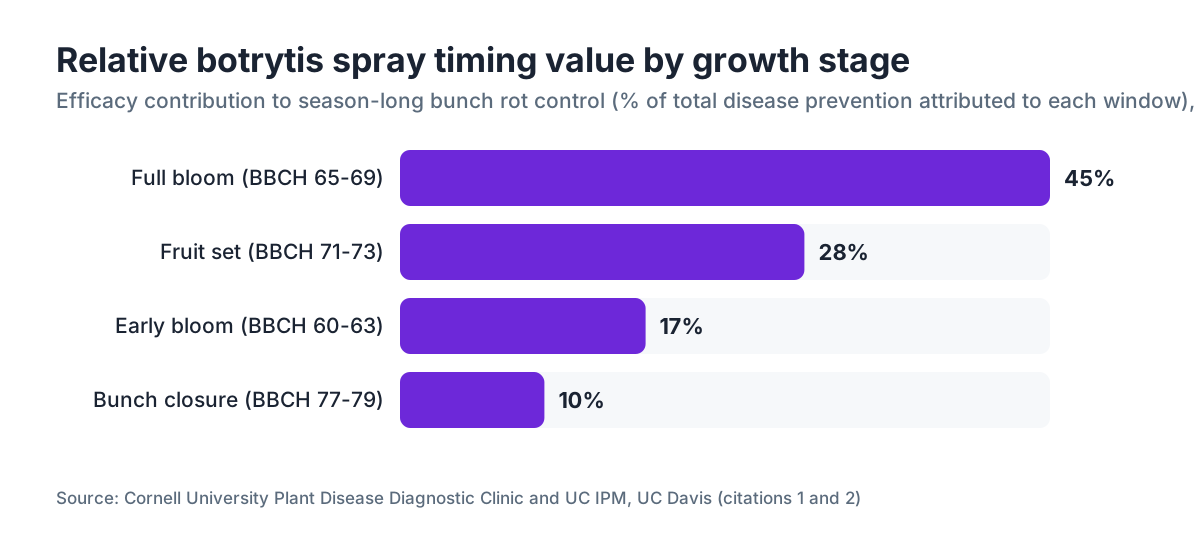
- The best early-season program hits three windows: early bloom (10-30% flower open), full bloom, and fruit set.
- Rotate FRAC groups 1, 7, 9, and 17 to slow resistance.
- A single well-timed bloom spray can cut bunch rot incidence by 50% or more in susceptible varieties.
Why does early-season timing matter more than late-season rescue sprays?
Botrytis cinerea infects grapevines long before you see gray mold on berries. The fungus colonizes flower parts, especially the anthers and cap stems, and those infected tissues get trapped inside the developing cluster. By the time bunch rot shows up in August or September, you're looking at the outcome of infections that started in May or June. Late-season sprays slow the spread. They don't undo that early colonization.
The classic Cornell research on this is clear: infections during bloom are the primary driver of bunch rot severity at harvest, especially in tight-clustered varieties like Chardonnay, Pinot Noir, and Riesling [1]. Spraying at or near harvest is reactive. The growers who keep botrytis below economic thresholds year after year are the ones who protect the cluster during flowering, not the ones spraying Elevate every two weeks in August.
There's another reason early sprays earn their keep. Bloom-window applications hit a brief, predictable period when the cluster is open and spray penetration is actually possible. Once the canopy closes and berries swell, getting fungicide into cluster interiors becomes nearly impossible without air-blast equipment running at high volumes. You have maybe a three-week window each spring where biology and access both favor you. Miss it and you're playing defense all season.
What are the critical spray windows for botrytis during the growing season?
Three windows matter most, and they're defined by growth stage, not calendar date.
Early bloom (BBCH 60-63, roughly 10-30% flower open). This is your first real opportunity. Cap stems and flower debris are exposed, humidity inside the cluster is high, and B. cinerea spore loads are building. A single application here doesn't give full-season coverage, but it knocks down the initial inoculum that drives late-season rot.
Full bloom to late bloom (BBCH 65-69). This is the single most important spray timing for botrytis control. UC Davis and UC Cooperative Extension guidance consistently ranks the bloom application as the highest-value intervention in the program [2]. Cover the cluster well. If you're running an air-blast sprayer, slow your ground speed and bump air volume.
Fruit set to early berry development (BBCH 71-73). A third application at fruit set catches infections that occur as the flower cap drops and the berry surface is still permeable. After this point, returns fall off fast unless disease pressure is extreme or the variety is unusually tight-clustered.
Some growers add a fourth spray at bunch closure (BBCH 77-79) in high-pressure years or with varieties like Pinot Noir where cluster tightness traps canopy humidity. WSU Extension calls this timing conditionally worthwhile when wet weather coincides with bunch closure [3]. In dry climates or open-clustered varieties, it's usually money you don't need to spend.
Post-veraison applications protect against berry-to-berry spread in wet years, but they don't replace the bloom program. Think of them as insurance, not foundation.
Which fungicide FRAC groups are registered and effective against botrytis?
Botrytis cinerea has one of the best-documented fungicide resistance profiles of any plant pathogen. It has beaten multiple chemical classes over the past 40 years, which means FRAC group rotation isn't a strategy you can skip. It's basic stewardship.
The groups you're likely to use:
| FRAC Group | Mode of Action | Example Active Ingredients | Resistance Risk |
|---|---|---|---|
| 1 (MBC) | Tubulin binding | Thiophanate-methyl | High (resistance widespread) |
| 2 (Dicarboximide) | Osmotic signal transduction | Iprodione (Rovral) | High (resistance common) |
| 7 (SDHI) | Succinate dehydrogenase inhibitor | Boscalid (Endura), fluopyram (Luna) | Medium-High |
| 9 (Anilinopyrimidine) | Amino acid biosynthesis | Cyprodinil + fludioxonil (Switch), pyrimethanil (Scala) | Medium |
| 17 (Hydroxyanilide) | Sterol biosynthesis (ergosterol) | Fenhexamid (Elevate) | Medium |
| BM (multi-site) | Multiple sites | Captan | Low |
| 19 (Phenylpyrrole) | Signal transduction | Fludioxonil (part of Switch) | Low |
FRAC Group 1 fungicides (benzimidazoles like thiophanate-methyl) face widespread resistance in botrytis populations across most wine regions. Cornell's Plant Disease Diagnostic Clinic has confirmed resistant isolates from New York vineyards going back decades [1]. Using them as your primary bloom fungicide is a bad bet.
The anilinopyrimidines (Group 9) and SDHIs (Group 7) give good control in most regions, but resistance is evolving. The 2020s brought confirmed SDHI-resistant botrytis isolates in California, France, and Germany [4]. That doesn't mean stop using them. It means don't lean on them alone.
Captan is genuinely underused. It's a multi-site contact fungicide with no meaningful resistance risk, decent efficacy at the bloom window, and a low per-application cost. The catch is residue limits: captan has a 7-day pre-harvest interval on grapes, and some buyers restrict captan residues, so check your winery contract before you spray it late in the season [5].
How do you build a resistance management rotation for botrytis fungicides?
The rule from FRAC and every university extension program that covers this: never apply the same FRAC group more than twice per season, and don't apply the same group in consecutive sprays [4].
A practical three-spray program for a high-pressure year might look like this:
- Early bloom: Scala (pyrimethanil, FRAC 9) solo or tank-mixed with captan
- Full bloom: Switch (cyprodinil + fludioxonil, FRAC 9 + 19)
- Fruit set: Elevate (fenhexamid, FRAC 17) or Luna Privilege (fluopyram, FRAC 7)
That rotation covers three different modes of action across three applications and stays inside the label limits for each product. If you add a fourth spray at bunch closure in a wet year, bring back captan or use a different SDHI than the one you used at fruit set.
One thing worth saying plainly: Switch is popular enough that growers who aren't thinking about FRAC management often use it at both bloom and fruit set. FRAC 9 applied twice back-to-back in one season speeds up resistance in the local population. You're doing more than harming your own vineyard. You're feeding a regional resistance problem that affects every grower around you. WSU Extension makes this point directly in their botrytis guidelines [3].
If you keep spray records in a digital system, tagging each application with its FRAC group makes season-to-season review much easier. VitiScribe's spray log field for FRAC group lets you filter applications by mode of action across multiple seasons, which helps when you're auditing your rotation over time.
Always read the label for the maximum number of applications per season. Elevate, for example, is labeled for no more than two applications per season on grapes in most states [6].
What application rates and spray volumes actually get coverage into the cluster?
Getting fungicide into a grapevine cluster is a physics problem as much as a chemistry one. Botrytis lives inside the cluster, and contact fungicides especially need to physically reach the target.
For conventional air-blast sprayers, WSU Extension recommends a minimum of 50 gallons per acre (GPA) at bloom in a standard vertical trellis system, with 75-100 GPA in denser canopies or high-pressure conditions [3]. At full bloom, when the cluster is most open, hitting 75 GPA with forward-and-reverse coverage beats a single pass at 40 GPA by a wide margin.
Pressure matters too. Many growers run lower pressures late in the season to cut drift, but at bloom you want enough atomization to push fine droplets into the cluster interior. 150-200 PSI is a reasonable target for air-blast equipment on trellis systems, though your nozzle selection shifts this a lot.
Higher-density plantings and Geneva Double Curtain or Scott Henry systems with more canopy layers may need even higher volumes. Canopy management before bloom, removing shoots and leaves near the fruiting zone, is one of the most effective things you can do to improve fungicide penetration. It's also free, which puts it ahead of most spray inputs on return.
For granular or wettable powder formulations, follow label directions on water volume and agitation. Products like Switch and Endura need thorough tank agitation to stay in suspension, and a poorly mixed tank means uneven coverage and weaker efficacy right when consistency counts most.
How does weather affect botrytis infection risk during bloom and what thresholds should trigger a spray?
Botrytis infection needs leaf wetness and moderate temperatures. The optimum germination range for B. cinerea is roughly 65-75°F (18-24°C), but it can infect at temperatures as low as 41°F (5°C) given enough moisture [7]. That wide temperature tolerance is part of why it's such a persistent problem.
The disease forecasting model most often cited in California extension materials (developed in part at UC Davis) uses temperature and hours of continuous leaf wetness to estimate infection risk [2]. Broadly:
- High infection risk: 6+ hours of leaf wetness at 65-75°F
- Moderate risk: 6+ hours of wetness at temps outside the optimum range, or shorter wet periods at optimum temps
- Low risk: fewer than 4 hours of wetness, or temperatures above 85°F
Few growers run formal models during bloom. What matters more is this rule of thumb: if rain is forecast within 48 hours of early bloom or full bloom, get your fungicide on before the rain event if you possibly can. Rain directly on open flowers is high-risk. Post-rain applications still help, but they're working after the exposure already happened.
Dry, warm climates like the Paso Robles vineyards region or parts of California's central valley see far less botrytis pressure at bloom than the Willamette Valley, Finger Lakes, or cool coastal appellations. In those dry areas, you might get away with a single full-bloom spray most years. In wet-spring regions, three applications aren't excessive. They're standard.
Nobody has great real-time decision-support tools that are both accurate and easy for small vineyard operations to run. The closest is UC IPM's online pest management guidelines, which describe the infection model in practical terms without demanding weather station data you may not have [2].
Which grape varieties need the most aggressive botrytis programs?
Cluster architecture drives susceptibility more than any other varietal trait. Tight-clustered varieties with thin skins are the highest-risk combination.
High-risk varieties that consistently need the full three-spray program:
- Pinot Noir (tight clusters, thin skins)
- Chardonnay (tight, cylindrical clusters)
- Riesling (very tight clusters, particularly susceptible)
- Gewurztraminer
- Sauvignon Blanc in wet climates
- Grenache (tight cluster in dense plantings)
Moderate-risk varieties where a two-spray program at early and full bloom is usually enough:
- Merlot
- Cabernet Franc
- Syrah
- Pinot Gris
Lower-risk varieties where a single full-bloom application often does the job in normal years:
- Cabernet Sauvignon (looser cluster architecture)
- Zinfandel in dry climates (though Zin is extremely susceptible in wet years because of berry cracking)
- Barbera
These are generalizations. Microclimate, canopy density, and irrigation all shift the risk profile. A Cabernet Sauvignon block with heavy irrigation, dense foliage, and north-facing rows in a coastal climate can develop botrytis as aggressively as Riesling in the Finger Lakes. Variety is a starting point, not a final answer.
What are the worker protection standard requirements for botrytis fungicide applications?
The EPA's Worker Protection Standard (WPS) under 40 CFR Part 170 applies to all pesticide applications in vineyards, including fungicide sprays during bloom [8]. The requirements that matter most for a small vineyard operation:
Restricted Entry Intervals (REIs). Every botrytis fungicide has a REI on the label, typically 12 or 24 hours for products used in vineyards. Switch (cyprodinil + fludioxonil) carries a 12-hour REI. Elevate (fenhexamid) is 12 hours. Rovral (iprodione) is 24 hours. Workers can't enter the treated area during the REI without the specific PPE listed on the label [8].
Application Exclusion Zones (AEZs). Under the 2015 WPS revisions (effective 2017), handlers must keep every worker out of the AEZ during the application. For most ground-based airblast sprayers, the AEZ extends 25 feet in any direction from the equipment [8].
Pesticide Safety Training. Agricultural workers on your payroll must get WPS safety training every year. As of the 2015 rule revisions, training has to be done before any work in a treated area, not within the first five days of employment as the old rule allowed [8].
Central Posting. Safety data sheets (SDS) and product labels must be accessible at a central location on the operation. For most small vineyards, that's the farm office or shop. Electronic access is acceptable under current WPS language [8].
None of this is a heavy lift if you have systems in place. The problems start when spray logs are missing REI times, or when workers walk into a block the morning after an evening application and nobody checked the REI. Keeping spray records that include the time of application, REI duration, and earliest re-entry time is the practical way to stay compliant.
EPA summarizes the 2015 WPS rule as ensuring workers receive "information and protections that reflect advances in our understanding of pesticide exposure." [8]
How do you keep accurate spray records for botrytis applications?
Spray records for botrytis applications need more than product name and date. A complete record for each application should include:
- Block ID and acreage treated
- EPA registration number and product name
- Active ingredient and FRAC group
- Application rate (oz or lb per acre) and total product used
- Dilution and total spray volume (gallons per acre)
- Application method and equipment
- Date and time of application
- Applicator name and license number (if applicable)
- Weather at time of application (temp, wind speed, wind direction)
- REI and earliest re-entry date/time
- Pre-harvest interval (PHI) and calculated earliest harvest date
That's a lot of fields. Paper records work, but they're easy to lose and painful to query when a buyer audits your records or a state inspector shows up. California, New York, and Washington all require pesticide use reporting to the state ag department, and your internal spray log has to support that reporting [9].
Digital spray log tools like VitiScribe make it faster to log an application in the field from a phone and automatically flag when a product's REI or PHI overlaps with planned operations. Software or a well-organized binder, the goal is the same: pull a complete spray history for any block on any date, fast.
Washington State requires Certified Pest Control Advisors (PCAs) to keep records of their written recommendations, and those records must be available to the Department of Agriculture for three years [9]. California has similar requirements under the county ag commissioner system. Know your state's specific rules.
Are there organic or reduced-risk options for botrytis management at bloom?
Yes, and they're more useful than many conventional growers assume.
Copper. Fixed copper fungicides (copper hydroxide, copper sulfate) have moderate activity against botrytis. They're OMRI-listed and common in organic programs. The drawback is copper building up in vineyard soils over time, and some European markets cap copper inputs per hectare per year. At bloom, copper is more useful inside a broader program than as a standalone botrytis product [10].
Kaolin clay. Not a fungicide, but kaolin clay (Surround WP) puts a physical barrier on berry surfaces that can cut infection opportunities. Some organic growers work it into their program. Data on botrytis efficacy specifically is thinner than for insect management.
Bicarbonate-based products. Potassium bicarbonate (Milstop, Armicarb) has genuine efficacy against botrytis in controlled trials, particularly at high rates. UC Davis extension materials list it as an option for organic programs [2]. It works better as a preventive than a curative, which actually fits the bloom window well.
Bacillus subtilis (Serenade). Biofungicides based on B. subtilis strains have modest efficacy against botrytis. They're registered for organic use and carry no resistance risk. The honest assessment: they work fine as a complement to a broader program in moderate-pressure years, but they aren't strong enough to carry standalone protection in high-pressure conditions.
Trichoderma-based products. Some biological products use Trichoderma harzianum or related strains. Research is mixed. Cornell has run trials; results vary enough by season that a blanket recommendation isn't honest.
For certified organic vineyards, a practical program often pairs potassium bicarbonate at bloom, Serenade at fruit set, and copper through the season, with the understanding that it's a lower-efficacy program than conventional options and leans hard on excellent canopy management to make up the difference.
What does a full early-season botrytis program actually cost per acre?
Rough cost ranges per acre for fungicide inputs only (not application labor or equipment), based on typical commercial pricing for 2024:
| Product | Rate | Approx. cost/acre |
|---|---|---|
| Switch 62.5 WG | 11-14 oz/acre | $28-36 |
| Elevate 50 WDG | 0.5-1.5 lb/acre | $18-38 |
| Endura (boscalid) | 9-11 oz/acre | $22-30 |
| Scala SC (pyrimethanil) | 18 fl oz/acre | $20-28 |
| Captan 80 WDG | 5 lb/acre | $10-14 |
| Luna Privilege (fluopyram) | 4-8.6 fl oz/acre | $24-45 |
A three-spray program using Switch at full bloom, Elevate at fruit set, and Scala at early bloom runs roughly $66-102 per acre in fungicide costs alone before labor. Application labor for a two-person crew running an air-blast sprayer in a small vineyard might add $25-50 per acre per application depending on your region and labor market.
For a 10-acre Pinot Noir block, you're looking at $660-1,020 in fungicide and $750-1,500 in labor across three applications. Call it $1,400-2,500 total for the bloom protection program. That's a real input cost. But botrytis bunch rot in a susceptible variety in a wet year can destroy 15-30% of your crop and knock down the price per ton on what survives because of wine quality damage. The math on early protection usually favors spraying.
Prices vary by supplier, region, and purchase volume. The ranges above are approximate and should be checked with your local ag supply dealer or cooperative purchasing program.
Frequently asked questions
When exactly should I apply the first botrytis spray in spring?
Apply the first spray at early bloom, which is BBCH growth stage 60-63, roughly 10-30% of flowers open. Don't wait for full bloom because you want fungicide on flower parts as they become exposed. In most wine grape regions this falls between late May and late June depending on variety and location. If rain is forecast during that window, apply before the rain event rather than after.
How many botrytis sprays do I actually need per season?
Two to three sprays cover most situations. Apply at early bloom, full bloom, and fruit set for tight-clustered varieties like Pinot Noir and Chardonnay in wet climates. One or two sprays may be enough in dry climates or with loose-clustered varieties. A fourth application at bunch closure is occasionally worthwhile in unusually wet years, but for most growers in most years, the three-spray bloom program is the foundation.
What is the best fungicide for botrytis in vineyards right now?
No single product wins outright. Switch (cyprodinil + fludioxonil, FRAC 9 + 19) is widely considered the most reliable bloom-window product because it combines two modes of action and moves well into flower tissues. Luna Privilege (fluopyram, FRAC 7) and Elevate (fenhexamid, FRAC 17) are strong fruit-set options. Rotate across FRAC groups each season. Resistance to benzimidazoles (FRAC 1) is widespread; treat that class as low-value.
What FRAC groups should I rotate through for botrytis resistance management?
Rotate among FRAC groups 7, 9, 17, and 19 as your primary options, using multi-site products like captan (BM) as a filler or tank-mix partner. Never apply the same FRAC group more than twice per season, and avoid back-to-back applications of the same group. FRAC Group 1 (benzimidazoles) has widespread resistance in most regions and should be used cautiously if at all. FRAC guidelines are published at frac.info.
Can I use the same botrytis fungicide at bloom and fruit set?
You can if the label allows a second application, but from a resistance management standpoint you shouldn't apply the same FRAC group in consecutive sprays. If you use Switch at full bloom, use a different mode of action at fruit set, such as Elevate (FRAC 17) or Luna Privilege (FRAC 7). Using the same product back-to-back accelerates resistance in the local botrytis population, which hurts your efficacy in future seasons.
Does canopy management reduce the need for botrytis fungicide sprays?
Yes, significantly. Leaf removal in the fruiting zone before or at early bloom improves air circulation, cuts cluster humidity, speeds cluster drying after rain or dew, and sharply improves spray penetration into the cluster interior. UC Davis Cooperative Extension consistently lists canopy management among the most cost-effective botrytis interventions available. In some low-to-moderate pressure situations, good canopy work plus a single well-timed bloom spray can match a three-spray program in a dense canopy.
What is the pre-harvest interval for common botrytis fungicides on grapes?
Pre-harvest intervals vary by product. Switch (cyprodinil + fludioxonil) has a 7-day PHI on grapes. Elevate (fenhexamid) is 0 days (can be applied through harvest). Luna Privilege (fluopyram) is 7 days. Captan 80 WDG is 7 days. Always check the specific product label for your state because supplemental labels or state registrations can differ. Record the PHI and earliest harvest date in your spray log at the time of application.
Are there EPA Worker Protection Standard requirements I need to follow for bloom sprays?
Yes. Under 40 CFR Part 170, you must observe the REI on the label (commonly 12-24 hours for most botrytis fungicides), keep workers out of the Application Exclusion Zone during application (25 feet for most ground equipment), give annual WPS safety training to all agricultural workers before they work in treated areas, and keep SDS and labels at a central location. Record the time of application and the REI in your spray log so you can confirm safe re-entry.
Do I still need to spray for botrytis in dry years or dry climates?
In genuinely dry climates where bloom happens with no rain and low humidity, a single full-bloom application is often enough, and some growers skip early-season applications altogether without major yield loss. Regions like Paso Robles or Napa Valley's inland blocks typically see far lower botrytis pressure at bloom than the Willamette Valley or Finger Lakes. Track your actual disease history block by block over several seasons; that record beats regional generalizations.
How do I record botrytis spray applications to meet California's pesticide use reporting requirements?
California requires all agricultural pesticide use to be reported monthly to the county agricultural commissioner under Food and Agriculture Code Section 13160. Your spray record must include the pesticide product name, EPA reg number, site treated (section-township-range for field operations), acreage, total product used, and date of application. Keep records for a minimum of two years. Many growers submit through their licensed PCA or directly via the CalAgPermits system.
What spray volumes are needed to get good coverage into grape clusters at bloom?
WSU Extension recommends a minimum of 50 gallons per acre for conventional air-blast sprayers on standard trellis systems, with 75-100 gallons per acre in denser canopies or high-pressure conditions. Coverage quality matters more than product choice for contact fungicides. Canopy management before bloom, running slower ground speed, and using both forward and reverse passes all improve coverage more than pushing up the application rate on the label.
What are organic options for botrytis control at bloom?
Potassium bicarbonate (Milstop, Armicarb) has genuine efficacy in trials and is OMRI-listed. Bacillus subtilis products (Serenade) are registered for organic use and work best as a complement in moderate-pressure seasons. Fixed copper has moderate activity against botrytis and is common in organic programs, though cumulative soil copper buildup is a concern. None of these matches the efficacy of conventional SDHI or anilinopyrimidine fungicides in high-pressure conditions.
How much does a three-spray botrytis program cost per acre?
Fungicide costs for a three-spray program using products like Switch, Scala, and Elevate run roughly $66-102 per acre. Adding application labor for a two-person air-blast crew brings total cost to approximately $1,400-2,500 per acre across three applications for a 10-acre block. Botrytis bunch rot can destroy 15-30% of crop value in susceptible varieties in wet years, so the protection economics generally favor the investment in high-risk blocks.
What temperatures and wet periods trigger botrytis infection risk at bloom?
Botrytis cinerea germinates best at 65-75°F with continuous leaf wetness of 6 or more hours. It can infect at temperatures as low as 41°F given enough moisture. Six-plus hours of wetness at optimum temperature is high infection risk. Rain forecast during open bloom is the clearest signal to apply a fungicide before the event. Temperatures above 85°F with dry conditions are genuinely low risk, but brief moisture events on warm nights are enough to drive infection.
Sources
- Cornell University, Plant Disease Diagnostic Clinic, Botrytis Bunch Rot of Grapes: Infections during bloom are the primary driver of bunch rot severity at harvest, especially in tight-clustered varieties; benzimidazole-resistant isolates confirmed in New York vineyards
- UC IPM, UC Davis, Pest Management Guidelines: Grape, Botrytis Bunch Rot: The full-bloom application is the highest-value botrytis intervention; potassium bicarbonate is listed as an organic option; infection model based on temperature and leaf wetness described
- Washington State University Extension, Grape Disease Management: Minimum 50 GPA recommended for air-blast sprayers at bloom; fourth application at bunch closure conditionally worthwhile in wet years; FRAC rotation guidance and back-to-back application warnings
- FRAC (Fungicide Resistance Action Committee), FRAC Code List 2024: SDHI-resistant botrytis isolates confirmed in California, France, and Germany; recommendation to limit same FRAC group to no more than two applications per season and avoid consecutive applications
- EPA, Captan Pesticide Registration, Label and Tolerances: Captan 80 WDG carries a 7-day pre-harvest interval on grapes; multi-site contact fungicide with no meaningful resistance risk
- EPA, Elevate 50 WDG (fenhexamid) Federal Label: Elevate is labeled for no more than two applications per season on grapes in most states; 0-day PHI on grapes
- UC Davis, Department of Plant Pathology, Botrytis cinerea biology and epidemiology: B. cinerea optimum germination temperature 65-75°F; can infect at temperatures as low as 41°F given sufficient moisture
- EPA, Worker Protection Standard (WPS), 40 CFR Part 170: WPS requires observance of REIs, Application Exclusion Zones of 25 feet for ground equipment, annual worker safety training before work in treated areas, and central posting of SDS and labels; 2015 revisions text quoted
- California Department of Pesticide Regulation, Pesticide Use Reporting: California requires monthly pesticide use reporting to the county agricultural commissioner; records must include EPA reg number, site, acreage, total product used, and application date; records retained minimum two years
- Oregon State University Extension, Organic Fungicide Options for Grape Disease Management: Fixed copper has moderate activity against botrytis and is OMRI-listed; copper accumulation in vineyard soils is a documented long-term concern in organic programs
- Cornell Cooperative Extension, New York State IPM Program, Botrytis Management in Vineyards: Three-spray program at early bloom, full bloom, and fruit set recommended for tight-clustered varieties in eastern wine regions; canopy management listed as high-value non-chemical intervention
Last updated 2026-07-09