Annual spraying and pest control for California vineyards and wineries

TL;DR
- California vineyards typically run 8 to 12 spray applications per growing season targeting powdery mildew, Botrytis, leafhoppers, mealybugs, and spider mites.
- Every application requires a written record under California Food and Agriculture Code Section 12981.
- Restricted materials need a licensed Pest Control Adviser recommendation.
- Costs range from $300 to $900 per acre per season depending on pest pressure and whether you hire a PCA.
What pests and diseases actually threaten California vineyards every year?
The short list is long. Powdery mildew (Erysiphe necator) is the number-one fungal threat in nearly every California grape region, from Napa Valley to the Paso Robles wineries area to the warm inland valleys near Ponte Winery in Temecula [1]. Grapes have no natural resistance to the fungus. Miss the window between budbreak and about 30 days post-bloom, and you can lose the whole crop.
Botrytis cinerea (gray mold) matters most in cooler, foggier coastal sites. It colonizes flower clusters and ripening berries, and it loves tight-clustered varietals like Pinot Noir and Chardonnay. Eutypa dieback and Botryosphaeria cankers are wood diseases that don't respond to foliar sprays at all, but they tend to show up in exactly the blocks where spray timing has been sloppy.
Three insects cost California growers the most sleep: western grape leafhopper (Erythroneura elegantula), grape mealybug (Pseudococcus maritimus), and Pacific spider mite (Tetranychus pacificus) [2]. Leafhopper rarely kills vines, but it hammers photosynthetic capacity and sparks worker discomfort complaints at harvest. Mealybug is a winemaking disaster. The insects produce honeydew that feeds sooty mold, and they vector grapevine leafroll-associated viruses. Spider mite populations explode after sulfur applications wipe out predatory mites, which is one reason program design matters more than any single product choice.
Less common but worth knowing: vine mealybug (Planococcus ficus) keeps spreading north from the San Joaquin Valley, glassy-winged sharpshooter (Homalodisca vitripennis) remains a quarantine concern in Southern California, and grape berry moth is an emerging threat in some North Coast blocks [3]. The UC Integrated Pest Management program runs a full pest ID library at ipm.ucanr.edu, and it's the best free resource going for California-specific thresholds and treatment windows.
How many spray applications does a California vineyard need per season?
Eight to 12 applications covers most conventionally managed blocks with moderate disease pressure, according to UC Cooperative Extension survey data and PCA fieldwork [1]. The honest caveat: it swings hard on variety, region, and whether you farm conventionally or organically.
Here's roughly how a season breaks down for a Central Coast Cabernet Sauvignon block:
| Growth Stage | Typical Applications | Primary Targets |
|---|---|---|
| Dormant / Delayed dormant | 1 | Scale, mites (oil) |
| Budbreak (2-4 inch shoot) | 1-2 | Powdery mildew (sulfur or EBDC) |
| Pre-bloom to bloom | 2-3 | Powdery mildew, Botrytis |
| Post-bloom (fruit set) | 1-2 | Powdery mildew, leafhopper |
| Bunch closure to veraison | 2-3 | Powdery mildew, mealybug, mite |
| Pre-harvest | 0-1 | Botrytis (if needed) |
Organic programs run on the high end, 10 to 14 applications, because sulfur and copper have shorter residual activity than synthetic fungicides and need tighter intervals [4]. Some growers on very dry east-facing slopes in warm inland regions get away with 6 applications in a low-pressure year. Nobody should plan a program around the best case.
Intervals matter as much as total count. The protectant window for sulfur against powdery mildew is generally 7 to 14 days under moderate temperatures (60 to 90°F), but sulfur phytotoxicity turns into a real risk above 95°F [1]. That's why automated weather stations and degree-day models like UC's Powdery Mildew Risk Index exist, and why using them cuts total applications rather than adding them.
What California-specific legal requirements govern vineyard pesticide applications?
California has the most demanding pesticide regulatory framework in the country. Three layers of law apply to every commercial vineyard application, plus a fourth at the county level.
First, California Food and Agricultural Code (FAC) Section 12981 requires that any person applying pesticides commercially, including a vineyard owner treating their own acreage, keep written records of every application [5]. The record has to capture the property location, the pest treated, the product name and EPA registration number, the amount applied, the application date, and the applicator's name. Keep records two years. County Agricultural Commissioner inspectors can demand them.
Second, restricted-use pesticides (RUPs) require a written recommendation from a licensed Pest Control Adviser (PCA) before purchase or use [5]. Plenty of vineyard fungicides and insecticides, including certain EBDC fungicides and organophosphate insecticides, are restricted materials in California. The PCA system is a California invention, not a federal requirement, but here it's not optional.
Third, the EPA Worker Protection Standard (WPS), revised in 2015 and enforced at the state level through the California Department of Pesticide Regulation (CDPR), sets requirements for re-entry intervals (REIs), personal protective equipment, pesticide safety training, and emergency decontamination [6]. As EPA's own guidance puts it, the WPS requires that agricultural employers "provide workers and handlers with information about pesticide applications." For California vineyard operators, that means posted application information at a central location, annual training for every worker who enters treated areas, and REI compliance backed by fines that start at $1,000 per violation.
County-level restrictions add the fourth layer. Several California counties, including Ventura and Santa Barbara, run Sensitive Areas restrictions that limit certain applications near schools or waterways. Check with your County Agricultural Commissioner before applying any material in a new block or near a property line.
What records do California vineyards have to keep for spray applications?
The minimum legal record under FAC 12981 is short and, frankly, not enough to defend an audit or run the block well [5]. A complete spray record should include:
- Date and time of application
- Field or block ID and acreage treated
- Pest or disease targeted
- Product name, EPA Reg. No., and label rate
- Actual rate applied (per acre and total)
- Water volume per acre
- Equipment used and calibration date
- Applicator name and license number
- Wind speed and direction, temperature, relative humidity at application
- Re-entry interval and restricted-entry date
- PCA recommendation number (for restricted materials)
- Any PHI (pre-harvest interval) deadline
The PHI piece trips up small wineries constantly. If the label says a 7-day PHI and your harvest crew enters the block 5 days after application, that's a WPS violation and a possible market access problem if your buyer runs residue testing.
Paper logbooks are legal. They also fail in practice. Picture a Napa vineyard manager running 40 blocks across multiple ranches, printing field maps, entering applications three days late because the spray contractor didn't call in same-day. Digital records with GPS block mapping kill the transcription errors and timestamp the entry automatically. That gap is exactly what VitiScribe was built to close, linking PCA recommendations to application records in one place.
UC Cooperative Extension Sonoma County has a solid paper-format spray record template that meets FAC 12981 minimums [7]. Reasonable starting point if you're not ready to go digital.
What does a full-season spray program cost in California?
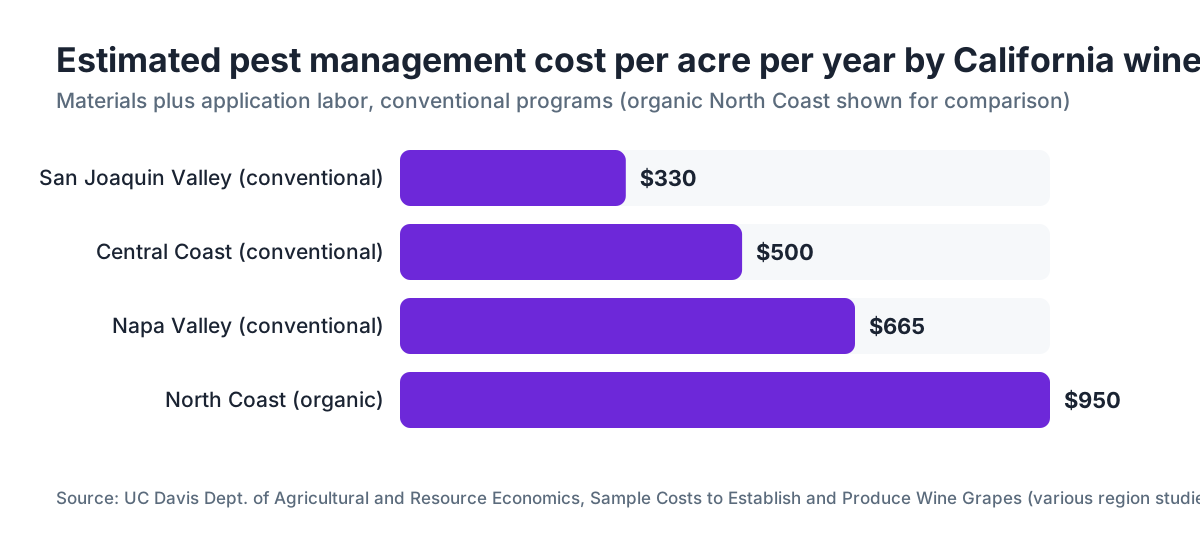
Plan on $280 to $900 per acre per year for materials and application labor, before PCA fees. Cost data for pesticide programs is scattered and regional, but UC Cooperative Extension publishes annual cost studies for the major growing regions, and those are the most reliable public benchmarks around [8].
For a Napa Valley Cabernet Sauvignon block, the UC Davis 2023 cost study put pest management (materials plus application labor) at roughly $590 to $740 per acre per year for a 40-acre conventional operation. In the San Joaquin Valley, where labor is cheaper and the disease profile differs, the same category runs $280 to $380 per acre. Those numbers cover fungicide, insecticide, and miticide materials but not PCA fees.
PCA fees in California typically run $800 to $2,500 per year for a single-ranch account, depending on acreage and service intensity. If you use restricted materials, that fee isn't negotiable.
Hire-out spray contractors (airblast tractor and operator) usually charge $18 to $35 per acre per pass across the Central and North Coast as of 2024. That adds up fast at 10 passes on 50 acres.
Organic materials carry a real premium. Copper-based fungicides and OMRI-listed biocontrols cost 20 to 40% more per application than comparable conventional programs, which is part of why labor-adjusted pest management for certified organic North Coast vineyards often lands at $900 or more per acre per season [8].
Drone application is showing up in California vineyards, mostly on steep-terrain sites in the Sonoma Coast and Sierra Foothills. Drone spray services currently run $45 to $80 per acre per pass, so they only pencil out where tractor access is genuinely difficult or flagging labor is the bigger cost.
Which fungicides and insecticides are most commonly used in California vineyard spray programs?
A well-built California program rotates FRAC (Fungicide Resistance Action Committee) groups to slow resistance in powdery mildew and Botrytis. The core fungicide toolkit looks like this:
| Product Class | FRAC Group | Common Active Ingredient | Primary Target |
|---|---|---|---|
| Sulfur | M2 | Elemental sulfur | Powdery mildew |
| DMI / Sterol inhibitor | 3 | Tebuconazole, Myclobutanil | Powdery mildew |
| SDHI | 7 | Boscalid, Fluopyram | Powdery mildew, Botrytis |
| QoI / Strobilurin | 11 | Azoxystrobin, Trifloxystrobin | Powdery mildew |
| Botryticides | 9, 12, 17 | Cyprodinil, Fenhexamid, Fludioxonil | Botrytis |
| Copper | M1 | Copper hydroxide | Downy mildew, bacterial |
QoI fungicides (FRAC 11) are now badly overused in California vineyards, and resistance in E. necator populations has been confirmed in multiple North Coast counties [9]. UC Davis Plant Pathology recommends limiting strobilurin applications to two per season and never applying them back-to-back.
On the insect side, insect growth regulators like pyriproxyfen handle grape leafhopper, and spirotetramat is a mainstay for mealybug. Kaolin clay (Surround WP) has a real following in organic and transitional programs for its physical deterrent effect on leafhoppers and mites, and it carries no REI, which matters a lot near harvest.
Biological controls aren't fringe anymore. Beauveria bassiana products (BotaniGard, Mycotrol) see regular use for mealybug in California, and predatory mite releases (Galendromus occidentalis) are standard practice across many Napa and Sonoma operations to counter spider mite flares after sulfur. South Coast Winery in Temecula and operations along the mountain winery corridor in the Santa Cruz Mountains often run heavier biological programs behind consumer-facing organic marketing commitments.
How does the EPA Worker Protection Standard apply to vineyard spray operations?
The EPA WPS (40 CFR Part 170), most recently updated in 2015 with enforcement phased in through 2017, applies to any agricultural employer that uses pesticides on a farm where workers are employed [6]. For California vineyards, that covers every ranch with even seasonal labor.
The obligations break down four ways.
Training. Every agricultural worker and pesticide handler must receive WPS safety training before working in treated areas, and it repeats annually. The training has to cover the content specified in the WPS and be delivered in a language the worker understands.
Posting. A pesticide application and safety information display goes at a central location on the establishment. It must show the most recent 30 days of application information: product name, EPA reg. number, active ingredient, location treated, date and time of application, and REI.
Re-entry intervals. Workers can't enter treated fields during the REI shown on the product label. REIs for common vineyard fungicides range from 4 hours (many sulfur products) to 24 hours (certain SDHI fungicides) to 48 hours (some copper products at high rates). Handlers applying products with long REIs need full PPE per the label.
Decontamination. Employers must provide water, soap, and towels for worker decontamination within a quarter mile of where workers are working.
CDPR enforces the WPS at the state level and runs compliance audits regularly. Fines for WPS violations in California range from $1,000 to $10,000 per violation under California Food and Agricultural Code Section 12993 [5]. The violations vineyard inspectors find most often are missing central posting, incomplete application records, and inadequate handler PPE documentation.
What is Integrated Pest Management (IPM) and does it actually work for California vineyards?
IPM is a decision-making framework, not a product list. You treat only when monitoring shows pest populations have crossed an economic threshold, rather than spraying on a calendar. UC IPM defines it as "an ecosystem-based strategy that focuses on long-term prevention of pests" through biological control, habitat manipulation, and resistant varieties, with pesticides used as a last resort [10].
Does it work? Yes, with a caveat. For insects like leafhopper and mealybug, real threshold-based IPM can cut insecticide applications by 30 to 50% versus calendar programs, with no measurable yield or quality loss in UC trials. For powdery mildew, pure threshold-based management is harder, because the disease establishes inside the tissue before you see symptoms. Most experienced California PCAs run a hybrid: mandatory protectant fungicides during the high-risk window (pre-bloom through 4 to 6 weeks post-bloom), and threshold-based decisions outside it.
The monitoring workload is real. A proper IPM program takes weekly vine-by-vine canopy assessments through the growing season. Many small vineyards don't have the staff hours, which is why calendar programs persist. A practical compromise is running UC's online risk models, the Powdery Mildew Risk Index and the temperature-based degree-day models for grape leafhopper egg hatch, to add decision logic to a mostly calendar program.
WSU Extension publishes comparable IPM frameworks for the Pacific Northwest that California growers borrow from, especially for mite management and biocontrol integration [11]. The UC ANR IPM program lives at ipm.ucanr.edu, and Cornell's disease forecasting work is another useful reference for method, even though it was developed for Eastern varieties.
How do pre-harvest intervals affect spray timing near harvest?
Pre-harvest interval (PHI) is the number of days that must pass between the last application of a pesticide and harvest. It's a legal requirement under FIFRA (the Federal Insecticide, Fungicide, and Rodenticide Act) and printed on every label. Blow the PHI and you risk violating federal law and producing fruit with residues above EPA tolerances.
The squeeze gets real in August and September. Say your Chardonnay is scheduled to harvest September 5, and you catch a mealybug flare on August 20. Spirotetramat (Movento), a common mealybug material, carries a 7-day PHI for grapes. So you apply by August 29 at the latest, and you'd better be certain harvest doesn't slide to August 30 or 31 for any reason.
The rule most experienced PCAs follow is to stack a 3 to 5 day buffer on top of the label PHI to absorb harvest-date uncertainty. If the PHI is 7 days, don't apply if harvest is within 10 to 14 days. That buffer costs you an application option and costs you nothing in legal exposure.
Wineries sourcing fruit across multiple vineyard blocks should require spray records from every grower confirming PHI compliance before accepting fruit. That's increasingly standard in winery-grower contracts in Napa, Sonoma, and the Paso Robles wineries region. The winery's liability doesn't vanish just because the grower applied the pesticide.
What records and compliance systems do small California winery owners actually need?
Small California winery owners who farm their own estate grapes carry the full stack: CDPR application records, WPS compliance, PCA recommendation files, and organic certification paperwork if they're certified or transitional.
The minimum viable system has four parts. A spray record log that meets FAC 12981, signed and dated at time of application. A central WPS display board updated within 24 hours of each application. Annual WPS training records for every worker, with signed attendance sheets. And files of every PCA recommendation for restricted materials.
Past the legal floor, most winery-vineyard operations benefit from block-level accumulation records that show total product applied per season. Many winery certifications (Napa Green, Fish Friendly Farming, California Sustainable Winegrowing Alliance) require annual reporting of pesticide use by product and acre. Try reconstructing that in December from a stack of paper logs. It's miserable.
This is where a purpose-built record system pays for itself. VitiScribe links block maps, spray records, PCA recommendations, and PHI countdown timers in one place, so a three-ranch operation doesn't need a manager driving between ranches to update three binders. The free trial covers a single ranch fully.
For operations that use custom crush or source from multiple growers, the record-keeping obligation runs both directions. CDPR wants the applicator's record. The winery's food safety program wants the grower's record. They need to match.
Are there organic spray options that satisfy California certification requirements?
Yes, and the California organic vineyard market is big enough now that the commercial product selection is genuinely good. CCOF (California Certified Organic Farmers) and USDA National Organic Program (NOP) certified operations are limited to materials on the National List under 7 CFR Part 205 [12].
For powdery mildew, organic growers lean on elemental sulfur, potassium bicarbonate (Milstop, Kaligreen), copper sulfate, and biological fungicides built on Bacillus subtilis (Serenade) or Reynoutria sachalinensis (Regalia). Sulfur is the workhorse. At typical rates (3 to 5 lbs per acre per application, 8 to 12 applications), sulfur runs $15 to $35 per acre per application depending on formulation, putting annual fungicide materials cost at $150 to $420 per acre for sulfur alone.
For insects and mites, the options are insecticidal soaps (M-Pede), kaolin clay (Surround), spinosad (Entrust SC), pyrethrin (Pyganic), and Beauveria bassiana. Entrust SC, derived from spinosad, is one of the most effective organic options for grape leafhopper and carries a 4-hour REI, which keeps it practical at most points in the season. Note that CCOF sets an annual spinosad use limit to protect pollinators.
Copper is a growing worry in California organic viticulture. The EU has moved to restrict copper to 4 kg per hectare per year (about 3.6 lbs per acre). California NOP currently allows up to the label rate, but CCOF pushes operations to keep copper to the minimum necessary. Copper accumulation in vineyard soils is a legitimate long-term problem, especially in older organic blocks that have been under copper programs for 30-plus years.
How do California growers comply with county agricultural commissioner reporting?
California requires that any person applying a pesticide commercially submit a Pesticide Use Report (PUR) to their County Agricultural Commissioner. For growers applying on their own land (defined as a property interest, broader than ownership), it's a monthly report, due by the 10th of the following month [13].
The PUR captures the commodity treated, the section-township-range location, the acreage treated, the product (California registration number), the amount used, and the application date. CDPR compiles these into the California Pesticide Use Reporting database, which is publicly searchable and forms the basis for statewide pesticide use statistics.
The common reporting mistakes in vineyards are predictable. Wrong site code (grapes for wine, grapes for raisin, and grapes for table are separate commodity codes in the CDPR system). Failing to report applications of minimum-risk pesticides that still land on the California Restricted Materials list. Filing more than 30 days late.
Late PUR submission carries fines of up to $5,000 per violation per day in California. In practice, first-time late filers often get a notice to comply rather than an immediate fine, but county commissioners treat repeat violations seriously, especially in Fresno, Tulare, and Kern, where the sheer volume of pesticide use makes enforcement a priority.
Operations in unusual settings, like the hillside estates near Allegretto Vineyard Resort in Paso Robles or coastal sites like Gervasi Vineyard-style operations, still report under the same state PUR system regardless of terrain or scale.
Frequently asked questions
How many times a year do you typically spray a vineyard in California?
Most California vineyards run 8 to 12 spray applications per growing season. The exact number depends on variety, region, disease pressure, and farming system. Organic programs often run 10 to 14 applications because sulfur and copper have shorter residual activity than synthetic fungicides. High-pressure years in foggy coastal regions can push the count higher, while dry inland sites in low-pressure years may get by with 6 to 8.
Do I need a licensed Pest Control Adviser (PCA) to spray my California vineyard?
You need a licensed PCA recommendation before purchasing or applying any restricted-use pesticide in California. Many vineyard fungicides and insecticides fall into this category. For minimum-risk or general-use pesticides, you can apply without a PCA recommendation, but you still need to keep records. If you're unsure whether a product is restricted in California, check the CDPR's online registration database or call your County Agricultural Commissioner.
What spray records does California law require vineyard operators to keep?
California Food and Agricultural Code Section 12981 requires written records of every commercial pesticide application: property location, pest treated, product name, EPA registration number, amount applied, date, and applicator name. Records must be kept for two years and made available to County Agricultural Commissioner inspectors on demand. California also requires monthly Pesticide Use Reports submitted to the county by the 10th of the following month.
What is the EPA Worker Protection Standard and how does it affect vineyard labor?
The EPA WPS (40 CFR Part 170) requires agricultural employers to train all workers and handlers annually, post current application information at a central location, enforce re-entry intervals, and provide decontamination supplies. In California, CDPR enforces the WPS. Violations carry fines starting at $1,000 per violation. The standard applies to any California vineyard that employs even seasonal workers in fields treated with pesticides.
What is the pre-harvest interval and why does it matter for California wineries?
The pre-harvest interval (PHI) is the minimum number of days between the last pesticide application and harvest. It's printed on every product label and required by federal law. California wineries sourcing fruit should require grower spray records confirming PHI compliance before accepting deliveries. Violations mean fruit with residues above EPA tolerances, which can trigger regulatory action and void winery liability protections. Add a 3 to 5 day buffer beyond the label PHI whenever harvest dates are uncertain.
How much does a typical California vineyard pest management program cost per acre?
UC Cooperative Extension cost studies put pest management (materials plus application labor) at $590 to $740 per acre per year in Napa Valley for conventional programs and $280 to $380 per acre in the San Joaquin Valley. Organic programs often exceed $900 per acre per season in the North Coast. PCA fees add $800 to $2,500 per year per ranch. Spray contractor costs run $18 to $35 per acre per pass for ground airblast equipment.
What fungicides are most effective against powdery mildew in California grapes?
Sulfur (FRAC M2) is the backbone of most California powdery mildew programs. DMI fungicides (FRAC 3, such as myclobutanil and tebuconazole) and SDHI fungicides (FRAC 7) provide systemic activity at lower rates. QoI fungicides (FRAC 11, strobilurins) have confirmed resistance in California E. necator populations in multiple North Coast counties, so they should be limited to two applications per season and never used consecutively. Rotate FRAC groups every application.
Can drones replace tractor sprayers in California vineyard operations?
Drones are beginning to see commercial use in California vineyards, mainly on steep terrain where tractor access is genuinely dangerous or cost-prohibitive. Current pricing runs $45 to $80 per acre per pass, which only makes financial sense where tractor operation would cost more or carry injury risk. Regulatory approval for agricultural drone application in California requires FAA Part 137 certification and state pesticide applicator licensing. Coverage uniformity in dense canopies is still an active research question.
What's the difference between a Pest Control Adviser and a Pest Control Operator in California?
A Pest Control Adviser (PCA) is licensed to recommend pesticides. A Pest Control Operator (PCO) is licensed to apply them commercially. In California viticulture, the PCA writes the recommendation for any restricted-use material; the PCO or a licensed vineyard employee applies it. The same person can hold both licenses. Vineyard owners applying pesticides on their own property are not required to hold a PCO license but must follow PCA recommendations for restricted materials.
How do I report pesticide use to the California County Agricultural Commissioner?
Submit a monthly Pesticide Use Report (PUR) to your County Agricultural Commissioner by the 10th of the month following each application. Reports must include the commodity treated (use the correct grape commodity code for wine grapes), section-township-range location, acreage treated, California product registration number, amount applied, and application date. Late submission carries fines up to $5,000 per violation per day. Most counties accept electronic submission through CDPR-approved systems.
What pesticides can certified organic California vineyards use?
USDA NOP-certified organic vineyards are limited to materials on the National List (7 CFR Part 205). For powdery mildew, that means sulfur, potassium bicarbonate, copper, Bacillus subtilis, and Reynoutria sachalinensis. For insects and mites: kaolin clay, insecticidal soaps, pyrethrin, spinosad (Entrust), and Beauveria bassiana. All materials must have an OMRI listing or be reviewed by your certifier. Copper use is increasingly scrutinized due to soil accumulation concerns.
How does IPM differ from a standard calendar spray program in California vineyards?
A calendar program applies pesticides on fixed intervals regardless of pest levels. IPM applies treatments only when monitoring shows pest populations have exceeded an economic threshold. UC Davis trials show threshold-based IPM can reduce insecticide use by 30 to 50% for grape leafhopper without measurable yield loss. For powdery mildew, most California PCAs use a hybrid: mandatory protectant fungicides during the high-risk pre- and post-bloom window, threshold-based decisions outside that window.
What are the most common WPS violations found in California vineyard inspections?
CDPR enforcement data consistently shows three top violations: missing or incomplete central posting of application information, late or incomplete spray records, and inadequate handler PPE documentation. Worker training record gaps (missing signatures, training not in worker's primary language, training not completed before field entry) are also frequent. Annual self-audits against the WPS checklist on the CDPR website take about two hours and can prevent fines that start at $1,000 per violation.
Do California winery tasting rooms that don't farm grapes need to worry about spray compliance?
No, unless the winery also operates a vineyard or employs workers who enter treated agricultural fields. Urban operations like city-style wineries that source all fruit from third-party growers have no direct CDPR spray record or WPS obligation. They should, however, require grower-supplied spray records and PHI certifications as part of their fruit purchase contracts to protect against residue liability and ensure organic or sustainability certification compliance.
Sources
- UC ANR Integrated Pest Management, Grape Pest Management Guidelines: Powdery mildew is the primary fungal threat in California vineyards; sulfur phytotoxicity risk above 95°F; 7-14 day protectant window for sulfur under moderate temperatures
- UC ANR IPM, Western Grape Leafhopper and Pacific Spider Mite pest notes: Western grape leafhopper, grape mealybug, and Pacific spider mite are the primary insect pests in California vineyards
- California Department of Food and Agriculture, Pierce's Disease and Glassy-winged Sharpshooter Program: Glassy-winged sharpshooter remains a quarantine pest concern in Southern California vineyards
- UC Cooperative Extension, Organic Viticulture Production Guide: Organic programs typically require 10-14 spray applications per season due to shorter residual activity of sulfur and copper
- California Food and Agricultural Code Section 12981, California Legislature: FAC 12981 requires written pesticide application records kept for two years; PCA recommendation required for restricted materials; fines up to $10,000 per WPS violation under FAC 12993
- EPA Worker Protection Standard, 40 CFR Part 170: WPS requires agricultural employers to 'provide workers and handlers with information about pesticide applications'; annual training, central posting, REI enforcement, and decontamination supplies required
- UC Cooperative Extension Sonoma County, Vineyard Spray Record Template: UC Cooperative Extension Sonoma County provides a spray record template satisfying FAC 12981 minimum requirements
- UC Davis Department of Agricultural and Resource Economics, Sample Costs to Establish and Produce Wine Grapes: Pest management costs for Napa Valley Cabernet Sauvignon run $590-$740 per acre per year; San Joaquin Valley $280-$380 per acre; organic North Coast often exceeds $900 per acre
- UC Davis Department of Plant Pathology, Fungicide Resistance in Grape Powdery Mildew: QoI (strobilurin, FRAC 11) resistance in Erysiphe necator has been confirmed in multiple North Coast California counties; limit to two applications per season
- UC ANR Statewide IPM Program, What is IPM?: UC Davis IPM defines IPM as 'an ecosystem-based strategy that focuses on long-term prevention of pests' through biological control, habitat manipulation, and resistant varieties
- Washington State University Extension, Pacific Northwest Pest Management Handbooks - Grapes: WSU Extension IPM frameworks for spider mite management and biocontrol integration in Pacific Northwest viticulture
- USDA Agricultural Marketing Service, National Organic Program, 7 CFR Part 205 National List: USDA NOP certified organic operations are limited to materials on the National List under 7 CFR Part 205; allowed materials include sulfur, copper, Bacillus subtilis, spinosad, pyrethrin, and kaolin clay
- California Department of Pesticide Regulation, Pesticide Use Reporting: California requires monthly Pesticide Use Reports submitted to County Agricultural Commissioner by the 10th of the following month; late filing fines up to $5,000 per violation per day
Last updated 2026-07-09