Economic threshold documentation for spray go-no-go decisions

TL;DR
- An economic threshold (ET) is the pest density at which the cost of a spray equals the revenue you'd lose without it.
- Documenting your ET-based go-no-go decisions protects you during pesticide audits, satisfies Worker Protection Standard recordkeeping rules, and cuts unnecessary sprays by 20-40% in well-run IPM programs, according to UC Cooperative Extension research.
What is an economic threshold and why does it matter for spray decisions?
An economic threshold is a specific, measurable pest level, typically expressed as a count per leaf, cluster, or vine, at which you should spray to prevent economic damage. Below that number, you hold off. Above it, you act. That's the whole logic.
The term comes from integrated pest management (IPM) theory and has two related concepts worth keeping straight. The economic injury level (EIL) is the pest density at which damage costs equal control costs. The economic threshold sits below the EIL, giving you time to get a spray on before damage actually hits that breakeven point [1]. In practice, grape growers use the ET as the field trigger.
Why does this matter for documentation? Because a spray log entry that just says "saw some mites" doesn't hold up during a third-party sustainability audit, a CDFA pesticide use report inspection, or a food safety review. An entry that says "counted 4.2 motile Pacific spider mites per leaf on 25 vines, ET is 6.0 per leaf for this growth stage, no spray" tells the story. It shows you're managing the vineyard, more than reacting.
For small wineries running their own estate blocks, this kind of paper trail is also competitive. Buyers and certifiers increasingly ask for it. The documentation habit costs you nothing except a little discipline, and it saves spray costs that add up fast across even 20 acres.
What economic thresholds exist for common vineyard pests?
Real ET values for wine grapes come from university research, mostly at UC Davis, Cornell, and WSU. They're not guesses. Here's a working reference for the pests you're most likely to document:
| Pest | Economic Threshold | Growth Stage / Timing | Primary Source |
|---|---|---|---|
| Pacific spider mite | 6 motile mites/leaf (some sources: 20% infested leaves) | Post-bloom through veraison | UC IPM [2] |
| Willamette mite | 20-30 motile mites/leaf | Pre-bloom to fruit set | WSU Extension [3] |
| Grape leafhopper (1st gen) | 15-20 nymphs/leaf | 6-8 weeks post-bloom | UC IPM [2] |
| Grape leafhopper (2nd gen) | 15-20 nymphs/leaf | Same threshold, re-assessed | UC IPM [2] |
| Vine mealybug | Presence + honeydew | Any time before harvest | UC IPM [2] |
| Western grape leafhopper | Varies by variety and market; table grapes use lower ETs | Post-bloom | Cornell Viticulture [4] |
| Grape berry moth | 3-5% cluster infestation (biofix-based degree-day models also used) | Multiple generations | Cornell Viticulture [4] |
| Botrytis (gray mold) | No hard ET; risk-based on canopy density, humidity, variety | Pre-bunch closure | UC IPM [2] |
A few things to flag. Botrytis and powdery mildew don't have a true ET the way arthropod pests do, because disease establishes before you can count it. For those pathogens, you document risk factors: canopy closure score, relative humidity observations, days since last rain, and the decision model you're following (such as the UC Davis powdery mildew risk index or the UC IPM powdery mildew treatment timing guidelines) [2]. That's still threshold-based thinking, just with a different input.
Thresholds also shift. WSU Extension notes that the Willamette mite ET can drop to 10-15 per leaf in late summer, when populations build fast and natural enemies thin out [3]. Document which threshold version you applied and why.
How do you build a spray go-no-go decision record?
A good record captures six things: who scouted, when and where, what they counted, what the threshold is, what the decision was, and why. That last piece is where most people shortchange themselves.
Here's a template structure you can use in any format, paper or digital:
- Date and time of scouting
- Block ID and growth stage (BBCH scale or your own internal stage)
- Pest or pathogen targeted
- Sampling method (how many vines, which leaves, what position on the canopy)
- Raw count or observation (e.g., "5 vines scouted, 10 leaves per vine, average 3.8 motile mites/leaf")
- Economic threshold applied (cite your source, more than the number)
- Decision: spray or no-spray
- If no-spray: re-scout date scheduled
- If spray: product name, EPA registration number, application rate, equipment calibration date, applicator name
- Weather conditions at scouting time
That structure works for both go and no-go decisions. Many growers only log sprays. That's a mistake. A documented no-spray decision is evidence of IPM practice. It's what separates you from someone who just rotates a spray calendar.
For operations running SustainableWinery, LODI RULES, or California Certified Organic certification, auditors specifically look for evidence of threshold-based decisions rather than calendar-based ones [5]. No-spray records are your proof.
VitiScribe's field record module is built around this exact six-part structure, so you can log a scouting event and a spray decision (or a hold decision) in the same workflow rather than keeping two separate logs.
What sampling method should you use to get a reliable pest count?
The count is only as good as your sampling method. A random walk through a block and eyeballing a few leaves isn't scouting. It's wishful thinking.
For spider mites, the standard UC IPM protocol calls for randomly selecting 50 leaves per block (10 vines, 5 leaves each), choosing leaves from the mid-canopy zone, and counting motile mites under a hand lens or 10x loupe [2]. You record the average per leaf and compare to the ET. If you use the percent-infested method instead of the per-leaf count, you need a minimum of 20 leaves and mark each as infested or not.
For leafhoppers, you count nymphs on the underside of basal leaves. Cornell recommends 50 leaves from 25 vines, two leaves per vine, randomly selected across the block [4].
Block size matters. A standard scouting unit is generally one uniform block up to about 5 acres. If you have 12 acres of Cabernet Sauvignon split across two soil types with different irrigation, treat those as separate scouting units.
Sample along a predetermined route, more than the perimeter. Edge rows near dusty roads or adjacent orchards often carry higher mite populations and will skew your average if you oversample them. Some growers stratify the sample on purpose: 70% interior vines, 30% edges.
Record your sampling method in your go-no-go document. "50 leaves per block, mid-canopy, random" is a replicable method. "Checked some leaves" is not.
How does economic threshold documentation satisfy pesticide recordkeeping compliance?
Federal and state pesticide recordkeeping requirements mostly focus on applications, not decisions not to apply. But the documentation still connects to compliance in three ways.
First, under California law, any grower using a restricted materials permit must keep pesticide use records and submit Pesticide Use Reports (PURs) to their county agricultural commissioner within a set time window (generally within one month of application) [6]. Those records must include the pest targeted. Documenting your ET justification before the spray ties your application to a defined economic rationale, which protects you if the commissioner questions why you applied a restricted material.
Second, the EPA Worker Protection Standard (WPS), updated in 2015, requires agricultural employers to keep certain records about pesticide applications, including which pesticide was used and the application-specific safety data [7]. The WPS itself doesn't require threshold documentation, but it does require that workers have access to application information. Your go-no-go record, attached to your application record, makes that information package complete.
Third, third-party certification programs, including LODI RULES for Sustainable Winegrowing and the California Certified Organic Farmers (CCOF) program, require documented evidence that pest management decisions followed IPM principles [5]. An auditor from any of these programs can ask for your spray decision records. If you don't have them, you don't pass.
The EPA states that "the goal of IPM is to manage pest damage by the most economical means, and with the least possible hazard to people, property, and the environment" [8]. That language implies threshold-based decision-making. Your records are how you prove you're doing it.
What's the economic case for documenting no-spray decisions?
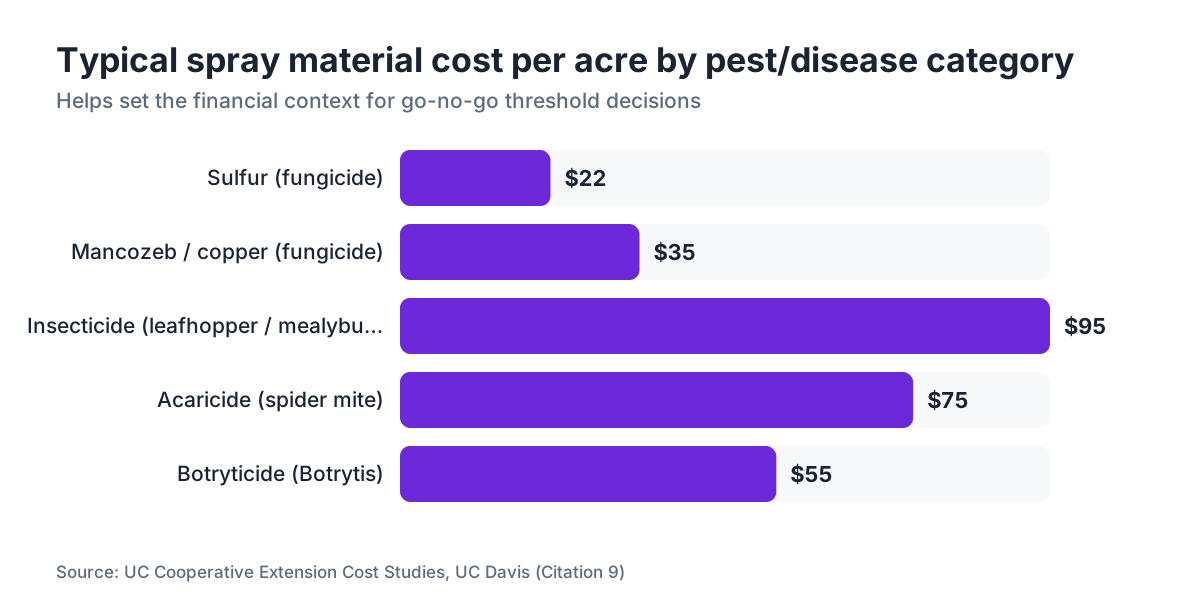
The direct cost of a vineyard spray ranges widely. A typical sulfur application runs $15-30 per acre in materials alone. A mancozeb or copper fungicide application is $20-50 per acre. Insecticide applications for leafhopper or mealybug can run $40-150 per acre depending on product and application method, before you factor in labor and equipment [9].
A rigorous IPM program backed by documented threshold decisions cuts spray frequency. UC Cooperative Extension has documented reductions of 20-40% in total pesticide applications on farms that shifted from calendar-based to threshold-based spray decisions, though the exact number depends on pest pressure that year [1]. Take a 50-acre estate that runs 8 spray passes and cuts it to 5. The math is plain: three fewer passes at $60 average per acre per pass equals $9,000 saved on that block in one season.
There's also a resistance management angle. Every unnecessary spray selects for resistance. Pacific spider mites have documented resistance to several acaricide classes in California vineyards [12]. Skipping a spray when you're below threshold doesn't just save money today. It preserves the efficacy of your chemistry for when you actually need it.
Then there's the market premium question. Some growers, particularly those selling to natural or low-intervention wine labels, can document a reduced spray program as a selling point. That requires the records to exist. You can't claim 30% fewer sprays if you never tracked the no-spray decisions.
How do you handle diseases like powdery mildew that don't have a fixed ET?
Powdery mildew, Botrytis, and downy mildew don't fit the simple pest-count model because infection happens before visible symptoms appear. You can't count lesions before you spray and still protect the crop. So the threshold approach shifts to risk assessment.
For powdery mildew (Erysiphe necator), UC IPM provides a disease index that weighs temperature, hours of leaf wetness, and vine susceptibility [11]. WSU developed the DMCAST model for downy mildew using similar environmental inputs [3]. These tools produce a risk score, and your threshold is effectively: above this risk score, spray; below it, hold.
In your go-no-go document, you record the inputs instead of a pest count:
- Date and block
- Temperature range over the prior 7 days
- Hours of leaf wetness or humidity above 85%
- Last rain event and amount
- Canopy density score (your own scale is fine, just define it)
- Risk model used and score generated
- Decision and rationale
This is slightly more work than a mite count, but it's the honest version of threshold-based documentation for diseases. Cornell Cooperative Extension recommends keeping these environmental logs integrated with your spray calendar so you can reconstruct the decision logic later [4].
One honest caveat: nobody has great data on the exact threshold reliability of these models across all California microclimates. The models were calibrated in specific regions. If you're on a coastal foggy site versus a hot interior valley, your real risk at a given score may differ from what the model assumes. Note that in your record. Auditors and agronomists respect intellectual honesty.
What does a completed go-no-go decision record actually look like?
Here's a real example of a completed no-spray decision record in plain text. This is what you'd want to show an auditor:
Date: June 14, 2025
Block: Estate Cab Block 3, 4.2 acres, BBCH 71 (fruit set)
Scout: J. Hernandez
Target pest: Pacific spider mite (Tetranychus pacificus)
Sampling method: 50 leaves, 10 vines x 5 leaves, mid-canopy, random interior route
Count: Average 2.1 motile mites per leaf. 4 of 50 leaves exceeded 5 mites.
Economic threshold applied: 6.0 motile mites per leaf (UC IPM Pest Management Guidelines for Grapes, 2024)
Decision: NO SPRAY. Population well below ET.
Re-scout date: June 21, 2025
Conditions at scouting: 91F, low humidity, dusty conditions on north row edge (higher counts noted there, accounted for in sampling by keeping only 3 leaves from edge vines)
Notes: Natural enemy presence noted (6-spotted thrips on 8 of 50 leaves). Will factor into re-scout assessment.
That's a 10-minute entry. It's legally defensible, it's auditor-ready, and it documents that you made a real decision based on real data. Compare that to a blank line in a spray log or nothing at all.
For the spray-go version, you'd add the product name, EPA registration number, rate applied, water volume, equipment used, and the applicator's pesticide license number. California requires that information for restricted materials applications [6]. The threshold documentation just completes the story of why that spray happened.
How often should you be scouting and at what growth stages?
Scouting frequency depends on the pest and the season. Here's a general calendar most California and Pacific Northwest operations can use as a starting point:
| Growth Stage | Key Pests to Scout | Minimum Scouting Frequency |
|---|---|---|
| Bud break to 3-inch shoot | Grape bud moth, overwintering mite eggs | Every 2 weeks |
| Bloom to fruit set | Leafhopper 1st gen, mite activity begins | Weekly |
| Post-fruit set to bunch closure | Spider mite, mealybug, Botrytis risk | Weekly to twice weekly in hot, dusty years |
| Bunch closure to veraison | Grape berry moth, mite second flush | Weekly |
| Veraison to harvest | Spotted wing drosophila (where present), late leafhopper | Twice weekly near harvest |
| Post-harvest | Mite overwintering counts, mealybug crawlers | Once or twice |
Scout frequency is also a compliance marker. LODI RULES sustainable winegrowing requires documented scouting at defined intervals for Tier 2 and Tier 3 compliance [5]. If you can't show when you scouted, you can't prove the threshold-based decision was informed.
A practical note. The biggest scouting gap most growers have is the post-bloom period in June, when mite populations can double in 5-7 days under hot conditions. Miss two consecutive weeks during that window and you end up making reactive, above-threshold spray calls. More scouts or more frequent self-scouting is cheaper than a late emergency acaricide application.
How does digital recordkeeping change this workflow?
Paper records work fine if you're disciplined about them. The failure mode is transcription: notes taken in the field on a clipboard don't make it into the master log, or they do but without enough detail.
Digital tools built for vineyard operations let you capture scouting data in the field on a phone, attach it to a block map, and generate a go-no-go decision record that's already formatted for audit use. If your tool ties into your spray application records, you can link the threshold documentation directly to the application event so the decision trail lives in one place.
VitiScribe's spray record module does this. You log a scouting event with your counts, the system stores the ET you applied, and the go or no-go decision is timestamped to the scout's account. When you generate a pesticide use summary for your county PUR or a sustainability audit, the threshold documentation comes with it rather than sitting in a separate binder.
Whatever system you use, the key is that the no-spray decision is a first-class record type, more than an absence of a spray record. Most simple spreadsheets don't prompt for this. Most purpose-built vineyard apps do.
For the vineyard operations context, the right tool is the one your team will actually use in the field on a hot afternoon in August. Simple and fast beats feature-heavy and ignored.
What are the common mistakes in economic threshold documentation?
The most common error is circular: growers document a spray after the fact and work backward to justify it with a threshold number they never actually measured. Auditors catch this because there's no pre-spray scouting record dated before the application. The fix is simple. Scout first, record the count, decide, then apply. In that order, every time.
Second most common mistake: using an ET that doesn't match your region, crop stage, or pest species. The Pacific spider mite ET is not the same as the Willamette mite ET. The ET at fruit set is not the same as the ET at veraison. If you're in Oregon using a California ET table without checking WSU's Pacific Northwest guidelines, your threshold may be off [3].
Third mistake: failing to document natural enemy presence. If you're counting mites and also seeing six-spotted thrips or western predatory mites at meaningful densities, that's relevant to the spray decision. Spraying into a healthy predator population often backfires by wiping out biological control. Note predator presence in your record, even if it doesn't change the number.
Fourth mistake, and the sneaky one: only keeping records in good years. During a heavy mite year when you spray every block, documentation discipline often collapses. Those are exactly the records you need. Heavy-pressure seasons are when third-party reviewers look hardest at whether your decisions were economically rational or just panic sprays.
One more. Some growers use ET documentation for organic-approved materials but skip it for conventional chemistry, on the theory that it matters less. It doesn't. The state pesticide use report requirement applies to restricted materials regardless of whether they're organic-approved.
Frequently asked questions
What is the economic threshold for spider mites in a vineyard?
UC IPM sets the economic threshold for Pacific spider mites at 6 motile mites per leaf for wine grapes, measured on mid-canopy leaves during a 50-leaf random sample. Some programs use a 20% leaf infestation rate as an alternative metric. Willamette mite ET is higher, around 20-30 motile mites per leaf, per WSU Extension guidelines. Both thresholds shift lower late in the season when populations build fast.
Do I have to document spray decisions that result in no application?
No federal law requires you to file no-spray records, but LODI RULES, California Certified Organic, and most sustainability certifications do require documented evidence of threshold-based IPM practice, which means showing that you scouted and made a conscious hold decision. Without no-spray records, there's no way to prove your program is threshold-based rather than calendar-based. Third-party auditors look for this specifically.
What records do I need to keep under the EPA Worker Protection Standard?
Under the 2015 WPS update, agricultural employers must keep records of each pesticide application for two years, including the product name, EPA registration number, active ingredient, application date, and location. The WPS also requires that this information be posted at a central location accessible to workers within 24 hours of application. The threshold documentation isn't mandated by WPS, but it completes the application decision record and satisfies broader IPM documentation requirements.
How many vines should I scout to get a statistically reliable count?
UC IPM recommends 50 leaves per block (10 vines, 5 leaves each) for spider mites. Cornell recommends 50 leaves from 25 vines for leafhoppers. The minimum meaningful sample for most vineyard arthropod pests is 30-50 leaves per block up to about 5 acres. Larger blocks or blocks with high variability should be broken into separate scouting units. Always use a random interior route rather than just walking the perimeter.
Can I use the same economic threshold for organic and conventional vineyards?
The pest density threshold itself doesn't change based on certification type, because it's based on the economics of crop damage. What changes is which products you can use once you cross it. An organic-certified block crosses the same mite ET as a conventional block, but your product options are limited to organically approved materials. Document the same way either way: pest count, threshold applied, product selected, and the rationale.
How do I document a disease risk threshold when there's no pest count to record?
For powdery mildew and Botrytis, document environmental inputs instead: temperature range over the prior 7 days, hours of leaf wetness or relative humidity above 85%, days since last rain, canopy density, and the risk model or index you applied (such as UC IPM's powdery mildew risk index or WSU's DMCAST). Record your calculated risk score and the decision it produced. This is threshold-based documentation even without a pest count.
How long do I need to keep pesticide use records in California?
California requires growers to retain pesticide use records for at least three years from the date of application, per the California Food and Agricultural Code Section 12981. Pesticide Use Reports must be submitted to the county agricultural commissioner within one month of application. Best practice is to keep your complete go-no-go documentation, including scouting records and no-spray decisions, for the same three-year period so the records are cohesive during any audit.
What's the difference between an economic threshold and an economic injury level?
The economic injury level (EIL) is the pest density at which crop damage costs exactly equal the cost of control. The economic threshold (ET) is the lower, earlier trigger point at which you apply a treatment to prevent the population from reaching the EIL. In practice, vineyards use the ET for spray decisions. The EIL is the theoretical ceiling; the ET gives you the lead time to act before actual economic damage occurs.
Do WSU extension thresholds apply in California vineyards?
WSU-derived thresholds are calibrated for Pacific Northwest conditions, primarily Washington and Oregon. For California vineyards, UC IPM's pest management guidelines for grapes are the primary reference. The Willamette mite ET from WSU (20-30 per leaf) is commonly referenced in northern California too, but California-specific guidance from UC IPM takes precedence. Always note which source's threshold you applied in your documentation.
What scouting method should I document for grape berry moth?
Grape berry moth management in eastern U.S. vineyards (Cornell region) primarily uses degree-day models based on biofix, the date of first consistent adult trap capture. Cornell recommends recording your biofix date, accumulating degree days (base 50F), and applying thresholds at defined DD windows. Document the biofix date, the DD accumulation method, the current DD count, and whether you crossed the treatment threshold for each generation. UC IPM has parallel guidance for western grape berry moth.
How do third-party sustainability auditors evaluate my spray records?
Auditors for programs like LODI RULES or SIP Certified typically review spray logs alongside scouting records to confirm that applications were preceded by documented pest assessments. They look for the date of scouting, the pest count or risk score, the threshold applied, and a citation for that threshold. They also look for no-spray decisions as evidence of restraint. Missing scouting records before a spray, or spray logs with no threshold justification, are common findings.
Is there an economic threshold for vine mealybug?
Vine mealybug doesn't have a traditional per-vine count ET the way mites do, because even low populations can cause significant damage through direct feeding, honeydew, and sooty mold, and because mealybug-transmitted viruses make a single-population economic calculation difficult. UC IPM recommends treating upon confirmed presence combined with evidence of honeydew or crawlers during the season. Document: confirmed sighting location, crawler activity, honeydew presence, and the decision rationale.
Can I hire a licensed pest control adviser (PCA) to do my scouting and does that satisfy documentation requirements?
Yes, and in California any grower using a restricted materials permit for certain pesticides is required to have a written recommendation from a licensed PCA. The PCA's written recommendation constitutes threshold-based documentation if it includes the pest assessment and rationale. Keep the original PCA recommendation with your spray records. You can still maintain your own parallel scouting log, which strengthens the record and helps you build field knowledge over time.
What's the minimum spray record a small estate vineyard actually needs to keep?
At minimum, California requires application date, product name, EPA registration number, pest targeted, acreage treated, and total product applied for any restricted materials use. For unrestricted materials, records are still best practice even if not legally mandated. Adding a scouting summary and ET citation to each spray record takes two minutes and satisfies IPM certification requirements. For a small estate under 10 acres, this can be a simple spreadsheet with those six application fields plus a scouting notes column.
Sources
- UC Statewide IPM Program, University of California Agriculture and Natural Resources, What is IPM?: IPM programs that shifted from calendar-based to threshold-based spray decisions have documented reductions in total pesticide applications; ET sits below the EIL to allow response time.
- UC IPM Pest Management Guidelines: Grape, University of California: Economic thresholds for Pacific spider mite (6 motile mites/leaf), grape leafhopper (15-20 nymphs/leaf), vine mealybug, and powdery mildew risk assessment protocols for California wine grapes.
- WSU Extension, Integrated Pest Management for Grapes in the Pacific Northwest: Willamette mite economic threshold of 20-30 motile mites per leaf, with guidance that ET can drop to 10-15 per leaf late in the season; DMCAST downy mildew forecasting model.
- Cornell Cooperative Extension, Grape IPM and Viticulture Resources: Leafhopper sampling of 50 leaves from 25 vines; grape berry moth degree-day and biofix-based thresholds; recommendation to integrate environmental logs with spray calendars.
- LODI RULES for Sustainable Winegrowing, Certification Standards: LODI RULES certification requires documented evidence of threshold-based IPM decisions and scouting records at defined intervals for Tier 2 and Tier 3 compliance.
- California Department of Pesticide Regulation, Pesticide Use Reporting: California requires pesticide use records to be submitted to the county agricultural commissioner within one month of application; restricted materials require a licensed PCA recommendation.
- US EPA, Worker Protection Standard for Agricultural Pesticides: The 2015 EPA WPS update requires agricultural employers to maintain pesticide application records for two years and post application information accessible to workers within 24 hours of application.
- US EPA, Integrated Pest Management (IPM) Principles: EPA states: 'the goal of IPM is to manage pest damage by the most economical means, and with the least possible hazard to people, property, and the environment.'
- UC Cooperative Extension, Sample Costs to Establish and Produce Winegrapes, North Coast Region: Typical vineyard spray material costs: sulfur $15-30/acre, mancozeb/copper $20-50/acre, insecticides $40-150/acre depending on product; per-pass costs used for ET cost-benefit analysis.
- California Food and Agricultural Code, Section 12981, Pesticide Record Retention: California law requires pesticide use records to be retained for at least three years from the date of application.
- UC IPM, Powdery Mildew of Grape, Pest Management Guidelines: UC Davis powdery mildew risk index for vineyards uses temperature and leaf wetness inputs rather than a traditional pest count ET; treatment timing guidelines based on risk score thresholds.
- WSU Extension Viticulture and Enology, Spider Mite Management in Wine Grapes: Pacific spider mites have documented resistance to several acaricide classes in California vineyards; threshold-based decisions preserve chemistry efficacy.
Last updated 2026-07-10