Documenting grapevine leafroll virus vector management spray decisions

TL;DR
- Grapevine leafroll virus spreads mostly through mealybugs and soft scales.
- Controlling those vectors takes timed insecticide applications backed by written records that meet the EPA Worker Protection Standard, state pesticide reporting laws, and private audit standards.
- A defensible spray record captures the scouting trigger, the reason you picked that product, the application details, and the re-entry interval.
- Every time you spray.
What vectors actually spread grapevine leafroll virus, and why does that matter for spray records?
Grapevine leafroll-associated viruses (GLRaVs, especially GLRaV-3) move through vineyards on the mouthparts of mealybugs and soft scales. The grape mealybug (Pseudococcus maritimus), vine mealybug (Planococcus ficus), and obscure mealybug (Pseudococcus viburni) are the confirmed primary vectors in California and the Pacific Northwest [1]. Cottony cushion scale and some other soft scales carry certain strains too, though how well they transmit varies by species and virus variant.
That biology shapes what you write down. A fungicide calendar spray happens because the calendar says so. A vector spray happens because something moved: you hit a threshold-level infestation, or a confirmed outbreak showed up next door. The causal chain has to live on paper, not in your memory.
Here's why that matters. A neighbor files a drift complaint. A buyer's food-safety auditor pulls your file. A county ag commissioner questions your pesticide use report. In every case you need to show the decision was justified and timed right.
UC Cooperative Extension's grape pest guidelines note that vine mealybug has expanded across California wine regions since the 1990s [1]. Wider spread means more regulator and auditor attention on how growers document control. Getting the records right from day one costs almost nothing. Fixing a compliance gap after an inspection costs a lot.
What information is legally required in a pesticide application record?
Federal law under the Federal Insecticide, Fungicide, and Rodenticide Act (FIFRA) Section 8 requires anyone who applies a restricted-use pesticide to keep records for two years [2]. Most states go further and extend that requirement to all commercial applications, beyond restricted-use products, and many hold you to three years or longer.
California, the largest grape-producing state, makes growers file a Notice of Intent before applying any pesticide on a Pest Management Schedule, then submit a Pesticide Use Report (PUR) to the county agricultural commissioner within one month of application [3]. Washington requires commercial applicators to keep application records for two years and to include specific data fields on each one [4].
Every legally defensible spray record for a vector application needs, at minimum, these fields:
| Field | What to record |
|---|---|
| Date and time of application | Actual start and end, beyond the calendar date |
| Operator name and license number | Required for restricted-use products |
| Property location | APN or block/row designation |
| Crop and growth stage | E.g., "Cabernet Sauvignon, BBCH 15 (5-leaf)" |
| Pest target | "Vine mealybug (Planococcus ficus), vector of GLRaV-3" |
| Product name, EPA Reg. No., formulation | Exactly as it appears on the label |
| Application rate (per acre) and total volume | Both dilute rate and total gallons |
| Total acres treated | |
| Equipment type and calibration date | Airblast sprayer, hand gun, etc. |
| Weather conditions | Temp, wind speed/direction, RH at application |
| REI posted or communicated | Restricted-entry interval per label |
| Pre-harvest interval (PHI) remaining | Days to harvest vs. PHI on label |
| Applicator signature |
Missing any one of these is the fastest way to fail an audit. The EPA Worker Protection Standard (40 CFR Part 170) adds requirements specific to agricultural establishments. You post the central display with application information (product, location, REI) before workers enter treated areas, and you retain that posting record for two years [5].
What does the EPA Worker Protection Standard require for leafroll vector sprays specifically?
The EPA WPS (40 CFR Part 170) was revised in 2015 and became fully effective in 2018 [5]. For any pesticide application on an agricultural establishment, including vector sprays in vineyards, the WPS requires the agricultural employer to post an application-specific display at a central location before workers go back into treated areas.
That display carries the product name, EPA Registration Number, active ingredient(s), the location and description of the treated area, the date and time the application will end, the REI, and whether personal protective equipment is required for early entry.
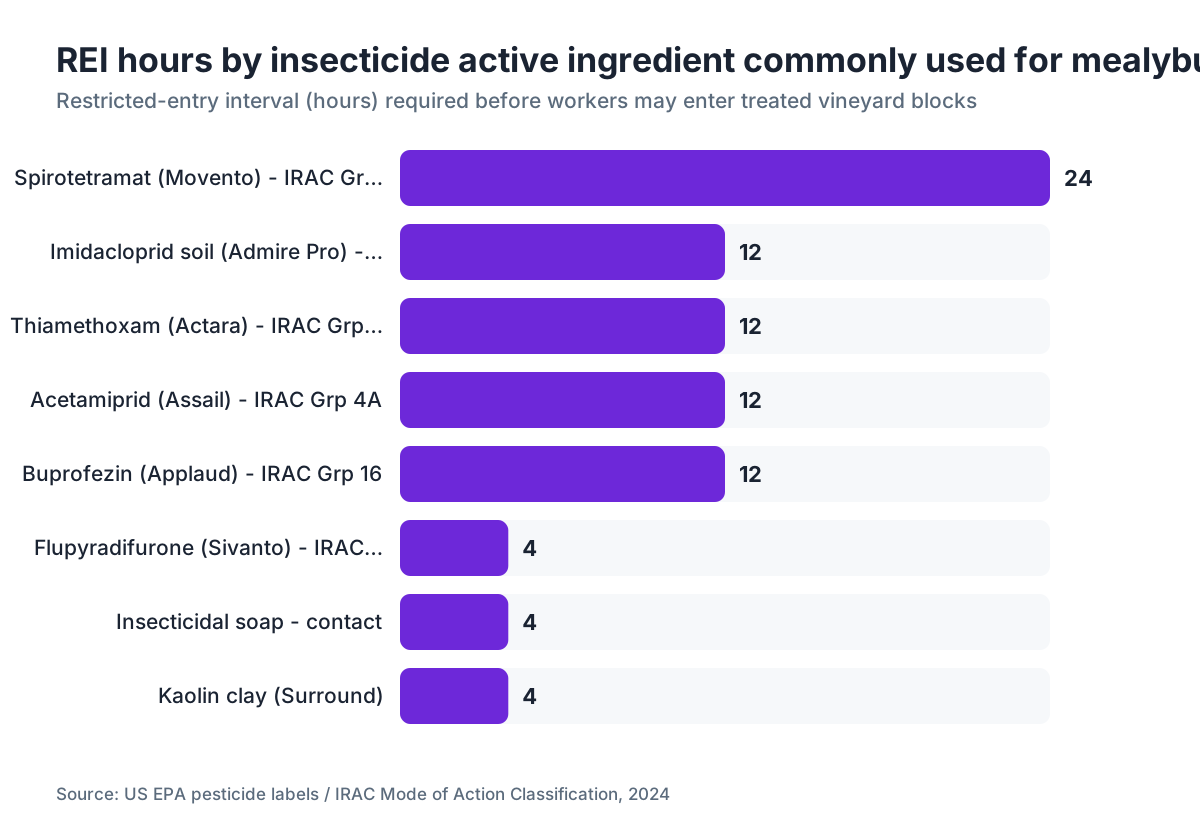
The REI is not optional padding. Plenty of insecticides used for mealybug control carry 12-hour, 24-hour, or even 48-hour REIs. Spirotetramat (Movento), used for systemic vine mealybug suppression, carries a 24-hour REI. Buprofezin (Applaud) carries a 12-hour REI. Your record has to show the REI was communicated and that no worker entered the block before it expired.
The WPS also requires pesticide safety training before workers enter any treated area, plus retained training records. Link your spray records to your training log. An auditor who asks "how did you verify workers knew the REI for that block on that date?" needs a traceable answer, and a linked file gives it.
One line from EPA's WPS is worth keeping on file: "Agricultural employers must provide workers and handlers with information about pesticide applications to protect them from pesticide exposure" [5]. That sentence defines what your documentation has to accomplish.
How do you document the scouting trigger that justified the spray decision?
The scouting record is the front half of a defensible decision. Without it, a spray record is just a list of chemicals applied. With it, you can tell any auditor, buyer, or neighbor exactly why you sprayed on that date.
For vine mealybug, UC IPM recommends monitoring with sticky tape traps on vine trunks plus visual inspection of canes and leaf petioles, with economic thresholds usually stated as percent infested vines rather than one hard number, since populations shift by region and cultivar sensitivity [1]. WSU Extension likewise recommends systematic monitoring before you make a spray decision for grape mealybug in Washington [10].
Your scouting record for a vector trigger should capture:
- Date and block scouted
- Who did the scouting (name, qualifications)
- Scouting method (sticky tape, visual, pheromone trap count)
- Findings: crawlers per trap, percent vines infested, life stage observed
- Threshold used and its source (UC IPM guidelines, your PCA's recommendation)
- Decision made: spray, hold, re-scout in X days
- If a PCA was involved, their signature or written recommendation
In California, any recommendation to apply a pesticide on agricultural land has to come from a licensed Pest Control Adviser (PCA), or from the grower acting in that role [3]. If you use a PCA, their written recommendation becomes part of your compliance record. Keep it with the spray record.
Running a degree-day model to time crawler emergence is the best way to hit mealybug crawlers when systemic uptake is highest and contact coverage lands well. If you do, write down the model, the biofix date, and the accumulated degree days at application. WSU's Decision Aid System and UC IPM both publish degree-day models for mealybug species [1][10].
Which insecticides are registered for mealybug and scale vector control, and what are the record-keeping differences?
Product choice sets several things you have to record: REI, PHI, restricted-use status, and whether a groundwater protection area restriction applies in your county. The table below sums up commonly used materials as of 2025. Verify current registrations before you order. Labels change.
| Active Ingredient | Trade Name (example) | RUP? | REI | Typical PHI (days) | Notes |
|---|---|---|---|---|---|
| Spirotetramat | Movento | No | 24 hr | 7 | Systemic; two-sided coverage needed |
| Buprofezin | Applaud | No | 12 hr | 30 | IGR; targets crawlers |
| Imidacloprid | Admire Pro | Yes (soil) | 12 hr | 30 | Soil app; bee toxicity concern |
| Thiamethoxam | Actara | No | 12 hr | 7 | Foliar neonicotinoid |
| Acetamiprid | Assail | No | 12 hr | 7 | Foliar neonicotinoid |
| Flupyradifurone | Sivanto | No | 4 hr | 7 | Reduced-risk butenolide |
| Kaolin clay | Surround | No | 4 hr | 0 | Physical barrier; limited efficacy alone |
| Insecticidal soap | Various | No | 4 hr | 0 | Contact only; tank mix adjunct |
For restricted-use pesticides like soil-applied imidacloprid formulations, you hold records for two years under federal law and your applicator or PCA has to be licensed [2]. The record also needs the certified applicator's license number.
If you're in an area with a groundwater protection order or a county-level restriction on neonicotinoids near bloom, that restriction belongs in your decision documentation. Your spray record should note "application made outside restricted bloom window" or cite the county order you reviewed before you decided.
Managing certified organic blocks? Check Cornell's NYS IPM program and the USDA Organic Integrity Database, because approved mealybug materials in organic systems are a much shorter list [6].
How do you record application conditions and equipment calibration for a vector spray?
Weather matters more for insecticides targeting crawlers and mobile life stages than it does for most fungicides. Mealybug crawlers are small and mobile. Spray in high wind and you get drift complaints plus poor coverage. Spray below 55 degrees F and many contact materials lose their bite against crawlers.
Your record should capture temperature, relative humidity, and wind speed and direction at application time, not "calm" or "good conditions." Use a calibrated handheld weather meter. Plenty of growers pull data from a nearby CIMIS station (in California) or an AgWeatherNet station (in Washington) and cite it, which works fine as long as the station is close enough to represent your block [3].
Equipment calibration is its own record. Your airblast or speed sprayer needs calibrating for the gallons-per-acre output that hits label-required coverage. Calibration records should show date, nozzle type and condition, operating pressure, ground speed, and calculated output per acre. An uncalibrated sprayer either under-doses (resistance risk, poor control) or over-doses (residue violations, drift liability). Keep calibration records separate from spray records, but cross-reference them.
Vine mealybug hides under bark and down in the root zone, so coverage quality is the whole ballgame. Your application record can note the coverage approach, something like "directed to trunk and cordon with shroud" or "full canopy coverage at 150 gallons per acre," to show you followed the label's coverage requirement.
What do state pesticide use reporting laws require beyond the federal minimum?
Federal FIFRA sets the floor. Most wine grape states set a higher bar.
California runs the most detailed pesticide use reporting system in the country. Every pesticide application on agricultural land goes to the county agricultural commissioner within one month [3]. The report carries the same fields as your application record plus commodity code, site code, and product quantity used. California's Department of Pesticide Regulation (CDPR) publishes the data online, so your applications sit in a public record. Accuracy matters for reasons beyond compliance.
Washington makes commercial applicators keep records for two years with specific required fields, and the state Department of Agriculture can inspect them at any time [4]. Oregon runs similar rules under ORS Chapter 634.
New York requires pesticide application records to be recorded and kept for three years under the Environmental Conservation Law [6]. Cornell Cooperative Extension's IPM program publishes guidance on what counts as an adequate record for audit purposes in New York.
Sell to a winery that carries a sustainability certification (SIP Certified, LODI Rules, CCOF) and those programs stack extra documentation on top of state law. SIP Certified, for one, requires you to document the pest threshold or economic justification for each application, more than what you sprayed [7]. That's exactly why the scouting record is the foundation of everything else.
How do you structure a spray record file for a multi-year leafroll vector management program?
A single spray event is easy to document. A three-year suppression program across 40 acres, with rotating chemistries, annual roguing of infected vines, and mealybug monitoring, is a different animal. The system has to let you pull the history of one block on a specific date, show the full rotation for a resistance review, and prove PHIs held all season.
Go block-based. Each vineyard block gets its own folder, physical or digital, holding the current season's spray log, the scouting log, the PCA recommendations, and the equipment calibration record. At season's end, that folder gets archived. Then answering "what did we apply in Block 7 in August 2023, and what was the scouting trigger?" takes a minute.
Tools like VitiScribe keep spray records, scouting logs, and REI/PHI tracking linked by block and date, which beats spreadsheets for this kind of cross-referencing. That said, a well-organized spreadsheet, or even a paper binder with consistent formatting, passes any audit if the fields are complete and legible.
For resistance management, your records should show you rotated modes of action across applications within and between seasons. IRAC (the Insecticide Resistance Action Committee) puts spirotetramat in Group 23, buprofezin in Group 16, and the neonicotinoids in Group 4A [8]. Three consecutive Group 4A applications on the record? That's a documented resistance risk staring back at you. Showing rotation is good science and a defensible record at the same time.
How do you document spray decisions around bloom to protect pollinators?
Bloom is the highest-risk window for pollinators in a vineyard. Grapevines are wind-pollinated and growers don't run bee colonies for pollination, but vineyards sit inside farm landscapes where managed and wild bees forage. Apply insecticides during bloom and you carry both a legal exposure and a reputational one.
Many state laws and some county ordinances restrict bee-toxic materials during bloom. California's Department of Food and Agriculture has issued guidance on protecting bees from pesticide exposure, and several counties adopted pollinator protection plans that require notifying beekeepers before certain materials go out [3].
Your bloom-period spray record should spell out:
- Vine phenological stage at application (is bloom actually over?)
- Whether registered hives sit within the notification distance your county or state specifies
- Whether you notified any registered beekeepers
- The toxicity classification of the material applied (for example, "acute bee toxicity: toxic on dry residue, low acute contact toxicity when dry")
Some growers add a short line like "bloom complete in this block as of [date]; no open flowers observed at time of application." That's the kind of specific detail that protects you if a beekeeper complains later.
EPA's pollinator protection language on individual pesticide labels is legally binding. The label is the law. Your record should show you read it and followed it.
What are the most common record-keeping failures found during compliance audits?
Pull the guidance from UC ANR, WSU Extension, and CDPR audit reports and the common failures in vineyard pesticide records turn out to be plain. Mundane omissions, mostly.
Missing REI documentation is the single most cited WPS deficiency. The application record exists, but there's no evidence the REI was posted or communicated to workers. That's a WPS violation even if nobody got hurt.
Vague pest identification comes next. "Insects" or "sucking pests" is not adequate. The record has to name the species, or at least the genus and pest category. "Vine mealybug (Planococcus ficus), vector of GLRaV-3" is correct. "Bugs on vines" is not.
Missing application rate math shows up all over paper-based records. The grower writes the per-acre rate off the label but skips the total product used or the total acres treated, which makes it impossible to verify dose compliance.
Weather recorded as "good" with no actual numbers is a soft failure. It may not get you cited, but it puts doubt on whether the application ran under label-compliant conditions.
No link between scouting and the spray decision is the most consequential gap in a sustainability audit. SIP Certified, LODI Rules, and similar programs will cite you for an application with no documented pest pressure behind it. The spray might have been completely appropriate. Without a scouting record showing why, you can't prove it.
Fixing these gaps costs nothing and takes about five minutes per application once the habit sticks. Fixing a failed audit costs time, attorney fees, and sometimes a certification.
How long do you need to keep leafroll vector spray records?
Retention requirements stack, and you keep records for the longest period any one of them demands.
Federal FIFRA Section 8 sets two years for restricted-use pesticides [2]. The EPA WPS requires the application-specific central display information to be retained at the establishment for two years [5]. California requires pesticide use reports to be kept for three years [3]. Oregon requires three years. Washington requires two years for commercial applicators [4].
Sustainability certifiers generally want three to five years of records for re-certification audits.
Here's the practical answer. Keep complete spray records, scouting records, and WPS posting records for at least three years in digital backup, and hold anything tied to a certification cycle for five. PDF scans of paper records in cloud storage satisfy this in a way a binder in a barn does not.
And if you sell the vineyard, lease the land, or get acquired, those records travel with the property for compliance purposes. Build a handoff packet before you need one.
How do you document a spray decision when you're following a PCA's written recommendation?
In California, a licensed Pest Control Adviser's written recommendation is a legal document. It has to be signed by the PCA, has to identify the pest, the product, and the application site, and the grower keeps it for two years [3]. The PCA keeps a copy too.
When you follow a PCA recommendation, your spray record should:
- Reference the recommendation by date and the PCA's license number
- Confirm what you actually applied matched the recommendation (if you substituted a product, note why and document any follow-up with the PCA)
- Note any deviations in rate, timing, or equipment from what was recommended
The PCA recommendation is not a license to skip documenting the application. You still need the full application record: who applied it, when, at what rate, under what conditions, with what equipment. The recommendation documents the decision authority. The application record documents the execution.
Operating without a PCA and making your own calls as a grower-operator? You take on full documentation duty for both the scouting trigger and the application. That's legal in most states when you're spraying your own land, but the record needs to be even more thorough, because there's no second professional's signature anchoring the decision chain.
Frequently asked questions
What is the minimum information required on a vineyard spray record for a mealybug application?
At minimum: date and time, applicator name and license number (if RUP), property location, crop and growth stage, pest target by species name, product name and EPA Registration Number, application rate per acre, total volume applied, acres treated, equipment type, weather conditions at application, REI communicated or posted, PHI remaining, and applicator signature. Missing any of these creates an audit vulnerability.
Do I need a PCA recommendation to spray for vine mealybug in California?
Yes, if the application is made on agricultural land in California. Under the California Food and Agricultural Code, any recommendation to apply a pesticide on agricultural property must come from a licensed Pest Control Adviser, unless the grower is acting as their own PCA on their own property. Even then, a written self-generated recommendation referencing pest presence is best practice.
How long do I need to keep vineyard spray records under the EPA Worker Protection Standard?
The WPS requires application-specific information posted at the central display to be retained at the agricultural establishment for two years (40 CFR Part 170). FIFRA also requires two years for restricted-use pesticides. State rules range from two to three years, and California requires three. Keep everything at least three years, and hold certification-linked records five.
What spray records do sustainability certification audits like SIP Certified require?
SIP Certified requires that every pesticide application include documented justification tied to observed pest pressure or an economic threshold. A spray log without a scouting record connecting pest levels to the application decision will not satisfy SIP certification audit requirements. Keep scouting records filed with corresponding spray records and cross-referenced by block and date.
What weather conditions should I record at the time of a mealybug spray application?
Record temperature (air, at canopy height), relative humidity, wind speed, and wind direction at the start and end of application. Use a calibrated handheld weather meter rather than a verbal estimate. Some growers supplement with data from the nearest CIMIS (California) or AgWeatherNet (Washington) station, noting the station name and distance from the block treated.
How do I document insecticide mode-of-action rotation for resistance management in my spray records?
Add an IRAC Group number to each spray record entry alongside the product name. For example, spirotetramat is IRAC Group 23; imidacloprid is IRAC Group 4A. At the season level, review your records to confirm no single IRAC group was used in more than two consecutive applications. This documents your resistance management program and satisfies some sustainability audit requirements.
Can I use a mobile app or spreadsheet for vineyard pesticide records, or do I need paper?
Federal and state regulations do not require paper. Electronic records are acceptable as long as they are legible, reproducible, and available for inspection on request. Whatever format you use, backup is essential. Paper records in a damp barn fail. Cloud-synced digital records with regular backups and access controls last longer. The required data fields are the same regardless of format.
How do I document a spray application that I decided not to make after scouting?
Document it anyway. A scouting record that concludes "mealybug levels below threshold; no spray warranted" is evidence of an active IPM program. Sustainability certifiers and food-safety auditors view documented no-spray decisions as positive signs of threshold-based decision-making. Record the date, block, scouting method, findings, and the threshold you compared them against.
What do I need to record if I apply an insecticide during the restricted bloom period?
Record the vine phenological stage confirmed at time of application, who confirmed it, whether registered bee hives sit within the notification distance your county or state specifies, whether you notified registered beekeepers, and the bee toxicity classification from the product label. If bloom was not complete, document why the application was still made and what label provisions or exemptions you relied on.
Does the spray record need to reference grapevine leafroll virus specifically, or just the mealybug pest?
Legally, naming the pest (mealybug species) is enough for regulatory records. For sustainability certifications and private audits, specifying "vector management for GLRaV-3" adds context that shows IPM rationale. It also helps your own multi-year records, where distinguishing vector management applications from other pest control efforts lets you judge whether the program is working.
What happens if an employee enters a treated block before the REI expires, and how do records factor in?
An REI violation is a federal WPS violation (40 CFR Part 170) whether or not anyone gets sick. Your records are your defense or your liability. If records show the REI was posted, communicated at toolbox meetings, and the block was marked, you've shown good-faith compliance. If records say nothing about REI communication, the violation stands with no mitigating documentation.
How do I handle spray records when I hire a contract applicator rather than applying myself?
The contract applicator usually provides their own application record, but you as the landowner or farm operator keep responsibility for WPS compliance on your property. Get a copy of the contractor's application record, verify it includes all required fields, confirm WPS posting happened before workers re-entered, and keep the contractor's record and your own WPS documentation together in the block file.
What degree-day models are available for timing mealybug crawler emergence, and should I record them?
UC IPM publishes a degree-day model for grape mealybug (Pseudococcus maritimus) using a lower threshold near 51.8 degrees F. WSU Extension provides degree-day guidance for vine mealybug timing in Washington. Yes, record the model used, biofix date, and accumulated degree days at time of application. This shows your spray timing was scientifically justified, which strengthens both regulatory and sustainability audit records.
Sources
- UC IPM - Grape Pest Management Guidelines (Mealybugs): Vine mealybug (Planococcus ficus) and grape mealybug (Pseudococcus maritimus) are primary vectors of GLRaV-3; UC IPM recommends monitoring with sticky tape traps before making spray decisions, and vine mealybug has expanded across California wine regions since the 1990s.
- US EPA - Pesticides (FIFRA record-keeping): Federal law under FIFRA Section 8 requires that applicators of restricted-use pesticides keep records for two years.
- California Department of Pesticide Regulation: California requires growers to submit a Pesticide Use Report to the county agricultural commissioner within one month of application, to retain records for three years, and requires a licensed PCA recommendation for applications on agricultural land.
- Washington State Department of Agriculture: Washington State requires commercial pesticide applicators to retain application records for two years and includes specific required data fields per application; records are subject to state inspection.
- US EPA - Agricultural Worker Protection Standard (40 CFR Part 170): The EPA WPS requires central display posting of application-specific information before workers enter treated areas, with a two-year retention requirement. Direct quote: 'Agricultural employers must provide workers and handlers with information about pesticide applications to protect them from pesticide exposure.'
- Cornell Cooperative Extension - NYS IPM Program: New York requires pesticide application records to be retained for three years under the Environmental Conservation Law; Cornell IPM publishes guidance on adequate record format for audit purposes.
- SIP Certified - Sustainability in Practice Standards: SIP Certified requires documentation of pest threshold or economic justification for each pesticide application as part of certification audit requirements.
- IRAC - Mode of Action Classification Scheme: Spirotetramat is classified as IRAC Group 23; buprofezin as Group 16; imidacloprid, thiamethoxam, and acetamiprid as Group 4A (neonicotinoids).
- UC Agriculture and Natural Resources: UC ANR recommends degree-day based timing for mealybug crawler applications and documents vine mealybug range expansion across California wine regions.
- WSU Extension: WSU Extension recommends systematic monitoring before spray decisions for mealybug in Washington vineyards and provides degree-day guidance for vine mealybug crawler emergence timing.
- LODI RULES for Sustainable Winegrowing: LODI RULES requires documented pest scouting records linked to spray decisions as part of integrated pest management certification requirements.
Last updated 2026-07-10