Treating powdery mildew on grapes: what actually works
TL;DR
- Powdery mildew (Erysiphe necator) is the most economically damaging fungal disease in most grape-growing regions.
- Effective treatment combines well-timed sulfur or DMI fungicide applications from budbreak through veraison, strict resistance management by rotating FRAC codes, and canopy management that reduces humidity.
- Organic growers rely on sulfur, potassium bicarbonate, and narrow-rate oils.
- No single spray controls it; programs do.
What is powdery mildew on grapes and why does it matter so much?
Powdery mildew on grapes is caused by the obligate biotrophic fungus Erysiphe necator (formerly Uncinula necator). It's the most widespread and economically significant fungal disease in viticulture, hitting vineyards in every major wine region on earth. Unlike most fungal pathogens, it doesn't need leaf wetness to germinate. It thrives in moderate temperatures (65-77°F is optimal) with high relative humidity, which makes the interior of a dense grape canopy near-perfect habitat.
The disease overwinters as cleistothecia (sexual spore structures) on the bark, or as mycelium in infected buds. Primary infections emerge at or just after budbreak. Left alone, the fungus colonizes leaves, shoots, cluster stems, and berries with a white-gray powdery coating. On berries, infection before or during bloom is catastrophic: berry skin cells stop dividing while the flesh keeps expanding, and the berry cracks open. Cracked berries invite Botrytis and other secondary rots. One bad block can taint an entire tank of wine.
The economic scale is real. A 2013 University of California analysis estimated that powdery mildew management, counting both fungicide costs and crop losses from poor control, costs California growers roughly $270-300 million a year [1]. That number has almost certainly grown with input costs. Susceptibility varies by variety. Chardonnay, Cabernet Sauvignon, Merlot, and Pinot Noir are all highly susceptible. Muscadine species (Vitis rotundifolia) carry natural resistance, but most commercial Vitis vinifera varieties do not.
When should you start treating powdery mildew on grapes?
Start at budbreak. That's the answer. Most growers who lose the fight against powdery mildew lose it in the first three to four weeks of the season, when shoot tissue is young, tender, and most susceptible.
Cornell's New York State IPM program identifies budbreak through about 6-8 inches of shoot growth as the highest-risk window for primary infections from overwintering inoculum [2]. Miss a spray in that window and you don't just get current infections. You build the spore load that drives secondary infection pressure through bloom and berry set, which is when damage is most expensive.
The general spray calendar for a standard-susceptibility variety in a warm region looks like this:
| Growth Stage | BBCH Code | Action |
|---|---|---|
| Budbreak (2-3 in. shoot growth) | 05-07 | First spray, sulfur or DMI |
| 6-8 in. shoot growth | 12-14 | Second spray, continue sulfur |
| Bloom (10-80% flowering) | 65-69 | Critical window, DMI or SDHI |
| Berry set through pea-size | 71-73 | Continue on 10-14 day interval |
| Bunch closure | 77-79 | Final spray before veraison in most programs |
| Veraison | 81 | Most programs stop here |
Spray interval is driven by weather. Under cool, dry conditions you can stretch to 14 days. Under warm (70-80°F), humid, or dense-canopy conditions, tighten to 7-10 days. The interval isn't a calendar courtesy. It's a biological deadline: sulfur efficacy tops out around 10-14 days post-application [3].
One more thing on timing. The 236-degree-day (base 50°F) model developed at UC Davis is widely used in California to predict when 1% of overwintering cleistothecia have discharged ascospores. Spraying before that threshold hits helps you time your season opener. The UC IPM website keeps updated degree-day models for California counties [1].
What fungicides work best for grape powdery mildew treatment?
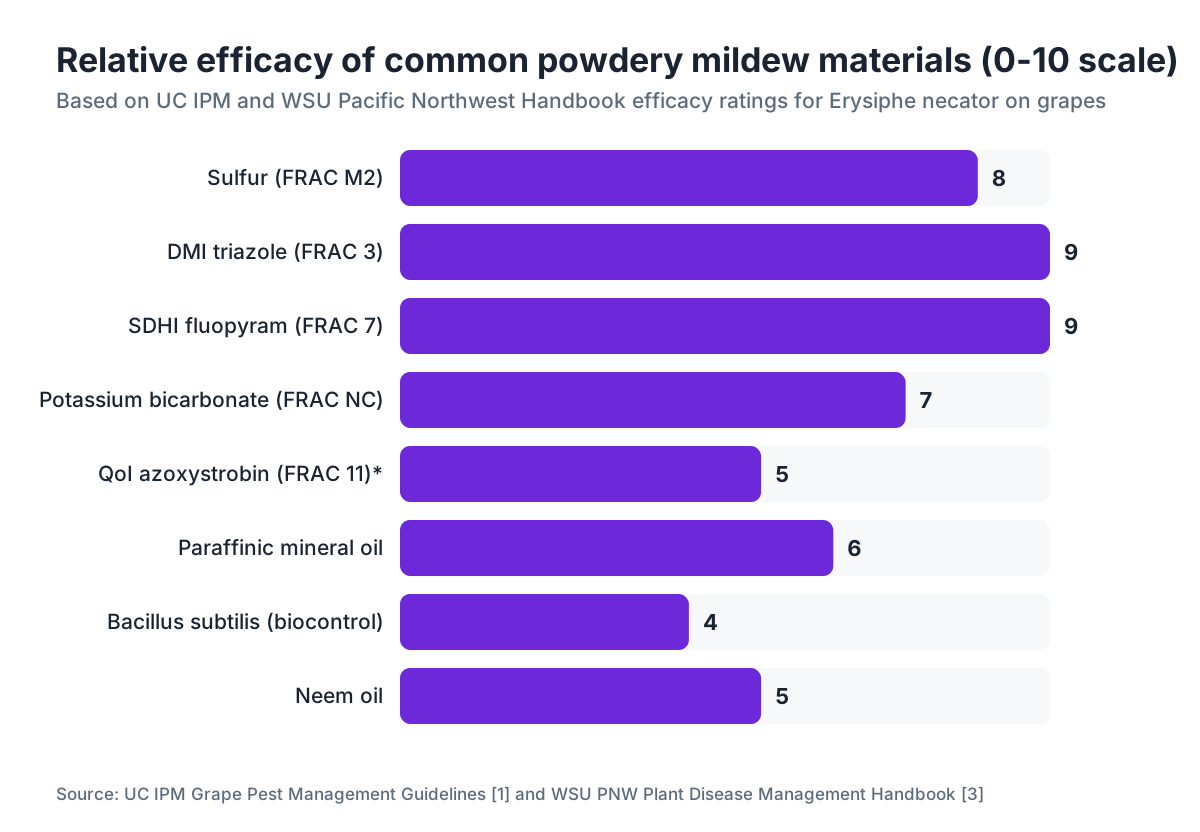
Fungicides for grape powdery mildew fall into several FRAC (Fungicide Resistance Action Committee) groups. Rotating among them is mandatory, not optional, because E. necator has shown resistance to DMIs and QoIs in vineyards across California, Washington, and the eastern U.S. [4].
Here are the main chemical classes and their characteristics:
Sulfur (FRAC M2) is the workhorse. Elemental sulfur has no known resistance mechanisms in E. necator. It works by contact, so coverage matters more than anything else. Apply at 3-4 lb per acre (wettable sulfur) on a 7-14 day interval. Don't apply when temperatures top 90-95°F or within 2 weeks of a paraffinic oil application. Sulfur burns the vine above those thresholds. Cost is low: wettable sulfur runs roughly $0.50-2.00/lb depending on formulation and volume.
DMIs (Demethylation Inhibitors, FRAC 3) include triazoles like myclobutanil (Rally 40W), tetraconazole (Mettle), and triadimefon. They have protective and curative activity (the curative window is roughly 72-96 hours post-infection). Because resistance is documented, limit DMI use to 2-4 applications per season and always rotate to a different FRAC group between applications [4].
QoIs (Quinone Outside Inhibitors, FRAC 11) include azoxystrobin (Abound) and pyraclostrobin. Resistance in E. necator is well documented. Many California and Pacific Northwest populations now carry high levels of QoI resistance [4]. Some advisors have dropped QoIs entirely on high-pressure blocks.
SDHIs (Succinate Dehydrogenase Inhibitors, FRAC 7) include fluopyram (Luna Privilege) and fluxapyroxad. This is newer chemistry with strong efficacy and systemic activity. Rotate to slow resistance.
Potassium bicarbonate (FRAC NC) such as Kaligreen or Armicarb disrupts fungal cell wall pH, kills surface mycelium on contact, and carries no resistance risk. It has no curative activity worth relying on, but it's a useful rotation partner.
Mineral oils (paraffinic, OMRI-listed versions available) smother the fungus and block spore germination. They're useful in organic programs but need careful timing to avoid phytotoxicity.
WSU's Viticulture and Enology program keeps an annually updated table of registered fungicides, efficacy ratings, and resistance risk for the Pacific Northwest [3].
How do you manage fungicide resistance in powdery mildew programs?
Resistance management is where most small vineyard operations fall short. The logic is simple. Spray the same FRAC group over and over, and you select for the individuals in the E. necator population that carry resistance mutations. Those individuals survive, reproduce, and within a few seasons you have a block where that chemistry does nothing.
The practical rules are:
- Never apply the same FRAC group more than twice in a row. Most programs alternate between FRAC M2 (sulfur), FRAC 3 (DMI), and FRAC 7 (SDHI) through the season.
- Know your local resistance situation. UC Davis Plant Pathology and WSU have published resistance frequency data for California and Washington populations [4]. QoI resistance is so widespread in California coastal counties that some PCAs have dropped FRAC 11 entirely.
- Sulfur and potassium bicarbonate have no resistance risk. Use them heavily as anchor treatments all season, saving the at-risk chemistries for the highest-pressure windows (bloom through berry set).
- Mixture products that combine two FRAC groups (for example, Pristine = FRAC 7 + FRAC 11) can extend the useful life of each, but skip them if one component is already defeated in your blocks.
Accurate spray records are more than a compliance chore. They're how you track your FRAC rotation across multiple blocks over multiple seasons. Manage more than a few acres and that's genuinely hard to do in a spreadsheet. That's one reason vineyard teams use field operations software like VitiScribe to log applications with FRAC codes and set automatic rotation alerts.
What are the best organic treatments for powdery mildew on grapes?
Organic treatment for powdery mildew on grapes is a real program, not a compromise. It just demands tighter spray intervals and more attention to the canopy than a conventional program does.
The core organic materials are:
Sulfur stays the backbone. OMRI-listed wettable sulfur formulations are widely available. Same timing rules apply as in conventional programs. Sulfur is the cheapest broad-spectrum option for organic growers.
Potassium bicarbonate (Kaligreen, Armicarb, MilStop) is genuinely effective, with strong knockdown of surface mycelium. Use at 2-3 lb per 100 gallons of water. It has no systemic activity, so coverage is everything. Rotate it with sulfur to diversify your mode of action.
Neem oil / clarified hydrophobic extract of neem has some contact efficacy against powdery mildew. It's slower than sulfur and has a tighter phytotoxicity window. Don't use within 2 weeks of sulfur.
Paraffinic mineral oils (Stylet-Oil, JMS Stylet-Oil) are OMRI-listed. They work best as preventives applied on 7-10 day intervals early in the season. The sulfur-oil incompatibility rule applies again: wait at least 2 weeks between applications.
Bacillus subtilis products (Serenade, Rhapsody) are OMRI-listed and can go into a rotation, but independent efficacy data for grape powdery mildew specifically is thinner than for the chemistries above. The UC IPM Grape Pest Management guidelines rate biofungicides as moderate to low efficacy as standalone treatments [1].
A practical organic program in California might look like this: sulfur at budbreak, potassium bicarbonate at 6-inch shoot growth, sulfur at pre-bloom, potassium bicarbonate at bloom (many growers avoid sulfur right at bloom over phytotoxicity concerns on flower parts in hot weather), sulfur at berry set, then a 10-day interval through bunch closure.
For growers in the vineyard world where organic certification is a selling point, documenting every application with material, rate, and weather conditions is required for third-party organic audits.
Does canopy management actually reduce powdery mildew pressure?
Yes. More than most growers give it credit for.
E. necator can't germinate in direct ultraviolet light. UC Davis research has shown that grape berries getting direct sun have far lower powdery mildew infection rates than shaded berries in the same cluster zone [1]. Shoot positioning, leaf removal, and hedging change the microclimate inside the canopy in ways that matter.
Specific practices that help:
Leaf removal in the cluster zone is the single most useful cultural practice. Pulling 1-2 leaves on the east side (morning sun, afternoon shade) drops humidity and raises UV exposure. Timing matters: leaf removal at or just after fruit set gives the best mildew reduction without adding sunburn risk on berries.
Shoot positioning (getting shoots vertical and evenly spaced) improves spray penetration a lot. A tractor-speed ground application into a tangled, unpositioned canopy loses 30-50% of its coverage efficacy compared to a positioned canopy. That's not a small number.
Vigor management through rootstock choice, deficit irrigation, and nitrogen restraint reduces the dense, tender shoot growth E. necator loves. High-vigor blocks with a lot of lateral growth are consistently higher-risk blocks.
Row orientation is a long-game decision, but north-south rows in the northern hemisphere maximize direct sun hours on both canopy faces and shorten the morning dew window.
None of these practices replace fungicides under high pressure. But in a season when you've already hit your maximum allowed application count for a given chemistry, a well-managed canopy can be the difference between an acceptable level of infection and a loss.
How do you treat powdery mildew on grape leaves versus clusters?
The fungicide program is the same. What differs is the consequence of infection, and that changes your tactical priorities.
Leaf infection is less destructive. Powdery mildew on grape leaves cuts photosynthesis, and severe leaf infection can cause early defoliation, weakening the vine and dropping carbohydrate reserves for next season. But leaf infection alone rarely ruins a crop. It's a warning that your program has gaps.
Cluster and berry infection is where the real damage happens. Infections at or near bloom (the 10 days before to 3 weeks after full bloom) are the highest-risk period. E. necator that colonizes the rachis (cluster stem) or individual berries before the skin lignifies (around 6-8 weeks post-bloom) makes berry skin cells stop dividing while the pulp keeps growing, and the berry cracks. Once berries crack, secondary infection by Botrytis cinerea, acetic acid bacteria, and other pathogens follows fast.
For powdery mildew on grape leaves specifically: if you see visible mycelium on leaves in midsummer and your primary spray program has been steady, the leaf infection usually points to bad coverage (check your water volume and nozzle pattern) or resistance to one of your active ingredients. Switching to full-rate sulfur with added spreader-sticker and a 7-day interval usually stops leaf progression.
For cluster protection, the key spray is the one applied 2-3 days before bloom starts. That application needs a systemic product (DMI or SDHI) to work inside the cluster. Contact materials alone can't reach the interior of a tight cluster.
What water volume and application equipment get the best coverage?
This part gets ignored. Fungicide chemistry is half the equation. Getting it onto the target tissue is the other half.
For conventional air-blast sprayers, University of California recommends a minimum of 50-100 gallons per acre in high-vigor, dense-canopy vineyards [1]. Many growers run 75 gallons per acre as a baseline. Apply sulfur at 3 lb per acre in only 25 gallons of water and the concentration may be fine, but you won't physically cover the interior cluster zone.
Tunnel sprayers (more common in Europe and in some larger California operations) cut drift and improve coverage uniformity, but they're expensive. For most small operations, a well-calibrated conventional air-blast with properly angled nozzles is the practical standard.
Drone application is growing on steep slopes and irregular terrain where tractor access is hard. USDA AMS has started approving specific drone applications for registered pesticide use, and EPA worker protection standard exemptions for drones are still evolving. But coverage data at commercial label rates is still thin compared to ground equipment.
Nozzle selection matters. Fan nozzles aimed into the canopy with some turbulence from the blower beat hollow-cone nozzles for penetrating interior cluster zones. Run a coverage check with water-sensitive paper cards placed inside clusters at different canopy depths at least once at the start of each season.
Spray timing within the day has an effect too. Morning applications let the material dry before afternoon heat (important for sulfur), and spraying in strong wind wrecks coverage consistency. Calm conditions, early morning or late afternoon, give the best results.
What does the EPA worker protection standard require for powdery mildew sprays?
The EPA Worker Protection Standard (WPS), codified at 40 CFR Part 170, applies to pesticide applications in agricultural settings including vineyards. Every spray application for powdery mildew treatment on grapes falls under WPS if the vineyard employs any agricultural workers [5].
The key WPS requirements for vineyard spray operations are:
Restricted Entry Interval (REI): Each fungicide product label sets an REI, the minimum time that must pass after an application before workers can enter the treated area without personal protective equipment (PPE). For sulfur products, the REI is typically 24 hours. For DMI fungicides it varies; many carry a 12-24 hour REI. Always check the specific product label, which is the legal document.
Application Exclusion Zone (AEZ): Since the 2015 WPS revision, the EPA added the AEZ requirement. For ground applications, no worker or other person may be in the area within 100 feet of the sprayer in the direction of spray [5].
Posting: Treated vineyard blocks must be posted at all entry points during the REI with a WPS-compliant sign showing the pesticide applied, the date and time of application, and the REI.
Training: Any worker who enters a treated area must get WPS safety training first. Keep records of that training for 2 years.
Central posting of safety information: Handlers' and workers' rights, emergency contact information, and safety data sheets must be kept and posted at a central location every worker can reach.
The REI and PPE requirements on the product label are federal law, not suggestions. State agriculture departments (like CDFA in California or WSDA in Washington) add requirements that may be stricter. EPA's WPS page has the full rule text and compliance guides [5].
How do you keep spray records that satisfy compliance requirements?
Spray records are required by most state pesticide use reporting laws, and third-party auditors routinely ask for them: organic certification, SIP certification, LODI Rules, and others. California's pesticide use reporting (PUR) program, run by the California Department of Pesticide Regulation, requires licensed pesticide applicators to submit records of every restricted-material application within one month [6].
A compliant spray record for a powdery mildew application needs to capture at minimum:
- Date, time, and block/field designation
- Product name, EPA registration number, and active ingredient
- Amount applied (per acre and total)
- Application method (air-blast, hand-gun, drone, etc.)
- Target pest (Erysiphe necator / grape powdery mildew)
- Applicator name and pesticide applicator license number
- REI start and end time
- Wind speed and direction, temperature, and humidity at time of application
- Water volume per acre
For organic certification, you also need to show that the material is on the approved National Organic Program (NOP) materials list and, in most cases, that it appears on your Organic System Plan as an approved input.
Paper logs work, but they make FRAC rotation tracking, REI lookups, and annual reporting genuinely tedious across multiple blocks. VitiScribe's field operations module is built for this exact workflow, with block-level spray logs, FRAC code tracking, and export formats that match state reporting requirements.
Whatever tool you use, keep original spray records for at least 3 years. Some state programs and organic certifiers require 5 years on file.
For operations in states covered by EPA's National Pollutant Discharge Elimination System (NPDES) requirements for pesticide applications near water bodies, extra notification and record-keeping may apply [5].
How much does a powdery mildew spray program cost per acre?
Cost varies widely by region, program intensity, and whether you're organic or conventional. Here are realistic ranges based on current (2024-2025) input costs and published UC Davis cost-of-production studies [7].
A conventional program running 8-10 applications per season might include:
| Material | Approx. cost per acre per application | Typical applications/season |
|---|---|---|
| Wettable sulfur (3 lb/acre) | $1.50-$4.00 | 4-6 |
| DMI fungicide (Rally 40W at 4 oz) | $12-$20 | 2-3 |
| SDHI fungicide (Luna Privilege) | $18-$28 | 1-2 |
| Potassium bicarbonate | $5-$9 | 2-3 |
Fungicide material costs alone typically run $60-$150 per acre per season for a conventional program. Add labor for application at 1-3 hours per acre per application depending on equipment and block size, plus machine operating costs, and total powdery mildew management for conventionally farmed Napa or Sonoma Chardonnay can reach $300-600 per acre per season when labor is counted.
Organic programs using sulfur, potassium bicarbonate, and oils tend to have slightly lower material costs but need more frequent applications (7-10 day intervals are harder to stretch than 14 days with a systemic DMI), so labor costs can wipe out or exceed the material savings.
The UC Davis Cost and Return Studies for wine grapes, published by the UC Agricultural Issues Center, show that pest management as a category (which includes powdery mildew fungicides) runs roughly 8-15% of total vineyard operating costs depending on variety and region [7]. That's a big line item, and a strong argument for getting your program right instead of cutting applications to save $30 an acre.
What do university extension programs say about integrated powdery mildew management?
Three university programs dominate the practical guidance on grape powdery mildew in the U.S., and they agree on core principles while reflecting regional differences.
UC Davis / UC IPM: The UC IPM Grape Pest Management guidelines, maintained by the UC Statewide IPM Program, are the deepest publicly available resource in the country. They cover the full disease cycle, fungicide efficacy ratings, resistance management, and degree-day models for California conditions [1]. UC Davis researchers including Doug Gubler (now emeritus) have been central to U.S. powdery mildew research since the 1980s.
Cornell University / NYSAES: Cornell's New York State IPM program produces annual guidelines for eastern U.S. growers, who face a different humidity and rainfall profile than western growers. Cornell's guidelines note that because rainfall and dew periods are more frequent in the Northeast, spray intervals should be tighter and the bloom window is even more critical than in California [2]. Cornell's Viticulture and Enology program at Geneva also runs the Appellation Cornell newsletter with current disease pressure updates.
Washington State University: WSU's extension viticulture program, based in Prosser at the Irrigated Agriculture Research and Extension Center, publishes the Pacific Northwest Plant Disease Management Handbook, which includes annual fungicide efficacy ratings for grape powdery mildew specific to PNW conditions [3]. WSU researchers have also contributed to QoI resistance frequency mapping across Washington vineyards.
All three programs agree on the same foundation: start early, protect bloom, rotate FRAC groups, and manage canopy. Where they split is in specific product recommendations, which partly reflects regional resistance profiles and label registrations that vary by state. The UC IPM guidelines, for example, are more explicit about QoI resistance in California coastal counties than the WSU handbook, which reflects real differences in resistance frequency data [4].
Extension programs also increasingly stress that spray interval decisions should be weather-driven using validated degree-day models rather than fixed calendar intervals. The UC IPM website makes those models free for California growers.
Frequently asked questions
Can powdery mildew on grapes be treated after you see it on the berries?
Partially. DMI fungicides have a 72-96 hour post-infection curative window and can arrest active infections in early stages. But berries already showing cracking, russet skin, or extensive white mycelium are beyond rescue. The curative claim on DMI labels applies to early-stage infections, not established colonies. If you see visible disease on berries at or after bunch closure, focus on protecting uninfected clusters and managing the crop going forward.
Is baking soda an effective organic treatment for powdery mildew on grapes?
Sodium bicarbonate (baking soda) shows up in home gardening advice. Commercial potassium bicarbonate (Kaligreen, Armicarb) is the OMRI-listed agricultural version, and it does have demonstrated efficacy. Baking soda has some effect in small-scale tests, but it carries phytotoxicity risk at higher concentrations and leaves sodium deposits that can affect soil over time. For vineyard use, stick to potassium bicarbonate formulations labeled for grapes.
When should you stop spraying for powdery mildew in the season?
Most programs stop at veraison (when berries begin to soften and color). Berry skins lignify around that point and become far less susceptible to new infection. The exception is when the rachis (cluster stem) is still green and soft past veraison, which can still be infected. In practice, few growers spray past 3-4 weeks post-veraison under normal conditions. Late sprays also raise preharvest interval (PHI) concerns, so check the product label.
What temperature is too hot to spray sulfur on grapes?
Sulfur becomes phytotoxic when temperatures top 90-95°F within 24 hours of application, though some sources set the threshold as low as 87°F for sensitive varieties. Avoid applying sulfur when high temperatures are forecast. During a heat event, switch to potassium bicarbonate or a systemic fungicide with a wider temperature window. Never apply sulfur within 2 weeks of a paraffinic mineral oil application, regardless of temperature.
Does powdery mildew affect wine quality beyond the obvious crop damage?
Yes. Even subclinical infection without visible berry cracking has been linked to elevated off-flavor compounds in finished wine. Research published in the American Journal of Enology and Viticulture identified 1-octen-3-ol and other fungal metabolites in wine made from mildewed fruit. Sensory panels in those studies detected musty or moldy notes at relatively low infection levels. This is one reason PCAs push for clean fruit even in years when infection looks manageable.
How do you tell powdery mildew from downy mildew on grape leaves?
Powdery mildew appears as white-gray powdery growth on the upper leaf surface. Downy mildew (Plasmopara viticola) produces oily green-yellow spots on the upper leaf surface and white cottony sporulation on the lower surface. Powdery mildew develops without leaf wetness and in drier conditions. Downy mildew needs free water for sporangia release and is driven by rainfall events. The two diseases require different fungicide programs and rarely respond to the same materials.
Are there resistant grape varieties that don't need powdery mildew treatment?
Yes, but with trade-offs. Several Vitis rotundifolia and interspecific hybrid varieties (Chambourcin, Traminette, some USDA and Swiss 'PIWI' varieties) carry significant powdery mildew resistance. True Vitis vinifera varieties like Chardonnay, Pinot Noir, and Cabernet Sauvignon have essentially no useful resistance. Cornell and UC Davis have both published variety resistance ratings. Resistant varieties may still need reduced-frequency programs rather than zero sprays, since no commercial table or wine grape variety is immune.
What is the restricted entry interval (REI) for common powdery mildew fungicides?
REIs vary by product. Wettable sulfur products typically carry a 24-hour REI. DMI fungicides like myclobutanil (Rally 40W) typically carry a 24-hour REI. Luna Privilege (fluopyram) carries a 12-hour REI. Potassium bicarbonate products generally carry a 4-hour REI. Always read the actual product label, which is the legally binding document. State requirements may be stricter than the federal label. Under EPA WPS, no worker may enter during the REI without full PPE.
How many sprays per season does a typical grape powdery mildew program require?
Most programs in high-pressure regions run 8-12 applications from budbreak through veraison. Low-pressure years or low-susceptibility varieties may get by with 6-8. Tight canopies with good cultural practices sit at the low end, dense high-vigor blocks with a history of resistance issues at the high end. Every application should have a clear justification by growth stage and weather rather than a fixed schedule.
Can you use the same fungicide at every spray in a powdery mildew program?
No. Using the same FRAC group repeatedly selects for resistance. Even sulfur, which has no known resistance mechanism in Erysiphe necator, benefits from rotation with other modes of action to reduce selection pressure on the whole population. For DMIs and QoIs, resistance is already documented in many California and Pacific Northwest vineyards. Spray records that track FRAC codes by block and application date are the practical tool for enforcing rotation across a full season.
Does neem oil work for grape powdery mildew?
Neem oil, specifically the clarified hydrophobic extract, has contact activity against powdery mildew and is OMRI-listed. Independent university efficacy trials rate it as moderate for powdery mildew compared to sulfur or potassium bicarbonate. It can be a useful rotation partner in an organic program but shouldn't be the primary material in high-pressure situations. Don't apply within 2 weeks of sulfur, and follow label rates carefully to avoid phytotoxicity.
What records do California growers need to keep for powdery mildew spray applications?
California requires licensed pesticide applicators to submit Pesticide Use Reports (PURs) to the county agricultural commissioner within one month of each restricted-material application. Required fields include applicator name and license number, product name and EPA registration number, amount applied, acreage, crop, pest target, and application method. The California DPR maintains the PUR database. Growers should also keep application records for at least 3 years for WPS compliance and audit purposes.
Sources
- UC IPM Statewide Program, University of California - Grape Pest Management Guidelines: Powdery Mildew: UC Davis analysis estimated powdery mildew management costs California growers approximately $270-300 million annually; UV light suppresses E. necator germination; degree-day models for California counties; biofungicides rated moderate to low efficacy as standalone treatments
- Cornell Cooperative Extension, New York State IPM Program - Grape Disease Identification: Budbreak through 6-8 inches of shoot growth is the highest-risk window for primary powdery mildew infections from overwintering inoculum; tighter spray intervals needed in Northeast due to higher humidity
- Washington State University Extension - Pacific Northwest Plant Disease Management Handbook: Sulfur efficacy window tops out around 10-14 days post-application; annually updated fungicide efficacy ratings and resistance risk for PNW grape powdery mildew
- Fungicide Resistance Action Committee (FRAC) - Grape Powdery Mildew Resistance Reports; confirmed also via UC Davis Plant Pathology program: E. necator resistance to DMI and QoI fungicides is documented in California, Washington, and eastern U.S. vineyards; QoI resistance widespread in California coastal counties
- U.S. EPA - Worker Protection Standard (40 CFR Part 170): WPS requires restricted entry intervals, application exclusion zones of 100 feet for ground applications, posting of treated fields, and worker training; WPS applies to all vineyard pesticide applications with employees; NPDES requirements for applications near water bodies
- California Department of Pesticide Regulation - Pesticide Use Reporting: California licensed pesticide applicators must submit pesticide use reports to the county agricultural commissioner within one month of each restricted-material application
- UC Agricultural Issues Center / UC Cooperative Extension - Sample Costs to Establish and Produce Wine Grapes: Pest management accounts for approximately 8-15% of total vineyard operating costs depending on variety and region; DMI fungicide (Rally 40W) and SDHI cost ranges
- American Journal of Enology and Viticulture - Fungal metabolites in wine from mildewed fruit (via American Society for Enology and Viticulture): Subclinical powdery mildew infection linked to elevated 1-octen-3-ol and other fungal metabolites; sensory panels detected musty or moldy notes at relatively low infection levels
- USDA National Organic Program - Materials for Organic Crop Production (OMRI List integration): Sulfur, potassium bicarbonate, neem oil clarified hydrophobic extract, and paraffinic mineral oils are approved materials on OMRI list for organic crop production; must appear on Organic System Plan
- WSU Viticulture and Enology - Irrigated Agriculture Research and Extension Center, Prosser: WSU researchers contributed to QoI resistance frequency mapping across Washington vineyards; WSU publishes PNW-specific disease management updates
Last updated 2026-07-09