How many gallons are sprayed per vineyard acre (and why it matters)
TL;DR
- Most commercial vineyards apply 30 to 100 gallons of spray solution per acre per pass, with 50 to 75 gallons common for a mid-canopy block on an airblast sprayer.
- The right number tracks your canopy size, not a sticker on the tractor cab.
- Calibration errors of 20 to 30% are common, and your per-acre volume is the number every pesticide label and spray record hangs on.
What is a typical gallons-per-acre rate for vineyard spraying?
Most vineyards run between 30 and 100 gallons per acre per pass. A lot of operations land in the 50 to 75 gallon range for a mid-canopy block sprayed with a conventional airblast machine [1]. The range is wide because it has to be.
A young block with thin canopy might need only 20 to 30 gallons per acre for adequate coverage. A mature, high-vigor Chardonnay block on bilateral cordon at 6-foot by 10-foot spacing, dense by August, can need 80 to 100 gallons or more before you're confident the interior wood is wet.
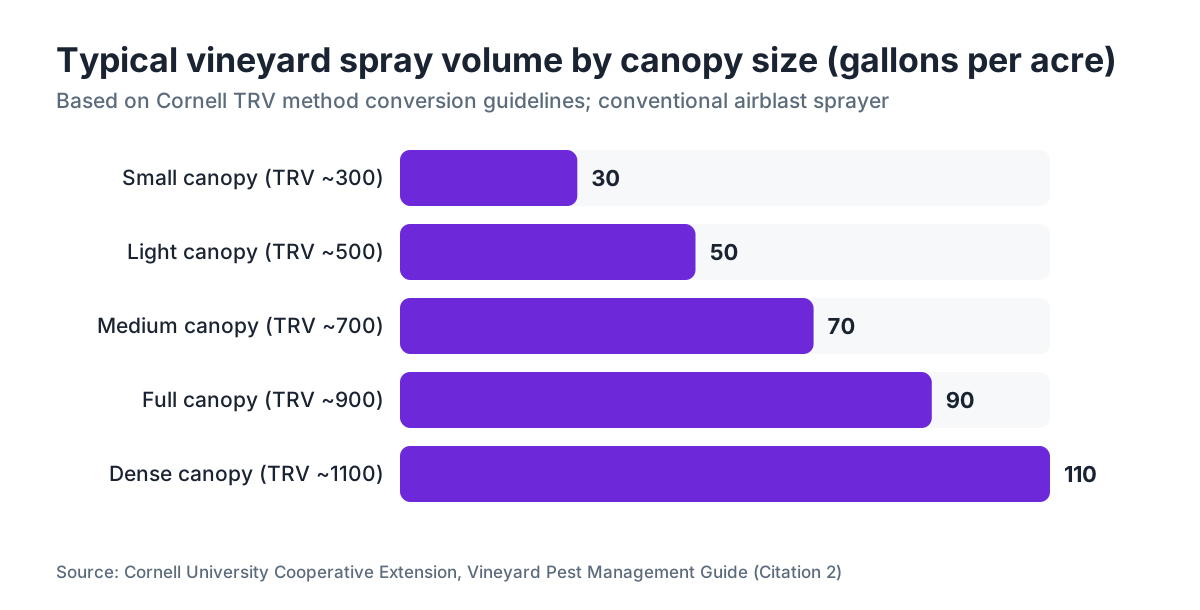
The gallons-per-acre figure isn't arbitrary. It flows from your canopy volume and what the target pest needs for coverage. Cornell's viticulture extension recommends the Tree Row Volume (TRV) method, which estimates the amount of foliage in a given row and sets gallons per acre accordingly, instead of defaulting to a blanket rate someone wrote in a notebook ten years ago [2].
One thing worth saying plainly: the number on your tank mix label matters here. Pesticide labels carry the force of federal law under FIFRA. If the label says 'apply in a minimum of 50 gallons per acre,' you can't apply in 30 and stay legal, no matter what your neighbor does [11].
How are vineyards sprayed and what equipment is used?
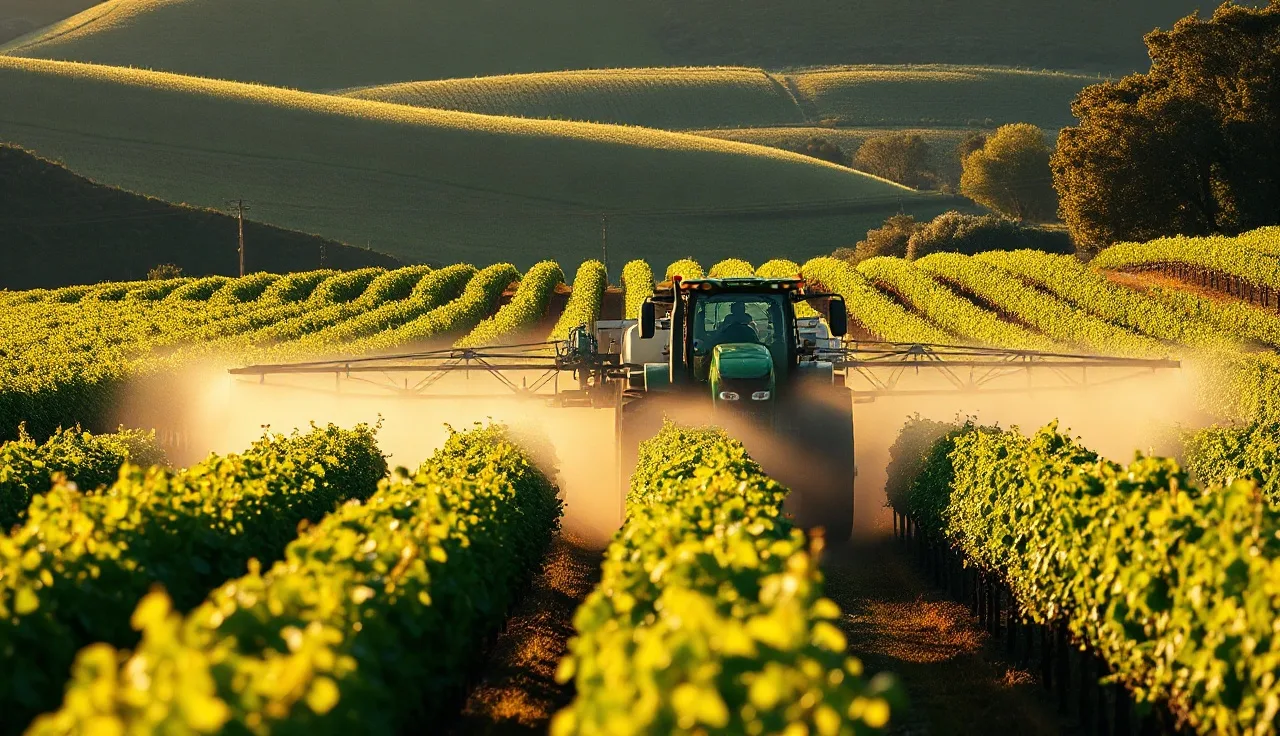
The airblast sprayer is the workhorse. It moves air at high velocity through a turbine or fan, and that air carries spray droplets into the canopy from both sides of the row at once. A tractor pulls it down the middle of the row. For most operations with conventional spacing, this is still the cheapest way to get good coverage, and calibration is manageable once you understand the variables.
Above the airblast on the cost curve sit tower sprayers and tunnel sprayers. Tower sprayers direct air from several points along a vertical boom, which improves penetration in tall training systems like Smart-Dyson or Scott Henry. Tunnel (or recycling) sprayers capture overspray on the far side of the row and recycle it, cutting spray volume by 30 to 70% in trials, though they cost more and need narrower rows than many older California and Pacific Northwest blocks allow [4].
Backpack and hand-gun application still has a place for small blocks, spot treatments, and steep terrain where a tractor can't go safely. Some operations on very steep slopes in regions like the Finger Lakes or Paso Robles use helicopter or drone application. Drone coverage uniformity in dense canopies is still an open research question.
Growers weighing operation types can read the vineyard article, which covers how different setups shape production decisions broadly.
What factors change how many gallons per acre you need?
Canopy density is the biggest single driver. A dense canopy needs more gallons to reach the penetration and coverage that actually controls powdery mildew, botrytis, or whatever you're fighting. The TRV method puts a number on it: multiply average canopy height (feet) by average canopy width (feet), divide by row spacing (feet), and you get your Tree Row Volume. Cornell's guidelines suggest roughly 100 gallons per acre at a TRV of 100, scaling up or down proportionally [2].
Sprayer speed matters enormously and gets ignored. Many operators set their fan and pump, then drive faster when they're in a hurry. Double your ground speed from 3 mph to 6 mph and you cut the gallons deposited per acre in half, everything else equal. That's the calibration error that shows up as disease pressure six weeks later.
Droplet size drives both coverage and drift. Finer droplets coat waxy surfaces better but drift more easily. Coarser droplets cut drift but can miss interior leaf surfaces. In California's San Joaquin Valley, drift rules are strict enough that many operations have moved to coarser nozzles and slowed down to compensate [5].
Water quality rarely comes up and it should. High pH water (above 8) can break down certain fungicides through alkaline hydrolysis before they ever hit the canopy. Buffer your tank water if your well or municipal source runs alkaline. This doesn't change gallons per acre directly, but it decides whether those gallons do anything useful.
Then there's growth stage. Pre-bloom, your canopy is small and you can get away with lower volumes. At berry set and through veraison, the canopy is at or near maximum and volumes should follow. Plenty of operators spray the same gallons per acre in April that they need in July. They overspend early and under-protect late.
How do you calibrate a vineyard sprayer for accurate gallons per acre?
Calibration is where theory meets the muddy reality of a spray program. The core procedure is simple. Fill the tank with a known volume of water. Spray a measured distance at your intended operating speed, fan speed, and pressure. Calculate the area covered. Divide the water used by the area. That's your gallons per acre. UC Davis Cooperative Extension publishes a free calibration guide with the step-by-step math, and any operator can work through it in a morning [1].
Fix these variables before you spray and don't touch them during the block: ground speed (use GPS or mark your tractor), engine RPM (which drives both ground speed through the transmission and fan speed), and nozzle pressure (read it at the manifold, not the pump). If any of these drift mid-application, your gallons per acre drifts with them.
Check your nozzles every season. A nozzle worn to 10% over its rated output is spraying 10% more volume than you think, which means you may be over-applying a restricted-use pesticide. That's a label violation. Replace nozzles when output runs past plus or minus 10% of the rated flow for that nozzle type [6].
Washington State University extension research found calibration errors of 20 to 30% are common in commercial vineyard operations that don't recalibrate every year [7]. That's a real gap between what growers think they're applying and what's actually going out the nozzles.
What spray records do you legally have to keep for a vineyard?
Federal law under FIFRA requires that any restricted-use pesticide (RUP) application be recorded, and those records must be kept at least two years [11]. The federal fields include date and time of application, location and size of the area treated, pest targeted, product name and EPA registration number, total amount applied, and applicator name and certification number.
State rules often go further. California's Department of Pesticide Regulation (CDPR) requires spray records within 72 hours of application for all agricultural pesticide use, more than RUPs, and those records must include the water volume applied on top of the pesticide amount [5]. That's the gallons-per-acre number again. Oregon, Washington, and New York all run mandatory pesticide reporting programs with their own timelines and fields.
The EPA Worker Protection Standard (WPS) adds another layer. Under 40 CFR Part 170, pesticide safety information has to be posted, and entry restrictions have to be observed and documented [8]. WPS doesn't make you log gallons per acre specifically, but it does require that workers know what was applied, where, and when. That ties straight back to keeping accurate application records.
Wineries that farm their own estate blocks, like some paso robles wineries operations or a south coast winery style estate producer, carry the same record-keeping burden as any grower. It sits with whoever directed the application.
Manage multiple blocks, multiple spray events, and multiple applicators, and keeping those records straight by hand gets messy fast. That's where a platform like VitiScribe earns its keep, letting you log the application details, gallons per acre, and applicator cert numbers in the field instead of rebuilding them from a muddy notebook on a Friday afternoon.
How does gallons per acre affect pesticide efficacy and label compliance?
A pesticide label isn't a suggestion. Under FIFRA it's a federal document, and applying a pesticide in a manner inconsistent with its labeling is a federal violation, full stop. Most labels specify a minimum gallons per acre, a range, or the phrase 'sufficient water to provide thorough coverage' [11]. That last one puts the burden on you to know what thorough coverage means for your canopy and to document how you hit it.
Applying too little water per acre is the more common mistake. The pesticide concentration in the tank climbs (same active ingredient, fewer gallons), and coverage area per gallon drops. You end up with hot spots of overly concentrated material on some leaves and skipped coverage on others. Neither one gives you disease control, and neither keeps you inside the label rate.
Applying too much water dilutes the active ingredient below effective rates and, with materials like sulfur, can run off into the soil and irrigation system. There's a cost argument too. Water carries the energy cost of the pump, the time cost of refilling, and in dry regions the actual price of the water.
The Cornell guide puts it plainly: "Applying more water than necessary does not improve pest control and can increase the risk of phytotoxicity from some materials when applied at high water volumes in hot weather" [2].
What is the Tree Row Volume method and how do you use it?
TRV is a calibration approach developed in European viticulture and adapted for North American conditions by Cornell and others. The formula is TRV = (canopy height in feet) x (canopy width in feet) / (row spacing in feet) x 1000 [2]. The result is a number you look up in a conversion table to find a recommended gallons-per-acre rate.
Run an example. A block with 4-foot canopy height, 2-foot canopy width, and 9-foot row spacing gives a TRV of 889. At that TRV, Cornell's table suggests roughly 90 gallons per acre for conventional airblast. A tightly managed, spur-pruned Cabernet block at the same spacing but with a 1.5-foot canopy width drops to TRV 667 and might need only 60 to 70 gallons per acre.
The method is genuinely useful because it adjusts as your canopy changes through the season. Measure in early June, measure again in late July, and your gallons-per-acre recommendation moves with the vines. That's a far more defensible approach than spraying 75 gallons per acre because that's the number someone wrote on a tractor cab sticker in 2009.
WSU extension has adapted TRV for Pacific Northwest conditions and published adjustment factors for common training systems in that region, including high-density plantings and overhead trellis systems [7].
How much does spraying a vineyard cost per acre?
Direct application costs for a conventional airblast pass run roughly $15 to $40 per acre for equipment and labor, before the pesticides themselves. That range comes from USDA cost-of-production data and various extension budgets, and it's wide because custom rates, labor markets, and equipment depreciation vary a lot by region [9].
Fuel is a real cost. A tractor pulling an airblast sprayer at 3 mph through a 10-acre block burns more per hour than many operators expect, and a wet year can mean 12 to 18 passes from budbreak to harvest.
Pesticide costs dwarf equipment costs for most programs. A full sulfur and copper-based organic program might run $80 to $150 per acre per season in material alone. A conventional program with DMI fungicides and a miticide can hit $200 to $350 per acre in materials, depending on the year and what you're fighting [10].
Custom application has a different structure. Many small growers in regions like the Finger Lakes or Willamette Valley hire spray contractors, who charge per acre per pass. Rates in those markets run $20 to $60 per acre per pass depending on terrain, travel distance, and material, though good data here is sparse and regionally specific.
How many spray passes does a vineyard typically need per season?
In a wet, high-pressure year, a conventional wine grape operation in the Northeast or Pacific Northwest might make 12 to 18 passes from budbreak through veraison. In a dry year in a low-humidity region like eastern Washington or California's Central Valley, that can drop to 4 to 8 passes for the same materials [7].
Timing beats count. The critical windows are budbreak (mite and early disease management), the 3 to 5 inch shoot stage (early powdery mildew), pre-bloom through bloom (powdery mildew and botrytis do their worst damage here), and post-fruit set through canopy closure. Miss the bloom window and you can't recover it. Botrytis infection set at bloom shows up as harvest losses you'll blame on weather when the real cause was a missed spray.
Multiply your average gallons per acre by your number of passes and your total acreage, and you get the season's total spray volume. A 20-acre block sprayed at 60 gallons per acre for 10 passes means 12,000 gallons of spray solution mixed and applied. That's a real number for planning water supply, tank fill logistics, and spray record documentation.
What are the drift and environmental rules you have to follow?
Pesticide drift is regulated at both the federal and state level. FIFRA requires that pesticides be applied in a way that minimizes drift, and EPA label requirements often set maximum wind speed limits (usually 10 to 15 mph), nozzle size restrictions, and buffer zones near water bodies or sensitive crops [11].
California has the most detailed state-level drift rules, including required downwind buffer distances from schools and residences for certain materials, plus mandatory reporting of any drift incident to the county agricultural commissioner [5]. Other western states run similar frameworks.
EPA publishes a drift reduction technology list that rates sprayer configurations by their drift reduction performance. Switching from fine to coarse droplets is the simplest mechanical fix. Air-assist systems and shrouded booms help too, though shrouded booms are less common on vineyard airblast equipment.
For operations near water, many fungicides and insecticides carry aquatic toxicity language on their labels that prohibits application within a set distance of standing water or streams. That's label language, which means it's federal law. Check the label before you spray any block that drains into a waterway.
How should gallons sprayed be recorded in your spray log?
Your log entry for gallons applied should capture two distinct numbers: total gallons mixed in the tank, and gallons applied per acre for the block treated. They aren't always the same. Mix 300 gallons for a 5-acre block and you're targeting 60 gallons per acre. End up with 30 gallons left in the tank and only 4.5 acres sprayed, and your actual applied rate is different from your intended rate.
California's DPR requires total product applied per site, and that total has to reconcile with your gallons-per-acre rate and the acres treated [5]. If those numbers don't add up, you have a compliance problem in an audit. Most state programs accept a reasonable variation (some specify plus or minus 5 to 10%), but a 30% gap between intended and recorded application raises questions.
Record field conditions at the time of application: temperature, wind speed and direction, relative humidity, and vine growth stage. These aren't always legally required fields. They are your defense if a spray failure turns into a crop loss claim or a neighbor complains about drift. They're also useful agronomically when you're trying to work out why a fungicide program worked one year and failed the next.
Managing spray records across multiple blocks and seasons, VitiScribe's spray record module lets you build calibrated block-by-block rate defaults, so your per-acre volumes pre-populate from your most recent calibration. That cuts the chance of a transcription error turning into a compliance gap.
What do UC Davis, Cornell, and WSU extension programs say about spray volume best practices?
UC Davis Cooperative Extension's viticulture program recommends annual sprayer calibration and matching water volume to canopy development stage instead of a fixed rate. Their pest management guidelines for wine grapes walk through the calibration math and include product-specific volume recommendations for the major fungicides and insecticides used in California [1].
Cornell's Lake Erie Regional Grape Program publishes TRV-based spray volume guidelines specifically for eastern wine grapes, acknowledging that northeastern pressure from downy mildew and black rot demands more frequent and often higher-volume passes than western programs. Their recommendation to use TRV as the basis for setting gallons per acre is the most defensible framework available for operators who want to explain their rate choices to an auditor or a certifier [2].
WSU's Viticulture and Enology extension team publishes calibration guides tuned to Columbia Valley and Yakima Valley conditions, including adjustment factors for the narrow row spacings in newer Washington plantings and the high-trellis systems used in some Concord and Riesling blocks [7].
None of these programs names a single gallons-per-acre number as universally correct. All three make the same point: the right number is the one that matches your canopy, your sprayer, and your pest target, verified through actual calibration rather than inherited assumption.
Frequently asked questions
How many gallons per acre does a typical vineyard spray application use?
Most conventional airblast vineyard applications run 30 to 100 gallons per acre, with 50 to 75 gallons per acre common for mid-sized canopies in commercial wine grape production. The exact number depends on canopy density, sprayer type, ground speed, and what the pesticide label specifies as a minimum or range. Cornell's TRV method gives you a defensible way to set your rate from actual canopy measurements.
What is the Tree Row Volume (TRV) method for vineyard spraying?
TRV is a calibration formula that estimates the volume of foliage in a vineyard row and converts it to a recommended gallons-per-acre rate. The formula is (canopy height in feet) x (canopy width in feet) / (row spacing in feet) x 1000. Cornell's extension publishes conversion tables that translate your TRV number into a gallons-per-acre recommendation for conventional airblast sprayers.
How often should a vineyard be sprayed during the growing season?
In high-humidity regions like the Northeast or Pacific Northwest, 12 to 18 passes per season is common in wet years. In drier regions like eastern Washington or California's central coast, 4 to 8 passes may be enough. The bloom window is the most critical timing: miss a spray between 30% bloom and fruit set and you create botrytis infection risk no later application can fully correct.
What spray records does a vineyard operator have to keep by law?
Federal FIFRA rules require records for any restricted-use pesticide application: date, location, acres treated, pesticide name, EPA registration number, amount applied, and applicator certification number. California requires reporting within 72 hours for all agricultural pesticide use. Most states run similar programs. Records must be kept a minimum of two years under federal rules, and some states require longer retention.
What happens if you apply a pesticide at the wrong gallons per acre?
Applying below a label's minimum gallons per acre is a FIFRA violation, since pesticide labels carry the force of federal law. It also risks under-coverage and disease control failure. Applying above the label's maximum risks phytotoxicity, environmental runoff, and also breaks the label. Cornell notes excess water volume with some materials in hot weather can cause leaf damage. The right rate matches your label and your canopy.
How do you calibrate an airblast sprayer for vineyard use?
Fill the tank with a known volume of water. Spray a measured distance at your actual operating speed, RPM, and pressure. Calculate the area covered and divide the water used by that area to get gallons per acre. UC Davis Cooperative Extension publishes a free step-by-step guide. WSU research found 20 to 30% calibration errors are common in operations that don't recalibrate annually, a significant compliance and coverage risk.
Can drone or aerial spraying replace airblast sprayers in vineyards?
Drones are being used in some steep-terrain and hard-to-reach blocks, and helicopter application has a longer history in those situations. But coverage uniformity of drone application in dense vine canopies remains an open research question, with current studies showing inconsistent penetration compared to conventional airblast. For most flat-to-moderate terrain operations, airblast stays the standard. Drone use may expand as the technology and regulatory clarity improve.
How does ground speed affect gallons per acre in a vineyard sprayer?
Ground speed has a direct inverse relationship with gallons per acre: doubling your speed from 3 mph to 6 mph cuts the gallons deposited per acre by roughly half, all else equal. This is one of the most common sources of calibration error. Operators who speed up through easy terrain and slow down on slopes end up with uneven coverage across a single block. Fix your speed before you spray and hold it.
What are the pesticide drift rules for vineyard spray applications?
Federal FIFRA rules require minimizing drift, and most pesticide labels set maximum wind speeds (usually 10 to 15 mph) and sometimes buffer distances from water or sensitive areas. California has the strictest state-level rules, including mandatory buffer distances from schools and residences for certain materials and required reporting of any drift incident to the county agricultural commissioner. Aquatic buffer language on labels is federal law and must be observed.
How does canopy density change spray volume needs through the season?
Canopy grows substantially from budbreak through veraison. A block that needs 30 gallons per acre in April may need 80 gallons per acre by late July to get the same interior coverage. The TRV method accounts for this: measure canopy height and width at different growth stages and adjust your gallons per acre. Many operators under-apply late in the season because they never recalibrated from their early-season rate.
What is the EPA Worker Protection Standard and how does it affect vineyard spray records?
The EPA Worker Protection Standard (40 CFR Part 170) protects agricultural workers from pesticide exposure. It requires posting pesticide safety information, observing restricted entry intervals (REIs) after applications, and training workers and handlers. WPS doesn't require logging gallons per acre specifically, but it requires documenting what was applied and where, which means accurate spray records are necessary to meet both WPS and label compliance at once.
How much does spraying a vineyard cost per acre?
Direct equipment and labor costs for a conventional airblast pass run roughly $15 to $40 per acre, excluding materials. Pesticide costs are the larger variable: an organic sulfur and copper program might run $80 to $150 per acre for the season, while a conventional program with DMIs and other fungicides can reach $200 to $350 per acre in material costs depending on disease pressure and what you're targeting.
Do organic vineyards spray differently than conventional ones?
Organic vineyards use allowed materials like sulfur, copper, and OMRI-listed biologicals rather than synthetic fungicides or insecticides, but the mechanics of spraying and the gallons-per-acre logic are identical. Sulfur in particular needs thorough coverage and often higher water volumes in dense canopies to work. Organic programs typically require more frequent applications, especially during high-pressure periods, because most organic materials have shorter residual activity.
What is a restricted-use pesticide and does it change how I log gallons per acre?
Restricted-use pesticides (RUPs) can only be bought and applied by certified applicators or people under their direct supervision. Under FIFRA, RUP applications must be recorded with all required fields including amount applied, which comes from your gallons-per-acre rate and total acres treated. General-use pesticides don't carry that federal recording requirement, though state rules (like California's) often require documentation for all agricultural pesticide uses regardless of classification.
Sources
- UC Davis Cooperative Extension, Pest Management Guidelines: Grapes: UC Davis recommends annual sprayer calibration and matching water volume to canopy development stage for California wine grape pest management
- Cornell University Cooperative Extension, viticulture and grape pest management guidelines (Tree Row Volume method): Cornell recommends the Tree Row Volume method for setting vineyard spray volume and publishes TRV conversion tables translating canopy measurements into gallons-per-acre rates
- USDA Agricultural Research Service, tunnel and recycling sprayer research: Recycling tunnel sprayers can cut spray volume by 30 to 70% compared to conventional airblast in appropriate vineyard configurations
- California Department of Pesticide Regulation, pesticide use reporting and enforcement: California DPR requires spray records within 72 hours of application for all agricultural pesticide use, including water volume applied per acre; drift incidents must be reported to county agricultural commissioners
- UC Davis Cooperative Extension, sprayer calibration for vineyard applications: Nozzles should be replaced when output runs past plus or minus 10% of the rated flow for the nozzle type to maintain application accuracy
- Washington State University Viticulture and Enology extension, sprayer calibration and Tree Row Volume adjustment factors: WSU extension found calibration errors of 20 to 30% common in operations that don't recalibrate annually and publishes TRV adjustment factors for Pacific Northwest training systems
- U.S. EPA, Agricultural Worker Protection Standard (WPS), 40 CFR Part 170: The EPA Worker Protection Standard requires pesticide safety information posting, restricted entry interval observance, and worker/handler training documentation
- USDA Economic Research Service, Commodity Costs and Returns: USDA cost-of-production data supports the $15 to $40 per acre per pass range for conventional airblast equipment and labor costs excluding pesticide materials
- UC Davis Cooperative Extension, Sample Costs to Establish and Produce Wine Grapes: UC Davis cost studies support fungicide program material costs ranging from $80 to $350 per acre per season depending on program type and disease pressure
- U.S. EPA, pesticide registration and labeling requirements under FIFRA: Pesticide labels carry the force of federal law under FIFRA; labels specify minimum and maximum application volumes, wind speed limits, and aquatic buffer requirements, and applying inconsistent with the label is a federal violation
Last updated 2026-07-09