Adding soil to planted vineyard rows: what actually works
TL;DR
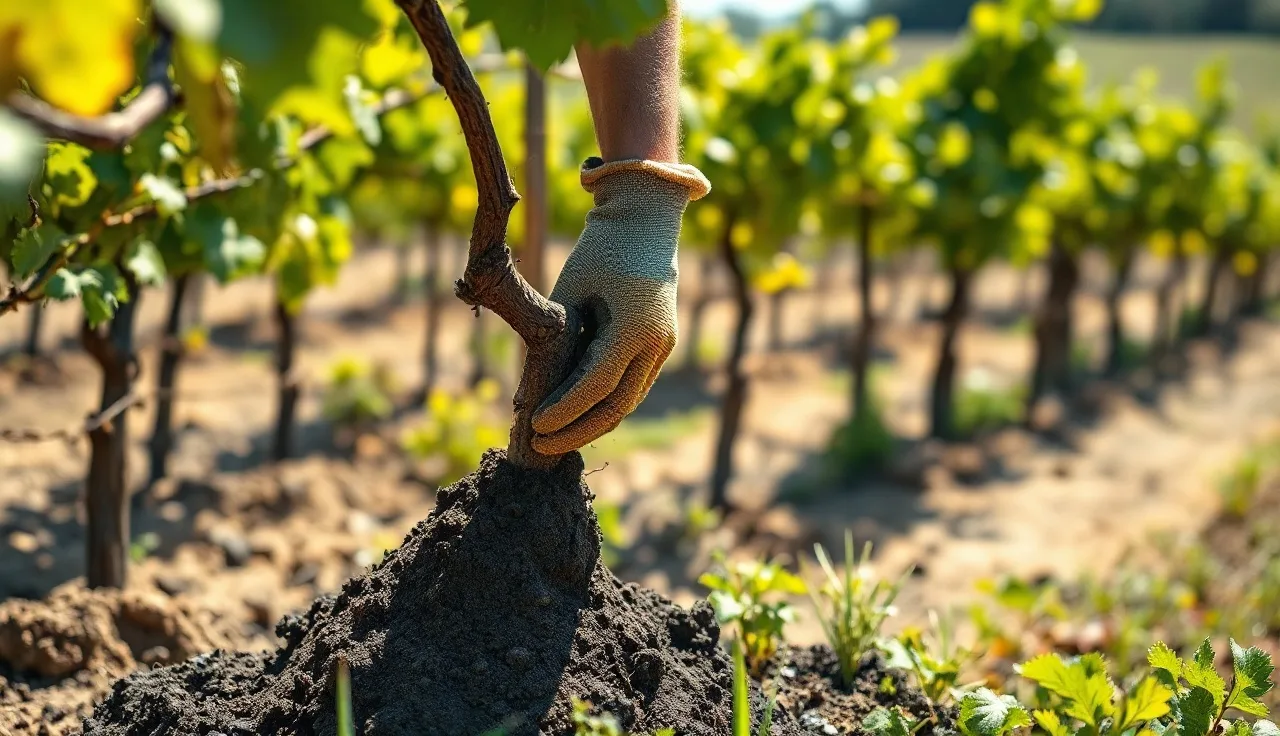
- You can add soil to planted vineyard rows to fix erosion, raise low spots, or rebuild berms, but the amount and method decide whether it helps or kills the vine.
- Cover the graft union by even 2 to 3 inches and you invite crown gall and Phytophthora root rot.
- Most operations use shallow lifts of 1 to 3 inches, with tested fill soil and a drainage plan.
Why would you add soil to a planted vineyard row in the first place?
Erosion is the reason most of the time. In steep blocks, winter rains can strip 2 to 4 inches of topsoil off the berm in one bad season, leaving roots exposed and young vines wobbling in the ground. Growers also add soil to correct settling after deep ripping, to raise a chronically wet low spot, or to build a proper crown that sheds water away from the trunk.
There are quieter reasons too. Some managers lay down a thin layer of loamy topsoil to change the surface texture after a soil test shows a compacted or water-repellent layer near the crown. Others are cleaning up mistakes from the original development, where the land contractor graded too hard and left a block with uneven soil depth.
What you're almost never doing when you add soil to a planted row is improving overall fertility in any real way. The volumes are too small. If nutrition is the goal, compost, cover crops, and targeted fertigation do the job better. Soil addition is a physical fix, not a biological one. Treat it that way and you'll make better calls.
What are the real risks of adding soil around established vines?
Burying the graft union is the risk that ends vines. On most Vitis vinifera grafted to phylloxera-resistant rootstocks, the union sits 2 to 6 inches above the original soil surface at planting. Raise the grade and cover that union, and the scion wood forms its own roots, which have no phylloxera resistance. You've de-grafted the vine over a season or two without touching a knife.
Phytophthora crown rot is the second serious one. Phytophthora cinnamomi and P. megasperma thrive in saturated soil around the base of the trunk. UC plant pathologists have documented how even a modest grade raise that traps moisture near the crown can push a marginally susceptible block into chronic rot. The disease moves fast once it settles in, and there's no practical cure for an infected vine.
Crown gall (Agrobacterium vitis) deserves a thought too. Any soil work that puts a blade against the trunk, or that uses fill from an infected site, can carry the bacterium in. The pathogen enters through wounds, and the crown is the most wound-prone spot during soil work.
Poorly structured soil can also choke off oxygen to existing roots. Fine clay laid over coarser native soil builds a perched water table even when the surface drainage looks fine from where you're standing.
How much soil can you safely add at one time?
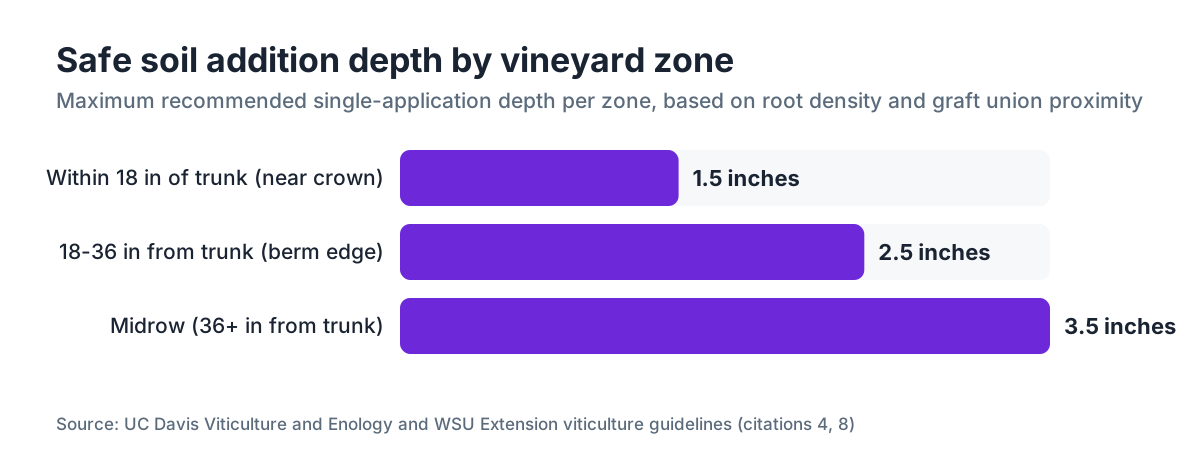
Less than most growers think. A single application above 2 inches carries real risk to the graft zone, the crown, and the roots you already have. Guidelines from UC Cooperative Extension and WSU's viticulture program suggest keeping any single lift to 1 to 2 inches within 18 inches of the trunk, and not going past 3 to 4 inches even in the midrow where roots are sparse.
Need to raise grade by 6 inches or more? That's a multi-year project. Add an inch in year one. Watch for disease symptoms and drainage behavior through winter and spring. Add the next lift the following fall. Rushing it is how you lose a block.
Erosion repair on steep slopes changes the math. You're often replacing soil that was there six months ago, so you're restoring a known grade instead of raising it. The graft-union caution still holds. Measure from the trunk base you can see, not from your memory of where the dirt used to sit.
Here's a field rule worth adopting: before you add anything, mark the graft union height on every vine in the work area with paint or flagging tape. That reference stays visible after the soil goes in, so you can confirm at a glance that you haven't buried it.
What kind of soil should you bring in?
Match the texture to what's already there. If your rows are sandy loam, hauling in heavy clay builds that perched water table problem you're trying to avoid. You want textural continuity, or at least compatibility. Run a soil test on both the existing profile and the proposed fill. It's basic due diligence and costs $30 to $80 per sample at most land-grant university labs.
Avoid fill from unknown sources. Construction fill, road-cut spoils, and dirt off another farm can carry Phytophthora, Verticillium, nematodes, weed seeds, and contaminated runoff. California's Healthy Soils Program guidance and CDFA recommendations both point toward tested or certified material when you're adding to permanent crops.
Compost-amended topsoil is a reasonable choice if you can verify it was properly heat-treated. Under USDA National Organic Program standards, windrow composting requires 131 degrees F for at least 15 days, which kills most weed seeds and many pathogens. Compost-heavy mixes settle a lot, so plan for 15 to 25 percent volume loss as the material compacts over the first season.
Some growers run a blend: 70 percent matched native topsoil screened on site, 30 percent aged compost. That's a sensible middle ground. Test both components before you mix them.
How does soil addition affect drainage and what should you check first?
Before you move a single cubic yard, run a percolation test where you plan to raise grade. Dig a hole 12 inches deep, fill it with water, let it drain, refill, and time the second drain. Slower than 0.5 inches per hour is already marginal drainage. Piling soil on top of that without a plan makes it worse.
If you're raising grade to fix a low spot, figure out why the low spot is wet in the first place. Is it a hardpan two feet down? A subsurface clay lens? Sloppy berming from the original install? Adding soil to a chronically wet area without touching the cause is temporary at best. You may need drain tile or a rip through the restrictive layer before any fill goes in.
Slope matters too. Soil added on a flat row stays put. Soil dumped on a 10 percent slope in a winter-rainfall region walks downhill with the first good storm if it isn't firmed and covered. A biodegradable erosion mat, or a temporary cover crop seeded right after the soil goes in, holds the surface while roots take hold.
What's the right time of year to add soil to vineyard rows?
Late summer through early fall is the window in most regions. Vines are past harvest, the soil profile is usually dry enough to work without compaction, and you've got weeks before the rain to let the new material settle and firm before it saturates.
Spring is a distant second. The vines are pushing growth, so any disturbance to the root zone hits at maximum stress. You also risk spreading soilborne pathogens when the soil is warm and moist, which is exactly when they're most active.
Never add soil when the ground is frozen or saturated. You'll compact the profile and gain nothing. And skip work around the trunk during dormancy if there's been recent mechanical damage, since wound sites are most open to Agrobacterium when the vine isn't making defensive compounds.
In California's interior valleys and Washington's Columbia Basin, mid-August through October is generally reliable. In Oregon's Willamette Valley and New York's Finger Lakes, late August through late September is tighter but workable.
What equipment and methods work best for this job?
For small corrections under an inch, hand work with a garden fork and wheelbarrow is the safest method. Full control, zero risk of a blade catching the trunk, and you place material exactly where you want it. A three-person crew can treat 200 to 300 vines a day this way.
For bigger volumes in open midrow areas, a small tractor with a box blade or rear grader blade works well. Keep the blade path at least 30 inches off the trunk row. The final placement near the vine base still gets done by hand or with a small soil conveyor.
Don't run a disc or rotary tiller near the crown after soil is added. The whole point was to protect the root and crown zone. Tilling through it right away throws that away.
Doing a whole-block raise of 3 to 4 inches in the midrow only? A dump truck plus a tractor with a front loader is efficient. Lay the material in windrows between vine rows, blade it into position, and leave the vine row itself for hand finishing. Record the volume added per acre and the date in your field records. If you keep digital spray and field logs, tools like VitiScribe let you attach soil amendment records to specific blocks, which pays off if a disease problem shows up two seasons later and you need to reconstruct what changed.
Are there worker safety rules that apply when adding soil to vineyard rows?
Yes, and they're worth knowing even though a soil task doesn't feel like a regulated one. The EPA's Worker Protection Standard (WPS) under 40 CFR Part 170 covers agricultural workers doing tasks in planted fields, which includes soil handling in planted blocks. If pesticide-treated soil is being moved, or workers are operating near recently sprayed foliage, the restricted-entry interval (REI) applies.
The WPS requires that workers get pesticide safety training before working in fields. It also requires access to pesticide application information, decontamination supplies (water, soap, clean towels), and emergency medical information. None of that goes away just because you're not spraying that particular day.
For mechanized work, OSHA's rollover protective structure (ROPS) requirement for tractors applies under 29 CFR 1928.51. A tractor working a 15 percent slope without ROPS is a real hazard, and vineyard slopes hit that threshold all the time.
If imported soil comes from a site with any history of industrial use, a basic environmental review is worth the cost. Vineyard soils end up in wine. Heavy metal contamination in fill can be a genuine problem, especially for growers chasing organic certification.
How do you document soil additions for compliance and record-keeping?
Most organic certifiers require that any material added to certified ground be documented with source, volume, and composition. The USDA National Organic Program (NOP) prohibits applying prohibited substances to certified land, and some fill soils carry synthetic residues. Keep the delivery ticket, the source farm or quarry name, and any soil test results.
Conventional operations have a lighter paper burden, but the discipline still pays. Record the block, the date, the cubic yards applied, the source material, and any pre-addition soil tests. If a disease problem or a cluster of vine losses shows up later, that record tells you whether the soil addition was a possible cause.
Winery and vineyard buyers are asking sharper questions about soil inputs, especially during a sale valuation. A clean record of what went into the ground protects you in that conversation.
Cornell's viticulture extension program recommends treating soil amendments in planted blocks with the same documentation discipline as spray records, since both shape the soil chemistry and biology that drives vine health over decades. That's good advice, and it costs nothing but the habit.
What does the research say about soil addition effects on vine performance?
Direct research on adding topsoil to planted vineyard rows is thin. Most published work covers new vineyard establishment or cover crop and compost effects, not fill added to existing blocks. Nobody has good controlled-trial data on this; the closest relevant work comes from graft union burial studies and Phytophthora management research.
Work published in the American Journal of Enology and Viticulture found that graft union burial by 3 to 4 cm was enough to produce scion rooting in susceptible variety and rootstock combinations within two growing seasons, effectively negating phylloxera resistance. That's the clearest quantitative threshold in the literature.
For Phytophthora, UC plant pathology publications note that soil saturation within 6 inches of the crown for periods longer than 48 to 72 hours creates conditions for infection, and that any grade change prolonging saturation in that zone raises risk.
On the upside, WSU extension work in the Columbia Basin documents that correcting eroded berm crowns in established blocks does improve vine water status in dry years, because the root zone is no longer exposed and drying out. The benefits are real. They just have to be weighed against the risks, one block at a time.
Graft union burial: what's the actual safe threshold?
The graft union has to stay at or above the finished soil grade after any addition. No exceptions. The commonly cited target from UC Davis viticulture recommendations is to keep the union 2 to 4 inches above the surface, which leaves a buffer for settling and lets you inspect it by eye.
If your existing soil already sits right at the union, you have essentially no margin for any fill near the trunk. In that case, the midrow is your only safe zone for work.
Some rootstocks are more prone than others to scion rooting when buried. Own-rooted vines don't have this concern at all, though own-rooted vinifera in phylloxera-present soils is a different problem entirely. For grafted vines on standard rootstocks like 110R, 1103P, 3309C, or SO4, assume zero tolerance for union burial and build from there.
Inherited a block where earlier soil work has already partly buried the union? The fix is to hand-excavate the soil away from the trunk, confirm the union position, and re-establish proper grade. Do it in late summer before harvest pressure hits. It's slow work, but a lot cheaper than losing vines to crown rot over the next three years.
Soil addition vs. other options: when is adding soil actually the right call?
Adding soil makes sense when the problem is specifically a grade deficit: exposed roots, a sunken berm that pools water, or documented erosion loss. For those, it's a reasonable tool.
For general soil health, it's a poor use of labor and money next to the alternatives. A cover crop between rows builds organic matter, feeds soil biology, cuts erosion, and costs a fraction of hauling topsoil. Compost top-dressed in the midrow does more for long-term biology than fill soil ever will.
For nutrient correction, a fertigation program built on petiole analysis is faster and more precise than any soil amendment, including good topsoil.
For water management, fixing the underlying drainage with tile, ripping, or a berm redesign solves the problem for good. Add soil to a wet spot without fixing drainage and you just move the waterlogged zone up a few inches.
So be honest about what you're actually fixing. A physical grade problem calls for soil addition. Something else dressed up as a grade problem won't respond to it, and might get worse.
For growers running multiple blocks across a vineyard with mixed soil histories, keeping correction records organized by block over time helps a lot when you're diagnosing performance gaps later. VitiScribe tracks soil amendment entries alongside spray records and weather data, so you can see the full history of what a block has received.
Frequently asked questions
Can adding soil to vineyard rows kill established vines?
Yes, indirectly. The two main mechanisms are graft union burial, which lets the scion root and negates phylloxera resistance, and Phytophthora crown rot, triggered by prolonged soil moisture near the trunk. A single application over 3 to 4 inches near the vine base carries real risk. Keep additions shallow, match the soil texture to existing material, and always verify the graft union stays above finished grade.
How deep can I add soil without covering the graft union?
Measure the union height above current grade before you do anything. If the union sits 4 inches up, you have roughly 2 to 3 inches of margin near the trunk after accounting for settling. Most practical guidance keeps any single lift to 1 to 2 inches within 18 inches of the trunk. In the midrow, where roots are sparse, 3 to 4 inches per application is more tolerable, but watch drainage.
What type of soil is best to add to vineyard rows?
Texture-matched topsoil from a known, pathogen-free source. If your existing profile is sandy loam, bring in sandy loam or loam, not clay. Mismatched textures create layering that traps water. Test both the existing soil and the fill before adding. Compost-blended topsoil (70/30) is a reasonable option if the compost was properly heat-treated. Avoid construction fill and road-cut spoils entirely.
What time of year is best to add soil in a vineyard?
Late summer through early fall, after harvest and before the rain starts. The soil profile is dry enough to work without compaction, and you get weeks for the fill to settle and firm before winter rains arrive. Spring is a distant second. Avoid adding soil when the ground is frozen or saturated, or during active shoot growth in spring, when root-zone disturbance does the most damage.
How does adding soil affect vine drainage?
It can help or hurt depending on soil texture and site drainage. Correcting a sunken berm that pools water raises the crown out of the wet zone. But fine-textured soil over coarse native material creates a perched water table, concentrating saturation right where you don't want it. Always run a percolation test first, and fix any hardpan or subsurface clay lens before adding fill.
Do I need to document soil additions for organic certification?
Yes. The USDA National Organic Program requires documentation of all materials added to certified ground, including source, composition, and volume. Fill soil can carry synthetic residues or prohibited substances if it comes from the wrong place. Keep delivery tickets, the source name, and soil test results. Organic certifiers ask for this during annual inspections, and gaps in records are a compliance risk.
Can I use a tractor to add soil near vine trunks?
Only in the midrow zone. Keep any tractor blade or bucket at least 24 to 30 inches off the trunk row to avoid trunk damage and root injury. Do the final placement near the vine base by hand. Using a tractor for midrow delivery and hand-finishing near the trunk is the standard approach for larger jobs. Never run a disc or tiller through fresh fill near the crown.
Will adding soil help with phylloxera management?
No. Adding soil does nothing for phylloxera management and can make things worse by burying the graft union, which lets the scion form its own susceptible roots. Real phylloxera management depends on resistant rootstocks, graft union integrity, and monitoring for scion rooting. If you've inherited a block with partly buried unions, hand-excavate the soil away from the trunk before adding anything.
What are the worker safety requirements for soil work in a vineyard?
The EPA Worker Protection Standard (40 CFR Part 170) covers all agricultural workers in planted fields, including soil work. Workers must have pesticide safety training and access to decontamination supplies and application records even on non-spray days. Tractor operators on slopes over 15 percent need ROPS-equipped equipment under OSHA 29 CFR 1928.51. These requirements apply whether or not any spraying happens that day.
How much does it cost to add soil to a planted vineyard block?
Costs vary a lot by region and method. Fill topsoil typically runs $15 to $40 per cubic yard delivered, depending on source and distance. Hand labor for placement adds $50 to $120 per hour for a crew. A small correction of half an acre might cost $500 to $2,000 in materials plus labor. A full block raise of 3 to 4 inches across several acres can run $8,000 to $20,000 or more. Get a soil test first; it costs $30 to $80 and may show the job isn't needed.
Can I add soil in winter during vine dormancy?
Not if the ground is saturated or frozen. Dormancy removes one risk, active root stress, but not the others. Saturated soil compacts easily under equipment, and Phytophthora is active in wet winter conditions. If your winter is dry, a dormant-period correction is workable in mild climates. In wet-winter regions like the Willamette Valley or Finger Lakes, fall application before the rains is much safer.
How do I fix a vineyard block where previous soil addition has already buried the graft union?
Hand-excavate the soil away from the trunk in late summer. Use a trowel or narrow hoe to remove fill carefully, avoiding trunk wounds. Clear a 6-inch radius around the trunk base, verify the union position, and re-establish a slight crown slope so water sheds away from the trunk. Inspect the union and lower trunk for soft tissue, discoloration, or galls before covering with fresh, well-drained material at the correct grade.
Does adding soil improve wine quality or vine yield?
Not directly, and not in any way that's been rigorously measured for fill added to planted rows. Correcting an exposed root zone or a chronically wet crown can restore healthy vine function, which supports normal yield and fruit quality. But adding soil beyond a physical correction doesn't improve quality. Cover crops, compost, and canopy management have far more documented impact on fruit composition than topsoil.
Sources
- American Journal of Enology and Viticulture - graft union burial and scion rooting in Vitis vinifera: Graft union burial of 3 to 4 cm produced scion rooting in susceptible variety/rootstock combinations within two growing seasons, effectively negating phylloxera resistance
- University of California Agriculture and Natural Resources - Phytophthora crown and root rot of grapevines: Soil saturation within 6 inches of the vine crown for 48 to 72 hours creates conditions for Phytophthora infection, and grade changes that prolong saturation in that zone increase risk
- University of California Agriculture and Natural Resources - soil management in vineyards: Fine-textured soil placed over coarser existing soil creates a perched water table effect; percolation below 0.5 inches per hour indicates marginal drainage conditions
- UC Davis Viticulture and Enology - graft union management and planting depth: UC Davis viticulture recommendations specify maintaining the graft union 2 to 4 inches above soil surface and limiting soil additions near the trunk to 1 to 2 inches per application
- California Department of Food and Agriculture - Healthy Soils Program: CDFA recommendations point toward sourcing certified or tested material when adding to permanent crops
- EPA - Worker Protection Standard, 40 CFR Part 170: The WPS applies to agricultural workers performing tasks in planted fields including soil handling; requires pesticide safety training, decontamination supplies, and access to application records
- USDA Agricultural Marketing Service - National Organic Program: NOP requires documentation of all materials added to certified ground and prohibits application of prohibited substances; heat composting standard is 131 degrees F for at least 15 days in windrow systems
- Washington State University Extension - vineyard soil management, Columbia Basin: WSU extension documents that correcting eroded berm crowns in established blocks improves vine water status in dry years; single lift recommendations do not exceed 3 to 4 inches in midrow zones
- OSHA - Rollover Protective Structures for tractors, 29 CFR 1928.51: OSHA requires ROPS on tractors operating in agricultural settings; vineyard slopes routinely reach or exceed the threshold where rollover risk is significant
- Cornell University College of Agriculture and Life Sciences - viticulture extension: Cornell viticulture extension recommends documenting soil amendments in planted blocks with the same discipline as spray records
Last updated 2026-07-09