Grapevine downy mildew: causes, symptoms, and control
TL;DR
- Downy mildew (Plasmopara viticola) is the most damaging leaf and cluster disease in humid grape regions.
- It infects when temperatures sit between 50 and 77 degrees F with rain or heavy dew.
- Left alone, it destroys 75% or more of a crop.
- The standard defense is a spray program timed to infection periods, backed by resistant varieties and clean records.
What is grapevine downy mildew and what causes it?
Downy mildew of grapevine is caused by Plasmopara viticola, a water mold (oomycete) that sits closer to algae than to true fungi on the family tree. That distinction changes which fungicides work. Most DMI (demethylation-inhibiting) fungicides that flatten true fungi do almost nothing to oomycetes, so products aimed at the sterol pathway fail here while phosphonates and carboxylic acid amides do the job. [1]
The pathogen is native to North America. Native Vitis species like V. labrusca and V. riparia carry tolerance built over thousands of years of shared history with it. European Vitis vinifera, the stuff planted across California, Oregon, Washington, and New York, has essentially none of that defense. When P. viticola crossed the Atlantic on American vine cuttings in the 1870s, it tore through vineyards from Portugal to Germany. The modern spray calendar for vinifera grapes exists because of that wreck. [2]
The disease overwinters as oospores in fallen leaf debris. Those oospores are tough. They shrug off frost, drought, and soil disturbance. In spring, when soil temperature at 4 inches hits roughly 50 degrees F and 0.4 inches (10 mm) of rain falls over 24 to 48 hours, the oospores germinate, release zoospores, and rain splashes those zoospores onto the lower leaf surface. They enter through the stomata. Infected tissue then pushes out sporangiophores, the white or grayish cotton on the leaf underside that gives the disease its name.
What do downy mildew symptoms look like on grapevines?
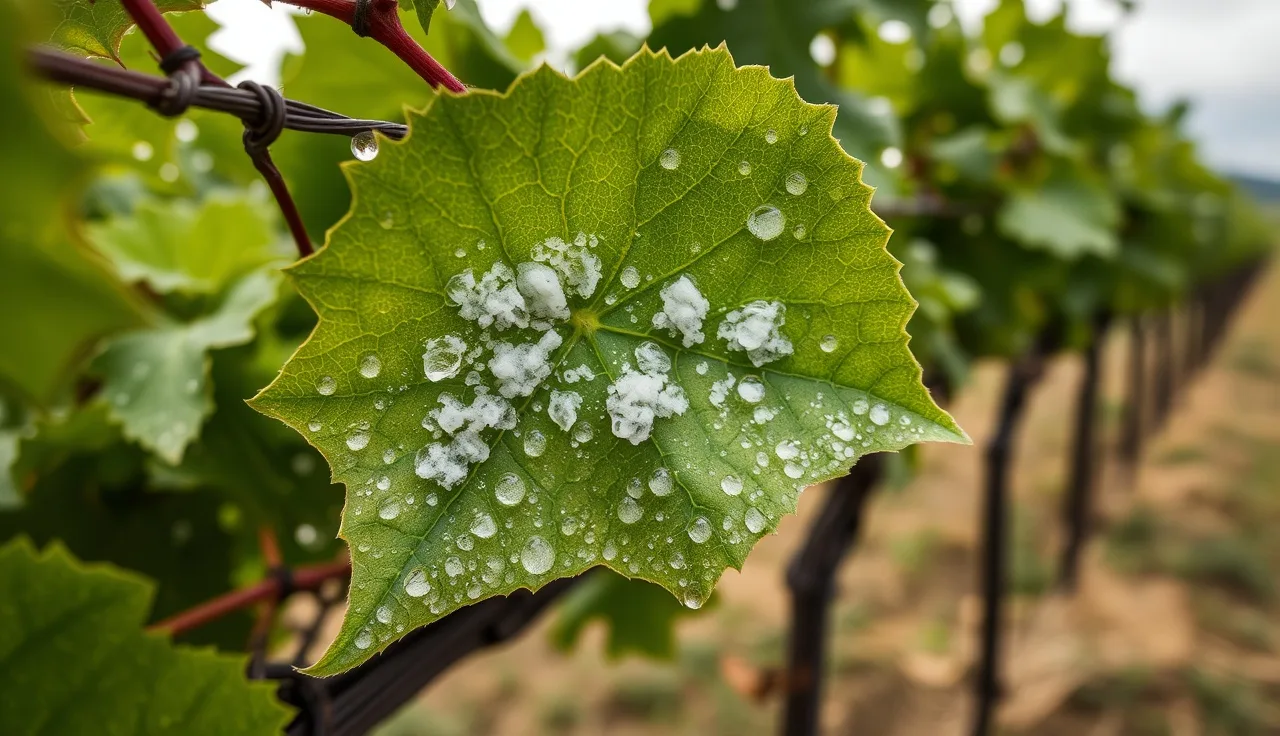
The first thing most growers actually spot is an oil spot: a yellow, translucent, greasy-looking patch on the upper leaf surface, usually 0.5 to 2 cm across. Hold the leaf up to morning light and the translucence jumps out. That's the pathogen working through the mesophyll below the cuticle. [3]
Flip the leaf. On the underside you may find the white cotton that confirms it. That's the sporangiophore mass forced out through the stomata. Cool, humid nights push sporulation. By midmorning on a warm day the surface dries and the white coating vanishes until the next damp night.
As infection runs on, oil spots turn brown and die. Badly hit leaves drop early. Defoliation through July and August cuts photosynthesis, drops sugar accumulation, and drains the carbohydrate reserves the vine needs, which sets up a weak season the following year.
On clusters, infection before or during bloom is the nightmare case. Young berries hit at or near bloom turn brown and shrivel, a symptom growers call brown rot or hardening. The technical name is primary berry infection, and it can wipe out a whole cluster. Berries infected after they reach roughly 8 to 10% Brix show mottled skin and often skip the cotton entirely; some regions loosely call this leather rot, though that term gets used sloppily. After veraison, berries turn largely resistant to new infection, but the leaves stay open to it all season. [3]
Shoot tips and tendrils can catch it too, going stunted and curled with a coat of white sporulation. Infected shoot tips sometimes look white and felt-like right before they die back.
What conditions trigger a downy mildew infection period?
The old viticulture heuristic is the 10-10-10 rule: 10 mm of rain, 10 degrees C air temperature, and green tissue at least 10 cm long. Those three together flag primary infection risk. Extension programs refine it, because the real temperature window is wider, roughly 50 to 77 degrees F (10 to 25 degrees C), with the sweet spot near 64 to 68 degrees F (18 to 20 degrees C). [4]
After primary infection, secondary cycles run faster and hit harder. Secondary sporangia on infected leaves can release zoospores and start new infections within 4 to 7 days under good conditions. A wet spring with repeated rain can stack five or six secondary cycles before July 4th in maritime climates like California's North Coast or the Finger Lakes in New York.
Humidity keeps sporulation going even with no rain. Fog, overhead irrigation, and dense canopies that hold moisture at the leaf surface all stretch the infection window. That's the practical reason suckering, shoot positioning, and fruit-zone leaf removal are disease management tools, more than tidiness.
Forecasting models, including UC Davis's DMDCAST and the older Goidanich-Galligari model used in Europe, weigh temperature, leaf wetness hours, and inoculum pressure. The UC IPM program runs a web tool that tells you whether a given weather window counts as an infection period. [4] WSU's extension resources cover similar models tuned for the inland Pacific Northwest, where warm dry summers shrink the disease window but wet springs still demand early attention. [5]
How much crop loss can downy mildew actually cause?
Loss numbers swing hard by region, variety, and year, which makes any single global figure close to useless. University of California Cooperative Extension has documented 50 to 75% yield losses in unsprayed vinifera blocks during high-pressure years in northern California. [3] Cornell Cooperative Extension research in the Finger Lakes has logged similar ranges in wet years, with Chardonnay and Pinot Noir taking the worst of it. [6]
The money bleeds past the direct yield hit. Early defoliation drains vine carbohydrate reserves, which cuts next year's bud fruitfulness. A grower who loses clusters and carries weakened vines into winter faces two hard seasons back to back. Wineries buying fruit from a hammered block sometimes drop the per-ton contract price on quality grounds, on top of the raw tonnage gone.
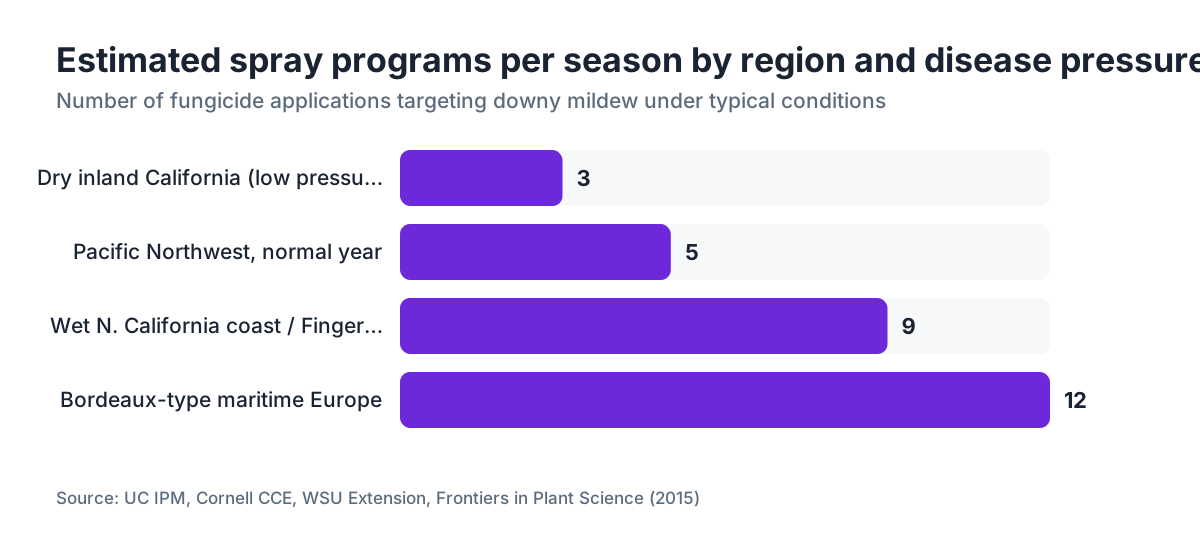
Across Europe, Plasmopara viticola costs the wine industry over 1 billion euros a year once fungicide bills and yield losses are added up, according to a 2015 review in Frontiers in Plant Science. [7] European growers average 10 to 15 fungicide treatments per season to hold it back, a number North American growers in wet regions get close to in bad years.
| Region / scenario | Typical spray programs per season | Potential yield loss (no spray) |
|---|---|---|
| Dry inland California | 2-4 | 10-30% |
| Wet N. California coast / Finger Lakes | 6-12 | 50-75% |
| Pacific Northwest, normal year | 3-6 | 20-50% |
| Bordeaux-type maritime Europe | 8-15 | 60-80% |
These ranges come from extension program data. They're honest approximations, not controlled trial results.
Which grapevine varieties are most susceptible to downy mildew?
Among V. vinifera, Merlot, Syrah, Cabernet Franc, Chardonnay, and Pinot Noir rate as highly susceptible. Muscat varieties sit toward the susceptible end too. Cabernet Sauvignon runs slightly more tolerant but still needs protection. Among whites, Sauvignon Blanc is generally moderately susceptible. [3]
Interspecific hybrids from American Vitis parentage carry varying resistance. Vidal Blanc, Seyval Blanc, Marquette, and Frontenac, all popular across the Midwest and Northeast for cold hardiness, also carry real downy mildew tolerance from their native roots. They still want some spray protection in wet years, but they often coast on fewer applications. [6]
The push for disease-resistant varieties (PIWI in Europe, from the German Pilzwiderstandsfaehige) has produced vinifera-hybrid crosses like Regent, Prior, and Muscaris that carry the Rpv (resistance to Plasmopara viticola) gene stack. Some show near-immunity in field trials. There's ongoing worry that pathogen races will overcome single-gene resistance, so the most durable resistance stacks multiple Rpv loci. Cornell's grape breeding program has released several USDA-Cornell hybrids with stacked resistance, and its Viticulture and Enology team publishes variety trial data on a regular basis. [6]
What fungicides work against downy mildew on grapevines?
Because P. viticola is an oomycete, the effective chemistry list differs from what you'd reach for against powdery mildew. The working groups break down like this.
Phosphonates (phosphonate salts, phosphorous acid) move systemically, stirring the plant's own defenses and suppressing the pathogen directly. Aliette (fosetyl-Al) and potassium phosphite products are the common ones. They're cheap, widely used, and solid as early-season protectants. [1]
Mefenoxam and metalaxyl (the phenylamide group) are highly systemic and very effective, but resistance in P. viticola populations is documented across many regions. Use them only in mixtures with a contact material, never alone, and cap them at two applications per season per FRAC (Fungicide Resistance Action Committee) guidelines. [1]
Carboxylic acid amides (CAAs) include mandipropamid (Revus) and dimethomorph (Forum). Good efficacy, systemic, effective at low rates. FRAC recommends no more than three applications per season on resistance grounds.
Cyazofamid (Ranman) and oxathiapiprolin (Orondis) are newer chemistries with excellent efficacy even at low rates. Orondis has posted strong performance across multiple states. Both need strict resistance management, and most labels cap them at two applications per season.
Contact protectants (copper, mancozeb, captan, ziram) carry zero resistance risk thanks to their multi-site mode of action. Copper is the backbone of organic programs. Mancozeb is one of the cheapest effective materials going and rotates well with systemics. The catch on mancozeb is a 24-hour REI (restricted entry interval) and a 66-day pre-harvest interval (PHI) on most wine grape labels. [8]
Timing beats chemistry. A copper spray placed ahead of an infection period beats a late systemic sprayed after sporulation already started. Most programs run a 7 to 14 day interval through the high-risk stretch from shoot emergence to veraison, tightening to 7 days during wet spells.
For anyone keeping spray records, tracking which FRAC code went on and how many times per season isn't optional. It's the core of resistance management and increasingly part of buyer and certification audits. Tools like VitiScribe can handle the FRAC code tallying so you're not counting by hand across a season of field notes.
How do you build a downy mildew spray program for a vineyard?
A good program starts before you touch a spray gun. You need your risk level going in. High pressure last year? Is the block in a fog zone or a low frost pocket where humidity hangs around? Are you on susceptible vinifera or tougher hybrids?
Here's the calendar backbone most vinifera programs run in humid regions.
Budbreak to 5 or 6 inches of shoot growth: put down a copper or mancozeb protectant if rain is forecast. Oospore germination ramps up here. Don't wait for symptoms.
Five-inch shoot to bloom: the highest-risk window. Bloom infection destroys clusters. Tighten spray intervals to 7 days during rain. Use a systemic (CAA or phosphonate) mixed with a contact material.
Bloom to fruit set: hold coverage. Young berries are wide open. Don't miss this window.
Fruit set to veraison: berries harden off and resist better, but leaves stay susceptible. Keep protecting, though you can stretch to 10 to 14 day intervals in dry weather.
Post-veraison: leaf protection still matters for vine health. Scale back but don't walk away entirely in a high-pressure year.
Inside pre-harvest interval windows, your options narrow fast. Know your PHIs cold. Copper hydroxide runs a 0-day PHI on most labels; phosphonates typically 28 to 66 days depending on the product. Check the label, not your memory. [8]
WSU Extension's viticulture program and Cornell's Cooperative Extension both publish regional spray guides updated yearly with new registrations and resistance management notes. [5][6] UC IPM runs a pest management guidelines page for grape downy mildew that lists materials, rates, and timing. [4]
What are the EPA worker protection standard requirements for downy mildew spray applications?
The EPA's Worker Protection Standard (WPS), revised in 2015 and administered under 40 CFR Part 170, covers agricultural pesticide use including every fungicide you'd spray for downy mildew. [9] If anyone in your vineyard might touch pesticide-treated plant surfaces, WPS applies. That covers the person spraying and anyone working the block inside the restricted entry interval.
Here's what WPS asks of vineyard operators.
You have to post application information (start and end times, product name, EPA registration number, active ingredient, location, REI, and PHI) in a central spot workers can reach. The posting goes up before the application starts and stays up for 30 days after the REI expires. [9]
Workers must get WPS safety training before they enter treated areas, and you keep the training records. New employees need training within their first 30 days if they'll enter treated areas during that window.
You provide decontamination supplies (water, soap, single-use towels) in the field, within a quarter mile of workers, during applications and through the whole REI.
The label is the law. If the mancozeb label says 24-hour REI, nobody enters for 24 hours. No exceptions for just walking through.
WPS record-keeping runs straight into state spray log rules. California's Department of Pesticide Regulation (CDPR) requires Pesticide Use Reports (PURs) for all commercial applications within 7 days. [10] Washington runs similar records through WSDA. These aren't just compliance paper. They're your defense when a neighbor or buyer asks what went on and when.
Plenty of vineyard managers scrawl paper spray logs and type them up later, which invites errors and eats time during a busy spray season. A digital field record that timestamps applications against the spray calendar makes WPS compliance far easier to audit.
Can cultural practices reduce downy mildew pressure without sprays?
Yes, but in a wet year with heavy inoculum, cultural practices alone won't rescue a susceptible vinifera block. Treat them as pressure reduction, not a cure.
Canopy management is the highest-leverage tool you have. Dense canopies trap moisture, drag out leaf wetness, and block spray from reaching the underside of leaves. Shoot positioning, fruit-zone leaf removal (especially on the morning-sun side in the Northern Hemisphere), and hedging all open up airflow and improve coverage. Cornell research shows fruit-zone leaf removal cuts disease severity on clusters, though the canopy above the fruit still needs protection. [6]
Row orientation matters too. North-south rows dry faster in the morning than east-west rows in most Northern Hemisphere vineyards. Designing a new block? Factor that in.
Cover crop management under the vine can cut splash dispersal of oospores from soil to leaf. Mulches that block raindrop impact on bare soil have been studied for other soilborne diseases, and the principle carries over here, though the main inoculum (infected leaves) sits above ground, so the effect is only partial.
Fall cleanup genuinely helps. Raking or mulching infected leaf litter drops the overwintering oospore load. Most vineyards skip it, partly because it's labor-heavy and partly because oospores in adjacent hedgerows and uncultivated ground still supply plenty of inoculum. But in a small block or a low-input research setting, it isn't wasted work.
Overhead irrigation timing shifts disease pressure. If you run overhead sprinklers (common in frost protection), morning watering lets foliage dry before the dew period starts. Evening or overnight overhead water stretches leaf wetness badly and should be avoided during high-pressure stretches whenever you can.
For growers with vineyards in regions like Paso Robles where summer drought naturally chokes off the disease window, cultural practices may carry the load once the spring risk period passes. Wetter regions never get that break.
How do you confirm a downy mildew diagnosis vs. other grapevine diseases?
The white cotton on the leaf underside is the most reliable field sign you'll get. Nothing else common on grapevines looks quite like it.
Early oil spots on the upper surface are trickier and get confused with a few things. Nutrient deficiencies, zinc especially, cause interveinal yellowing that a new observer reads as an oil spot. Spray injury from sulfur or copper applied at the wrong temperature throws similar spotting. Powdery mildew works the upper surface with a white powder there, not the underside cotton of downy mildew. Black rot (Guignardia bidwellii) makes round brown lesions ringed with black pycnidia, nothing like the oily translucent spots of early downy mildew.
Unsure? Here's the simple field confirmation. Take a symptomatic leaf, lay it underside-up in a plastic bag with a few drops of water, and leave it at room temperature overnight in the dark. If P. viticola is present, sporangiophores erupt through the stomata and you'll see white fuzz by morning. It's an old plant pathology trick and it works.
For confirmed ID or an odd presentation, your state's land-grant university plant diagnostic lab can run molecular or microscopic confirmation. UC Davis, Cornell, and WSU all run plant disease clinics that take vineyard samples. [4][5][6] Turnaround runs from a few days to two weeks depending on the lab and the season.
Logging when oil spots first show, then matching that against your weather data and last spray, sharpens your spray calendar the next year. That correlation is far easier to rebuild from timestamped digital records than from handwritten field notes.
What's the organic approach to managing downy mildew in vineyards?
Certified organic vineyards have fewer chemistry options, but not zero. Copper is the workhorse. Copper hydroxide, copper octanoate, copper sulfate, and Bordeaux mixture (copper sulfate plus hydrated lime) are all OMRI-listed and effective when applied before or at the start of an infection period. [11]
The problem with copper is accumulation. Repeated copper over years builds soil copper to levels that turn phytotoxic to vine roots and toxic to earthworms and soil microbes. The EU capped copper use at 4 kg per hectare per year averaged over 7 years (28 kg per hectare total), after decades of Bordeaux mixture left some European vineyard soils carrying copper 10 to 20 times background levels. [12] California and other US states haven't set a formal per-season cap, but the USDA National Organic Program framework requires materials be used in ways that don't harm the soil, which in practice means track your copper loads and keep them low.
Phosphorous acid (phosphonate) products from inorganic sources are NOT OMRI-listed for certified organic production. Some growers assume they qualify because they read as natural in a loose sense. If you're certified, check the OMRI listing before you spray.
Biological fungicides based on Bacillus subtilis (Serenade), Reynoutria sachalinensis extract (Regalia), and similar materials show some activity as resistance inducers or mild suppressants. The efficacy research is mixed. A 2018 review in Biological Control found that while some biological agents looked promising under controlled conditions, field results ran inconsistent against conventional fungicides. For organic programs they work best backing up copper, not replacing it.
Successful organic management of downy mildew in wet regions usually means more spray passes (copper has no residual systemic activity), tighter canopy work, and living with somewhat higher disease pressure than a conventional neighbor. Growers weighing the vineyard tradeoffs of going organic in a downy mildew-prone region should budget 8 to 15 copper passes per season in wet-spring years.
What spray records do you need to keep for downy mildew applications, and for how long?
Record-keeping demands come from at least three places: state pesticide use reporting rules, federal EPA WPS requirements, and any third-party certification (SIP, Lodi Rules, Fish Friendly Farming, USDA Organic).
At the federal level, WPS requires application information be posted and accessible, but it doesn't set a retention period for those records. States do. California requires PURs filed within 7 days of each application under California Food and Agricultural Code Section 12997, and county agricultural commissioners can audit. CDPR holds those records for years. [10]
Washington's Pesticide Management Division requires growers to keep pesticide use records for 7 years under WAC 16-228-1250. [13] New York's DEC runs similar requirements under ECL Article 33.
Beyond the legal floor, here's what makes a spray record actually useful for managing the disease.
Date and time. Start and end, because REI runs from completion.
Product name, EPA registration number, and FRAC code group.
Rate applied (per acre, per 100 gallons, or per 1000 sq ft, depending on the product).
Application method (air-blast sprayer, backpack, whatever) and water volume per acre.
Weather at application: wind speed and direction, temperature, and whether foliage was wet. Many labels restrict spraying in rain or high wind.
Block or vineyard location sprayed.
Applicator name and license number if a licensed applicator is required.
Signature or initials.
The PHI tracking piece gets underrated. When harvest planning starts in August and you're staring at a block that got mancozeb 50 days ago with a 66-day PHI, you need those records exact, not close. Gaps between what you wrote and what you actually sprayed can turn into liability. VitiScribe exists to make timestamped spray logging fast in the field so records stay accurate and pull up clean at audit time.
Frequently asked questions
What is the 10-10-10 rule for downy mildew in grapes?
The 10-10-10 rule is a field heuristic for primary infection risk: 10 mm of rain, 10 degrees Celsius air temperature, and at least 10 cm of green shoot growth all present at once. When those three line up, P. viticola oospores can germinate and zoospores can infect leaf tissue. It's a handy rule but simplified. Most modern forecasting models add leaf wetness duration and temperature range refinements.
How quickly can downy mildew spread through a vineyard block?
Secondary spread can happen in 4 to 7 days under ideal conditions (temperatures 64 to 68 degrees F, wet or humid nights). A single infected leaf produces thousands of sporangia per night, and wind and rain splash carry them to nearby leaves and vines. A block can go from scattered oil spots to widespread sporulation within 10 to 14 days during a wet spring, which is why pre-infection sprays beat rescue sprays.
Can downy mildew overwinter in the vineyard?
Yes. Plasmopara viticola overwinters as oospores in infected leaf litter on the vineyard floor. Oospores are sexually produced, genetically diverse, and highly resistant to cold, drought, and soil disturbance. They survive until spring, when soil warmth and rain trigger germination. Removing or mulching infected leaf litter after harvest cuts the oospore bank, though nearby sources like hedgerows and adjacent vineyards still contribute inoculum.
What is the difference between downy mildew and powdery mildew on grapes?
Different pathogens entirely. Downy mildew (Plasmopara viticola) is an oomycete that needs free water to infect; its white sporulation shows on the leaf underside with oil spots up top. Powdery mildew (Erysiphe necator) is a true fungus that prefers moderate humidity without free water; its white powder shows on the upper leaf surface, shoot tips, and berry skin. Their chemistries barely overlap: sulfur handles powdery mildew but does nothing to downy mildew.
Which fungicide FRAC codes work against grapevine downy mildew?
FRAC groups active against Plasmopara viticola include Group 4 (phenylamides: mefenoxam), Group 33 (phosphonates: fosetyl-Al), Group 40 (carboxylic acid amides: mandipropamid, dimethomorph), Group 49 (cyazofamid), and Group U15 (oxathiapiprolin). Multi-site contact materials in FRAC Group M1 (copper), M3 (dithiocarbamates including mancozeb), and M4 (captan) carry no resistance risk. FRAC recommends rotating modes of action each spray and capping high-risk single-site chemistries at 2 to 3 applications per season.
Is copper spray enough to control downy mildew organically?
Copper is the backbone of organic downy mildew programs, but it's a protectant with no systemic activity. It only works if applied before infection periods and if rain doesn't wash it off before its label residual runs out. In wet years, organic growers in humid regions often apply 8 to 15 copper sprays per season. Biological materials like Serenade or Regalia perform inconsistently on their own; use them as adjuncts to copper, not replacements.
What pre-harvest interval do I need to observe for mancozeb on wine grapes?
Most mancozeb labels for wine grapes carry a 66-day pre-harvest interval in the United States. Always confirm on your specific product label, since formulations differ slightly. A 66-day PHI means your last mancozeb application has to be done by early July for a mid-September harvest. Tracking that precisely in your spray records is what keeps you compliant when harvest dates shift.
How does canopy management reduce downy mildew risk?
Dense canopies trap humidity, stretch leaf wetness, and block spray from the lower leaf surfaces where the stomata sit. Shoot positioning, fruit-zone leaf removal, and hedging open up air circulation so foliage dries faster after rain or dew. Cornell research found fruit-zone leaf removal cut cluster disease severity measurably. Better spray penetration also means active ingredients reach target tissue at effective rates, so you get more control per gallon.
What records does the EPA worker protection standard require for pesticide applications in vineyards?
Under 40 CFR Part 170, you must post application information (product name, EPA registration number, active ingredient, location treated, start and end times, REI, and hazard information) in a central location workers can reach before the application begins. The posting stays up for 30 days after the REI expires. Workers must get WPS safety training, and decontamination supplies must be available in the field during applications and through the REI period.
Do resistant grape varieties fully eliminate the need for downy mildew sprays?
Not fully, at least not yet. Varieties with multiple stacked Rpv (resistance to Plasmopara viticola) genes show very high field resistance, sometimes needing zero or one spray in a low-pressure year. But single-gene resistance can be overcome by new pathogen races, and even multi-gene varieties may need occasional protection in an exceptionally wet year. Cornell and USDA grape breeding programs publish annual field trial data on resistance stability worth checking before you commit a block.
How long do I need to keep spray records for vineyard fungicide applications?
It depends on your state. California requires pesticide use reports filed within 7 days of application; Washington requires retention of pesticide use records for 7 years under WAC 16-228-1250. Check your state's pesticide management rules directly. Third-party certifications (Lodi Rules, USDA Organic, SIP) often require 3 to 5 years of records. Keeping timestamped digital records makes retrieval at audit far less painful than hunting through paper logs.
What temperature range does Plasmopara viticola prefer for infection?
The infection range is roughly 50 to 77 degrees F (10 to 25 degrees C), with the optimum near 64 to 68 degrees F (18 to 20 degrees C). At the optimum, with wet leaf surfaces for 4 to 6 hours, primary infection can set. Temperatures above 86 degrees F (30 degrees C) slow sporulation and the disease cycle, one reason warm dry inland regions like much of central California see lower pressure than coastal or humid continental ground.
Can I use systemic fungicides after I see downy mildew sporulation in my vineyard?
Some systemic fungicides (carboxylic acid amides, phenylamides) carry post-infection activity in a narrow window, usually up to 48 to 72 hours after infection begins. Once active sporulation is visible, you're past that curative window. At that point, a contact protectant to block new infections plus removal of heavily infected shoot tips and leaves to cut inoculum is more practical. Leaning on systemics as rescue material after sporulation also cranks up resistance selection pressure.
Sources
- UC ANR Publication 3343, Grape Pest Management, Third Edition: Phosphonate and carboxylic acid amide chemistries are effective against Plasmopara viticola; phenylamide resistance is documented and products should only be used in mixtures
- UC Davis Viticulture and Enology, Grape Disease Resources: Plasmopara viticola is native to North America and was introduced to European vineyards with American vine cuttings in the 1870s
- UC IPM, Pest Management Guidelines: Grape, Downy Mildew: UC Cooperative Extension has documented yield losses of 50-75% in unsprayed vinifera blocks during high-pressure years; oil spots and white cottony sporulation are described as primary diagnostic signs
- UC IPM, Grape Downy Mildew Forecasting and Disease Management: The 10-10-10 rule and the DMDCAST forecasting model are described; the infection temperature window is 10-25 degrees C with optimum near 18-20 degrees C
- Washington State University Extension, Viticulture Program, Grape Disease Management: WSU Extension publishes downy mildew forecasting guidance calibrated for inland Pacific Northwest conditions and annual spray guides with updated registrations
- Cornell Cooperative Extension, Viticulture and Enology, Grape Disease Management: Cornell documents 50-75% yield losses in wet Finger Lakes years; fruit-zone leaf removal is shown to reduce cluster disease severity; USDA-Cornell hybrids with stacked resistance are described
- Frontiers in Plant Science, 2015, 'Plasmopara viticola, the Causal Agent of Downy Mildew of Grapevine: From Its Origins to Pathogen Biology': Plasmopara viticola causes over 1 billion euros in annual economic damage to the European wine industry when fungicide costs and yield losses are combined; European growers average 10-15 fungicide treatments per season
- EPA, Pesticide Product Label System, Mancozeb (Dithane, Manzate labels): Mancozeb carries a 24-hour REI and a 66-day PHI for wine grapes on standard registered labels
- EPA, Agricultural Worker Protection Standard, 40 CFR Part 170: WPS requires posting of pesticide application information before applications begin, worker safety training, and provision of decontamination supplies; the standard was revised in 2015
- California Department of Pesticide Regulation, Pesticide Use Reporting: California requires Pesticide Use Reports to be filed within 7 days of each commercial pesticide application under California Food and Agricultural Code Section 12997
- OMRI (Organic Materials Review Institute), Product List, Copper Fungicides: Copper hydroxide, copper octanoate, copper sulfate, and Bordeaux mixture are OMRI-listed for certified organic use
- European Commission, Commission Implementing Regulation (EU) 2018/1981, Copper Renewal: The EU capped copper use at 4 kg/hectare/year averaged over 7 years in response to soil copper accumulation documented in European vineyards
- Washington State Department of Agriculture, Pesticide Management Division, WAC 16-228-1250: Washington State requires growers to retain pesticide use records for 7 years under WAC 16-228-1250
Last updated 2026-07-10