Common grapevine diseases: causes, identification, and control
TL;DR
- Six diseases cause most vineyard losses in North America: powdery mildew, downy mildew, Botrytis bunch rot, Pierce's disease, Eutypa dieback, and crown gall.
- Each has a distinct pathogen, timing, and fix.
- Powdery mildew alone can wipe out a whole crop if you miss the early spray window.
- Knowing the pathogen type tells you which fungicide or cultural practice actually works.
What are the most common diseases of grapevines?
Six diseases account for most vineyard losses in North America: powdery mildew (Erysiphe necator), downy mildew (Plasmopara viticola), Botrytis bunch rot (Botrytis cinerea), Pierce's disease (Xylella fastidiosa), Eutypa dieback (Eutypa lata), and crown gall (Agrobacterium vitis). A handful of others matter too, depending on where you farm: black rot (Guignardia bidwellii), Phomopsis cane and leaf spot, and trunk diseases like Esca.
Each one has a different cause, and that changes everything about control. Powdery and downy mildew are both called fungal, but they're not the same thing. Powdery mildew is an obligate biotrophic ascomycete. Downy mildew is an oomycete, closer to water molds than true fungi. Botrytis is a necrotrophic fungus. Pierce's disease is a bacterium. Eutypa and Esca are wood-rotting fungi. Crown gall is a soil bacterium. A fungicide that stops powdery mildew does exactly nothing to a bacterium like Xylella. Buy the wrong product and you've wasted the money and the crop.
Where you farm shapes the pressure you actually face. The humid East Coast is brutal for downy mildew, Botrytis, and black rot. California's dry summers knock downy mildew flat, but powdery mildew loves the warm, rainless conditions. Pierce's disease is endemic to the Southeast and spreading in the San Joaquin Valley [1]. The Pacific Northwest fights powdery mildew and Botrytis, with Eutypa and crown gall showing up on older vines.
What causes powdery mildew on grapes and how do you identify it?
Powdery mildew is the number-one fungal disease of grapevines worldwide [2]. The pathogen, Erysiphe necator (formerly Uncinula necator), overwinters as chasmothecia (fruiting bodies) in bark or as dormant mycelium inside infected buds. When temperatures reach roughly 50°F (10°C) and humidity climbs, ascospores release and infect young tissue. It doesn't need free water to germinate. That's why it thrives in the dry, warm weather that suppresses everything else.
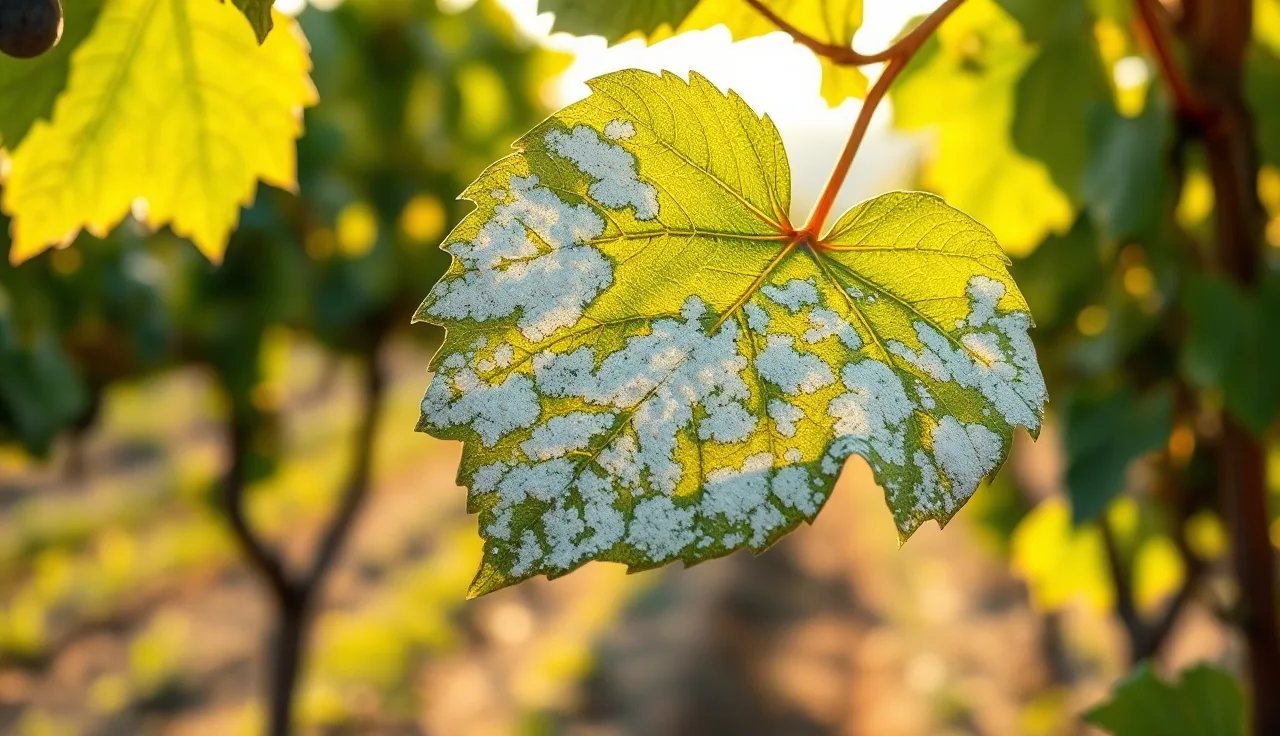
Spotting it is usually easy. You'll see a white to gray powdery coating on leaves, shoots, and berries. On berries, early infection leaves a russeted, web-like scar; a bad infection splits the fruit open. Green tissue is susceptible; mature brown wood is not. If it hits the inflorescence before bloom, it can wreck fruit set for the entire cluster [2].
UC IPM uses a degree-day risk model (base 50°F) starting at budbreak. Once you accumulate enough degree-days after budbreak, the first ascospore release becomes probable and early-season sprays turn mandatory [2]. Missing that window is the single most common mistake growers make. One unsprayed week around bloom can push berry infection to 100% on susceptible varieties like Chardonnay or Cabernet Sauvignon.
Control leans on protectant fungicides (sulfur, mineral oil), DMI fungicides (myclobutanil, tebuconazole), QoI (strobilurin) fungicides, and SDHI fungicides. Rotate modes of action every two to three applications to slow resistance. Sulfur is cheap and it works, but it burns tissue above 90°F, so watch your timing in hot climates [3].
How is downy mildew different from powdery mildew in grapes?
Downy mildew (Plasmopara viticola) is an oomycete, not a true fungus, and that difference is the whole game. Fungicides that target ergosterol biosynthesis, like the DMIs, are largely useless against it. The pathogen needs free water for its sporangia to germinate and infect through stomata. The classic trigger is the "10-10-10 rule": 10°C (50°F), 10 mm of rain, and 10 days after budbreak [4].
Symptoms open as pale yellow-green oily spots on the upper leaf surface, called "oil spots." In humid weather, a white cottony sporulation shows up on the underside of those same spots. That white fuzz is your diagnostic tell. Berries infected before they reach pea size develop a gray-white felt and go hard. Infected cluster stems and rachises turn brown and collapse.
Control options include copper-based fungicides (copper hydroxide, copper oxychloride), phosphonate fungicides (fosetyl-Al, phosphorous acid), and oomycete-specific chemistries like mefenoxam (Ridomil) and mandipropamid (Revus). Cornell's grape program notes that copper is still the backbone of organic downy mildew programs and has been in use since the Bordeaux mixture days of the 1880s [4]. Resistance to mefenoxam is documented in some populations, so don't run it solo.
In a wet East Coast year, downy mildew can take eight to twelve fungicide applications a season. In California's Central Valley, it may never appear. Watch your local forecast, not a national one.
What is Botrytis bunch rot and when is it worst?
Botrytis cinerea infects dead floral tissue at bloom, then goes quiet inside the developing berry. It wakes back up as the berry ripens and skin tension rises at veraison [5]. The result is a gray-brown mold that races through a tight cluster. One infected berry can colonize an entire cluster in 48 hours under wet, cool conditions (roughly 59 to 77°F, or 15 to 25°C).
This is the disease that makes cluster architecture matter. Tight-clustered varieties like Pinot Noir trap moisture and build the interior humidity the fungus wants. Loose, open clusters like Riesling are naturally safer. Canopy management is your first defense. Leaf removal in the fruit zone after fruit set cuts humidity and improves spray penetration, and UC IPM documents that it reduces Botrytis incidence more effectively than fungicide applications alone [5].
The flip side is "noble rot," where controlled Botrytis on ripe white grapes concentrates sugar and produces botrytized wines like Sauternes and Trockenbeerenauslese. Same pathogen, different conditions, opposite outcome. Most of the time, though, Botrytis is a yield and quality killer.
Fungicide options include fenhexamid (Elevate), cyprodinil plus fludioxonil (Switch), and boscalid (Pristine). Resistance is a real, documented problem, because Botrytis reproduces asexually and throws off resistance mutations fast [5]. Rotate modes of action. Time applications at bloom, at fruit set, and at bunch closure.
What is Pierce's disease and why is it considered incurable?
Pierce's disease is caused by Xylella fastidiosa, a bacterium that colonizes the xylem, the vine's water-conducting tissue. Glassy-winged sharpshooters (Homalodisca vitripennis) and other leafhoppers feed on xylem fluid and carry the bacterium vine to vine. Once a vine is infected, there is no chemical cure. The bacterium multiplies, blocks water movement, and the vine dries out from the inside [1].
Symptoms show up in summer. Leaf margins scorch and turn brown while a band of yellow or red (color depends on variety) separates the green interior from the dead edge. Leaves eventually drop, but the petiole, the leaf stem, stays stuck to the cane for weeks. That's a diagnostic sign. Fruit shrivels and won't ripen. Infected canes mature unevenly, green unripe patches next to mature wood, sometimes called "green islands." Vines usually decline over one to five years [1].
Management is all prevention: control the leafhopper vectors with insecticides, pull infected vines fast, plant resistant varieties where you can (UC Davis has released resistant selections through its Pierce's Disease Research and Education Program), and keep new plantings away from riparian corridors where wild hosts feed sharpshooter populations [1]. CDFA runs an active monitoring program in Southern California.
Outside California, Florida, and the Gulf Coast, Pierce's disease is a smaller worry. Cold winters kill or knock back X. fastidiosa in the vine. In much of the Southeast, European Vitis vinifera varieties are basically unfarmable because of this one disease.
What are the main trunk diseases of grapevines?
Trunk diseases (Eutypa dieback, Esca, Botryosphaeria canker, and Petri disease) come from wood-colonizing fungi that enter through pruning wounds and slowly destroy the permanent structure of the vine. They're chronic, not acute. They've gotten more common as vineyards age and pruning wound protection gets skipped [6].
Eutypa dieback (Eutypa lata) is probably the most damaging trunk disease in California. Cut through infected wood and you'll see a distinctive wedge-shaped canker. Above it, spring shoots come up stunted, with small, distorted, chlorotic leaves. Growers call it "dying arm." Rain splash spreads the ascospores from infected wood, and fresh wounds stay susceptible for several weeks after pruning in cool, wet conditions [6].
Esca is a complex of several fungi (Phaeomoniella chlamydospora, Phaeoacremonium minimum, and Fomitiporia mediterranea are the main ones). It makes tiger-stripe leaf symptoms, stripes of dead tissue between the veins, and it can trigger "apoplexy," where a vine that looked fine wilts and dies during summer heat. Esca is all over European vineyards and shows up more and more in California and Washington.
Prevention is the only reliable tool right now. Apply wound sealants (Trichoderma, thiophanate-methyl, or Bacillus subtilis products) right after pruning. Prune in dry weather. Remove and destroy infected wood instead of leaving it on the ground. WSU Extension documents that double pruning, cutting canes to a long stub first and making the final cut later, cuts Eutypa infection rates compared to single-pass pruning [7].
Once a vine has a real Eutypa or Esca infection in the main trunk, your options are cutting back to healthy wood or replanting. No registered fungicide reliably cures an established trunk infection.
How does crown gall damage grapevines?
Crown gall comes from Agrobacterium vitis, a soil bacterium that gets into vines through wounds, especially freeze damage at the soil line. The bacterium slips a piece of its own DNA (a Ti plasmid) into plant cells and reprograms them to form tumor-like galls. Those galls choke off water and nutrient flow through the trunk and can girdle young vines, which then crash fast [8].
The disease hits hardest where hard freezes happen. A winter that damages trunk tissue at the crown hands the bacterium both the wound and the stress it needs to build galls. Galls run from small rubbery knobs to big cauliflower-like growths several inches across. New ones are soft and cream to light brown; old ones harden and darken.
A. vitis lives systemically inside infected vines, so the bacterium can sit throughout a vine even when you see no symptoms. Propagate from an infected mother vine and you carry the disease straight into new plantings. That's the whole argument for buying certified, pathogen-tested planting material. USDA APHIS maintains certified nursery stock programs that test for bacterial pathogens including A. vitis [8].
There's no cure once a vine is infected. Management is freeze-damage prevention (mound soil over the graft union before winter, hold off on dormant pruning until hard frost risk passes), pulling severely galled vines, and replanting with clean material. Some growers try deep-shank ripping to disrupt gall tissue at replant, but that's anecdotal, not proven.
What is black rot and Phomopsis, and do they matter in your region?
Black rot (Guignardia bidwellii) matters intensely in the humid eastern United States and almost not at all in dry-summer California. The pathogen overwinters in mummified berries and infected canes. Wet spring weather releases spores that infect leaves, shoots, and fruit. Infected berries start as a small tan spot with a darker border, then shrivel fast into hard black mummies that hang in the cluster. In a wet year on Long Island or in Virginia, black rot can destroy 80% or more of the crop on susceptible varieties [9].
Phomopsis cane and leaf spot (Diaporthe ampelina) makes small black-centered lesions on leaves early and dark streaking on infected canes. It's mostly a problem on canes and shoot bases in wet springs. Bad infections weaken canes and can hit the cluster rachis, which leads to berry drop. It's rarely the main target, but the early-season program aimed at black rot and downy mildew usually catches it anyway.
Both are managed well by protectant fungicides (mancozeb, captan, ziram) timed from budbreak through bunch closure. Cornell publishes detailed spray timing guides for eastern growers that sequence these applications against several targets at once [9]. If you farm the East Coast and you're not running a region-specific spray calendar, you're almost certainly over-spraying or under-spraying against your real risk.
Hybrid varieties (Marquette, Frontenac, Vignoles) carry much better disease resistance than Vitis vinifera. They're worth a hard look if disease pressure or spray cost is eating your margins.
How do you build an effective spray program for multiple grapevine diseases?
A real spray program is a schedule built around your specific diseases, your region's weather, your variety's susceptibility, and your regulatory limits. It is not a product list.
Start with a scouting baseline. Walk your rows at budbreak, at 6-inch shoot growth, at bloom, at fruit set, at bunch closure, and at veraison. Write down what you see: disease presence, growth stage, weather. This is the exact field log most compliance audits want, and it's the data that lets you defend a spray timing decision to a pest control advisor or an auditor. VitiScribe was built to keep those spray records and scouting logs in the field, with fields for growth stage, product, rate, and PHI tracking.
For a California North Coast operation (Napa, Sonoma), powdery mildew is your main fungal target. A typical program runs sulfur or mineral oil from budbreak through bloom, then DMI or SDHI fungicides through bunch closure, with Botrytis-specific products at bloom and bunch closure. Figure 8 to 14 applications a season depending on variety and weather [3].
For an East Coast operation, add downy mildew and black rot to the target list. The spray interval tightens to 7 to 10 days in wet, cool late-spring weather. Total applications on vinifera in a wet year can top 20. That's real money. Fungicide materials alone run $300 to $800 per acre per season depending on product choices, before you count application cost.
Mode of action rotation is not optional if you want to slow resistance. The Fungicide Resistance Action Committee (FRAC) assigns a mode of action code to every registered fungicide. Build your rotation so no two back-to-back applications share the same FRAC code [3].
Pre-harvest intervals (PHIs) are legally binding. Some products carry 7-day PHIs; others run 30 days or more. Apply a product with a 14-day PHI and harvest 10 days later, and you've violated the EPA pesticide label, which is enforceable under FIFRA [10]. Track your application dates against your harvest window. This is exactly where paper records get risky at scale.
What do EPA Worker Protection Standard rules require for vineyard disease spray records?
The EPA Worker Protection Standard (WPS), revised in 2015 with most provisions effective by 2017, sets the federal floor for pesticide safety on agricultural establishments, vineyards included [10]. The record-related rules: keep records of each pesticide application for at least two years, post safety data at a central spot workers can reach, hand any worker or handler who asks a copy of the pesticide label and safety data sheet, and train all agricultural workers and pesticide handlers before they first enter a treated area.
WPS also requires you to set a restricted-entry interval (REI) for each application, notify workers of treated areas (posted signs or verbal/written notice), and make sure workers and handlers wear the personal protective equipment the label specifies. The label is federal law under FIFRA. "The label is the law" is more than a saying [10].
Small vineyards under 11 acres get some WPS exemptions, notably the family farm exemption for immediate family. Those exemptions are narrower than most growers assume. Employ any non-family labor during the season, even seasonally, and you almost certainly carry full WPS obligations.
State rules stack on top. In California (through CDFA and county agricultural commissioner offices), Pesticide Use Reports (PURs) get filed monthly with the county ag commissioner, and restricted-use pesticides need a licensed pest control advisor (PCA) recommendation before purchase and application [11]. Washington and Oregon have their own analogous requirements. Check your state department of agriculture for the exact schedule and format, because they differ.
Which grapevine diseases can be mistaken for nutrient deficiencies or other problems?
Misdiagnosis is common and it's expensive. A few patterns come up again and again.
Early-season powdery mildew on leaves can look like calcium or boron deficiency, because both cause distorted, cupped young leaves. The difference: powdery mildew shows the white powdery coating under magnification, and deficiencies don't. Take a 10x hand lens into the vineyard. It settles a lot of arguments.
Pierce's disease leaf scorch gets misread as drought stress, potassium deficiency, or salt burn all the time. The tell is the scorched margin plus the petiole that stays attached after the leaf blade drops. Drought stress causes uniform wilting, not marginal scorch. Potassium deficiency causes interveinal chlorosis on older leaves before any marginal scorch. If a petiole is still hanging on the cane days after the blade fell, test for X. fastidiosa [1].
Early-season Eutypa dieback on shoots looks almost exactly like zinc deficiency: stunted shoots, small distorted leaves. The difference is location. Eutypa symptoms hit one arm or one side of the vine; zinc deficiency shows up vine-wide. Cross-section the suspect arm and look for the wedge-shaped wood canker [6].
Botrytis on white varieties after bloom can read as sunburn or early coulure (poor fruit set). Botrytis clusters show gray sporulation under magnification, or after a few hours in a humid bag. Sunburn hits exposed, outward-facing surfaces and bleaches cleanly, with no sporulation.
When you genuinely can't tell, send a tissue or wood sample to your state plant diagnostic lab. UC Davis Plant Pathology and WSU's Plant Pest Diagnostic Clinic both test for a modest fee, and one correct diagnosis is worth more than five misapplied sprays.
How much do grapevine diseases cost growers, and what's the economic case for prevention?
Nobody has clean industry-wide numbers on this, and the estimates swing hard by region, variety, and year. The best regional data comes from university economic studies and state pesticide use reports.
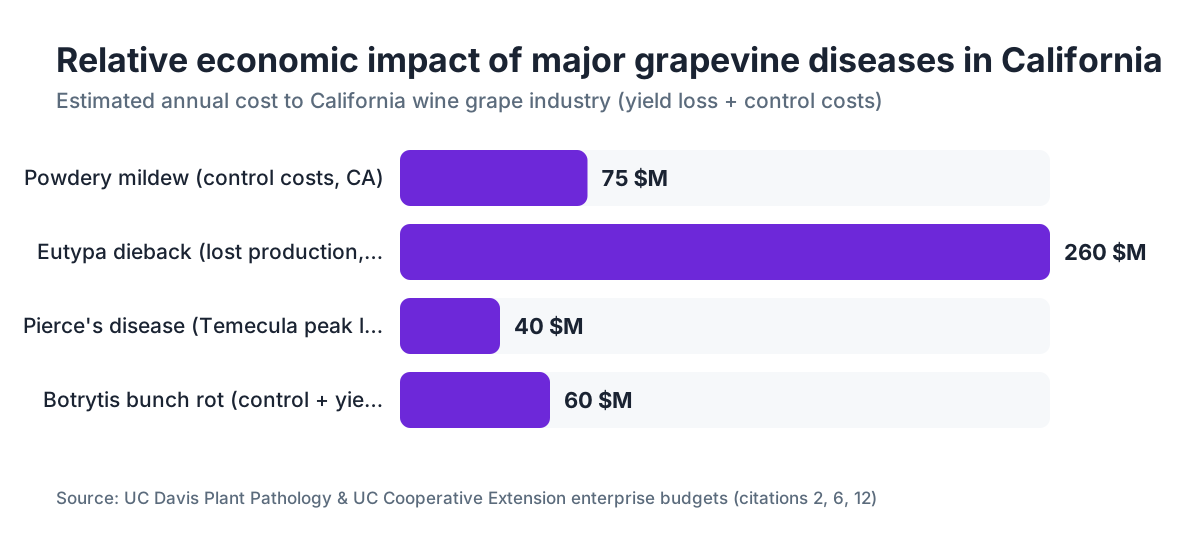
Powdery mildew is estimated to cost the global industry roughly $1.5 billion a year when yield loss and control costs are combined [2]. In California, the direct control cost (fungicide applications) on wine grapes runs an estimated $100 to $250 per acre per season, and an unmanaged infection can destroy 50% or more of a crop on susceptible varieties in a bad year [2].
Eutypa dieback is estimated to cost California wine grape growers $260 million a year in lost production, based on a UC Davis economic analysis that counted reduced yield plus premature vine replacement [6]. That figure dates to the early 2000s and probably understates today's replacement and replanting costs.
In the Temecula wine region of Southern California from the late 1990s into the early 2000s, Pierce's disease effectively wiped out about 40% of the vineyard area before glassy-winged sharpshooter controls and resistant varieties went in [1].
The case for prevention over treatment is clear across all of these, mostly because the worst ones have no cure. Spending $150 per acre on a timely powdery mildew program is simple math against losing 30% of your crop value. The harder call is trunk disease prevention, where the payoff from wound sealing and careful pruning shows up 5 to 15 years later in vine longevity, not in this year's harvest.
For a 10-acre vineyard, a full-season disease management program (materials plus labor) typically runs $2,000 to $6,000 per season, based on UC Cooperative Extension enterprise budgets for North Coast wine grapes [12]. The range is wide because it hangs on how many applications you make and what products you pick.
What records should you keep for grapevine disease management?
At a minimum, your application records need: date and time of application, product name and EPA registration number, rate applied (per acre), total quantity applied, target pest, and applicator name. That covers federal WPS and most state PUR requirements [10][11].
Beyond the legal floor, good disease records add scouting observations with dates and growth stages, weather data around each spray decision (temperature, humidity, rainfall), PHI tracking against your projected harvest window, and notes on efficacy you see in later scouting visits. Those last two are what separate growers who spray on calendar from growers who spray on risk. They also document the judgment calls that protect you if a residue question ever comes up.
California's PUR system requires growers or their PCAs to file monthly reports with the county agricultural commissioner, including the treated crop, location by township/range/section, acreage treated, and pesticide product information [11]. Miss a PUR filing and you face fines, plus you can lose the ability to buy restricted-use pesticides.
Keep records at least two years for WPS. Keep them three years if you sell grapes to wineries with organic or sustainable certifications that want a third-party audit trail. Some buyers, especially in premium Napa and Sonoma, now want digital records with GPS field identification, which paper simply can't deliver efficiently.
If you farm more than a few acres and file records across multiple states, software that stores application records, auto-calculates PHIs, and exports formatted PUR reports stops being a luxury. VitiScribe does exactly this, with spray record templates pre-formatted for California county ag commissioner requirements and alerts when a planned harvest date collides with a recent application's PHI.
Frequently asked questions
What is the most common disease of grapevines worldwide?
Powdery mildew (Erysiphe necator) is the most widespread and economically damaging grapevine disease globally. It hits every major wine region, thrives without free water unlike most fungal diseases, and can destroy an entire crop if you miss the early-season spray window. UC Davis estimates it costs the global industry roughly $1.5 billion a year in yield loss and control costs combined.
Can grapevine diseases spread from vine to vine in the same row?
Yes, most can, though the mechanism differs. Powdery and downy mildew spread by airborne spores and travel real distances. Botrytis spreads by direct contact between infected and healthy berries within a cluster and row. Pierce's disease spreads only through insect vectors, not plant-to-plant contact. Trunk diseases move slowly through contaminated pruning tools or by root grafting between adjacent vines.
What grapevine diseases are worst in humid climates?
The eastern United States and other humid regions face the most complex disease pressure. Downy mildew, black rot, Botrytis bunch rot, and Phomopsis all favor warm, wet conditions. Growers in Virginia, New York, and the Midwest can run 15 to 20-plus spray applications a season on vinifera. Disease-resistant hybrid varieties are far more practical in these regions.
How do I know if my grapevine has Eutypa or Esca?
Both are trunk diseases but they differ in the field. Eutypa makes stunted, distorted shoots with small, cupped, chlorotic leaves on one arm early in the season, plus a wedge-shaped internal wood canker. Esca shows tiger-stripe leaf symptoms (interveinal necrosis) in summer and can cause sudden apoplexy, where a vine wilts and dies. Send a wood sample to a plant diagnostic lab to confirm.
Is Pierce's disease found outside California and the Southeast?
Pierce's disease (Xylella fastidiosa) is endemic to the southeastern United States and the coastal and valley regions of California. Cold winters suppress it elsewhere because X. fastidiosa can't survive sustained freezes in the vine. In Europe, a related X. fastidiosa strain has caused severe olive tree losses in Italy, prompting EPPO quarantine measures, but the grape-specific strain hasn't established in Europe's main wine regions.
What fungicides are approved for organic vineyard disease management?
Organic-approved options include sulfur (powdery mildew), copper hydroxide or copper sulfate (downy mildew and some bacterial diseases), potassium bicarbonate (powdery mildew), mineral oil (powdery mildew), and Bacillus subtilis-based biocontrols (Botrytis). Efficacy is generally lower than synthetic options under high pressure. Copper rates in organic programs are increasingly restricted in Europe and under review in the US over soil accumulation concerns.
How do you prevent grapevine trunk diseases from getting worse each year?
Prevention centers on pruning wound management. Apply a registered wound protectant (Trichoderma-based or thiophanate-methyl-based) right after every cut, ideally within 30 minutes. Prune in dry weather, or just before rain is forecast, not after. Consider double pruning to push final cuts to late in the dormant season when wounds are less susceptible. Remove and burn infected wood instead of leaving it on the vineyard floor.
What is the pre-harvest interval (PHI) and why does it matter for disease sprays?
The pre-harvest interval is the minimum number of days between the last pesticide application and harvest, as specified on the product label. Under FIFRA, the label is federal law. Harvesting before the PHI expires risks illegal residues on fruit, winery rejection, and regulatory action. Always calculate your PHI from your last application date against your planned harvest, and document both in your spray records.
Do all grape varieties get the same diseases?
No. Vitis vinifera is highly susceptible to most fungal diseases and completely susceptible to Pierce's disease. American species (V. labrusca, V. riparia) and hybrids bred from them carry natural resistance to several diseases. Marquette, Frontenac, and Norton resist downy mildew, powdery mildew, and black rot meaningfully. Even within vinifera, Pinot Noir and Chardonnay are notably more prone to powdery mildew and Botrytis than Cabernet Sauvignon or Syrah.
What are the grapevine disease reporting requirements in California?
California requires monthly Pesticide Use Reports (PURs) filed with the county agricultural commissioner for all pesticide applications. Restricted-use pesticides also require a pest control advisor (PCA) recommendation before purchase and application. The California Department of Food and Agriculture oversees Pierce's disease as a regulated pest with its own monitoring and reporting program. Check with your county ag commissioner for local filing formats and deadlines.
Can you cure a grapevine once it has crown gall?
There's no curative treatment for crown gall. Agrobacterium vitis lives systemically throughout infected vines, so removing visible galls does not clear the bacterium. Management means preventing the freeze wounds that trigger gall formation, using certified clean planting material, and pulling severely affected vines. Some growers replant with own-rooted vines in gall-endemic sites, but the bacterium persists in soil and can infect new plantings.
How do you tell Botrytis bunch rot apart from other berry diseases at harvest?
Botrytis makes a gray-brown fuzzy sporulation on infected berries, easiest to see after you pull berries off the cluster and leave them in a humid environment for a few hours. Infected berries feel hollow or soft and smell musty. Black rot makes hard, shriveled black mummies with no fuzzy sporulation. Sour rot (a bacterial and yeast complex) smells vinegary and often comes with insect damage around the infection.
What does WSU Extension recommend for managing trunk diseases in the Pacific Northwest?
WSU Extension recommends double pruning as the primary cultural tool: make a long-spur cut first, then return later in the dormant season to make the final cut close to the cordon or trunk. This shortens the time fresh wound surfaces are exposed during wet, cool weather when spores are most active. They also recommend registered wound sealants and training workers on tool sanitation between vines.
How often should you scout for grapevine diseases during the season?
Scout at a minimum at six phenological windows: budbreak, 6-inch shoot growth, just before bloom, fruit set, bunch closure, and veraison. In high-pressure years or on susceptible varieties, weekly scouting from budbreak through bunch closure is better. Record what you see each time, including growth stage and weather. Those notes justify your spray timing decisions and satisfy compliance record requirements.
Sources
- CDFA Pierce's Disease Control Program: Pierce's disease caused by Xylella fastidiosa is transmitted by glassy-winged sharpshooters and is incurable once established in a vine; CDFA maintains an active monitoring and control program in Southern California.
- UC Davis Viticulture and Enology, Powdery Mildew of Grape: Powdery mildew is the most economically significant fungal disease of grapevines; UC IPM documents the degree-day model for ascospore release timing and estimates global annual losses at approximately $1.5 billion.
- UC Cooperative Extension, Grape Pest Management Guidelines (UC IPM): Sulfur fungicides can cause phytotoxicity above 90°F; DMI and SDHI fungicide rotation is recommended to manage resistance in powdery mildew programs.
- Cornell Viticulture and Enology, Downy Mildew of Grapes: The 10-10-10 rule (10°C, 10 mm rain, 10 days after budbreak) is the standard infection trigger for downy mildew; copper-based fungicides remain the backbone of organic programs.
- UC IPM, Botrytis Bunch Rot of Grape: Botrytis cinerea infects dead floral tissue at bloom and activates at veraison; leaf removal in the fruit zone is documented to reduce Botrytis incidence more effectively than fungicide applications alone; resistance to botryticides is well documented.
- UC Davis Department of Plant Pathology, Eutypa Dieback of Grapevine: Eutypa dieback caused by Eutypa lata is estimated to cost California wine grape growers $260 million per year; wound sealants applied immediately after pruning are the primary prevention tool.
- WSU Extension, Grapevine Trunk Diseases: WSU Extension documents that double pruning significantly reduces Eutypa lata infection rates compared to single-pass pruning by reducing wound exposure during peak spore release periods.
- Cornell Cooperative Extension, Black Rot of Grapes: Black rot (Guignardia bidwellii) can destroy 80% or more of a crop in wet years on susceptible eastern varieties; Cornell publishes region-specific spray timing guides sequencing protectant fungicide applications from budbreak through bunch closure.
- EPA Worker Protection Standard, 40 CFR Part 170: The EPA Worker Protection Standard requires pesticide application records be maintained for at least two years; the pesticide label is enforceable as a federal document under FIFRA and specifies legally binding restricted-entry intervals and pre-harvest intervals.
- CDFA, Pesticide Use Reporting (PUR) Program: California growers must file monthly Pesticide Use Reports with their county agricultural commissioner; restricted-use pesticides require a licensed pest control advisor recommendation before purchase and application.
- UC Cooperative Extension, Sample Costs to Establish and Produce Wine Grapes (North Coast): UC Cooperative Extension enterprise budgets for North Coast wine grapes put full-season disease management (materials plus labor) at roughly $2,000 to $6,000 per season on a 10-acre vineyard, depending on application count and products.
Last updated 2026-07-09