Home vineyard spraying: the complete practical guide

TL;DR
- A home vineyard spray program runs 8 to 15 applications a season, from bud break through veraison.
- The costly mistakes: spraying after disease shows, skipping records, and using products not labeled for grapes.
- Sulfur, copper, and a handful of OMRI-listed materials cover most fungal threats.
- Match every spray to growth stage, not the calendar.
Why do home vineyards need a spray program at all?
Grapes are one of the most disease-prone fruits you can grow. Powdery mildew (Erysiphe necator), downy mildew (Plasmopara viticola), Botrytis bunch rot, and black rot (Guignardia bidwellii) can take 50 to 100% of a crop in a wet year with zero intervention. [1] That's not a scare figure. Cornell's viticulture program has documented near-total powdery mildew losses on susceptible varieties in the Northeast when growers missed a single key spray window.
Here's the good part. A home planting, usually a few dozen vines, is easy to manage. No airblast sprayer. No agronomist on retainer. You learn how the diseases behave, pick the right materials, and spray at the right growth stages. The rest is detail.
If you want to see what a full-scale operation looks like, the vineyard overview is worth a read. For a backyard block the logic is identical: prevention beats cure, every single time.
What diseases are you actually trying to prevent?
The list shifts by region, but three threats turn up wherever grapes grow in the U.S., and a fourth dominates east of the Rockies.
Powdery mildew is the constant. It likes warm days and cool nights, so it hammers California and the inland West, but it does real damage in the East too. Spores infect green tissue between 50°F and 90°F, and unlike most fungi it needs no free moisture to germinate. [1] That last part catches growers flat-footed.
Downy mildew needs water. Infection wants leaf wetness for at least 2 hours and temperatures above 50°F. It's the main problem in the humid East and Midwest. The Cornell Grape Disease Forecast Model, run through the New York State IPM program, gives real-time infection risk from weather data. [2]
Botrytis (gray mold) goes after tight-clustered varieties at bloom and again near harvest, driven by humidity. Black rot is severe east of the Rockies, hitting young shoots, leaves, and berries through a short spring window.
| Disease | Primary region | Trigger | Key spray window |
|---|---|---|---|
| Powdery mildew | All regions | Warm days, no rain needed | Bud break through bunch closure |
| Downy mildew | East, Midwest | Leaf wetness + warmth | First rain after 1-inch shoot growth |
| Botrytis | All regions, humid worse than dry | High humidity, dense canopy | Bloom through post-set |
| Black rot | East of Rockies | Leaf wetness, 60-85°F | 2 weeks pre-bloom through 4 weeks post-bloom |
Step one is knowing which of these is your real enemy. A Napa grower thinks about powdery mildew and almost nothing else. A grower in Ohio fights all four.
When should you start spraying in spring?
Start earlier than feels natural. The first powdery mildew spray goes on at or just before bud break, the moment tiny green tissue shows. [3] If you wait until you see mildew, you've already lost. Downy mildew sprays usually begin when shoots hit 1 to 2 inches and the first real rain is in the forecast.
Growth stage beats the calendar every time. A cold spring can push your first spray to early May in Virginia. A warm one puts you out with the backpack in late March. University extension programs stage vines on the Eichhorn-Lorenz (E-L) scale. The trigger points that matter:
- E-L 4-5 (bud break, green tip visible): first sulfur or copper for powdery mildew
- E-L 9 (2-3 leaves unfolded, shoots 1-2 inches): first downy mildew spray if rain is coming
- E-L 17-19 (pre-bloom through full bloom): the make-or-break window, where disease pressure decides your crop
- E-L 27-29 (berry set through pea-size): the second window, especially for black rot and Botrytis
- E-L 35 (veraison, berries begin to color): sprays mostly stop here unless Botrytis is active
UC Davis Cooperative Extension recommends a 7 to 14 day interval from pre-bloom through bunch closure, tightened to 7 days or less when it's wet and pressure is high. [3]
What spray materials actually work for home growers?
You have more options than you'd guess, and several are cleared for organic production.
Sulfur is the backbone of a home program. Growers have used it on grapes for over 150 years. It's cheap (roughly $20 to $40 for a 5-lb tub of wettable sulfur), it controls powdery mildew well, and it's OMRI-listed. Two catches: keep it at least 2 weeks away from any oil spray to avoid phytotoxicity, and don't apply above 90°F or you'll scorch leaves. [4]
Copper (copper hydroxide or copper octanoate) covers downy mildew with some activity on black rot and Botrytis. Also OMRI-listed. Copper builds up in soil, so stick to labeled rates and don't pile it on year after year. [4]
Neem oil and potassium bicarbonate (Kaligreen, MilStop) are solid backups, useful if you're staying organic. Neem has some powdery mildew activity as a contact material. Potassium bicarbonate is a good eradicant when you catch early mildew colonies.
Synthetic fungicides give you systemic movement and longer residual. For home use, garden-center products with myclobutanil (Spectracide Immunox is one), tebuconazole, or azoxystrobin show up labeled for grapes. Read the label. If grapes aren't on it, you cannot legally use it on grapes. No exceptions. [5]
Say this part plainly: resistance management matters even in a 30-vine block. Rotate mode-of-action groups. Don't spray the same systemic more than 2 to 3 times a season. The FRAC (Fungicide Resistance Action Committee) code is printed on every fungicide label. [6]
| Material | Disease target | Organic OK? | Approx. cost per application (small block) | PHI (days) |
|---|---|---|---|---|
| Wettable sulfur | Powdery mildew | Yes | $2-5 | 0-3 |
| Copper hydroxide | Downy mildew, black rot | Yes | $3-8 | 0-4 |
| Potassium bicarbonate | Powdery mildew | Yes | $3-7 | 0 |
| Myclobutanil | Powdery mildew, black rot | No | $5-12 | 14-21 |
| Azoxystrobin | Multiple | No | $8-15 | 14 |
What equipment do you need for a backyard vineyard?
A backpack sprayer is the right tool for almost every home vineyard. A 4-gallon unit (Solo, Hudson, or similar) costs $60 to $120 and handles 50 to 200 vines without complaint. [7] Spend the extra $20 on a stainless-steel pump assembly if you plan to use copper, which eats plastic parts over time.
Under 20 vines? A 2-gallon hand pump sprayer does the job and costs less. You just pump more often.
Nozzle choice matters more than people expect. A flat fan nozzle set for medium droplets (200 to 300 microns) gets into the canopy better than a cone nozzle. Spray from above and below, because powdery mildew colonizes leaf undersides as happily as the tops.
Calibrate before the season starts. Fill with clean water, time how long it takes to cover a set number of vines at your normal walking pace, and work out gallons per vine. You want foliage wet to the point of runoff without heavy drip. Most backpack sprayers push 2 to 4 gallons per minute through a fan nozzle at 40 psi.
Pressure is the underrated variable. Below 30 psi and you get poor penetration in a dense canopy. Most backpacks run 20 to 60 psi depending on how hard you pump. Hold pressure steady down each row.
Do you need to follow any legal requirements for home vineyard spraying?
Yes, and this is where backyard growers get sloppy.
The one rule above all others: read and follow the pesticide label. The label is a federal legal document under the Federal Insecticide, Fungicide, and Rodenticide Act (FIFRA). [5] Using a pesticide in a way its labeling doesn't allow is a federal violation. That covers applying a product to grapes when grapes aren't listed, exceeding the maximum rate, or ignoring the pre-harvest interval (PHI).
The EPA's Worker Protection Standard (WPS) is written for agricultural establishments that employ workers. For a purely personal planting where only the owner touches the vines, WPS technically doesn't apply. [8] But bring in anyone else to help spray, including a family member who isn't a co-owner, and the WPS requirements kick in: pesticide safety information, decontamination supplies, and emergency assistance if someone gets exposed.
State rules add another layer. Some states require an applicator license for any commercial application, and a few restrict specific materials near waterways, organic buffers, or property lines. California's Department of Pesticide Regulation has reporting requirements for certain materials even for small operators. [9] Check your state ag department site before you assume you're clear.
On PHI: the clock starts the day of your last application. A 14-day PHI product sprayed August 15th means the earliest legal harvest is August 29th. Keep a log.
How should you keep spray records for a home vineyard?
Spray records feel like busywork when you've got 30 vines. They aren't.
Each application record should carry the date, product name and EPA registration number, target pest, rate applied, total volume mixed, growth stage at application, wind speed and direction, and the applicator's name. [9] That's the exact core data a commercial operation captures.
Why bother on a hobby block? Three reasons. Sell any fruit, even a few crates to neighbors or a farm stand, and you're in commercial territory where records can be legally required. Have an incident (drift onto a neighbor's garden, a bee kill, an applicator illness) and records are your protection. And season to season, records show you where your program holds and where disease keeps breaking through.
A notebook works. A spreadsheet works better. Tools like VitiScribe are built for exactly this, letting you log applications from your phone in the field and auto-generate the record formats state agencies and organic certifiers accept. If you're running past a hobby block or want to sell fruit someday, purpose-built record-keeping pays off at audit season.
Whatever you use, keep records at least 2 years. EPA recommends 2 years for commercial operators, and some state programs want longer. [8]
How do you protect yourself and your family during spraying?
Personal protective equipment (PPE) requirements are printed on every fungicide label, and they change by product. For most home vineyard fungicides the minimum is long sleeves, long pants, chemical-resistant gloves, and eye protection. Some synthetics require a respirator.
Sulfur is low-toxicity but irritates skin and eyes at concentrated rates, and it's a respiratory irritant as airborne dust, so wear a simple dust mask while mixing the wettable powder. Copper products irritate eyes and skin. Any systemic synthetic deserves more caution: read the signal word (Caution, Warning, or Danger) and match your PPE to it.
Don't spray on windy days. Anything over 10 mph pushes drift risk up sharply. Spray early morning when wind is calm and temperature inversions are less likely. Steer clear of active bee foraging hours. Copper and sulfur are low-risk to bees, but some synthetic fungicides are not. [10]
Keep kids and pets out until sprays dry. Re-entry intervals (REI) are on the label, and most home vineyard fungicides run 4 to 24 hours. That number is law, not a suggestion.
What spray schedule works for a typical home vineyard?
No single schedule fits everyone, because your region and your variety mix set the risk. Here's a workable starting point for a moderate-risk site (East Coast or Midwest, a mix of European and hybrid varieties):
- Bud break (E-L 4-5): Sulfur at 3-4 lb/100 gal OR copper at labeled rate. Target: powdery mildew, overwintering spores.
- 3-4 leaves unfolded (E-L 9-12): Sulfur plus copper tank mix if rain is forecast. Target: powdery and downy mildew.
- Pre-bloom (E-L 17-18): Your most important spray. Systemic material if you're not organic (myclobutanil or azoxystrobin), or potassium bicarbonate plus copper if you are. Repeat every 7 days through the window.
- Bloom (E-L 19): Apply carefully to spare pollinators; spray evening or early morning. Botrytis risk peaks here.
- Post-set (E-L 27-29): Continue 7 to 10 day intervals with sulfur in rotation. Add a Botrytis-specific material (fenhexamid, or Bacillus subtilis for organic) if fruit set is dense.
- Bunch closure (E-L 32): Last high-priority window. Swing back to sulfur-based materials.
- Veraison (E-L 35): Most programs end here. Keep watching Botrytis in humid years.
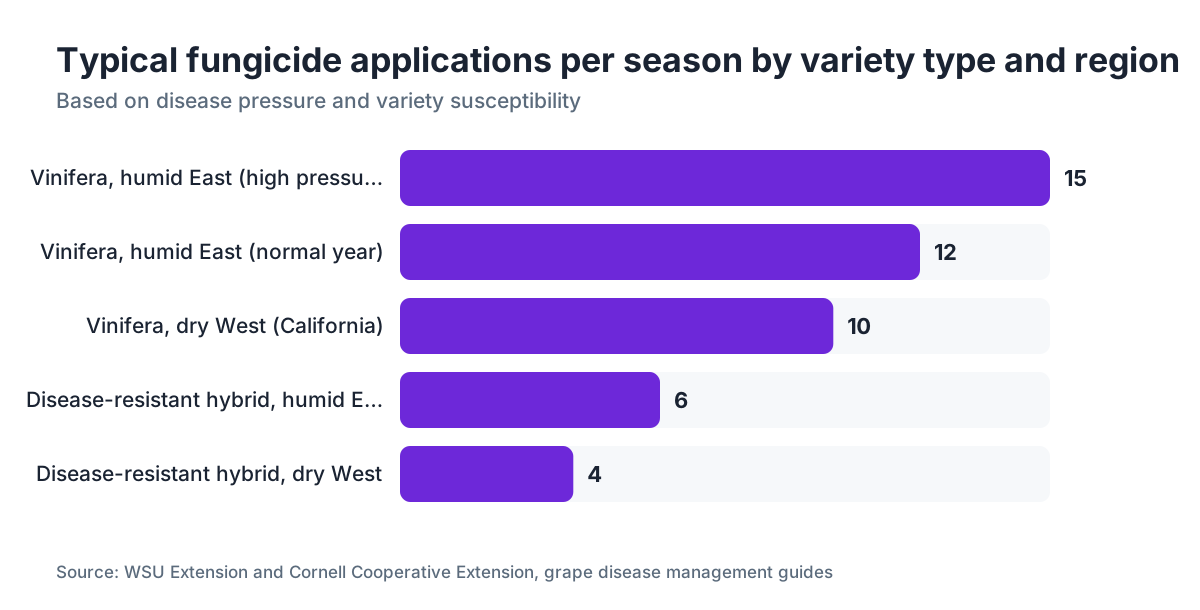
WSU Extension recommends a minimum of 8 applications for adequate control on susceptible varieties in wet years, with high-pressure years pushing to 15 or more. [11] For resistant varieties (Marquette, Crimson Cabernet, Frontenac) you can cut the program hard.
Curious how large operations handle this? The spray thinking at bigger properties in regions like paso robles wineries looks nothing like a backyard block, but the disease biology underneath is exactly the same.
How do resistant grape varieties change your spray program?
A lot. This is the biggest lever a home grower has.
Varieties bred with Vitis rotundifolia or other resistant wild species carry partial to near-complete resistance to powdery mildew, downy mildew, or both. Cornell's grape breeding program (behind Marquette, La Crescent, and Traminette) has published resistance ratings showing these varieties need 50 to 75% fewer fungicide applications than Vitis vinifera cultivars like Chardonnay or Pinot Noir under humid conditions. [2]
For a home grower in the East or Midwest, planting resistant varieties may be the highest-return decision you make. You still need some coverage, mainly black rot on hybrids and Botrytis on any tight cluster, but a 4 to 6 spray program often does what 12-plus applications can barely manage on straight vinifera.
If you're growing Cabernet Sauvignon in a humid region because you love it, fine, plan around it. A stripped-down spray program on high-susceptibility vinifera in a wet year is a crop-loss recipe. Cornell Extension is blunt about it: "susceptible cultivars in humid climates without consistent fungicide applications will frequently suffer severe disease losses." [2]
For a look at warmer, drier growing conditions where mildew pressure runs high but downy mildew stays low, the south coast winery context is a useful reference point.
What are common spray mistakes home growers make?
Spraying too late tops the list. By the time you see symptoms, the infection has a 7 to 10 day head start. Fungicides work far better as preventatives than eradicants. The moment you think you might need to spray, you probably needed to three days ago.
Wrong rate comes second. Underdosing to save product or ease residue worries gives poor coverage and speeds resistance. Overdosing burns money and risks phytotoxicity. Follow the label rate for the specific crop and stage.
Poor canopy management multiplies every other failure. A dense, untended canopy blocks spray and builds the humid microclimate Botrytis loves. Pulling leaves in the fruit zone before and after bloom improves coverage, airflow, and skin toughness at once. [3] The spray program and the canopy program are one system.
Ignoring the PHI. Growers sometimes spray right before harvest to chase late-season pressure, then eat the fruit or hand it to neighbors. A 14-day PHI product on fruit you're picking in 5 days is illegal. Switch to zero-PHI materials (sulfur at some rates, potassium bicarbonate) late in the season.
Skipping the sprayer rinse. Leftover pesticide degrades in the tank, clogs nozzles, and contaminates the next batch. Rinse thoroughly with clean water after every use. Before switching from synthetics to organic materials, a dilute bleach rinse followed by a water flush is good practice.
Records that turn to mush. A logbook left in the barn that gets wet or fades is worthless when you need to reconstruct your spray history. Digital records, even a spreadsheet backed up to the cloud, hold up. VitiScribe handles it automatically if you want a purpose-built option.
How do you handle spray drift and neighbor concerns?
Drift is a legal problem and a neighbor problem at the same time. Pesticide drift onto a neighbor's property is a FIFRA violation if it causes damage or if the product was applied against its label, which almost always prohibits off-target movement. [5]
What actually cuts drift on a home vineyard:
Spray when wind is 2 to 8 mph. Below 2 mph you risk temperature inversions and erratic movement; above 10 mph drift climbs fast. [10] Use larger droplets, which fall faster and travel less. Ease off the pressure a little on the edge rows nearest a property line. Shielded nozzles are available for backpack sprayers and slash edge-of-field drift.
Got neighbors with bees? Call them before you spray. Beekeepers genuinely appreciate the heads-up, and copper and sulfur are far gentler on bees than many synthetics. Spray in the evening if bees are a concern.
Have an irrigation ditch, wetland, or creek nearby? Check your state's rules for required buffer distances. California, for one, requires a 60-foot buffer from surface water for some products. [9] That catches more home growers than they expect.
Frequently asked questions
How many times a year do you need to spray a home vineyard?
Most home vineyards need 8 to 15 applications a season, concentrated between bud break and bunch closure. Disease-resistant hybrids can get by with 4 to 6. Susceptible Vitis vinifera in humid climates (East Coast, Pacific Northwest) often needs the full 12 to 15. WSU and Cornell extension programs both use this range as a planning baseline.
Can I use organic spray materials on my backyard grapes?
Yes. Sulfur, copper, potassium bicarbonate, neem oil, and Bacillus subtilis are all OMRI-listed and cover most home vineyard disease pressure. Sulfur is the workhorse for powdery mildew. Copper handles downy mildew. The limitation: organic materials generally need shorter intervals and give less residual protection than synthetics under high pressure.
What is the pre-harvest interval (PHI) and why does it matter?
The pre-harvest interval is the minimum number of days between your last pesticide application and harvest. It's legally required under FIFRA. Common home vineyard fungicides carry PHIs of 0 to 21 days depending on the product. Spray inside the PHI window and then consume or sell the fruit, and you're violating federal law. Check the label for every product before late-season sprays.
Do I need a pesticide applicator license to spray my own vineyard?
For a home planting you manage yourself and don't sell fruit from commercially, most states don't require a license. But restricted-use pesticides (RUPs) require a license regardless of context, and spraying for hire needs certification. Most garden-center products are general-use pesticides with no license required. Confirm with your state department of agriculture.
What's the best fungicide for powdery mildew on grapes?
For home growers, wettable sulfur applied preventively is the most practical and cheapest option, and it's organically approved. If pressure is high or symptoms already show, potassium bicarbonate gives faster knockdown. Synthetic options like myclobutanil (Immunox) are more systemic and longer-lasting but carry a 14 to 21 day PHI. Rotate materials to manage resistance.
When should I stop spraying in the season?
Most home vineyard programs end at or just after veraison, when berries begin to color, around E-L stage 35. Past that point berry skins harden and fungicide penetration drops. The exception is Botrytis in humid years, where some growers apply a Botrytis-specific material at veraison on tight-clustered varieties. Always respect the PHI of whatever product you use.
Is it safe to spray grapes with sulfur near a vegetable garden?
Sulfur has very low mammalian toxicity and is approved on vegetables as well as grapes. The main risk is phytotoxicity to sulfur-sensitive plants, including some cucurbits (cucumbers, melons) and apricots. Avoid drift onto those crops. Stay at label rates, and don't spray above 90°F. Sulfur breaks down quickly in the environment.
How do I know what diseases are most likely in my region?
Your local cooperative extension office is the best starting point. Cornell covers the Northeast, UC Davis covers California, and WSU covers the Pacific Northwest. Each publishes region-specific disease guides and, in some cases, real-time forecasting tools built on local weather. The dominant threats shift hard from California (powdery mildew dominant) to the East Coast (all four major diseases).
Does the EPA Worker Protection Standard apply to a home vineyard?
WPS applies to agricultural establishments that employ workers or handlers. If you're the only person working your home vineyard, WPS doesn't apply to you personally. But if anyone else, including a paid helper or a family member working under your direction, handles pesticides or enters treated areas, WPS requirements for training, decontamination, and emergency assistance do apply. EPA's WPS page lists the exemption criteria.
Can spray drift from my vineyard cause legal problems with neighbors?
Yes. Off-target pesticide movement is a FIFRA violation if it damages neighboring property or results from label-inconsistent application. Document your spray conditions (wind speed, direction, rate) every time. Use low-drift nozzles and appropriate pressure, especially near property lines. If a neighbor alleges drift damage, your spray records are your main defense. State departments of agriculture investigate complaints.
What PPE do I need when spraying my home vineyard?
At minimum: long sleeves, long pants, chemical-resistant gloves (nitrile at least), and safety glasses or goggles. Your product's label requirements govern. Some synthetic fungicides require a half-face respirator with organic vapor cartridges. Signal words on the label (Caution, Warning, Danger) mark increasing toxicity. Caution products are lowest risk; Danger products demand the strictest PPE.
How do I calibrate my backpack sprayer for vineyard use?
Fill with clean water. Walk your normal spraying pace while pumping at your normal pressure through a known length of row. Collect and measure the output from a single nozzle for 30 seconds, then scale up. Aim for thorough wet coverage to the point of runoff, roughly 0.25 to 0.5 gallons per vine for a well-trained, modest-canopy plant. Recheck calibration whenever you change nozzles or walking pace.
How long should I keep spray records for a home vineyard?
EPA recommends commercial operators keep records at least 2 years. For home growers, 2 years is a practical minimum. If you ever sell fruit, apply for organic certification, or face a drift or crop-damage complaint, 3 to 5 years of records is far more useful. Digital records in a cloud-backed system are more durable than handwritten logs and easier to search.
Do disease-resistant grape varieties eliminate the need to spray?
They cut it a lot, not to zero. Cornell research shows resistant hybrids like Marquette and Frontenac can need 50 to 75% fewer applications than Vitis vinifera under humid conditions. But black rot still hits some hybrids, Botrytis hits any tight cluster, and even highly resistant varieties benefit from a few early copper sprays in wet years. A big advantage, not a free pass.
Sources
- UC Davis Cooperative Extension, Grape Powdery Mildew Management: Powdery mildew infects green tissue at temperatures between 50°F and 90°F without requiring free moisture; losses of 50-100% of crop are documented in unsprayed susceptible varieties
- Cornell University Cooperative Extension, NYS Integrated Pest Management, Grape Disease Forecasting: Susceptible cultivars in humid climates without consistent fungicide applications frequently suffer severe disease losses; disease-resistant varieties require 50-75% fewer applications
- UC Davis Cooperative Extension, Grape Fungicide Timing Guide: UC Davis recommends 7-14 day spray intervals during pre-bloom through bunch closure, shortened to 7 days or less during wet high-pressure conditions; first application at bud break
- USDA Agricultural Marketing Service, National Organic Program: Sulfur and copper are allowed for organic use under the National Organic Program; copper accumulates in soil and should be applied at minimum labeled rates
- U.S. EPA, Federal Insecticide, Fungicide, and Rodenticide Act (FIFRA): Using a pesticide in a manner inconsistent with its labeling is a federal violation under FIFRA; the label is a legal document
- Fungicide Resistance Action Committee (FRAC), Mode of Action Classification: FRAC codes identifying fungicide mode-of-action groups are printed on labels; rotating codes prevents resistance development
- Washington State University Extension, Small Farm Equipment for Vineyards: Backpack sprayer units (4-gallon capacity) cost $60-$120 and are appropriate for small home vineyard blocks
- U.S. EPA, Agricultural Worker Protection Standard: WPS applies to agricultural establishments where workers or handlers are employed; EPA recommends commercial operators retain pesticide records for at least 2 years
- California Department of Pesticide Regulation, Pesticide Use Reporting: California requires specific pesticide use reporting and maintains buffer requirements of 60 feet from surface water for certain products
- U.S. EPA, Reducing Pesticide Drift: Wind speeds above 10 mph significantly increase pesticide drift; recommended application window is 2-8 mph; spray timing near pollinators should avoid active foraging hours
- Washington State University Extension Viticulture, Pacific Northwest Grape Disease Management Guide: WSU recommends a minimum of 8 applications for adequate disease control on susceptible varieties in wet years, with high-pressure years requiring up to 15 or more
- Cornell University Grapes and Wine, Eichhorn-Lorenz Growth Stage Guide: The Eichhorn-Lorenz (E-L) scale defines key grape growth stages used to time fungicide applications; E-L 17-19 (bloom) is identified as the most critical spray window
Last updated 2026-07-09