Vineyard spraying equipment: a complete guide for growers

TL;DR
- Vineyard spraying equipment runs from backpack sprayers under $200 to tractor-mounted airblast units at $8,000 to $40,000 and up.
- The right pick depends on vineyard size, canopy density, and spray material.
- Airblast sprayers dominate commercial blocks above 5 acres.
- Calibration, label-specified PPE under EPA's Worker Protection Standard, and accurate spray records are non-negotiable on every operation.
What types of spraying equipment do vineyards actually use?
Vineyard sprayers fall into a handful of clear categories, and the lines between them matter more than most growers think when they're budgeting or scaling up.
Backpack and hand-pump units are the starting point. They hold 2 to 5 gallons, cost $50 to $200, and work fine for spot treatments, small trials, or filling the gaps a tractor can't reach. They're slow. They're hard on the operator. And they stop making sense above an acre or two of dense canopy.
Hand-gun or hose-end sprayers on a small tank (25 to 100 gallons) mounted to a utility vehicle give you more range and take the weight off your back. Some growers run these for organic contact sprays or wettable sulfur on the vineyard perimeter.
Airblast sprayers are the workhorse of commercial viticulture. A PTO-driven fan pushes an air stream that carries droplets into and through the vine canopy. Tanks run 100 to 800 gallons. A standard tower or radial-flow airblast unit covers 3 to 6 acres per hour depending on row spacing and travel speed. UC Davis Statewide IPM describes airblast as the standard application method for most California vineyards [1].
Cross-flow and tunnel sprayers step up the precision. They fire air and spray horizontally through the canopy from both sides at once. Canopy interception is better, off-target drift is lower, and material use can drop 20 to 40% against a conventional airblast [2]. The price reflects that. Expect $25,000 to $60,000 for a new tunnel unit.
Electrostatic sprayers charge the droplets so they wrap around leaf surfaces. They're catching on where resistance management and reduced-rate programs matter. The capital cost is still high next to conventional airblast, and calibration asks more of you.
Drone application is real and growing on steep or terraced ground where tractor access is impossible. But regulatory status varies by state, and most states require a licensed applicator for every commercial drone application. Treat drone spraying as a supplement, not a replacement, for now.
How do you choose the right sprayer for your vineyard size and layout?
The single biggest mistake growers make is buying equipment calibrated for someone else's operation. Here's how to think it through honestly.
Start with acreage and row spacing. A 3-acre hobby block with 9-foot rows looks nothing like a 50-acre planting on 6-foot rows, and the sprayer that handles one will either underwhelm or overkill the other. Under 5 acres, a compact 100-gallon airblast or even a well-kept hand-gun setup may be the right economic call. Above 10 acres, a full-size airblast unit starts paying for itself in time savings alone.
Canopy architecture matters a lot. High-cordon or vertically shoot-positioned (VSP) trellises create a defined target zone. A sprayer with adjustable nozzle heads or a tower stack lets you concentrate output there instead of spraying open air above and below the fruit zone. Geneva Double Curtain (GDC) or sprawl-trained systems need more lateral throw.
Slope and access are hard constraints. Most tractor-mounted airblast sprayers want relatively flat to moderate terrain (under 25 to 30% grade is a common practical limit). For steeper ground, cable-pulled sprayers, orchard-grade tracked carriers, or the drone option come into play.
Water source and refill logistics get overlooked constantly. A 500-gallon tank sounds great until you learn your well only does 5 gallons a minute and you're refilling twice per block. Some operations run a nurse tank in a follow vehicle. Plan the whole workflow, not the equipment spec alone.
Then consider the spray program itself. If you're mostly running sulfur and copper, a simpler conventional airblast is fine. If you're on reduced-risk materials at tight label rates, the precision of a cross-flow or electrostatic unit may pay back in material savings and resistance management over time.
For a look at how vineyards of different scales approach these calls in practice, examples from specific growing regions lay out the tradeoffs well.
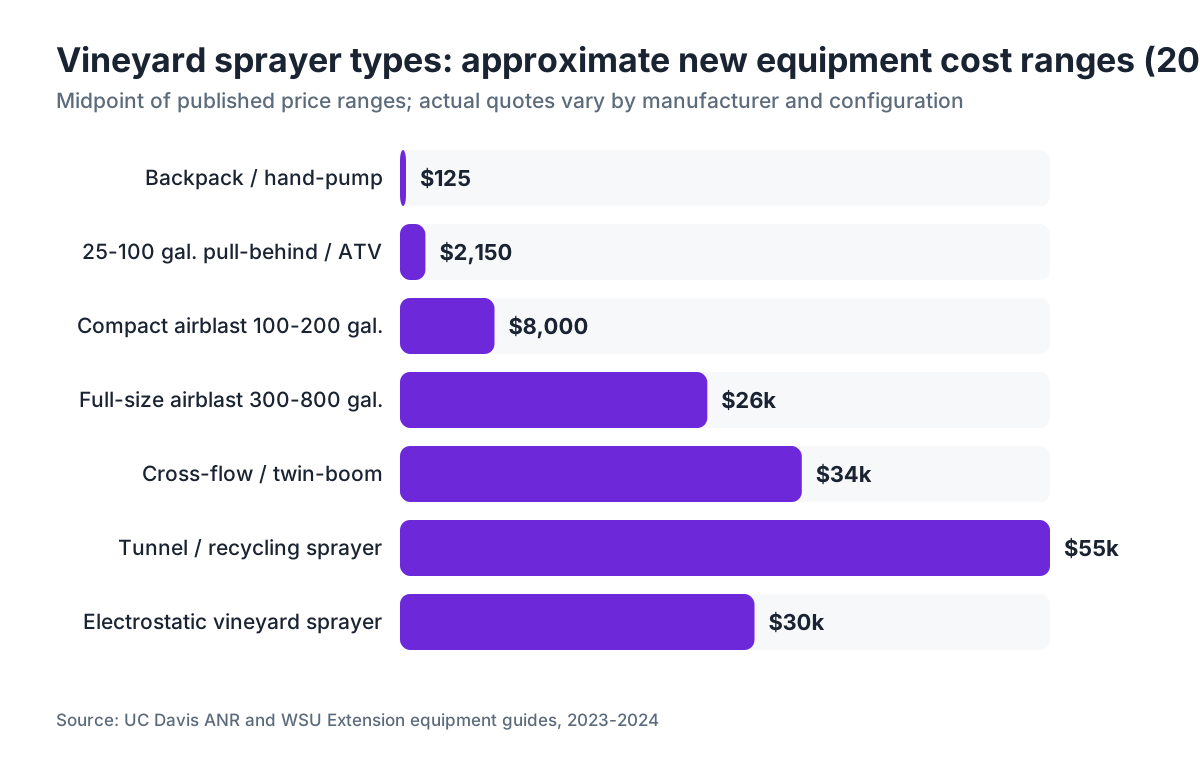
What does vineyard spraying equipment cost, new and used?
Prices move with steel and component costs, so treat these as 2024 reference ranges, not firm quotes.
| Equipment type | New price range | Used market (rough) |
|---|---|---|
| Backpack / hand-pump sprayer | $50 to $200 | $15 to $80 |
| 25 to 100 gal. pull-behind or ATV unit | $800 to $3,500 | $300 to $1,500 |
| Compact airblast (100 to 200 gal.) | $4,000 to $12,000 | $1,500 to $6,000 |
| Full-size airblast (300 to 800 gal.) | $12,000 to $40,000 | $4,000 to $18,000 |
| Cross-flow / twin-boom sprayer | $18,000 to $50,000 | $8,000 to $25,000 |
| Tunnel / recycling sprayer | $30,000 to $80,000 | $12,000 to $40,000 |
| Electrostatic vineyard sprayer | $15,000 to $45,000 | Limited market |
Used airblast sprayers are genuinely good value if you can verify pump condition, nozzle wear, and fan bearing health. Pumps on high-use sprayers run $800 to $2,500 to replace. Always ask for service records.
The hidden cost is calibration time and supplies: pressure gauges, graduated cylinders, catch trays, nozzle screens, and replacement tips. Budget at least $150 to $400 per season for consumables on any commercial sprayer. Cornell Cooperative Extension recommends annual nozzle replacement as a baseline for consistent output [3].
Leasing or custom application is worth pricing for small operations. Custom spray contractors in major grape regions typically charge $18 to $35 per acre per pass depending on region and material cost. At 5 acres and 12 passes a season, that's $1,080 to $2,100 a year, which compares well against financing a $15,000 sprayer plus maintenance.
How do you calibrate a vineyard airblast sprayer correctly?
Calibration is where most spray records go wrong. Growers pick a number off the label, set a pressure, and go. That's a recipe for under-application (resistance, crop loss) or over-application (residue violations, wasted money).
The goal is to deliver a known volume of water per acre, so that when you mix pesticide at label rate you actually hit the target concentration. Washington State University Extension lays out a standard catch-and-measure method that works for most airblast situations [4]. You tape plastic bags or small catch jars to representative vines across the canopy, make a pass at your operating speed and pressure, measure the collected volume, and back-calculate gallons per acre.
Here's a fast field method. Mark a 100-foot section of row. Fill your tank to a known level. Make one pass at normal operating speed. Measure how much water you use to refill back to that same level. Then run the numbers: (ounces collected x 43,560) / (row width in feet x 100 feet x 128) = gallons per acre. Adjust pressure or speed until you hit your target, usually 50 to 150 gallons per acre for most conventional programs.
Travel speed is your most powerful lever. Slowing from 3.5 mph to 2.5 mph raises application volume by roughly 40% with no other change. Know your actual ground speed, not what the tractor dash claims. A GPS app on a phone is accurate enough for this.
Check nozzle output one at a time. A nozzle 10% off from its neighbors creates uneven coverage. WSU recommends checking nozzle output at least twice per season and whenever you switch nozzle types [4]. Keep a calibration log as part of your spray records. Regulators in many states ask for it.
What are the EPA Worker Protection Standard requirements for vineyard sprayers?
EPA's Agricultural Worker Protection Standard (WPS), revised in 2015 and codified at 40 CFR Part 170, covers any vineyard that employs workers and uses registered pesticides [5]. Most vineyards with employees fall under it.
Here are the WPS requirements that touch spraying equipment directly.
Personal protective equipment (PPE) must match what the pesticide label specifies, and the label is a legal document. If it calls for chemical-resistant gloves and a respirator, those aren't optional. EPA's WPS guidance states that agricultural employers must ensure handlers wear the personal protective equipment required by the pesticide product labeling [5].
Decontamination. Handlers must have access to water, soap, and a clean towel at the spray site. That means your setup either includes a portable wash station or you've confirmed a fixed one is close enough.
Application exclusion zones (AEZs). Under the 2015 rule, a 100-foot AEZ applies during most outdoor applications. Workers who aren't handlers stay out. This shapes how you coordinate field crews during spray windows.
Pesticide safety training is required for all handlers (anyone who mixes, loads, or applies) and all workers who enter treated areas. Training has to cover equipment-specific hazards.
Record-keeping. You must keep pesticide application records for at least two years, including product name, EPA registration number, application date, location, rate, and handler information. California, Washington, and Oregon each layer additional requirements on top of federal WPS [6].
California growers, note this. The California Department of Pesticide Regulation requires licensed pest control advisors for many restricted materials and adds reporting obligations beyond federal WPS [6]. Your county agricultural commissioner's office has the current rules.
How do you reduce spray drift in vineyards?
Drift is a compliance problem and an economics problem at once. Material that lands off-target doesn't protect your vines, and it can bring neighbor complaints, regulatory action, or a label violation.
Airblast sprayers produce more drift than almost any other application method, because the high-velocity air needed to penetrate canopy also carries fine droplets out of the target zone. UC Davis research found that a poorly operated airblast sprayer can lose 30 to 50% of applied material to off-target drift under adverse conditions [1].
The practical controls are simple. Spray only when wind is 2 to 10 mph and blowing away from sensitive areas; most labels now spell out this range. Below 2 mph, temperature inversions trap fine droplets and they wander unpredictably. Above 10 mph, you're fighting physics.
Nozzle choice matters enormously. Flat-fan nozzles at high pressure make small droplets (below 150 microns) that drift easily. Hollow-cone nozzles produce a wider droplet spectrum. Dropping pressure from 150 PSI to 80 to 100 PSI usually grows median droplet size and cuts drift, with no loss of coverage if you account for the volume change.
Adjustable output heads let you shut off nozzles aimed at open air on the end rows and above the canopy where there's no target. That alone can trim total material use 15 to 25% on VSP-trained vines.
Shielded designs are the strongest hardware fix, from shrouds around the nozzle cluster to full tunnel systems. Some California growers near sensitive crops and residential areas have moved to tunnel sprayers specifically to meet drift buffer requirements.
Keep a weather log with every application. It documents good-faith compliance and gives you data to defend against a drift complaint.
What spray record requirements must vineyard operators follow?
Spray records are the paper trail that proves you applied the right material at the right rate at the right time. Federal law requires them under FIFRA for restricted-use pesticides. Most states require them for all pesticide applications. And most third-party certifications (SIP, CSWA, and various sustainability programs) require them too.
At the federal minimum, restricted-use pesticide (RUP) applications must be recorded within 30 days and kept for two years under 40 CFR 169.2 [7]. The record has to include date, product name and EPA registration number, total amount applied, location, crop, size of area treated, and the certified applicator's license number.
California wants records within 7 days of application, kept for 3 years, and reported monthly to your county agricultural commissioner [6]. Washington requires records within 72 hours for commercial applicators [8]. Oregon has similar timing [10]. Know your state.
What gets growers in trouble most: incomplete records (missing the EPA reg number or the exact site), records written from memory days later, and records that don't match the label rate. A log showing 2 lb/acre of a product with a 1.5 lb/acre label maximum is a violation, even if the actual application was fine and the paperwork just has a math error.
A field-level digital record system removes most of that risk. VitiScribe, for one, connects spray log entries to your product library and flags rate calculations against label maximums before you finalize a record, which is exactly the error-catching that stops the most common compliance failures.
Third-party wine certifications increasingly pull spray records into annual audits. Having them organized and searchable isn't optional if you sell to wineries with sustainability commitments.
How should you maintain and winterize vineyard spraying equipment?
A $20,000 airblast sprayer that gets neglected over winter is a $12,000 sprayer by spring. The maintenance steps are unglamorous and not complicated.
The end-of-season flush is the step that matters most. Pump clean water through every line, nozzle, and manifold. Then run a tank cleaner (check compatibility with your tank material) to strip pesticide residues that degrade seals and corrode fittings. Triple-rinse everything.
Nozzle inspection and replacement should happen in fall, not spring when you're already behind. Pull every tip, check for wear (a tip flowing 10% over rated output is effectively shot), and replace anything out of spec. Nozzle tips run $2 to $8 each, a fraction of what mis-calibrated application costs in wasted material.
Pump winterization matters in freeze-prone climates. Run RV-grade non-toxic antifreeze through the pump, hoses, and manifold to protect against cracked casings. Drain all water from the tank, agitator lines, and boom sections. Trapped water that freezes will crack plastic fittings and manifold bodies.
Grease the PTO shaft fittings, fan bearings, and any pivot points. Check fan belt tension and condition. Inspect hose runs for cracking, especially at bends and connections. UV and chemical exposure make hoses brittle over time.
Document everything you find and fix. A maintenance log attached to the equipment record tells the next person exactly what's been done and lets you spot patterns, like that left-side manifold valve that fails every two seasons.
Store the sprayer under cover if you possibly can. Sun and weather wreck the tank faster than almost anything, and a cracked fiberglass or poly tank mid-season is an expensive emergency.
How does organic viticulture change your sprayer requirements?
Organic certification doesn't mean you spray less or that equipment demands shrink. In some programs you spray more often, because contact materials like copper and sulfur have shorter residual periods than conventional synthetic fungicides.
The biggest sprayer difference for organic programs is tank contamination. If you run the same unit on conventional and organic blocks, cross-contamination from any non-approved material can put a certification at risk. Many dual-program operations either dedicate a separate tank and plumbing set to organic blocks or run a documented triple-rinse protocol between uses. Your certifier will ask about this.
Sulfur is the foundation of most organic fungicide programs, and it's hard on equipment. It's abrasive. It settles and clogs lines when agitation stops. And it reacts poorly with copper-containing fittings and impellers. Use stainless or plastic-bodied pumps and fittings where you can, keep agitation running whenever the tank holds sulfur, and flush right after every use.
Copper programs (copper hydroxide, copper sulfate, fixed copper) are less abrasive but heavier. They need good agitation and leave a blue-green residue that's obvious if you skip a flush. The NOP rules cap total copper for organic operations at a running average of no more than 3 pounds of elemental copper per acre per year [9]. Your spray records are the evidence that you stayed under it.
Many organic growers also use kaolin clay (Surround) as a physical pest barrier, and it's brutal on sprayers. Kaolin is basically fine white grit. It needs high agitation, wide-bore screens, and dedicated tips because it wears them fast. Some growers keep a separate low-cost sprayer just for kaolin.
What's the best way to keep spray records for audits and certifications?
The gap between "we keep records" and "we can produce clean records on 48 hours notice" is where operations get caught short.
Paper logs work fine if they're actually filled out in the field, in real time, and stored somewhere organized. The failure mode is obvious. The sheet gets wet. The handwriting turns illegible. Someone fills in three days at once from memory. The binder disappears. For a small operation running 30 to 40 spray events a season, paper with a scanned backup is defensible.
Spreadsheets (Excel, Google Sheets) are a step up but still lean on manual-entry discipline. The upside is searchability and the ability to total seasonal product use, which is exactly what you need for NOP copper limits, SIP audits, and CDPR reporting.
Field-level software is the current standard for operations facing multiple compliance overlays (WPS, state reporting, organic certification, winery sustainability audits). The good systems connect your product library to application records, calculate rates automatically, flag pre-harvest intervals (PHIs), and export in whatever format your certifier or county ag commissioner wants. VitiScribe handles this across spray, scouting, and field operations in a single log, which matters when an auditor wants the full picture for a given block on a given date.
Whatever system you use, these fields belong in every record: date and time, applicator name and license number if required, block or location ID, product name and EPA reg number, rate applied (per acre and total), water volume (gallons per acre and total), equipment used, and weather at application. Some programs also want growth stage and pest target.
Pre-harvest intervals are the record field that carries the most risk. A PHI violation (harvesting inside the label-required interval) is a food safety issue, more than a paperwork one. Your records need to trace every application to every block and show harvest never fell inside the PHI window.
What safety equipment and training does your spray crew need?
PPE requirements come from two places: the pesticide label (which is federal law) and EPA WPS (which adds employer-level obligations). Neither is optional.
For most fungicide and insecticide applications, handlers need chemical-resistant gloves (nitrile at minimum, specific materials for specific products), eye protection (goggles or a face shield, more than safety glasses for most liquid concentrates), long-sleeved clothing, chemical-resistant footwear, and a NIOSH-approved respirator when the label calls for one. Read the actual label for every product. The label is not the same as the safety data sheet, and the label's PPE requirements are what matters legally.
WPS requires handlers to receive pesticide safety training before they handle pesticides, and the training must cover equipment-related hazards directly: how to spot leaks, how to respond to a spill, how to decontaminate equipment and themselves. EPA publishes compliant training materials through its pesticide worker safety program [5].
Emergency contact information must be posted at the mix and load site and in or near the tractor cab. That includes the national Poison Control number (1-800-222-1222) and the name and location of the nearest medical facility able to treat pesticide exposure.
Re-entry intervals (REIs) are separate from PPE but just as non-negotiable. The standard REI for many fungicides is 4 hours (until sprays dry), but some materials carry 24-hour, 48-hour, or longer REIs. Workers entering before the REI expires need specific PPE even for incidental contact. Post REI information at every field entrance during the interval.
Cornell Cooperative Extension's integrated pest management resources offer some of the clearest practical guidance on handler safety equipment and training documentation in vineyard settings [3].
Frequently asked questions
What size sprayer do I need for a 5-acre vineyard?
A 100 to 200 gallon compact airblast sprayer is the practical sweet spot for 5 acres. At 50 to 100 gallons per acre application volume, that's one to two tankloads per block. Some growers at this scale run a 50-gallon ATV pull-behind with a good fan unit, which costs less but takes longer per pass. Factor in your water access speed and how many passes you plan each season.
How often should vineyard sprayer nozzles be replaced?
Most extension programs, Cornell included, recommend checking nozzle output at least twice per season and replacing any nozzle flowing more than 10% above its rated output. In practice, most commercial operations replace flat-fan and hollow-cone tips annually as a baseline. Outer-boom nozzles wear faster than center ones. Tips cost $2 to $8 each, and the calibration error they cause is far more expensive than the replacement.
Can I use a drone to spray my vineyard?
Yes, with conditions. Commercial drone application requires a licensed pesticide applicator in most states and compliance with FAA Part 107 rules. The pesticide label must explicitly allow aerial application, and many labels written before drone adoption do not. For steep, terraced, or otherwise tractor-inaccessible blocks, drones are a legitimate option. Spray coverage uniformity in dense canopy is still a real challenge next to airblast.
What's the difference between an airblast sprayer and a tunnel sprayer?
An airblast sprayer projects air and spray outward into the canopy from one or both sides. A tunnel sprayer fully surrounds the vine row with a shroud, recaptures spray that passes through the canopy, and recirculates it. Tunnel sprayers can cut material use 30 to 50% against airblast and sharply reduce drift. They cost $30,000 to $80,000 new and make the most sense on high-value blocks or where drift compliance is a hard constraint.
How do I calculate the right gallons-per-acre application rate?
Mark a 100-foot test section, fill your tank to a known level, make one full pass at operating speed, then measure how much water you use to refill. Multiply that volume by the number of 100-foot sections per acre (based on your row spacing) to get gallons per acre. Adjust travel speed or pressure until you hit your target, usually 50 to 150 gallons per acre for most programs. Record the setting that works as your calibration baseline.
What records do I legally need to keep for vineyard pesticide applications?
For restricted-use pesticides, federal law (40 CFR 169.2) requires records completed within 30 days and kept at least two years. Most states require all pesticide applications to be recorded. California mandates records within 7 days, kept 3 years, and reported monthly to the county ag commissioner. Every record must include product name, EPA registration number, application date and location, rate, total amount applied, and the applicator's license number.
What does the EPA Worker Protection Standard require for vineyard spray operations?
EPA WPS (40 CFR Part 170) requires handlers to wear label-specified PPE, have access to decontamination water and supplies at the application site, receive pesticide safety training before handling, and stay clear of any application exclusion zone during spraying. Employers must post safety information and keep pesticide application records. California and Washington layer additional requirements on top of the federal baseline.
How do I winterize my vineyard sprayer to prevent damage?
After the final spray, flush with clean water and tank cleaner, triple-rinse, then pump non-toxic RV antifreeze through the whole system: pump, manifold, boom lines, and nozzle bodies. Drain the tank completely. Pull and inspect every nozzle tip, replacing worn ones now instead of in spring. Grease PTO fittings and fan bearings, check hoses for cracking, and store under cover. A post-season maintenance log prevents repeat failures.
Does organic certification affect what sprayer equipment I can use?
Organic certification doesn't restrict sprayer type, but cross-contamination from conventional materials is a serious risk. Many certifiers require documented tank cleanout procedures if you use one sprayer on organic and conventional blocks, or a dedicated unit. Sulfur applications call for stainless or plastic pump and fitting materials. NOP rules also cap copper at a 3 lb/acre annual elemental copper average, which makes accurate spray records essential to prove compliance.
How do I reduce spray drift from my vineyard airblast sprayer?
Spray only in 2 to 10 mph winds, pointed away from sensitive areas. Grow droplet size by lowering operating pressure and switching to larger-orifice nozzles. Shut off nozzles aimed at open air above or below the canopy target. Slow your travel speed to give the canopy more time to catch droplets before they exit the row. Keep a weather log with every application to document your conditions.
How much does it cost to hire a custom spray contractor for a small vineyard?
Custom spray contractors in major grape-growing regions typically charge $18 to $35 per acre per pass, excluding material costs. For a 5-acre vineyard with 12 spray events a season, that's roughly $1,080 to $2,100 a year in labor and equipment. That often beats financing and maintaining your own sprayer at that scale, especially if your program uses common materials the contractor already stocks.
What chemicals are hardest on vineyard sprayer equipment?
Kaolin clay (Surround) is extremely abrasive and wears nozzle tips fast; it also settles quickly and demands constant agitation. Sulfur is abrasive and reacts with copper-alloy fittings and impellers. Copper-based materials leave residue that needs thorough flushing to prevent corrosion. Strongly acidic or alkaline tank mixes can degrade hose and seal materials faster than normal. Check material compatibility for your specific tank and pump before mixing anything new.
How do I know if my sprayer is properly calibrated before the season starts?
Run a clean-water calibration on a measured test section before your first application. Measure actual nozzle output one at a time against the manufacturer's rated flow at your target pressure. Check travel speed with a GPS app rather than trusting the tractor speedometer. Compare your calculated gallons per acre against your target rate. Record the settings that hit your target as your baseline for the season.
Sources
- UC Davis Statewide Integrated Pest Management Program, Pest Management Guidelines: Grape: Airblast is the standard application method for most California vineyards; poorly operated airblast sprayers can lose 30-50% of applied material to off-target drift under adverse conditions.
- Oregon State University Extension Service, Vineyard spray application resources: Cross-flow and tunnel sprayers can reduce material use by 20-40% compared with conventional airblast through better canopy interception and recapture.
- Cornell University, Cornell Cooperative Extension Integrated Pest Management Program: Annual nozzle replacement is recommended as a calibration baseline; nozzles flowing 10% above rated output should be replaced.
- Washington State University Extension, Pest Management Resources: WSU describes the catch-and-measure method for airblast sprayer calibration and recommends checking nozzle output at least twice per season.
- U.S. EPA, Agricultural Worker Protection Standard (WPS), 40 CFR Part 170: WPS requires that agricultural employers ensure handlers wear PPE required by the pesticide product labeling; a 100-foot application exclusion zone applies during most outdoor applications.
- California Department of Pesticide Regulation, Pesticide Use Reporting: California requires pesticide application records within 7 days, kept for 3 years, and reported monthly to the county agricultural commissioner.
- U.S. EPA, FIFRA Section 8 and 40 CFR Part 169.2, Restricted-Use Pesticide Record Keeping: Federal law requires restricted-use pesticide application records to be kept for at least two years and completed within 30 days of application.
- Washington State Department of Agriculture, Pesticide Management Division: Washington requires commercial pesticide applicators to complete application records within 72 hours.
- USDA National Organic Program, 7 CFR Part 205, Allowed and Prohibited Substances: NOP regulations cap total copper applications for organic operations at a running average of no more than 3 pounds of elemental copper per acre per year.
- Oregon Department of Agriculture, Pesticide Use Reporting and Record Keeping: Oregon has pesticide record-keeping timing requirements for commercial applicators similar to Washington state.
Last updated 2026-07-09