Copper sulfate vineyard spraying: rates, timing, and compliance

TL;DR
- Copper sulfate is the workhorse fungicide for downy mildew and Botrytis, cleared for both conventional and organic programs.
- US growers face no federal cap on annual copper, but California limits many applications to about 1.4 lb metallic copper per acre, and the EU caps copper at 28 kg/ha over 7 years (4 kg/ha/year average).
- Timing, formulation, and clean spray records drive both efficacy and compliance.
What does copper sulfate actually do in a vineyard?
Copper sulfate is a contact fungicide and bactericide. When it lands on wet leaf tissue, it releases copper ions. Those ions wreck fungal enzyme systems and stop spores from germinating before infection starts. Copper does not move inside the plant. So coverage is everything.
The main targets are downy mildew (Plasmopara viticola) and, in some programs, Phomopsis cane and leaf spot early in the season. Copper has modest activity against Botrytis cinerea and some bacterial diseases too. For powdery mildew (Erysiphe necator), copper alone is weak. Don't expect it to carry that fight.
Growers have sprayed copper on grapevines since the 1880s. Alexis Millardet developed Bordeaux mixture (copper sulfate plus lime) in Bordeaux, France, after noticing that vines dusted with the blue paste to discourage roadside theft somehow dodged the downy mildew epidemic of 1882 [1]. Keep that history in mind. This is one of the oldest, best-studied fungicides in viticulture, and the research base under it runs deep.
What are the main copper sulfate formulations, and which should you use?
Copper products are not interchangeable. The differences change phytotoxicity risk, rain fastness, and cost per pound of metallic copper delivered.
| Formulation | Typical % Metallic Cu | Relative Rainfastness | Phytotox Risk | Notes |
|---|---|---|---|---|
| Bordeaux mixture (copper sulfate + hydrated lime) | ~25% (varies by prep) | Moderate | Low-Moderate | Classic, cheap, requires on-site mixing |
| Basic copper sulfate (tribasic) | ~53% | Good | Moderate | Common wettable powder |
| Copper hydroxide | ~57% | Good | Moderate-High | Widely used, fine particles |
| Copper octanoate | ~10% | Low | Low | Softer option, OMRI listed |
| Copper oxychloride | ~58% | Good | Moderate | Common in Europe |
Metallic copper (also written as elemental copper or Cu equivalent) is the number that matters for regulators and for tracking how much copper you're loading into the soil. Convert every product label rate to metallic copper before you compare or record it [2].
Most California growers on a conventional program reach for fixed copper hydroxide products (Kocide 3000, Nu-Cop 50 DF, and similar). Bordeaux mixture still earns its place in organic programs where you have bulk materials and the time to mix. Copper octanoate is a reasonable low-risk pick in years when you want to hold coverage without stressing vines during heat or after frost damage.
One practical note. Tribasic copper sulfate and copper hydroxide are not interchangeable on a label-rate basis. Read each label for that product's specific metallic copper content.
How much copper sulfate should you apply per acre, and how often?
There is no single federal application rate in the US. The EPA registers each copper product on its own, and rates vary by label. Typical labeled rates for copper sulfate products run from 0.5 to 2.0 lb metallic copper per acre per application, with seasonal totals often listed at 4 to 12 lb of product (which may work out to 2 to 6 lb metallic copper depending on formulation) [3].
California is the only US state with a formal regulatory cap. Fresno, Kern, Madera, Merced, San Joaquin, Stanislaus, and Tulare counties run permit requirements for copper once applications pass a threshold. California Department of Pesticide Regulation guidance points to roughly 1.4 lb metallic copper per acre per year as the ceiling before growers face extra scrutiny in many districts. Verify the exact threshold with your local county agricultural commissioner, because it moves county to county [4].
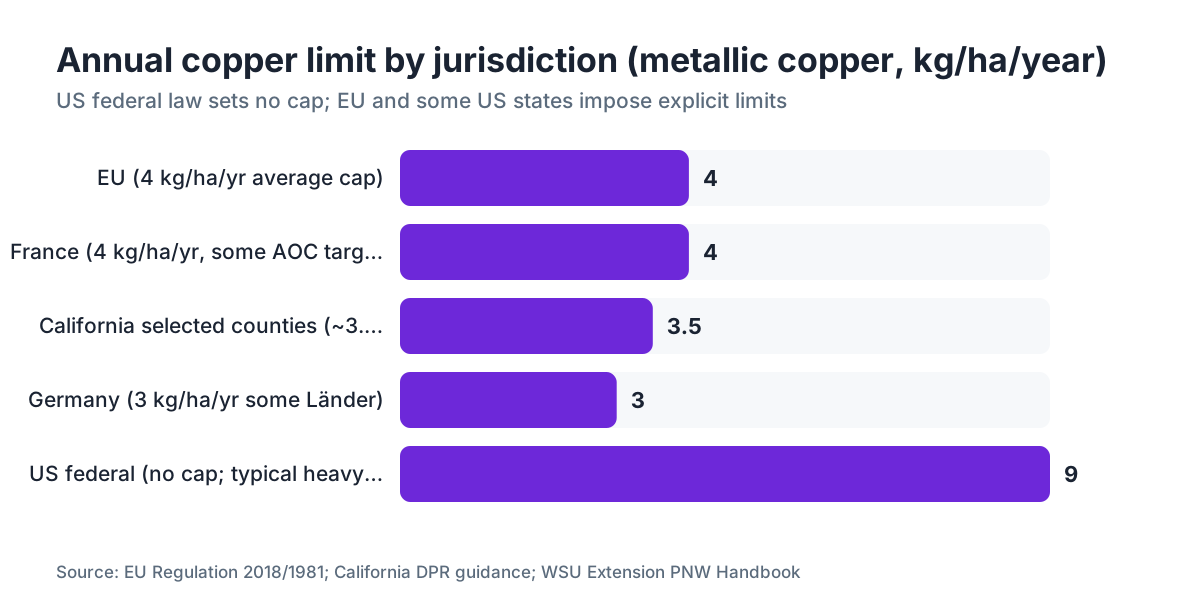
In Europe the cap is explicit and shrinking. EU Regulation 2018/1981 holds copper to a maximum of 28 kg/ha over 7 years, a 4 kg/ha/year average. France, Germany, and Spain have put this into national practice, and growers there log every application. Several French AOC rules set even tighter internal targets.
For a working spray calendar, most downy mildew programs in the eastern US and Pacific Northwest start at 5-inch shoot growth (roughly late April to early May depending on latitude) and continue on a 7-to-14-day interval through veraison [5]. You don't usually need post-veraison copper for downy mildew, though some programs run it later for Botrytis suppression on susceptible varieties.
When is the best time to spray copper sulfate on grapevines?
Timing copper is mostly about getting it onto tissue before infection happens, not after. Downy mildew follows the 10-10-10 rule as a rough field heuristic: risk climbs when temperatures pass 10°C (50°F), shoots reach 10 cm or longer, and rainfall hits 10 mm. That is when you want copper on the vines. Wait until you see sporulation and you're already behind.
Spray early in the morning, after dew dries but before midday heat. Copper hitting wet tissue in hot weather can burn leaves badly. UC Davis extension guidance flags copper during cool, wet weather as lower risk, while hot, dry conditions after application can drive copper injury and tip burn, especially on young tissue [6].
The most copper-sensitive stages are shoot tips and young leaves at 2-to-6-inch growth, the window right after bloom when berry skin is thin, and any point when the vine is under heat or water stress. If you're in a heat event above 90°F, hold the copper.
For a western US program facing both downy mildew and Phomopsis, a typical spray window looks like this:
- Budbreak to 6-inch shoots: single copper application for Phomopsis if you had cane lesions the prior year
- Pre-bloom (10-to-15-inch shoots through 80% bloom): primary downy mildew window, 7-day intervals in wet years, 10-14 days in dry years
- Post-bloom through mid-July: continue based on disease pressure and weather
- After veraison: stop copper in most programs unless specific late-season pressure calls for it
Don't spray within 24 hours of expected frost. Copper can add to ice nucleation on leaves under some conditions.
Is copper sulfate approved for organic viticulture?
Yes. Copper sulfate and other copper fungicides are allowed under USDA National Organic Program (NOP) standards, with one caveat: copper materials sit in the "allowed with restrictions" list at 7 CFR Part 205, specifically 205.601(i)(3). The restriction is that copper must be used so it minimizes soil accumulation. There is no explicit NOP annual rate cap, but certifiers often ask growers to document reasonable efforts to cut copper use over time [7].
OMRI (Organic Materials Review Institute) lists plenty of copper products, including copper hydroxide, copper octanoate, and Bordeaux mixture components, as NOP-compliant [12]. Check the specific product's OMRI listing before you use it in a certified organic program. Formulation additives can disqualify a product even when the active ingredient is fine.
The tension in organic viticulture is real. Copper is one of very few effective broad-spectrum fungicides allowed under NOP, so growers lean on it harder than they'd like. That reliance runs straight into the soil accumulation concern. The best move is to pair copper with sulfur, bicarbonates, and cultural practices (canopy management, air circulation) so you can hold copper rates as low as possible while still protecting the crop.
What do EPA worker protection standard rules require for copper sulfate sprays?
The EPA Worker Protection Standard (WPS), revised in 2015 under 40 CFR Part 170, covers all agricultural pesticide applications including copper sulfate [8]. Four requirements hit vineyard operations hardest.
Restricted Entry Interval (REI). Most copper sulfate products carry a 24-hour REI. During that window, no workers enter the treated vineyard for any reason unless they have full label PPE. Some products list a 4-hour REI when certain conditions are met, but 24 hours is the common one.
Application exclusion zone (AEZ). Under the 2015 WPS revision, a 100-foot AEZ applies to outdoor applications when a sprayer is within that distance of workers or other people. For most equipment-based vineyard applications, this means checking that harvest crews, canopy workers, or neighboring operations are clear before you start the pass.
Pesticide safety training. All agricultural workers and handlers who may be exposed must get WPS training. Training has to be done before workers enter areas where a pesticide was applied in the last 30 days, and training records must be kept [8].
Central posting. You must post safety information, including the product Safety Data Sheet and pesticide application records, in a central spot workers can reach.
California stacks its own rules on top of federal WPS, run through the county agricultural commissioner. California requires a permit for many copper products above certain rates, and Pesticide Use Reports (PURs) get filed monthly. Cornell's IPM program notes New York growers must keep pesticide application records for at least 2 years under state law, matching the federal WPS minimum [9].
For keeping this straight across many spray events and block layouts, a platform like VitiScribe generates WPS-compliant spray records straight from field entries, which saves real time during county audits.
Does copper sulfate build up in vineyard soil, and should you worry about it?
Yes, copper accumulates. It does not break down, volatilize, or leach much in most vineyard soils. Decades of continuous copper in European wine regions have produced documented phytotoxic soil copper levels. A 2013 survey of French vineyards published in Environmental Science & Technology found median topsoil copper of 90 mg/kg, with many sites over 200 mg/kg. The EU's reference point for agroecosystem soil copper is 100 mg/kg before regulators weigh intervention [10].
In the US, older California wine regions show similar accumulation, though systematic national data is thin. Washington State University extension has documented established Columbia Valley vineyards averaging 30 to 80 mg/kg copper in the top 15 cm, which is elevated but generally below the toxicity threshold for vine roots (those symptoms tend to appear above 150 mg/kg in sandy soils) [11].
The biological concern shows up first in earthworms and soil microbes, well before vine roots suffer. Several European studies found earthworm density dropping at soil copper above 60 mg/kg, far below the levels that produce visible foliar symptoms.
Practical steps to manage accumulation:
- Get a baseline soil copper test if you don't have one. Test the top 15 cm separately from 15-30 cm.
- Rotate formulations so you're not leaning on copper alone for disease control.
- Use the minimum effective rate. Lower-rate, high-frequency programs (0.25-0.5 lb metallic Cu per application every 7 days) can match lower-frequency high-rate programs with less total copper per season.
- Keep organic matter up. Higher-OM soils bind copper more tightly and cut bioavailability to soil organisms.
How do you mix and calibrate a copper sulfate spray correctly?
Mixing order changes suspension stability and phytotoxicity. For most wettable powder and dispersible granule copper products, the rule is simple: fill the tank halfway with water, add the copper product with agitation running, then fill to final volume. Dumping copper into an empty tank or a fully loaded one invites settling and clumping.
Bordeaux mixture is a different animal. Never pour copper sulfate solution into lime suspension in the tank without pre-mixing. Dissolve copper sulfate in half the water in one container, slake the lime in the other half in a second container, then pour both into the spray tank at the same time. Adding copper sulfate to lime (not lime to copper sulfate) cuts the chance of phytotoxic free copper ions in the mix.
Calibration is the step most growers rush and most regret. To calibrate a sprayer for rate accuracy:
- Find your sprayer's actual output per acre. Run water through each nozzle at operating pressure and speed, measure gallons per minute per nozzle, and calculate gallons per acre from your ground speed and row spacing.
- Calculate the copper product needed per tank load from that output.
- Check nozzle wear often. A worn nozzle can put out 15 to 20 percent more than rated volume, which turns straight into over-application and possible label violations.
WSU Extension's Pacific Northwest Pest Management Handbook recommends calibrating vineyard sprayers at least once per season and after any nozzle replacement [11]. That is the floor. Recalibrating at the start of each block when ground speed or slope shifts is better practice.
What are the safety risks of copper sulfate for the applicator?
Copper sulfate is moderately toxic (EPA Toxicity Category II for eye irritation, Category III for oral, dermal, and inhalation in most formulations). The acute risks are mainly eye and skin irritation from concentrated product. Chronic copper toxicity in humans is rare at agricultural exposure levels, but people who carry Wilson's disease should avoid repeated exposure.
Label PPE for most copper sulfate products requires a long-sleeved shirt and long pants, chemical-resistant gloves (nitrile or neoprene, not fabric), protective eyewear, and shoes plus socks during mixing and loading. Some labels require a respirator while mixing dusty wettable powder formulations [3].
For tractor-mounted applications, a closed cab with a filtered air intake gives meaningful protection. Open-cab and ATV sprayer operators need the full label PPE because drift exposure is real.
Store copper sulfate away from fertilizers, especially nitrogen sources. It reacts with alkaline materials and can corrode metal containers. Keep it dry. Most formulations hold a 3-to-5-year shelf life if stored sealed in a cool, dry spot.
Disposal of excess mix is regulated. Never dump concentrated copper spray into a waterway, storm drain, or irrigation ditch. EPA pesticide disposal rules under FIFRA require excess pesticide to be disposed of per label instructions or through a licensed pesticide disposal program [3].
How do US copper rules compare to EU regulations?
Here the two regulatory systems split hard, and it matters if you sell grapes or bulk wine to European buyers who ask questions.
| Jurisdiction | Annual cap (metallic Cu/ha) | Cumulative cap | Notes |
|---|---|---|---|
| United States (federal) | None | None | Label rates only; no aggregate cap |
| California (selected counties) | ~3.5 kg/ha (~1.4 lb/acre) under local permits | None stated | Varies by county; verify with ag commissioner |
| European Union | Average 4 kg/ha/year | 28 kg/ha over 7 years | EU Reg 2018/1981; member states may be stricter |
| France | 4 kg/ha/year average | 28 kg/ha/7 years | Many AOC cahiers des charges set targets below this |
| Germany | 3 kg/ha/year in some Länder | 28 kg/ha/7 years | State-level implementation varies |
The EU landed on 4 kg/ha/year after reviewing copper's status as a candidate for substitution under Regulation (EC) 1107/2009. The review noted, in the official EU publication, that copper compounds are considered "to present an intermediate risk" and set the limit to balance the need to protect organic farming against environmental risks to soil organisms [10].
For US growers, no federal cap is not a license to over-apply. Residue monitoring for exported wine and juice has tightened, and buyers in some European markets now ask for copper application histories. Clean, detailed records are turning into a market requirement more than a regulatory one.
For record-keeping that survives both domestic compliance and export documentation requests, VitiScribe's spray log tracks metallic copper equivalents per block per season automatically.
What are the best integrated pest management alternatives to reduce copper reliance?
Cutting copper dependency helps soil health, cost control, and your regulatory standing. What's available depends on whether your program is conventional, organic, or transitional.
Conventional growers have real options. Several systemic fungicides (mefenoxam/metalaxyl, dimethomorph, cymoxanil) give excellent downy mildew control with systemic movement copper can't match. Rotate copper with these materials and total copper load drops without weaker protection. Phosphonate products (potassium phosphite) hit downy mildew broadly through a different mode of action.
Organic growers work with a narrower toolbox, but it isn't empty. Copper alternated with sulfur is the common foundation. Bicarbonate materials (potassium bicarbonate, sold as Kaligreen or Armicarb) have genuine efficacy on powdery mildew and modest activity on downy mildew. Fixed copper at lower rates (0.25-0.5 lb metallic Cu/acre per application) on a tight 7-day schedule has matched higher-rate programs in wet seasons in Cornell trials [9].
Canopy management earns its own mention because it changes how much copper you need. Dense, poorly ventilated canopies dry slowly after rain and stretch the infection window. Fruit-zone leaf removal, shoot positioning, and hedging won't replace copper in high-pressure years, but they cut disease severity and therefore the number of applications. Cornell's viticulture extension has published multi-year data showing canopy improvements in Finger Lakes Riesling reduced fungicide applications by 20 to 30 percent in average years [9].
Disease-resistant varieties are increasingly relevant if you can plant new blocks. Interspecific hybrids (Marquette, Frontenac, Aromella) and newer European varieties (Muscaris, Souvignier Gris) carry partial resistance to both downy and powdery mildew and run on minimal copper. That's a long-term investment, but the spray-cost reduction is documented and real.
What records do you need to keep for copper sulfate applications?
Federal WPS under 40 CFR Part 170 requires pesticide application records for at least 2 years [8]. California requires Pesticide Use Reports filed with the county agricultural commissioner no later than the 10th of the month following application, with records retained for 2 years. Some certifiers (organic, GAP, retailer programs) require longer retention, usually 3 to 5 years.
At minimum, a complete copper sulfate spray record should include:
- Date and time of application
- Block or field ID and acreage treated
- Product name, EPA registration number, and formulation
- Rate applied per acre (both product rate and metallic copper equivalent)
- Total product used
- Carrier volume (gallons per acre)
- Target pest
- Applicator name and license number (if applicable)
- Equipment used
- Weather at application (temperature, wind speed and direction, relative humidity)
- REI start and end times
- Any restricted entry during REI (with PPE documentation)
Many California county agricultural commissioners now accept digital records, though a printed backup is still smart for audits. The record-keeping burden for copper runs higher than for many pesticides, because of the growing regulatory interest in soil loading and because organic certifiers review copper use closely.
Tracking cumulative metallic copper per block per season takes a little math if you use different formulations. A running total column in your spray log, converted to metallic copper equivalent for each entry, takes about 30 seconds per application and saves serious time if anyone ever asks you to prove compliance.
Frequently asked questions
How much copper sulfate per acre should I apply for downy mildew prevention?
Most labeled programs run 0.5 to 1.0 lb metallic copper per acre per application for preventive downy mildew sprays. In high-pressure, wet conditions you can go to the upper end of the labeled rate, but more frequent applications at lower rates (0.25-0.5 lb every 7 days) often give better season-long control with less total copper deposited. Always convert product rate to metallic copper equivalent before recording.
Can I mix copper sulfate with other pesticides in the tank?
Copper is generally incompatible with sulfur (the mix can cause severe phytotoxicity, especially in hot weather), with oil-based materials, and with many soluble fertilizers. It is often compatible with neutral-pH fungicides like mancozeb if a jar test shows no flocculation, but always run a jar compatibility test before mixing a new combination. The label compatibility section governs. When in doubt, spray them separately.
What is the re-entry interval (REI) for copper sulfate in vineyards?
Most copper sulfate and fixed copper products carry a 24-hour REI under the EPA Worker Protection Standard. Some formulations (particularly copper octanoate products) list a 4-hour REI under specific conditions. The REI is stated on each product's label, so use the label for the specific product you're applying, not a general assumption about copper. Post the REI and application time at the field entry point as WPS requires.
Is copper sulfate safe for organic certification?
Yes, with restrictions. Copper sulfate and other copper compounds are listed as allowed with restrictions under USDA NOP at 7 CFR 205.601(i)(3). The restriction requires that use minimizes soil accumulation. Your certifying agent may ask for application records showing rates and totals. Check that the specific product carries an OMRI listing or your certifier's approval, because adjuvants can disqualify otherwise-compliant copper products.
How do I prevent copper sulfate from burning grapevine leaves?
Avoid applying copper to wet tissue, during temperatures above 85-90°F, or when vines are under drought stress. Young tissue at 2-to-6-inch shoot growth is especially sensitive, so use lower rates there. Bordeaux mixture made with enough lime (the lime buffers free copper ion activity) is less phytotoxic than tribasic copper sulfate or copper hydroxide at equivalent rates. Apply in early morning after dew has dried.
How much copper is too much in vineyard soil?
The EU treats 100 mg/kg dry weight in topsoil as a level warranting attention. Phytotoxicity to vine roots generally begins above 150 mg/kg in light sandy soils, higher in clay-rich or high-organic-matter soils. Earthworm and microbial suppression can start above 60 mg/kg, which is well within the range found in many established European and California vineyards. Baseline soil testing every 3-5 years lets you track the trend.
Does copper sulfate require a permit in California?
Copper sulfate is a restricted-use material in California for some uses and rates. Growers in many counties must get a permit from the county agricultural commissioner before applying above threshold rates. California also requires monthly Pesticide Use Reports for all copper applications. Requirements vary by county, so contact your local county ag commissioner's office directly. Permit requirements are separate from the federal EPA registration.
What is the pre-harvest interval (PHI) for copper sulfate?
PHI varies by product. Many copper sulfate and fixed copper products list a 0-day pre-harvest interval, meaning you can apply up to harvest. Residues on fruit surfaces can affect fermentation if levels run high, though, and some buyers hold internal specifications. Check the specific product label for the PHI. Organic buyers and export markets may add residue monitoring requirements beyond what the US label specifies.
How does the EU's 4 kg per hectare copper limit compare to typical US application programs?
A typical US conventional downy mildew program using 6-8 copper applications per season at 1.0 lb metallic copper per acre totals roughly 5-8 lb/acre, or 5.6-9.0 kg/ha. That exceeds the EU's 4 kg/ha/year average. Many US growers already sit below the EU limit if they run reduced-rate programs or alternate copper with synthetics, but heavy programs in wet regions can pass it. The EU limit averages over 7 years, so one high-pressure year can be offset.
What WPS training do vineyard workers need before working around copper sulfate applications?
Under the 2015 EPA Worker Protection Standard (40 CFR Part 170), all agricultural workers and pesticide handlers must receive WPS safety training before entering a treated area within 30 days of application. Training must cover pesticide hazards, safe handling, first aid, and workers' rights. Employers must keep records of training completion. California adds its own training requirements on top of federal WPS, administered through county agricultural commissioners.
Which copper formulation has the lowest phytotoxicity risk for early-season vineyard sprays?
Copper octanoate (sold under brands like Cueva) has the lowest documented phytotoxicity risk among copper formulations, partly because of its lower metallic copper content (around 10%) and its formulation chemistry. Bordeaux mixture made with an adequate lime ratio is the next-lowest risk. Copper hydroxide and tribasic copper sulfate carry higher risk on young tissue, especially in cool, wet conditions followed by heat. UC Davis extension recommends copper octanoate for sensitive early-season stages.
How do I calculate metallic copper per acre from a product label rate?
Multiply the product rate (lb/acre) by the percentage metallic copper listed on the label, expressed as a decimal. For example, 2 lb/acre of a product that is 53% metallic copper equals 2 × 0.53 = 1.06 lb metallic copper per acre. Always use the metallic copper equivalent for record-keeping and for comparing applications across products, since regulatory limits and soil loading calculations are expressed in metallic copper, not product weight.
Can copper sulfate be used in a chemigation or drip irrigation system?
Copper sulfate is sometimes run through drip irrigation for soil amendments or disease control in other crops, but for vineyard fungicide use (foliar protection against downy mildew), chemigation through drip is not effective because copper has to coat leaf and cluster surfaces. Foliar application by sprayer is the correct delivery method. Some labels flatly prohibit chemigation, so check the label for the specific product before considering any alternative method.
How long do copper spray records need to be kept?
Federal WPS requires pesticide application records for at least 2 years. California state law requires Pesticide Use Reports and supporting records for 2 years. Organic certification programs typically require 3 to 5 years depending on the certifier. Export documentation requests, GAP audits, and some retailer supply chain programs may ask for longer retention. Keeping records indefinitely in a digital system costs essentially nothing and removes the risk of non-compliance during unexpected audits.
Sources
- UC Agriculture and Natural Resources, Bordeaux Mixture History: Alexis Millardet developed Bordeaux mixture in the 1880s after observing that copper sulfate paste on vines prevented downy mildew infection
- UC ANR Pest Notes: Fungicides for Disease Management in Vineyards: Metallic copper (elemental copper equivalent) is the standard measure for comparing copper product rates and for regulatory compliance purposes
- EPA, Pesticide Registration and Label Requirements under FIFRA: Registered copper sulfate products carry specific application rates, PPE requirements, and disposal instructions under FIFRA label requirements
- California Department of Pesticide Regulation, Pesticide Use Reporting: California requires monthly Pesticide Use Reports for copper applications and imposes permit requirements in multiple counties above threshold rates
- Washington State University Extension, Pacific Northwest Pest Management Handbook: Most downy mildew programs start at 5-inch shoot growth and continue on a 7-to-14-day interval through veraison
- UC Davis Viticulture and Enology Extension, Fungicide Application Guidelines: UC Davis extension flags copper application during hot, dry conditions as a phytotoxicity risk, particularly on young shoot tips and thin-skinned berry tissue
- USDA National Organic Program, 7 CFR Part 205 Allowed and Prohibited Substances: Copper-based materials are listed as allowed with restrictions under NOP at 7 CFR 205.601(i)(3), requiring that use minimizes soil accumulation
- EPA, Worker Protection Standard 40 CFR Part 170: The 2015 revised WPS requires a 100-foot application exclusion zone, worker training before entry within 30 days of application, and records kept for at least 2 years
- Cornell University, New York State IPM Program, Vineyard Disease Management: Cornell multi-year trials found canopy management improvements reduced fungicide applications by 20-30% in average seasons in Finger Lakes Riesling; New York state law requires pesticide records for at least 2 years
- European Commission, Commission Implementing Regulation EU 2018/1981 on copper compounds: EU Regulation 2018/1981 caps copper at a maximum of 28 kg/ha over 7 years (4 kg/ha/year average), noting that copper compounds present an intermediate risk to soil organisms
- Washington State University Extension, Pacific Northwest Pest Management Handbook: WSU Extension recommends calibrating vineyard sprayers at least once per season; Columbia Valley established vineyards average 30-80 mg/kg copper in topsoil
- USDA Agricultural Marketing Service, National Organic Program: OMRI lists copper hydroxide, copper octanoate, and Bordeaux mixture components as NOP-compliant for organic vineyard use when formulation additives meet NOP standards
Last updated 2026-07-09