How to grow grapes for wine: a practical field guide
TL;DR
- Wine grapes take 3-4 years before your first usable harvest.
- You need well-drained soil, a growing season warm enough to ripen your variety (measured in growing degree days), and a rootstock that survives phylloxera.
- Nail pruning, canopy openness, and spray timing and you get clean fruit.
- Miss them and you fight disease and thin flavors for years.
What do wine grapes actually need to grow well?
Wine grapes are picky, not mysterious. Vitis vinifera, the species behind nearly every classic wine variety, comes from the Mediterranean basin. It wants long warm dry summers and cool winters with enough chill to break dormancy cleanly. The rough thresholds most viticulturists work from: a growing season of at least 150 frost-free days, mean growing season temperatures (April through October in the Northern Hemisphere) between 50°F and 68°F (10°C to 20°C), and growing-season rainfall below 30 inches, or irrigation on hand to cover the gap [1].
Soil matters less than beginners think, within limits. Grapes make their best fruit on moderately infertile, well-drained ground. Heavy clay that holds water is your enemy. It pushes vigorous shoot growth at the expense of fruit quality, and it keeps the root zone wet in ways that invite Phytophthora and other root pathogens. Sandy loam, gravelly loam, or rocky hillside soils are the target. Aim for a soil pH between 5.5 and 6.5, and run a full soil test (much more than pH) before you plant anything [2].
Sunlight and air drainage separate good vineyards from mediocre ones. Slopes facing south or southwest in the Northern Hemisphere collect more heat units. They also drain cold air downhill, which cuts frost risk at budbreak and harvest. Flat valley floors are convenient but often frost-prone and high-vigor.
Watch a site through a full winter and spring before you commit. Where does the cold air pool at 4 a.m. in April? That's the question a real estate listing won't answer.
How do you choose the right wine grape variety for your site?
Variety selection is the highest-leverage decision you'll ever make in a vineyard. Get it wrong and no amount of skill fixes it. The rule from UC Davis and most extension programs is blunt: match the variety to your climate, never the reverse [1].
Growing degree days (GDD) is the number the industry runs on. You calculate GDD by summing daily average temperatures above 50°F from April 1 through October 31. UC Davis plant scientist A.J. Winkler built the original five-region classification, and it's still in daily use:
| Winkler Region | GDD Range | Example Varieties |
|---|---|---|
| I | Below 2,500 | Pinot Noir, Chardonnay, Riesling |
| II | 2,501-3,000 | Cabernet Sauvignon, Merlot, Sauvignon Blanc |
| III | 3,001-3,500 | Zinfandel, Grenache, Barbera |
| IV | 3,501-4,000 | Carignan, Malvasia |
| V | Above 4,000 | Table grapes, heat-tolerant varieties |
Source: UC Davis, Winkler et al., General Viticulture, 1974 [1]
Pinot Noir ripens around 2,300-2,500 GDD and falls apart in heat. Zinfandel needs at least 2,800-3,000 and won't ripen in a cool coastal valley. These aren't preferences. Planting against your GDD is a mistake you pay for every year the block is in the ground.
Rootstock is the other half of the decision. Across most US wine regions, phylloxera (Daktulosphaira vitifoliae) sits in the soil and kills ungrafted vinifera roots over 5 to 15 years. UC Cooperative Extension and the Cornell viticulture program both call for phylloxera-resistant rootstocks on essentially every new planting in affected regions [2][3]. Common picks: 110R (drought-tolerant, high-vigor), 101-14 Mgt (lower vigor, good on fertile ground), and 3309C (moderate vigor, adaptable). Your county extension viticulturist knows which rootstocks are actually performing in your soils.
Want regional context a GDD table can't give you? Looking at what paso robles wineries plant, or what south coast winery grows, shows you how these numbers play out on real ground.
What does site preparation look like before you plant vines?
Plan on at least one full season of site prep before a single vine goes in. This isn't optional if you're serious about the block lasting 25 years.
Start with a soil test from a real agricultural lab, not a garden-center kit. You want a full nutrient panel, pH, organic matter percentage, and a nematode assay if you're anywhere with known root-knot or dagger nematode pressure. Nematodes wreck young vines and can damage rootstocks. Oregon State and other land-grant extension programs publish pre-plant soil and fumigation decision guides worth reading before you spend money [4].
If your pH runs above 6.5, you may need to work sulfur in well ahead of planting. If it's below 5.5, agricultural lime works, but it takes 6 to 12 months to move the soil profile in any real way. Do that work a year early.
Deep ripping (subsoiling to 24-36 inches) breaks hardpans that would choke root growth and trap water. Install drainage before you rip. Tile or French drains cost real money, and they're still far cheaper than replanting a block that drowns every wet spring.
Get a cover crop or clean-cultivated floor established and your irrigation in the ground before vines arrive. Drip is the standard for wine grapes in most regions. It saves water, lets you fertigate, and keeps foliage drier than overhead systems, which matters for disease [1].
How do you plant wine grape vines correctly?
Vine spacing and row orientation follow from your trellis, equipment width, and how you plan to manage vigor. Row spacings usually run 8 to 12 feet. Within-row spacing typically lands between 4 and 8 feet. Tighter spacing raises vine competition, which can sharpen fruit quality on fertile soils, but it costs more to plant and more to farm every year after.
Row orientation drives disease pressure and heat load. North-south rows put morning and afternoon sun on both faces of the canopy, which dries fruit after rain and improves exposure. East-west rows shade one side most of the day and tend to carry more disease on the shaded face.
For grafted vines, the graft union has to sit above the soil line, usually 2 to 4 inches up. Bury it and the scion (your variety) can root on its own, and your phylloxera protection is gone. This mistake is more common than it should be.
Plant dormant bare-root vines in late winter or early spring, as soon as the soil is workable and frost risk is fading. Potted green vines can go in later, but they cost more and need careful watering to establish. Water in hard at planting and hold steady soil moisture through the first summer.
Year one is about roots, full stop. Don't push yield. Don't even let the vine set fruit.
What trellis system should you use for wine grapes?
Your trellis sets your canopy shape, your labor bill, whether you can machine-harvest, and in the end your wine quality. There's no single right answer, but a few systems run most commercial wine grape acreage in North America.
Vertical shoot positioning (VSP) is the most common in cool to moderate climates. Shoots grow straight up between pairs of catch wires. You get good sun exposure, good spray penetration, and compatibility with most canopy equipment. VSP works best on low-to-moderate vigor vines. Put a high-vigor vine in VSP and you get a dense, shaded wall that breeds disease.
Scott Henry and Lyre systems are sprawling or divided canopies built for high-vigor sites. They add fruiting surface per vine and tame excess shoot growth by splitting the canopy in two. More work to manage, but sometimes the honest answer for a vigorous block.
In cold-climate regions across the upper Midwest and parts of the Northeast, where winter kill is real, Geneva Double Curtain (GDC) or low-cordon systems that let you bury canes for winter protection can make sense. Cornell's New York State Agricultural Experiment Station has done long-running work on cold-hardy systems [3].
End posts, line posts, and wire gauge are not where you save money. Undersized posts or thin wire fail under a mature canopy in a wet summer, and they fail mid-season when you can least deal with it. Oregon State and land-grant extension programs publish post spacing and wire diameter specs for standard VSP builds [4].
How do you prune wine grape vines and why does it matter so much?
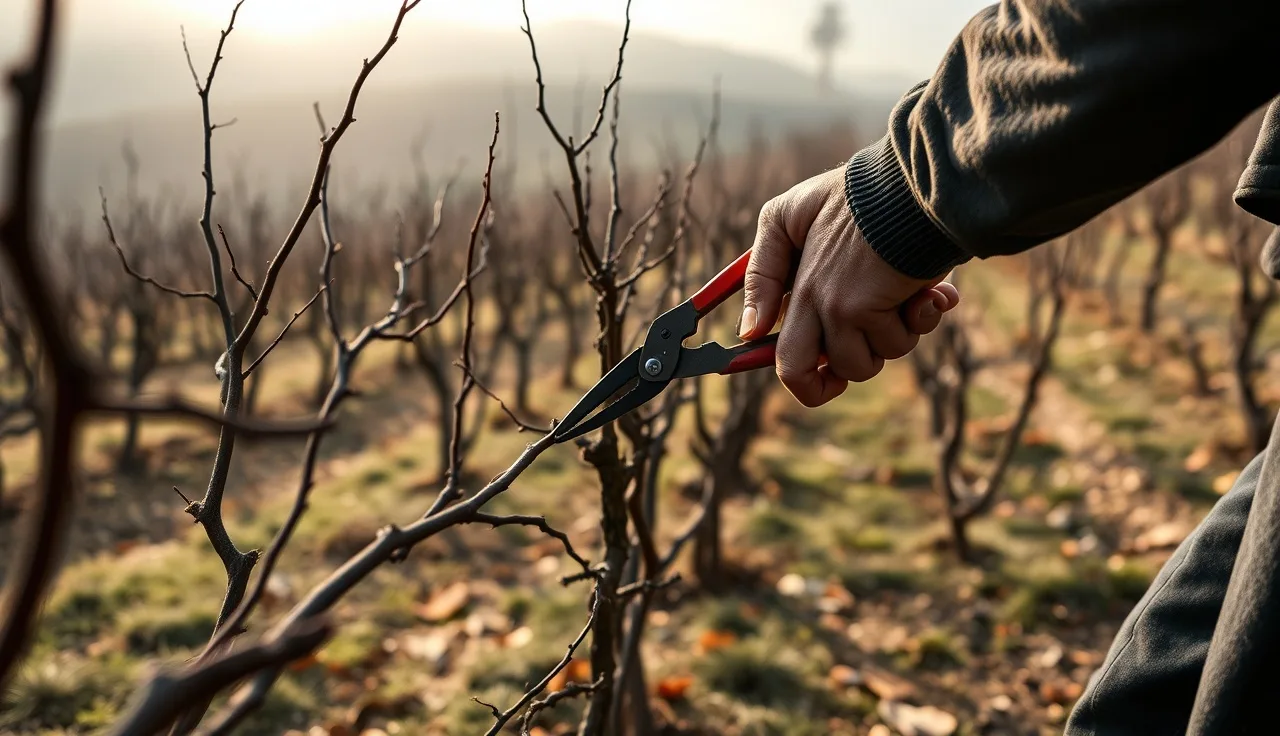
Pruning is the single most important annual job in a vineyard. Everything else in the season reacts to what you do in February and March. Pruning sets bud count, which sets shoot count, which sets canopy density, crop load, and fruit quality. Do it right and summer is easier. Do it wrong and you spend the growing season chasing a structural problem you locked in during dormancy.
Two main systems: cane pruning and spur pruning. In cane pruning you select two to four new canes off last year's growth, tie them to the wire, and cut everything else away. Each cane usually carries 8 to 15 buds depending on variety and vigor. In spur pruning you keep permanent cordons along the wire and cut last year's growth back to 2-bud spurs spaced every 4 to 6 inches. Spur pruning is faster and more consistent for mechanized work. Cane pruning handles fruitfulness better in varieties where the basal buds (near the base of the cane) are weak, like Riesling and some Pinot clones.
Timing counts. Prune too early in winter and you expose wood to cold damage if a hard freeze follows. Prune late, close to budbreak, and the vine bleeds more sap but actually takes less cold injury, which is why late pruning gets recommended in freeze-prone areas. In most California climates, UC Davis guidance is to prune after the coldest stretch of winter has passed, typically January through early March [1].
Bud count per vine is your crop-load lever. The starting-point formula most viticulturists use is the Ravaz Index, the ratio of fruit weight to pruning weight. A Ravaz Index between 5 and 10 is generally considered balanced for most vinifera, though the right range shifts by variety and site [1]. Weigh your prunings for a few seasons to calibrate to your own block.
Wound management has grown into a real conversation over the last decade as trunk diseases (Eutypa dieback, Botryosphaeria, Esca) have spread. Painting large cuts with a registered pruning-wound sealant, or a paste product like Topsin-M, is now standard in a lot of California and Pacific Northwest vineyards. Skip pruning in wet weather, when fungal spores are most active [2].
How do you manage the canopy during the growing season?
Once shoots break in spring, you're managing light and airflow through the canopy until harvest. You want it open enough to dry fast after rain or dew, with enough leaf area to ripen fruit but not so much shade that sugar stalls or humidity builds and feeds powdery mildew and Botrytis.
Shoot thinning comes early, usually when shoots hit 6 to 10 inches. You strip suckers (shoots off the trunk below the cordon or cane), watersprouts (vigorous uprights off old wood), and extra shoots crowding the spur zones. It's hand work, and it flies on a well-kept vine. On a neglected or over-vigorous vine it's slow and miserable.
Leaf removal around the fruit zone is standard in most cool-climate and disease-prone regions. Pulling 2 to 4 leaves on the morning-sun side opens airflow around clusters, hardens berry skin, and cuts Botrytis risk. Work from UC Davis and the American Journal of Enology and Viticulture shows early leaf removal (pre-bloom to fruit set) in cool climates reduces cluster compactness, which is the main physical driver of Botrytis susceptibility [5]. In hot climates, pulling leaves on the afternoon side burns fruit, so timing and side selection matter.
Hedging or shoot topping keeps canopy height and lateral growth in check through summer. Most VSP blocks get hedged 1 to 3 times between fruit set and veraison (color change). Don't overdo it. Strip too much leaf area late and you slow ripening right when you need it.
If you're running several blocks, field-level records earn their keep here. Software like VitiScribe logs timing, crew hours, and block-by-block notes, so you can tie a canopy decision back to fruit chemistry at harvest instead of relying on memory.
What diseases and pests do you need to manage in a wine grape vineyard?
Disease and pest pressure swings hard by region, but a handful of problems show up across almost every wine-growing area in North America.
Powdery mildew (Erysiphe necator) is the most widespread fungal disease in wine grapes. It's in nearly every growing region, thrives at moderate temperatures (65-85°F), spreads without rain, and can gut fruit quality and yield if you let it run. The standard California program uses sulfur as the backbone, with DMI fungicides (like myclobutanil or tebuconazole) and SDHI or QoI fungicides rotated in to slow resistance. Spray timing keyed to degree-day models beats calendar spraying every time [2].
Botrytis (gray mold, Botrytis cinerea) is the other major fungal threat. It gets in through wounds and tight clusters in humid weather near harvest. Tight-clustered varieties like Pinot Noir and Gewurztraminer are the most exposed. Cluster-zone leaf removal, cluster thinning, and well-timed Botrytis-specific fungicides (like fenhexamid or cyprodinil/fludioxonil) are the tools.
In the East and Midwest, downy mildew (Plasmopara viticola) is a primary concern and needs a different fungicide program. Warmer eastern areas add Pierce's disease pressure, and summer rain drives more Botrytis. Cornell's IPM program publishes region-specific spray scheduling tools [3].
Pests worth knowing: grape leafhopper and western grape leafhopper cut photosynthesis and get monitored by leaf damage. Grape mealybug is serious in California because it vectors grapevine leafroll virus. Grape berry moth is the dominant insect in eastern vineyards. Spotted lanternfly keeps expanding and is now a major threat in Mid-Atlantic and Northeastern blocks.
For any pesticide application, EPA Worker Protection Standard (WPS) compliance is mandatory [6]. That means restricted-entry intervals (REIs) posted at field entry points, PPE requirements, pesticide safety training for all ag workers, and emergency information on hand. WPS training runs annually for handlers, and you have to provide it before workers enter treated areas. Violations carry heavy fines and can trigger a cascade of audits.
Keep spray records current, accurate, and reachable. At minimum: product name, EPA registration number, application date, rate, location, applicator name, and weather at application. Many states require these records for 3 years [6].
How do you irrigate wine grapes and manage water stress?
Water in wine grapes is subtler than in most crops, because mild water stress at the right growth stage improves wine quality. Severe stress at any stage does damage. The whole skill is timing.
Pre-veraison mild stress (deficit irrigation) slows shoot growth, keeps berries smaller, and concentrates flavor. Research in the American Journal of Enology and Viticulture, cited widely by UC Cooperative Extension, supports holding soil water potential (read by pressure bomb or soil sensors) in a range that produces controlled stress without triggering leaf roll or berry shrivel [1][5].
Post-veraison, the call is about vine health without diluting fruit. In a very hot year or on sandy soil, you may need to irrigate through harvest. In a cooler year on heavier ground, you can often cut water at veraison and coast.
Measure, don't guess. Pressure bomb (pressure chamber) readings on shoot tips or mature leaves give you direct vine water status. Soil moisture sensors (capacitance or tensiometric) give continuous data at set root-zone depths. Neither is cheap. Both pay for themselves in mistakes you didn't make.
Dry-farmed vineyards (no irrigation) follow all of the above, it just happens at the mercy of rainfall timing. Dry farming needs deep soils, wide vine spacing to cut competition, and varieties or rootstocks built for drought. It's more common in older California plantings and some European-influenced programs. It is not right for every site.
How do you know when wine grapes are ready to harvest?
Harvest timing is where a year of work turns into a number. Pick too early and the wine is thin and simple. Pick too late and you've lost acid, built raisined flavors, and, in wet climates, handed Botrytis the block.
The standard measurements are Brix (sugar concentration), titratable acidity (TA), and pH. You read Brix with a refractometer or hydrometer on juice from randomly sampled berries. Most wine grapes come off between 21 and 26 Brix, but the target follows the wine style. Sparkling base picks earlier, at 17-20 Brix. Late-harvest styles can run past 30. TA targets usually fall between 5.5 and 8.0 g/L, and pH between 3.2 and 3.7, though style and winemaker preference push those around.
Sensory reads matter as much as the numbers. Seed color (green means immature, brown means ripe), skin tannin texture (harsh and green versus soft and ripe), and flavor development are things you learn only by tasting through the vineyard on a schedule. Walk the blocks and taste 20 to 30 berries per block regularly through the last 4 to 6 weeks before your expected window. There's no shortcut.
Weather is always the wild card. Rain during harvest dilutes fruit, drives Botrytis, and splits thin-skinned berries. Have a harvest date in mind. Be ready to move it 48 to 72 hours on a weather event.
To see how commercial wineries in warm climates handle harvest timing and fruit sourcing, operations like ponte winery and gervasi vineyard show what integrated vineyard-to-winery decisions look like in practice.
What does the timeline and cost of starting a wine grape vineyard look like?
Nobody in this business hands you honest cost numbers upfront, so here they are.
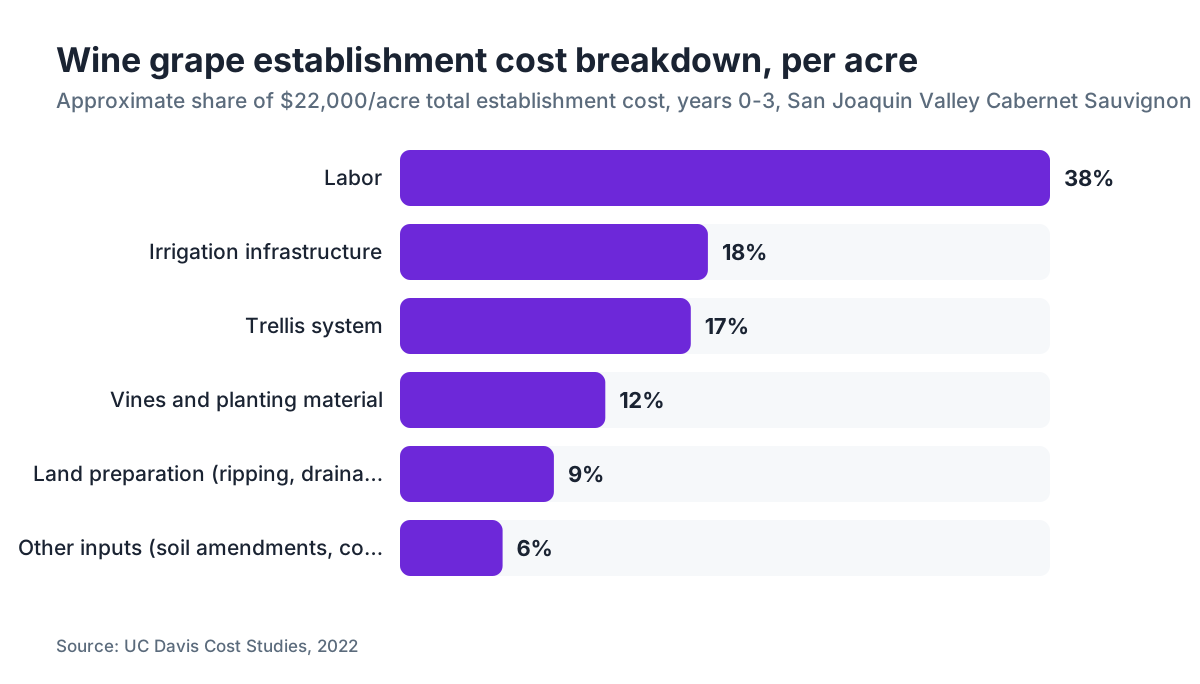
Establishment costs for a new wine grape vineyard in the US typically run $15,000 to $35,000 per acre through year three, before you sell a single ton. The range is wide because land clearing, irrigation, trellis, vine cost, and labor swing hard by region and scale. UC Cooperative Extension publishes county-by-county cost-of-production studies that are the most reliable public benchmarks going [7]. Its 2022 San Joaquin Valley study for Cabernet Sauvignon put establishment at roughly $22,000 per acre over three years. Napa or Sonoma Coast run higher. Washington State runs somewhat lower.
Here's the basic timeline:
| Year | Key Activities | Expected Revenue |
|---|---|---|
| Year 0 (pre-plant) | Soil testing, ripping, drainage, irrigation install | None |
| Year 1 | Planting, vine establishment, training | None |
| Year 2 | Trellis completion, training, canopy management | Minimal or none |
| Year 3 | First partial crop (often dropped for vine balance) | Maybe 25-50% of full yield |
| Year 4+ | First commercial harvest | Full yield approaching |
Full production for most wine grape varieties runs 2 to 4 tons per acre, though premium programs often hold to 1.5-2.5 tons per acre on purpose. Grape prices range from under $500 per ton for bulk commodity fruit to $3,000-$8,000+ per ton for premium Napa or Sonoma fruit, per USDA price reporting [8].
Annual operating costs at full production run $3,000-$6,000+ per acre in most California regions, with labor the largest single line at 40-60% of the total [7].
Tracking those costs block by block, year over year, is where a system earns its cost. Tools like VitiScribe log inputs, labor hours, and spray events by block. Without that, you're guessing at your true cost of production right when you sit down to negotiate a grape contract or run ROI.
What records do you legally need to keep when growing wine grapes?
Record-keeping comes at you from several directions: your state department of agriculture, EPA, your state's environmental agency, and possibly your grape contract or appellation rules.
For pesticides, most states meet or exceed federal minimums. Under FIFRA (Federal Insecticide, Fungicide, and Rodenticide Act), restricted-use pesticide (RUP) applications must be recorded within 30 days and kept for 2 years. California goes further and requires all pesticide use to be reported monthly to the county agricultural commissioner under the state's Pesticide Use Reporting system, RUP or not [9].
EPA's Worker Protection Standard (WPS) requires you to keep and display pesticide application and safety information at a central location workers can reach, provide annual pesticide safety training, and keep the training records [6]. The 2015 WPS revision tightened handler training, restricted-entry intervals, and emergency medical access.
Irrigation and water-use records may be required depending on your state's water rights framework. In California, water reporting keeps getting stricter. Washington runs its own water permit reporting through the Department of Ecology.
Good records protect you commercially, too. Sell fruit to a winery and they'll likely want documentation of spray applications, including pre-harvest intervals (PHIs). Some wineries, and all certified organic programs, require independent verification that your records are complete and accurate.
Keep every spray record, every water-meter reading, every fertilization log, every scouting note. Date it, sign it, back it up.
Frequently asked questions
How long does it take to grow wine grapes before the first harvest?
Most wine grape vineyards take 3 to 4 years to a viable commercial harvest. Year one is pure vine establishment. Year two you finish the trellis and train shoots. Year three usually gives a partial crop, often dropped to keep the vine in balance. Year four is normally the first season you carry fruit all the way to harvest.
Can you grow wine grapes in any climate?
No. Wine grapes (Vitis vinifera) need a specific window: at least 150 frost-free growing days, mean growing season temperatures between 50°F and 68°F, and enough heat accumulation, measured as growing degree days (GDD). Too much summer heat gives flat, jammy fruit. Too little warmth won't ripen most varieties. Cold-hardy hybrids push the range colder but produce different wine styles.
What soil is best for growing wine grapes?
Moderately infertile, well-drained soils make the best wine grapes. Sandy loam, gravelly loam, and rocky hillside soils are classic. Heavy clay that holds water pushes excess vegetative growth and root disease. Target a soil pH between 5.5 and 6.5. Run a full soil test, including nutrients and nematode pressure, before planting. Fixing soil problems after the vines are in is very hard.
Do wine grapes need a lot of water?
Less than most people expect. Wine grapes are moderate water users, and mild pre-veraison stress actually improves concentration and quality. Drip systems applying 12 to 24 inches per season are common in California. Severe stress does damage at any stage. Dry-farmed vineyards exist on deep soils with adequate winter rain, but they need careful site selection and variety matching.
How often do you prune wine grape vines and when?
Once a year, during dormancy. In most of North America that means January through early March. Prune too early in winter and you risk cold injury to exposed wood if a hard freeze follows. Prune closer to budbreak and you cut that risk at the cost of more sap bleeding. The window and method (cane versus spur) depend on region, variety, and trellis.
What is the difference between cane pruning and spur pruning wine grapes?
Cane pruning removes almost all last year's growth and keeps 2 to 4 new canes tied to the wire, each carrying 8 to 15 buds. Spur pruning keeps permanent cordon arms and cuts last year's shoots back to 2-bud spurs. Spur pruning is faster and more consistent for machines. Cane pruning handles varieties with weak basal buds better, like Riesling and some Pinot Noir clones.
Do you need to graft wine grapes onto rootstocks?
In most US wine regions, yes. Phylloxera (Daktulosphaira vitifoliae) is in soils across California, the Pacific Northwest, and many eastern regions. It destroys the roots of ungrafted Vitis vinifera over 5 to 15 years. Grafting onto resistant rootstocks is the main defense. Your state extension viticulture program can confirm phylloxera presence in your county and recommend rootstocks for your soil.
How do you control powdery mildew in wine grapes?
Manage it with a season-long fungicide program, usually starting at budbreak and running through fruit set or later. Sulfur is the backbone and is approved for organic production. DMI, SDHI, and QoI fungicides rotate in to slow resistance. Timing keyed to growing degree-day models beats calendar programs. Open canopies and good air circulation cut pressure a lot.
What records are required for wine grape growers using pesticides?
Federal law under FIFRA requires restricted-use pesticide records kept for 2 years. California requires monthly reporting of all pesticide use to the county agricultural commissioner under the state Pesticide Use Reporting system. EPA's Worker Protection Standard requires training records, application information posted at field entry, and documented pre-harvest intervals. Many states add requirements. Check with your state department of agriculture.
How many tons per acre do wine grapes yield?
Commercial wine grape vineyards typically produce 2 to 4 tons per acre at full production, which begins around year 4-5. Premium programs often hold to 1.5-2.5 tons per acre on purpose to concentrate quality. Bulk vineyards in warm valleys can run 6-10+ tons per acre. Your target depends on your market (bulk, custom crush, estate wine) and your grape contract specs.
What Brix level should wine grapes be at harvest?
Most wine grapes come off between 21 and 26 Brix. Sparkling base wines are picked earlier at 17-20 Brix to hold acidity. Late-harvest and dessert styles can reach 28-35 Brix. But Brix alone doesn't set harvest. pH, titratable acidity, seed color, skin tannin texture, and flavor all factor in. Tasting through the vineyard on a schedule in the weeks before harvest is irreplaceable.
How much does it cost to plant a wine grape vineyard per acre?
Establishment costs typically run $15,000-$35,000 per acre through year three, before commercial fruit. The range depends on land clearing, trellis, irrigation, vine cost, and regional labor. UC Cooperative Extension publishes county-specific cost-of-production studies, the most reliable public benchmark. Its 2022 study for Cabernet Sauvignon in San Joaquin Valley put establishment at roughly $22,000 per acre over three years.
What are the most common mistakes new wine grape growers make?
Planting the wrong variety for the site's climate and GDD is the costliest. Grafting into phylloxera-present soil without resistant rootstocks is a close second. Underbuilding the trellis to save money is common and expensive to fix. Skipping the pre-plant soil test leaves pH or nutrient problems that linger for years. Starting without a powdery mildew program in year one can wipe out a crop before you know it's happening.
Can you grow wine grapes organically?
Yes, and many do. Organic production uses sulfur and copper-based fungicides as the main disease tools, plus biological controls and cultural practices like leaf removal and canopy management to lower pressure. It works well in dry climates with low disease pressure. In humid eastern regions it's harder but doable. USDA National Organic Program certification requires a 3-year transition and annual certification through an accredited certifier.
Sources
- UC Agriculture and Natural Resources (UC ANR): Growing degree day thresholds, Winkler region classifications, pruning timing recommendations, and deficit irrigation research for wine grapes in California
- UC Statewide Integrated Pest Management Program (UC IPM): Powdery mildew management, trunk disease wound management recommendations, and fungicide program guidance for California wine grapes
- New York State Integrated Pest Management Program, Cornell University: Cold-climate trellis systems, rootstock recommendations for northeastern regions, and region-specific spray scheduling for Botrytis and downy mildew
- Oregon State University Extension Service: Pre-plant soil and fumigation decision guidance and post and wire specifications for VSP trellis systems in the Pacific Northwest
- American Journal of Enology and Viticulture: Research supporting early leaf removal to reduce cluster compactness and Botrytis susceptibility, and pre-veraison deficit irrigation effects on fruit concentration
- US EPA, Agricultural Worker Protection Standard: WPS requirements for training records, restricted-entry intervals, application posting, and emergency medical access for agricultural pesticide handlers and workers
- UC Davis Agricultural and Resource Economics Cost Studies: Establishment cost estimates of approximately $22,000 per acre over three years for Cabernet Sauvignon in San Joaquin Valley (2022 study); annual operating costs of $3,000-$6,000+ per acre at full production
- USDA National Agricultural Statistics Service: Wine grape price ranges by region and variety, including premium Napa and Sonoma fruit pricing and bulk commodity pricing
- California Department of Pesticide Regulation: California requirement for monthly reporting of all pesticide use to the county agricultural commissioner under the state Pesticide Use Reporting system
- USDA Agricultural Marketing Service, National Organic Program: Three-year transition period requirement and annual certification process for USDA organic certification of wine grape vineyards
Last updated 2026-07-10