How to grow grapes from cuttings: a practical field guide
TL;DR
- Grapevines root readily from hardwood cuttings taken during dormancy, usually January through March.
- Cut 12-18 inch sections with 2-4 nodes, wound the base, dip in IBA rooting hormone, and stick in fast-draining media.
- Good technique gets you 60-80% rooting.
- Softwood cuttings root too, but they need a mist system and closer attention.
Why propagate grapevines from cuttings instead of buying certified stock?
Certified nursery vines are the safest choice for a new block. They come tested for grapevine leafroll virus, fanleaf, and other systemic pathogens that a cutting from your own vineyard can carry right along with it. Say that upfront and mean it.
Still, there are real reasons to propagate your own. You have an old-vine block of something obscure and the nursery has never heard of it. You want to expand a clone that's outperforming everything else at cost. You run a few thousand vines, and $3 to $6 per certified plant times a few thousand plants adds up fast. [1]
The other honest reason: it works. Vitis vinifera and most American hybrids root extremely well from hardwood cuttings. Extension trials at UC Davis and Washington State have reported rooting rates of 60-85% under controlled conditions, depending on variety, timing, and hormone treatment. [2][3] Rootstock cuttings vary more, but popular ones like 110R and 3309C root reliably too.
Before you take a single cutting, know your state's rules. Some states restrict movement of propagation material. If you're in a Pierce's disease region like coastal California or the Gulf South, starting from potentially infected wood is a serious risk. Ask your local farm advisor first.
For the manager filling in a few hundred missing vines or saving a heritage selection, home propagation is a legitimate, low-cost tool. Here's how to do it right.
What's the difference between hardwood and softwood grape cuttings?
They're two different techniques with different timing, gear, and success profiles.
Hardwood cuttings come from fully dormant, mature cane wood collected in winter. The cane is firm and brown, the nodes are set. This is the standard commercial method for good reason. The material stores well, you can process large batches on a cold January day, and you don't need a mist bench. Most small-scale propagators should start here.
Softwood cuttings (sometimes called green cuttings) come from actively growing shoot tips in late spring or early summer. The wood is green, flexible, still building its cell structure. These root faster under the right conditions, but they need a mist propagation system to keep the leaves from drying out before roots form. Without intermittent mist, success rates fall off a cliff. If you have the equipment, it's a fine approach. If you don't, hardwood is your path.
There's a middle option too: semi-hardwood cuttings from partially lignified shoot wood in early summer. Some propagators swear by these for varieties that root slowly from hardwood, but the published data on consistent success rates is thin. The closest guidance comes from WSU Extension, which notes semi-hardwood can work for difficult-to-root hybrids but needs more attention to humidity control. [3]
This guide leans on hardwood, because that's what 90% of vineyard managers will actually do.
When is the best time to take grape cuttings?
Timing is one of the two or three things that most reliably predicts success.
The window for hardwood cuttings opens after the vine has fully hardened off in late fall and closes before bud swell in spring. In most California wine regions that's roughly December through February. In the Pacific Northwest and New York, January through early March is the common window. [2][3]
The window closes at bud swell for a physiological reason. Once the vine breaks dormancy, carbohydrate reserves start moving toward shoot growth instead of root initiation. Cuttings taken too late have lower root-to-shoot ratios and often push a weak shoot before roots have any chance to establish.
You also skip October and early November, even if the vine looks dormant, because the wood hasn't finished hardening its reserves. Wait for a vine that has taken at least 2-4 weeks of cold, preferably after a killing frost.
If your dormant pruning happens in January or February anyway, collecting propagation material at pruning time is easy. It's no extra work. You're just saving some of the canes you'd have dropped in the row middles.
How do you select and prepare the canes?
Not all cane wood roots equally. The best track record belongs to canes that are pencil-thick (roughly 6-10 mm diameter), well-matured, moderately vigorous, and free of obvious disease. Skip the thick bull canes from overloaded sections of the cordon, and skip the thin, wispy wood. Pencil thickness is the standard benchmark in most extension guides, and it holds up. [2]
Cut the selected canes into sections. For hardwood cuttings, the standard length is 12-18 inches. Make the top cut just above a node (about a half inch above) at a slight angle so water sheds off, and the basal cut just below a node. That angled top cut doubles as a reminder of which end is up later.
How many nodes? Aim for 2-4 per cutting. Two nodes gives you a bud to push a shoot while the base calluses and roots. Four nodes gives you more stored carbohydrate and some backup if the top bud fails.
Wounding the base improves rooting in many varieties. Use a sharp knife to peel two 1-2 inch strips of bark from opposite sides of the basal end, exposing the greenish cambium. The wound increases the surface area for callus formation and root initiation, and IBA (indole-3-butyric acid) rooting hormone soaks into wounded tissue much better. Published rooting trials confirm that wounding combined with IBA beats either treatment alone. [4]
How do you use rooting hormone on grape cuttings?
IBA is the standard rooting hormone for woody cuttings, and it genuinely works. The question is what form to use.
IBA comes in three practical forms: a powder, a liquid concentrate you dilute to a quick-dip, and a ready-to-use gel. For small batches the powder (sold as Rootone or generic IBA powder at 0.3-0.8% IBA) is cheap and effective. Dip the basal 1-2 inches in water first so the powder sticks, then tap off the excess.
For larger batches, the liquid quick-dip method wins on consistency. A high-concentration IBA solution, typically 10,000-20,000 ppm, applied for 3-5 seconds, treats many cuttings at a uniform rate. You can buy pre-mixed quick-dip concentrate from horticultural suppliers or mix your own from IBA powder dissolved in 50% ethanol. Mixing your own carries regulatory considerations under federal pesticide law, so use a registered commercial product unless you're sure of the rules in your state. [5]
IBA is a plant growth regulator, not a pesticide in the everyday sense, but its use still falls under EPA Worker Protection Standard rules if employees handle treated material. Keep that in your records. [6]
Gel formulations like Clonex work well for small batches and forgive a beginner's touch because they hold contact with the cutting base. They cost more per cutting but earn it if you're only doing a few hundred.
The rate consensus across extension sources lands around 3,000-8,000 ppm for hardwood grape cuttings, with the higher end for harder-to-root varieties like Cabernet Sauvignon and Nebbiolo. [3][4]
What rooting media and containers work best?
Grape cuttings need media that drains fast but holds some moisture. Two things kill cuttings: rot from soggy, airless conditions, and desiccation from media that dries out too quick. Balance those and you're most of the way there.
A 50/50 mix of perlite and coarse sand works reliably and cheaply. Straight perlite is popular too and handles overwatering better than heavier mixes. Some propagators add 25-30% coir for moisture retention. Avoid straight potting mix or garden soil. Both are too dense and too prone to Pythium and Fusarium root rots.
Container choice matters less than drainage. Deep cells (8-12 inches) beat shallow ones because they give the root system room. Standard deep-cell propagation trays, individual 4-inch pots, or bundles stuck straight into an outdoor callusing bed all work. Some growers skip containers, bundle cuttings in groups of 25-50, tie them with twist-ties, wrap the basal ends in moist burlap or peat moss, and store them horizontally at 35-40°F for a 4-6 week callusing period before sticking.
The bundle-and-callus approach is the traditional commercial method, and it still works. You're giving the basal nodes time to build callus tissue (the white, undifferentiated cells that roots emerge from) before the bud pushes a shoot. If the shoot races ahead of root development, the cutting burns through its stored carbohydrate and dies. Callusing slows the top and gives the bottom a head start.
Records are the thing small growers skip and later regret. Track which cuttings came from which rows or mother vines. A simple propagation log, even a spreadsheet, saves real headaches when you plant out six months later. If you're running a larger program, VitiScribe ties those records to specific vineyard blocks without spinning up a parallel paper system.
What temperature and humidity do grape cuttings need to root?
Roots form best at media temperatures around 65-75°F (18-24°C), while the air and the buds stay cooler, around 50-60°F. This split is the whole principle of professional grape propagation: warm the roots, cool the tops.
Why? If the air warms first, the buds break and push a shoot before there are roots to feed it. The cutting then drains its carbohydrate reserve trying to keep a leafed-out shoot alive, and dies. Warm-bottom, cool-top setups trigger root initiation before shoot growth takes off.
Commercial operations do this with heated propagation benches or bottom-heat cables under the media. For small-scale work, set cuttings over a seed-starting heat mat at 70-75°F and keep the room or shelter cool. Even trays on a warm concrete floor above a basement furnace get you a workable differential.
Relative humidity around the cuttings should stay moderately high, especially for softwood. Hardwood cuttings have no leaves to lose water, so humidity matters less, but keeping the media consistently moist (not wet) matters a lot. Check moisture daily for the first few weeks.
Light during the early callusing phase matters less than temperature. Once buds break and a shoot develops, normal ambient light or a simple grow-light setup keeps growth from going pale and weak (etiolation).
How long does it take for grape cuttings to root?
Under good conditions, callus starts forming within 2-4 weeks. Visible roots at the base usually show up at 3-6 weeks. A cutting is genuinely well-rooted and ready for potting up or transplant when roots run 1-2 inches long and branch, which usually takes 6-10 weeks total from sticking. [2]
Varietal differences are real. Vitis vinifera varieties that root easiest include Chardonnay, Sauvignon Blanc, and Grenache. Harder ones include Cabernet Sauvignon, Nebbiolo, and some Muscat types. Rootstocks vary widely: 101-14 and 3309C root readily, while 1103P and some SO4 selections are temperamental. [3]
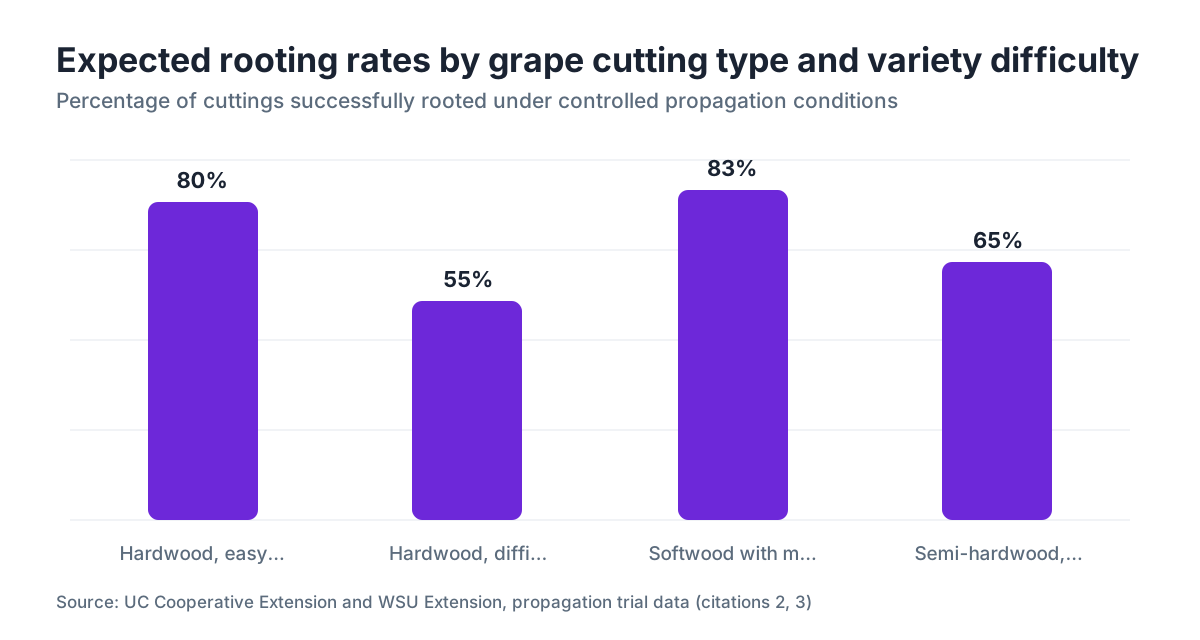
The table below shows approximate rooting timelines and rates by cutting type under controlled conditions.
| Cutting type | Optimal rooting temp (soil) | Typical time to visible roots | Expected rooting rate |
|---|---|---|---|
| Hardwood, easy varieties | 70-75°F | 3-5 weeks | 70-85% |
| Hardwood, difficult varieties | 70-75°F | 5-8 weeks | 40-65% |
| Softwood (with mist) | 68-72°F | 2-3 weeks | 75-90% |
| Semi-hardwood | 68-74°F | 3-6 weeks | 55-75% |
These ranges come from UC Cooperative Extension and WSU Extension propagation trial data. Your results will shift with hormone use, wounding, and media. [2][3]
Don't rush transplanting. A cutting that looks well-rooted in the cell can have a fragile root ball that won't survive a move. Wait until roots show clearly at the drainage holes or through a clear container before potting up.
How do you care for rooted cuttings through the first growing season?
Once a cutting has a good root system (usually by late spring if you started in January), harden it off before it lives outside for good. Move trays to a shaded outdoor spot or a cold frame for a week, then step up light exposure over 2-3 weeks.
First-year cuttings in containers need regular water, a modest fertilizer program, and cover from extreme heat. A dilute balanced fertilizer (something like 20-20-20 at half label rate) every 2-3 weeks, starting about a month after rooting, feeds the young plant without burning the delicate roots.
Let the vine grow the first season. Some propagators pinch back to push lateral development, but for wine grape propagation the goal is root mass and a strong primary shoot. Don't try to impose vine form in year one.
Scout for pests and disease even on young container vines. Mites move in fast in warm propagation environments. Powdery mildew hits stressed young vines. Treat early. A cutting carrying a disease load won't establish well in the vineyard.
By late summer or fall, a well-managed cutting should have a lignified shoot 12-18 inches long, a good fibrous root system, and the look of a real small vine. Then it's ready for field planting in fall (in mild-winter regions) or overwintering in dormancy for planting the following spring.
For larger programs, this is where sanitation records earn their keep. If a mother vine batch showed disease symptoms, you want that tracked before those vines go in the ground. See our general vineyard management overview at vineyard.
What can go wrong and how do you fix it?
Callus forms but no roots develop. Usually the media temperature ran too low (below 65°F) or the hormone dose was too light. Check your heat mat with a thermometer, since they drift. Rewounding and re-dipping cuttings sometimes rescues a failing batch if you catch it early.
The shoot pushes fast, then collapses. Classic case of the bud racing ahead of root development, caused by warm air over cool media. Reverse the differential. Some growers trim the advancing shoot to cut demand on the cutting's carbohydrate reserve while roots catch up.
Rot at the base. Too wet, media too dense, or a Botrytis or Pythium infection. Switch to a perlite-heavy mix, water less often, and open up air circulation. A light fungicide drench with a labeled material helps if rot is active. Check EPA-registered options for your situation, since rooted cuttings in propagation are a different use pattern than field applications.
Weak callus, yellow leaves, slow growth after rooting. Often nitrogen deficiency in low-nutrient media like pure perlite. Start a dilute fertilizer program earlier. Could also be root-bound if the cutting sat in a small cell too long.
Zero callus and shriveled cuttings. The wood desiccated, probably because it was stored too long before sticking, stored too warm, or the media dried out. The fix is proper storage: bundled in moist paper or burlap at 35-40°F before sticking.
Varietal identification mess. If your propagation block holds multiple selections and labels get separated, planting turns into a guessing game. Label every tray and every bundle with the variety, clone (if known), and source row. Cheap nursery tags and a permanent marker are all it takes.
Are there legal or disease-risk issues with propagating your own vines?
Yes, and they deserve real attention.
Viral diseases, especially grapevine leafroll-associated viruses (GLRaV-1, 2, 3) and grapevine fanleaf virus (GFLV), stay symptomless in some cultivars and propagate straight through cuttings. A visually healthy mother vine can still be a virus reservoir. UC Cooperative Extension has documented leafroll rates of 70-80% in some older California blocks. [7] Propagate from those and you copy the infection into every vine you plant.
Testing comes first. Send dormant wood to a certified lab for ELISA or PCR testing before you build a cutting collection. It isn't cheap, roughly $40 to $100 per vine per panel, but it beats planting a diseased block. Foundation Plant Services (FPS) at UC Davis maintains certified, virus-indexed, clean foundation stock and is the standard reference for California growers. [8]
Phytosanitary rules matter next. Interstate movement of grapevine propagation material is regulated by USDA APHIS, and some counties add restrictions even within a state. Check USDA APHIS plant health regulations and your state department of agriculture before moving cuttings across state lines. [9]
Plant patents and PVP certificates come third. Many modern commercial varieties, especially newer hybrid wine grapes like Marquette, La Crescent, and various Vitis-series releases, are protected by Plant Variety Protection (PVP) certificates or plant patents. Propagating these without a license is illegal. Check the USDA Plant Variety Protection Office database before you propagate any variety you didn't breed. [10]
Worker protection closes it out. If employees handle rooting-hormone-treated cuttings, EPA Worker Protection Standard rules apply to pesticide handling records. [6] Log what was used, at what rate, and who handled it.
How does propagating from cuttings compare to grafting onto rootstock?
Own-rooted vines (grown from cuttings) have their appeal, mostly in Phylloxera-free areas. They're cheaper to produce, they skip graft union management, and some growers argue they give a more vigorous, more honest expression of the variety. Old-vine Chenin Blanc in South Africa, Gobelet-trained Grenache in the southern Rhone, much of Chilean Carmenere: all own-rooted, because Phylloxera never arrived or arrived late.
If Phylloxera is in your soil, own-rooted vinifera vines will eventually die. Full stop. Phylloxera (Daktulosphaira vitifoliae) attacks the roots of susceptible V. vinifera directly, and no cultural trick saves a vine with a wrecked root system. [12] Grafting onto a resistant rootstock is not optional there.
For American hybrid varieties (Marquette, Frontenac, Norton, Chambourcin), own-rooted planting from cuttings is standard, because they carry native Phylloxera resistance.
The economics favor cuttings when you're expanding a known Phylloxera-free block or working with hybrids. Rootstock grafting (bench grafting or field grafting) adds labor cost and needs rootstock material. For a small grower filling in a few hundred vines in a safe environment, own-rooted cuttings are the practical call.
Some newer plantings in confirmed Phylloxera regions have tried own-rooted vines on sandy soils, where Phylloxera struggles in loose sand, but that's a calculated risk, not a general recommendation. Cornell Cooperative Extension has published rootstock selection guidance for New York growers that covers the tradeoff well. [11]
Frequently asked questions
Can you grow grapes from cuttings taken at any time of year?
You can try any time, but success drops sharply outside the dormant hardwood window (roughly December through February in most regions). Hardwood cuttings from dormant wood carry high carbohydrate reserves and need no leaves to survive rooting. Summer green cuttings can root but demand a mist propagation system. Without one, they desiccate and fail within days. For most growers, dormant hardwood is the right answer.
How long does it take to grow a grape vine from a cutting to planting size?
A hardwood cutting taken in January or February usually reaches field-planting size, meaning a lignified shoot of 12-18 inches with a developed root system, by late summer or fall of the same year. That's roughly 7-9 months. If you want to play it safe and give the plant a full second season in a container, count on 18 months from cutting to planting.
Do grape cuttings need rooting hormone to root?
No, but it helps a lot. Grapevines root without IBA, but rooting rates and root count both improve with hormone treatment, especially for harder-to-root varieties like Cabernet Sauvignon. UC Davis and WSU extension trials consistently show higher success with IBA-treated, wounded cuttings versus untreated controls. Easy-rooting varieties like Chardonnay still root reasonably well untreated. For anything difficult, use IBA.
What's the best rooting medium for grape cuttings?
A 50/50 mix of perlite and coarse sand drains well and cuts rot risk. Pure perlite works too and forgives overwatering. Avoid standard potting mix or garden soil, both too dense and carrying Pythium risk. If you add coir for moisture retention, keep it to 25% of the mix. The properties that matter are fast drainage and enough structure to hold the cutting upright.
Can you propagate any grape variety from cuttings, including wine grapes?
Most Vitis vinifera wine grapes root well from hardwood cuttings, though some (Cabernet Sauvignon, Nebbiolo) are harder than others. American hybrids and most table grapes root very readily. The main exception: if a variety is under a plant patent or PVP certificate, propagating it without a license is illegal regardless of technique. Check the USDA PVP database before propagating any commercial release.
How many nodes should a grape cutting have?
Two to four nodes is the standard range. Two is the practical minimum: one basal node near the rooting zone and one apical node to push a shoot. More nodes mean more stored carbohydrate, which sustains the cutting while roots develop. Very long cuttings (6+ nodes) add no benefit and waste wood.
Should I remove leaves from grape cuttings?
Hardwood cuttings have no leaves, so this isn't an issue. For softwood or semi-hardwood cuttings, strip the lower leaves that would sit in the rooting medium and leave 1-2 leaves at the top. Cutting large leaves in half lowers moisture demand on a leafed cutting that has no roots yet. Without a mist system, fewer leaves improve survival.
How do I store grape cuttings before sticking them?
Bundle cuttings in groups of 25-50 with the basal ends aligned, wrap loosely in moist newspaper or burlap, seal in a plastic bag, and store at 35-40°F (2-4°C), not in the freezer. Check moisture every 1-2 weeks. Properly stored hardwood cuttings hold for 2-3 months without much viability loss. Label bundles clearly with variety and source block.
What diseases can be spread through grape cuttings?
Grapevine leafroll-associated viruses (GLRaV-1, 2, 3), grapevine fanleaf virus (GFLV), and Grapevine virus A and B all propagate through cuttings from infected mother vines. Visually healthy vines can still carry leafroll virus without symptoms in some cultivars. Test mother vines by ELISA or PCR before building a propagation collection, or source material from a certified foundation program like UC Davis Foundation Plant Services.
Can I propagate rootstock varieties the same way as scion varieties?
Yes, with some variation in difficulty. Common rootstocks like 101-14, 3309C, and 110R root well from hardwood cuttings using the same technique. Some rootstocks (1103P, Dogridge) are harder to root and benefit from higher IBA rates and longer rooting times. WSU Extension and UC Cooperative Extension both publish rootstock-specific propagation guidance worth checking before you start.
How deep should I stick grape cuttings into the rooting medium?
Bury the bottom two-thirds of the cutting, leaving one or two nodes above the media surface. For a 12-inch cutting, that's roughly 8 inches below the surface. This buries multiple nodes where callus and root initiation happen, and it keeps the cutting stable so it doesn't rock and break developing roots when you water.
Will grape cuttings root in water?
They often initiate some root-like callus in water, but water-rooted cuttings have a poor track record when moved to soil. Water roots are structurally different from soil roots and often fail to adapt. Stick cuttings directly into rooting media rather than water-rooting first. The extra step adds work and almost always lowers final survival.
How do I know when my grape cutting has rooted and is ready to transplant?
The reliable signs are roots visible at the drainage holes, resistance when you gently tug the cutting (it won't slide out easily), and active, healthy shoot growth. Resist the urge to pull cuttings out to check, since disturbing them before roots stabilize does damage. Wait until drainage-hole roots appear, then check one cutting carefully as a test.
Sources
- USDA National Agricultural Statistics Service, Grape Price and Production Survey: Certified nursery vine pricing context; NASS tracks commercial plant pricing through annual fruit surveys
- UC Cooperative Extension, Grape Propagation Publication: Hardwood cutting timing (December-February), pencil-thickness selection, 60-85% rooting rates, 6-10 week root development timeline
- Washington State University Extension, Propagating Grapes from Cuttings: Semi-hardwood viability for difficult hybrids, rootstock rooting rates, IBA concentration ranges (3,000-8,000 ppm), cold-region timing (January-March)
- Cornell Cooperative Extension, Grape Propagation and Nursery Production: Wounding combined with IBA outperforms either treatment alone; bottom heat importance for root initiation before shoot growth
- EPA, Pesticide Registration and Regulations: IBA rooting compounds are regulated; use of homemade high-concentration solutions carries regulatory considerations under federal pesticide law
- EPA, Worker Protection Standard for Agricultural Pesticides: EPA Worker Protection Standard applies to employees handling pesticide-treated propagation materials including IBA-treated cuttings
- UC Cooperative Extension, Grapevine Leafroll Disease Management: Leafroll virus rates of 70-80% documented in some older California vineyard blocks; propagation from infected mother vines spreads virus systemically
- UC Davis Foundation Plant Services (FPS), Grapevine Program: FPS maintains certified, virus-indexed foundation stock grapevine material; standard reference source for California propagation compliance
- USDA Agricultural Marketing Service, Plant Variety Protection Office: USDA PVP database tracks protected varieties; propagating PVP-covered cultivars without license is illegal under the Plant Variety Protection Act
- Cornell Cooperative Extension, Rootstock Selection for New York Grapes: Own-rooted vs grafted vine tradeoffs including Phylloxera risk and sandy soil considerations for New York growers
- UC Davis Department of Viticulture and Enology, Phylloxera Biology and Management: Phylloxera attacks roots of susceptible Vitis vinifera; own-rooted vines in affected soils eventually die without resistant rootstock
Last updated 2026-07-09