Powdery mildew in wine grapes: farm hours, timing, and real cost
TL;DR
- Powdery mildew (Erysiphe necator) is the most expensive fungal disease wine grapes face across most U.S.
- regions.
- A full-season spray program runs 8 to 20 farm hours per acre depending on your equipment and spray interval.
- Miss the two-week window around bloom and you can lose 20 to 80 percent of the crop.
- Sulfur, DMI, and QoI fungicides anchor most programs, but resistance management matters as much as timing.
What is powdery mildew and why does it hit wine grapes so hard?
Powdery mildew in wine grapes comes from Erysiphe necator (formerly Uncinula necator), a fungus that lives only on living plant tissue. It doesn't need free water to germinate, which sets it apart from downy mildew and Botrytis. It does best at 70 to 85 degrees F with relative humidity above 40 percent. That describes spring and early summer in nearly every wine region in the country, coastal and inland alike. Warm days and dry air, right at bloom, is exactly what the fungus wants.
The fungus overwinters two ways: as chasmothecia (sexual fruiting bodies) tucked into bark crevices, or as mycelium inside dormant buds. Once temperatures push past 50 degrees F and you've stacked up enough degree-days after budbreak, those structures release ascospores that start primary infections. From there the asexual conidia cycle can repeat every 5 to 7 days under ideal conditions. That's the reason a two-week gap in your spray program at the wrong time turns a manageable problem into a crop you can't sell.
On berries the damage is more than skin deep. Infected tissue cracks as the berry grows, and those cracks open the door to secondary rots. Wine from heavily infected fruit can carry a musty, mousy off-flavor that survives fermentation. Some studies put the quality threshold at as little as 3 to 6 percent infected clusters. Above that, premium programs often reject the fruit outright.
When does powdery mildew infection risk peak during the growing season?
Two windows carry the highest risk. The first runs from budbreak to about 4 inches of shoot growth, when young tissue is most susceptible. The second runs from 2 weeks before bloom through 3 to 4 weeks after bloom, when the berry surface is at its peak. UC Davis plant pathology research shows that berries lose most of their susceptibility roughly 3 to 5 weeks after bloom, once the fruit surface matures [1].
The calendar is a blunt instrument. A degree-day model gives you a sharper read. The Gubler-Thomas risk index, developed at UC Davis, tracks temperature accumulation to predict how hard the fungus is sporulating and returns a low, moderate, or high risk score each day. Low risk, you might stretch to a 14-day interval. High risk, you're back in the vineyard at 7 days or tighter. UC IPM hosts an online calculator that pulls weather data and runs the model for you [2].
Growers underestimate flag shoots. These are shoots that grow out of buds already colonized by mycelium, and they emerge coated in white fungus, acting as a running inoculum source early in the season. Scout for them in the first 4 to 6 weeks after budbreak. They tell you your baseline pressure for the year. More than 1 to 2 percent flag shoot incidence in a block means your intervals need to tighten right away.
Cool rainy springs delay primary inoculum release, but they also tempt growers to skip sprays. That's the trap. When temperatures spike, sporulation catches up in a week and the growers who sat out get blindsided. The weather delay is real. The disease clock doesn't stop.
How many farm hours per acre does a full powdery mildew program actually take?
This is the number vineyard managers lose sleep over, and the honest answer is that it depends on your equipment, your spray interval, and how much canopy work rides along with the disease program.
Here's a realistic breakdown built from published extension data and standard equipment assumptions [3][4]:
| Program type | Applications/season | Hours/application (tractor + operator) | Estimated total hours/acre |
|---|---|---|---|
| Airblast sprayer, 7-day interval, high pressure | 14-18 | 0.4-0.7 | 6-12 |
| Airblast sprayer, 10-day interval, moderate pressure | 10-12 | 0.4-0.7 | 4-8 |
| Tower sprayer, 7-day interval | 14-18 | 0.3-0.5 | 4-9 |
| Backpack or handgun (small/irregular blocks) | 10-14 | 1.5-2.5 | 15-35 |
| Helicopter or aerial (large flat operations) | 8-12 | 0.1-0.2 | 1-2 |
Those are tractor-and-operator hours, not total labor. Add mixing and loading (roughly 0.1 to 0.3 hours per acre per application, depending on tank size), record-keeping time, and scouting. A serious scouting program adds another 1 to 3 hours per acre per season for a trained scout walking the vineyard weekly.
Run a 20-acre block with a mid-size airblast sprayer on a 10-day interval, and you're probably looking at 100 to 200 total farm hours for the disease component alone, budbreak through veraison. That's a big number. It's also not the whole picture, because a single tractor pass often does double duty (mowing, shoot positioning, spraying), and pinning hours to one operation is genuinely hard.
WSU Extension enterprise budgets for Washington wine grapes put disease management (all diseases combined) at 8 to 15 machine hours per acre annually, with powdery mildew programs making up the bulk of that in eastern Washington [4].
What fungicides work best and how do you rotate them to prevent resistance?
Sulfur is still the workhorse. It's cheap (roughly $0.50 to $2.00 per acre per application at typical rates), it kills on contact, and Erysiphe necator resistance to sulfur is not a practical concern. The catch: sulfur can burn foliage above about 90 to 95 degrees F, has no systemic activity, and needs reapplying every 7 to 14 days. Some varieties, especially Concord and certain Vitis labrusca hybrids, are sulfur-sensitive. Most Vitis vinifera wine grapes take it fine at labeled rates [1].
DMI fungicides (FRAC Group 3, including myclobutanil, tebuconazole, and tetraconazole) move systemically and give you kickback activity up to about 72 to 96 hours after infection. That's genuinely useful after an infection event, when you need to shut down mycelium that's already established. Resistance is real here. Populations of E. necator with reduced DMI sensitivity have been documented in California and other states [5].
QoI fungicides (FRAC Group 11, strobilurins like azoxystrobin and trifloxystrobin) were excellent when they launched. Resistance is now widespread enough that they belong in the rotation, never as your primary tool. In some California regions, QoI-resistant populations are effectively dominant [5]. Lean on them alone and you'll lose them.
SDHI fungicides (FRAC Group 7) and Group 13 quinoxyfen give you more chemistry to rotate through. Potassium bicarbonate (Kaligreen, Armicarb) is a solid organic option with decent efficacy when you apply it early and on a short interval. No systemic activity, no resistance worries.
The rotation most California growers run looks roughly like this: sulfur for the first 2 to 3 applications at budbreak, a DMI or SDHI around bloom, back to sulfur through early berry development, with a QoI or quinoxyfen worked in once or twice mid-season. Never apply a QoI more than twice per season in any block with resistance history. The UC IPM guidelines lay this out plainly [2].
Organic programs have fewer levers. Sulfur, copper (weak against powdery mildew), potassium bicarbonate, and some plant oil materials cover most of it. Organic growers usually run shorter intervals, and that adds farm hours fast.
How do you calculate your actual fungicide cost per acre per season?
Fungicide is the most visible cost line, but it's rarely the biggest one once labor and equipment come in. Here's a realistic range for common materials at typical wine grape rates. Prices move, so check your local ag supplier for current quotes.
| Material | FRAC Group | Typical cost/acre/application | Notes |
|---|---|---|---|
| Wettable sulfur | M2 | $0.50-2.00 | Resistance management anchor |
| Myclobutanil (Rally) | 3 (DMI) | $8-18 | Systemic, kickback activity |
| Tebuconazole | 3 (DMI) | $6-16 | Similar to myclobutanil |
| Azoxystrobin (Abound) | 11 (QoI) | $12-22 | Widespread resistance; rotate carefully |
| Trifloxystrobin (Flint) | 11 (QoI) | $14-25 | Same resistance concern |
| Boscalid + pyraclostrobin (Pristine) | 7+11 | $18-30 | Good mid-season rotation option |
| Quinoxyfen | 13 | $16-28 | Useful resistance-break rotation |
| Potassium bicarbonate | -- | $4-10 | Organic; short interval needed |
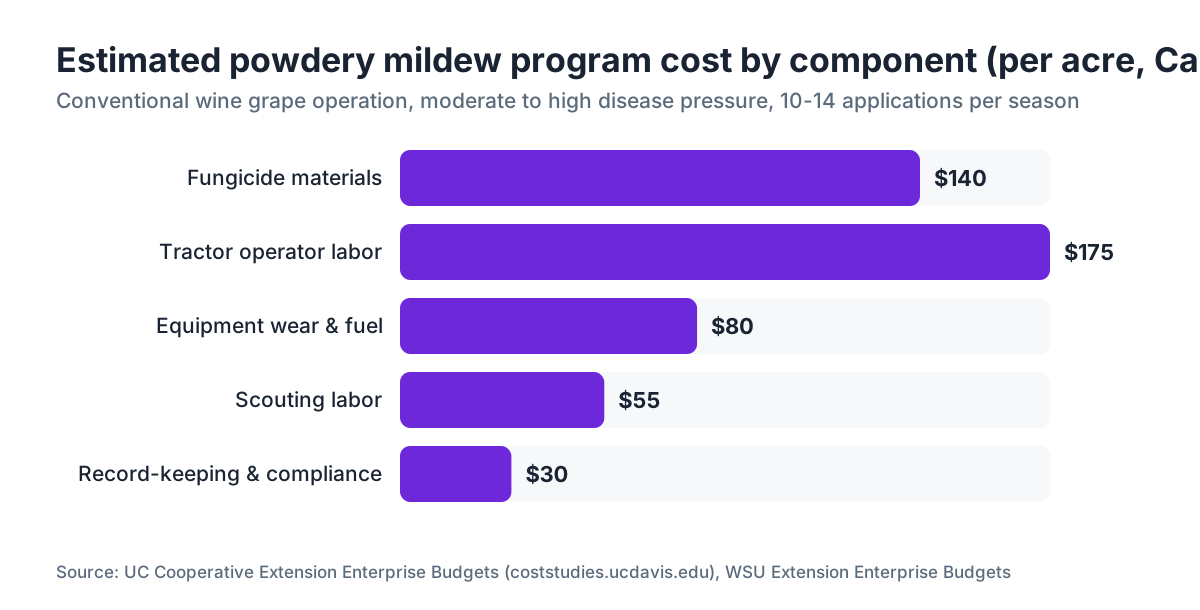
For a 12-application season blending sulfur, DMIs, and QoIs, a realistic all-in fungicide cost lands at $80 to $200 per acre for conventional programs. Add labor and equipment and you're often at $250 to $500 per acre for the full disease budget under moderate to high pressure [3][4].
That number stings less against the alternative. A 20 to 40 percent crop loss on Napa Valley Cabernet at $3,000 to $6,000 per ton makes a $400 per acre spray program look cheap. In lower-value appellations the math gets tighter, which is exactly why tuning your spray interval with a degree-day model moves the bottom line.
What spray records do you legally have to keep, and for how long?
In California, any pesticide application that requires a permit (nearly every EPA-registered fungicide does) has to be reported to the county agricultural commissioner. The Pesticide Use Report (PUR) is due within 7 days of the end of the month in which you made the application [6]. The report has to include operator name, license number, commodity treated, location, acreage, product name, EPA registration number, amount applied, date, start and end time, and target pest. California runs some of the strictest pesticide reporting in the country, and your county ag commissioner can audit those records.
At the federal level, the EPA Worker Protection Standard (WPS) requires that application-specific information stay posted at a central location accessible to workers for 30 days after the restricted entry interval (REI) expires [7]. That posting covers product name, active ingredient, EPA registration number, treatment location, date and time of application, and the REI. WPS applies to any farm using pesticides that employs agricultural workers or handlers.
For USDA organic certification, the National Organic Program (NOP) requires 5 years of records showing compliance, including every material applied and its approved status [8]. Your certifier asks for these at every annual inspection.
For non-organic growers in most states, the practical floor is this: keep application records at least 3 years, keep your Safety Data Sheets accessible, and hold your restricted use pesticide purchase and use records if you have any. Keep 5 years to be safe. Product liability claims and neighbor disputes can surface long after the application.
Digital record systems like VitiScribe speed up PUR compliance because they auto-fill fields from your product library and spit out the required report format. A well-organized spreadsheet or paper log is legally sufficient in most states, too. What actually matters is that you can hand over legible, complete records on demand.
How does canopy management change powdery mildew pressure and spray coverage?
This is where disease farm hours and canopy farm hours tie together. Shoot positioning, hedging, and fruit-zone leaf removal all have measurable effects on disease pressure and fungicide penetration.
Fruit-zone leaf removal is probably the most evidence-backed canopy practice for powdery mildew. Pulling 1 to 3 leaves around the cluster zone before bloom improves air movement, drops humidity in the cluster microclimate, and sharply improves spray penetration. A study in Plant Disease found that fruit-zone leaf removal cut powdery mildew incidence by 40 to 70 percent in some varieties [9]. It helps with Botrytis too, so the effort rarely goes to waste.
Hedging (summer pruning of shoot tips) controls canopy height and keeps you out of the thick, shaded interior that powdery mildew loves. Dense interiors can get effectively zero fungicide coverage even when you're spraying on schedule. Calibrate your airblast sprayer for a given canopy density, then let the vines outgrow it, and your effective dose per unit of leaf area falls off a cliff.
Shoot positioning, especially in VSP trellis, keeps shoots vertical and separated. That maintains airflow and lets spray reach the fruit from multiple angles. It's tedious work. It's also one of the higher-return investments you can make in both disease control and spray efficiency.
In high-humidity regions or with susceptible varieties, good canopy management plus a well-timed spray program beats either one alone by a wide margin. Cornell's viticulture extension program publishes canopy guidelines tied to disease management for New York wine grapes [10].
Which grape varieties are most susceptible to powdery mildew?
Every Vitis vinifera variety is susceptible to some degree. The fungus co-evolved with European grapes, and none of the major wine varieties carry meaningful natural resistance. Among widely planted varieties, some are consistently harder to manage than others.
Chardonnay, Gewurztraminer, and Muscat varieties sit on the more susceptible end in most published trial data. Cabernet Sauvignon and Merlot fall in the middle. Syrah trends toward slightly lower susceptibility in several California trials, though the data isn't uniform across regions.
American and hybrid varieties tell a different story. Many V. labrusca, V. riparia, and complex hybrids carry real powdery mildew resistance. Some of the newer disease-resistant varieties from Cornell (Marquette, Noiret, Traminette) and European breeding programs (Regent, Solaris, Cabernet Cortis) show strong field resistance. They won't interest most premium producers working in established appellations. They're worth knowing about for growers in tough climates and for the organic sector, where spray options are thinnest.
The takeaway is simple. Variety choice sets your baseline disease pressure before you've sprayed a drop. If you're planting a new block in a humid location, an hour with your local extension agent on variety selection is worth more than any single spray product decision.
What are the worker safety requirements for fungicide applications in vineyards?
The EPA Worker Protection Standard (WPS) is the primary federal framework. It requires agricultural employers to protect workers from pesticide exposure through training, notification, personal protective equipment access, and decontamination supplies [7]. EPA revised the WPS in 2015, with changes that phased in through 2018.
The requirements that matter most for fungicide work:
Re-entry intervals (REIs): The label is federal law. A 24-hour REI means workers can't enter the treated area during that window without the handler PPE the label lists. Sulfur usually carries a 24-hour REI. DMI fungicides often run 12 to 24 hours. Check every label every time. REIs vary by formulation.
Central posting: Post WPS safety information at a central location before each application, including the pesticide used, location, and REI dates and times.
Training: Workers have to get WPS safety training before they enter treated areas after the first day of the growing season. Handlers must be trained and certified, or directly supervised by a certified applicator.
Decontamination: Provide soap, water, and single-use towels. During application and during the REI, decontamination supplies have to be within a quarter mile of workers in the treated area.
The California Department of Pesticide Regulation (CDPR) administers WPS in California and layers on tougher state rules, including fieldworker safety regulations under CCR Title 3 [6]. Other states run their own WPS enforcement; check with your state department of agriculture.
PPE for sulfur is fairly modest (long sleeves, gloves, eye protection in most cases). Some DMI and QoI products require a respirator during mixing and loading. The handler section of each label spells out exactly what's required.
How do you use degree-day models to cut spray costs without increasing risk?
The Gubler-Thomas powdery mildew risk model is the most widely used tool for this, validated across many seasons and regions in California [2]. It uses daily temperature readings to calculate a risk index. Low risk (index 0 to 60), you can stretch intervals to 14 days. Moderate (60 to 80), spray every 10 to 14 days. High (above 80), the recommendation is 7 days.
The payoff is real. In a season with a cool May and a hot June, you might run 10 to 14 day intervals in May (saving 2 to 4 applications) and tighten to 7 days in June, with no more disease risk than a blanket 10-day program. UC Davis reported that model-guided programs saved an average of 2 to 4 applications per season with no measurable yield loss in validation trials [2].
The model is only as good as your temperature data. An on-site weather station is the most accurate input. CIMIS (California Irrigation Management Information System) stations cover many California wine regions well if you're within 2 to 5 miles of one. Station density thins out fast outside California. In Washington, Oregon, and New York you may need your own station or a commercial weather service.
WSU Extension has built degree-day tools for Pacific Northwest conditions, and Cornell's NEWA (Network for Environment and Weather Applications) runs disease forecasting for northeast growers, powdery mildew included [10][11]. All of these are free, web-based tools. There's no good reason not to use one.
What the models can't see is your local topography and vine microclimate. A low-lying frost pocket that holds humidity past 10 AM sees higher real-world risk than ambient temperature data predicts. Ground-truth the model against your own scouting early in the season.
How do you build and document a complete powdery mildew spray program?
A defensible spray program has five parts: a pre-season plan, a scouting protocol, an application log, a material acquisition record, and a post-season review.
The pre-season plan should spell out your target intervals by growth stage, your fungicide rotation by FRAC group, your trigger for shortening intervals (risk index above 80, or first flag shoot spotted), and the specific products you'll rotate. Writing it down before the season is good agronomy. It also documents that you're following a resistance management plan, which matters if a certification body audits you or a neighbor files a complaint.
Scouting is the feedback loop. Weekly vineyard walks from budbreak through veraison, watching flag shoots early and cluster infection mid-season, give you the data to adjust the plan. A simple percent-incidence count (shoots or clusters showing symptoms per 50 sampled) takes about 30 to 45 minutes per block. Record the date, location, and finding every time.
Your application log has to capture date and time, block or field ID, product name and EPA registration number, amount mixed and applied, application method, operator name, weather at the time of application (temperature, wind speed, wind direction), and vine growth stage. This is the core of PUR compliance in California and WPS posting everywhere.
Digital tools make this faster. VitiScribe was built around vineyard spray record compliance, so the application log fields map straight to California PUR requirements and WPS posting. You can scan product barcodes to pull EPA numbers, link records to field maps, and generate PUR reports automatically. That workflow earns its keep when you're running multiple blocks on a 7-day interval.
The post-season review doesn't need to be elaborate. Look at where disease escaped, what the risk index was doing during those windows, whether your intervals actually held, and what your applications and costs came to by block. That's the data that makes next year's plan dramatically better.
What does powdery mildew actually cost wine grape growers per acre?
There's no single authoritative number. Costs swing with region, variety, and severity. But the pieces are real and you can estimate them.
Yield loss from severe infection can reach 20 to 80 percent in unmanaged or poorly managed blocks. UC Davis work on the economic impact of powdery mildew estimated that California growers collectively spend hundreds of millions of dollars a year on fungicide programs to hold it off, which makes it the highest-cost fungal disease in California viticulture [1].
For a managed program, the pieces look like this:
Fungicides: $80 to $200 per acre per season (conventional). Organic programs usually run higher because they need more applications of shorter-residual materials.
Labor and equipment: $150 to $300 per acre per season for tractor operator time, mixing and loading, and equipment wear on a mid-scale operation with modern gear.
Scouting: $30 to $80 per acre with a trained independent scout. Less if the owner-operator does it.
Record-keeping and compliance: often ignored, genuinely a real cost. Completing PUR forms, maintaining WPS posting, and handling organic paperwork for disease management runs 2 to 5 hours per block per season.
Total managed program cost: $280 to $600 per acre per season in most conventional California wine grape operations, based on published UC Cooperative Extension enterprise budgets [3]. Regions with lower land and labor costs (eastern Washington, parts of New York) trend toward the lower end.
The cost of managing it badly is harder to pin down and potentially much larger. Beyond yield loss, quality penalties from contaminated fruit can drag on prices for years if you damage a winery relationship. And in a bad year, a block written off as unsaleable is a total revenue loss for the season that no fungicide budget could ever match.
Frequently asked questions
How many spray applications does a typical powdery mildew program require per season?
Most commercial wine grape programs in moderate to high pressure regions run 10 to 18 applications per season, from just before budbreak through late berry development (about 3 to 5 weeks post-bloom). The exact number rides on your spray interval, which you adjust with disease risk models and scouting. Low-pressure seasons in cool climates might get by with 8 to 10. Hot inland valleys with susceptible varieties may need 16 or more.
Can you use sulfur alone for a full powdery mildew program?
Sulfur alone can work under low to moderate pressure, especially for growers minimizing resistance concerns or holding organic certification. The tradeoff is shorter intervals (7 to 10 days maximum), because sulfur has no systemic or kickback activity. It leaves no residual after rain, and it can burn foliage above 90 to 95 degrees F. Most conventional growers use sulfur as the backbone of a rotation, not the only tool.
What's the difference between powdery mildew and downy mildew in grapevines?
Powdery mildew (Erysiphe necator) is a dry-weather disease that thrives without free water and produces white powdery growth on the surface of leaves and fruit. Downy mildew (Plasmopara viticola) needs wet conditions and standing water to infect, and produces white downy growth on the undersides of leaves. They call for different fungicide classes: most powdery mildew materials do nothing against downy mildew, and vice versa.
How do I know if my powdery mildew spray program is actually working?
Scouting is the only reliable answer. Walk the block weekly during the high-risk period (budbreak through 4 weeks post-bloom) and sample 50 shoots or clusters per block. Record percent incidence of visual symptoms. A well-managed conventional program keeps cluster infection below 1 to 3 percent through veraison. If you're seeing higher levels despite on-schedule applications, check coverage first (canopy density, spray calibration), then possible fungicide resistance.
Do I have to file a Pesticide Use Report (PUR) for every sulfur application in California?
Yes. In California, all agricultural pesticide applications, including sulfur, must be reported to the county agricultural commissioner via the monthly Pesticide Use Report, due within 7 days of the end of the application month. The only exemptions cover certain minimal-use situations. Check with your county ag commissioner for current exemption thresholds. Most routine fungicide applications in a commercial vineyard require reporting.
What's the restricted entry interval (REI) for common powdery mildew fungicides?
REIs vary by product. Wettable sulfur typically carries a 24-hour REI. Myclobutanil (Rally) is 24 hours. Azoxystrobin (Abound) is 4 hours. Boscalid plus pyraclostrobin (Pristine) is 12 hours. Always read the specific label for the formulation you're using, because REIs can differ between formulations of the same active ingredient. The label is a federal legal document and its REI is not negotiable.
How does powdery mildew affect wine quality even at low infection levels?
Infection as low as 3 to 6 percent of clusters can produce detectable off-flavors described as musty, mousy, or fungal. The responsible compounds include geosmin and certain volatile sulfur compounds made by the fungus and by the grape's response to infection. Some winemakers set tolerance thresholds below which they judge the impact manageable. Others write a zero-tolerance clause for visible mildew on incoming fruit right into the source contract.
What powdery mildew management tools are available for certified organic wine grape growers?
Organic growers are mostly limited to sulfur, potassium bicarbonate (Kaligreen, Armicarb), copper (low efficacy against powdery mildew specifically), and some plant oil materials like neem oil. Every material has to be approved by your certifier. Organic programs generally need shorter spray intervals and more farm hours because the materials have shorter residual activity. Canopy management matters even more when your spray options are limited.
How do I calibrate my airblast sprayer for better powdery mildew coverage?
Start with water-sensitive paper placed at multiple canopy positions (outside, inside, top, bottom of the cluster zone) and make a run at your normal speed and fan setting. Look for at least 50 droplets per square centimeter at every position. Adjust fan direction, output, and travel speed from there. UC Davis and WSU both publish calibration guides specific to wine grape airblast sprayers. Recalibrate whenever canopy density shifts during the season.
Can powdery mildew resistance to DMI fungicides be tested for in my vineyard?
Yes, though it isn't routine for most growers. University research labs, including groups at UC Davis and Cornell, have published protocols for sensitivity testing of local E. necator populations. In practice, most growers infer resistance from field failures: if a DMI product stops controlling the disease on an interval that used to work, reduced sensitivity is likely. Rotating FRAC groups is a better prevention strategy than waiting for a test to confirm the problem.
How soon after an infection event should I apply a fungicide to still get kickback?
DMI fungicides (Group 3) have the best kickback and generally work if applied within 72 to 96 hours of an infection event. QoI and SDHI fungicides have some post-infection activity but work better as protectants. Sulfur and potassium bicarbonate have essentially no kickback. If you suspect an infection event (warm temperatures, high humidity) and your last application was more than 5 days ago, a DMI is usually the right call for the next pass.
What records do I need to keep for WPS compliance when spraying fungicides in a vineyard?
At minimum: the pesticide product name, EPA registration number, active ingredient, application location, date and time of application, and the REI so workers know when they can re-enter. This has to be posted at a central location accessible to workers and stay posted for 30 days after the REI expires. You also need handler and worker training records showing every employee received WPS safety training before working in treated areas.
Is there a free powdery mildew risk model I can use for my vineyard?
Several free options exist. UC IPM hosts the Gubler-Thomas model with California CIMIS weather integration at ipm.ucanr.edu. Cornell's NEWA platform (newa.cornell.edu) runs powdery mildew forecasts for New York and northeast states. WSU Extension has degree-day tools for Pacific Northwest vineyards. You need a nearby weather station with reliable temperature data. On-site is best, but a CIMIS or NEWA station within 2 to 3 miles is usually adequate.
How many farm hours does scouting for powdery mildew add to my season?
A meaningful scouting program, sampling 50 shoots or clusters per block weekly during the high-risk period, takes roughly 30 to 60 minutes per block per week. Over a 14-week monitoring season (budbreak through 4 weeks post-bloom), that's 7 to 14 hours per block for scouting alone. For a 5-block, 20-acre operation, plan on 35 to 70 total scouting hours per season. It's real labor. It's also the data that justifies stretching intervals and saves you more in fungicide than the scouting costs.
Sources
- UC Davis / UC ANR - Powdery Mildew of Grape (Pest Management Guidelines): Powdery mildew is the highest-cost fungal disease in California viticulture; berries lose most susceptibility 3-5 weeks after bloom; sulfur phytotoxicity occurs above 90-95°F
- UC IPM - Gubler-Thomas Powdery Mildew Risk Index model description and online tool: The Gubler-Thomas degree-day model produces a risk index guiding 7, 10, or 14-day spray intervals; model-guided programs save an average of 2-4 applications per season
- UC Cooperative Extension - Sample Costs to Establish and Produce Wine Grapes (enterprise budgets): Total managed powdery mildew program cost in California wine grapes estimated at $280-600 per acre per season; fungicides $80-200 per acre per season
- WSU Extension - Wine Grape Enterprise Budgets for Washington State: Disease management totals 8-15 machine hours per acre annually in Washington wine grape operations, with powdery mildew programs representing the majority in eastern Washington
- UC Davis Department of Plant Pathology - Fungicide Resistance in Erysiphe necator: QoI-resistant E. necator populations are now effectively dominant in some California regions; DMI-reduced sensitivity populations have been documented in California and other states
- California Department of Pesticide Regulation - Pesticide Use Reporting: California requires Pesticide Use Reports (PUR) filed within 7 days of the month of application; county agricultural commissioner administers WPS compliance in California
- EPA - Agricultural Worker Protection Standard (WPS), 40 CFR Part 170: WPS requires central posting of pesticide application information including product name, active ingredient, EPA registration number, location, date/time, and REI; decontamination supplies required within a quarter mile of workers in treated areas
- USDA Agricultural Marketing Service - National Organic Program Regulations: NOP requires 5 years of records demonstrating compliance with organic regulations, including all materials applied
- Plant Disease (APS journal) - Fruit zone leaf removal effects on powdery mildew incidence: Fruit zone leaf removal reduced powdery mildew incidence by 40-70% in some grape varieties in published trial data
- Cornell University - Grape Canopy Management and Disease Guidelines (Cornell Cooperative Extension): Cornell viticulture extension publishes canopy management guidelines tied to disease management for New York wine grapes
- Cornell University - NEWA (Network for Environment and Weather Applications) - Grape Powdery Mildew Model: NEWA provides free online powdery mildew disease forecasting tools for northeast grape growers based on regional weather station data
Last updated 2026-07-09