How wine grapes are classified under FSMA and what records are required

TL;DR
- Wine grapes headed for commercial winemaking are usually exempt from FSMA's Produce Safety Rule through the manufacturing/processing path, because fermentation kills the pathogens the rule targets.
- The exemption isn't automatic.
- You still need written records to prove it applies, and mixed-use farms can face partial coverage.
- Here's how the classification works and what paperwork you have to keep.
What is FSMA and why does it affect vineyards at all?
The Food Safety Modernization Act (FSMA) was signed into law in January 2011. It is the biggest overhaul of federal food safety law since 1938 [1]. FDA's implementing rules rolled out between 2015 and 2020 and set binding requirements for farms, food facilities, and everyone in between. Vineyards got swept in with the rest of agriculture.
The rule most vineyard managers need to know is the Produce Safety Rule (PSR), at 21 CFR Part 112. It sets standards for growing, harvesting, packing, and holding produce. Whether your grapes fall inside or outside that rule decides how much compliance work lands on your desk.
Short version: most wine grapes qualify for an exemption from the PSR's core requirements. But 'qualify' is not the same as 'automatically exempt.' You have to show your operation fits the criteria. That means records.
Are wine grapes classified as 'produce' under FSMA's Produce Safety Rule?
Yes. Grapes are produce under FSMA's definition, which covers fruits and vegetables in their raw or natural state [2]. A grape is a fruit, so it starts inside that definition. Two exemptions then pull most wine grapes out of the rule's active requirements.
First, the 'rarely consumed raw' (RCR) list. FDA built a list of commodities people almost never eat raw, so the microbial risks that drive the PSR don't hit them the same way. Wine grapes are NOT on that list, no matter what a neighbor told you at a trade show. The list has things like asparagus and artichokes. Grapes didn't make the cut, because table grapes get eaten raw and FDA didn't split the classification by intended use.
Second, and this is the one that matters for most vineyards: the manufacturing/processing exemption. Under 21 CFR Part 112, a farm is exempt for produce that gets commercial processing that adequately reduces microorganisms of public health significance [3]. Winemaking, meaning alcoholic fermentation, meets that standard. The alcohol produced during fermentation is a recognized kill step for the relevant pathogens.
So wine grapes are technically 'produce' and almost always exempt from the PSR's water quality, soil amendment, and worker training requirements because of where they go after harvest. That distinction shows up fast when a buyer asks for your food safety plan.
What is the manufacturing/processing exemption and how does it apply to grapes?
The manufacturing/processing exemption in 21 CFR §112.2(b)(1) says the Produce Safety Rule does not apply to produce that 'is used for or sold for use for further manufacturing or processing... in a manner that adequately reduces the presence of microorganisms of public health significance' [3]. FDA recognizes alcoholic fermentation as one such process.
Two things have to be true for the exemption to hold. One: the grapes actually go through that qualifying process. Two: there is a written disclosure between the farm and the buyer.
FDA requires the farm to disclose in writing that the produce 'is not processed to adequately reduce the presence of microorganisms of public health significance,' and the customer must give written acknowledgment that they will complete the processing [3]. In plain terms: the winery or crush facility has to acknowledge, in writing, that they're receiving raw grapes and will run them through fermentation.
For vertically integrated operations, where the vineyard and winery are one legal entity, FDA has said the exemption still applies but can run on internal documentation instead of an external agreement. Get that internal memo or SOP in writing anyway. A verbal understanding won't survive an inspection.
Sell to multiple buyers? You need a written disclosure on file for each one. Don't assume the purchase contract covers it unless you've checked that it includes the FSMA-required language.
Does the farm size exemption (qualified exemption) apply to small vineyards?
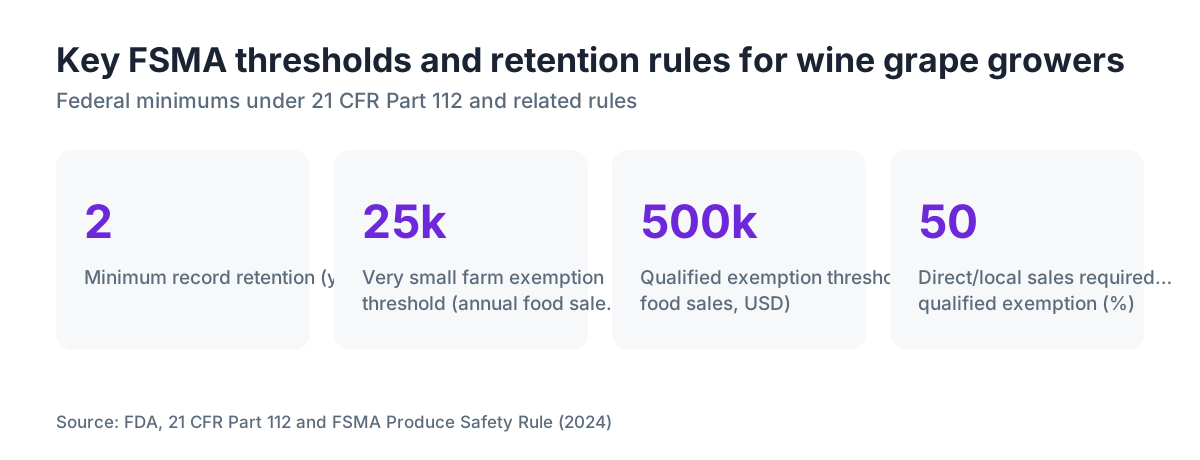
Separate from the processing exemption, FSMA has a 'qualified exemption' for very small farms [4]. If your average annual food sales over the prior three years are under $25,000, you're outside the PSR entirely. That's a low bar. Most commercial vineyards clear it easily and don't qualify.
There's also a 'qualified exemption and modified requirements' tier. If your farm's average annual food sales are under $500,000 AND more than half of those sales go directly to consumers or to restaurants and retailers in the same state or within 275 miles, you can claim a modified exemption [4]. You still post a disclosure (the farm's name and full address on the label or at the point of sale) and keep records proving you meet the criteria.
Most wine grape growers sell business-to-business, and those sales often cross state lines, which knocks out the geographic part of this exemption. But if you run a farm stand or a U-pick, do the math on your numbers.
| Exemption tier | Annual sales threshold | Sales channel requirement | Core record needed |
|---|---|---|---|
| Very small farm | Under $25,000 (3-yr avg) | None | Proof of sales figures |
| Qualified exemption | Under $500,000 (3-yr avg) | Over 50% direct/local | Sales records + disclosure |
| Manufacturing/processing | Any size | Grapes go to fermentation | Written buyer disclosure |
| No exemption | Any size, non-qualifying | B2B, non-qualifying process | Full PSR compliance |
What written records does a vineyard need to maintain under FSMA?
Here's where a lot of vineyard managers get tripped up. Being exempt from the Produce Safety Rule's operational requirements doesn't free you from record-keeping. It means you need records that prove you're exempt.
For the manufacturing/processing exemption, you need:
- A written disclosure to each buyer (winery, crush pad) stating that the grapes have not been processed to reduce microorganisms and that the buyer will provide the qualifying processing step.
- A written acknowledgment from each buyer confirming they got the disclosure and will apply the qualifying process.
- Records showing your grapes were in fact sold for that qualifying use.
For the qualified exemption (small farm, direct sales):
- Sales records showing your three-year rolling average annual food sales.
- Records of sales by channel, proving the more-than-50% local/direct threshold.
- Labeling or point-of-sale disclosure documentation.
If any part of your operation does fall under the PSR (say, a mixed-use farm where some produce skips a qualifying process), you'll need more records: agricultural water testing, soil amendment applications, worker health and hygiene training, and equipment sanitation [2].
FDA requires PSR records to be kept for at least two years, with some exceptions running longer [3]. Keep them legible, retrievable during inspection, and backed up offsite.
How long do you have to keep FSMA records, and in what format?
The PSR sets a two-year minimum retention period for most records [3]. The clock starts when the record was created, not when the crop came off the vine.
Hold the buyer disclosures and acknowledgments for at least two years after the transaction they cover. If FDA or a buyer's third-party auditor comes calling, you'll usually be asked to show records going back two full growing seasons.
Format is flexible. FDA accepts paper or electronic. What the rule requires is that records be accurate, legible, and retrievable within a reasonable time during an inspection [2]. 'Reasonable' isn't a number in the rule, but investigators expect records on-site or accessible within hours, not weeks.
Electronic systems are fine and make retrieval faster. If you use field management software (VitiScribe, for example, has record-keeping tools built for vineyard compliance documentation), make sure you can export records in a readable format and keep a backup outside the system itself. A software outage during an inspection is your problem, not the inspector's.
One practical note. If you sell grapes to wineries in several states, some states set their own agricultural recordkeeping requirements that run past the federal two-year floor. California's County Agricultural Commissioner system, for one, has its own reporting cadence alongside federal requirements.
Does the EPA Worker Protection Standard apply to wine grape vineyards alongside FSMA?
Yes, and the two are separate systems. FSMA and the EPA's Worker Protection Standard (WPS) are independent federal requirements that often hit the same vineyard at the same time [5].
The WPS, run by EPA under the Federal Insecticide, Fungicide, and Rodenticide Act (FIFRA), covers pesticide application and reentry protection for farm workers. It requires pesticide safety training, access to labeling information, decontamination supplies, and emergency medical help. Revised WPS rules that took effect starting in 2017 tightened training requirements.
Here's where FSMA and WPS records touch. Spray and pesticide application records you keep for WPS (applicator certifications, product labels, restricted-entry intervals, application dates and rates) also fill out the broader record of your production practices. An FDA investigator reviewing a vineyard under FSMA can ask to see those records. They won't enforce WPS (that's EPA's job), but sloppy records in one system usually signal sloppy records across the board.
WSU Extension has a useful summary of how WPS recordkeeping applies to Washington vineyards, and UC Davis Cooperative Extension has published similar guidance for California [6][8]. If your state runs its own pesticide use reporting (California's DPR requires annual pesticide use reports from every agricultural operation, for instance), those records run on their own calendar too.
What happens if a vineyard fails to maintain the required FSMA records?
FDA has a range of enforcement tools. For a farm without the required written disclosures and acknowledgments, the most immediate risk is a warning letter followed by a mandatory compliance action.
So far, FDA's enforcement under the PSR has leaned toward education and voluntary compliance rather than immediate fines. That posture can change, and a food safety incident tied to your operation speeds everything up.
FDA can issue a public warning letter (these go on the public FDA database), order administrative detention of produce in the supply chain, pursue injunctive relief, or refer knowing violations for criminal prosecution [1]. For a vineyard that genuinely qualifies for the processing exemption but just lacks the paperwork, the exposure sits mostly on the written disclosure requirement.
Buyers are a second layer of risk, and for most small operations it bites faster than FDA. Major winery buyers, especially those supplying retail chains, increasingly require third-party food safety audits (SQF, PrimusGFS, Azzule Systems) as a condition of purchase. Fail an audit because you can't produce your buyer disclosures or exemption documentation, and you lose the contract. That's a real business hit with a faster feedback loop than a federal enforcement action.
Cornell Cooperative Extension's viticulture team has noted that buyer-driven food safety requirements often go beyond what federal rules strictly mandate, especially for vineyards supplying larger national brands [7].
Do custom crush clients and estate wineries face different FSMA requirements?
This comes up a lot. The answer turns on where the legal line between 'farm' and 'facility' falls in your operation.
Under FSMA, a farm that does only farming activities is subject to the PSR (or its exemptions). A food facility that manufactures or processes food is subject to the Preventive Controls for Human Food rule, 21 CFR Part 117, not the PSR [1]. Wineries transform grapes into wine through manufacturing, so they're generally regulated as food facilities under Part 117.
Sell exclusively to a separate licensed winery? You're a farm. Your FSMA obligations sit under the PSR and its exemptions.
For a winery that also grows grapes on the same property, or an adjacent property it controls, FDA's 'farm' definition includes a 'secondary activities farm' concept: certain activities a farm does for another farm don't push it into facility status [2]. But the moment grapes cross into a separate legal entity that processes them, or a custom crush facility handles your grapes for you, the facility-side requirements kick in for that entity.
Custom crush clients (growers who ship grapes to a custom crush facility and get finished wine back) sit in a murky middle. The custom crush facility is clearly a food facility under Part 117. The grower is generally still a farm. The written processing disclosure from the grower to the custom crush facility still applies, and initiating it is the grower's job.
What do university extension programs say about FSMA compliance for vineyards?
UC Davis Cooperative Extension, Cornell Cooperative Extension, and Washington State University Extension have all produced FSMA guidance for fruit and vegetable growers, grape growers included.
UC Davis has published practical guidance noting that wine grapes are generally covered by the manufacturing/processing exemption, while stressing that farms need written documentation to back that claim [6]. Their materials flag the buyer disclosure requirement as the most commonly missing piece during third-party audits of California vineyards.
Cornell's team has focused on helping New York vineyards understand the split between the farm definition and the facility definition, which matters in a state full of small estate wineries where vineyard and winery share an address [7]. Their extension publications also cover how the PSR meets New York's own agricultural recordkeeping requirements.
WSU Extension has produced a commodity-specific guide for Washington wine grape growers, walking through the manufacturing/processing exemption step by step and giving template language for the required buyer disclosures [8]. That template is worth adapting even outside Washington, because it's been checked against the actual regulatory text.
All three programs land on one point: the exemptions are real, but an unsubstantiated exemption is a liability. An empty file protects nobody.
How do you set up a simple FSMA compliance record system for a vineyard?
You don't need expensive software to meet the basic documentation for the manufacturing/processing exemption. A folder, physical or digital, organized by growing season and buyer works fine for small operations.
Here's the minimum viable system:
For each growing season, keep a folder with: signed buyer disclosure agreements (one per buyer entity), copies of the acknowledgment each buyer sent back, your sales summary showing which buyers took which volumes, and any other records that support exemption claims (sales channel breakdown for the qualified exemption tier, if it applies).
If you're in a state with pesticide use reporting (California) or County Agricultural Commissioner oversight, keep those records in the same organized system. An inspector who sees one tidy binder has a very different day than one watching you dig through email attachments for an hour.
For operations with multiple vineyards, multiple buyers, or employees applying pesticides, a digital system that timestamps entries and exports quickly becomes genuinely useful instead of a nice-to-have. Field management platforms built for vineyards can track spray records, worker training logs, and buyer agreements in one place. If you're comparing options, look for the ability to generate a dated, exportable compliance packet on demand, the kind of thing you hand an auditor when they walk in. VitiScribe was built around exactly that workflow.
Review your records at the end of each harvest, before anything gets filed away, to confirm every buyer returned a signed acknowledgment. That end-of-season check catches gaps while they're still easy to fix.
Frequently asked questions
Are wine grapes on the FDA's 'rarely consumed raw' exemption list?
No. The FDA's rarely consumed raw (RCR) list does not include grapes. Because table grapes are commonly eaten without processing, FDA didn't split the classification by end use. Wine grape growers rely instead on the manufacturing/processing exemption, which requires written documentation showing the grapes will go through fermentation, not the RCR designation.
Do I need a food safety plan as a wine grape grower?
If you qualify for the manufacturing/processing exemption or the small farm exemption, you're not required to have a written food safety plan under the Produce Safety Rule. But many winery buyers and third-party auditors (SQF, PrimusGFS) require one as a contract condition regardless of federal law. A simple written food safety policy protects you in both the regulatory and commercial worlds.
What exactly should the buyer disclosure letter say?
The disclosure must state that the produce has not been processed to adequately reduce the presence of microorganisms of public health significance and that the buyer will provide that processing. WSU Extension has published template language for wine grape growers. At minimum it should identify your farm, the buyer, the commodity, the growing season, and state that fermentation or equivalent processing will be applied by the receiving facility.
Does a vertically integrated winery with its own vineyard need the buyer disclosure?
Yes, though it's an internal document rather than a third-party agreement. FDA still requires the disclosure to exist even when the farm and winery are one legal entity. An internal memo, SOP, or a section of your food safety plan stating that estate grapes will undergo fermentation does the job. Keep it signed, dated, and updated each season.
How does the $500,000 qualified exemption threshold work in practice for vineyards?
You average your annual food sales across the three prior calendar years. If that average is under $500,000 and more than half of sales went directly to consumers or to in-state or within-275-mile retailers and restaurants, you qualify. Most commercial vineyards selling bulk grapes to wineries miss the geographic and channel test even when they clear the dollar threshold, because those are arm's-length B2B transactions.
What records do I need to keep for EPA Worker Protection Standard compliance in a vineyard?
WPS requires records of pesticide applications (product, rate, date, location, applicator), worker training dates and trainer qualifications, and access to safety data sheets and labeling. The revised WPS that took effect in 2017 requires initial and annual training. Records must be kept for two years from the date created. California, Washington, and other states may require added pesticide use reporting beyond WPS minimums.
Can an FDA inspector show up unannounced at my vineyard to check FSMA records?
Yes. FDA has authority to conduct unannounced inspections of farms covered by the Produce Safety Rule. For farms claiming exemptions, investigators can ask to see the documentation supporting that exemption. In practice FDA has prioritized larger operations and those with known food safety incidents, but small vineyards aren't immune. State agriculture departments may inspect under cooperative agreements with FDA.
If I sell grapes to multiple wineries in different states, does FSMA apply differently across states?
The federal Produce Safety Rule applies uniformly regardless of state. But if you're trying to claim the qualified exemption's local sales channel requirement, interstate sales don't count toward your 50% local threshold. Each buyer still needs their own written disclosure and acknowledgment. Some states have parallel food safety rules, and California specifically runs its own agricultural commissioner oversight system alongside federal requirements.
Does FSMA apply to organic wine grape growers differently?
The Produce Safety Rule applies based on the commodity and farm size, not on organic certification. Organic certification through the USDA National Organic Program (NOP) is a separate track with its own recordkeeping, including five-year retention of audit control records under 7 CFR Part 205. Certified organic wine grape growers keep compliance with both NOP and FSMA, though the FSMA exemptions apply equally to organic and conventional operations.
How does FSMA's Produce Safety Rule interact with California's county agricultural commissioner requirements?
They run in parallel. California's County Agricultural Commissioners enforce state pesticide regulations and may get delegated authority from CDFA for certain FSMA-related activities under cooperative agreements with FDA. Pesticide use reports required by the California DPR (due annually by January 31 for the prior calendar year) are separate obligations. Meeting both means coordinating records so a single spray log entry captures the data each system needs.
What is the penalty for failing to have the required buyer disclosure under FSMA?
FDA enforcement escalates from warning letters to administrative detention, injunctive relief, and criminal prosecution in serious cases. For first-time paperwork gaps without a food safety incident, warning letters are the usual starting point. Civil penalties under FSMA can reach hundreds of thousands of dollars per violation for intentional violations, though that level is reserved for egregious cases. Buyer-contract termination is often faster and more painful than federal enforcement for small vineyards.
Do I need FSMA records if I only sell grapes at a farmstand or U-pick operation?
Direct-to-consumer sales at your farm may qualify you for the qualified exemption's modified requirements, which swap full PSR compliance for a labeling or point-of-sale disclosure. You still need sales records proving you meet the dollar threshold and channel breakdown. If any of those fresh grapes could be eaten without further processing (eating them off the vine counts), the PSR's worker hygiene and sanitation provisions may still apply regardless of your exemption tier.
How do third-party food safety audits like SQF or PrimusGFS relate to FSMA compliance for vineyards?
They're separate but aligned. Third-party audit schemes are buyer requirements, not federal law. Many large wineries now require SQF Level 2 or PrimusGFS certification as a purchasing condition, especially for national brands. These audits assess essentially the same practices FDA looks for under the PSR, often more. Passing a third-party audit doesn't exempt you from FDA oversight, but strong audit performance is evidence of good compliance posture.
Sources
- FDA, Food Safety Modernization Act, center page (fda.gov/food): FSMA was signed into law in January 2011 and is the largest overhaul of federal food safety law since 1938; FDA enforcement tools include warning letters, administrative detention, injunctive relief, and criminal referral, and wineries that process grapes are regulated as food facilities under 21 CFR Part 117.
- Electronic Code of Federal Regulations, 21 CFR Part 112 (Standards for Produce Safety): FDA defines produce broadly to include fruits and vegetables in their raw or natural state; records must be accurate, legible, and retrievable within a reasonable time during inspection; the rule includes a secondary activities farm concept and additional records for covered operations.
- Electronic Code of Federal Regulations, 21 CFR Part 112, Subpart A: 21 CFR §112.2(b)(1) states the rule does not apply to produce 'used for or sold for use for further manufacturing or processing... in a manner that adequately reduces the presence of microorganisms of public health significance'; written disclosure and acknowledgment are required; records must be retained for at least two years.
- Electronic Code of Federal Regulations, 21 CFR Part 112, Subpart A (coverage and exemptions): FSMA provides a full exemption for farms with average annual food sales under $25,000 over the prior three years, and a qualified exemption with modified requirements for farms under $500,000 that make more than half of sales direct to consumers or to local retailers and restaurants within 275 miles or in-state.
- EPA, Agricultural Worker Protection Standard (WPS): The EPA Worker Protection Standard is a separate federal requirement under FIFRA covering pesticide application and reentry protections for agricultural workers, including training, labeling access, decontamination, and emergency medical assistance; revised rules took effect starting in 2017.
- UC Agriculture and Natural Resources (UC Davis Cooperative Extension): UC Davis has published guidance noting that wine grapes are generally covered by the manufacturing/processing exemption but that written documentation is required, and that missing buyer disclosures are the most commonly identified gap during third-party audits of California vineyards.
- Cornell Cooperative Extension, Produce Safety Resources for Farms: Cornell extension materials address the distinction between farm and facility definitions for co-located vineyard-winery operations in New York, and note that buyer-driven food safety requirements often exceed what federal rules strictly mandate.
- Washington State University Extension: WSU Extension has produced commodity-specific guidance for wine grape growers walking through the manufacturing/processing exemption and providing template language for required buyer disclosures reviewed against the regulatory text, plus a summary of WPS recordkeeping for Washington vineyards.
- USDA National Organic Program, 7 CFR Part 205: Certified organic operations must retain audit control records for five years under NOP requirements, a separate obligation from FSMA's two-year retention floor.
- California Department of Pesticide Regulation, Pesticide Use Reporting: California DPR requires annual pesticide use reports from all agricultural operations, due January 31 for the prior calendar year, a requirement that runs parallel to EPA WPS and FSMA records.
Last updated 2026-07-10