How to grow grapes: a practical guide from vine to harvest
TL;DR
- Grapes grow on woody perennial vines, not trees.
- Plant bare-root vines in early spring, give them full sun, well-drained soil, and a sturdy trellis.
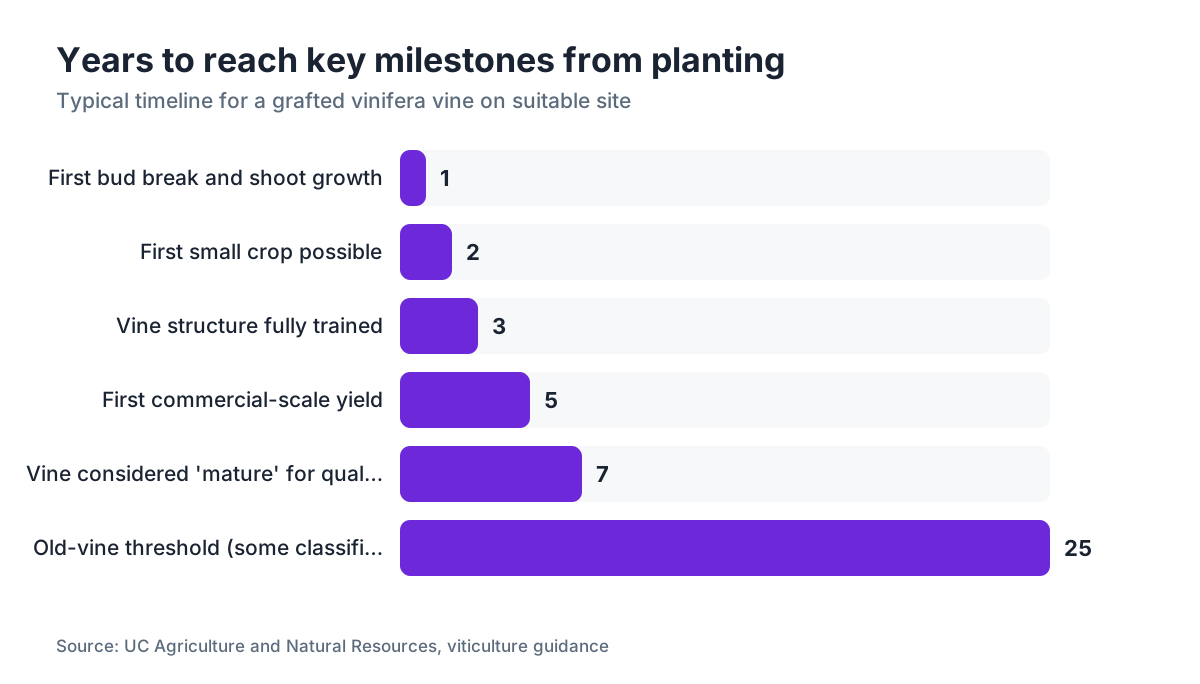
- Your first small crop shows up in year two or three, a full harvest by year four or five.
- Prune every dormant season, match the variety to your winters, and a single vine can bear fruit for 50 to 100 years.
What do grapes grow on, and how do grapes grow?
Grapes grow on vines, specifically a woody perennial in the genus Vitis. They do not grow on trees, though a vine will happily climb one if you let it, which is bad for the tree and makes the vine nearly impossible to manage. The vine has a permanent woody trunk and arms (called cordons), plus flexible annual shoots that push out each spring. Flowers form on those new shoots, get pollinated, and turn into the clusters you pick in late summer or fall.
A young vine looks deceptively simple: a thin green shoot poking out of the ground. By year three or four it has real structure. A trunk. Two or four cordons running horizontally along a wire. Dozens of fruiting shoots hanging off them. The bark on the trunk is shaggy and peeling, the leaves broad, lobed, and bright green, often with slightly fuzzy undersides depending on the variety.
Do grape vines flower? Yes, though the flowers are tiny and greenish-white, nothing like a rose. Most commercial wine and table grape varieties are self-fertile, so you do not need multiple plants for fruit set.
How long do grape vines live? A healthy vine on good rootstock in a suitable climate lives 50 to 100 years, and some old-vine Grenache and Carignan blocks in Spain and southern France are well past that [1]. Longevity comes down to site, rootstock choice, and whether you stay ahead of disease pressure.
Where do grapes grow, and can you grow them in your climate?
Grapes grow commercially on every continent except Antarctica, but the sweet spot is the temperate band roughly between 30 and 50 degrees latitude in both hemispheres [9]. The classic wine regions sit right there: California, the Pacific Northwest, France, Spain, Italy, Australia. Grapes are more adaptable than most people assume.
For backyard and small-farm growers, the honest answer is that variety selection matters more than latitude. Cold-hardy hybrids from the University of Minnesota (Marquette, Frontenac, La Crescent) handle winters down to minus 20 to 30 degrees Fahrenheit [7]. Cornell's breeding program gave us Cayuga White and Traminette for the eastern states [2]. Muscadine grapes (Vitis rotundifolia) thrive in the humid Southeast where Vitis vinifera would rot out from Pierce's disease. Vinifera varieties like Cabernet Sauvignon, Chardonnay, and Riesling want at least 150 to 180 frost-free days and a winter cold enough to force full dormancy without killing the canes.
Where can you grow grapes on a small scale? Almost anywhere, if you pick the right variety for your winters, your disease pressure, and your soil. Call your local Cooperative Extension office before you buy anything. Cornell Cooperative Extension keeps variety guidance for the Northeast [2], UC Davis has done deep work on varieties suited to California's many microclimates [3], and Washington State University Extension covers the Columbia Valley and out from there [4].
Chill hours matter for some varieties. Soil drainage matters everywhere. A wet, heavy clay soil kills more grape plantings than frost ever will.
How to start a grape vine: site prep and planting
Pick your site before you pick your variety. Grapes want full sun, at least six to eight hours of direct light a day, and they want moving air to hold down fungal disease. A gentle south- or southwest-facing slope is ideal in the Northern Hemisphere. Stay out of low spots where cold air settles and burns young shoots in a late-spring frost.
Do grape vines need full sun? Yes, consistently. Shaded vines make weak, unripe fruit and turn into disease magnets. If your site gets less than six hours of direct sun, grow something else.
Get a soil test before you plant. Your local Extension office or a private lab runs a full nutrient-and-pH panel for $20 to $50. Grapes prefer a pH between 5.5 and 6.5 for most varieties [3]. If you need to move the pH, work lime or sulfur into the top 12 to 18 inches at least a season ahead. Install drainage tile or raised rows now, because fixing drainage after the vines are in the ground is miserable.
Where to buy grape vines: get certified, virus-tested planting material from a licensed nursery whenever you can. UC Davis Foundation Plant Services keeps a repository of clean planting material for wine grape varieties [8]. Reputable nurseries include Sunridge Nurseries in California and Double A Vineyards in New York, which is strong on cold-hardy stock. Expect $3 to $8 per bare-root vine in quantity, more for grafted plants on specialty rootstocks.
How to start grape vines: plant bare-root vines in early spring as soon as the ground works, before or just as buds break. Dig a hole or trench about 12 inches deep. Set a grafted vine so the graft union sits 2 to 4 inches above the soil surface. Backfill with native soil, tamp gently, water in well. Spacing follows your trellis: a standard VSP (Vertical Shoot Positioning) setup runs 6 to 8 feet between vines in the row and 8 to 10 feet between rows if you drive a tractor through.
How to transplant grape vines: moving an established vine is hard, and survival drops off fast after year two. If you have to, prune the vine hard (to one or two canes), dig a wide root ball, and move it in early spring while it's fully dormant. Keep it watered all first season. Don't expect fruit for two years after the move.
How to construct a grape vine trellis
A trellis is not optional. Grapevines left to sprawl on the ground rot, get eaten, and yield lousy fruit. Build the trellis before or right at planting so you're not fighting an established vine later.
The simplest trellis that actually works for a backyard or small block is a two-wire system. Here's the parts list:
- End posts: 4-inch diameter pressure-treated wood or steel T-posts, 8 feet long, set 2 to 2.5 feet in the ground. Brace them with diagonal braces or guy wires, because wire tension pulls them inward over time.
- Line posts: smaller posts (2 to 3 inch diameter) set every 18 to 24 feet between end posts.
- Wire: high-tensile galvanized wire, 12 or 12.5 gauge. Low-carbon high-tensile wire is the standard because it holds tension without stretching much. Figure $0.10 to $0.20 per foot in quantity.
- First wire height: 30 to 36 inches off the ground (the fruiting wire).
- Second wire height: 18 to 24 inches above the first (for shoot positioning).
For a VSP system, the most common choice for small vineyards and backyard growers, you want two foliage wires above the fruiting wire that you can spread apart to hold upright shoots. Some growers run a movable catch-wire setup with snap-on wire holders, which makes shoot tucking faster.
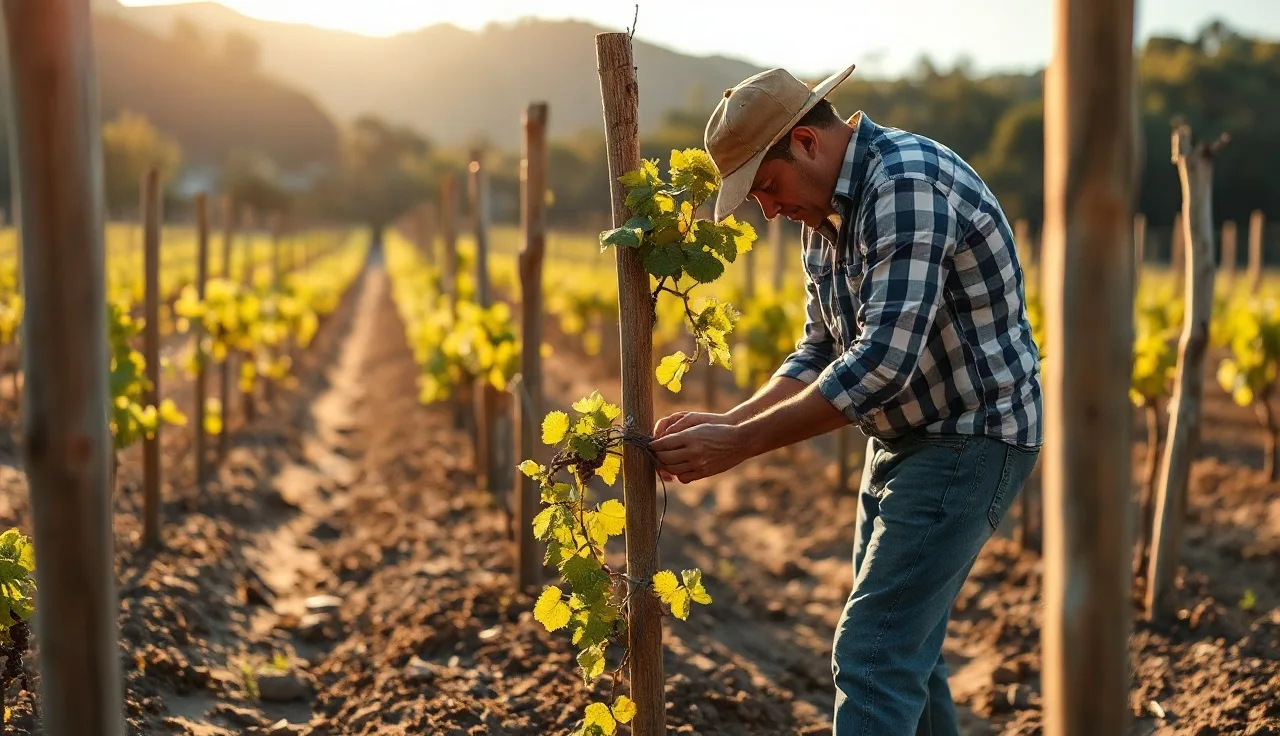
How to trellis grape vines: once the trellis is up, tie the young vine's single upright shoot to a bamboo stake or the post with soft ties, never wire. The whole job in year one is to grow one strong vertical shoot to wire height. In year two you train that shoot into the cordon structure. Don't let the vine flop around in year one. It slows establishment badly.
How to train grape vines through the first three years
Training is the multi-year job of building the permanent vine structure. It's different from pruning, which you do every dormant season once the structure exists.
Year one: after planting, let all shoots grow freely until midsummer, then pick the single strongest, most vertical shoot as the future trunk. Tie it to your stake as it climbs. Remove the rest. The target is getting that trunk shoot to wire height (30 to 36 inches) by the end of the season. If it falls short, no harm done. Try again next year.
Year two: if the trunk shoot reached wire height, cut it back to just above the fruiting wire in late winter. That push forces two shoots from just below the cut, and those become your cordons. Train one each direction along the fruiting wire, tying loosely as they run. If the trunk didn't reach the wire in year one, let it grow up to the wire in year two and repeat.
Year three: by now you should have two cordons running the fruiting wire. In late winter, cut back the laterals on those cordons to two-bud spurs spaced 6 to 8 inches apart. Those spurs are what throw your fruiting shoots from here on. You can take a small crop in year three, maybe 1 to 2 pounds per vine. Don't chase yield yet. You're still building roots.
WSU Extension's viticulture publications lay out this training sequence in detail for the Pacific Northwest, and the principles carry across regions [4].
How to look after grape vines: season-by-season management
Once your vines are established, the care settles into a predictable annual rhythm.
Dormant season (late winter): this is when you prune. For spur-pruned cordons, cut each shoot back to two buds. For cane-pruned systems like Guyot, select one or two canes from last year's growth, tie them to the wire, and cut everything else back to a renewal spur. Cornell's viticulture program has solid pruning guides for both systems [2]. In cold climates, don't prune too early, before the coldest weather has passed, because freshly cut wood is a little more vulnerable.
Early spring: bud break is the most frost-sensitive moment of the year. Watch the forecast. If the models show temperatures below 28 degrees Fahrenheit after bud break, you may need frost protection: wind machines, overhead irrigation, or smudge pots. One bad frost event can wipe out an entire year's crop.
Spring through fruit set: work the canopy. Pull suckers off the trunk, tuck shoots into the catch wires, and hedge (top) shoots that shoot up past the top wire. Keep the fruiting zone open for airflow. This is also when most of your spray program runs, covering fungal diseases (powdery mildew, downy mildew, botrytis) and insects. Keep your pesticide application records current and accurate. Once you're past a small backyard planting, a real spray record system saves you hours at audit time. VitiScribe is built specifically for vineyard spray records and compliance documentation.
Summer: scout for pests and diseases weekly. Pull leaves around the cluster zone after fruit set to open airflow and let spray reach the fruit. Don't overdo it on hot sites, where sunburned fruit becomes its own problem.
Harvest: timing depends on variety, target use (table versus wine), and actual Brix (sugar level). Most wine grapes hit harvest between 20 and 26 degrees Brix, though that swings widely by style. Table grapes come off by taste and texture. Check clusters in several spots across the block. Ripening is never even.
When and how to fertilize grape vines
Over-fertilizing grapes is at least as common a mistake as starving them, and it does real damage. Too much nitrogen pushes leaf and cane growth at the expense of fruit, builds dense shaded canopies that breed disease, and drags out ripening.
When to fertilize grape vines: base every decision on a soil test and, for established vines, a petiole (leaf stem) tissue analysis pulled at bloom. The petiole test gives you the truest read of what the vine is actually taking up [3]. UC Davis recommends sampling petioles opposite the basal cluster at full bloom for wine grapes [11].
How to fertilize grape vines: nitrogen is usually the first question. Most established vines in decent soils need 20 to 60 pounds of actual nitrogen per acre per year, depending on vine size and crop load [11]. Apply it in early spring before bud break, or split it between early spring and bloom. Never apply nitrogen after veraison, when the berries start to color, because it drives late-season vegetative growth and hurts fruit quality.
Potassium is the second most common deficiency. It shows up as marginal leaf scorch (leaf edges turning brown) and low juice pH. Phosphorus shortages are rarer in most soils but appear as poor fruit set and reddish leaves.
For young vines in the first two years, a light application of a balanced granular fertilizer or compost in early spring is plenty. Go easy on nitrogen near planting. Heavy doses burn roots and force top growth that won't harden off before winter.
| Nutrient | Target petiole level at bloom | Common deficiency symptom |
|---|---|---|
| Nitrogen | 0.8 to 1.2% | Pale, small leaves; weak shoots |
| Potassium | 1.5 to 2.5% | Marginal leaf scorch |
| Magnesium | 0.3% or above | Interveinal chlorosis on older leaves |
| Boron | 25 to 50 ppm | Poor fruit set, shot berries |
Source: UC Cooperative Extension, viticulture nutrient management guidelines [11].
How to manage pests: do deer eat grape vines, and what else should you worry about?
Deer eat grape vines aggressively. Young shoots and leaves stay palatable to them from early spring through fall, and a single deer can defoliate a young vine overnight. Repeated browsing kills it. If deer are on your property, exclusion fencing at least 8 feet tall for white-tailed deer is the only reliable fix. Trunk guards and individual vine cages help protect young vines the first season or two, but they don't replace perimeter fencing once you have more than a handful of vines.
Beyond deer, the major pests and diseases depend heavily on your region:
- Powdery mildew (Erysiphe necator): the most economically significant fungal disease for vinifera everywhere. Spreads in warm, dry weather with mild nights. Manage it proactively with a spray program starting at bud break.
- Downy mildew (Plasmopara viticola): a different pathogen that favors wet, humid conditions. A big problem in the East and Midwest.
- Botrytis bunch rot: infects at flowering and turns into a harvest-time headache in tight-clustered varieties and humid regions.
- Grape berry moth (Paralobesia viteana): a major pest in the East. Larvae damage berries and open the door to rot organisms [10].
- Leafhoppers and spider mites: more common in hot, dry climates.
- Pierce's disease: a bacterial disease spread by sharpshooters (a type of leafhopper), fatal to vinifera in the Southeast and parts of California. No cure. Variety selection is your only real tool.
Pesticide applications in commercial and even semi-commercial settings fall under the EPA Worker Protection Standard (WPS), which requires specific training, posting of restricted-entry intervals, and record-keeping [5]. Even with just a few employees, know your WPS obligations before you spray anything.
For backyard growers going organic, sulfur-based fungicides work against powdery mildew and many are OMRI-listed. Copper-based products cover downy mildew. Neither is harmless: sulfur burns tissue above 90 degrees Fahrenheit, and copper builds up in soil with repeated use.
Are grape vine leaves edible, and other things you can do with your vine
Grape vine leaves are edible and have a long culinary history across the Mediterranean, the Middle East, and the Balkans. Stuffed grape leaves (dolmades in Greek, yaprak sarma in Turkish) are the best-known use. Young, tender leaves picked in late spring and early summer taste best. Older leaves get tough and tannic.
You can eat grape vine leaves raw in salads when they're very young, blanch them for stuffing, or brine them for keeping. Vitis vinifera leaves are the usual choice, but most Vitis species leaves are fine to eat. If you're pulling leaves from a sprayed vineyard, follow the pesticide label re-entry and pre-harvest intervals to the letter, and wash the leaves well.
Beyond the leaves, the young tendrils are edible and taste mildly tart and grape-y. Some cooks toss them into salads. The dormant canes work for smoking meat (grape wood smoke is mild and pleasant) and for basket weaving. Almost nothing on a vine has to go to waste if you pay attention.
Is my grape vine dead? How to tell and what to do
This question lands every spring, usually from newer growers who planted the year before. Grapevines go fully dormant in winter and look stone dead: brown, dry canes, no sign of life. That's normal.
The scratch test is the fastest diagnostic. Use your thumbnail or a pocket knife to scratch the bark on a cane or the trunk. Green or creamy-white and slightly moist underneath means the vine is alive. Brown, dry, and fibrous all the way through means that section is dead.
Check several canes. A vine can carry dead canes on a live trunk and crown. Check the graft union (if grafted) and the crown just below soil level. If the crown is alive, the vine will almost always push new growth from there, even when every bit of above-ground wood is dead from winter kill.
If the whole vine is dead, brown from the ground up through the crown, replace it. There's no bringing back a dead root system.
If the trunk is alive but all the canes are dead from cold, cut the dead wood back to the trunk in early spring. The vine pushes shoots from latent buds on the trunk. Pick one or two strong ones and retrain. You lose a year of production, but the vine lives.
Slow leaf-out doesn't mean the vine is dead. Some varieties (Chardonnay especially) break buds later than their neighbors. Wait until surrounding vines are fully leafed out before you call it.
Persistent wilting, wood with orange or brown vascular streaking, and gummy cankers on the trunk point to Botryosphaeria or Eutypa dieback (trunk diseases), not winter kill. Those call for cutting out infected wood well below the visible symptoms, and if the whole trunk is infected you may end up replanting.
Keeping records: compliance and spray logs for small vineyards
If you grow grapes commercially or semi-commercially, the paperwork doesn't go away. California requires pesticide application reports to the county agricultural commissioner within 7 days of application under the California Food and Agricultural Code [6]. Most other wine-producing states have similar restricted-use pesticide record-keeping rules. Even non-restricted pesticides belong in your log, both for liability protection and for any organic or sustainability certification you want to chase.
A basic spray log captures date, block or field ID, product name, EPA registration number, target pest, rate applied, water volume, applicator name, and REI (restricted entry interval). The EPA WPS requires that application information be available to workers and that REIs be posted at the field entrance. As EPA puts it, the standard is meant to "reduce the risk of pesticide poisonings and injuries among agricultural workers and pesticide handlers" [5].
For anyone farming more than a few acres, tracking this on paper or a loose spreadsheet gets messy fast. VitiScribe is built specifically for vineyard spray records, block-level notes, and compliance documentation, so your records are ready the day your county ag commissioner or a certifier asks.
Lean on your local vineyard associations too. If you want a sense of what established vineyards look like operationally, the vineyard hub on VitiScribe covers broader vineyard management topics.
What do established wine regions tell us about growing grapes at home?
Walking a working vineyard is one of the fastest ways to pick up practical knowledge that would otherwise take years to accumulate. Regions like Paso Robles wineries in California's Central Coast show how growers manage dry-farmed blocks on calcareous soils, while a destination like Gervasi Vineyard in Ohio shows what's possible with cold-hardy varieties in a humid continental climate.
The lesson from any established region is the same: matching site to variety is what lets vines live for decades and produce reliably. Growers in those regions didn't win by fighting their climate. They won by finding the varieties and rootstocks that suit it.
For your own planting, that means sitting down with your local Extension viticulture advisor before you buy a single vine. An hour of free consultation can save you years of failed experiments.
Frequently asked questions
How long does it take to get grapes from a new vine?
Expect a small crop in year two or three, but a full commercial-level yield takes four to five years after planting. Most viticulturists don't count on a vine until year three at the earliest. The first couple of years are about building root depth and permanent structure. Pushing fruit too early stunts long-term vine development.
Do grape vines need full sun?
Yes. Grapes need at least six to eight hours of direct sun a day. Less than that and you get weak shoot growth, poor ripening, and disease-prone dense canopies. South- or southwest-facing slopes are ideal in the Northern Hemisphere. Partial shade might work for ornamental purposes, but you won't get quality fruit.
Can grapes grow on trees, or do they need a trellis?
Grapes climb trees in the wild, but it's a bad management situation: you can't prune properly, you can't spray the fruit zone, and the vine competes with the tree for water and nutrients. For any productive planting, a dedicated trellis is necessary. Even for a single backyard vine, a simple two-wire post-and-wire setup is worth the afternoon it takes to build.
How do I know which grape variety to plant in my region?
Call your local Cooperative Extension office first. Cornell has variety guidance for the Northeast, UC Davis covers California varieties in depth, and WSU Extension handles the Pacific Northwest. The factors that matter: winter hardiness, days to maturity against your frost-free season, and disease resistance for your humidity and rainfall. Don't buy a variety because you like the wine from it. Buy it because it suits your site.
Will deer eat grape vines?
Yes, reliably and aggressively. Deer browse young shoots, leaves, and even bark on young trunks. A single night of feeding can set a young vine back weeks. For any planting bigger than a few vines, perimeter exclusion fencing at least 8 feet tall is the practical answer. For individual young vines, mesh trunk guards or cage protectors buy time but aren't a long-term fix.
Are grape vine leaves edible?
Yes. Young grape leaves picked in late spring are edible raw or cooked and show up widely in Mediterranean and Middle Eastern cooking, most famously as stuffed grape leaves (dolmades). Older leaves are tougher and more tannic. If the leaves come from a sprayed vineyard, observe every pesticide pre-harvest interval on the product label and wash the leaves well before use.
How do I tell if my grape vine is dead or just dormant?
Do the scratch test: scratch a small patch of bark on a cane or the trunk with your thumbnail. Green or creamy-white moist tissue underneath means alive. Brown, dry, fibrous tissue means that section is dead. Check the crown just below soil level last. If it's green, the vine will likely push new growth even when all the above-ground canes are winter-killed.
When should I prune grape vines?
Prune during dormancy, after the coldest weather has passed but before bud break. In most temperate regions that's late February through March. Pruning too early, before the last hard freeze, slightly raises cold-damage risk to freshly cut wood. Pruning too late, after bud break, wastes the energy the vine already spent pushing those buds and causes bleeding from fresh cuts.
How do I fertilize grape vines properly?
Start with a soil test and, for established vines, a petiole tissue test at bloom. Grapes need relatively modest nitrogen: 20 to 60 pounds of actual nitrogen per acre per year for most established vineyards. Apply in early spring before bud break. Never add nitrogen after veraison. Potassium and magnesium are the next most common needs. UC Cooperative Extension guidelines are the best reference for nutrient thresholds.
How do I transplant an established grape vine?
Transplanting is hard on any vine older than two years, and survival drops sharply after year three. If you have to do it, prune the vine back to one or two canes, dig a wide root ball in early spring while it's fully dormant, replant right away at the same depth, and water consistently through the first growing season. Don't expect fruit for at least two years after the move, and accept that some vines simply won't survive it.
Do grape vines flower, and do you need multiple plants?
Yes, grape vines flower each spring on new shoots. The flowers are small, greenish-white, and fragrant. Nearly all commercial wine and table grape varieties are hermaphroditic (self-fertile), so one plant gives you fruit. Muscadine grapes are the exception: many cultivars carry only female flowers and need a self-fertile pollinator variety planted nearby.
Where can I buy grape vines, and what should I look for?
Buy certified, virus-tested planting material from licensed nurseries whenever you can. UC Davis Foundation Plant Services keeps a repository of clean wine grape material. For cold-hardy varieties, Double A Vineyards in New York is a well-regarded source. Expect $3 to $8 per bare-root vine, more for grafted material on specialty rootstock. Skip unnamed varieties from big-box garden centers if you want reliable performance.
What records do I need to keep for a small commercial vineyard?
At minimum: pesticide application logs with product name, EPA registration number, date, rate, applicator, and REI. California requires submission to the county agricultural commissioner within 7 days for restricted-use pesticides. Most states require similar records for restricted-use materials. Keep spray records at least two years, longer if you're pursuing organic certification. Worker Protection Standard documentation is also required if you have any employees.
How do I manage grape vines organically?
The core tools are sulfur (for powdery mildew), copper (for downy mildew and botrytis), and kaolin clay (for some insects and sunburn). Canopy work, especially shoot positioning and leaf pulling to open airflow, cuts disease pressure a lot. Organic management is harder with vinifera in humid climates. Disease-resistant hybrid varieties make organic production far more realistic for growers outside California and the arid West.
Sources
- Wine Institute, old vine definitions and age references: Established grapevines can live well over 100 years in suitable conditions; old-vine Grenache and Carignan blocks in Spain and southern France are well past 50 to 100 years old.
- Cornell College of Agriculture and Life Sciences, Cornell AgriTech grape program: Cornell's grape breeding program developed cold-hardy varieties (Cayuga White, Traminette) suited to eastern U.S. climates; Cornell Extension provides pruning and training guides for spur and cane-pruned systems.
- University of California Agriculture and Natural Resources, viticulture resources: UC recommends petiole tissue sampling at full bloom for nutrient analysis; preferred soil pH for grapes is 5.5 to 6.5.
- Washington State University Extension: WSU Extension covers vine training sequences and pruning systems applicable to the Pacific Northwest and broadly to temperate viticulture regions.
- U.S. EPA, Agricultural Worker Protection Standard: The EPA Worker Protection Standard requires that pesticide application information be available to workers and that restricted-entry intervals be posted at field entrances; it is intended to reduce pesticide poisonings and injuries among agricultural workers and handlers.
- California Department of Pesticide Regulation, Pesticide Use Reporting: California requires pesticide application reports to the county agricultural commissioner within 7 days of application under the California Food and Agricultural Code.
- University of Minnesota Extension, fruit and grapes: University of Minnesota cold-hardy grape varieties including Marquette, Frontenac, and La Crescent can handle winter temperatures to minus 20 to 30 degrees Fahrenheit.
- UC Davis Foundation Plant Services: UC Davis Foundation Plant Services maintains a repository of certified, virus-tested grapevine planting material for wine grape varieties.
- USDA National Agricultural Library: Grapes are grown commercially worldwide across temperate regions roughly between 30 and 50 degrees latitude in both hemispheres.
- Cornell College of Agriculture and Life Sciences, grape pest management: Grape berry moth (Paralobesia viteana) is a major insect pest in eastern U.S. viticulture; larvae damage berries and create entry points for rot organisms.
- University of California Agriculture and Natural Resources, vineyard nutrient management: Target petiole nitrogen at full bloom is 0.8 to 1.2%; potassium target is 1.5 to 2.5%; established vineyards typically require 20 to 60 pounds of actual nitrogen per acre per year.
Last updated 2026-07-09