How to apply compost to vineyard rows without damaging surface drip

TL;DR
- Apply compost in a 2-to-4-inch layer centered on the vine row, keeping it at least 6 inches away from drip emitters and tape.
- Hand-rake or use a low-clearance spreader.
- Apply before budbreak or after harvest when vine stress is lowest.
- Check emitter output immediately after any compost work near the line.
Why does compost application threaten surface drip systems?
Surface drip is fragile in ways buried systems aren't. The tape sits right where you're working, often an inch or two off the soil surface, and it runs the full length of every row. One careless equipment pass can pinch, nick, or crush emitters. Even hand work can push compost debris into a self-cleaning emitter and kill it.
The problem compounds because compost is heavy and wet at application time. A cubic yard of finished compost weighs 800 to 1,100 pounds depending on moisture [1]. Drop that much material on a section of 8-mil drip tape and you can deform the emitter housing enough to cut flow rate without leaving a visible break. You won't know you have a problem until a vine goes dry in July.
There's a biological risk most people miss. Compost piled directly against an emitter raises the local moisture and temperature around the emitter body. That environment speeds up biofilm development inside the emitter channel, which is a leading cause of gradual clogging in pressure-compensating models [2].
None of this means you can't topdress with compost. It means you need a plan.
What's the right compost depth and placement for vineyard rows?
Two to four inches of finished compost is the standard recommendation for established vineyard floors, according to UC Cooperative Extension [3]. Less than two inches breaks down too fast to change soil structure. More than four inches suppresses gas exchange in heavy soils and buries emitters.
Placement matters as much as depth. Center your strip on the vine row, and keep compost at least 6 inches clear of any emitter body or drip tape connection point. If your tape runs along the cordon wire directly above the soil, that 6-inch clearance applies horizontally from the tape position as well as vertically.
For young vines (first and second leaf), drop the rate to 1 to 2 inches and widen the clearance to 12 inches from the emitter. Young drip systems are often installed at grade or slightly below, so burial risk is higher, and vine roots are still shallow enough that deep soil amendment near the trunk does limited good anyway.
Strip width matters too. In most VSP-trained vineyards, a strip 18 to 24 inches wide centered on the vine row is plenty. You don't need to cover the whole drive row. The inter-row vehicle path compacts under the spreader anyway, and compost there rarely reaches vine roots before it gets incorporated.
Which application methods protect drip tape best?
Here's an honest ranking of the four common methods, from lowest to highest drip-line risk:
| Method | Equipment ground clearance | Drip risk | Best for |
|---|---|---|---|
| Hand wheelbarrow and rake | N/A | Lowest | Small blocks, young vines |
| Walk-behind compost spreader | 6-10 in | Low-medium | Single rows, tight spacing |
| 3-point hitch side-discharge spreader | 12-18 in | Medium | Wide rows (10 ft+), mature tape |
| Full-width vertical-beater spreader | Varies, often <8 in | Highest | NOT recommended with surface drip |
Hand application with a wheelbarrow and landscape rake is the slowest method and the only one that gives you tactile feedback when the rake finds the drip line. You feel it before you damage it. For blocks under 5 acres with surface drip, this is what I'd do.
Walk-behind compost spreaders (think BCS or Grillo two-wheel tractors with a rear spreader attachment) work well if you set the throw direction away from the tape and keep forward speed slow. Under 2 mph is a reasonable target.
Three-point hitch side-discharge spreaders work on wider rows if you set the discharge deflector to throw away from the tape, make a single pass on the far side of the row first, then a second pass centered. Never drive directly over exposed tape with any tractor-mounted equipment without first confirming your lowest ground-clearance component clears the line.
Full-width vertical-beater spreaders are built for pasture and orchard floor work. The beaters run close to the ground and will find your drip tape. Skip this method entirely for vineyards with surface systems.
When is the best time of year to apply compost around drip lines?
Timing is your biggest risk-management lever. The two safest windows are pre-budbreak (late winter, soil still cool) and post-harvest (after leaf fall in cool climates, or after the last irrigation cycle of the season in warmer ones).
Pre-budbreak works for three reasons. The irrigation system is typically off or running minimal cycles. You have maximum visibility of the tape before canopy obscures the row. And any compost that contacts an emitter gets flushed through during the first full irrigation cycle, well before the vine needs peak water delivery.
Post-harvest application helps in blocks where you've had a pest or disease problem worsened by high soil moisture. Applying compost to dry soil lets you work fast and see everything. The compost then has four to six months to partially break down before peak-season irrigation loads the system.
Mid-season application, when vines are actively growing and irrigation runs daily or every other day, is the highest-risk window. You're more likely to miss a damaged emitter because you assume the system is working, and vine stress from a blocked emitter can show up within 48 hours in hot weather. If you must apply mid-season, run an emitter flow check the same afternoon you finish spreading.
How do you protect emitters and tape connections before spreading?
Pre-application protection is faster than post-application repair. Three approaches actually work.
First, flag every emitter position before any equipment or spreader enters the row. Orange pin flags work. Place one flag 6 inches on each side of each emitter along the tape run. It doubles as a training marker for any crew doing hand spreading.
Second, for emitters on risers (where the emitter sits elevated off the tape on a short stake), remove them and cap the barb before spreading if you're using mechanized equipment. Most pressure-compensating emitters unclip or unscrew in under 30 seconds. Store them in a labeled bucket, cap the barbs with goof plugs or vinyl end caps, and reinstall after spreading and raking.
Third, for tape connections at the mainline (where the lateral connects to the header), wrap the connection with a layer of burlap before spreading. Burlap is visible, biodegradable, and keeps compost from packing into the joint. Unwrap it after you rake the row.
None of these steps takes more than 15 to 20 minutes per acre for an organized crew. That's cheap insurance against diagnosing a clogged or pinched emitter in August.
What compost maturity level is safest near drip lines?
Use only finished, fully mature compost near any drip system. This is non-negotiable.
Immature compost, meaning material that hasn't finished thermophilic decomposition and curing, is still biologically active. It generates heat (internal temperatures can top 140°F during active decomposition), it carries high ammonia levels, and it holds far more moisture than finished material [4]. All three properties are bad news near a drip emitter.
How do you know it's finished? Finished compost smells earthy, not ammonia-like or sulfurous. It has a consistent dark color with no recognizable feedstock pieces larger than half an inch. The California Compost Quality Council, whose standards get referenced across western states, says finished compost should have a C:N ratio of 25:1 or lower and a CO2 respiration rate under 8 mg CO2-C per gram of volatile solids per day [5]. Most commercial compost vendors will supply a test report on request.
Granular or pelletized compost is worth a look for drip-protected applications. The pellets go down with a drop spreader, they don't pack against emitter bodies the way bulk material does, and they break down with irrigation contact. The tradeoff is cost. Pelletized products typically run 3 to 5 times the price of bulk finished compost per cubic yard equivalent.
How do you check that drip emitters still work after compost application?
Run a full system inspection within 24 hours of application. Not a week later. Not at the start of the next scheduled irrigation cycle.
The simplest field check: run the system for 5 minutes and walk every vine, looking for wet soil at the emitter position. Dry soil next to a running system is the tell. Mark any suspect emitters with a flag and come back with a catch cup.
A catch cup test is the standard method for quantifying emitter output. Place a 100 mL graduated cylinder or a commercial catch cup under each suspect emitter for 1 minute at operating pressure. Compare the reading to the emitter's rated flow (typically 0.5 to 1.0 GPH for pressure-compensating vineyard emitters, which at 1-minute intervals equals roughly 8 to 17 mL per minute). A reading more than 15 percent below rated output suggests partial blockage [6].
Found a blocked emitter? Flush the lateral first: open the end cap, run full pressure for 30 seconds, then re-test. If it's still underperforming, remove the emitter, clear the barb hole with a toothpick or emitter pick tool, rinse the emitter body, and reinstall. If flow is still off, replace it. Emitters run $0.15 to $0.60 each, so this is not a place to cut corners [6].
Logging which emitters you tested and their output readings is good practice for any block, and it's exactly the kind of field operations record that a tool like VitiScribe handles without extra paper.
See also: vineyard for broader irrigation and floor management context.
Does compost application affect drip system water chemistry or clog risk?
Yes, and this is underappreciated. When compost breaks down in contact with irrigation water, it can leach tannins, soluble organics, and fine particulates into the water film at the emitter surface. Over a season, that residue feeds biofilm buildup inside the emitter labyrinth.
If your water source is already high in bicarbonates (alkalinity above 150 ppm), organic acids from decomposing compost can cause a localized pH shift at the emitter that speeds up scale precipitation. UC Cooperative Extension's irrigation water quality guidelines recommend testing source water at least once a year, and adjusting injection programs seasonally if alkalinity or iron levels are elevated [7].
Here's the practical version. If you apply compost and then notice your drip system pressure gauge reading higher than usual two to three weeks later, that's a sign of partial line obstruction. Flush all laterals from the end caps. If you run acid injection for scale prevention, run one slightly higher-concentration flush cycle the week after compost application.
Filtration at the mainline helps too. A 155-mesh or finer screen filter catches most organic fine particles before they reach the emitters. If your system runs a 75 or 80-mesh filter now, upgrading the screen after compost work is worth doing.
What do university extension programs say about vineyard compost application rates?
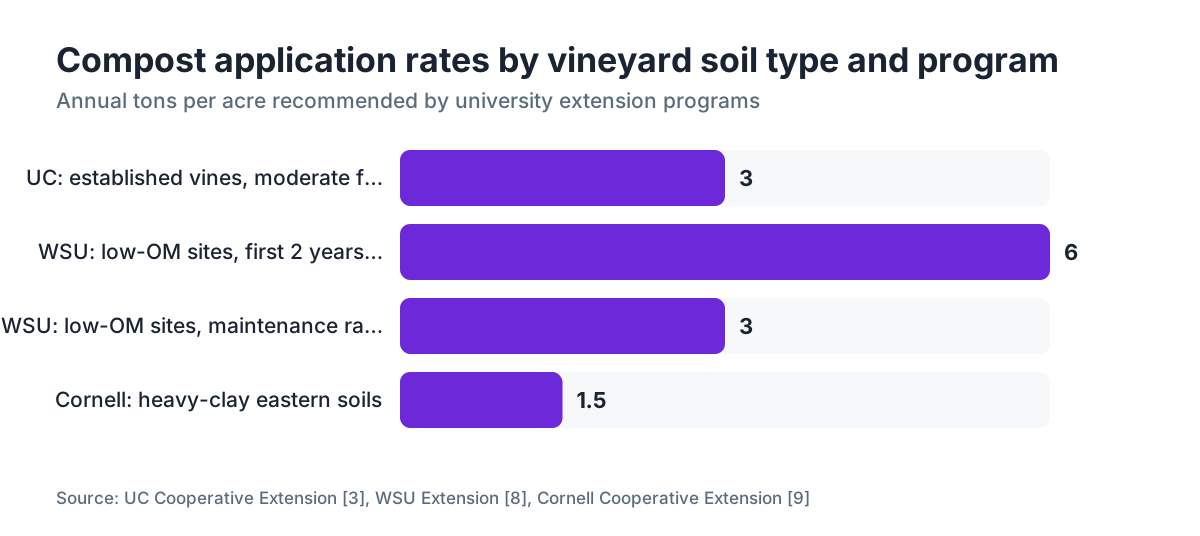
UC Cooperative Extension recommends 2 to 4 tons per acre per year for established vineyards on moderate-fertility soils, applied as a surface dressing in the vine row [3]. Washington State University Extension gives similar rates for Pacific Northwest conditions, and notes that sites with a history of low organic matter (below 1.5 percent by weight) may benefit from doubling that rate for the first two years to build baseline SOM before dropping to maintenance rates [8].
Cornell Cooperative Extension, covering New York and other eastern production regions, points out that heavy-clay soils common in the Finger Lakes may show compaction benefits from compost even at lower rates (1 to 2 tons per acre), because the main mechanism in those soils is aggregate stability improvement rather than nutrient supply [9].
None of these programs give specific drip-protection guidance in their compost publications, which is a gap in the extension literature. The irrigation equipment manufacturers (Netafim, Toro, Rain Bird) fill that gap in their installation and maintenance manuals with guidance that generally matches the 6-inch clearance rule described earlier.
For record-keeping: document your compost application date, source, volume or tonnage, and application method for each block. If you're in a region where compost applications count toward a nutrient management plan or organic certification, those records need to be inspection-ready.
Are there worker safety rules that apply to compost application in vineyards?
Compost is not a pesticide, so the EPA Worker Protection Standard (WPS) does not apply to compost application [10]. Other worker safety rules still matter.
First, finished compost produced from biosolids carries specific land-application requirements under EPA 40 CFR Part 503, including setback distances from water bodies and application rate limits [11]. Most commercial vineyard composts are not biosolid-derived, but verify with your supplier.
Second, any compost made from municipal solid waste sources may face California (or other state) restrictions on application near water sources or on land with surface irrigation systems. Check your state ag department's solid waste compost rules if you're sourcing from a municipal or commercial composting facility.
Third, OSHA's general industry heat illness and PPE standards apply to compost spreading crews. Finished compost can harbor thermophilic bacteria and actinomycetes that cause hypersensitivity pneumonitis in susceptible workers with repeated exposure. This is rare with normal field work, but anyone spending hours operating a compost spreader should have basic respiratory protection (an N95 respirator minimum) available [12].
Keep your compost purchase receipts and certificates of analysis on file. They're simple to store digitally and they document feedstock source if you're asked during an organic certification inspection.
What's the real cost of getting this wrong, versus doing it carefully?
A blocked emitter on a mature vine during July costs more than the labor to avoid it. The direct cost of replacing a drip emitter is under $1. The cost of diagnosing mid-season vine stress, re-running a sector to confirm the problem, then losing a portion of one vine's crop weight is harder to pin down but easily runs $50 to $200 per vine depending on your variety and market.
A crushed or punctured section of drip tape is a different problem. Replacing a section of 1/2-inch drip tape costs roughly $0.15 to $0.30 per foot for materials alone [6]. A 300-foot row run with a 6-inch puncture that goes undetected for two weeks means differential irrigation, differential ripening, and a non-uniform block at harvest. That's a quality problem, bigger than a repair bill.
The labor cost for careful compost application (flagging emitters, using appropriate equipment, post-application inspection) in a 10-acre block with 8-foot row spacing runs 4 to 8 hours of extra work compared to a fast bulk spread. At $20 to $25 per hour for experienced crew, that's $80 to $200. Call it the insurance premium. It's worth paying.
For blocks you're tracking long-term, see paso robles wineries for examples of how dry-climate operations handle floor management under tight water constraints, where drip system integrity is non-negotiable.
Track your compost applications, equipment settings, and post-application emitter checks in a field log. VitiScribe is built for exactly this kind of block-level record, so you have a searchable history when your irrigation consultant or certifier asks what you applied and when.
Can you apply compost by hand in small blocks and still get uniform coverage?
Yes, and for blocks under 3 acres, hand application with a wheelbarrow and a stiff-tine landscape rake is my actual recommendation. You get coverage you can control to the inch.
The trick is to pre-load the row before you rake. Drop piles from the wheelbarrow every 10 to 12 feet along the row before you start raking. Then distribute from each pile outward with the rake, working away from the drip tape. This keeps you from dragging debris across the tape line, which is what happens when people rake from the inter-row inward.
For a crew of two on a 1-acre block with 6-foot vine spacing and 10-foot row width, expect 4 to 6 hours for 2 inches of compost coverage. That's slow but accurate. Add a third person if you want to cover more than an acre per day at that depth.
Uniformity: rake in two perpendicular passes if the area allows. First pass lays material, second pass levels. Use a notched depth gauge (a 2-inch wooden dowel works) to spot-check depth every 20 feet. You don't need perfect. You need consistent enough that no zone gets buried under 6 inches or missed entirely.
For more on managing vineyard floor operations generally, the vineyard section of this site covers inter-row and in-row management in more detail.
Frequently asked questions
How close to drip emitters can you apply compost?
Keep finished compost at least 6 inches away from any emitter body or drip tape connection. For young vines in their first or second leaf, widen that clearance to 12 inches. The risk isn't only mechanical damage from weight. Compost packed against an emitter creates a moist, warm microenvironment that speeds biofilm clogging inside the emitter labyrinth.
Can compost block or damage drip tape emitters?
Yes, in two distinct ways. Heavy bulk compost applied directly over tape can deform emitter housings and cut flow rate without leaving a visible break. Fine organic particles from decomposing compost can also enter emitter channels and feed biofilm clogging. Both problems are preventable with proper placement and a post-application flow check within 24 hours.
Should you remove drip emitters before spreading compost?
For mechanized spreading equipment, removing emitters on risers and capping the barbs before you spread is the safest approach. It takes 20 to 30 seconds per emitter and eliminates any risk of the spreader contacting the emitter housing. For hand application with proper clearance technique, removal is optional. Reinstall emitters before running the next irrigation cycle.
What type of compost works best in vineyard rows?
Fully finished compost with a C:N ratio of 25:1 or lower and no recognizable feedstock pieces over half an inch. Immature compost is biologically active, generates heat, and holds excess moisture, all of which are harmful near drip emitters. Granular or pelletized compost is the safest form for emitter protection, though it costs 3 to 5 times more than bulk material.
How many tons of compost per acre should a vineyard apply annually?
UC Cooperative Extension recommends 2 to 4 tons per acre per year for established vineyards on moderate-fertility soils. Washington State University Extension suggests doubling that for the first two years on low-organic-matter sites (below 1.5 percent SOM) before dropping to maintenance rates. Cornell Extension recommends 1 to 2 tons per acre on heavy-clay eastern soils where aggregate stability is the primary goal.
When is the worst time to apply compost near drip lines?
Mid-season, when irrigation runs daily and vine stress risk is highest. If you damage or block an emitter during active growth, you may not detect it for days, and a vine can show heat stress within 48 hours of losing water delivery in hot weather. The safest windows are pre-budbreak in late winter and post-harvest after the irrigation system is shut down.
How do you test drip emitters after compost application?
Run the system for 5 minutes and walk every vine looking for wet soil at the emitter position. Dry soil next to a running system is the sign of a blocked or damaged emitter. For quantitative confirmation, use a catch cup: collect output for 1 minute and compare to the emitter's rated flow rate. A reading more than 15 percent below rated output indicates partial blockage.
Does compost application near drip lines affect water chemistry?
It can. Decomposing compost leaches soluble organics and fine particles into the water film at the emitter surface, feeding biofilm buildup over a season. In water with alkalinity above 150 ppm, organic acids from compost can trigger localized scale precipitation at the emitter. Flush laterals after compost application and consider one extra acid-injection cycle if you run chemical treatment programs.
What equipment should you NOT use to spread compost near surface drip?
Avoid full-width vertical-beater spreaders entirely. The beaters run close to the ground by design and will contact and damage surface drip tape on any normal application pass. Side-discharge spreaders with low ground clearance are also risky unless you've confirmed the lowest component of the spreader clears your tape by at least 2 inches with a physical measurement, not an estimate.
Is compost application in vineyards covered by EPA Worker Protection Standard?
No. Compost is not a pesticide, so the EPA Worker Protection Standard does not govern compost application. Workers spreading compost do face dust and bioaerosol exposure from thermophilic bacteria and actinomycetes in the material. OSHA general industry standards apply, and NIOSH recommends N95 respiratory protection for workers with repeated high-exposure compost work.
How do you apply compost uniformly by hand without missing spots?
Pre-load the row first: drop wheelbarrow piles every 10 to 12 feet before you start raking. Then distribute from each pile outward, raking away from the drip tape rather than toward it. Use a depth gauge (a 2-inch dowel works) to spot-check every 20 feet. For a two-person crew, expect 4 to 6 hours per acre at 2-inch coverage depth.
Do I need to document compost applications for organic certification?
Yes. USDA National Organic Program certification requires records of all materials applied to certified ground, including compost source, application date, and rate per acre. Keep the supplier's certificate of analysis on file to document feedstock source and confirm no prohibited materials were used. These records must be available for inspection at any time during a certification audit.
How does compost affect soil moisture under a drip system?
Finished compost improves soil water-holding capacity over time by increasing organic matter and improving aggregate structure. In the short term, a 2 to 4 inch surface layer acts as a mulch, cutting evaporative loss from the soil surface under the emitter. Your irrigation scheduling may need adjustment in the season after a compost application, particularly on sandy or low-OM soils that respond quickly to organic matter inputs.
Sources
- UC ANR Publication 21514, Soil and Water Management for Sustainable Viticulture: Finished compost bulk density and weight per cubic yard varies with moisture content, typically 800 to 1,100 lbs per cubic yard
- Netafim, Drip Irrigation Clogging Prevention and Maintenance Guide: Elevated moisture and temperature around emitter bodies accelerates biofilm development inside the emitter channel
- UC Cooperative Extension, Soil Management in Vineyards: UC Cooperative Extension recommends 2 to 4 tons per acre per year of finished compost as a surface dressing in established vineyard rows
- US Composting Council, Compost Maturity and Stability Guidance: Immature compost remains biologically active, generating heat, elevated ammonia, and higher moisture than finished material
- California Compost Quality Council, Compost Maturity Index: Finished compost should have a C:N ratio of 25:1 or lower and a CO2 respiration rate under 8 mg CO2-C per gram of volatile solids per day
- Netafim, Drip Irrigation Design and Maintenance Guide: Emitter output more than 15 percent below rated flow indicates partial blockage; replacement emitters run roughly $0.15 to $0.60 each and drip tape runs $0.15 to $0.30 per foot
- UC Cooperative Extension, Irrigation Water Quality Guidelines for California Agriculture, Publication 8086: UC Cooperative Extension recommends annual irrigation water quality testing and flags alkalinity above 150 ppm as a risk factor for scale precipitation in drip systems
- Washington State University Extension, Cover Crops and Compost in Pacific Northwest Vineyards: WSU Extension recommends doubling compost application rate for the first two years on vineyard sites with soil organic matter below 1.5 percent before dropping to maintenance rates
- Cornell Cooperative Extension, Organic Matter Management in Northeastern Vineyard Soils: Cornell Cooperative Extension notes that 1 to 2 tons per acre of compost per year is sufficient for heavy-clay eastern vineyard soils where aggregate stability rather than nutrient supply is the primary benefit
- EPA Worker Protection Standard, 40 CFR Part 170: The EPA Worker Protection Standard applies to pesticides and does not govern the application of compost or other non-pesticide soil amendments
- EPA Biosolids Regulations, 40 CFR Part 503: Compost derived from biosolids is subject to EPA 40 CFR Part 503 land application requirements including setback distances and application rate limits
- NIOSH, Health Effects of Occupational Exposure to Compost, DHHS Publication: NIOSH identifies thermophilic bacteria and actinomycetes in finished compost as potential causes of hypersensitivity pneumonitis with repeated occupational exposure and recommends N95 respiratory protection
- USDA National Organic Program, Allowed and Prohibited Substances: USDA NOP certification requires documentation of all materials applied to certified ground including compost source, application date, and application rate, available for inspection
Last updated 2026-07-11