How to record a compost tea application in organic vineyard logs

TL;DR
- Every compost tea application in a certified organic vineyard needs a written record covering the date, block or row ID, the inputs you brewed with, application rate, equipment, operator, and weather.
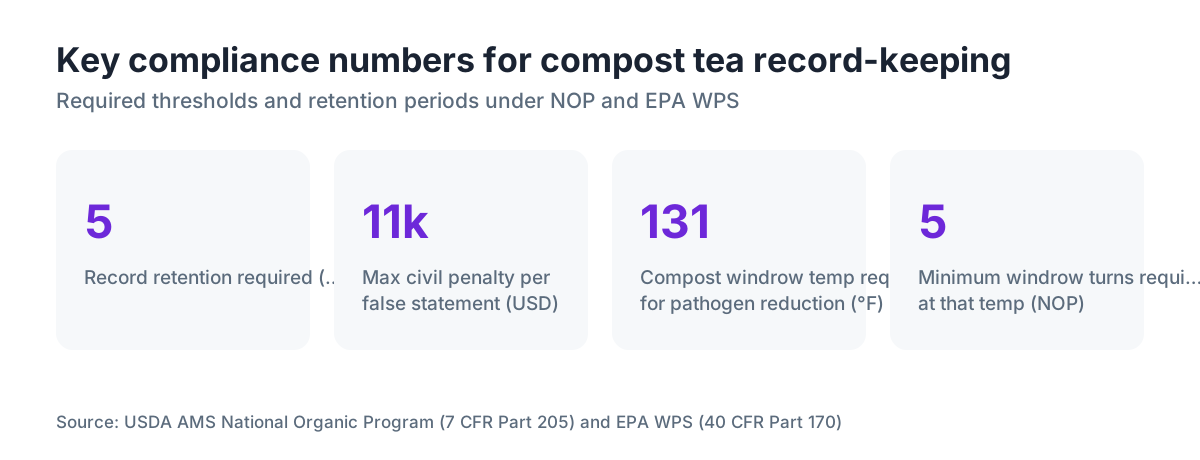
- The USDA National Organic Program requires those records be kept for five years and produced for inspection.
- Leave a field blank and an auditor reads it as noncompliance, not forgetfulness.
Why does recording a compost tea application matter for organic certification?
Organic certification is a paper audit as much as a farming practice. Your certifier never watches you spray. They read your logs, and an incomplete entry reads as a missed practice, not a missed line on a form.
The USDA National Organic Program, codified at 7 CFR Part 205, requires that certified operators keep records that "disclose all activities and transactions of the certified operation" and hold those records for not less than five years [1]. That language leaves no wiggle room. A compost tea application is a field activity and an input transaction, so it lands squarely inside that rule.
Compost tea sits in an awkward spot. It has no manufacturer label and no pre-approval sticker, because you brew it on-site. That means the whole compliance burden shifts onto your records. Every input you brew with (compost, molasses, fish hydrolysate, kelp, whatever) has to be documented and traced back to an approved source. The Organic Materials Review Institute (OMRI) listing for each ingredient, or your certifier's pre-approval of the recipe, belongs on file before you ever flip on the brewer [2].
Good records also protect you outside the audit. If a neighbor alleges drift, if a buyer questions your practices, or if you apply for a USDA EQIP Organic Initiative payment, your logs are the evidence. Write every entry like a skeptic will read it looking for a problem.
What specific fields must a compost tea log entry include?
There is no single federal form you have to use. That sounds like freedom, but it causes more grief than a mandated template would. Here is a complete entry, field by field.
| Field | Why it matters | Example entry |
|---|---|---|
| Date and time | Confirms application window, links to weather | 2024-06-14, 6:15 AM |
| Block / row ID | Ties activity to a specific parcel | Block 3, Rows 22-38 |
| Crop and growth stage | Documents timing against plant development | Chardonnay, pre-bloom (EL Stage 17) |
| Product description | Identifies what was applied | Actively aerated compost tea (AACT) |
| Brew inputs and quantities | Proves each ingredient was NOP-compliant | 5 gal finished compost (OMRI), 1 oz molasses (OMRI), 100 gal water |
| Brew duration and aeration method | Documents biological activity window | 24 hours, air pump at 5 CFM |
| Application rate (volume per acre) | Ties back to calibration records | 50 gal / acre |
| Dilution ratio | Clarifies concentrate vs. ready-to-use | 1:3 with well water |
| Application method and equipment | Identifies spray train or backpack, nozzle type | PTO sprayer, hollow-cone nozzles, 40 PSI |
| Target pest or use purpose | Justifies the application | Foliar microbial colonization, powdery mildew suppression |
| Operator name and signature | Establishes accountability | J. Rivera (signed) |
| Certifier pre-approval reference | Links to input approval | Certifier approval letter, 2024-03-01 |
| Weather at application | Documents conditions, relevant to WPS and efficacy | 62°F, wind 3 mph NW, humidity 74% |
| Re-entry interval (REI) | Required under EPA WPS even for exempt materials | 4 hours (per certifier guidance) |
| Adjacent water bodies | Documents any required buffer | North edge: 50-ft buffer from seasonal creek maintained |
That last column is not padding. It is the answer to every question an auditor is likely to ask. Fill every field every time. A blank cell invites a follow-up request, and follow-ups are where audits stall.
The EPA Worker Protection Standard (WPS), revised in 2015 and applicable to agricultural establishments, requires application records that include the product name, EPA registration number if one exists, active ingredient, location, date applied, and REI [3]. Compost tea has no EPA registration number, but the WPS record-keeping duty still attaches to the application event. Write "No EPA Reg. No., exempt biological" in that field rather than leaving it blank.
How do you document the brewing process itself, and does it count as a log entry?
Yes. The brew is a separate record from the field application, and you should treat it that way. Think of it like a tank mix record for a conventional pesticide. You log what goes in before you log what goes out.
A brew record needs the date and start time, the water source (municipal, well, or pond, with chlorine or chloramine noted since those kill the microbes you want), each input with its weight or volume, the aeration equipment, brew temperature if you measured it, the planned duration, and the name of the person who set it up. If you ran a microscopy check or a plate count to confirm biological activity before applying, log that result too. Cornell Cooperative Extension materials on compost and compost tea note that aeration duration and oxygen levels are the variables that drive microbial outcomes, so documenting them gives you a baseline you can reproduce [4].
The brew record then gets cross-referenced in the field application log. A short notation like "Brew Batch #24-06-14A" in the application record, with the brew record filed separately, keeps everything traceable without repeating every detail twice.
Brewing multiple batches a week during a busy stretch? A pre-printed brew sheet with checkboxes for each input saves time and cuts omission errors. The test is simple. Someone picking up your records cold should be able to reconstruct exactly what you brewed and what you applied.
What are the NOP-specific rules around compost tea ingredients, and how do they affect your log?
The NOP does not list "compost tea" as either approved or prohibited. What it does say is that all inputs must comply with 7 CFR 205.105, which bars synthetic substances not on the National List, and 7 CFR 205.203, which sets compost standards [1]. Because a brew concentrates and multiplies whatever lives in the source compost, certifiers scrutinize brew inputs harder than almost anything else on the farm.
Your log needs to show the compliance path for each ingredient. The cleanest way is a "Compliance basis" column next to each input:
- Finished compost: "Made on-site, thermophilic process, temp logs attached" or "Purchased, OMRI listed, invoice #4421"
- Molasses: "OMRI listed, Manufacturer X, Lot 2024-03A, invoice on file"
- Kelp meal: "OMRI listed, Manufacturer Y, SDS dated 2023-11-10"
- Water: "Well water, no additives, chlorine test negative (strip test, 2024-06-13)"
If your certifier requires pre-approval for each ingredient or each recipe change, the approval letter number belongs in the log. WSU Extension's organic farming resources note that certifiers vary widely on compost tea, with some requiring annual recipe approval and others reviewing on audit [5]. Learn your certifier's specific requirement and write it into your standard operating procedure before the season starts.
Fish hydrolysate trips up a lot of growers. It is often OMRI listed, but some products carry synthetic stabilizers. If it goes in a brew, your log has to reference the specific product name, lot number, and the OMRI listing or certifier approval. "Some fish product, 2 oz" fails.
How should the log be physically formatted, paper or digital?
NOP does not mandate paper or digital. It requires that records be accurate, legible, and available for inspection within the window your certifier specifies, usually 24 to 48 hours of a request during an unannounced inspection [1].
Paper logs work fine when they are organized. A three-ring binder per season, tabbed by block, with a consistent printed form for each application, is defensible and easy for a certifier to review on-site. The downside of paper is illegibility, lost pages, and the pain of searching across years when a question about one block's history comes up.
Digital logs need a tamper-evident quality in practice, even though NOP does not use that phrase. A timestamped PDF or a field platform with an audit trail (showing when each entry was made, not only the application date) beats a spreadsheet anyone can edit after the fact. If you live in a spreadsheet, export and lock it as a PDF at the end of each day.
For operators running more than a few blocks, a purpose-built vineyard record tool like VitiScribe can pull weather automatically, pre-fill block info, and build a compliant entry faster than typing into a spreadsheet. The real value is not speed. It is that the form's structure forces completeness before you can save. A well-maintained paper form does the same job. The tool matters less than the discipline.
Filing digitally? Back it up off-site. A house fire or a dead drive five years out should not erase records the law requires you to keep.
What weather and environmental data should you capture, and where does it come from?
Log weather at the time of application for three reasons. It affects efficacy (foliar sprays in high heat or wind kill the beneficial microbes), it documents your judgment if drift or runoff ever comes up, and it forms part of the EPA WPS record context.
At minimum, capture temperature, wind speed and direction, and relative humidity at application time. Spraying near a water body? Log that too and note the buffer you kept.
The source matters. "Felt like 70°F, not too windy" is not a record. Use a weather station reading, a NOAA station report, or a farm-mounted sensor. The NOAA National Centers for Environmental Information provides historical hourly data by station that you can download after the fact if you miss the real-time capture [6]. That backfill is fine as a cross-reference, but it should support a real-time observation you made in the field, not replace it.
UC Agriculture and Natural Resources extension recommends organic operators keep a field weather log or station as part of their farm management plan, for compliance and for agronomic calls in the moment [7]. A basic wireless weather station runs $100 to $300 and earns that back in audit confidence alone. Export its data and store it with your application records.
How long do you need to keep compost tea application records?
Five years from the date the record was created, per 7 CFR 205.103(b) [1]. That is the floor, not a target.
Some certifying agents and state departments of agriculture push past it. The California Department of Food and Agriculture Organic Program, for example, runs its certification consistent with the federal NOP minimum, but certifiers operating in California sometimes set longer internal requirements in their certification agreements [8]. Read your certifier's client handbook, not only the federal rule.
Keeping records past five years costs almost nothing digitally and occasionally saves you. A buyer doing due diligence on a vineyard purchase may want the full history. An estate process benefits from a documented run of organic management. Store them indefinitely if you can.
What does a properly completed compost tea log entry look like in practice?
Here is a full entry in plain text, the kind of thing you could type into a form or write on a pre-printed sheet.
Date: 2024-06-14
Time: 6:15 AM
Operator: J. Rivera
Block / Parcel: Block 3, Rows 22-38 (1.8 acres)
Crop: Chardonnay, EL Stage 17 (pre-bloom)
Purpose: Foliar microbial inoculant, preventive powdery mildew suppression
Product: Actively aerated compost tea (AACT), Brew Batch #24-06-14A
Brew inputs:
- 5 gal on-farm finished compost (thermophilic, temp logs Binder A, p.44) [OMRI compliant, on-site produced]
- 1 oz unsulfured molasses (Grandma's Brand, OMRI #X-1234, Lot 24A, invoice #5507)
- 0.5 oz kelp meal (Acadian, OMRI #X-5678, invoice #5508)
- 100 gal well water (chlorine strip test negative, tested 6:00 AM 06-13-2024)
Brew start: 06-13-2024, 6:00 AM. Duration: 24 hours. Aeration: 5 CFM pump, confirmed running.
Application rate: 50 gal / acre diluted 1:2 with well water
Total volume applied: 270 gal
Equipment: PTO sprayer, 3-pt hitch, hollow-cone nozzles, calibrated 04-30-2024 (cal record Binder A, p.12)
Pressure: 40 PSI
Weather (Onset Weather Station, Station ID WSV-3):
Temperature: 62°F, Relative humidity: 74%, Wind: 3 mph NW
Conditions: Partly cloudy, no rain 24 hrs prior
Buffer: 50-ft buffer from seasonal creek (north edge Block 3) maintained
REI: 4 hours (no EPA Reg. No., exempt biological, certifier guidance letter 2024-03-01)
Certifier pre-approval: ABC Organic Certification, Approval Letter #2024-OA-118, dated 2024-03-01
Notes: Applied before forecast wind increase (>10 mph expected after 9 AM). No equipment issues. Adjacent rows 1-21 not treated (scheduled 06-16-2024).
Signature: J. Rivera
That entry is defensible. Every field has a value, every compliance claim has a reference, and the weather note shows a decision made on purpose. A certifier auditing that block walks away with no open questions.
How do you handle a situation where something went wrong during the application?
Do not omit it. Do not rewrite the log. Write exactly what happened.
If the sprayer clogged and you covered only 60% of the block, note the actual area treated and the reason. If you ran out of brew and finished the block at a lower rate, document the actual rate. If weather turned mid-application and you stopped, log the stop time and the area completed.
The NOP does not penalize applicator errors. It penalizes omission and falsification. A certifier reading an honest "equipment failure, application stopped at Row 30, resumed 06-16-2024 (see log 06-16)" will accept it. A certifier who later finds through calibration records or field observation that your logged coverage does not match reality has a much harder conversation waiting for you.
If you applied a brew that you later realized held a non-compliant ingredient, tell your certifier immediately and document that notification in writing. Self-reporting always beats discovery. NOP's enforcement approach, at 7 CFR 205.662, draws a real line between willful violations and errors that were reported and corrected [1].
How does compost tea record-keeping connect to your overall organic system plan?
Your Organic System Plan (OSP) is the governing document that describes how you run the farm and which practices you use. Compost tea applications have to appear in the OSP before you start applying them. If your OSP says you manage powdery mildew with sulfur and copper, and you start adding compost tea mid-season without updating the document, you are operating outside your approved plan even when the tea itself is NOP-compliant.
Update the OSP to state that you brew and apply AACT, the general recipe and how it may vary, the purpose (soil drench for microbial inoculation vs. foliar for disease suppression), the equipment, and the frequency. Your certifier reviews the OSP annually and approves it before the season. Any mid-season change to the recipe or method should trigger a written request to your certifier and a record of their response.
The link between the OSP and the individual entries is what makes an audit hold together. The OSP says "we do this." The logs say "here is when and how we did it each time." They have to match. When they do not, the gap itself becomes a finding. The USDA's ATTRA program, run through the National Center for Appropriate Technology, treats the OSP as a living document and warns that operators often mistake it for a one-time application instead of a management record that changes as the operation does [9].
If you manage multiple blocks across different parcels, ask whether each parcel needs its own OSP section or whether one plan with a detailed field activity log covers it. Your certifier will state a preference, but either way the individual application records are the granular proof the plan is being followed.
What happens if your records are incomplete during a certification audit?
The outcome depends on what is missing and how your certifier reads it. A minor gap, say one missing weather observation across twenty applications, usually draws a corrective action request (CAR). You get a set window, often 30 days, to supply supporting documentation or acknowledge the gap and explain how you will fix the process.
A pattern of missing information, or missing records for inputs that need OMRI documentation, can trigger a notice of noncompliance. From there you have the right to appeal, but the process eats time and nerves. It can end in suspension of certification for specific products or operations.
Falsifying records is a federal offense under the NOP. 7 CFR 205.663 provides civil penalties of up to $11,000 per violation for knowingly making a false statement [1]. USDA adjusts that figure periodically, and the USDA Agricultural Marketing Service publishes the current civil penalty levels [1].
Here is the practical math. Incomplete records almost always cost more time to fix than they would have taken to complete in the field. Keep a laminated quick-reference card on the sprayer or in the ATV with the minimum required fields. Five minutes of documentation at application time beats a CAR response that has you pulling records from three binders three months later.
Are there university or extension resources that provide record-keeping templates for organic viticulture?
Yes, and they are worth using as a starting point rather than building a form from scratch.
WSU Extension has published organic farming record-keeping guidance through its sustainable agriculture program, with field application log templates you can adapt for vineyard use [5]. Cornell Cooperative Extension has materials specific to compost and compost tea, including documentation guidance for organic certification [4]. UC Agriculture and Natural Resources maintains a large library of organic viticulture resources, including transition planning materials that cover OSP record-keeping structure [7].
The USDA Agricultural Marketing Service publishes the NOP Handbook, which contains guidance documents on record-keeping. Its guidance on records and retention is worth reading once in full so you know the standard your certifier applies [1].
None of these give you a single "official" form, because NOP does not mandate one. What they give you is the framework. Take a template from WSU or Cornell, add the vineyard-specific fields from the table above, get it reviewed by your certifier before your first application of the season, then use it the same way every time. Consistency beats a perfect form that gets filled out irregularly.
For operators who want a connected system across all their vineyard records, VitiScribe's organic log module is built around NOP field requirements and links application records to block maps and weather data automatically. That integration earns its keep once you are running ten or more blocks in a season, though the same compliance outcome is reachable with a well-designed paper system.
Frequently asked questions
Can I log a compost tea application after the fact, or does it have to be done in real time?
NOP does not require real-time logging, but the record has to reflect what actually happened. Logging at the end of the same day is common and accepted. Logging days later from memory is risky, because weather and exact volumes turn into guesses. In that case, pull a weather station record to fill in conditions and note in the entry that the weather data came from an external source, not a field observation.
Does EPA worker protection standard apply to compost tea applications in organic vineyards?
Yes. The revised EPA WPS rule (40 CFR Part 170) applies to any pesticide application on an agricultural establishment, and compost tea applied for disease suppression fits that definition even with no EPA registration number. You post the application information in the central location, record it per WPS requirements, and observe any re-entry interval your certifier or protocol specifies. The WPS record must include application date, location, operator, and REI.
What is the required re-entry interval for compost tea, and where do I find it?
There is no federally mandated REI for compost tea, because it carries no EPA registration. In practice, most certifiers recommend 4 hours as a precautionary REI, consistent with general biological soil amendment practice. Your certifier's guidance letter or your OSP approval should specify the REI you are required to observe and record. Write that number onto your log form so it is never blank during an audit.
Do I need to document the microscopy or plate count results from a compost tea brew?
NOP does not require it, but it is strongly recommended. A microscopy result, or even a basic biological activity check before application, gives you documented evidence that the brew was actively aerated and alive, which shows the practice did something real rather than sitting compliant on paper. Cornell's compost tea materials reference biological activity documentation as good practice for operators who want consistent product quality over time.
What if my compost tea recipe changes mid-season? Do I need certifier approval each time?
It depends on what changes and what your certifier approved in your OSP. Adding a new ingredient, even an OMRI-listed one, that was not in your approved recipe usually requires a written amendment approval before use. Adjusting quantities of already-approved ingredients within a reasonable range may not. Contact your certifier before any recipe change and get the response in writing. Log the approval date and reference in the first entry using the new recipe.
Can I use municipal tap water in my compost tea brew if it contains chlorine?
You can, but chlorine and chloramine kill the microbes you are trying to grow. For compliance, the water source has to be documented either way. Agronomically, most extension guidance (including Cornell's compost tea materials) recommends well water, pond water, or letting municipal water off-gas for 24 hours or more before use. If you use treated municipal water, note that in your brew record and test the chlorine level. It is a record-keeping entry regardless of the source.
How do I document a compost tea soil drench application differently from a foliar spray?
The core fields are the same, but the method, equipment, and rate differ. For a soil drench, log the drip system or hand-watering method, the volume per vine or per acre, the target area (root zone, row center), and whether the brew went on before or after irrigation. The purpose field should read soil microbial inoculation rather than foliar disease suppression. Your certifier may want soil drenches logged as a separate application type from foliar sprays.
Is OMRI listing required for every ingredient in my compost tea, or just the non-compost ones?
For commercially purchased inputs, OMRI listing or an equivalent third-party review is the clearest compliance path. For on-farm compost used as a brew substrate, an OMRI listing is not possible, since it is not a commercial product. Instead, document that the compost was produced on-site with a compliant thermophilic process, and keep the temperature logs to prove it hit pathogen-reduction thresholds. Your certifier will state what documentation they need for on-farm compost in your annual OSP review.
How do I record a compost tea application that spans multiple blocks or multiple days?
Create a separate log entry for each block, even when they were sprayed the same day from the same batch. If a single brew batch spills across two days, reference the same brew batch number in both days' entries and note the volume used from that batch each day. Keep each block's records in its own file or clearly indexed, so an auditor reviewing Block 5 does not have to dig through Block 3's records to understand Block 5.
What records do I need to keep for the compost itself, separate from the tea application log?
If you purchase compost, keep the invoice, the OMRI certificate or equivalent, and the lot number. If you produce it on-farm, keep a compost production log with input materials, C:N ratio estimates, turning dates, and temperature readings across the pile. NOP 7 CFR 205.203 requires that raw manure, if used in the pile, be composted to specific thresholds (131°F for 15 days with five turnings in a windrow system). Those temperature records become part of your certification file.
Do compost tea records need to be signed by the person who did the application?
NOP does not explicitly require a signature on every field record, but most certifiers require it in their operator agreement. A signature establishes accountability and discourages retroactive changes. Even if your certifier does not require it, add an operator signature or initials field to your log form. If a question ever arises about who made a call in the field, the signature settles it in ten seconds.
How do I store digital compost tea application records to make them audit-ready?
Export records to timestamped PDF at the end of each application day. Store them in a folder structure organized by year, then by block or parcel. Back up to a second location, either cloud storage or an external drive kept off-site. During an audit, a certifier may ask for records within 24 to 48 hours. Being able to search by block name and pull a full season's records in minutes is the real test of whether your storage system works.
Can I use a shared phone app or farm management software to keep compost tea logs?
Yes, as long as the records are accurate, complete, and can be produced for inspection. The tool is not regulated. The content is. A good field app with timestamped entries, GPS block identification, and exportable PDF reports is often more defensible than a hand-filled paper form, because it is harder to alter retroactively and easier to search. Confirm with your certifier that they accept digital records; most do, but get it in writing before your first all-digital season.
Sources
- USDA Agricultural Marketing Service, National Organic Program, 7 CFR Part 205: Certified operators must maintain records disclosing all activities and transactions of the certified operation, retained for not less than five years. Civil penalties up to $11,000 per violation for knowing falsification.
- Organic Materials Review Institute (OMRI), OMRI Lists: OMRI listing indicates a product has been reviewed and is compliant with NOP standards for use in organic production.
- EPA, Agricultural Worker Protection Standard (WPS), 40 CFR Part 170: WPS requires application records including product name, location, date, and re-entry interval for all pesticide applications on agricultural establishments.
- Cornell Cooperative Extension, compost and compost tea guidance: Aeration duration and oxygen levels are the variables that most influence microbial outcomes in compost tea; biological activity documentation is recommended best practice.
- Washington State University Extension, organic farming and sustainable agriculture resources: Certifiers vary significantly in how they handle compost tea, with some requiring annual recipe approval and others reviewing on audit; field application log templates are available and adaptable.
- NOAA National Centers for Environmental Information: NOAA NCEI provides historical hourly weather data by station that can be downloaded for use as supplementary documentation in application records.
- University of California Agriculture and Natural Resources, organic viticulture and transition resources: UC ANR extension recommends organic operators maintain a field weather log as part of their farm management plan for both compliance and agronomic decision-making.
- California Department of Food and Agriculture, State Organic Program: The CDFA Organic Program operates certification requirements consistent with NOP federal minimums, with certifiers sometimes setting longer retention requirements in their client agreements.
- USDA ATTRA / National Center for Appropriate Technology, organic certification resources: The Organic System Plan is a living document; operators often mistake it for a one-time application rather than a management record that evolves with the operation.
- USDA AMS, National Organic Program, 7 CFR 205.203, Soil Fertility and Crop Nutrient Management Practice Standard: Raw manure used in compost must reach 131 degrees F for 15 days with five turnings in a windrow system to meet NOP pathogen reduction requirements.
Last updated 2026-07-10