Compost application rate calculations for vineyard nitrogen credits
TL;DR
- To calculate compost nitrogen credits, multiply your compost's total nitrogen percentage by the application rate (tons/acre), then apply a mineralization factor of roughly 10-15% in year one (UC Davis).
- A 5-ton/acre application of 1.5% N compost yields about 150 lbs total N, with 15-23 lbs of plant-available N credited in year one.
- Always get a compost lab analysis before calculating.
Why does vineyard nitrogen crediting from compost matter?
Grapevines are light feeders. Most established vineyards want somewhere between 20 and 60 lbs of actual nitrogen per acre per year, depending on variety, rootstock, soil, and your yield targets [1]. Apply too little and you get weak shoot growth and poor fruit set. Apply too much and you're looking at excess vigor, disease pressure, and in many California counties, a regulatory headache because you've violated your nutrient management plan.
Compost complicates this calculation in a way that synthetic fertilizer doesn't. A bag of calcium nitrate tells you exactly what you're getting. Compost doesn't. The nitrogen in compost is mostly organic, bound up in microbial biomass and humus, and it releases slowly as soil microbes break it down. That slow release is the whole point, but it also means you can't just read the label and dose accordingly.
If you're certified organic, under a water quality order, or subject to a nutrient management plan in states like California or New York, you need documented nitrogen credit calculations in your records. Regulators want to see that you didn't over-apply. Auditors want a paper trail. And frankly, even if nobody is looking over your shoulder, doing the math saves you money and keeps your vine balance where you want it.
What information do you need before you can calculate anything?
There are four numbers you need, and you can't guess at any of them reliably.
First: the compost analysis. This means a certified lab report showing total nitrogen (N), carbon-to-nitrogen ratio (C:N), moisture content, and ideally ammonium-N versus organic-N breakdown. UC Davis Cooperative Extension recommends sending compost samples to a certified lab, and most states have accredited agricultural labs that can run a standard compost panel for $30 to $80 [2]. Some compost suppliers provide this data on request, but always ask for a current lot analysis, not a historical average.
Second: the application rate you're planning, in tons per acre (dry weight basis, not wet weight). This is where people get tripped up. If your compost has 40% moisture, a ton of material as-delivered is only 0.6 tons of dry matter. The nitrogen content on the lab report is expressed as a percentage of dry weight, so if you're calculating from wet-weight application, you have to correct for moisture first.
Third: the mineralization rate for your specific compost type, adjusted for your climate. More on that below.
Fourth: any carryover nitrogen from prior-year compost applications, because compost releases N for two or three years after application [3].
How do you read a compost lab report for nitrogen content?
A standard lab report expresses nitrogen several ways, and reading it wrong is the most common calculation error.
Total nitrogen (TKN or total Kjeldahl nitrogen) is the number to use as your starting point. It includes both organic N and ammonium-N. A typical finished compost runs 0.8% to 2.5% total N on a dry weight basis, though some high-nitrogen feedstocks like poultry litter compost can go higher [4].
Ammonium-N (NH4-N) is the fraction that's immediately plant-available, roughly equivalent to synthetic fertilizer nitrogen in terms of timing. In a finished, mature compost, this fraction is usually small, often under 0.1% of total weight, meaning it's not a large piece of your credit calculation but it should be credited at 100% in year one.
Organic N is the difference: total N minus ammonium-N. This is the slow-release pool, and it's the number you'll apply a mineralization factor to.
Here's a simple example. Your lab report says:
- Total N: 1.5% (dry weight basis)
- Ammonium-N: 0.05% (dry weight basis)
- Moisture: 35%
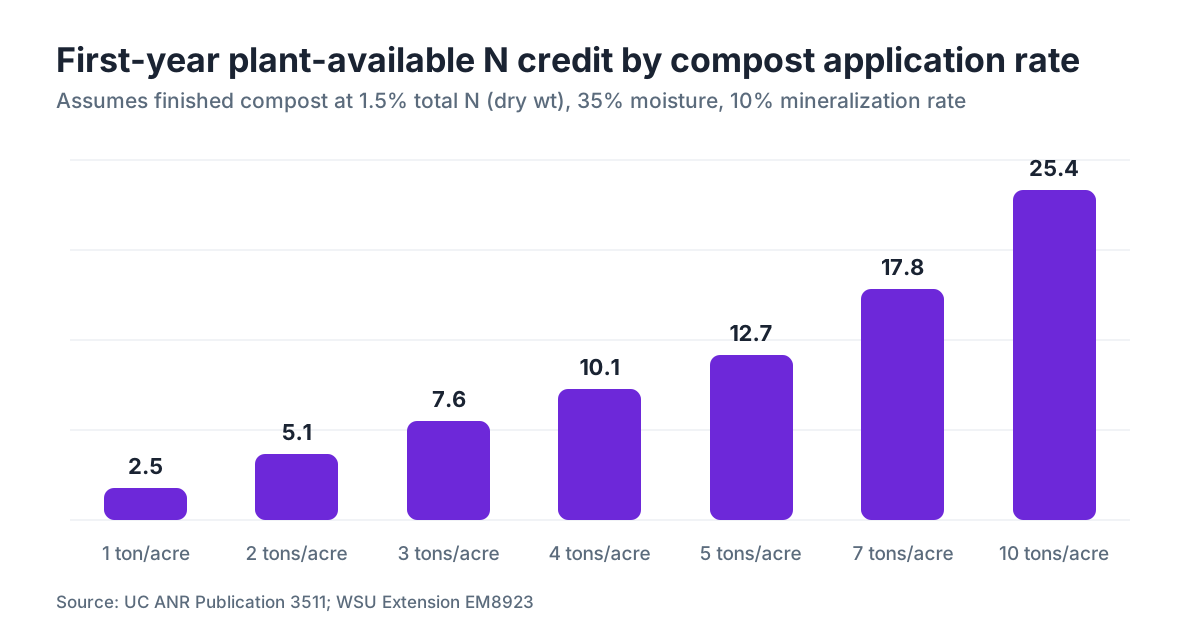
You're planning to apply 5 tons per acre as-delivered. First, convert to dry tons: 5 tons × (1 - 0.35) = 3.25 dry tons per acre. Total N applied = 3.25 tons × 2,000 lbs/ton × 0.015 = 97.5 lbs N/acre. Ammonium-N = 3.25 × 2,000 × 0.0005 = 3.25 lbs N/acre (credit 100%). Organic N = 97.5 - 3.25 = 94.25 lbs N/acre (apply mineralization factor).
What is the nitrogen mineralization rate for compost, and what number should you actually use?
Mineralization rate is the fraction of organic N that converts to plant-available inorganic N (nitrate or ammonium) in a given year. This number depends on compost maturity, C:N ratio, soil temperature, and moisture [3].
For a finished, mature compost with a C:N ratio between 15:1 and 25:1, research from UC Davis and WSU extension both point to a first-year mineralization rate of roughly 10% to 15% of total organic N [2][3]. That means if you applied 94 lbs of organic N, about 9 to 14 lbs of it becomes plant-available in year one.
For a less mature or high-N compost (C:N under 15:1), the rate can be higher, 20% or more. For a very stable, humus-heavy compost with a C:N above 30:1, the rate might drop to 5% or lower, and you may actually see temporary nitrogen immobilization where the compost ties up more N than it releases in the short term.
Compost also continues mineralizing in subsequent years, typically releasing another 5% to 8% of remaining organic N in year two, and 3% to 5% in year three [3]. If you've applied compost for multiple consecutive years, you need to add carryover credits from prior applications to avoid double-dipping on your N budget.
WSU Extension's Nutrient Management Guide for Wine Grapes uses a first-year credit of 10% for finished compost and specifically cautions that assuming higher rates without lab data is a common source of over-application [3]. Cornell's guidelines for New York vineyards suggest a similar 10-12% range for composted manure products applied in the Northeast, where cooler spring soils slow early-season mineralization [5].
The honest answer: nobody has perfect data on this for every region and every compost type. The closest thing to a regional consensus is the UC Davis DANR publication 3511 range of 10-15%, and most state nutrient management plan templates use 10% as a conservative starting assumption [2].
How do you calculate the full nitrogen credit from compost, step by step?
Here's the complete calculation in plain arithmetic. Use this as a template you can adapt to your own lab numbers.
Given:
- Compost total N: 1.5% (dry weight)
- Compost ammonium-N: 0.05% (dry weight)
- Compost moisture: 35%
- Application rate: 5 tons/acre (as-delivered)
- First-year mineralization rate: 10% (conservative)
Step 1: Convert to dry tons per acre.
5 × (1 - 0.35) = 3.25 dry tons/acre
Step 2: Calculate total N applied (lbs/acre).
3.25 × 2,000 × 0.015 = 97.5 lbs total N/acre
Step 3: Separate ammonium-N from organic N.
Ammonium-N = 3.25 × 2,000 × 0.0005 = 3.25 lbs/acre
Organic N = 97.5 - 3.25 = 94.25 lbs/acre
Step 4: Apply mineralization rate to organic N.
Year 1 organic N credit = 94.25 × 0.10 = 9.43 lbs/acre
Step 5: Add ammonium-N (credited 100%).
Total year 1 N credit = 9.43 + 3.25 = 12.68 lbs/acre
Step 6: Check carryover from prior years. If you applied the same rate last year, add approximately 5-8% of last year's organic N pool as a year-two credit.
So from a 5-ton application of this compost, you're looking at roughly 13 lbs of plant-available N in year one. If your vineyard target is 30 lbs N/acre, compost alone at this rate covers about 43% of that budget. You'd supplement with a small amount of additional N from another source, or increase the compost rate.
If you want to hit a target N rate from compost alone, flip the formula. Target N credit ÷ (mineralization rate + ammonium fraction × correction) = organic N needed, then back-calculate to application rate. It's a bit circular, but a spreadsheet makes it fast.
How does compost C:N ratio affect how much nitrogen your vines actually get?
The C:N ratio is the single most useful predictor of how fast compost will release nitrogen in the field. A ratio below about 20:1 means the microbial community has more nitrogen than it needs to break down the carbon, so excess N releases into the soil. Above 30:1, microbes are N-limited and will actually pull mineral N from the soil to fuel decomposition, temporarily reducing plant-available N [4].
For vineyards, a compost with a C:N of 15:1 to 25:1 is the sweet spot. It mineralizes at a useful rate without immobilizing soil N, and it's stable enough that you're not dealing with fresh-manure-style N spikes.
Here's a rough reference table for first-year N mineralization rates by C:N ratio, based on USDA and university extension guidelines:
| Compost C:N Ratio | First-Year N Mineralization (% of organic N) | Notes |
|---|---|---|
| < 15:1 | 20-30% | High N, fast release; watch for over-application |
| 15:1 to 20:1 | 15-20% | Good range for most organic programs |
| 20:1 to 25:1 | 10-15% | Typical finished compost |
| 25:1 to 30:1 | 5-10% | Stable; slower release |
| > 30:1 | < 5%, possible immobilization | May tie up existing soil N temporarily |
Sources: UC Davis DANR Publication 3511 [2] and WSU Extension EM8923 [3]. These are ranges, not fixed values. Actual rates in your vineyard depend on soil temperature, moisture, and microbial activity.
What application rates do most vineyards actually use, and how much N does that deliver?
The range in practice is pretty wide: anywhere from 1 to 10 tons of compost per acre per year, with most established vineyards landing in the 2 to 5 ton range for maintenance applications [2][3].
At the low end, 1 to 2 tons per acre is a soil amendment approach, targeting organic matter improvement with minimal N delivery, usually under 5 lbs of plant-available N per acre in year one from a finished compost.
At 3 to 5 tons per acre, you're getting into the range where compost contributes meaningfully to your N budget, maybe 10 to 25 lbs of plant-available N per acre in year one depending on compost quality. This is where most California organic vineyards operate.
At 5 to 10 tons per acre, you're making a soil-building investment more than a fertility move. The N delivery can approach or exceed typical vineyard requirements, and you need to be careful about cumulative nitrate loading, especially in areas with shallow water tables or near streams [6].
Large applications every two or three years are common too, particularly in wine regions with wet winters where growers can't get equipment into the vineyard rows during the window they'd prefer. A 6-ton application every two years averages to 3 tons per year, and you should credit it accordingly across years rather than treating year one as a 6-ton year and years two and three as zero.
For vineyards in regions with strong water quality oversight, like the Paso Robles area, the Lodi Winegrape Commission, or Napa's groundwater sustainability programs, your application rate may be constrained by the maximum N load allowed under your nutrient management plan more than by vine need.
Do you need to adjust the calculation for application timing and placement?
Yes, and this gets overlooked constantly. Compost applied in fall mineralizes more slowly over winter (cold soils, lower microbial activity) and releases more N in spring when temperatures rise, which matches up reasonably well with spring vine growth. But if you're in a high-rainfall area and you apply in fall, you may lose some of that mineralized N to leaching before the vines can use it.
Spring applications, within about 30 to 60 days of budbreak, tend to have better N-use efficiency in vineyards because mineralization timing overlaps with active uptake. WSU Extension notes that applying nitrogen sources within six weeks of budbreak is preferable for uptake efficiency in wine grapes [3].
Placement matters too. Compost broadcast on the surface and left unmixed mineralizes more slowly than compost incorporated into the top few inches of soil, because soil contact improves microbial activity. In vineyards where tillage is limited (undervine herbicide programs, cover crop systems), surface-applied compost is standard, and you should expect the lower end of the mineralization rate range.
Under-vine placement concentrates the material in the root zone and is common in smaller operations. Row-middle applications support cover crop growth and soil structure but put the compost farther from vine roots, reducing N uptake efficiency.
For organic matter goals, row-middle placement is fine. For nitrogen credit purposes, under-vine placement is more efficient.
What records do regulators and certifiers actually want to see?
This depends on your state and your certification program, but there's a common baseline that most auditors look for.
For USDA National Organic Program (NOP) certification, you need records documenting the source of your compost, evidence that it was produced under NOP-compliant conditions (time and temperature data or supplier affidavit), and your application records including rate, date, and field [7]. Auditors aren't doing N credit math themselves, but they want to see that you have a documented rationale for your application rates.
For state water quality orders in California (specifically the Central Coast and North Coast Agricultural Orders under the State Water Board), you need a Nitrogen Management Plan that includes compost N credits calculated following CDFA or Regional Water Board guidelines. The calculation method described in this article matches those guidelines, though specific forms vary by order [6].
For nutrient management plans under USDA-NRCS standards, the calculation follows NRCS Conservation Practice Standard 590, which requires you to credit all N sources including organic amendments [8]. Your local NRCS office or a Certified Crop Adviser (CCA) can help if you're on cost-share funding.
At minimum, keep for every compost application:
- The lab analysis (current lot, not historical)
- Application date and field identifier
- Rate applied (tons per acre, wet weight) and source documentation for moisture content
- Your N credit calculation showing the arithmetic
- Supplier delivery receipt or purchase record
Tracking all of this in a single system saves real time come audit season. Tools like VitiScribe let you attach lab PDFs directly to field operation records so everything is in one place rather than scattered across email threads and spreadsheet tabs.
How do compost nitrogen credits compare to synthetic fertilizer applications?
Here's the heart of why compost planning is harder than using synthetic N, and why it still pays off.
A 5-ton/acre application of finished compost (1.5% N, 35% moisture) delivers about 13 lbs of plant-available N in year one, as calculated above. To get that same 13 lbs from calcium nitrate (15.5% N), you'd apply about 84 lbs of product per acre, which costs roughly $30 to $60 per acre at current prices depending on supplier and region.
The compost itself might cost $40 to $120 per ton delivered, so 5 tons runs $200 to $600 per acre, not counting application. On a pure cost-per-lb-of-plant-available-N basis in year one, compost is almost always more expensive than synthetic fertilizer.
That framing misses the point, though. Compost is building organic matter, improving soil water-holding capacity, feeding soil biology, and adding a multi-year reservoir of slow-release nutrients. The year-two and year-three N carryover reduces future fertilizer inputs. The soil structure improvements reduce irrigation costs. The organic matter additions help with erosion compliance in many states.
The decision to use compost as a primary N source versus a soil amendment with supplemental synthetic N is partly agronomic and partly values-based. Most non-organic vineyards use compost at 2 to 3 tons per acre for soil health and supplement with small amounts of synthetic N timed to vine need. Pure organic operations go heavier on compost and use approved N sources like feather meal or blood meal to fill the gap.
Neither approach is wrong. The math just needs to account for what you're actually providing.
How do carryover credits from previous compost applications change your calculations each year?
This is the part that almost every simplified compost calculator ignores, and ignoring it leads to systematic over-application.
When you apply compost, you're adding more than a one-year N credit. The organic N that didn't mineralize in year one is still in the soil, and it keeps mineralizing in subsequent years. For a typical finished compost, the pattern looks roughly like this: 10% in year one, 5-7% of the original organic N pool in year two, and 3-5% in year three [3]. After that, remaining organic N has stabilized into humus and contributes very little additional mineral N.
If you apply 5 tons of compost every year, by year three you're stacking credits from three separate applications. The math gets messy fast, but the key principle is: add up all prior-year carryover credits before calculating how much additional N you need from this year's compost or other fertilizer.
A simplified multi-year carryover table, using the example above (97.5 lbs total N, 94.25 lbs organic N from a 5-ton application):
| Year of Application | Year 1 Credit (lbs N/acre) | Year 2 Credit | Year 3 Credit |
|---|---|---|---|
| Application 1 | 12.7 | 5.7 | 3.4 |
| Application 2 | - | 12.7 | 5.7 |
| Application 3 | - | - | 12.7 |
| Total credit, year 3 | - | - | 21.8 |
By year three, a steady 5-ton/acre/year compost program is delivering nearly 22 lbs of plant-available N per acre, up from 13 lbs in year one, with no change in application rate. For a vineyard targeting 30 lbs N/acre, that's almost 75% of the budget from compost alone. Knowing that changes your supplemental N decisions significantly.
For record-keeping that actually tracks this across seasons without rebuilding the spreadsheet every winter, a field operations platform with persistent field history is genuinely useful. VitiScribe structures records by block and year so carryover calculations are based on your actual application history, not estimates.
What are the most common calculation mistakes vineyard managers make with compost nitrogen credits?
A few mistakes come up over and over, and they're worth naming.
Using wet weight instead of dry weight is the most frequent error. If you apply 5 tons of compost at 40% moisture and calculate N as if all 5 tons were dry matter, you overestimate N delivery by 67%. Always correct for moisture first.
Using the supplier's typical analysis instead of a current lot analysis is almost as common. Compost N content varies significantly between batches, especially for operations using variable feedstocks. A difference of 0.5 percentage points in total N changes your credit by 33% at 1.5% vs. 1.0%.
Ignoring carryover from prior years leads to chronic over-application in multi-year programs, as shown in the table above. If you've been applying compost for three or more years, your real N delivery in year three is meaningfully higher than your year-one credit suggests.
Assuming a fixed mineralization rate without considering C:N ratio is a smaller but real error. If you switch compost suppliers and the new product has a very high C:N ratio, your year-one credit is lower than you'd expect, and vice versa.
Last one: forgetting that compost N counts toward permitted N loading limits under nutrient management plans. That can create real compliance problems. Regulators count all N inputs, more than synthetic fertilizer. Documenting that you credited compost N in your plan protects you.
Are there EPA or state worker safety rules that affect how you apply compost in vineyards?
The EPA Worker Protection Standard (WPS) doesn't specifically regulate compost application the way it governs pesticide applications, but there are related rules to know [9].
If your compost contains biosolids (sewage sludge-based material), EPA 40 CFR Part 503 sets strict application rate limits, pathogen reduction requirements, and land application record-keeping requirements. Most wine grape operations avoid biosolids-based compost for both regulatory complexity and market reasons, but it's worth confirming what's in your product. Ask your supplier directly: is this product Part 503 compliant biosolids, or is it derived from food scraps, yard waste, or animal manure?
For standard non-biosolids composts, OSHA's general industry standards apply to worker safety during loading and application. Compost dust can be a respiratory irritant, and workers handling large volumes should have access to appropriate PPE. California's CDFA and the California Department of Industrial Relations have additional requirements for agricultural workers handling amendment materials [10].
For operations under the NOP, materials used as soil amendments must appear on the OMRI (Organic Materials Review Institute) list or be reviewed by your certifier. Not all composts are automatically approved: the feedstocks matter, and any synthetic additives can disqualify the material.
Compost applications near water bodies may trigger setback requirements under your Regional Water Quality Control Board order (California) or state equivalent. In New York, the Department of Environmental Conservation sets buffer distances for nutrient applications near streams and wetlands [5].
Frequently asked questions
What is a typical nitrogen credit for compost applied in a vineyard?
For a finished compost with 1.5% total N (dry weight) applied at 5 tons per acre as-delivered (35% moisture), the first-year plant-available nitrogen credit is roughly 12 to 15 lbs per acre. That assumes a 10-15% first-year mineralization rate on organic N, which is the range recommended by UC Davis and WSU Extension for mature composts with a C:N ratio of 20:1 to 25:1.
How do I convert wet weight compost application rates to dry weight for calculations?
Multiply the as-delivered (wet) tons per acre by (1 minus the decimal moisture fraction). For example, 5 tons at 35% moisture = 5 × (1 - 0.35) = 3.25 dry tons per acre. Nitrogen content on lab reports is expressed as a percentage of dry weight, so you must use dry tons in your calculation. Skipping this step is the most common arithmetic error in compost N crediting.
What C:N ratio should I look for in vineyard compost?
A C:N ratio of 15:1 to 25:1 is the practical target for vineyard compost. Below 15:1, the material releases N quickly and you risk exceeding plant uptake capacity. Above 30:1, microbes may temporarily immobilize soil nitrogen to fuel decomposition, reducing plant-available N in the short term. Most certified finished composts fall in the 18:1 to 25:1 range.
How do I calculate second-year and third-year nitrogen carryover from compost?
After year one, approximately 5-7% of the original organic N pool mineralizes in year two, and another 3-5% in year three. Using the example of 94 lbs of organic N applied: year-two carryover is about 5.6 to 6.6 lbs N/acre, and year-three carryover is about 2.8 to 4.7 lbs N/acre. Sum carryover from all prior applications before setting your current-year N budget.
Do I need a lab analysis every time I apply compost, or can I use the supplier's data?
A current lot analysis is strongly preferred over supplier-provided typical values. Compost N content varies batch to batch based on feedstocks, turning frequency, and moisture during curing. UC Davis extension recommends independent lab analysis. For regulatory purposes, having your own lab report in your records is much stronger documentation than a supplier specification sheet, especially under water quality orders or organic certification audits.
Does the USDA National Organic Program have specific rules about compost nitrogen credits?
The NOP (7 CFR Part 205) requires that compost used as a soil amendment be produced following standards for feedstock type, and time and temperature requirements if raw manure is used, but it doesn't mandate a specific nitrogen credit calculation method. It does require you to document all inputs and maintain records demonstrating your operation follows your organic system plan, which should include a rationale for application rates.
How does compost application timing affect nitrogen availability to vines?
Spring applications within 30 to 60 days of budbreak generally provide better N-use efficiency because microbial mineralization timing overlaps with active vine uptake. Fall applications are convenient logistically but risk some N loss to leaching over winter in high-rainfall regions. WSU Extension recommends applying N sources within six weeks of budbreak when possible for wine grape nutrition programs.
What records do California vineyards under water quality orders need to keep for compost applications?
Under the Central Coast and North Coast Agricultural Orders (State Water Resources Control Board), vineyards must maintain a Nitrogen Management Plan documenting all N inputs including compost. Records should include the lab analysis for the applied material, application date and rate, field identification, and the N credit calculation. The CDFA and Regional Water Board provide calculation templates. Records must typically be retained for five years and available for inspection.
Can compost alone meet all the nitrogen needs of a vineyard?
In most cases, no, especially not in years one and two of a compost program. A 5-ton/acre application of typical finished compost yields only 12-15 lbs of plant-available N in year one, well below most vineyard targets of 20-60 lbs per acre. By year three of consistent annual applications, carryover credits can bring compost-derived N to 20-25 lbs/acre. Organic programs typically supplement with approved materials like feather meal or blood meal.
What is the difference between total nitrogen and plant-available nitrogen in a compost analysis?
Total nitrogen includes all N forms: ammonium-N (immediately available) plus organic N (slow-releasing). Plant-available N in year one equals the ammonium-N plus the fraction of organic N that mineralizes that season, typically 10-15% for finished compost. The rest remains in the soil as organic N and continues releasing in subsequent years. Crediting total N as plant-available is a significant calculation error that leads to under-application of other N sources.
How does soil temperature affect compost nitrogen mineralization rates in vineyards?
Soil microbial activity, and therefore N mineralization, is temperature-dependent. Mineralization is minimal below about 50°F (10°C) and peaks around 77-95°F (25-35°C). In cool northern California coastal vineyards or Pacific Northwest regions, spring soils may not reach active mineralization temperatures until May or June, meaning fall-applied compost may deliver less first-year N credit than the same compost in a warmer, inland setting.
Are biosolids-based composts allowed in vineyards, and how are they treated differently?
Biosolids-based composts are legal for non-organic vineyards under EPA 40 CFR Part 503, which sets pathogen reduction, metal content limits, and application rate restrictions based on soil metal loading. They are prohibited in certified organic operations under USDA NOP. Most wine grape growers avoid them due to market perception concerns, but agronomically they can be high-quality N sources. N credit calculations follow the same approach, using the lab analysis and applicable mineralization rates.
What is the maximum compost application rate for vineyards without a nutrient management plan?
There is no single national maximum; it depends on state law and whether you're under a water quality order. In California, most agricultural water quality orders require a Nitrogen Management Plan once you apply above certain N thresholds regardless of source. Oregon and Washington have similar requirements tied to nitrate-sensitive areas. In practice, applications above 5 to 6 tons per acre per year in sensitive watersheds warrant review by a Certified Crop Adviser or your Regional Water Board contact.
How do I find a certified lab to test my compost before applying it to my vineyard?
UC Davis, Cornell, and WSU extension programs all maintain lists of accredited agricultural testing labs in their states. The Organic Materials Review Institute (OMRI) and the US Composting Council's STA (Seal of Testing Assurance) program list labs that follow standardized compost analysis methods. A standard compost panel typically costs $30 to $80 and takes three to seven business days. Request the TMECC (Test Methods for the Examination of Composting and Compost) method specifically for vineyard use.
Sources
- UC Davis Cooperative Extension, Nutrient Management in Vineyards: Established vineyards typically require 20 to 60 lbs of actual nitrogen per acre per year depending on variety, rootstock, and yield targets
- UC ANR Publication 3511, Organic Matter Recycling Workshop, UC Davis: First-year N mineralization rate from finished compost is roughly 10-15% of total organic N; recommends certified lab analysis for compost samples
- WSU Extension EM8923, Nutrient Management Guide for Wine Grapes in Washington: WSU uses a first-year credit of 10% for finished compost, with year-two and year-three carryover of 5-7% and 3-5% respectively; recommends N application within six weeks of budbreak
- Cornell Cooperative Extension, Nutrient Management for Vineyards in New York: Cornell guidelines suggest 10-12% first-year mineralization for composted manure products in Northeast vineyards; New York DEC sets buffer distances for nutrient applications near water
- California State Water Resources Control Board, Agricultural Order (Irrigated Lands Regulatory Program): Central Coast and North Coast Agricultural Orders require a Nitrogen Management Plan documenting all N inputs including compost; records retained five years
- USDA Agricultural Marketing Service, National Organic Program 7 CFR Part 205: NOP requires documentation of compost source, production conditions, and application records; feedstock and time-temperature standards apply when raw manure is involved
- EPA Worker Protection Standard, 40 CFR Part 170: EPA WPS governs pesticide applications; compost is not a pesticide under WPS but biosolids-based materials fall under 40 CFR Part 503 with separate application and record-keeping requirements
- US Composting Council, Seal of Testing Assurance (STA) Program: STA program lists accredited labs following TMECC standardized compost analysis methods; standard compost panel typically costs $30 to $80
- Organic Materials Review Institute (OMRI), Materials List: OMRI lists approved materials for certified organic operations; not all composts are automatically approved under NOP
Last updated 2026-07-11