How to adjust spray records when vine row spacing changes within a block

TL;DR
- When a vineyard block has more than one row spacing, one acres-treated figure won't cover the whole block.
- Calculate treated acres for each spacing zone separately, deriving effective width from the row spacing, then add the zones together.
- Pesticide labels and EPA Worker Protection Standard records have to reflect the actual treated area, not the field boundary acreage.
Why does row spacing affect spray records at all?
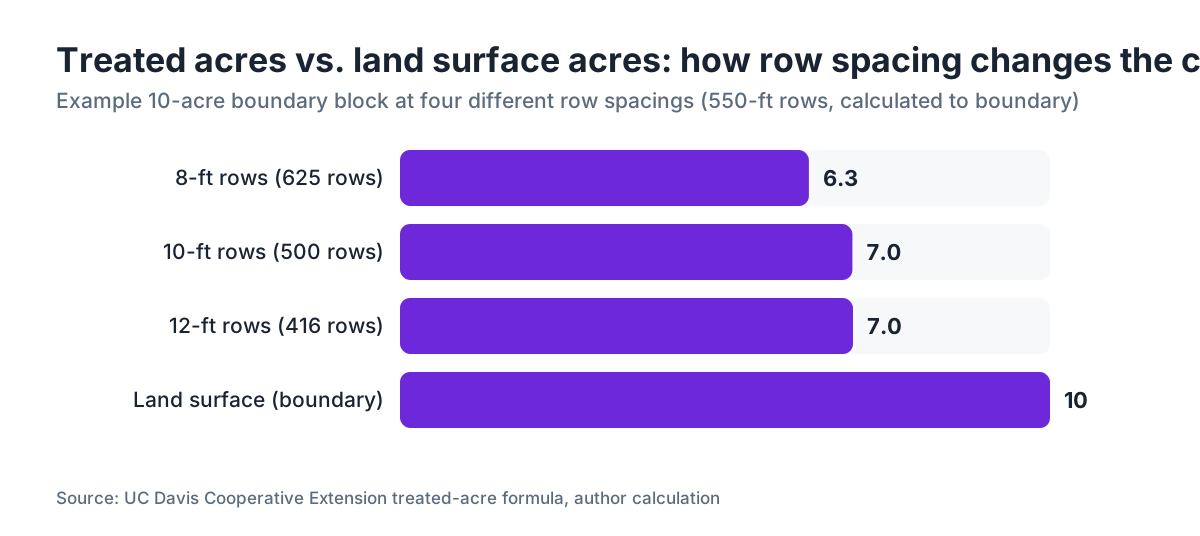
Treated acres and land surface acres are two different numbers. The gap matters most when your sprayer is calibrated to deliver a set volume per treated acre, because treated acres depend directly on the row spacing you're covering.
The formula extension programs at UC Davis and WSU use converts linear row feet to treated acres like this: multiply total row length (feet) by effective spray width (feet), then divide by 43,560 [1][2]. In a vineyard the effective spray width is usually the row spacing itself, because the sprayer swath equals one row-to-row distance per pass.
A block with 10-foot rows carries a different treated-acre figure than the same ground surface planted at 12 feet. Mix the two in one block, average the spacing, and you get a number that's wrong in both zones. Your label rate is written in product per acre. Wrong acreage means a wrong application rate, and that's a compliance problem.
What's the legal requirement for recording treated acres?
Under the EPA Worker Protection Standard (40 CFR Part 170), application records must include the location and description of the treated area [3]. State pesticide use reporting laws go further. California requires growers to file pesticide use reports (PURs) with the county agricultural commissioner within set time windows, and those reports have to report treated acreage to the nearest tenth of an acre [4].
Federal FIFRA record-keeping rules for certified applicators (40 CFR Part 171) also require recording the size of area treated [5]. The label itself is a legal document under FIFRA Section 12(a)(2)(G), which makes applying a pesticide "in a manner inconsistent with its labeling" a federal violation. Say your label reads 2 oz per acre and your acreage is overstated because you averaged two spacings. You may have put down more product per actual treated acre than the label allows.
Here's the practical takeaway. Your spray record needs to show treated acres, and in a mixed-spacing block that means separate calculations per zone, never a single averaged figure.
How do you calculate treated acres for each spacing zone in a block?
Start with your row lengths and row counts for each zone. This is the part that trips up most operations, because the numbers usually live in a planting map or old field notes, not in a spray log. Get it right once, write it into a reference sheet, and reuse it every time.
The calculation for each zone:
Treated acres = (Number of rows × Row length in feet × Row spacing in feet) ÷ 43,560
Work through a real example. Your Cabernet block has two zones:
| Zone | Rows | Row length (ft) | Row spacing (ft) | Calculation | Treated acres |
|---|---|---|---|---|---|
| A | 40 | 550 | 10 | 40 × 550 × 10 ÷ 43,560 | 5.05 |
| B | 30 | 550 | 12 | 30 × 550 × 12 ÷ 43,560 | 4.55 |
| Total | 70 | 550 | mixed | 9.60 |
Use the average spacing of 10.86 feet across 70 rows and you'd land on 9.58 acres. Close, but subtly wrong. Worse, you'd have no record showing the two zones exist, which matters the moment an inspector or auditor asks you to show your work.
Record Zone A and Zone B as separate line items, or add a notation that flags the two spacing zones and shows the math for each. UC Davis Cooperative Extension has published reference worksheets for exactly this kind of calculation [1].
How do you handle spray volume and product rate when spacing differs?
Your airblast or tunnel sprayer is set to deliver a target gallons-per-acre (GPA), and that number comes from a calibration done at one specific row spacing. Move from a 10-foot zone into a 12-foot zone at the same tractor speed and fan and nozzle settings, and you're covering more ground per linear foot of travel. You end up depositing fewer gallons per treated acre.
WSU Extension's sprayer calibration guides recommend recalibrating or adjusting speed any time row spacing shifts by more than about 10 to 15 percent, because the volume delivered per canopy unit changes enough to affect coverage and dose [2]. A 20 percent jump in row spacing (10 feet to 12 feet) with no speed correction drops your effective GPA in the wider rows by about 17 percent.
For record-keeping you have two defensible options. One, record a single spray event with the averaged GPA marked approximate and a note explaining the two zones and their separate calculations. Two, and cleaner for compliance, record the zones as separate application events on the same date, with GPA and product volume figured per zone. The second is more work up front. It's also far easier to defend during an audit or when a state inspector asks why your product use doesn't match your acreage.
Growers running several mixed-spacing blocks face this exact repetitive math every spray. A digital record-keeping system handles it well. VitiScribe, for instance, lets you define sub-block zones with distinct row spacing and auto-calculates treated acres per zone, so the per-acre rate math stays consistent all season [see vitiscribe.com].
What should the actual spray record entry look like?
A compliant entry for a mixed-spacing block needs, at minimum: the date, the block or field name, the product name and EPA registration number, the application method, treated acreage per spacing zone, total product used per zone, and the applicator name. Most states tack on a few more fields, but those are the core.
Here's a two-zone entry in practice:
Date: 2025-06-14
Block: Estate Cab, Rows 1-40 (Zone A, 10-ft spacing), 5.05 treated acres
Product: [Product name], EPA Reg. No. XXXXX
Rate: 4 fl oz/acre
Product used: 20.2 fl oz
Applicator: [Name], License No. XXXXX
Date: 2025-06-14
Block: Estate Cab, Rows 41-70 (Zone B, 12-ft spacing), 4.55 treated acres
Product: [Product name], EPA Reg. No. XXXXX
Rate: 4 fl oz/acre
Product used: 18.2 fl oz
Applicator: [Name], License No. XXXXX
You can fold these into one entry if your format allows a notes field, but the acreage breakdown has to stay visible. A single line reading "Estate Cab, 9.6 acres" with no notation of the spacing change is technically acceptable if your underlying field map shows the zones. It's harder to audit, and it puts the burden on you to reconstruct the calculation later.
Does the EPA Worker Protection Standard require zone-level detail?
The WPS application record requirements (40 CFR 170.309) list what has to be documented: the crop or site treated, the location and description of the treated area, the date of application, the product name and EPA Reg. No., and the applicator's name [3]. The regulation says "description of the treated area," which is broad enough to cover zone-level detail when zones have different spacing.
EPA's WPS guidance says records must be sufficient for the handler to reconstruct the application in the event of an illness or exposure investigation [3]. Picture an applicator exposure incident in Zone B, the 12-foot rows, with a record that shows only an averaged acreage for the whole block. You may not be able to demonstrate the actual product concentration the worker met. That's a real liability gap.
Some state environmental and labor agencies run joint WPS audits, and they check whether application records match actual field conditions. Attaching a planting map to your spray records that shows the spacing zones closes that gap without rewriting your record format.
How do you find your row spacing if it's never been accurately measured?
More common than people admit. Older plantings often carry inconsistent spacing within a block because of irregular terrain, a replant after vine losses, or an imprecise original layout. Nobody measured it carefully at planting, and the original records are long gone.
The fastest fix: walk the block with a measuring wheel or a 100-foot tape and measure row-to-row distance at several points in each zone. Do it in multiple spots, because spacing can drift a foot or more from one end of a row to the other in older plantings. Average the measurements. Record the date and write the spacing into your field map.
Blocks with GPS-capable spray equipment give you another route. The distance between parallel passes on a GPS-guided sprayer equals your row spacing at the time of application, and that data already sits in your machine controller file. Many modern GPS field computers calculate coverage area automatically, though you should confirm their method matches the treated-acre formula above [2].
Working from aerial imagery? High-resolution orthophotos from the USDA Farm Service Agency's NAIP program let you measure row-to-row spacing with decent accuracy at a desktop [6]. FSA's Web Soil Survey and Common Land Unit mapping tools also give you the boundary acreage of each field, but those are surface acres, not treated acres.
What about blocks where row spacing changes continuously, not in distinct zones?
This shows up in older terraced vineyards, contour-planted blocks, and hillside sites where rows follow the terrain instead of a uniform grid. You don't have two clean zones. You have a gradient.
For record-keeping you make a reasonable, documented approximation. The approach most extension-trained farm advisors use: split the block into the fewest distinct zones that capture the real variation, measure representative spacing in each, and calculate treated acres per zone. If spacing ranges from 9 to 11 feet across a block, you might use three zones (9 feet, 10 feet, 11 feet) and count the rows in each.
The principle from FIFRA compliance is that your records have to be accurate, but there's no regulatory mandate for GPS-centimeter precision in treated-acre calculation. A documented, systematic measurement with a written methodology holds up. An undocumented guess does not. Cornell University's Grape program has published guidance on field record systems that covers this kind of approximation for complex terrain [7].
Document the methodology once, attach it to your field records, apply it the same way every time. If an inspector questions your acreage, the method note is your evidence.
How do GPS and variable-rate sprayer technology change this calculation?
Precision sprayer systems, especially those with variable-rate technology (VRT) or section control, can log treated area automatically from GPS position. These systems record actual coverage instead of a calculated estimate, and in theory they take the manual zone math off your plate.
In practice, the GPS coverage log gives you coverage area (the ground the machine passed over) rather than treated acres in the regulatory sense. If your section-control map reports 9.8 acres, that's surface area with no correction for row spacing. Apply to 10-foot rows on a 12-foot grid surface and that difference matters for label compliance.
Some precision ag software does calculate treated acres correctly by accounting for row spacing in the field boundary definition. If yours does, verify it. Cross-check against the manual formula for a known block before you trust it for compliance records. The two should match within a few percent. If they don't, find out which method the software uses before you submit PUR data to your state agency.
WSU's Precision Agriculture program has published testing protocols for GPS sprayer record accuracy that help with this kind of validation [2].
What mistakes do growers most often make in mixed-spacing spray records?
Four errors come up again and again when mixed-spacing blocks get audited.
First, using field boundary acres off an FSA map as the treated acreage. FSA Common Land Unit acreage is land surface area, not treated acres. The two diverge most in blocks with wide headlands, roads, or irregular shapes, and the gap widens as row spacing tightens.
Second, averaging row spacing for the whole block without documenting that an average was used. Miss the average by even half a foot and your per-acre rate is wrong, with no paper trail showing how you got the number.
Third, failing to update records when part of a block gets replanted at a different spacing. Replant 15 rows at 12 feet in a block that's otherwise 10 feet and you've created a permanent mixed-spacing situation. Plenty of spray record systems never get updated to reflect it.
Fourth, calculating product volume from total treated acres but logging it as one product batch with no zone breakdown. If you mixed product for 9.6 acres and sprayed both zones, your record should show how that volume split. No split, and a compliance reviewer has no way to verify your per-acre rate in either zone.
For operations juggling this across multiple blocks, VitiScribe's sub-block record structure lets you define each spacing zone once and carry that geometry through every spray event automatically, which kills the third and fourth errors at the source [see vitiscribe.com].
How do you backfill records for past spray events if spacing was wrong?
Find that past records used incorrect acreage, and the right move is a corrective notation, not an edit to the original entry. Changing a completed record creates a documentation integrity problem. Instead, create a supplemental note that references the original entry, explains the error, provides the corrected calculation with the measurement methodology, and carries a date and signature.
For California PUR submissions, CDFA and the county ag commissioners have procedures for correcting filed reports. You file an amended PUR that references the original report number. The process is documented in the CDFA pesticide use reporting guide [4]. Other states run similar amendment procedures. Call your state or county agricultural commissioner's office before amending old reports, because the process and deadlines vary.
For your internal records, attach the corrective note to the relevant season's spray log. If your state requires you to hold pesticide records for a set period (California requires two years for most growers; the federal FIFRA standard for certified applicators is two years [5]), keep the original and the correction together.
The consequence of a wrong acreage in a past record is usually small if the error was minor and no worker exposure or environmental incident is tied to it. But in an organic or third-party certification program, auditors scrutinize acreage calculations harder, because material use per acre is a compliance metric for those certifications too.
Frequently asked questions
Can I just use one average row spacing for the whole block on my spray record?
Technically yes, but it's risky. If the two spacing zones differ by more than about 10 percent, an averaged figure produces a per-acre rate that's wrong in at least one zone. Better to calculate treated acres for each zone separately, record them as distinct line items or add a documented note showing the math, and keep a field map that shows the zone boundaries. That gives you something defensible if you're ever audited.
How do I calculate treated acres in a vineyard block?
Multiply number of rows by row length in feet by row spacing in feet, then divide by 43,560. So 40 rows at 550 feet long with 10-foot spacing gives (40 × 550 × 10) ÷ 43,560 = 5.05 treated acres. Do this separately for each spacing zone in a mixed block. Don't use FSA field boundary acreage as a substitute; that number reflects land surface, not spray coverage.
Does the EPA WPS require me to record treated acres by sub-block zone?
The WPS (40 CFR 170.309) requires a description of the treated area sufficient to reconstruct the application. It doesn't mandate sub-block zone breakdowns by name, but if your block has meaningfully different spacing in different zones, a single acreage figure without explanation may not be sufficient for an exposure or illness investigation. Adding a spacing notation and zone math satisfies the regulation and protects you.
What if my GPS sprayer records coverage area automatically? Can I use that for my spray record?
GPS coverage area from a sprayer is the ground surface area the machine passed over, not treated acres adjusted for row spacing. Depending on how the software calculates it, the numbers may diverge from the treated-acre formula. Cross-check your sprayer's GPS acreage against the manual calculation for a known block. If they agree within a few percent, the GPS log is likely using the correct method. If not, use the manual calculation and note the discrepancy.
How often should I re-measure row spacing in a block?
Measure once with care, write it into a permanent field map, and re-measure any time you replant rows or change the block layout. Row spacing doesn't change on its own, so annual re-measurement is unnecessary. What does change: replants, removed rows, added headlands. After any modification to the block structure, update your field map and recalculate treated acres for all affected zones before the next spray event.
Does row spacing affect my pesticide label compliance more than my records?
Yes. Pesticide labels set rates in product per acre, where acre means treated acre calculated from actual row spacing. If your spray record understates treated acres (by using too wide a spacing), your calculated per-acre rate looks artificially low, but you may actually be applying more product per true treated acre than the label allows. Applying above label rate is a FIFRA violation under Section 12(a)(2)(G), regardless of whether the error was a record-keeping mistake.
How do I handle a block where spacing changes because of replanted rows after vine loss?
If the replanted rows went in at the same spacing as the rest of the block, nothing changes. If they went in at a different spacing (common when moving from traditional to high-density planting during a partial replant), treat those rows as a new zone. Count the replanted rows, measure the new spacing, calculate treated acres for that zone, and note the change date in your field map. Update your spray record template to reflect the new zone structure going forward.
What records do I need to keep and for how long under FIFRA?
Under 40 CFR Part 171, certified pesticide applicators must keep application records for two years from the date of application [5]. California state law requires pesticide use records to be maintained for two years and filed with the county agricultural commissioner within defined reporting windows [4]. Some third-party certification programs (organic, sustainability certifications) require three to five years of records. Keep the longest applicable period.
How do I correct a spray record that used the wrong row spacing?
Don't alter the original record entry. Add a separate corrective notation that references the original entry, states the error, provides the corrected calculation with your measurement source and date, and is signed and dated by you. For state PUR filings in California and most other states, file an amended report with the county ag commissioner referencing the original report number. Keep the original and the amendment together in your records.
Does row spacing matter for organic certification spray records?
Yes. Organic certification auditors verify that approved material use per acre stays within allowed thresholds and that no prohibited materials were used. If your treated-acre figure is wrong, your materials-per-acre calculation is wrong, which can trigger a finding even if the actual product was compliant. NOP-accredited certifiers generally follow the same treated-acre calculation as conventional programs. Accurate spacing-based acreage is required, not optional.
Can I use satellite or drone imagery to measure row spacing for my records?
Yes, with caveats. High-resolution orthophotos (1-meter or better resolution, available from USDA NAIP or commercial drone flights) let you measure row spacing from a desktop reasonably accurately. The practical floor for reliable measurement is imagery with 10 cm/pixel resolution or better. Ground-truth your image measurement with at least a few tape measurements in each zone. Document your measurement source and date in your field map.
How do I record mixed-spacing blocks in a spreadsheet spray log?
Add a Zone column next to the Block column. List each zone as a separate row in your spray log (same date, same product, different zone and treated acres). Keep a separate reference tab with your block map: block name, zone name, row count, row length, row spacing, and calculated treated acres per zone. Pull from that reference tab every time you enter a new spray event. This takes 10 minutes to set up and eliminates the re-calculation every spray.
What's the difference between treated acres and land surface acres in a vineyard context?
Land surface acres (what shows on an FSA map) measure the total ground area within a field boundary, including roads, headlands, drainage ditches, and gaps. Treated acres measure the area actually covered by the sprayer, calculated from row length and row spacing. In a well-managed vineyard with tight headlands and consistent rows, the two numbers might be within 5 to 10 percent of each other. In irregular or older blocks, the gap can be 15 to 25 percent.
Sources
- UC Davis Cooperative Extension, UC Statewide IPM Program, Pesticide Application Records: Treated acres in a vineyard are calculated from row length and row spacing, not field boundary acres; UC Davis extension publishes the formula (rows × row length × row spacing) ÷ 43,560.
- Washington State University Extension, Sprayer Calibration for Vineyards: WSU Extension recommends recalibrating or adjusting tractor speed when row spacing changes by more than 10 to 15 percent to maintain target gallons-per-acre delivery.
- EPA, Worker Protection Standard for Agricultural Pesticides, 40 CFR Part 170: 40 CFR 170.309 requires application records to include the location and description of the treated area, and records must be sufficient to reconstruct the application in the event of an exposure incident.
- California Department of Food and Agriculture, Pesticide Use Reporting Program: California requires growers to submit pesticide use reports to the county agricultural commissioner and to maintain records for two years; treated acreage must be reported to the nearest tenth of an acre.
- EPA, FIFRA Record-Keeping Requirements for Certified Applicators, 40 CFR Part 171: Under 40 CFR Part 171, certified pesticide applicators must retain application records including size of area treated for two years from date of application.
- USDA Farm Service Agency, National Agriculture Imagery Program (NAIP): USDA NAIP provides high-resolution orthophotography that can be used to measure vineyard row spacing from a desktop interface.
- Cornell University College of Agriculture and Life Sciences, Grape Program: Cornell's grape program addresses field record systems for complex terrain including documented approximation methods for blocks where row spacing varies continuously rather than in distinct zones.
- EPA, Federal Insecticide, Fungicide, and Rodenticide Act (FIFRA), 7 U.S.C. Section 136j(a)(2)(G): Under FIFRA Section 12(a)(2)(G), applying a pesticide in a manner inconsistent with its labeling is a federal violation; label rates are expressed per treated acre, making accurate acreage calculation a legal requirement.
- USDA Farm Service Agency, Common Land Unit and Field Boundary Mapping: FSA Common Land Unit acreage represents land surface area within a field boundary and is not equivalent to treated acres for pesticide application records.
- USDA National Organic Program, Certified Operation Recordkeeping Requirements: NOP-accredited certifiers verify materials use per acre during organic certification audits, making accurate treated-acre calculation required for organic operations as well as conventional.
Last updated 2026-07-09