How to avoid over-irrigating during fruit set in wine grapes
TL;DR
- Fruit set (roughly 4 to 6 weeks after bloom) is the window where water stress matters most.
- Too much water here inflates berries, dilutes soluble solids, and pushes shoot growth that competes with clusters.
- Keep predawn leaf water potential between -0.2 and -0.4 MPa, midday stem water potential at -0.8 to -1.2 MPa, and replace only 50 to 60% of vineyard ET until veraison.
Why is fruit set the most water-sensitive period for wine grapes?
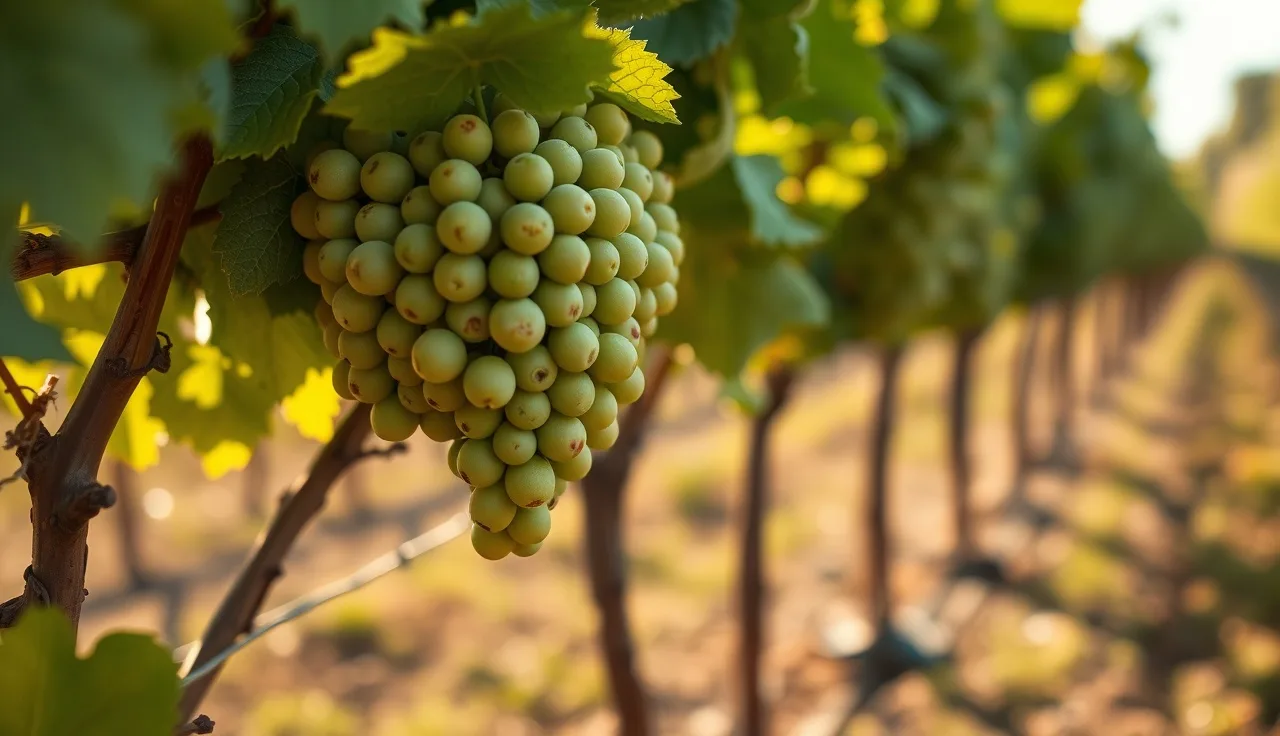
Fruit set is the window, typically 4 to 6 weeks after full bloom, when fertilized flowers harden into berries and cell division kicks off. Get the water balance wrong and you either drop clusters through drought stress or, far more common in irrigated vineyards, waterlog the fruit into oversized, flavor-poor berries that haunt you clear through harvest.
The physiology is simple. During cell division, which runs from fruit set to roughly 40 days post-bloom, every extra unit of water the vine absorbs drives up berry volume [1]. That sounds harmless until you remember the skin-to-volume ratio drops as berries enlarge. A thinner relative skin means less tannin, less color, and softer acid in the finished wine. A University of California Cooperative Extension study tied excessive early-season irrigation to lower Brix at harvest in Cabernet Sauvignon plots in the San Joaquin Valley [2].
Shoot growth is the other trap. Vigorous shoot tips and developing clusters compete for the same photoassimilates. Push soil moisture too high from fruit set through lag phase and the vine sends carbohydrate to vegetative growth instead of clusters. Dense canopies follow. Those canopies trap humidity, raise disease pressure, and shade the fruit that needs light to ripen evenly. None of this is theoretical. It's the sequence every seasoned grower has watched unfold.
The vine tells you before things go sideways. You just have to know where to look.
What is the right soil moisture target during fruit set?
The most useful single number is how much of your total available water (TAW) you let deplete before you irrigate. During fruit set, most extension guidance puts management allowable depletion (MAD) at 40 to 50 percent of TAW for wine grapes [3]. You irrigate before half the plant-available water in the root zone is gone, but you never sit near field capacity.
Field capacity in a loam usually lands around 0.28 to 0.33 cm³/cm³ volumetric water content. Permanent wilting point sits near 0.12 to 0.14 cm³/cm³. Your TAW is the difference across the rooting depth. For a vine rooted to 60 cm, that might be 60 to 90 mm of available water depending on texture. At 40% MAD you'd irrigate after depleting 24 to 36 mm. That is not much water, which is exactly why checking every 3 to 5 days during fruit set is not overkill.
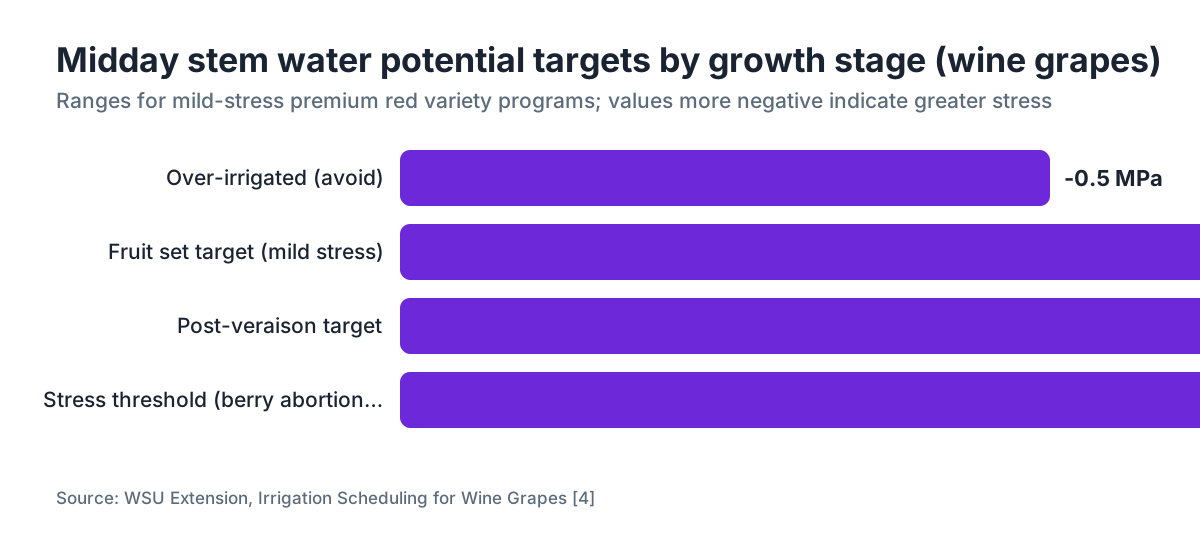
WSU Extension puts the preferred midday stem water potential for wine grapes during fruit set at -0.8 to -1.0 MPa for mild to moderate stress, right where most premium red programs want to run [4]. Go wetter than -0.6 MPa midday and you're in the over-irrigation zone. Go drier than -1.2 to -1.4 MPa this early and berry set percentage drops, because stressed vines abort more berries.
Soil texture drives all of this. Sandy loams drain fast and recover fast, so you can correct a light over-irrigation event quickly. Clay-heavy soils hold water long after a rain or an irrigation set, and vines on those soils stay vulnerable to extended wet conditions even when the surface looks bone dry.
| Soil texture | Typical TAW (mm per 30 cm depth) | How quickly it drains after irrigation |
|---|---|---|
| Sand | 25-40 | 12-24 hours |
| Sandy loam | 50-75 | 1-2 days |
| Loam | 75-100 | 2-4 days |
| Clay loam | 90-120 | 4-7 days |
| Clay | 100-150 | 7-14 days |
Know your texture and root depth before fruit set arrives. It's the only way to build a schedule you can trust.
How do you calculate how much water to apply during fruit set?
Start with reference evapotranspiration (ETo), which your local CIMIS station in California, or the NOAA climate data platform elsewhere, reports daily [5]. The vine's crop coefficient (Kc) at fruit set in a mature, fully canopied vineyard runs 0.45 to 0.65, depending on row spacing and trellising. Multiply ETo by Kc to get vineyard evapotranspiration (ETc).
Most California premium-wine programs replace 50 to 60 percent of ETc during fruit set rather than 100 percent, running a deliberate mild deficit [2]. Cornell's viticulture program lands in the same place for Finger Lakes Riesling and Chardonnay: apply irrigation equal to 50 to 65% of calculated ETc from post-set through veraison to hold mild stress without losing crop [6].
Here is a worked example. Say ETo is 6 mm per day, Kc is 0.55, and you're targeting 55% replacement.
ETc = 6 mm x 0.55 = 3.3 mm per day
Target application = 3.3 mm x 0.55 = 1.8 mm per day
For a drip system with emitters at 0.6 m spacing and rows 2.4 m apart, 1.8 mm per day across the canopy area works out to roughly 2.6 liters per vine per day. Run your drip for the hours needed to deliver that, adjusting for system uniformity and emitter flow rate. A system with distribution uniformity below 85% is costing you control at the exact moment precision pays.
Track what you actually apply. A paper log works, but errors pile up fast across a 60-day fruit-set-to-veraison window. An irrigation record tied to your field notes makes diagnosis far easier when cluster development goes wrong. Tools like VitiScribe are built for this, linking daily irrigation events to plant water status readings so you get one continuous record instead of scattered notebooks.
What are the visual signs of over-irrigation during fruit set?
Experienced growers say they can feel when a block runs too wet. That instinct is real, and it rests on a handful of specific tells.
The fastest signal is shoot tip behavior. Vines at mild deficit slow or stop tip elongation naturally after fruit set. Over-irrigated vines keep pushing. If you're hedging three times before veraison and the tips still look like they want to outrun the trellis wires, your soil is too wet.
Leaf color is subtler but worth reading. Over-irrigated vines often carry extra-dark, almost blue-green foliage from heavy nitrogen uptake driven by high soil moisture. The leaves are large and soft. Set them next to a slightly drier block and the size difference usually jumps out.
Berry sizing is the signal that matters most, and it gives the slowest feedback. Pull 10 berries from three clusters at weekly intervals and weigh them. If berries in one block run consistently 15 to 20% heavier than the same variety in a tighter-irrigated block next door, that's your over-irrigation signature. By the time it shows, three weeks of cell division may already be locked in.
Standing water 48 hours after a drip or microsprinkler set in a block with decent drainage is a red flag. If you're seeing surface saturation that long after irrigation, your run time is almost certainly too long for your soil's infiltration rate.
How do plant water potential measurements prevent over-irrigation?
A pressure chamber (pressure bomb) is the most direct way to know what's happening inside the vine. You measure predawn leaf water potential or midday stem water potential, compare against published thresholds, and set irrigation from real vine response instead of a modeled guess.
Predawn leaf water potential is the equilibrium reading. The vine has sat in the dark for hours with no transpiration, so leaf water potential equalizes with soil water potential in the root zone. Values above -0.2 MPa at predawn generally mean the vine is at or near field capacity, which is the over-irrigation zone for fruit set. Between -0.2 and -0.4 MPa is adequate supply. Below -0.4 MPa you're in mild deficit. Below -0.6 MPa at predawn, the deficit is getting serious.
Midday stem water potential, where you bag a leaf for 90 minutes before measurement to stop transpiration, is more sensitive and responds to same-day conditions. WSU's irrigation guide for wine grapes lists a midday stem water potential of -0.8 to -1.2 MPa as the desired mild-stress range for red varieties during fruit set and early bunch stem hardening [4]. Readings consistently above -0.7 MPa midday tell you you're watering too much.
Measuring twice a week on 3 to 5 representative vines per block is enough to catch drift before it does damage. Mark the same vines. Use fully expanded, sun-exposed leaves. Take readings at the same time of day. Sloppy protocol, not any flaw in the method, is the main reason growers get numbers they can't trust.
No pressure chamber in the budget? Proxy with a well-calibrated soil moisture sensor network at two depths, 30 cm and 60 cm, in representative spots under the emitter and midway between. Tensiometers read soil water tension directly in centibars. During fruit set, holding the 30 cm reading between 20 and 40 centibars in a loam is a reasonable target, but calibrate to your own soil.
Does rainfall during fruit set change how you manage irrigation?
Yes, and this is where most over-irrigation mistakes actually start. Growers run their scheduled sets, then it rains 20 mm, and the schedule never adjusts. Three weeks later the cluster weights are off and nobody connects it to that wet stretch in June.
Rain during fruit set is a free irrigation event, except you didn't pick the timing or the amount. After any rain above 15 mm (roughly 0.6 inches), pause the drip schedule and take soil moisture readings before you resume. In many regions a 25 mm rain in a loam vineyard during fruit set replaces 10 to 15 days of ETc deficit, so you may not need to irrigate again for 1 to 2 weeks.
Check drainage too. If your rows slope less than 1 to 2 percent and the soils run moderately heavy, rain pools in low spots and stays there far longer than a soil sensor a few rows away will show. Walk the block after a real rain and look for standing water and slow-drying zones.
In high-rainfall regions like the Willamette Valley or New York's Finger Lakes, growers often lean on rainfall through fruit set with minimal supplemental water. Cornell's guidance for those regions warrants supplemental irrigation during fruit set only when cumulative soil water deficit passes 40 to 50% of TAW, which in a wet year may never happen [6]. The risk there is not drought. It's persistent saturation from heavy clay subsoils that hold water long after the surface looks fine.
A running rain log alongside your irrigation events is the only way to see the true water balance. Simple in a spreadsheet, and easy to let slip when harvest prep is hitting at the same time.
What varieties or rootstocks are most sensitive to over-irrigation at fruit set?
Varieties differ in how hard they respond to high soil moisture at fruit set. As a rule, high-vigor varieties on vigorous rootstocks are the most exposed. Extra canopy from excess water on a 110R or SO4 rootstock can grow genuinely out of hand.
Cabernet Sauvignon and Syrah tolerate mild water stress well and respond nicely to deficit programs during fruit set. UC Davis work shows clear quality gains from holding midday stem water potential in the -1.0 to -1.2 MPa range from fruit set through veraison [1]. Merlot and Chardonnay sit more sensitive on the deficit side, but both also show strong berry-size responses to over-irrigation, so precise management matters just as much.
Pinot Noir is its own case. It isn't inherently over-vigorous, but many Pinot programs target berry sizes at or below 1.5 grams for premium wine. Over-irrigation during fruit set on a variety already prone to tight clusters creates compaction that worsens botrytis in cool, wet regions. Any Pinot grower in a humid area should treat fruit set water management as a disease decision as much as a quality one.
On the rootstock side, 3309C, 420A, and Riparia Gloire impose moderate vigor control and give you buffer. 5BB Kober, 1103P, and SO4 under high fertility and heavy irrigation are where the runaway-canopy stories come from. Know your rootstock's vigor class and set your irrigation targets around it.
For growers in Paso Robles wineries country and the wider Central Coast, where deep alluvial soils over strong rootstocks can push enormous canopies, tracking vigor proxies like lateral shoot length and internode length weekly through fruit set is worth the time.
How does over-irrigation during fruit set affect wine quality downstream?
The chain runs in a straight line. Over-irrigation at fruit set makes larger berries. Larger berries carry more juice per unit of skin. More juice dilutes the compounds that come from the skin: anthocyanins, tannins, aromatic precursors, potassium. At harvest, Brix may still hit target because the vine has time to concentrate sugars late, but phenolic maturity often lags behind.
A UC Davis study on Cabernet Sauvignon comparing irrigation treatments from fruit set through veraison found that vines irrigated at 100% ETc replacement produced wines rated significantly lower for color intensity, tannin structure, and overall quality than vines at 50% ETc replacement, even when harvest Brix matched [1]. That single finding has shaped premium California red programs for two decades.
Acid chemistry shifts too. Large-berried fruit tends toward lower titratable acidity at harvest, partly from dilution and partly because rapid early growth alters malic acid metabolism. In regions where natural acidity is already marginal, over-irrigation during fruit set can cost you 0.5 to 1.0 g/L of TA by harvest. That's a commercially real difference.
Flavor and aroma are harder to quantify, but wines from over-irrigated fruit read consistently flatter. Varietal character that should be clear, Cabernet's cassis or Syrah's savory edge, comes across muted. You can't fix it in the cellar. Decisions made in a 4-week window in late spring set the ceiling on what's possible 5 months later.
What irrigation records do you need to keep, and why does it matter for compliance?
Irrigation record-keeping touches several compliance requirements depending on your region and whether you run any chemigation (applying fertilizer or pesticides through the irrigation system).
For straight water application, most states don't mandate irrigation records on their own. But if you fertigate, those events fall under the EPA Worker Protection Standard when any pesticide is involved, and in some states nitrate management plans require water and fertilizer application records above a certain acreage threshold [7].
California growers in the State Water Board's Irrigated Lands Regulatory Program (ILRP) must maintain records of irrigation water use, water source, and applied amounts as part of their Central Valley and Coastal watershed order compliance [8]. Those records need to be kept at least 3 years in most regions. "Growers must keep records of their farming operations," the Water Board states in its ILRP guidance, and those records include water use.
Compliance aside, water records are your first diagnostic tool when something breaks. If berry set is poor or cluster development is uneven, the first thing a good consultant asks for is your irrigation log from the 6 weeks around fruit set, paired with any soil or plant water potential readings from that stretch.
A practical fruit-set irrigation log needs: date, block or zone ID, application amount (liters or inches), run time, system uniformity if checked, any rainfall that week, soil moisture sensor reading or pressure chamber result, and notes on vine appearance. That's 8 data points per event. A paper form works. A digital record in a field operations platform is easier to search and harder to lose. VitiScribe was built for this kind of block-level record, tying irrigation to plant observations in a format that satisfies both agronomic review and regulatory audit.
For growers supplying wineries with sustainability or organic certifications, third-party auditors increasingly want irrigation records as proof of responsible water use. Rebuilding that data from memory after the fact is a bad place to be.
See also the vineyard hub for broader coverage of field operations recordkeeping.
What are common mistakes to avoid when setting up drip irrigation for fruit set?
The single most common mistake is never adjusting run times off the spring schedule. Growers commission drip in April or May when ETo is low, set a run time that replaces roughly 100% of ETc at that point, then forget to cut it back as the canopy expands and ETo climbs. By fruit set in June that same run time over-applies by 30 to 50%.
Ignoring distribution uniformity (DU) is the next one. A drip system at 75% DU means that to get enough water to the driest spots, you over-apply to 25% of the system. Poor lateral flushing, clogged emitters, and pressure variation across zones are the usual causes. WSU Extension recommends measuring DU at least once a season by catching emitter output in small cups across a zone over a timed period [4]. Anything below 85% is worth fixing before it costs you fruit quality.
Timing sets badly against canopy demand is the third big error. Run drip through peak solar hours when evapotranspiration demand tops out, skip the night, and the vine still hits stress pulses no matter what your daily total says. Nighttime or early-morning drip lets the soil reach equilibrium before the vine's peak demand window.
And failing to account for rain events, as covered above, is routine. A printed or digital irrigation log with a column for weekly rainfall is a 5-minute fix that saves weeks of confusion.
How do cover crops affect soil moisture during fruit set?
If a living cover crop is still growing through fruit set, whether by design as a permanent sward or because weed control ran late, it's drinking your soil water. In a dry year in a drip-irrigated block, competitive cover crop use can drive vine stress harder and faster than your irrigation model predicts. In a wet year, a well-managed cover crop helps you by drawing down excess moisture, which is a real advantage at fruit set.
Rye or barley left standing through bloom and fruit set can pull 50 to 100 mm of water from the profile before summer dormancy kills it off, depending on stand density and temperature [2]. In a region with little rain from May to July, that's a serious stress multiplier. Mow or terminate the cover crop at or before bloom if you want soil moisture available mostly to the vine during fruit set.
Native grass swards in alternate rows are common in premium regions. There, the soil under the vine row (where your drip runs) stays largely vine-exclusive, and the inter-row sward competes against ground with no emitters. That's a workable balance, but it means your under-emitter sensors may read adequate while the inter-row dries out and roots in the vine's outer root zone feel more stress than your sensors show.
Know where your sensors sit relative to your emitters and your cover crop. Sensor placement that doesn't reflect the real vine root zone gives you meaningless numbers, and the confusion compounds fast during a quick warm-up in late spring.
Frequently asked questions
What is fruit set in wine grapes and when does it happen?
Fruit set is when fertilized flowers develop into small green berries. It happens roughly 4 to 6 weeks after full bloom, which in most California regions falls between late May and early July depending on variety and elevation. Fruit set triggers rapid cell division in the berry, making it the period where irrigation most directly shapes final berry size and composition.
How do I know if I'm over-irrigating during fruit set?
The fastest signal is shoot tip behavior: over-irrigated vines keep pushing vigorous growth well past fruit set. Pressure chamber readings consistently above -0.6 MPa midday stem water potential also point to excess moisture. Longer term, berries tracking 15 to 20% heavier than your target variety weight at the same stage, compared to a tighter block, is a reliable tell. Walking blocks weekly and checking soil moisture at 30 and 60 cm catches problems early.
What midday stem water potential should I target during fruit set?
For most premium red varieties on a mild-stress program, target -0.8 to -1.2 MPa midday stem water potential during fruit set. WSU Extension uses this as its standard mild-stress benchmark. Values consistently above -0.7 MPa suggest over-irrigation. Values below -1.4 MPa this early risk berry abortion and lower cluster weight. Measure at the same time of day on sun-exposed, mature leaves.
How much of ETo should I replace during fruit set?
Most extension guidelines for premium wine grapes recommend replacing 50 to 60% of calculated ETc from fruit set through veraison. At a typical crop coefficient of 0.5 to 0.6 for a mature canopy, that comes to roughly 25 to 36% of reference ETo per day. Cornell recommends 50 to 65% ETc replacement for cool-climate varieties like Riesling and Chardonnay in the Finger Lakes.
Does over-irrigation during fruit set reduce wine quality?
Yes, clearly. UC Davis research on Cabernet Sauvignon found that 100% ETc replacement from fruit set through veraison produced wines rated significantly lower for color intensity and tannin structure than 50% replacement, even when harvest Brix matched. Larger berries mean lower skin-to-juice ratio, diluted anthocyanins and tannins, and muted varietal character. You can't recover those compounds in the winery.
Can cover crops cause over-irrigation problems during fruit set?
Cover crops in alternate rows generally don't interfere with drip-delivered water in the vine row. But standing cover crops under the vine row compete directly for soil moisture. Rye or barley left standing through fruit set can pull 50 to 100 mm of water from the profile. In dry springs that accelerates vine stress. In wet springs it helps drain excess. Terminate cover crops by bloom if you want a predictable water balance during fruit set.
What soil moisture sensors work best for monitoring irrigation during fruit set?
Tensiometers and capacitance-based sensors (such as Sentek or Decagon models) are the most common in commercial vineyards. Place sensors at two depths, 30 cm and 60 cm, in a representative spot midway between emitters and at least 1 meter from the trunk. During fruit set, target 20 to 40 centibars tension at 30 cm in loam. Readings above 50 centibars indicate stress; below 15 centibars indicates excess moisture.
Does rainfall count toward my irrigation budget during fruit set?
Absolutely. Any rainfall above 15 mm should trigger a pause in your drip schedule and a soil moisture check before you resume. In loam soils, a 25 mm rain during fruit set may replace 10 to 15 days of calculated ETc deficit. Growers who run irrigation on a fixed calendar without accounting for rain are the most frequent source of over-irrigation during fruit set in wet years.
How does rootstock choice affect over-irrigation risk during fruit set?
High-vigor rootstocks like 5BB Kober, SO4, and 1103P amplify shoot growth in response to high soil moisture. On these rootstocks, over-irrigation at fruit set can produce canopies that need two to three extra hedging passes before veraison, raising labor costs and disease pressure. Lower-vigor rootstocks like 3309C and 420A give you more buffer. Know your rootstock's vigor class and lower your irrigation target accordingly.
What irrigation records am I required to keep as a California vineyard operator?
California growers under the Irrigated Lands Regulatory Program (ILRP) must maintain records of irrigation water use, source, and application amounts, typically kept for 3 years. If you fertigate with any registered pesticide, EPA Worker Protection Standard requirements also apply. Beyond compliance, irrigation logs tied to soil moisture readings are your primary diagnostic tool for fruit set management and for third-party sustainability audits.
What is management allowable depletion (MAD) and how does it apply to fruit set?
MAD is the percentage of total available water (TAW) you let the root zone deplete before irrigating. During fruit set, UC Cooperative Extension recommends a MAD of 40 to 50% of TAW for wine grapes. That keeps vines in mild deficit without drought stress. TAW depends on soil texture and root depth. A loam rooted to 60 cm typically holds 90 to 120 mm of TAW, so you'd irrigate before 45 to 60 mm is depleted.
Is Pinot Noir more sensitive to over-irrigation at fruit set than other varieties?
Pinot Noir isn't especially vigorous, but it's more sensitive to the downstream effects of over-irrigation. Programs targeting berries below 1.5 grams for premium wine see the clearest berry-size response to excess moisture. In humid regions, larger berries in tight Pinot clusters sharply raise botrytis risk. Many Pinot programs run slightly tighter deficit targets during fruit set than Cabernet or Syrah for this reason.
How does over-irrigation affect titratable acidity at harvest?
Over-irrigated, large-berried fruit typically shows lower titratable acidity at harvest, from dilution and from altered malic acid metabolism during rapid early growth. In warm regions where TA is already marginal, excessive fruit-set irrigation can cost 0.5 to 1.0 g/L of TA by harvest. That's a meaningful shift in style and stability, and tartaric additions alone can't fix it without hurting palate balance.
When should I start cutting back irrigation after veraison?
After veraison, most programs move to a more aggressive deficit to promote sugar accumulation and skin maturation. Stem water potential targets commonly drop to -1.2 to -1.5 MPa midday. In practice, irrigation frequency falls sharply: many premium California blocks go to once a week or less after veraison, depending on ETo. Stop irrigating entirely 2 to 3 weeks before anticipated harvest unless heat is extreme enough to shut the vine down.
Sources
- UC Davis Department of Viticulture and Enology, 'Regulated Deficit Irrigation Alters Anthocyanin, Tannin, and Sensory Properties of Cabernet Sauvignon Grapes and Wines': Vines irrigated at 100% ETc replacement from fruit set through veraison produced wines rated significantly lower for color intensity and tannin structure compared to 50% ETc replacement treatments
- UC Cooperative Extension, 'Deficit Irrigation of Grapevines for Wine Production': Excessive early-season irrigation was associated with lower Brix at harvest in Cabernet Sauvignon plots; cover crops left standing can use 50 to 100 mm of soil water before summer dormancy
- UC Cooperative Extension, Tulare County, 'Irrigating Wine Grapes': Management allowable depletion (MAD) of 40 to 50% of TAW is the recommended threshold for initiating irrigation in wine grapes during fruit set
- Washington State University Extension, 'Irrigation Scheduling for Wine Grapes': Midday stem water potential of -0.8 to -1.2 MPa is the desired mild-stress range for wine grapes during fruit set; distribution uniformity should be measured at least once per season and values below 85% warrant correction
- California Department of Water Resources, CIMIS Reference Evapotranspiration Network: CIMIS provides daily reference ETo data by station, used as the basis for vineyard ETc calculations throughout California
- Cornell University Cooperative Extension, 'Irrigation Management for Vineyards in the Finger Lakes Region': Supplemental irrigation during fruit set is only warranted when cumulative soil water deficit exceeds 40 to 50% of TAW; target 50 to 65% ETc replacement from post-set through veraison for cool-climate varieties
- U.S. EPA, Worker Protection Standard for Agricultural Pesticides: Chemigation events involving registered pesticides are subject to EPA Worker Protection Standard requirements, including record-keeping obligations
- California State Water Resources Control Board, Irrigated Lands Regulatory Program: California growers under the ILRP are required to maintain records of irrigation water use, source, and application amounts, typically retained for at least 3 years
- WSU Extension, 'Drip Irrigation System Maintenance for Vineyards': Systems with distribution uniformity below 85% require correction; measuring DU by catching emitter output in timed cup tests is recommended at least once per season
Last updated 2026-07-11