How to respond to a pesticide residue exceedance in wine grapes

TL;DR
- A pesticide residue exceedance means a detectable residue in or on your grapes exceeds the legal tolerance set by EPA (for U.S.
- markets) or the importing country's MRL.
- Your first moves are to stop harvest on the affected blocks, pull your spray records, identify the violation source, and notify your winery buyer immediately.
- Depending on the finding, the fruit may need to be destroyed, renegotiated, or held pending retesting.
What is a pesticide residue exceedance and how does it happen in a vineyard?
A residue exceedance is when a lab analysis finds a pesticide compound in or on harvested grapes at a concentration above the applicable legal maximum residue level (MRL) or tolerance. In the U.S., the EPA sets tolerances under the Federal Food, Drug, and Cosmetic Act (FFDCA), codified at 40 CFR Part 180 [1]. The Food and Drug Administration (FDA) and USDA enforce those tolerances at the commodity level. For wine grapes destined for export, particularly to the EU, Japan, or Canada, the importing country's MRL applies and those are often lower than U.S. tolerances.
Exceedances happen through several distinct pathways. The most common is a pre-harvest interval (PHI) violation: a product was applied too close to harvest, so the residue didn't have enough time to degrade below the tolerance. The second most common is a product applied to an adjacent crop drifting onto the vineyard. A third, often overlooked pathway is using an unregistered pesticide on grapes, which creates a zero-tolerance situation regardless of concentration because there is no established tolerance on that crop.
A fourth pathway catches growers off guard every few years: a chemical applied legitimately years earlier that persists in soil (some organochlorines, for example) gets taken up by vines and shows up at harvest. Nobody applied anything wrong this season, but the fruit still fails. This is the scenario that most benefits from good historical spray records going back five or more years.
Here's the practical bottom line. Most exceedances in commercial wine grape production trace back to a PHI that wasn't respected, a product mislabeled or confused in the spray program, or drift from a neighboring operation.
What are the EPA and state tolerance thresholds I need to know?
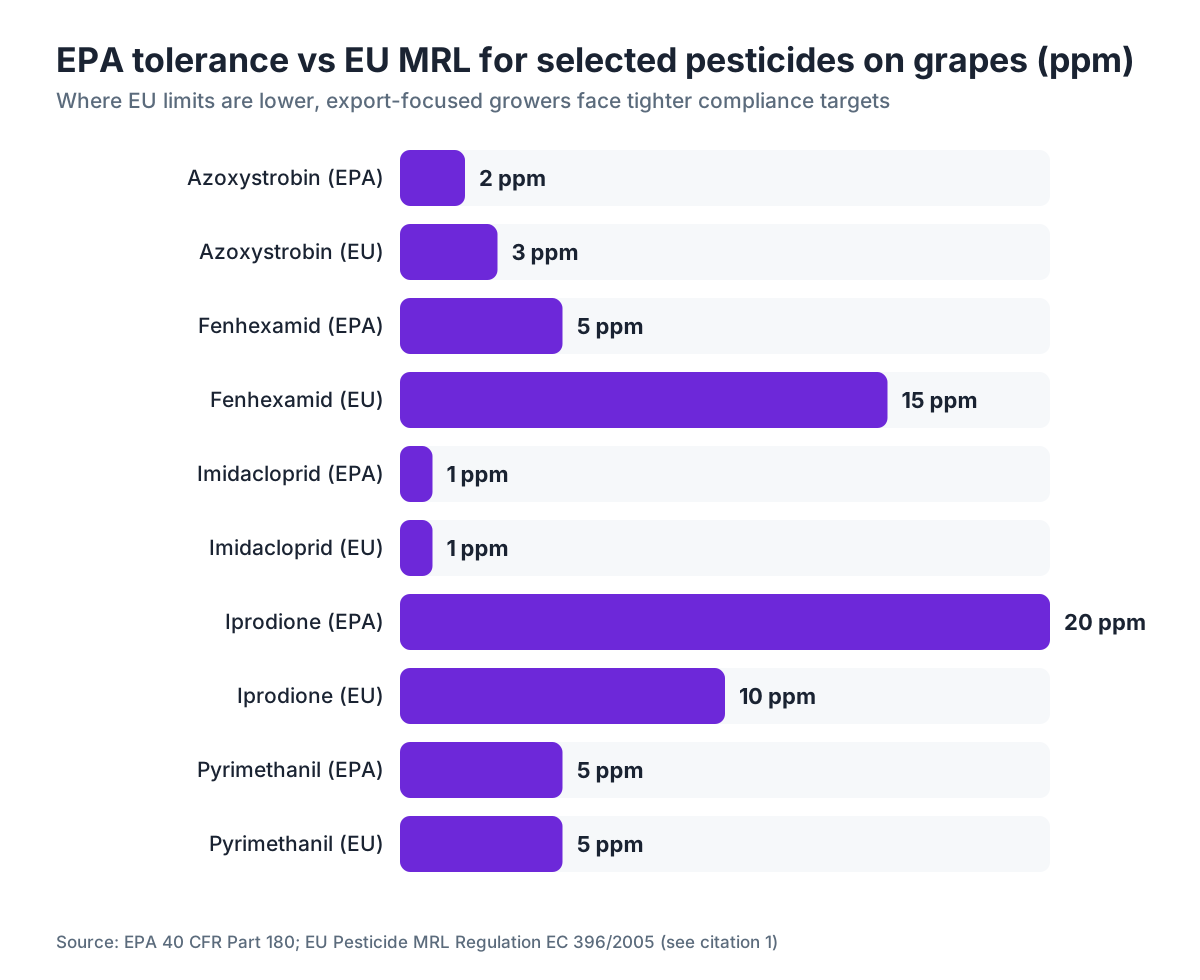
EPA tolerances for pesticides on grapes are published in 40 CFR Part 180 and the specific tolerance for each active ingredient varies enormously [1]. A few examples show the range:
| Active Ingredient | EPA Tolerance on Grapes (ppm) | EU MRL on Grapes (ppm) |
|---|---|---|
| Azoxystrobin | 2.0 | 3.0 |
| Fenhexamid | 5.0 | 15.0 |
| Imidacloprid | 1.0 | 1.0 |
| Chlorpyrifos | 0.01 (post-2022 revocation, now zero) | 0.01 |
| Iprodione | 20.0 | 10.0 |
| Pyrimethanil | 5.0 | 5.0 |
Chlorpyrifos is a special case. EPA revoked all food tolerances for chlorpyrifos in 2021, effective August 2021, which means any detectable residue in grapes is now a violation in the U.S. [2]. That's a good example of why you review the tolerance table every season instead of carrying last year's numbers forward.
California, Washington, and Oregon each layer additional requirements on top of federal law. California's Department of Pesticide Regulation (CDPR) maintains a separate restricted materials list and requires county permits for many products used in vineyards [3]. Washington State Department of Agriculture (WSDA) enforces a parallel licensing and reporting system [4]. A grower who is compliant federally may still face state-level enforcement action.
For export markets, you need the MRL of the destination country rather than the U.S. tolerance. The EU MRL database (EU Pesticide MRL Regulation EC 396/2005) is searchable at the European Commission's website. Japan's MRL list is maintained by the Ministry of Health, Labour and Welfare. Both are stricter than U.S. tolerances on several fungicide classes heavily used in viticulture. If your winery ships wine overseas, this matters even though you're selling grapes domestically, because the wine buyer prices in their export compliance exposure.
What are the first steps to take in the first 24 hours after learning about an exceedance?
Speed matters here, but panic doesn't help. Here's the sequence that makes sense in the first 24 hours.
First, stop harvest immediately on any block covered by the finding. If you've already harvested and delivered the fruit, you need to notify your buyer before the fruit is processed. Once grapes are crushed into a lot, that lot may be condemned or held, and the winery's liability position changes. Early notification is not an admission of guilt. It's professional conduct, and in many contractual relationships it's required.
Second, pull your spray records for that block for the entire growing season and the prior season. You're looking for three things: what was applied, the application date, and the PHI listed on the label. Cross-reference application date plus PHI against actual harvest date. If the math shows a PHI violation, document it clearly because regulators and buyers will want to see it, and a transparent account of what happened reads far better than a discovered omission.
Third, preserve a sample. If the original sample was pulled by the winery or a third party and you didn't have a split sample, request the lab retain the original and ask for a retest from the same sample. If you still have fruit in the field or in a gondola, take your own samples to a certified lab immediately. Retest costs are modest (typically $50 to $300 per analyte depending on method) [5] and a retest can either confirm or clear you.
Fourth, check whether the testing method and laboratory are accredited. Not every lab result that triggers a buyer's rejection is a valid regulatory finding. Results from non-accredited labs or from non-validated methods may not hold up in a formal dispute. Ask the testing party for the lab's ISO 17025 accreditation certificate and the analytical method used. This matters for your defense if the situation escalates.
Do I have a legal obligation to report a pesticide residue exceedance to regulators?
This depends entirely on who found it and how.
If the exceedance was found by a government inspector, the FDA, USDA, or state ag department already knows. You don't need to self-report to an agency that already has the data. Your obligation at that point is to respond to any official notice you receive.
If the finding came from your own testing or your buyer's testing with no government involvement yet, the mandatory reporting picture is more nuanced. There is no blanket federal requirement that a grower self-report a private test result showing a residue exceedance. But continuing to sell the fruit or use it in commerce with knowledge that it violates the FFDCA could count as introducing an adulterated food into commerce, which carries civil and criminal penalties under 21 USC 342 [6].
California has an additional layer. CDPR requires growers to report certain pesticide-related incidents including accidents and suspected illnesses, but the reporting requirement in 3 CCR Section 6680 is event-driven (worker exposure, environmental incidents) rather than residue-level-driven [3]. That said, if a county agricultural commissioner opens an investigation based on a residue finding, you'll want legal counsel before making statements.
The honest advice here is this. If the fruit hasn't moved and you found the problem yourself, do not sell it while it's out of tolerance. That decision is both the legally safer path and the only ethical one. If the fruit has already moved to the winery, call your buyer, call your agricultural attorney, and get your spray records in order before doing anything else.
How does a residue exceedance affect my grape purchase contract and who bears the financial loss?
Grape purchase agreements vary enormously, but most include language covering rejection for pesticide residue violations. Read your contract's force majeure clause, rejection clause, and indemnification language before you make any calls. Some contracts allow the winery to reject the fruit at delivery and charge the grower for testing costs. Others specify binding arbitration for disputes. A few high-value contracts include a shared-testing protocol that governs acceptable labs and methods, and those provisions are your friend in a dispute.
The financial loss generally falls to the grower for a spray program error. If the exceedance stems from documented drift from an adjacent property, the legal exposure shifts to the source of the drift, but you'll need to prove it. Drift claims require contemporaneous documentation: wind speed and direction logs, spray records from the neighboring operation (sometimes obtainable through a public records request if they're a commercial operation using restricted materials), and ideally samples from the boundary zone.
For growers with crop insurance, some policies cover loss from pesticide residue, but this is not standard. USDA Risk Management Agency's Whole Farm Revenue Protection plan may cover income loss from a rejected crop under some circumstances, but the specific policy language governs [7]. Call your crop insurance agent before destroying any fruit, because premature disposal without documentation can void a claim.
If the winery suffers losses because they processed fruit they didn't know was over-tolerance and then failed their own compliance testing, they may seek to recover those losses from the grower. This is where indemnification clauses and a clear paper trail of when you disclosed what become financially critical.
What should I document and preserve as evidence after an exceedance?
Documentation is what separates a manageable situation from a legal disaster. Preserve all of the following.
Spray records: every application in the affected block for the current and prior season, including the applicator's name, license number (required under the EPA Worker Protection Standard for commercial applications), product name, EPA registration number, application rate, application date, and weather conditions [8]. If you're using paper records, photograph them immediately. If you're in a digital system, export and back up the relevant records to a separate location.
Equipment calibration records: these show whether your sprayer was delivering the labeled rate or whether a miscalibration might have caused over-application.
Weather logs: wind speed and direction on the application date, relevant if you're arguing for or against drift.
Purchased product labels and Safety Data Sheets: the label at the time of purchase may differ from the current label if the registration was amended. The label you applied under is the legally operative document.
Split samples: if you had any retained sample from the original lot, protect it under documented chain of custody. Freeze it if it's a juice or must sample.
Buyer communication records: email or text timestamps showing when you notified the buyer matter for the contract dispute and for any regulatory timeline questions.
A tool like VitiScribe can pull spray records for a specific block across multiple seasons in seconds, which is exactly the kind of retrieval speed you need when a buyer is on the phone asking what you applied and when. Whether you use dedicated software or a well-organized binder, what matters is that the records exist and are complete.
Can the affected grapes be salvaged or do they have to be destroyed?
This is the question growers want answered most, and the honest answer is: sometimes yes, sometimes no.
For a PHI violation where the exceedance is marginal and the residue degrades predictably, waiting additional time after harvest before crushing is sometimes possible. Some residues dissipate during winemaking (fermentation, fining, and filtration can reduce certain residue levels), but this is not reliable enough to use as a compliance strategy and you shouldn't count on it to bring an out-of-tolerance lot into tolerance. The FDA's position is that the tolerance applies at the point of harvest of the raw agricultural commodity [6]. Dilution with compliant fruit to bring a blend under tolerance is also prohibited.
Practical salvage options that may be available:
Retest with a different sample to verify the first result. As noted above, analytical errors happen. If a retest from the same lot comes back in tolerance, document the discrepancy and get guidance from your state ag department on how to proceed.
Alternative market: some out-of-tolerance fruit can lawfully go to non-food uses (distilled spirits made for industrial use, vinegar production under specific circumstances, animal feed in some cases). Each of these pathways has its own regulatory requirements and needs legal review before pursuing.
Formal written waiver from the buyer: in rare circumstances where the tolerance is close and the buyer accepts the risk, a written commercial waiver may exist. This does not make the fruit legally compliant; it simply shifts contractual liability. It does not protect anyone from FDA enforcement.
Destruction with documentation: if destruction is required or chosen, document it thoroughly with video, witness signatures, and county ag commissioner involvement if applicable. This documentation is required for most crop insurance claims [7].
What are the penalties I'm facing if a regulatory agency gets involved?
Federal penalties under FIFRA (the Federal Insecticide, Fungicide, and Rodenticide Act) and the FFDCA can reach $10,000 per violation for commercial applicators and $1,000 per violation for private applicators [9]. These are per-occurrence figures, meaning multiple applications or multiple lots can multiply the total. Criminal violations (knowing and willful introduction of adulterated food into commerce) carry significantly higher exposure including potential imprisonment under 21 USC 333 [6].
State penalties vary. California CDPR can impose civil penalties up to $5,000 per violation for pesticide law violations under California Food and Agricultural Code Section 12999, and referrals for criminal prosecution are not uncommon for egregious cases [3]. Washington WSDA civil penalties under RCW 15.58 can reach $7,500 per violation [4].
For growers who cooperate early, have clean records, and can show the violation was unintentional (a genuine PHI miscalculation, for example), outcomes are typically civil fines and a compliance agreement rather than criminal referral. Regulators distinguish between a grower who miscounted days and a grower who knowingly sold adulterated fruit. Your spray records are the evidence that establishes which category you're in.
University extension programs have published guidance on how to work constructively with state ag departments after a finding. UC Davis's Cooperative Extension [10] and Washington State University Extension [11] both maintain viticulture-specific resources, and their farm advisors can often help you make the initial contact with regulators before you've hired an attorney.
How do I prevent a residue exceedance from happening again?
Prevention is mostly a system problem, not a knowledge problem. Most growers know the PHIs for their core products. Exceedances happen when the system breaks down: a different crew member applies the last spray, the harvest date moves up by a week due to weather, or the product label changes and the old PHI is still in use.
The highest-leverage change most vineyards can make is a hard-block system that prevents a harvest order from being issued for a block until the longest PHI of any product applied that season has elapsed. This sounds obvious, but it requires spray records to be current and accessible at the time the harvest decision is made, which means records need to be entered within 24 hours of application, not after the fact.
A second high-leverage change is a pre-harvest residue check on a sampling schedule, particularly for blocks where the last spray was close to the PHI boundary or where a new product was trialed. Pre-harvest testing costs a few hundred dollars and catches problems before they become buyer rejections, crop losses, or regulatory events.
Third: when you use a new product, read the label against your export market requirements rather than just the EPA tolerance. If your winery ships any wine to the EU or Asia, ask them directly which active ingredients create export problems. Several common fungicides (iprodione, for example) have significant MRL differences between U.S. and EU tolerances that can create compliance issues for export-focused wineries even when the U.S. tolerance is met.
Cornell's Integrated Pest Management program and WSU's wine grape IPM resources both publish season-specific guides with PHI tables that are worth running against your spray program every season [11][12].
How do I rebuild trust with my winery buyer after an exceedance?
This is the part nobody writes about, but it's arguably as consequential as the regulatory response for a grower's long-term business.
Wineries that buy from independent growers run real financial and reputational risk from residue issues. A buyer who loses confidence in your spray program will either add testing requirements, reduce the price to reflect compliance risk, or not renew your contract. Rebuilding trust requires concrete actions, not assurances.
The most effective action is inviting the buyer's vineyard manager or viticulturist to review your updated spray program before the next season starts. Showing them your record-keeping system, your PHI tracking method, and the specific procedural change you made in response to the exceedance is worth more than any number of verbal commitments.
If your buyer requires independent third-party audits going forward, accept that without negotiating it away. Stewardship certifications like CCSB (California Sustainable Winegrowing Alliance) or LIVE (Low Input Viticulture and Enology) include spray record reviews that give buyers documented evidence of your practices [13]. Some growers resist the audit burden, but the certification can actually improve contract security and sometimes price.
A few buyers will move on regardless. That's their right. But most long-term grape purchase relationships survive a single well-handled exceedance if the grower was transparent, moved fast, and can show a changed process. The ones that end relationships are usually those where the buyer felt they were the last to know.
For tracking your corrective actions and documenting your updated program in a form buyers can actually review, VitiScribe's spray record and compliance tools are worth a look, particularly if your current system is still paper-based.
What's different about responding when the exceedance is from pesticide drift, not your own spray?
Drift cases are handled differently from the start because you're the injured party, not the responsible party.
Document everything the moment you suspect drift. Photographs of spray patterns on leaves, buffer zone damage, or unusual residue distribution across your vineyard (heaviest at the property boundary, tapering inward) can establish a spatial pattern consistent with drift. Weather station data from the date of the suspected drift event is essential. If you have a vineyard weather station, pull and archive that log immediately.
File a complaint with your county agricultural commissioner. In California, this is mandatory for anyone who suspects pesticide misuse caused damage or residue [3]. The commissioner will investigate, which may include sampling neighboring crops and reviewing the neighboring applicator's records. This investigation creates an official record that supports your insurance claim and any civil action.
Under the EPA Worker Protection Standard (WPS), agricultural employers also have obligations when pesticide drift exposure may have occurred affecting workers [8]. If your crew was in the vineyard during or after a suspected drift event, you have a separate obligation to evaluate worker exposure and provide appropriate decontamination and medical access.
The buyer conversation is different in a drift case. You did everything right, and you were exposed to a third party's error. Bring the county ag commissioner's complaint documentation to that conversation. It changes the dynamic significantly.
Frequently asked questions
How long do I have to report a pesticide residue exceedance to the FDA?
There's no fixed federal self-reporting deadline for a private residue finding, but selling fruit you know is adulterated is a violation of the FFDCA immediately. If the FDA or USDA found the exceedance through their own testing, respond promptly to any official notice, typically within 10 to 30 days depending on the notice type. State deadlines vary. California CDPR requires pesticide incident reports within 24 hours for acute incidents and 3 business days for others.
Can I still use the grapes for wine if they exceed the EPA tolerance?
Generally no. The EPA tolerance applies to the raw agricultural commodity at harvest. Diluting out-of-tolerance fruit with compliant fruit is specifically prohibited under FFDCA. Some residues do degrade during fermentation and processing, but this isn't a compliant pathway. Verified destruction with documentation, or a non-food use with its own regulatory clearance, are the lawful options. Get legal counsel before processing any fruit you know is out of tolerance.
What's the difference between an EPA tolerance and an MRL?
In U.S. law, EPA sets 'tolerances' under FFDCA for pesticide residues on food commodities. Most other countries, including EU member states, use 'maximum residue levels' (MRLs). The terms are functionally identical: the highest permitted residue level in or on a food at the point of sale. The numbers differ by country and can vary significantly for the same active ingredient, which matters for any wine grapes destined for export-focused wineries.
Do I need a lawyer when a residue exceedance is investigated by a state ag department?
You don't legally need one, but it's wise to consult one before making formal statements to investigators. An agricultural attorney familiar with your state's pesticide law can tell you what disclosure is required versus what is voluntary, review your records for gaps before regulators see them, and advise on whether your spray records support a good-faith defense. Consultation fees for a first call are typically a few hundred dollars, far less than a contested civil penalty.
What pre-harvest residue testing programs should vineyard managers know about?
Several certified labs offer pre-harvest residue screening panels specifically for wine grapes covering 100 to 400+ analytes. Pricing runs from roughly $150 to $500 per sample depending on analyte count and turnaround time. UC Davis Cooperative Extension and WSU Extension both recommend pre-harvest testing when any spray was applied close to the PHI boundary. Some wineries require pre-harvest testing certificates for all contracted blocks, especially export-focused operations.
How do I find the pre-harvest interval for a pesticide I applied in my vineyard?
The PHI is printed on the product label, which is the legally binding document. Look for it in the directions for use section, usually near the application rate table. The EPA's pesticide product label system (PPLS) at labels.cdms.net allows label lookup by product name or EPA registration number. If you've used a product whose label was recently amended, confirm you have the current label; PHIs occasionally change on re-registration.
What happens if my winery's finished wine tests over tolerance? Is that a different situation?
Yes. Tolerance standards apply to the raw agricultural commodity (grapes), not to processed products like wine, which is regulated differently. The EU applies MRLs to wine directly for some compounds through EC 396/2005, and the TTB (Alcohol and Tobacco Tax and Trade Bureau) oversees wine composition in the U.S. A finished wine finding involves the winery directly rather than the grower, and triggers a different regulatory response pathway. The grower's spray records are still relevant evidence.
Can drift from a neighbor's orchard or vineyard cause me to fail residue testing?
Yes, and it happens. Documented drift cases have resulted in growers failing residue tests for compounds they never applied. The spatial pattern of residue in the vineyard (higher concentration near the drift source, tapering inward) is key evidence. File a complaint with the county agricultural commissioner immediately, preserve weather records from the drift date, and notify your buyer in writing that you're investigating a third-party drift event. Your grape contract may have a specific clause covering this.
Are there pesticides with a zero tolerance on grapes that I should know about?
Yes. Pesticides without an established EPA tolerance on grapes have an effective zero tolerance, meaning any detectable residue is a violation regardless of how small. Chlorpyrifos had all food tolerances revoked in 2021. Some pesticides registered on other crops but not grapes fall into this category if there's no established tolerance. Always verify that a product is registered for use on wine grapes specifically, more than on grapes generically or on a neighboring crop.
How does the EPA Worker Protection Standard connect to a pesticide residue event?
The WPS (40 CFR Part 170) requires agricultural employers to keep pesticide application records accessible to workers and their representatives for at least two years, provide pesticide safety training, and ensure restricted-entry intervals (REIs) are enforced. In a residue investigation, WPS records serve as corroboration of your spray records. If a drift event is suspected, WPS obligations around worker notification and decontamination may be triggered independently of the residue compliance question.
Does crop insurance cover losses from a pesticide residue rejection?
It depends on the policy. USDA Risk Management Agency's Whole Farm Revenue Protection (WFRP) may cover income loss from a rejected crop under documented circumstances, but standard crop insurance policies often exclude losses from regulatory non-compliance. Contact your insurance agent before destroying any fruit, get the rejection documented in writing from your buyer, and save all lab reports. Premature destruction without documentation commonly voids claims.
How far back should my spray records go to defend against a residue finding?
Keep at minimum three full growing seasons. Some persistent compounds (particularly soil-applied materials) can produce residue findings years after application, so five years of records is a more defensible position. EPA WPS requires two years minimum. California CDPR regulations also require growers to retain pesticide use records for two years, but in a contested regulatory case, older records can be dispositive evidence in your favor.
What sustainable or organic certification programs require residue testing of wine grapes?
California Certified Organic Farmers (CCOF) and USDA National Organic Program certification require that grapes be grown without prohibited substances, and inspectors can require residue verification testing. California Sustainable Winegrowing Alliance (CSWA) certification does not mandate residue testing but does require documented spray records. LIVE certification (Oregon and Washington) requires spray record review as part of annual audit. Some buyers impose their own pre-harvest testing requirements on top of any certification.
Sources
- EPA, 40 CFR Part 180 Tolerances and Exemptions for Pesticide Chemical Residues in Food: EPA sets tolerances for pesticide residues on food commodities including grapes under the Federal Food, Drug, and Cosmetic Act, codified at 40 CFR Part 180.
- EPA, Chlorpyrifos; Tolerance Revocations Final Rule (August 2021): EPA revoked all food tolerances for chlorpyrifos effective August 2021, making any detectable residue in grapes a violation in the U.S.
- California Department of Pesticide Regulation, Laws and Regulations: California CDPR maintains a restricted materials list, requires county permits, and mandates pesticide use records retention and incident reporting under state law.
- University of California Cooperative Extension, Pest Management Guidelines: Grapes: Pre-harvest residue screening panels from certified labs are used in commercial grape production to verify compliance before delivery.
- FDA, Federal Food, Drug, and Cosmetic Act, 21 USC 342 and 333: Under the FFDCA, introducing adulterated food into commerce is a prohibited act; the tolerance applies at the point of harvest of the raw agricultural commodity.
- USDA Risk Management Agency, Whole Farm Revenue Protection: USDA RMA's Whole Farm Revenue Protection plan may cover income loss from a rejected crop under documented circumstances, depending on policy language.
- EPA, Worker Protection Standard 40 CFR Part 170: WPS requires agricultural employers to keep pesticide application records accessible for two years and enforce restricted-entry intervals; records serve as corroboration in residue investigations.
- California Sustainable Winegrowing Alliance, Program Standards: CSWA certification requires documented spray records and is used by buyers as evidence of responsible spray management practices.
Last updated 2026-07-11