Foliar boron timing for fruit set improvement in grapes
TL;DR
- Spray foliar boron between 50% bloom and petal fall, when the flower is pulling nutrients straight from the transpiration stream for pollen germination and tube growth.
- One spray at 0.1 to 0.2 lb elemental boron per acre in that window improves fruit set in boron-deficient vines, according to UC Davis and WSU extension research.
- Test petioles first.
- Adequate vines get no benefit.
Why does boron matter so much for grape fruit set?
Boron is the micronutrient growers underestimate until they're staring at a cluster full of shot berries. The element is non-mobile in phloem tissue. A vine cannot shift boron from leaves to flowers the way it moves potassium around. Whatever the flower needs, it pulls straight from the transpiration stream at the moment it needs it.
That creates a narrow problem window. Boron is required for pollen germination and pollen tube elongation [1]. Without enough of it at anthesis, pollen tubes either fail to grow or grow too slowly to fertilize the ovule before it stops being receptive. You get poor set: small seedless shot berries scattered among normally fertilized ones, a condition old viticulture texts call millerandage.
Boron deficiency shows up more often than growers expect. UC Cooperative Extension has documented deficiency or marginal sufficiency in vineyards across California's North Coast and Central Valley, especially on sandy soils, on high-calcium soils where calcium competes with boron uptake, and in seasons with dry springs that cut the mass flow of boron to root surfaces [2]. A wet year masks the problem. A dry bloom brings it right back.
When exactly should you apply foliar boron to improve fruit set?
Timing is the whole game. Spray too early and the boron ends up in vegetative tissue. Spray during peak bloom in heat and you risk burning open flowers. Spray after petal fall and you've missed pollen tube elongation entirely.
WSU Extension and UC Davis both point to a two-spray program as the most reliable approach [1][3]:
| Timing | Growth Stage | Purpose |
|---|---|---|
| Pre-bloom | 3 to 5 leaves (E-L 12-14) | Build leaf tissue boron reserves before demand spikes |
| Bloom | 50% cap fall (E-L 23) | Direct delivery to open flowers during pollen tube elongation |
| Post-bloom (optional) | Petal fall to small berry | Rescue spray if weather disrupted the bloom application |
The 50% bloom spray is the one that moves fruit set. A WSU study on 'Concord' and wine grape cultivars found bloom-timed foliar boron improved fruit set percentage over no-spray controls, with the effect strongest in vines that had marginal leaf boron (below 25 ppm in petioles collected at bloom) [3].
Here's the honest caveat. If your vines already carry adequate boron (petiole boron above 30 ppm at bloom), a foliar spray is unlikely to do anything for fruit set. You're paying to solve a problem you don't have. Test tissue first.
What rate of boron should you apply, and what product should you use?
Rate matters more than brand. Target 0.1 to 0.2 lb of elemental boron per acre per application [1][2]. Most liquid boron products sell as solubor (20% boron by weight) or as various chelates. Read the label and calculate backward from elemental boron, never from product ounces.
For solubor at 20% boron, 0.5 to 1.0 lb of product per acre lands in the right elemental range. Rates above 0.25 lb elemental boron per acre per spray have caused phytotoxicity in some trials, especially in heat. Stay conservative.
A few product notes that actually matter.
Solubor dissolves well, it's widely available, and it's cheap. Uptake is reasonable, not exceptional. That's about the whole story.
Boron chelates (ethanolamine-based products) cost more and claim better cuticle penetration. Independent data comparing chelated and non-chelated boron on grape fruit set is thin. UC Davis Cooperative Extension's nutrient guidelines draw no strong distinction [2]. On a tight budget, solubor at the right rate and timing is defensible.
Water pH affects boron availability. Mix in water below pH 7. Alkaline water reduces uptake, and a simple citric acid acidifier helps if your well runs above pH 7.5.
Never exceed 1.0 lb elemental boron per acre per season. Boron toxicity in grapes shows up as marginal leaf scorch and becomes a soil accumulation problem over years of heavy application [2].
How do you know if your vineyard actually needs boron?
Spray records and crop history are the first clue. Persistent hen-and-chicken across multiple varieties and seasons, not explained by extreme bloom heat or powdery mildew pressure, puts boron deficiency on the short list.
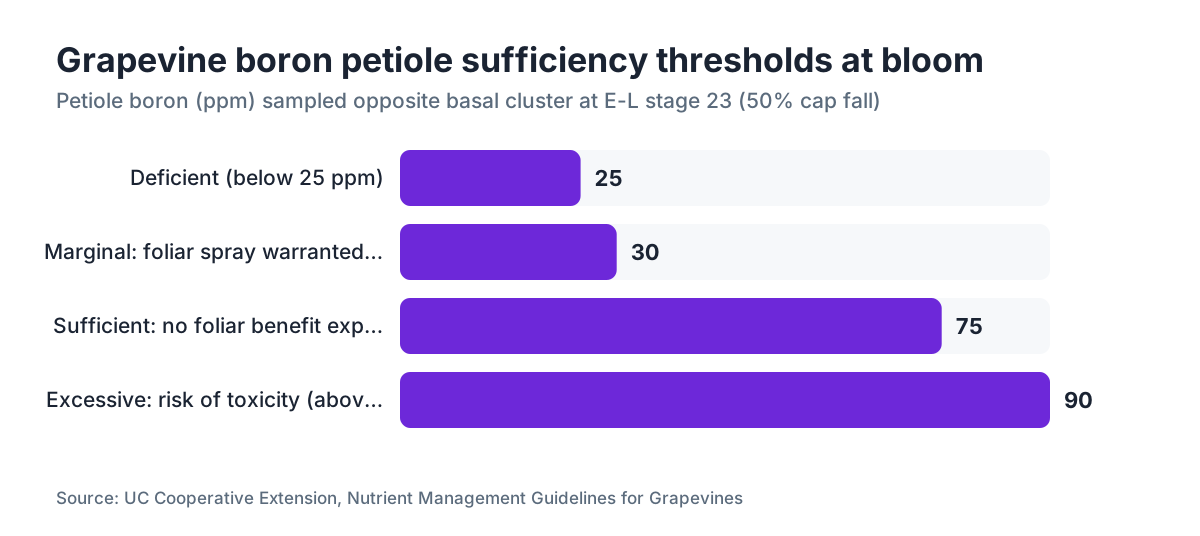
Petiole tissue testing at bloom (E-L 23, opposite the basal cluster) is the diagnostic standard. The sufficiency range for boron in grape petioles at bloom is generally cited as 25 to 75 ppm [2][4]. Below 25 ppm is a real deficiency. The 25 to 30 ppm range is marginal enough that a pre-bloom and bloom foliar spray usually pays.
Soil boron testing is less reliable than tissue testing for spray decisions. Soil boron availability shifts with moisture and pH in ways that don't translate predictably to plant uptake [9]. Tissue testing tells you what the vine actually absorbed.
Cornell University's viticulture program recommends pairing late-dormancy petiole testing with bloom sampling to catch deficiencies before they cost you a crop [4]. If you only test once, bloom petioles are the more actionable number.
One thing nobody talks about enough: boron deficiency symptoms in foliage (small cupped leaves, interveinal chlorosis, zigzag shoot growth) look a lot like other problems. Don't diagnose on symptoms. Test.
Can you apply boron during bloom without hurting pollinators or burning flowers?
Yes, with care. Grapes are self-fertile and wind-pollinated, so bee exposure during a vineyard bloom spray matters less than it would in an almond or apple orchard. But cover crops in bloom (mustard, clover, phacelia) matter to bees even when the vines don't.
Spray early morning or evening when foraging is lower. Mow cover crop blooms before spraying if bee traffic on your vineyard floor is heavy.
Boron at label rates doesn't burn flowers under normal temperatures. Phytotoxicity risk spikes when you tank-mix boron with oil-based adjuvants, or when you spray above 90 degrees F. Bloom sprays in high heat are genuinely risky. Delay if afternoon temperatures will top 90 degrees F during or right after application.
The EPA Worker Protection Standard (WPS) under 40 CFR Part 170 applies to any pesticide application, and some boron fertilizer products are registered as pesticides in certain states, which triggers restricted-entry intervals and posting rules [5]. Check your product label. If it carries an EPA registration number, WPS applies. If it's a straight fertilizer with no EPA reg number, WPS doesn't apply, but your state department of agriculture likely still has safe-handling requirements.
Does foliar boron work better than soil boron applications for fruit set?
For the fruit-set problem during bloom, foliar wins. Soil-applied boron has to move through the profile, get taken up by roots, and reach flower tissue. You cannot move fast enough through the soil pathway to fix a bloom-timing deficiency this season.
Soil applications make sense as a longer-term correction. Broadcast granular boron (borax or similar) in late fall or winter at 1 to 2 lb elemental boron per acre, repeated every two to three years, raises baseline tissue levels in later seasons [2]. Soil boron in winter plus a foliar bloom spray is the approach most extension specialists recommend for vineyards with confirmed deficiency.
Don't apply soil boron every year. It accumulates, and soil toxicity is hard to reverse. Once every two to three years is the standard, and only with documented deficiency.
On sandy, low-CEC soils, boron leaches fast and the soil benefit fades sooner. Foliar programs carry more weight in those soils.
What varieties are most prone to boron deficiency and poor fruit set?
No variety is immune, but some are harder to manage. Among wine grapes, Chardonnay and Merlot have a reputation for fruit set inconsistency that boron deficiency can worsen. Table grapes, particularly some Muscat family varieties, show hen-and-chicken more visibly because cluster appearance sells.
Variety aside, the bigger driver is site. Sandy loam soils, high-pH soils above 7.5 (where boron binds to calcium and turns less available), and irrigated desert vineyards with high-carbonate water all run toward lower boron availability [2][3].
Cold, wet bloom complicates everything. Low temperatures slow pollen tube growth even in boron-sufficient vines. Hot, dry bloom dries out the stigma faster than tubes can elongate. Boron deficiency compounds both weather problems. It doesn't cause them on its own.
Grow in a Mediterranean climate with a dry May, and you'll want tissue tests every two years minimum. Deficiencies turn up more often than you'd guess.
How do you tank-mix boron with other bloom-time sprays?
Bloom is a crowded spray window. You might be running sulfur or a DMI fungicide for powdery mildew, and the temptation is to throw the boron in the same tank. Sometimes that works. Sometimes it's a mess.
Boron plus sulfur: avoid it. Sulfur at bloom is already a marginal call on phytotoxicity, and adding boron doesn't help. If mildew pressure is real, use a DMI fungicide at bloom instead of sulfur so you can safely include boron.
Boron plus DMI fungicides (myclobutanil, tebuconazole, and similar): generally compatible. Check the specific label for incompatibilities and run a jar test before mixing large batches.
Boron plus foliar calcium: common and usually fine. The two don't antagonize each other at typical rates, though high rates of both in hard water can precipitate. Add each separately and let it dissolve before combining.
Boron plus adjuvants: non-ionic surfactants at 0.05 to 0.1% v/v improve uptake without raising burn risk. Skip silicone-based spreaders. They push boron into leaf tissue too fast and increase burn risk.
Run a jar compatibility test the day before a large application. Mix proportional amounts in a mason jar, shake, and let it stand 15 minutes. Precipitation or gel means incompatibility.
If you track spray applications across multiple blocks and want to link tissue data to spray events, a field platform like VitiScribe attaches petiole results directly to the spray record. Season over season, you can see whether your boron program is actually moving tissue levels in the right direction.
What does good application technique look like for a foliar boron bloom spray?
Coverage matters more for boron than for most foliar sprays because you're trying to get product onto flower caps and receptive floral tissue, more than leaf surfaces. Canopy penetration is the job.
Aim for 30 to 50 gallons of water per acre for wine grapes with a moderate canopy. If you're running 15 gallons per acre on a short, narrow canopy at pre-bloom, that's fine for coverage. At bloom, with a fuller canopy, push volume up.
Nozzle choice: hollow-cone nozzles make finer droplets and better flower penetration than flat-fan nozzles for this. Tower sprayers or airblast units set to aim air toward the fruit zone rather than straight out work well.
Spray in the morning when temperatures sit under 80 degrees F and wind is under 5 mph. Boron drying too fast on the flower surface before absorption cuts efficacy.
Calibrate your sprayer before bloom, not during it. If you think you're putting on 0.75 lb solubor per acre but a worn pump runs your output 20% low, you've underdosed. That's a common reason a program that looks right on paper shows nothing in the fruit.
How do you document boron applications to stay in compliance?
In California, commercial pesticide applications, including foliar nutrient products that carry a California Department of Pesticide Regulation (CDPR) registration, require a Pesticide Use Report (PUR) filed with the county agricultural commissioner within 7 days of application [6]. Not every boron fertilizer is DPR-registered. The ones that aren't don't require a PUR, but keep your own records for food safety audits (California Leafy Greens Marketing Agreement, GFSI/SQF, and the like) anyway.
At minimum, your spray records should capture: product name and EPA or DPR registration number if applicable, application date and time, field or block ID, rate applied (product and elemental), water volume per acre, operator name, and equipment used [8]. That's the core record that satisfies most audits.
WSU Extension's spray record guidance for vineyards also recommends logging the tissue test results that triggered the application, which builds a documented reason-for-treatment trail useful during compliance reviews [8].
The EPA Worker Protection Standard requires pesticide application information be posted at a central location for 30 days after application when the product carries an EPA registration number [5]. The posting has to include product name, active ingredient, EPA registration number, application location, date and time, and the restricted-entry interval.
Keeping this consistent across seasons is where small operations struggle. VitiScribe's spray record module is built around exactly this structure, with CDPR-compliant PUR export and WPS posting templates, so you're not rebuilding forms every year.
If you sell to wineries with sustainability certification requirements (Certified California Sustainable Winegrowing, LIVE, or similar), your spray records are audit documents [10]. Keep them at least three years, preferably five.
What results should you realistically expect from a boron spray program?
The honest answer turns almost entirely on whether you have a real deficiency.
In vines with confirmed low boron (below 25 ppm in petioles at bloom), a well-timed bloom spray improves fruit set. A WSU trial on 'Concord' grapes showed fruit set gains of several percentage points over untreated controls when bloom-timed boron went onto deficient vines [3]. In wine grapes, even modest fruit-set gains mean more yield and more uniform clusters.
In vines with adequate boron, the same spray produces no detectable benefit. That's not a product failure. It's how plant nutrition works. You can't push tissue past sufficiency and expect more fruit.
Nobody has great data on economic return per dollar of boron in wine grapes specifically. The closest studies sit in table grapes and 'Concord,' where the fruit set improvement is visually obvious. The principle holds across micronutrient work: correcting a deficiency at the right time pays back well, and spraying nutrients into sufficient tissue does not [1][2].
Set expectations. One season of sprays won't permanently fix a site with chronically low-boron soil. You're buying a better crop this year. The longer fix is a multi-year program of soil correction plus pre-bloom and bloom foliar applications.
Frequently asked questions
How many boron sprays do grapes need for fruit set improvement?
Most extension programs recommend two: one pre-bloom at 3 to 5 leaves (E-L stage 12-14) to build tissue reserves, and one at 50% cap fall (E-L 23) to support pollen tube elongation directly. If weather forces one choice, the bloom spray matters most for fruit set. A third post-bloom spray gets used occasionally if rain disrupted the bloom application.
What concentration of boron should I mix in my spray tank?
Target 0.1 to 0.2 lb elemental boron per acre per application. For solubor (20% boron by weight), that's 0.5 to 1.0 lb of product per acre. Divide by your total spray volume in gallons to get in-tank concentration. Do not exceed 0.25 lb elemental boron per acre per spray. Rates above that have caused phytotoxicity in some trials, especially in hot weather.
Can I apply foliar boron if rain is forecast during bloom?
Allow 4 to 6 hours of dry weather after application for absorption. Rain within 2 to 3 hours washes off a big share of the dose. If your bloom window is short and rain-interrupted, split the application across two narrower dry periods. A post-bloom rescue spray partly compensates for a washed-off bloom application, but it's less effective for fruit set than a well-timed bloom spray.
Is boron safe to apply during bloom without hurting the flowers?
At label rates (0.1 to 0.2 lb elemental boron per acre), boron isn't phytotoxic to open flowers under normal temperatures. Risk climbs above 90 degrees F or when boron mixes with oil-based adjuvants or sulfur. Spray early morning when temperatures are moderate. Grapes are self-fertile and wind-pollinated, so bee interference matters less than in orchard crops, but mow cover crops before spraying to cut pollinator exposure.
What is the petiole boron level that indicates deficiency in grapevines?
The standard sufficiency range for boron in grape petioles sampled at bloom (E-L 23, opposite the basal cluster) is 25 to 75 ppm. Below 25 ppm is deficient. The 25 to 30 ppm range is marginal and usually warrants a pre-bloom plus bloom foliar spray. Above 30 ppm, additional foliar boron is unlikely to help fruit set. UC Davis Cooperative Extension cites these thresholds in its nutrient management guidelines.
How often should I apply soil boron to vineyards?
Once every two to three years is the standard recommendation for soil-applied boron when tissue testing confirms deficiency. Apply 1 to 2 lb elemental boron per acre broadcast in late fall or winter. Don't apply every year. Boron accumulates in soil and toxicity is hard to reverse. On sandy, low-CEC soils that leach boron, you may repeat sooner, but monitor with tissue tests rather than spraying on a fixed schedule.
Does foliar boron help with hen-and-chicken disorder in grapes?
Boron deficiency is one of several causes of hen-and-chicken (millerandage), so correcting it helps when deficiency is the real problem. But poor set also comes from cold bloom weather, extreme heat, powdery mildew infection of flowers, and variety genetics. Tissue test before blaming boron. Below 25 ppm at bloom, a foliar program is a reasonable first step. If tissue levels are adequate, look elsewhere.
Can I tank-mix boron with sulfur at bloom?
Generally not recommended. Sulfur at bloom already carries phytotoxicity risk, and combining it with boron doesn't reduce that risk. If you need mildew protection during bloom and want to apply boron, switch to a DMI fungicide (myclobutanil, tebuconazole, or similar) for the bloom spray so you can safely include boron in the tank. Always run a jar compatibility test before any new combination.
Do I need to file a Pesticide Use Report for a foliar boron application in California?
It depends on the product. If your boron fertilizer carries a California DPR registration number, it's treated as a pesticide and a PUR must be filed with the county agricultural commissioner within 7 days of application. Many straight boron fertilizers (solubor, for example) aren't DPR-registered and don't require a PUR. Check your product label. Regardless of PUR status, keep your own spray records for food safety audits.
What's the difference between pre-bloom and bloom boron applications?
A pre-bloom spray at 3 to 5 leaves (E-L 12-14) builds boron reserves in young leaf tissue before flowering demand spikes. The vine draws on those reserves during early flower development. A bloom spray at 50% cap fall puts boron into the transpiration stream while pollen tube elongation is happening. Both help. The bloom timing is the more directly effective one for fruit set. If you can only do one, do the bloom spray.
How do weather conditions during bloom affect whether boron sprays work?
Foliar absorption depends on the spray drying slowly enough for tissue to take it up. Hot, dry, windy conditions dry the spray too fast and cut uptake. Cold weather slows transpiration, which also cuts uptake. Ideal conditions are morning temperatures below 80 degrees F, relative humidity above 50%, and wind under 5 mph. A non-ionic surfactant at 0.05% v/v extends the absorption window in marginal conditions.
Are there grape varieties that respond better to foliar boron than others?
Varieties with historically inconsistent set, including Chardonnay and Merlot among wine grapes, and some Muscat types, show more visible responses to boron programs, partly because they're more sensitive to deficiency rather than more responsive to boron itself. Site factors (sandy soil, high pH) matter more than variety. Any variety on a boron-deficient site benefits from a well-timed foliar program.
How long after a foliar boron application can workers re-enter the vineyard?
If your boron product carries an EPA registration number, the restricted-entry interval (REI) on the label governs re-entry. Most EPA-registered boron fertilizers carry a 4-hour REI. If the product is an unregistered fertilizer with no EPA reg number, the Worker Protection Standard REI doesn't apply, but your state may still have re-entry rules for fertilizers. Check the label first and post application information at a central location as 40 CFR Part 170 requires if WPS applies.
Sources
- UC Davis Agriculture and Natural Resources, Grape Nutrition and Fertilization: Boron is required for pollen germination and pollen tube elongation in grapevines; deficiency causes poor fruit set and millerandage
- UC Cooperative Extension, Nutrient Management Guidelines for Grapevines: Sufficiency range for boron in grape petioles at bloom is 25 to 75 ppm; foliar application target is 0.1 to 0.2 lb elemental boron per acre; soil boron should not exceed 1.0 lb elemental per acre per season
- Washington State University Extension, Vineyard Nutrition and Spray Management: Bloom-timed foliar boron improved fruit set percentage in WSU trials on Concord and wine grape cultivars with marginal petiole boron below 25 ppm
- Cornell University College of Agriculture and Life Sciences, Viticulture and Enology Program: Cornell recommends pairing late-dormancy petiole testing with bloom sampling to catch boron deficiencies before they affect fruit set
- U.S. Environmental Protection Agency, Agricultural Worker Protection Standard (40 CFR Part 170): The Worker Protection Standard applies to EPA-registered pesticide applications and requires restricted-entry intervals plus central posting of application information for 30 days
- California Department of Pesticide Regulation, Pesticide Use Reporting: California requires Pesticide Use Reports for DPR-registered pesticide applications to be filed with the county agricultural commissioner within 7 days of application
- WSU Extension, Vineyard Spray Record Guidance: WSU recommends spray records capture product name, registration number, application date, field ID, rate, water volume, operator, and equipment for compliance and audit purposes, plus the tissue test that triggered treatment
- UC Cooperative Extension, Soil and Plant Tissue Testing in Viticulture: Soil boron testing is less reliable than tissue testing for bloom-timing decisions because soil boron availability changes with moisture and pH in ways that don't translate predictably to plant uptake
- California Sustainable Winegrowing Alliance, Certification Standards: Spray records are audit documents under California sustainable winegrowing certification programs and must be retained for multiple seasons
Last updated 2026-07-11