How to document a nutrient management plan for water quality compliance

TL;DR
- A compliant nutrient management plan (NMP) documents your soil-test results, nutrient application rates, timing, equipment calibration, and buffer zones near waterways.
- Most states require NMPs above a set acreage or in water quality priority areas.
- Update the plan annually and keep records at least three years, often five, depending on your state permit.
What is a nutrient management plan and who legally needs one?
A nutrient management plan is a written record that matches the fertilizer or manure you apply against what the soil and vines can actually use, so nutrients don't run off into streams or leach into groundwater. For vineyards, that means tracking nitrogen, phosphorus, and potassium at a minimum, plus boron, zinc, or sulfur if your region's permit requires it.
Who has to have one depends on your state and your operation size. EPA's NPDES program under the Clean Water Act requires Concentrated Animal Feeding Operations (CAFOs) to have certified NMPs [1]. Many states have extended similar requirements to irrigated crop operations, including vineyards, above certain acreage thresholds or in designated water quality priority areas. California's Central Valley Regional Water Quality Control Board, for example, requires growers in its irrigated lands program to document nutrient applications and keep those records for five years [2]. Washington's TMDL (Total Maximum Daily Load) watersheds carry similar mandates [3].
Even if your state doesn't require a formal NMP right now, a documented plan is your best defense if you're ever cited for a water quality complaint. Regulators treat written plans as evidence of good faith. Unwritten plans give you almost nothing during an audit, even if you've done everything right for twenty years.
What records must a nutrient management plan actually contain?
The core elements come from USDA NRCS Conservation Practice Standard 590, the closest thing the industry has to a federal template. NRCS lists these required components: a current soil test (no older than one to four years depending on the nutrient), a plant tissue test or yield goal to establish crop need, a calculation of application rate in pounds of actual nutrient per acre, records of application timing and method, and documentation that application stayed outside required setbacks from waterways [4].
For vineyards, each annual record generally carries these data points:
- Block ID and acreage
- Soil sample date and lab results (with lab name and method)
- Target nutrient application in lbs/acre of actual N, P2O5, K2O
- Product name, formulation, and guaranteed analysis from the label
- Actual rate applied (gallons or pounds per acre)
- Application date and method (drip fertigation, broadcast, foliar)
- Equipment used and calibration date
- Applicator name (and license number if a restricted-use product was involved)
- Field conditions at time of application (approximate wind speed, no rain within 24 hours, etc.)
- Buffer distance to any surface water or drainage inlet
Don't skimp on the buffer documentation. Many enforcement actions in vineyards have nothing to do with over-application in the middle of a block. They're about drift or runoff from applications made too close to a creek or drainage ditch. Recording the measured setback at the time of application takes about thirty seconds and has ended more than a few regulatory headaches.
WSU Extension's nutrient management guidance makes one point plain: the soil test is the anchor document. Without it, every application rate you chose looks arbitrary to a regulator [3].
How do soil tests and tissue tests feed into the written plan?
Your soil test tells you what's already in the ground. Your tissue test (or your yield history) tells you what the vines pulled out. The gap between those two numbers is what you're allowed to add. That logic is exactly what regulators want documented.
For a vineyard NMP, take soil cores from representative spots in each block, roughly one composite sample per five to ten acres depending on variability. Send them to a certified lab. UC Agriculture and Natural Resources recommends sampling in the same season each year so results stay comparable [5]. Most labs return pH, organic matter, extractable phosphorus and potassium, cation exchange capacity, and sometimes nitrate-N. Your NMP has to show how you turned those numbers into a fertilizer decision.
Tissue testing (petiole sampling at bloom or veraison) adds precision. A petiole nitrate-N above about 900 ppm at bloom usually means you don't need additional nitrogen. Below about 350 ppm, deficiency is likely [5]. Your plan should include both the raw lab number and your interpretation: "petiole NO3-N at 620 ppm at bloom; vine N status adequate; no additional N applied." That one sentence, written in your field log with the lab report attached, is exactly what a water board auditor wants to see.
If you're using a UC ANR fertilization decision table or a similar state extension calculator to set rates, note that in your plan too. A credible decision-support source shows your rate wasn't a guess [5].
How do you calculate and document the correct application rate?
Rate documentation is where most vineyard NMPs fall apart. Growers know what they applied. They often can't show why that number was chosen.
The calculation chain goes like this: (1) estimated crop removal in lbs/acre of N, P, K based on expected yield, (2) soil-test credit for existing plant-available nutrients, (3) organic matter credit if applicable, (4) any carryover credit from prior-year manure or compost, (5) the resulting net need you're filling with purchased fertilizer or a cover crop.
For a producing vineyard, nitrogen removal runs roughly 10 to 15 lbs N per ton of fruit harvested [6]. A block yielding three tons per acre removes somewhere between 30 and 45 lbs N. If your soil test shows 20 ppm nitrate in the top foot (roughly 60 lbs N/acre of available N for a loam soil), you may not need to add anything. Write that reasoning out in a single paragraph or a simple table, and you have compliant documentation.
For phosphorus and potassium, the Bray P1 or Mehlich-3 extractable values from your soil test convert to application credits using your state's recommendation tables. Cornell's nutrient management workbooks for New York carry those tables and the math [6]. Use whatever your state extension service publishes, because your state regulators recognize those references.
Store the calculation with the lab sheet and the product label. Three documents together close the loop: you knew what was there, you knew what the crop needed, and you applied a product that filled that gap.
What does a compliant application record look like in practice?
Here's a realistic example of what a single fertigation entry in a field record should contain. This is the level of detail auditors expect:
| Field | Block ID | Date | Product | Guaranteed Analysis | Rate (gal/acre) | Actual N (lbs/acre) | Method | Applicator | Buffer to Creek |
|---|---|---|---|---|---|---|---|---|---|
| Home Ranch | Block 3-N | 6/12/2025 | Peters Professional 20-10-20 | 20-10-20 | 2.5 | 2.1 | Drip fertigation | J. Morales | 75 ft |
The table pulls the guaranteed analysis from the label (so you can verify the actual nutrient pounds), converts to actual pounds of N per acre, and records the buffer distance. The applicator name ties back to your personnel log or pesticide record.
For the compliance file, attach three things: the product label (or a reference to the EPA registration number and guaranteed analysis), the soil test justifying the rate, and the calibration record for the fertigation system. Calibration gets skipped constantly. If your injector meter is off by 20 percent and you can't show a calibration check, your compliant rate is meaningless, because you can't prove what you actually put out.
Your records don't have to match this exact table. They can be handwritten in a field notebook, logged in a farm management app, or filled in on a state agency form. What they can't be is a receipt from a farm supply store with nothing attached. That's a purchase record, not an application record, and it won't pass a water board audit.
How long do you need to keep nutrient management records?
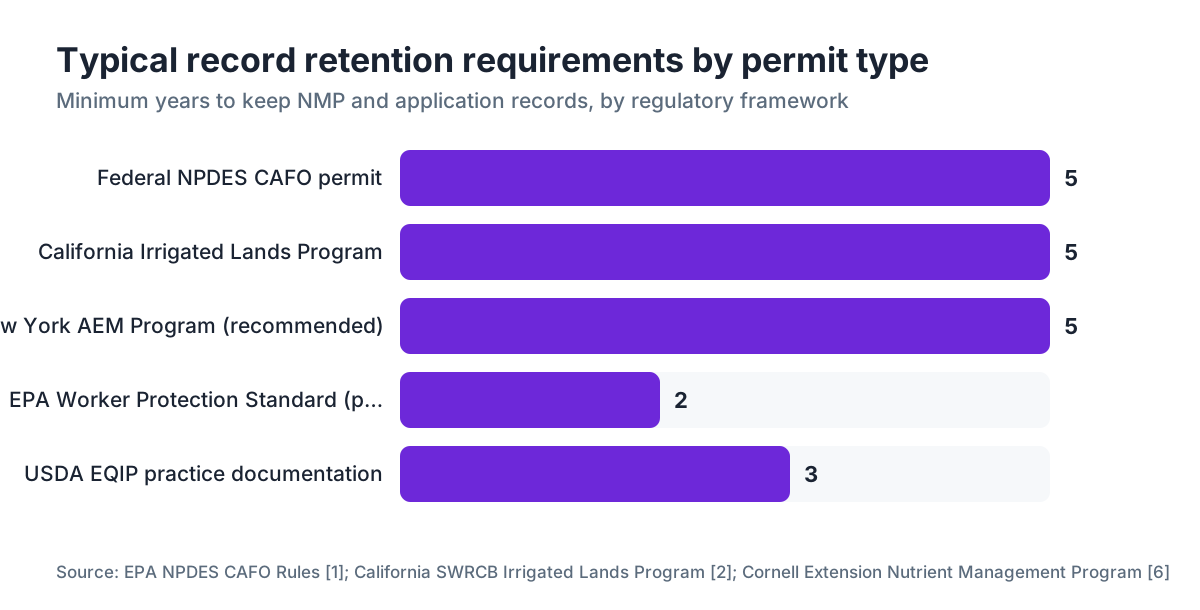
Retention requirements vary by permit type and state. Federal NPDES permits for CAFOs require five years of records [1]. California's irrigated lands coalitions generally require five years as well [2]. New York's Agricultural Environmental Management program recommends at least three years, though most advisors push for five to match federal practice [6].
The conservative answer: keep everything for five years, and organize records by year and block so you can pull a single season's file in under ten minutes when an inspector shows up. Paper files in a labeled binder work fine. So does a digital folder of scanned PDFs. What fails is a disorganized pile of receipts, printouts, and sticky notes you'd have to reconstruct under pressure.
One record almost everyone misses: the disposal or storage log for unused product. If you mixed a fertigation batch and didn't use all of it, what happened to the remainder? That question comes up in water quality inspections more than you'd expect.
What water quality buffer rules apply near vineyard waterways?
Buffer requirements near streams, ponds, and drainage ditches are usually written into state NMP and pesticide rules separately, but they belong in your NMP documentation because they govern when and where you can apply nutrients.
EPA's Section 319 nonpoint source guidance points states toward vegetated buffer strips of 35 to 100 feet near waterways as a best management practice, though the enforceable number comes from your state permit [7]. California's statewide Agricultural Order requires a minimum 50-foot vegetated buffer from top of bank for most surface water bodies in Tier 2 and Tier 3 operations [2]. Washington's shoreline rules vary by water body classification but commonly run 50 to 200 feet [3].
For your file, document the buffer widths physically present on each block adjacent to water, ideally with a simple field sketch or GPS coordinates. Note this once per season or any time the field layout changes. If you have a riparian area that qualifies as a vegetated buffer under your permit, photograph it every year. A dated photo of a healthy vegetated strip carries more weight during an inspection than a written description alone.
How do cover crops and compost complicate your NMP documentation?
Cover crops and compost are harder to document than synthetic fertilizer because the nutrient release is slower and less predictable.
For compost, you need the lab analysis of the material you applied, typically total nitrogen, phosphorus, potassium, moisture content, and carbon-to-nitrogen ratio. Only a fraction of the total N is plant-available in the first year. The standard first-year availability factor for composted material is roughly 10 to 25 percent of total N, depending on compost maturity and soil temperature [4]. Your NMP should show the math. Apply 2 tons per acre of compost at 1.2 percent total N and you've put out 48 lbs total N per acre, of which maybe 10 lbs is plant-available in year one. Credit that 10 lbs against your vine nitrogen need and document the factor you used and why (cite NRCS 590 or your state extension table).
Cover crops are trickier, because you're estimating the nitrogen they fix or recycle. With a legume cover crop, a biomass sample and a lab tissue-N analysis give you the best estimate of N returned to the soil at incorporation. Cornell's cover crop guides provide mineralization curves for common species [6]. If you don't have biomass data, most state NMP worksheets let you use published defaults (for example, 60 to 120 lbs N/acre for a well-established vetch stand). Use the published default, note your source, and you're covered.
This matters for water quality because the errors run both ways. Over-crediting compost or a cover crop makes you apply too little purchased fertilizer for the vines. Under-crediting it makes you pile purchased fertilizer on top of what the organic material already supplies. Either way, excess nitrogen can move toward groundwater or surface water.
How does an NMP connect to pesticide and spray records in a single compliance file?
Vineyard compliance files work best when the nutrient records and the pesticide records live in one organized system, because water quality inspectors often review both together. A nutrient that leaves your property in irrigation tailwater or runoff doesn't travel alone. An inspector checking for nitrate in a neighboring ditch will usually pull your pesticide records for the same season to see the full picture of what you put out and when.
A connected field operations log pays off here. Whether you use paper (a three-ring binder with dividers by season and block) or a digital system, structure records so that a single date links your soil prep notes, the fertigation record, and the pesticide application for that block. That's the difference between a manageable audit and a miserable one.
VitiScribe, the vineyard compliance and field operations platform, connects nutrient logs, spray records, soil test attachments, and equipment calibration into a single block-level file. That's the structure water board auditors and state agricultural inspectors expect to see. The record-keeping architecture matters as much as the records themselves.
If you manage multiple blocks across a larger property or source from multiple vineyard sites, the cross-referencing problem compounds fast. A single source of truth, paper or digital, keeps your fertigation log from saying one thing while your purchase orders say another.
For pesticide records, the EPA Worker Protection Standard requires application records for two years [8]. For water quality purposes, align your pesticide retention with your NMP retention (five years). It saves headaches when an inspector asks for both at once.
What are the most common NMP documentation failures that lead to violations?
Look through state water board inspection reports and agricultural department notices of violation and a few patterns repeat:
- Missing or expired soil tests. A soil test from six years ago doesn't justify this year's application rate. Regulators are getting firm about this. Test annually for N in high-leaching situations, every two to three years for P and K in more stable soils.
- No calculation connecting the soil test to the application rate. Even growers who test often can't show the math that turned a Mehlich-3 phosphorus of 35 ppm into "I applied 20 lbs P2O5 per acre." That translation, using your state extension's recommendation table, is the heart of the plan.
- Calibration records absent. If you apply through a drip system and can't show when the injector was last checked for accuracy, you can't defend your stated rate.
- Buffer documentation missing or vague. "We stayed away from the creek" is not documentation. "Applied to Block 3-N; nearest edge of application zone is 80 feet from top of bank of Arroyo Seco" is documentation.
- Records stored in a way that can't be produced during inspection. A shoebox of receipts fails immediately. An organized file, paper or digital, passes.
- Compost or manure applications with no lab analysis of the material. "I put out about two tons of compost" without a compost report leaves you no defensible nutrient credit calculation.
None of these failures needs expensive remediation. They're all paper problems, and paper problems are the easiest ones to fix before an inspection, not during one.
How do you actually write and structure the NMP document itself?
The NMP doesn't have to be a hundred-page binder. For most vineyards, a workable plan has three parts: a standing plan section updated annually, a block-by-block application log kept in-season, and an attachments file for lab reports and product labels.
The standing plan section covers your operation overview: total acreage, block map, soil types, irrigation system, proximity to waterways, your nutrient management goals, the decision criteria you use to set rates ("we target petiole N above 500 ppm at bloom; we use UC ANR tissue test guidelines"), and a description of your record-keeping system. This part changes only when your operation changes in a real way. Five to ten pages, tops.
The block-by-block application log is what you fill in through the season. One row or one entry per application event, with all the fields described earlier in this article. At year end, you file it with the lab reports and close out the season.
The attachments file holds all soil and tissue lab reports for the year, copies of product labels (or screenshots of guaranteed analysis), equipment calibration records, any compost or manure lab analyses, and a copy of the permit or coalition agreement your operation runs under.
If your state or regional water board offers an NMP template (California's coalitions provide standardized forms), use it. Regulators recognize their own forms, and using them shows you know what they're looking for. USDA NRCS also offers a free NMP template through its local field offices, built around Practice Standard 590 [4].
For farms with complex block arrangements or multiple permits, VitiScribe's block-level record structure maps directly onto this three-part architecture, so you can pull a single season's complete file for any block on demand.
Cornell's nutrient management training program and WSU's viticulture extension resources both publish sample NMP structures adapted for small and mid-sized vineyards [3][6]. They're free, they're state-relevant, and they're the kind of credible secondary source that makes your plan more defensible.
What agency resources and extension tools can help you build a compliant plan?
You don't need a consultant to build a functional NMP, though a certified nutrient management planner (required in some states for plans above certain thresholds) can be worth the cost if your situation is complex.
Free resources worth bookmarking:
- USDA NRCS Conservation Practice Standard 590 (Nutrient Management) is the federal baseline. Pull it from the NRCS Electronic Field Office Technical Guide for your state [4].
- UC Cooperative Extension's nutrient management publications for winegrape production, including petiole interpretation guides and fertilization decision tables [5].
- Cornell's Nutrient Management Spear Program covers eastern and Midwest vineyards with workbooks you can download and complete yourself [6].
- WSU Extension's nutrient management guides for Washington wine grape growers, with watershed-specific guidance for Yakima and Columbia Basin TMDL areas [3].
- Your state department of agriculture or regional water board likely runs a coalition or certification program with its own template forms. In California, the irrigated lands coalition you belong to should be your first call.
EPA's nonpoint source (NPS) pollution section gives the federal context for how states structure their agricultural water quality programs. Useful background if you ever need to understand why your state's requirements read the way they do [7].
One practical note: if you're building an NMP for the first time and your state keeps a certified planner list, running your draft by a planner for one hour of review costs far less than a violation, and it gives you a defensible plan you can adapt yourself in later years.
Frequently asked questions
Does a small vineyard under 10 acres need a formal nutrient management plan?
It depends on your state and whether you're in a designated water quality priority area. Many state programs set size thresholds, but operations near impaired waterways or in TMDL watersheds may have to document nutrient applications regardless of acreage. Even without a legal mandate, a simple written plan protects you if a water quality complaint is ever filed against your operation.
How often does a vineyard NMP need to be updated?
At minimum, annually. The application log gets updated every time you make a nutrient application. Review the standing plan section each year before the season starts, and revise it whenever your block configuration, irrigation system, or permit conditions change. Soil tests anchor the annual update: most states require results no older than one to four years for nitrogen and two to four years for phosphorus and potassium.
What soil test frequency is required for a compliant NMP?
USDA NRCS Practice Standard 590 calls for soil tests at intervals matched to the nutrient and risk level, generally every one to four years. For nitrogen in high-leaching sandy soils or irrigated settings, annual testing is recommended. For phosphorus and potassium in stable loam or clay soils, every two to three years is typical. Your state permit or regional water board may specify shorter intervals, so check your permit language.
Can I use drip fertigation records as my NMP application log, or do I need a separate document?
Fertigation logs can serve as your NMP application records if they carry the required fields: block ID, date, product name and guaranteed analysis, rate applied in gallons per acre and actual nutrient pounds per acre, applicator name, and any buffer or field condition notes. If your fertigation controller logs only flow rate and volume, add the nutrient calculation layer manually before the records count as NMP-compliant.
What is the difference between a nutrient management plan and a farm conservation plan?
A conservation plan (USDA NRCS Form CPA-52) addresses the full range of resource concerns on a farm, including erosion, water, air, and plants. A nutrient management plan is the nutrient-application component specifically, governed by NRCS Practice Standard 590. The two can live in one document, and NRCS often requires an NMP as part of a broader conservation plan for cost-share eligibility.
How do I document nutrient applications made through a third-party custom applicator?
The custom applicator is typically required to give you an application record with the same information you'd record yourself: product, rate, date, block, and their applicator license number. Get that record in writing, confirm the details match your purchase order and product label, and file it with your NMP. You're still responsible for NMP compliance on your land even when a contractor does the work.
What happens if I apply more nutrients than my NMP calculation calls for?
Document it honestly and note why. Equipment malfunction, unexpected rainfall interrupting an application, or a calibration error can all cause over-application. The record should show what happened, the variance in lbs/acre, and the corrective action you took. An isolated documented variance handled transparently is far less likely to draw an enforcement action than a pattern of under-reporting or no records at all.
Do organic vineyards still need a nutrient management plan for water quality compliance?
Yes. Organic certification covers input compliance with USDA NOP standards but doesn't replace water quality permit requirements. Nitrogen in fish emulsion or composted manure moves off your property in runoff just as readily as nitrogen from synthetic fertilizer. NMP documentation requirements apply to the nutrient, not the product category. Organic sources often need more documentation, because nutrient availability is less predictable.
What is a TMDL and how does it affect my vineyard NMP requirements?
A Total Maximum Daily Load is the maximum amount of a specific pollutant (often nitrate or phosphorus) that a water body can receive and still meet water quality standards, as defined under Section 303(d) of the Clean Water Act. If your vineyard drains to an impaired water body with a TMDL, your state may impose stricter NMP requirements, including lower application rate limits, mandatory setbacks, or required report submissions to the regional water board.
How do pesticide records relate to nutrient management plan documentation during an inspection?
Water quality inspectors often review both together because they're assessing the full picture of what leaves your property in runoff or tailwater. EPA's Worker Protection Standard requires pesticide application records for two years, but aligning pesticide retention to your five-year NMP schedule simplifies inspections. Organize both by season and block so you can produce a complete season's records for any block quickly.
Can a nutrient management plan help me qualify for USDA cost-share programs?
Yes. USDA EQIP (Environmental Quality Incentives Program) often requires a current NMP as a condition for practice payments, especially for irrigation water management and nutrient management practices. Having a certified NMP already in place makes you eligible to apply and speeds up the process, since NRCS doesn't have to start from scratch. Contact your local NRCS service center for program-specific requirements.
What records do I need if I apply manure from a neighboring livestock operation to my vineyard?
You need the manure's lab analysis (total N, P, K, moisture, and ideally nitrate-N and ammonium-N), the application rate and date, and a first-year availability calculation using your state's mineralization factors. If the manure comes from a CAFO, the transferor is legally required to give you records of nutrient content under EPA's NPDES CAFO rules. Keep those records with your NMP for five years.
How does a certified nutrient management planner differ from an agronomist or CCA?
A certified nutrient management planner (CNMP) meets USDA NRCS training requirements specifically for writing plans that meet Practice Standard 590, and their signature is required on plans submitted for EQIP cost-share in many states. A Certified Crop Adviser (CCA) has broader agronomic credentials but may or may not be certified to sign CNMPs depending on state requirements. For water quality compliance, either can help you build a sound plan.
Sources
- EPA, National Pollutant Discharge Elimination System (NPDES): Federal NPDES permits for CAFOs require certified NMPs and five years of records retention.
- California State Water Resources Control Board: California's irrigated lands program requires growers to document nutrient applications and retain records for five years; Tier 2 and Tier 3 operations must maintain vegetated 50-foot buffers from surface water bodies.
- Washington State University Extension: WSU Extension provides nutrient management guidance for Washington wine grape growers in TMDL watersheds; soil testing is identified as the anchor document for compliant NMPs.
- University of California Agriculture and Natural Resources: UC ANR recommends annual soil sampling in the same season for comparability; petiole nitrate-N above 900 ppm at bloom indicates adequate N status, below 350 ppm indicates likely deficiency.
- Cornell University College of Agriculture and Life Sciences, Nutrient Management Spear Program: Cornell Extension publishes nutrient management workbooks with P and K recommendation tables and cover crop mineralization curves; nitrogen removal from winegrapes runs roughly 10 to 15 lbs N per ton of fruit harvested.
- EPA, Nonpoint Source Pollution (Section 319): EPA Section 319 guidance recommends vegetated buffer strips of 35 to 100 feet near waterways as a nonpoint source pollution best management practice.
- EPA, Agricultural Worker Protection Standard: EPA Worker Protection Standard requires pesticide application records to be kept for two years.
- EPA, Impaired Waters and TMDLs (Clean Water Act Section 303(d)): A TMDL defines the maximum pollutant load a water body can receive under the Clean Water Act; agricultural operations draining to TMDL-listed waters may face stricter NMP requirements.
Last updated 2026-07-11