How to calculate and record application rate per vine versus per acre

TL;DR
- Divide your per-acre product rate by the number of vines per acre to get the per-vine dose.
- Typical wine grape planting densities run 450 to 1,210 vines per acre, so the math changes meaningfully by block.
- Spray records must capture both the area-based rate and the total product applied.
- This article walks through the full calculation, common errors, and what regulators actually want to see.
Why does the per-vine vs. per-acre distinction matter for your records?
Most pesticide labels express rates in ounces or pounds of product per acre. That works fine when you're treating a uniform field crop, but vineyards aren't uniform. A block planted at 5x10 spacing has 871 vines per acre. Your neighbor's 4x8 block has 1,361. Apply the same per-acre rate and those two blocks are getting very different amounts of product per plant.
This matters for two reasons. First, efficacy: many fungicide programs, especially those targeting powdery mildew at tight canopy stages, perform better when you think about coverage per shoot or per vine rather than just per acre. Second, compliance: the EPA Worker Protection Standard and most state pesticide regulations require spray records that let an inspector reconstruct exactly what was applied where [1]. If your records only say "1 qt/acre of product X on Block 4" and an inspector asks how many acres were treated or how much total product went out, you need the vine count to close that loop.
The per-vine calculation is also the right mental model for drip-applied fertilizers and chemigation, where you're dosing individual root zones, not a soil surface area. Get comfortable with both numbers and your records will be cleaner regardless of which format your state requires.
What is the formula for converting a per-acre rate to a per-vine rate?
The math is simple once your vine spacing is locked down.
Step 1: Calculate vines per acre.
Vines per acre = 43,560 sq ft ÷ (row spacing in feet × vine spacing in feet)
Example: rows 8 feet apart, vines 5 feet apart in the row.
43,560 ÷ (8 × 5) = 43,560 ÷ 40 = 1,089 vines per acre
Step 2: Convert the label rate to a per-vine dose.
Product per vine = (product per acre) ÷ (vines per acre)
Example: You're applying a fungicide at 12 fl oz per acre.
12 fl oz ÷ 1,089 vines = 0.011 fl oz per vine (about 0.33 mL per vine)
That number looks tiny, but it's the right anchor for checking whether your sprayer is calibrated to deliver that dose at your travel speed and nozzle output [2].
Step 3: Confirm total product used makes sense.
Total product = (product per acre) × (total acres treated)
If you treated 3.4 acres: 12 fl oz × 3.4 = 40.8 fl oz total. Cross-check against what you pulled from the tank. If your tank draw was much higher or lower, something is off, either the acreage estimate, the calibration, or the mix calculation.
Keep all three numbers, rate per acre, rate per vine, and total applied, in your spray record. That redundancy is what lets you catch errors before an audit does.
How do common vineyard planting densities affect the per-vine dose?
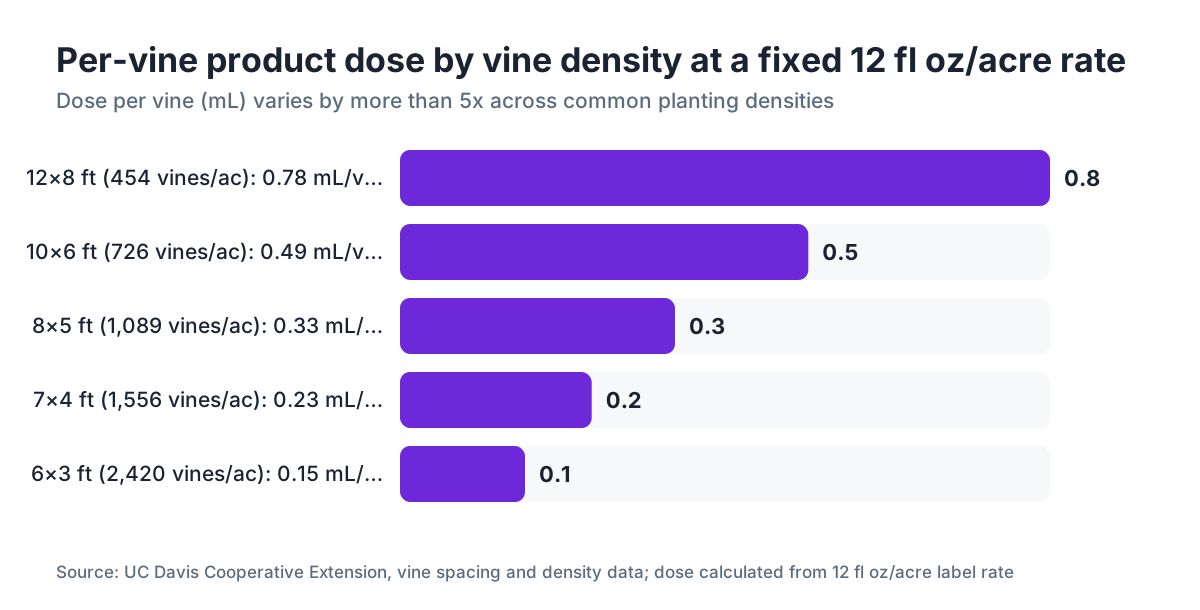
The range of vine densities in commercial American vineyards is wider than most growers realize. UC Davis extension data puts typical California wine grape densities between about 450 and 1,210 vines per acre, depending on variety, trellis system, and regional tradition [3]. Washington State vineyards often run higher, with some Riesling and Chardonnay blocks pushing 1,500 to 1,800 vines per acre on close European-style spacing.
Here's why that spread matters for your math:
| Row × Vine Spacing (ft) | Vines per Acre | Per-Vine Dose (at 12 fl oz/acre) |
|---|---|---|
| 12 × 8 | 454 | 0.026 fl oz (0.78 mL) |
| 10 × 6 | 726 | 0.017 fl oz (0.49 mL) |
| 8 × 5 | 1,089 | 0.011 fl oz (0.33 mL) |
| 7 × 4 | 1,556 | 0.008 fl oz (0.23 mL) |
| 6 × 3 | 2,420 | 0.005 fl oz (0.15 mL) |
A grower with 454 vines per acre puts more than five times the product on each vine compared to a grower at 2,420 vines per acre, even though both apply 12 fl oz per acre. If you're chasing a coverage problem or comparing spray programs across blocks, vine density is the variable you can't skip [3].
For multi-block operations, build a simple reference sheet with each block's spacing, vines per acre, and the resulting per-vine dose for your most common products. You'll use it constantly.
What information do spray records legally need to include?
Federal law sets the floor. The EPA Worker Protection Standard (40 CFR Part 170) requires that pesticide application records be kept for at least two years and be made available to workers and handlers upon request [1]. The WPS record must capture the product name and EPA registration number, the active ingredient, the location and description of the treated area, the date of application, and the name of the certified applicator.
The EPA's own guidance states that records should include "the amount of pesticide applied" [1]. That's where per-acre rate and total applied quantity both belong.
State requirements often go further. California's DPR requires pesticide use reports (PURs) for all agricultural pesticide applications, submitted monthly to the county agricultural commissioner, and those reports require acres planted, acres treated, pounds of active ingredient applied, and the specific site (township/range/section or GPS coordinates in some counties) [4]. Cornell's pest management guidelines for New York note that state-licensed commercial applicators must also keep records under 6 NYCRR Part 76, including the target pest and the application method [5].
WSU Extension's spray record templates, widely used across the Pacific Northwest, include fields for product name and EPA reg number, crop and location, date, applicator, rate per acre, total acres, total product used, weather conditions at application, and REI/PHI [6]. Using a template like that, or a digital system that captures the same fields, means you're covered across all three layers: federal WPS, state registration law, and good agronomic practice.
One thing inspectors flag over and over: records that list the rate but not the total quantity applied, or the quantity but not the acreage. You need both. The rate tells you what was intended. The total tells you what actually happened.
How do you calculate total product needed before you mix the tank?
Pre-mix calculation prevents both waste and under-treatment. Here's the full chain:
- Confirm your treated acreage. Walk or GPS the block if you're unsure. Using GIS-derived acreage from your planting maps is fine, but verify it against what you're actually covering. Many older blocks have irregular borders and the book acreage is wrong.
- Multiply: acres × label rate = total product needed. Round up to the nearest practical measure, but log what the label calls for as well as what you mixed.
- Estimate tank loads. If your sprayer holds 100 gallons and you're spraying at 50 gallons per acre, you'll need 2 tank loads per acre. For 3.4 acres, that's 6.8 tank loads, so seven full fills (with the last one partially used). Calculate product per tank load: (total product needed) ÷ (number of tank loads) or simply (label rate per acre) × (gallons per acre sprayed) ÷ (gallons per tank) × tank size.
Example with real numbers: fungicide at 12 fl oz/acre, 50 GPA application volume, 100-gallon tank, treating 3.4 acres.
- Total product needed: 12 fl oz × 3.4 = 40.8 fl oz
- Gallons to cover 3.4 acres: 50 × 3.4 = 170 gallons = 1.7 tank loads (round to 2 full tanks)
- Product per full tank: 12 fl oz × (100 gal ÷ 50 GPA) = 24 fl oz per tank
Record what you actually used when you're done, alongside what you planned to use. The difference is your calibration check. Tools like VitiScribe let you log planned versus actual quantities by block in the same entry, which makes that comparison automatic.
The WSU Extension calibration guide is the best free resource for sprayer output checks if you're not confident in your gallons-per-acre number [6].
How do you record applications when one block has uneven vine spacing or gaps?
Dead vines, end posts, access roads, and flood-damaged sections all create gaps in your vine count. This is one of the messiest real-world situations in spray record-keeping, and most guidance skips right past it.
The honest answer: track it two ways. Record the gross acreage of the block (the total footprint, gaps included) for regulatory purposes, since area-based records are what agencies expect. Then record the actual number of vines treated for your own agronomic tracking. If you have 1,000 vines in a block that's technically 1.1 acres but has a 0.1-acre turn row and a few dead vine spots, your per-vine dose calculation should use the actual vine count (say, 940 productive vines), not the theoretical count from the spacing.
For pesticide use reports, most states want treated acres, which is the acreage where product was applied. If you drive through the block including the gaps, the whole block footprint is the treated acreage for reporting. If you physically skip sections, those get their own line or a note.
Cornell's guidelines recommend annotating records when block conditions deviate from the standard, including unusual density areas or skipped sections [5]. Keep a simple block diagram with these notes and attach it to your records. An inspector who sees a gap in your vine count explanation and finds a corresponding annotation in your files will have no issue. The one who finds a discrepancy with no explanation is the problem.
What's the right application volume (gallons per acre) and how does it relate to rate calculations?
Application volume and product rate are separate variables that interact. The label rate tells you how much product to use per acre. The application volume (gallons per acre, or GPA) tells you how much water carrier you use to deliver that product. You can hit the right label rate at 20 GPA or 100 GPA. The product dose is the same per acre either way.
Where they connect: coverage quality. At very low GPA with dense canopy, you may not get the physical deposition needed for contact fungicides or insecticides to work, even if your per-acre product rate is correct. UC Davis's plant sciences program has documented coverage failures with common airblast sprayers in dense canopies at less than 50 GPA [3].
For record-keeping, always log your GPA alongside your product rate. State PUR forms typically ask for it. It's also the key variable for sprayer calibration: if your nozzles are outputting more or less than intended at your travel speed, your GPA is off, which means you're over- or under-applying even if your tank mix calculation was perfect.
The calibration formula: GPA = (GPM per nozzle × 5,940) ÷ (nozzle spacing in inches × travel speed in MPH). WSU Extension's sprayer calibration resources walk through this in detail with worked examples [6].
Log it every time you calibrate, and log whenever you change travel speed or nozzle configuration mid-season. That record protects you if there's a complaint about drift or if an efficacy question comes up later.
How do restricted-use pesticide records differ from general-use records?
Restricted-use pesticides (RUPs) require a licensed private or commercial applicator and carry stricter recordkeeping under 7 U.S.C. 136i-1 (the Federal Insecticide, Fungicide, and Rodenticide Act, or FIFRA) [7]. The FIFRA requirement for certified applicators using RUPs specifies that records be kept for two years and include the product and EPA registration number, the total amount applied, the location, the crop, the date, and the applicator's certification number.
For vineyard operators, this usually means organophosphates (some older materials still in use for leafhoppers), certain pyrethroids, and some systemic fungicides with specific label restrictions. The per-vine versus per-acre calculation doesn't change for RUPs, but the paperwork obligation is higher and the cost of an incomplete record is steeper.
California is the strictest jurisdiction: any RUP application triggers a pesticide use report to the county ag commissioner, and some counties require GPS coordinates of the treated area [4]. If you're in California and treating multiple blocks with an RUP in a single day, each block gets its own PUR entry.
The cleanest approach: keep one record template for all spray applications, general and restricted, that captures every field the RUP record requires. You'll never have a missing field on a general-use record, and your RUP records will be complete by default.
What are the most common calculation mistakes vineyard managers make?
A few errors show up again and again when growers audit their own records or get audited by an agency.
Using book acreage instead of measured acreage. Property maps and county assessor records often differ from actual treated acreage by 5 to 15 percent. GPS your blocks. A one-time investment in accurate acreage pays off every year in cleaner records and more honest tank mix calculations.
Forgetting to convert units mid-calculation. The label rate is in fluid ounces per acre. Your scale reads in pounds. Your measuring cup is in milliliters. Pick one unit system and do all your conversions before you start multiplying. 1 fl oz = 29.57 mL. 1 lb = 453.6 g. Write these on your mix station.
Applying the vineyard's total acreage instead of the treated acreage. If you have 20 acres of vines and treated 6 acres today, the record says 6 acres. This sounds obvious but it drives a surprising number of over-reporting errors in state PUR data.
Not recording the actual quantity pulled from inventory. You planned to use 40 fl oz. You actually used 43 because one tank ran a little long. The record should say 43. The discrepancy (if it's within a normal calibration range) is explainable. If the record says 40 and your inventory shows 43 missing, you have a gap.
Confusing product rate with active ingredient rate. Some state reports and all federal RUP records want pounds of active ingredient applied, not ounces of formulated product. These are different numbers. If your product is a 50% WP, applying 1 lb of product means 0.5 lb of AI. Check the label's active ingredient percentage and do the conversion explicitly [7].
What's a simple spray record template you can use right now?
Here's a field-ready template structure. Print it or adapt it to your preferred spreadsheet or farm management software.
| Field | What to Record |
|---|---|
| Date | MM/DD/YYYY, start and end time |
| Block ID / Location | Name or number, GPS boundary if available |
| Crop / Variety | e.g., Cabernet Sauvignon |
| Target Pest | e.g., Botrytis cinerea, powdery mildew |
| Product Name | Full label name |
| EPA Reg. Number | From label, e.g., 62719-xxx |
| Active Ingredient | Name and % from label |
| Label Rate | e.g., 12 fl oz/acre |
| Application Volume | GPA (gallons per acre) |
| Acres Treated | Measured, not estimated |
| Vines per Acre | From spacing calculation |
| Total Product Used | Actual quantity from tank draw |
| Pounds AI Applied | (% AI ÷ 100) × total product in lbs |
| Applicator Name | Print and sign |
| Cert. Number | If RUP |
| Weather Conditions | Temp, wind speed/direction, humidity |
| REI | Hours from label |
| PHI | Days from label |
| Notes | Gaps, equipment issues, unusual conditions |
This template covers WPS requirements [1], FIFRA RUP requirements [7], California PUR fields [4], Cornell's New York recommendations [5], and WSU's Pacific Northwest format [6]. If you use a digital record-keeping system, VitiScribe captures all of these fields and pre-fills EPA registration numbers from its product database, which saves real time across a season with 20 or 30 spray applications.
The weather conditions row matters more than most growers treat it. Wind speed at application is legally relevant for any product with a drift restriction, and temperature matters for products with heat-based volatility concerns. Log it every time.
How do you handle applications sold in metric units on foreign labels or for imported products?
This comes up more often than you'd think, especially with imported biological products, biorationals, and some specialty fungicides that move through Pacific Northwest and California markets via distributors who work across borders.
The label registered with the EPA is the one that governs your application in the U.S., and it will express rates in U.S. customary units (oz, lb, fl oz) or sometimes both. If you're working from a distributor sheet that gives rates in grams per hectare or liters per hectare, convert before you calculate.
Key conversions:
- 1 hectare = 2.471 acres. So divide g/ha or L/ha by 2.471 to get g/acre or L/acre.
- 1 liter = 33.814 fl oz = 0.264 gallons.
- 1 kilogram = 35.274 oz = 2.205 lbs.
Always verify the U.S. EPA label rate before mixing. The EPA label is the legal document. Distributor rate sheets are suggestions that may or may not match the registered label.
Your spray record should list the rate in the units from the EPA label, not from a metric distributor sheet. If an inspector is cross-checking your record against the registered label, matching units makes that comparison immediate and unambiguous.
How should these records be stored and for how long?
Federal law: two years minimum for WPS records [1] and two years for FIFRA RUP records [7]. Keep them from the date of application.
California: pesticide use reports go to the county, but your underlying field records (the spray logs that support the PUR submissions) should be kept at least as long as the submitted reports could be subject to audit. DPR recommends three years [4].
New York and Washington: three years is the standard recommendation from state extension programs, which gives you a one-year buffer beyond the federal floor [5][6].
Physical storage: spray records get wet, fade, and disappear. If you're keeping paper records, photograph or scan every record at the end of each spray day and store the digital copies somewhere off the physical property. A locked file cabinet in the farm office satisfies the legal requirement but doesn't protect you from fire or flood. Cloud backup costs almost nothing.
Digital systems need to be exportable. If your software shuts down or you change platforms, you need a way to get your records out in a readable format (PDF or CSV at minimum) covering your full retention window. Verify this before you commit to any system.
One practical note: state agricultural commissioners can request records with little notice. Having everything organized by crop year and block, rather than just chronologically, makes a records request a 20-minute job instead of a half-day scramble.
Frequently asked questions
How many vines per acre is typical for wine grapes in the United States?
Most California wine grape vineyards run 454 to 1,210 vines per acre, depending on row and vine spacing. Washington State blocks planted on European-style close spacing can exceed 1,500 vines per acre. UC Davis extension puts the typical California range at 450 to 1,210. The exact count for your block is 43,560 divided by the product of your row spacing and vine spacing, both in feet.
What is the formula for vines per acre?
Vines per acre = 43,560 ÷ (row spacing in feet × vine spacing in feet). For an 8-by-5-foot planting: 43,560 ÷ 40 = 1,089 vines per acre. This is the denominator you divide your per-acre product rate by to get the per-vine dose. Confirm your actual spacing with a tape measure; planted spacing often drifts from the design spec.
Do EPA spray records need to include the per-vine application rate?
No. Federal WPS and FIFRA records require the product name, EPA registration number, active ingredient, location, date, certified applicator name, and total amount applied. Per-vine rate is not a regulatory requirement at the federal level. It is, however, a useful internal check on calibration accuracy and a necessary calculation if you're troubleshooting coverage problems across blocks with different vine densities.
How long do I have to keep pesticide application records in California?
California's Department of Pesticide Regulation requires pesticide use reports be submitted to the county agricultural commissioner within 30 days of the end of the month of application. Your underlying field spray records that support those submissions should be retained for at least three years per DPR guidance, though the federal WPS floor is two years. Keep three to be safe.
What's the difference between product rate and active ingredient rate for spray records?
Product rate is the ounces or pounds of the formulated product you apply per acre. Active ingredient rate is the amount of the actual chemical per acre, calculated from the product's labeled AI percentage. For example, a 50% wettable powder applied at 2 lb/acre delivers 1 lb of active ingredient per acre. State pesticide use reports and federal RUP records typically ask for pounds of active ingredient rather than product volume.
How do I calculate how much product to put in each tank load?
Divide your total product needed for the block by the number of full tank loads required. Alternatively: (label rate per acre) × (tank size in gallons ÷ gallons per acre you're applying). Example: 12 fl oz/acre label rate, 100-gallon tank, spraying at 50 GPA means 12 × (100 ÷ 50) = 24 fl oz per tank. Log what you actually add to each tank, alongside the calculated amount.
Does vine spacing affect how much pesticide each plant receives even if the per-acre rate is the same?
Yes, directly. A block with 454 vines per acre at 12-by-8 spacing receives 0.026 fl oz per vine at a 12 fl oz/acre rate. A block at 7-by-4 spacing with 1,556 vines per acre receives 0.008 fl oz per vine from the same application. The per-acre dose is identical; the per-vine dose differs by more than three times. This matters when comparing program performance across blocks.
What weather conditions need to be recorded with a spray application?
At a minimum, log air temperature, wind speed, wind direction, and relative humidity at the time of application. Some products with drift or volatility restrictions require these by label. Wind speed above 10 mph triggers drift concerns for many materials. Temperature inversions matter especially for herbicide applications near sensitive areas. Many state programs and the Cornell guidelines recommend recording this as standard practice.
Can I use GPS block acreage from my planting maps for spray records?
Yes, if it's accurate, and it often isn't. Older planting maps, county assessor records, and even some farm management software carry acreage figures that diverge from measured reality by 5 to 15 percent. Walk your blocks with a GPS device or use a recent aerial measurement. Use that measured acreage for both your spray records and your tank mix calculations. The accuracy difference adds up across a season.
What's the minimum information required for a Worker Protection Standard spray record?
The EPA WPS (40 CFR Part 170) requires the product name and EPA registration number, active ingredient, location and description of the treated area, date of application, and the name of the certified applicator. Records must be kept for two years and made available to agricultural handlers and workers upon request. States may require additional fields; California's PUR system is the most detailed in the country.
How do I record a spray application when I didn't finish the last tank and had leftover mix?
Log the actual acres treated, the total product added to the tank across all loads, and note the approximate volume of mix remaining. Your total product used is what went into the tanks minus an honest estimate of the leftover. Some growers record leftover volume and back-calculate the product; others simply note the discrepancy. Either approach is fine as long as the record reflects reality, not the planned application.
Do organic vineyards have different spray record requirements than conventional ones?
The same WPS and FIFRA records apply. Organic certification adds a layer: your certifying agent (and NOP regulations under 7 CFR Part 205) requires that you record all inputs applied to certified acres, including OMRI-listed materials and permitted biologicals, and retain those records for five years. This is stricter than the federal pesticide recordkeeping floor. Keep organic spray records in a dedicated file separate from conventional blocks to avoid confusion during certification audits.
What's the best way to handle spray records for blocks with multiple varieties or mixed plantings?
Log each variety as a separate entry in your record, even if they were sprayed in a single pass. Include the acreage and vine count for each. State pesticide use reports typically require the crop by site and commodity; a mixed block with Cabernet and Merlot rows needs both listed. Keeping them separate also protects you if a pre-harvest interval question comes up for a variety that ripens earlier than another in the same block.
Sources
- EPA, Worker Protection Standard (40 CFR Part 170): WPS requires pesticide application records be kept for at least two years and made available to workers and handlers; records must include product name, EPA reg number, AI, location, date, and certified applicator name.
- UC Davis ANR, Grape Pest Management Program: Sprayer calibration and per-vine coverage considerations for wine grape fungicide programs in California.
- UC Davis Cooperative Extension, Vineyard Establishment and Economics: Typical California wine grape planting densities range from approximately 450 to 1,210 vines per acre depending on variety, trellis system, and regional practice.
- California Department of Pesticide Regulation, Pesticide Use Reporting: California requires pesticide use reports submitted monthly to the county agricultural commissioner, including acres planted, acres treated, pounds of AI applied, and site identification.
- Cornell University, New York and Pennsylvania Pest Management Guidelines for Grapes: Cornell recommends spray records include target pest, application method, and annotations when block conditions deviate from standard; New York commercial applicators must keep records under 6 NYCRR Part 76.
- Washington State University Extension, Spray Application Technology for Pacific Northwest Vineyards: WSU spray record templates include product name, EPA reg number, crop/location, date, applicator, rate per acre, total acres, total product used, weather conditions at application, and REI/PHI; calibration formula GPA = (GPM × 5,940) ÷ (nozzle spacing × travel speed).
- EPA, Restricted Use Products and FIFRA Recordkeeping (7 U.S.C. 136i-1): FIFRA requires certified applicators using restricted-use pesticides to keep records for two years, including product and EPA reg number, total amount applied, location, crop, date, and certification number; pounds of active ingredient are derived from the labeled AI percentage.
- USDA Agricultural Marketing Service, National Organic Program (7 CFR Part 205): NOP regulations require certified organic operations to retain all production and handling records for five years, including all input applications to certified acreage.
- EPA, Pesticide Registration, Label Requirements and Interpretation: The EPA-registered label is the legal document governing pesticide application in the United States; rate units on the registered label take precedence over distributor rate sheets.
- UC Davis Plant Sciences, Airblast Sprayer Coverage Research: UC Davis research documented coverage failures with common airblast sprayers in dense canopies at application volumes below 50 gallons per acre for contact fungicides.
Last updated 2026-07-11