How to calculate a pre-harvest interval compliance date from an application record

TL;DR
- Add the product's labeled PHI (in days) to the application date, then count forward on the calendar.
- The first day you can legally harvest is the day after that number runs out.
- If you made multiple applications, each one generates its own compliance date, and the latest date controls.
- Always read the actual label, not a database, because PHI varies by crop and formulation.
What is a pre-harvest interval and why does the math actually matter?
A pre-harvest interval, almost always shortened to PHI, is the minimum number of days that must pass between your last pesticide application and the day you pick the fruit. The number lives on the pesticide label, and the label is a federal legal document under FIFRA (the Federal Insecticide, Fungicide, and Rodenticide Act) [1]. Harvest before the PHI expires and you can put residues in your fruit above the EPA's established tolerance, which is the legal maximum residue level for that pesticide on that crop [2].
The consequences run in both directions. On the consumer side, residues above tolerance are a food safety violation. On the grower side, a buyer or winery can reject a load if they pull a sample and the lab flags it, and some contracts now require growers to certify PHI compliance in writing before delivery.
So the math matters because getting it wrong is more than a paperwork problem. A day miscounted can mean fruit that can't be sold, a fine, or a lost buyer. The calculation itself is simple once you understand exactly what you're counting.
Where do you find the PHI number for a specific product and crop?
The only authoritative source is the physical or PDF label of the specific product lot you used. Not a generic database. Not the distributor's website. Not last year's label. Labels get revised, and PHI numbers change between versions. The EPA requires that the label in effect at the time of application is the one that governs [1].
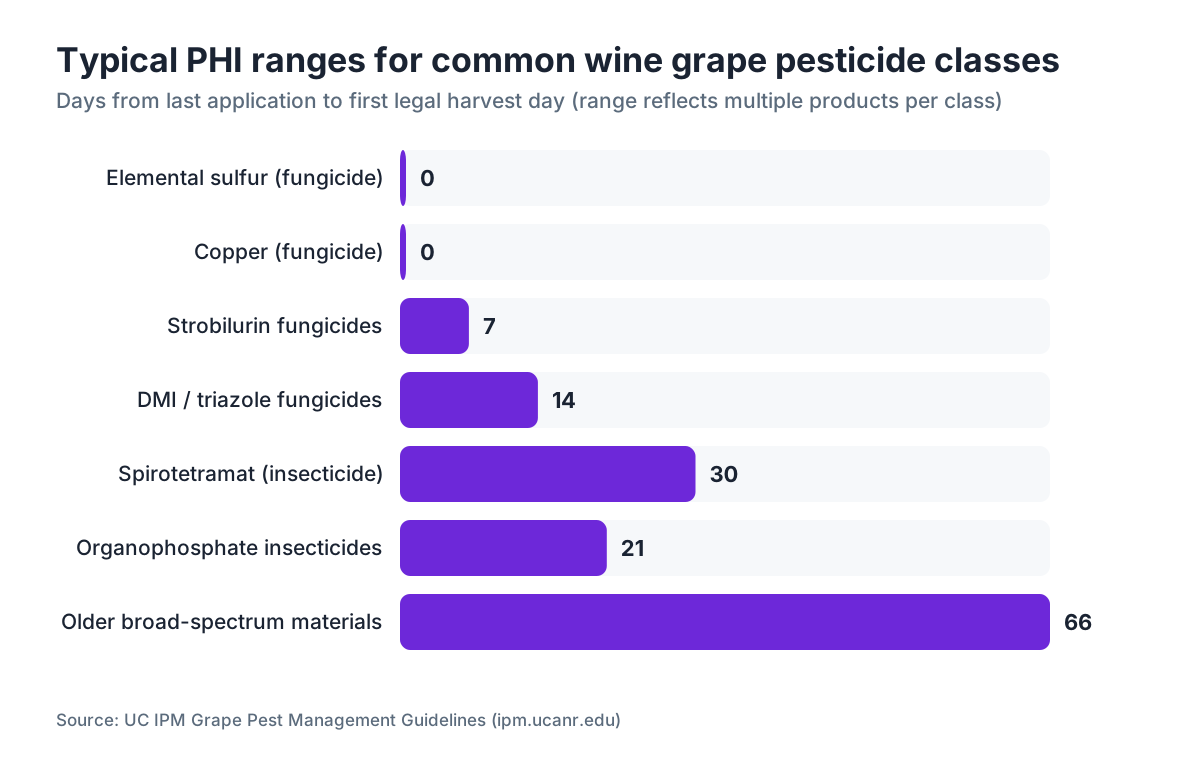
For grapes, PHI varies a lot across product classes. Common fungicide PHIs in California wine grape programs run from 0 days (some sulfur products) up to 14 days (some DMI fungicides like tebuconazole at certain rates) and out to 66 days for some older broad-spectrum materials [3]. Insecticides tend to run longer. Some organophosphates carry 21-day PHIs, and spirotetramat carries a 30-day PHI on grapes [4].
A few reliable secondary sources help you confirm what you're reading. The UC IPM Pest Management Guidelines for grapes publish PHI tables updated by season [3], and WSU's tree fruit and grape pest guides do the same for the Pacific Northwest [5]. Cornell's Integrated Crop and Pest Management program covers New York and eastern varietals [6]. Use those as a cross-check, not a substitute for reading the label you have in hand.
One detail trips people up. Some labels list different PHIs for different crops on the same page, and grapes (table, wine, and raisin) are sometimes listed separately. Read the crop-specific line, not the first PHI number you see.
How do you calculate the PHI compliance date step by step?
The calculation has three steps and takes about 30 seconds once you know the PHI.
Step 1: Identify the application date. Pull your spray record. The application date is the calendar date the material went on the vineyard block. Not the date you mixed the tank. Not the date you bought the product.
Step 2: Add the PHI number to that date. If the application date is August 1 and the PHI is 14 days, count 14 days forward from August 1. That lands on August 15.
Step 3: Determine the first legal harvest day. Here is where most errors happen. The compliance date, August 15 in this example, is the last day you cannot harvest. The first day you can legally harvest is August 16. The PHI must have fully elapsed, meaning every one of those days must have passed, more than started.
To put it as a formula:
First legal harvest day = Application date + PHI (days) + 1
So: August 1 + 14 days + 1 = August 16.
Some people drop that final +1 and think they can pick on day 14. You cannot. The label says "days before harvest," which means all 14 of those days must be complete. Day 14 is still inside the interval.
Run a sanity check. If your PHI is 14 and you applied on August 1, ask yourself: have 14 full days passed by August 15? Count on your fingers. Aug 2 is day 1, Aug 3 is day 2, and so on until Aug 15 is day 14. August 15 is the last day of the interval. Harvest starts August 16 [11].
What if you made multiple applications of the same or different products?
Every application generates its own independent compliance date. If you sprayed a 14-day PHI product on August 1 and again on August 10, the second application controls, because its first legal harvest day (August 25) falls later than the first application's (August 16).
Run a block through a season of fungicide and insecticide sprays and the rule stays simple: the latest compliance date among all applications to that block governs harvest. This is not the same as the last application date. A product applied earlier with a long PHI can push the compliance date further out than a product applied later with a short PHI.
Here's a realistic example for a Napa Valley Cabernet block in a high-pressure mildew year:
| Application # | Date | Product | PHI (days) | Compliance date | First legal harvest |
|---|---|---|---|---|---|
| 1 | July 20 | Sulfur (0-day PHI) | 0 | July 20 | July 21 |
| 2 | Aug 5 | Tebuconazole | 14 | Aug 19 | Aug 20 |
| 3 | Aug 18 | Kaolin clay | 0 | Aug 18 | Aug 19 |
| 4 | Aug 22 | Spirotetramat | 30 | Sept 21 | Sept 22 |
The controlling compliance date here is September 21, driven entirely by the August 22 spirotetramat application, even though the two 0-day materials would clear the same day they went on. You cannot harvest until September 22.
This is why a full spray record, with every application to every block, is the only way to know your actual compliance window. Miss one application record and you can think you're clear when you're not.
How do you handle PHI calculations across calendar quirks like month-end and daylight saving time?
Month boundaries are where people make arithmetic errors. The simplest fix is to count on an actual calendar instead of doing the mental math of "August has 31 days, so 14 days from August 25 is..." Open a calendar app, click the application date, and count forward.
Daylight saving time does not affect PHI calculations. The label specifies calendar days, not hours, so a 14-day PHI is always 14 calendar days regardless of clock changes.
Leap years matter only if you're spanning February in a year divisible by four, which is an unlikely edge case for wine grape harvest but worth knowing.
Work blocks across multiple states and you hit another wrinkle. A few state pesticide regulations add restrictions on top of the federal label. California's Department of Pesticide Regulation, for example, sometimes imposes supplemental labeling that tightens PHIs below what the federal label shows [7]. Check your state's supplemental label if one exists. Washington's Department of Agriculture likewise posts state-specific use requirements [8].
What records do you need to keep for PHI compliance documentation?
Federal law under FIFRA requires commercial applicators and certain restricted-use pesticide (RUP) buyers to keep records, but what a grower must document also depends on state law and, in many cases, on buyer contracts [1].
At minimum, a defensible application record for PHI compliance should include the block or field identifier, the application date, the product name and EPA registration number, the active ingredient, the application rate (which sometimes affects the PHI, since some labels tie the interval to rate), and the name of the applicator.
The EPA Worker Protection Standard (WPS) adds another layer [9]. Under WPS, employers must post pesticide application information on a central posting at the establishment before workers enter treated areas. The posting must include the product name, active ingredient, EPA registration number, location treated, date and time of application, and the REI (restricted entry interval). The PHI is a separate number from the REI, and both must be tracked.
California goes further. Growers who use any pesticide (not only RUPs) must file a Notice of Intent with the county agricultural commissioner before applying certain materials, and records of all agricultural pesticide applications must be submitted to the county within a defined window [7]. Other states set their own reporting schedules.
For the daily record, a spreadsheet works, but it gets unwieldy fast once you're managing dozens of blocks, several applicators, and multiple sprays a week during peak season. That's the problem digital spray record tools like VitiScribe are built to handle: the application date and PHI go in once, and the compliance date calculates automatically for every block.
Can the PHI compliance date change after you've already recorded the application?
Yes, in two situations.
First, a later application to the same block can carry a later compliance date, and that new date supersedes the earlier one. Your records don't change. You just have a new controlling date on top.
Second, and more concerning, is a label revision. If the EPA approves a label amendment that changes the PHI after you've applied the product, the label in effect on the day of application is the one that counts [1]. That's why keeping a copy of the actual label PDF from the application date matters. Print it or save it with your spray records.
There's also a practical scenario. You realize after entering the record that you used the wrong PHI, because you read the table grape row instead of the wine grape row, or you used an old label. Correct the record immediately with a note explaining the change and the reason. Corrected records beat inaccurate ones, and most state regulators expect records to show corrections with notes rather than being suspiciously pristine.
What is the difference between PHI and REI, and why do both show up in spray records?
These two intervals appear on the same label and in the same spray records, but they measure different things and protect different people.
The REI (Restricted Entry Interval) is the time after application during which workers cannot enter the treated area except under specific protective conditions [9]. REI is about worker safety during and after application. It's usually measured in hours, not days, though some materials carry 48-hour or 72-hour REIs. The EPA's Worker Protection Standard sets minimum REI requirements and the rules for posting and notifying workers [9].
The PHI is about food safety. It protects the person eating the fruit by making sure residues have degraded to acceptable levels before harvest.
Track both. An application might have a 4-hour REI and a 14-day PHI. Workers can re-enter after 4 hours for routine tasks, but the fruit cannot be harvested for 14 days. The two numbers run on separate clocks for separate reasons.
One common confusion: some growers assume that once the REI clears, the field is fully compliant. It is not. REI clearing means workers can enter. PHI clearing means you can pick. Both must be satisfied independently.
How do you calculate PHI compliance dates for tank mixes?
A tank mix is two or more pesticide products applied together in the same spray. Each product keeps its own PHI, independent of what it's mixed with.
To find the controlling compliance date for a tank mix, calculate the compliance date for each product separately using the same application date (since they all went on the same day). The product with the longest PHI controls.
Say you mix a 7-day PHI fungicide with a 21-day PHI insecticide and apply on August 10:
- Fungicide compliance: August 17, first legal harvest August 18
- Insecticide compliance: August 31, first legal harvest September 1
The tank mix as a whole has a first legal harvest of September 1.
This is worth thinking about before you mix. If you're three weeks from a planned pick and you add a 30-day PHI insecticide to your fungicide tank, you may have just pushed your legal harvest window past your planned date. Checking PHIs before mixing is a pre-spray step, not a post-spray paperwork step.
What happens if you discover a PHI violation before harvest?
Catch it before you pick and you're in the best possible position. The fix is straightforward: don't pick until the PHI clears. Document the error in your records with a note, adjust your harvest plan, and tell your winery or buyer if a date commitment is at stake. Buyers are far more understanding about a delay than about a residue violation after delivery.
Discover it after harvest and before delivery and you face a harder choice. You can hold the fruit while seeking advice from your state department of agriculture, your Certified Crop Adviser, or an ag attorney. Some states have provisions for tolerance petitions or emergency exemptions, but these are narrow and slow to obtain.
If the fruit has already gone to a winery and the issue surfaces later, through a residue test or audit, the regulatory conversation involves the grower and potentially the winery under FDA jurisdiction for the finished wine. The paper trail matters enormously here. Corrected records and documented intent to comply look very different to a regulator than no records at all.
The honest answer is that there's no good outcome after a PHI violation shows up in delivered fruit. Prevention through accurate record-keeping is the only strategy that actually works.
Are there any pesticides with a 0-day PHI, and do they still need to be recorded?
Yes. Elemental sulfur and many kaolin clay products carry a 0-day PHI on grapes, meaning you can technically harvest the same day you apply. Some copper products also carry 0-day PHIs, though this varies by formulation [3].
A 0-day PHI does not exempt a product from record-keeping. The application still needs to be logged because:
- State regulations require records of all agricultural pesticide applications regardless of PHI [7].
- Buyer contracts and third-party sustainability certifications (like LODI RULES or SIP Certified) require complete application records.
- The REI still applies. A sulfur spray might carry a 0-day PHI but a 24-hour REI, meaning workers cannot re-enter for 24 hours even though you could theoretically pick the same day.
In practice, applying sulfur the morning of harvest is unusual, because the product is sitting on the fruit. The 0-day PHI mostly matters as a planning tool. It tells you this product does not constrain your harvest timing if you need to spray close to pick.
For records, treat 0-day PHI applications exactly like any other. Log the date, product, rate, block, and applicator.
How should you organize spray records so PHI compliance dates are easy to verify at harvest?
The most common organizational failure is logging sprays by date rather than by block. When harvest comes and you're asking "is Block 7 clear to pick?" a chronological log makes you scan through weeks or months of entries for every one that mentions Block 7. That's slow and error-prone under harvest pressure.
Organize your spray records by block first, then by date within each block. Each block gets its own running log. At any point in the season you pull Block 7's log, scan the last few entries, and find the controlling compliance date in two minutes.
A few other practices save time at harvest.
Calculate the compliance date at the time of entry, not at harvest. When you log an application, write or enter the compliance date in the same row. Don't leave it as a calculation to do later under pressure.
Flag the controlling date prominently. Some growers keep a simple "current clearance date" field at the top of each block's record, updated after every application. That field is what the harvest crew and the winery see.
Keep label copies with your records. A digital folder named by product and year, with PDF labels, satisfies the "keep the label in effect at application" requirement and saves a lot of searching later.
For operations running more than 15 or 20 blocks, a purpose-built system that calculates compliance dates automatically and flags blocks that aren't yet clear is worth the time it saves. VitiScribe is one option built for vineyard spray record compliance, with block-level clearance tracking and label PHI lookups.
Frequently asked questions
Do I count the application date itself as day 1 of the PHI?
No. The application date is day 0. Day 1 begins the following calendar day. Apply on August 1 with a 14-day PHI and count August 2 as day 1 through August 15 as day 14. August 15 is the last day of the restricted interval. August 16 is the first legal harvest day. This is the most common counting error, and it costs growers a day of harvest window.
What if my spray record has the wrong date on it? Can I correct it?
Yes, and you should correct it immediately when you catch the error. Add a written note explaining what was wrong, what the correction is, and when you made the change. Do not erase or delete the original entry. Regulators expect corrections documented this way. A corrected record is always better than an inaccurate one. Destroying or falsifying records is a separate and much more serious violation.
Does the PHI apply separately to each vineyard block, or to the whole property?
PHI is block-specific, tied to each individual application event. If Block 7 was sprayed with a 14-day PHI product and Block 12 wasn't, only Block 7 carries that compliance date. You can harvest Block 12 immediately (assuming no other applications constrain it). This is why block-level record-keeping matters: property-level records lose the information you need for block-by-block harvest decisions.
Can my winery or buyer require a longer wait than the labeled PHI?
Yes. A buyer can contractually require a longer buffer than the label PHI as a condition of purchase. This is increasingly common in premium grape contracts and organic programs. The label PHI is the legal floor. Buyers can set higher requirements. Read your grape contract carefully before the season starts, and treat any buyer-specified interval as if it were a labeled PHI for planning.
Is there a difference between the PHI on a state-registered label and the federal label?
Yes, sometimes. California's Department of Pesticide Regulation and other state agencies can approve supplemental labels that modify PHIs compared with the federal label. The more restrictive requirement always applies. If California's supplemental label sets a 21-day PHI for a product the federal label lists at 14 days, California growers must use 21 days. Check your state's pesticide regulatory database for supplemental labeling.
What if I can't find the original label for a product I applied two months ago?
Contact the manufacturer or distributor for the label PDF matching the lot you bought. The EPA and the National Pesticide Information Center both maintain label resources that archive many current and historical labels. Your county agricultural commissioner may also have records. This is the argument for saving labels at purchase rather than hunting for them later.
How do organic certification programs interact with PHI requirements?
Organic programs run their own approved materials lists and often prohibit conventional pesticides entirely, so the PHI question mostly comes up for transitional blocks or materials that are both OMRI-listed and carry a PHI. Elemental sulfur and copper, common in organic programs, typically have 0-day PHIs on grapes. If an organic-approved product does carry a PHI, follow it exactly as you would for a conventional product. Your certifier may require additional recordkeeping.
Does a pesticide's REI affect when I can start harvest activities like leaf pulling near harvest?
Yes. The REI governs when workers can enter the treated area for any reason, including early harvest tasks like leaf pulling, shoot positioning, or cluster thinning near pick. If the REI hasn't cleared, workers cannot enter the block except under the protective equipment conditions specified on the label and in the EPA Worker Protection Standard. The REI and PHI run independently, and you must satisfy both.
Do PHI requirements apply to pesticides applied by a neighboring farm that drift onto my vineyard?
This is a genuinely complicated area. You didn't make the application, but residues may be present on your fruit. If you witness or have evidence of drift, document it immediately with photos, dates, and any communication with the neighboring operation. Consult your state department of agriculture for guidance specific to your situation. The regulatory exposure is real, but the rules on third-party drift are less clear than for intentional applications.
How far in advance should I check PHI compliance before scheduling a harvest crew?
At least one week before planned harvest for any block, go through every application record for that block in the current season and identify the latest compliance date. Then work backward from that date to confirm your pick date falls on or after the first legal harvest day. Doing this at crew scheduling rather than morning-of gives you time to adjust if you find a conflict, instead of sending a crew home.
Are there pesticides with no PHI listed on the label?
If a label has no stated PHI for the use in question, that does not mean there's no restriction. Contact the manufacturer and your state pesticide regulatory agency for clarification before harvesting. In some cases a missing PHI reflects an oversight in the label, not a clearance to harvest at any time. When in doubt, treat the situation as restricted until you have written confirmation otherwise.
What records does the EPA Worker Protection Standard require me to keep related to PHI?
Under 40 CFR Part 170 (the WPS), agricultural employers must maintain central posting information that includes the product name, active ingredients, EPA registration number, location and date of application, time the application will be complete, and the REI end date and time. The PHI itself isn't a WPS-specific posting requirement, but it must live in your application records. States may require posting or recordkeeping that goes further than the federal minimum.
Can I use an app or software to calculate and track PHI compliance dates?
Yes, and for multi-block operations it's genuinely worth it. Any system you use should store the application date and product PHI, then calculate the compliance date automatically. The catch is that the PHI it uses must match the actual labeled PHI, so you still verify the software's database against the label you have in hand. Automated calculation removes arithmetic errors but doesn't replace reading the label.
Sources
- EPA, Federal Insecticide Fungicide and Rodenticide Act (FIFRA) overview: The pesticide label is a federal legal document under FIFRA; the label in effect at the time of application governs.
- EPA, Pesticide Tolerances overview: EPA establishes tolerances (maximum residue levels) for pesticides on food crops; exceeding tolerances is a food safety violation.
- UC IPM, Grape Pest Management Guidelines: UC IPM publishes seasonal PHI tables for wine grape pesticides; common fungicide PHIs on grapes range from 0 days (sulfur) to 66 days for some materials.
- Bayer CropScience, Movento label (spirotetramat), EPA Reg. No. 264-840: Spirotetramat (Movento) carries a 30-day PHI on grapes per its federal label.
- Washington State University, Tree Fruit and Grape Pest Management Guides: WSU publishes pest management guides with PHI and use guidance for Pacific Northwest grapes.
- Cornell University, Integrated Crop and Pest Management Program: Cornell's pest management program provides PHI and use guidance for New York and eastern wine grape varietals.
- California Department of Pesticide Regulation, Pesticide Use Reporting: California requires growers to report all agricultural pesticide applications to the county agricultural commissioner and may issue supplemental labels that change federal PHIs.
- Washington State Department of Agriculture, Pesticide Program: Washington posts state-specific pesticide use requirements that may add to federal label restrictions.
- EPA, Agricultural Worker Protection Standard (WPS): The EPA WPS requires agricultural employers to post pesticide application information including product name, active ingredient, EPA registration number, location treated, application date and time, and REI.
- National Pesticide Information Center, Label and PHI resources: NPIC archives current and historical pesticide labels and can help growers locate the label in effect at the time of application.
- UC Agriculture and Natural Resources, Pre-Harvest Interval guidance: UC ANR defines PHI as the minimum number of days between last pesticide application and harvest, and notes that the full interval must elapse before harvest begins.
Last updated 2026-07-11