How to communicate pre-harvest interval clearance to a winery buyer

TL;DR
- A pre-harvest interval (PHI) clearance communication means sending your winery buyer a written confirmation, before harvest, that every pesticide applied to those blocks has satisfied its labeled PHI.
- That confirmation should include application dates, product names, EPA reg numbers, and the PHI for each application, tied to your proposed harvest date.
What is a pre-harvest interval and why does the winery care?
A pre-harvest interval is the minimum number of days that must pass between a pesticide's last application and harvest. The EPA sets it. It's printed on every pesticide label, and that label has the legal force of federal law under FIFRA [1]. Apply a fungicide with a 7-day PHI and harvest 5 days later, and you've broken federal law. The label is the law. Full stop.
Winery buyers care for reasons that go past bare compliance. Residue testing is standard in the premium wine trade now, and many buyers run their own lab screens on incoming fruit. If a residue comes back above the EPA tolerance or above a retailer's maximum residue limit, the buyer can reject the load or, worst case, face recall exposure on a finished wine. Nobody wants that conversation after crush.
Then there's liability. If you've documented clearance and something still goes wrong, the paper trail matters. If you haven't documented it, you own the whole problem. A winery's QC team needs something in writing before they can sign off on a harvest ticket. Giving it to them is good practice, and in some grape purchase contracts it's a contractual obligation.
What exactly should a PHI clearance document include?
The document doesn't need to be fancy. A one-page summary is fine. It needs enough information that a buyer's QC staff can check your math and pull the label themselves. Here's what belongs on it:
| Field | Why it matters |
|---|---|
| Grower name and farm address | Identifies the source block |
| Vineyard block ID(s) and acreage | Ties clearance to specific fruit |
| Proposed harvest date | The reference point for PHI calculation |
| Product trade name | Human-readable identification |
| EPA registration number | Unique identifier for the exact formulation [1] |
| Active ingredient(s) | Needed for tolerance lookups |
| Application date(s) | Starting point for PHI countdown |
| Days since last application (as of harvest date) | The actual clearance figure |
| PHI per label | The minimum required |
| Days of margin (days since application minus PHI) | Shows buffer, more than bare compliance |
| Applicator signature or initials | Attests to accuracy |
If any application was made by a licensed pest control adviser (PCA) or a licensed pest control operator (PCO), include their license number. Some buyers and some state handlers ask for this specifically. In California, all pesticide applications to agricultural crops must be reported to the county agricultural commissioner [2], and buyers increasingly want to see that your county records match your summary sheet.
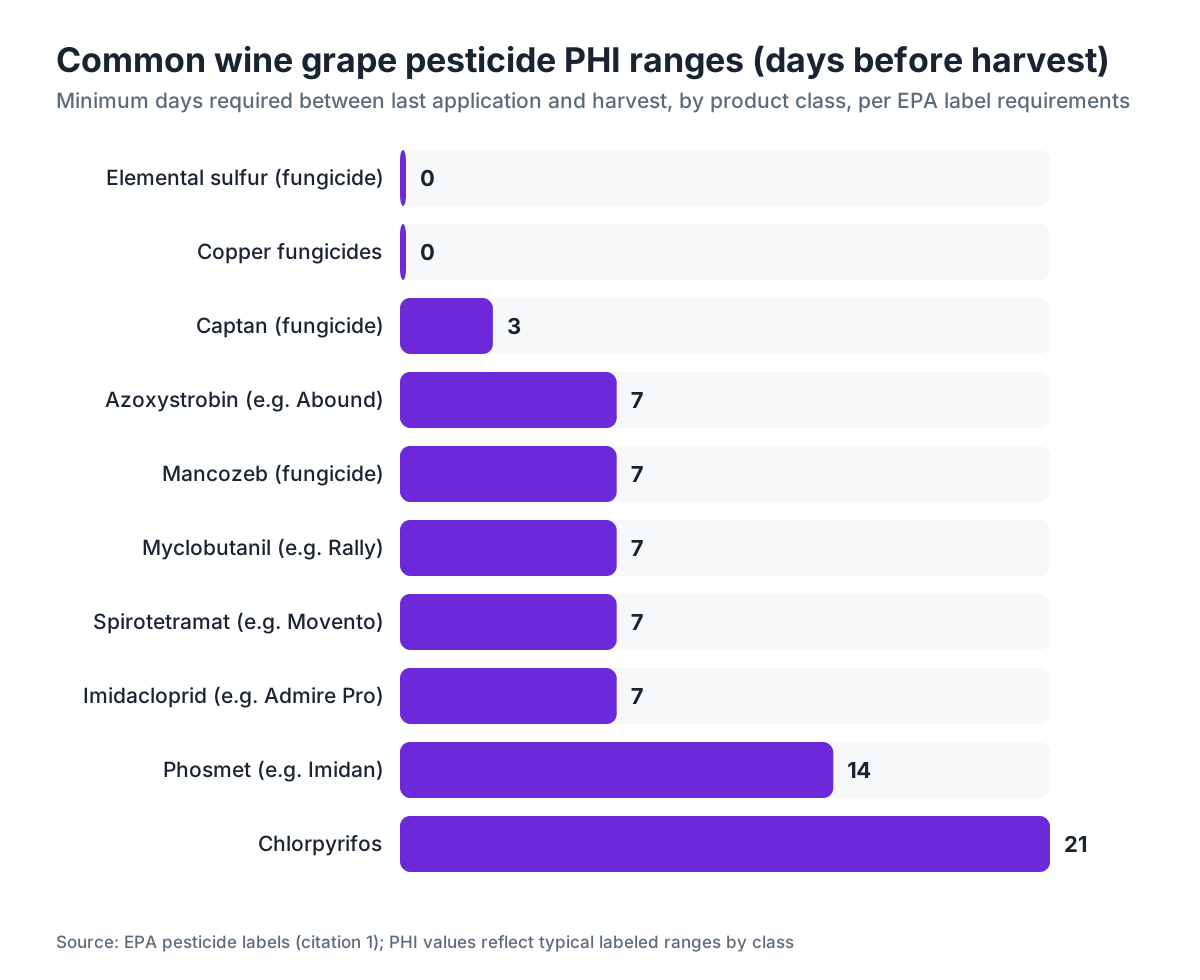
One thing people skip: tank mixes. If you sprayed a fungicide and an insecticide in the same pass, list both. The PHI for a tank mix is governed by the longest PHI among all products in the tank. If one product is 3 days and the other is 14, your PHI for that application is 14 days. Missing this is one of the most common errors in grower PHI summaries.
How far in advance should you send the PHI clearance to the buyer?
Send it as soon as you have a confident harvest window, ideally 5 to 10 days out. Buyers need time to read the records, run any questions back to you, and schedule receiving crews. If your QC contact is also reviewing Brix data, acid panels, and berry samples for a dozen growers at once, landing your paperwork the morning of harvest is not going to make anyone happy.
Running a phased harvest across multiple blocks? Send a rolling update for each block the week before that block comes in. Batch everything into one email per block, not a running thread of corrections.
The exception is a late-season spray that forces a harvest delay. In that case, notify the buyer immediately, before the original harvest window, with the new last-application date and the new earliest legal harvest date. That conversation goes much easier when it happens early. Buyers who find out about a PHI conflict on the day the gondolas were supposed to arrive tend to remember it.
What format should the communication take?
Email with a PDF attachment is the current standard for most commercial transactions. The email is your timestamped transmission record. The PDF is the actual document, signed or initialed.
Some buyers run grower portals where records get uploaded directly. If your buyer uses one, follow their format exactly. Fighting the system because you prefer a different template wastes everyone's time.
For smaller deals or direct relationships, a well-structured email body can stand in for a formal attachment, but only if it contains every field listed in the table above. A loose paragraph saying "all our PHIs are clear" is not documentation. It's a statement of belief.
A word on spray records vs. clearance summaries: your full spray records are your underlying documentation. The PHI clearance summary is a digest of those records prepared for the buyer. Both should exist. If a buyer asks to see the underlying records (some do, some don't), you should be able to pull them on the spot. Keeping spray records in a structured digital format makes generating the summary fast. Tools like VitiScribe are built for this workflow: you log applications as you make them, and the system tracks the PHI countdown against your planned harvest date automatically.
For growers subject to the EPA Worker Protection Standard, your application records must already contain the product name, EPA reg number, active ingredient, application date, location, and the restricted-entry interval (REI) [3]. The PHI data adds one more field. If your WPS records are solid, building the PHI summary is mostly a copy-paste job.
What state or federal laws govern the documentation you're providing?
Several layers apply, and they don't line up perfectly.
At the federal level, FIFRA (the Federal Insecticide, Fungicide, and Rodenticide Act) requires that pesticides be used in accordance with labeling, which includes PHI restrictions [1]. Tolerances for pesticide residues in or on food commodities, grapes included, are set by EPA under FFDCA and published in 40 CFR Part 180 [4]. If a residue exceeds the established tolerance, the fruit is legally adulterated.
The EPA Worker Protection Standard (40 CFR Part 170) governs how application information gets recorded and posted for worker safety [3]. Many WPS fields overlap with what a buyer needs, which is why it's efficient to build one record that does both jobs.
At the state level, California growers operate under the California Department of Pesticide Regulation (CDPR), which requires that pesticide applications to agricultural crops be reported to the county agricultural commissioner within a set timeframe (generally by the 10th of the month following application, under the Pesticide Use Report system) [2]. Oregon, Washington, and other wine states have their own versions. The Washington State Department of Agriculture administers pesticide registration and use requirements for Washington growers [5].
Some buyers, especially those with export markets, also track EU maximum residue limits (MRLs), which are sometimes lower than EPA tolerances. That's not a legal obligation for domestic growers, but if your fruit ends up in a wine bound for Europe, your buyer may ask about it. Worth knowing.
What happens if a PHI wasn't met and you've already told the buyer everything is clear?
Tell them immediately. Finding a PHI error after you've sent a clearance document is painful, but catching it before harvest beats catching it after the grapes are in the tank by a wide margin.
Call your buyer first, then follow up in writing the same day. Spell out exactly which product, which block, which application date, and what the correct PHI requires. Give them a revised earliest legal harvest date. Be specific: "Application of [product] on July 15 carries a 14-day PHI. The earliest legal harvest for Block 7 is July 29, not July 25 as stated in my original summary."
If the block is already harvested in error, you're now looking at a potential FIFRA violation, possible residue testing of the received fruit, and a hard conversation with your buyer about what happens to that lot. Depending on your state and your contract, this can trigger regulatory notification obligations. Get your PCA or legal counsel on the phone.
This is exactly why sending the clearance document several days before harvest, rather than day-of, gives you a correction window. Errors caught before the gondola rolls are administrative problems. Errors caught after crush turn into regulatory and financial ones.
How do winery buyers typically verify PHI clearance?
Buyers use a few verification approaches, often in combination.
First, they check your math. Given the product name or EPA reg number, they can look up the label and confirm the PHI. EPA's pesticide label database and DPR's label library both allow this. A buyer who takes compliance seriously will spot-check at least a few products per grower.
Second, some buyers cross-reference your county pesticide use reports (PURs) against your clearance summary. In California, PURs are public records available through CDPR [2]. If your summary says you last applied sulfur on August 1 but the PUR shows an application on August 8, the buyer will notice.
Third, residue testing. Post-harvest residue screening keeps getting more common in the premium tier. UC Davis extension has noted that buyer-side residue testing is part of the evolving standard of care in premium wine grape contracts, particularly for certified organic and estate wines. A clean PHI record doesn't guarantee a clean residue result (drift, equipment cross-contamination, and other factors exist), but it's your first line of documentation.
Fourth, some buyers ask for third-party verification, a practice more common in export-oriented wineries. This usually means a signed PCA letter attesting to the clearance. If your buyer requires it, build that step into your pre-harvest timeline.
Does organic certification change what you need to communicate?
Yes, in a few important ways.
Certified organic growers typically use OMRI-listed or NOP-compliant materials, many with short or zero PHIs. Sulfur, copper, and biologicals like Bacillus subtilis products are common examples. But "short PHI" doesn't mean "no PHI." Copper fungicides, for instance, may carry a 0-day PHI while still carrying other label restrictions.
The bigger communication point for organic buyers is affirming that no prohibited substances were applied to the block, ever, during the current certification period. That's a different document from a PHI clearance, and it usually means referencing your certification certificate and your organic system plan. Your certifier (a USDA-accredited certifying agent under the National Organic Program [10]) will have reviewed your inputs.
If you farm both conventional and organic blocks, make absolutely sure your PHI clearance summary labels which certification status applies to each block. Mixed summaries are how errors happen.
WSU Extension has published guidance on pesticide use in organic wine grape production that's worth having in your files, particularly for sorting out which materials require a PHI note at all under NOP rules [6].
Should PHI clearance be part of your grape purchase contract?
It should. If it isn't already in your contract, push to add it at the next negotiation. Spelling out what counts as acceptable documentation, the format, the lead time, and the consequences for non-compliance takes ambiguity out of what is otherwise a handshake expectation.
Cornell Cooperative Extension's viticulture team has pointed out that grape purchase contracts in New York increasingly include explicit pesticide disclosure provisions, particularly for buyers who source from multiple growers [7]. The trend runs the same way in California and the Pacific Northwest.
A well-drafted PHI clause spells out the grower's obligation to provide written PHI clearance (with required fields), the deadline relative to harvest, the buyer's right to request supporting records, and what happens if clearance can't be confirmed (typically, the buyer can delay or refuse harvest without penalty on their side).
If you're the grower, formalizing this protects you too. It sets clear expectations and gives you a defined process to follow instead of guessing what the buyer wants each season.
What's a simple workflow to track PHI clearance across multiple blocks?
A spreadsheet works, but it creates manual error risk every time you update a harvest date or find a late-season spray. Here's a reliable manual workflow if that's what you've got:
- Log every application immediately: product, EPA reg, application date, PHI per label, block ID.
- Create a running "earliest legal harvest" column: application date plus PHI in days.
- When your harvest date is confirmed, check every block's earliest legal harvest against that date. Flag any block where the harvest date lands before the earliest legal harvest date.
- Generate the clearance summary from that spreadsheet, sign it, and send it.
The catch: most growers are running 10 to 40 blocks with applications made across multiple passes during the season. One missed entry breaks the whole calculation. Digital spray logs that auto-calculate PHI against a rolling harvest date are meaningfully better for this. VitiScribe does this by design: you log the application, enter the PHI from the label, and the system flags any block where your planned harvest date would fall inside the PHI window.
Whatever system you use, the discipline is the same: log applications the same day they happen, not at the end of the week. PHI errors almost always trace back to records reconstructed from memory instead of logged in real time [8].
For growers in the Paso Robles wineries region or South Coast winery supply chains, buyers in those markets report increasing formality around PHI documentation as those AVAs grow in premium-tier recognition.
What are the most common mistakes growers make when communicating PHI clearance?
A few patterns come up over and over.
Forgetting tank mix PHIs. As noted earlier, the longest PHI in any tank mix governs the whole application. A grower who tracks each product separately can miss this.
Using the trade name alone without the EPA reg number. Trade names change with reformulations. The EPA reg number is the permanent identifier for the specific formulation and its label. Include both.
Sending clearance for the wrong harvest date. If you first planned harvest for August 20 but pushed it to August 17 after a buyer conversation, re-run all your PHI math against the new date and resend. Don't assume the old clearance still covers the earlier date.
Mixing up re-entry intervals and PHIs. They're different numbers. REI is about worker safety and how soon you can send someone back into the block. PHI is about harvest timing. Both live on the label, but they answer different questions [3]. A clearance document covers PHI. WPS posting covers REI. Don't conflate them.
Sending records only when the buyer asks. PHI clearance should go out proactively. Wait for the buyer to ask and you've already put friction into the relationship.
Frequently asked questions
Is there a federal form growers must use to document PHI clearance for wine grapes?
No. There's no federally mandated form. PHI clearance documentation is a grower-level practice that satisfies contractual and regulatory obligations (mostly FIFRA compliance and state PUR requirements), but the format is up to you and your buyer. What matters is that the content is complete: product name, EPA reg number, application date, PHI, and proposed harvest date, at minimum.
How do I find the PHI for a pesticide if I've lost the original label?
Use the EPA's pesticide label database at EPA.gov or your state's label repository (California's DPR Label Database is thorough). Search by product name or EPA registration number. The PHI is listed under the Directions for Use section. If the label has been updated since your purchase, use the current label, but remember you applied under the label in effect at the time of application, which may have carried a different PHI.
What PHI applies when you tank-mix two products with different PHIs?
The longer PHI governs the entire tank-mix application. If product A has a 3-day PHI and product B has a 14-day PHI, your effective PHI for that application is 14 days. List both products on your clearance document and note the controlling PHI. This is one of the most common calculation errors in grower PHI summaries.
Can a winery buyer refuse to accept grapes if they're not satisfied with the PHI documentation?
Yes. Under most grape purchase contracts, a buyer can refuse delivery if required documentation isn't provided or doesn't support legal harvest. Even without a contract clause, a winery accepting fruit with inadequate PHI records takes on legal exposure under FIFRA and FFDCA. Most buyers with any compliance sophistication will pause acceptance until documentation is complete and satisfactory.
How long should growers keep PHI records after the harvest?
California requires pesticide use records to be kept for at least 2 years [2]. EPA's Worker Protection Standard requires application records to be kept for 2 years as well [3]. Some buyers and certifiers (especially organic) ask for 5 years. Keeping records for at least 3 years gives you a reasonable buffer across all likely audit windows. Digital storage costs almost nothing.
Do PHIs differ between conventional and organic-approved pesticides?
Yes, they can. Organic-approved materials like copper fungicides often carry a 0-day PHI, but this varies by product and formulation. OMRI listing doesn't guarantee PHI exemption. Always check the actual label. The clearance documentation process is identical for organic inputs; you still record the application and confirm clearance even if the PHI is zero.
What should a grower do if harvest needs to happen before a PHI has been met?
There is no legal workaround. FIFRA requires adherence to the label PHI. Your options are: wait until the PHI is satisfied (pushing the harvest date), or accept that you cannot legally harvest that block on the planned date. Notify your buyer immediately with the revised earliest legal harvest date. Early communication usually preserves the relationship; springing it on the buyer day-of does not.
Are PHI records the same as spray records, or are they separate documents?
They're related but distinct. Spray records (or pesticide application records) are the raw log of every application you make, required under WPS and state regulations. PHI clearance documentation is a summary drawn from those records, prepared to show a buyer that all PHIs have been satisfied before harvest. Both need to exist. The spray records are your proof; the clearance summary is your communication.
How does the EU MRL differ from the EPA tolerance, and should growers care?
EPA tolerances under 40 CFR Part 180 govern U.S. domestic commerce. EU MRLs (set under EC Regulation No 396/2005) can be substantially lower for some compounds. A U.S. grower selling fruit domestically has no legal obligation to meet EU MRLs, but if your buyer exports wine to Europe, they face those limits on the finished wine. Ask your buyer whether EU MRL compliance is a requirement before you finalize your spray program.
What do university extension programs recommend for record-keeping systems?
UC Davis Cooperative Extension and Cornell Cooperative Extension both recommend pesticide application records that include at minimum the product name, EPA registration number, active ingredient, rate, date, and target pest or crop. UC Davis extension specifically notes that records sufficient for PUR compliance will also support PHI documentation once a harvest date field is added. Both programs push same-day logging over end-of-week reconstruction.
Is a licensed PCA required to sign the PHI clearance document?
Not universally, but some buyers require it, especially in California. In California, a licensed PCA is required to make pesticide use recommendations for most agricultural applications [2], and having the PCA attest to PHI clearance adds credibility. For export markets and premium estate programs, a PCA-signed clearance letter is increasingly expected. Check your grape purchase contract for any specific signature requirements.
What if the buyer's required harvest date is exactly equal to the PHI, not after it?
The label language typically states the PHI as the minimum number of days before harvest. 'Do not apply within X days of harvest' means the harvest date must be at least X days after the application date. If the harvest date equals exactly the PHI in days, you're on the legal minimum. Growers and buyers are both better off keeping at least a day or two of margin. Zero-day margin on a tight harvest window is a risk you probably don't need.
How do I handle PHI documentation when a custom crush winery is the buyer?
The same way you'd handle it with any buyer. Custom crush facilities receive fruit from many growers and face the same residue and compliance exposure. Some custom crush operations run more formal intake checklists than small estate wineries. Contact their receiving or QC coordinator before the season starts, ask what format they need, and follow it exactly. PHI clearance paperwork should be part of your pre-harvest intake package alongside Brix readings and weight estimates.
Sources
- EPA, Federal Insecticide, Fungicide, and Rodenticide Act (FIFRA): Pesticide labels are legally binding documents under FIFRA; using a pesticide inconsistently with its labeling is a federal violation.
- California Department of Pesticide Regulation, Pesticide Use Reporting: California requires all agricultural pesticide applications to be reported to the county agricultural commissioner; records must be kept for at least 2 years.
- EPA, Worker Protection Standard (40 CFR Part 170): The WPS requires employers to keep pesticide application records including product name, EPA reg number, active ingredient, application date, and REI for at least 2 years.
- EPA, Pesticide Tolerances, 40 CFR Part 180: Tolerances for pesticide residues in or on food, including grapes, are set by EPA under FFDCA and codified at 40 CFR Part 180; exceeding a tolerance renders the commodity legally adulterated.
- Washington State Department of Agriculture, Pesticide Management: The Washington State Department of Agriculture administers pesticide registration and use requirements for Washington growers.
- WSU Extension, Organic Wine Grape Production: WSU Extension publishes guidance on pesticide use in organic wine grape production, including which organic-approved materials carry PHI requirements.
- Cornell Cooperative Extension, Viticulture and Enology: Cornell Cooperative Extension notes that grape purchase contracts in New York increasingly include explicit pesticide disclosure provisions.
- UC Davis Cooperative Extension, Pest Management Guidelines for Grapes: UC Davis extension recommends that pesticide application records include the EPA registration number, application date, and rate, and notes that same-day logging reduces reconstruction errors.
- USDA Agricultural Marketing Service, National Organic Program: Under USDA NOP, certified organic growers must document all input materials through their certifying agent; organic certification does not exempt growers from PHI compliance where it appears on approved material labels.
Last updated 2026-07-11