How to complete a DLSE agricultural wage order compliance checklist

TL;DR
- California's DLSE enforces IWC Wage Order 14 for farm workers.
- A compliance checklist covers minimum wage, overtime thresholds, rest and meal periods, housing credits, piece-rate tracking, recordkeeping, and posting.
- Most citations come from incomplete time records and undocumented rest periods.
- This guide walks each checklist section in order so you can self-audit before a deputy walks your property.
What is the DLSE agricultural wage order compliance checklist?
The Division of Labor Standards Enforcement (DLSE) is the California agency that investigates wage theft and enforces the Industrial Welfare Commission (IWC) wage orders. For vineyard and farm operations, the controlling document is IWC Wage Order 14, which covers agricultural occupations. The "compliance checklist" is the self-audit framework DLSE field deputies use when they walk a property. It's also the structure any vineyard manager should use to self-inspect before that visit happens. [1]
There's no single fillable PDF from Sacramento. The checklist is a section-by-section review of every obligation in Wage Order 14, plus any statute that supersedes it, organized so a deputy can tick off violations as they move through your records. Smart managers build their own version from the order's text and run it quarterly.
The stakes are real. DLSE can assess civil penalties starting at $50 per employee per pay period for an initial wage statement violation and $100 per employee per pay period for subsequent ones under California Labor Code Section 226. Minimum wage penalties under Section 1197.1 run higher, starting at $100 per employee per pay period. [2] Twenty seasonal harvest workers, eight pay periods of missed rest period records, and you can do that math fast.
Which wage order applies to vineyard and farm workers in California?
IWC Wage Order 14 governs agricultural occupations. The IWC defines an agricultural occupation as work on a farm or in connection with the growing, harvesting, or processing of agricultural commodities. Grape growing and hand harvesting sit squarely inside that definition. Winery production work inside a bonded facility can fall under a different order (Wage Order 1 for manufacturing), so if you run a winery and a vineyard, you need to check which employees perform which tasks and assign the right order to each role. [1]
Here's the common trap. A tractor driver who also does cellar work splits time between Wage Order 14 and possibly Wage Order 1. DLSE generally applies the order that covers the majority of hours worked in a workweek. Keep clean records for anyone who crosses that line.
The wage order is posted publicly on the California DIR website. The version to reference is Order 14-2001, as amended. Print the full order, not a summary. [1]
What are the main sections of a DLSE Wage Order 14 compliance checklist?
A good checklist tracks the structure of the wage order itself. Below are the compliance areas you'll audit, in the sequence most DLSE field deputies work through.
1. Minimum wage
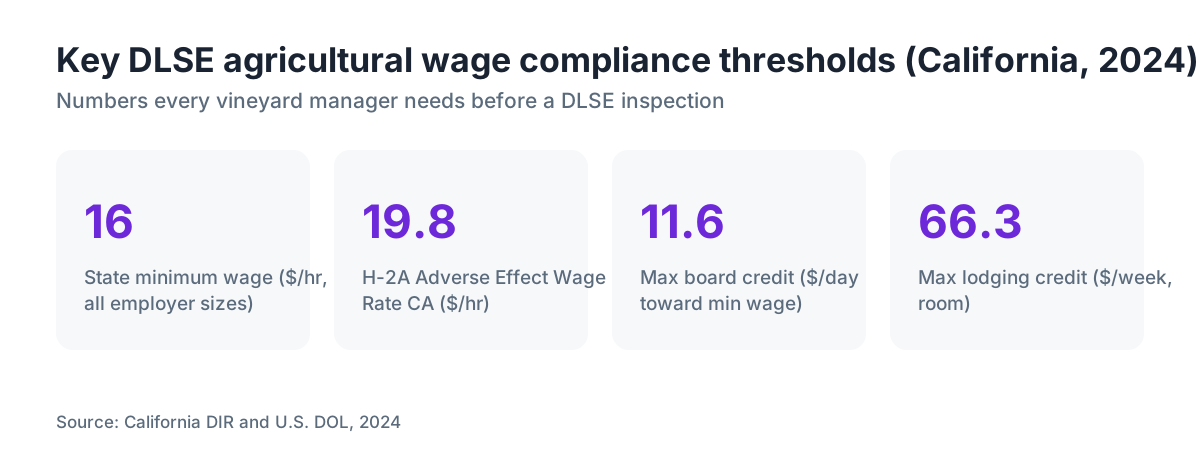
California's statewide minimum wage applies to agricultural workers. As of January 1, 2024, the floor is $16.00 per hour for all employers regardless of size, after the phase-in completed. [3] Check every job classification. Piece-rate workers must also clear minimum wage on a per-hour basis, even when the piece rate looks generous at a glance.
2. Overtime
Agricultural overtime changed under AB 1066, which phased in overtime protections for farm workers starting in 2019. For employers with 26 or more employees, overtime at 1.5x kicks in after 8 hours in a day or 40 hours in a week, effective January 1, 2022. Double time applies after 12 hours in a day. For employers with 25 or fewer employees, the full phase-in reached parity on January 1, 2025. [4] Seasonal harvest operations trip this wire constantly.
3. Rest periods
Wage Order 14 requires a paid 10-minute rest period for every four hours of work, or major fraction thereof. "Major fraction" means more than two hours. An eight-hour shift means two rest periods. Rest periods cannot be waived, and DLSE checks whether your time records show them. If you pay piece rate during harvest and your workers never leave the vine row, document that fact explicitly.
4. Meal periods
A 30-minute unpaid meal period is required no later than the end of the fifth hour of work. A shift of six hours or less lets the worker waive the meal period by mutual written consent. Get the waiver signed and keep it.
5. Wage statement requirements (pay stub)
California Labor Code Section 226 requires nine itemized elements on every pay stub: gross wages, total hours worked, piece-rate units if applicable, all deductions, net wages, pay period dates, employee name and last four digits of SSN or employee ID, employer name and address, and hourly rates in effect. [2] Miss one element and it's a violation.
6. Recordkeeping
Employers must keep payroll records for three years at the place of employment or a central California location. Agricultural records must show daily start and stop times, meal period times, and piece counts where applicable. Deputies will ask to see these on the spot.
7. Poster and notice requirements
Wage Order 14 must be posted where all employees can reach it, in English and Spanish. The current minimum wage notice, the Payday Notice, and the Workers' Compensation carrier notice all need to be up. If your crew speaks other languages, Cal/OSHA and DLSE both recommend translations, though only English and Spanish are strictly required for most posters.
8. Housing and meals (if provided)
If you provide housing or meals as part of compensation, the value you credit toward minimum wage is capped. For 2024, the maximum board credit is $11.60 per day and the maximum lodging credit is $66.34 per week for a room. [5] Charge more, or credit more against wages, and you're in violation.
9. Piece-rate records
Any worker paid piece rate during harvest needs total pieces, total hours, total compensation, and the effective hourly rate tracked. AB 1513 (California Labor Code Section 226.2) requires a separate line item on the pay stub for piece-rate work and for non-productive time pay. [6]
10. Child labor
Minors under 16 working in agriculture face specific hour limits, especially during the school year. Minors 12 and 13 may work in agriculture with parental consent outside school hours. Keep permit and consent paperwork filed separately.
How do you document rest periods and meal breaks for vineyard harvest crews?
This is where most small vineyards get cited. The problem usually isn't that they deny breaks. It's that they have no paper trail showing the breaks happened.
The simplest system that survives an audit: a daily crew log where the foreperson records break start and end times for each crew. Some managers use a paper sign-in sheet at the water station. Others use a timestamped photo of the crew at the break area. What doesn't work is a vague note in the ranch log reading "breaks given."
For piece-rate crews, Wage Order 14 is clear that rest periods get paid at the regular rate of pay, not the piece rate. So you calculate an average regular rate for the day (total piece-rate earnings divided by total hours) and confirm the rest period pay meets that floor. California Labor Code Section 226.2 spells this out for non-productive time. [6]
Say you run early harvests starting at 5 a.m. and the crew is done by 1 p.m. You still owe two 10-minute rest periods and one meal period. Map that into your schedule before harvest starts, not after.
What overtime rules apply to California agricultural workers after AB 1066?
AB 1066, signed in 2016, phased agricultural overtime into line with the rules covering non-agricultural work. That phase-in is now finished. [4]
For employers with 26 or more employees, the 8-hour daily overtime threshold took effect January 1, 2022. For employers with 25 or fewer employees, it took effect January 1, 2025.
In plain terms: a harvest crew that picks from 6 a.m. to 4 p.m. with a 30-minute lunch works 9.5 hours. One and a half of those hours are overtime at 1.5x the regular rate. For a piece-rate worker, the overtime premium is figured on the regular rate of pay for that workday, which is more than the base wage.
Any harvest manager who ran 10-hour days without overtime pay before AB 1066 needs a payroll system update. The UC Davis Agricultural Personnel Management program publishes guidance on this transition. [7]
| Employer size | Daily OT threshold (current) | Weekly OT threshold | Double time after |
|---|---|---|---|
| 26+ employees | 8 hours | 40 hours | 12 hours/day |
| 25 or fewer employees | 8 hours (as of Jan 1, 2025) | 40 hours | 12 hours/day |
What records does DLSE actually look at during a farm inspection?
When a DLSE deputy shows up, they ask for four things right away: payroll records, time records, wage statements from the most recent pay period, and proof that Wage Order 14 is posted on site. They can look back three years. [1]
Time records must show employee name, date, hours worked each day (start and end times included), meal period times, and piece counts per day where piece rate applies. If you use a payroll processor, confirm they capture all nine elements required under Labor Code Section 226. Most national payroll vendors default to federal requirements, which are less granular than California's. [2]
DLSE can also request pay stubs for any former employee who filed a complaint. Don't purge records at three years automatically. Wait a full 36 months from that worker's last date of employment, not from a fixed calendar date.
If you provide housing, deputies check the credit amounts against the DIR-published maximums and read the written agreement documenting the credit. A verbal arrangement doesn't hold.
One item people forget: the Payday Notice. California Labor Code Section 207 requires you to post the regular paydays and the time and place where employees get paid. Switch from weekly to biweekly pay and never update the notice, and that's a recordable deficiency.
How do EPA Worker Protection Standard requirements overlap with DLSE requirements?
They're separate systems. A DLSE visit and a Cal/OSHA or EPA inspection can land on the same day, and they'll look at some of the same paperwork.
The EPA Worker Protection Standard (WPS), enforced in California through Cal/OSHA's pesticide safety program and the County Agricultural Commissioner, requires a pesticide safety training record for every worker entering treated fields, a central display of pesticide application information, and a decontamination site with water, soap, and towels within a quarter mile of workers in treated areas. [8]
DLSE and WPS intersect at the worker training and posting requirements. If a worker is kept out of a field during a Restricted Entry Interval (REI) and loses piece-rate income as a result, DLSE may check whether that lost time was compensated at minimum wage. REI downtime counts as non-productive time under the piece-rate rules.
WSU Extension publishes practical WPS compliance guides for tree fruit and grape operations in the Pacific Northwest that translate directly to California obligations. [9] UC Davis Cooperative Extension also covers integrated WPS and labor compliance for California vineyards. [7]
How do you fill out a self-audit checklist step by step?
Start with a printed copy of IWC Wage Order 14 from the California DIR website and work each section as a yes or no question. Here's the sequence I'd use.
Step 1: Verify current minimum wage rates
Confirm your payroll system uses the current California minimum, $16.00 per hour as of January 1, 2024. [3] If you're in a city with a higher local minimum, confirm that rate too. Sonoma County tracks state law, but some municipalities exceed it.
Step 2: Pull a sample of time records
Grab three weeks from the past six months: one during harvest, one during slow season, one during pruning. For each week, verify start and stop times are recorded, break times show, daily hours sum correctly, and overtime is identified and paid.
Step 3: Check overtime calculations
For each sample week, confirm daily overtime at 1.5x after 8 hours, double time after 12 hours, and weekly overtime at 1.5x after 40 hours. For piece-rate workers, recalculate the regular rate of pay for those days and confirm the overtime premium applies to that rate, not the base minimum wage.
Step 4: Verify pay stub elements
Pull one pay stub per employee classification. Count the nine required elements from Labor Code Section 226. [2] A missing pay period end date or employer address is worth $50 to $100 per employee per period.
Step 5: Confirm poster compliance
Walk the bunkhouse, the packing shed, and the break area. Wage Order 14, the minimum wage notice, the Payday Notice, and the Workers' Comp carrier notice should all be current and visible. If your Wage Order poster predates the 2022 overtime amendments, replace it.
Step 6: Document rest and meal periods
Review your foreperson logs or crew sheets. Can you show break times for specific dates? If not, build a daily break log form now and backfill what you can with crew declarations.
Step 7: Review housing and meal credits (if applicable)
Compare what you deduct against the DIR-published maximums. Get signed written housing agreements from any employee in employer-provided housing. [5]
Step 8: Piece-rate audit
If you use piece rate, confirm non-productive time (safety meetings, travel between rows, waiting for the bin) is compensated separately at no less than minimum wage. Pull the piece-rate line items from recent pay stubs and check that the AB 1513 itemization is present. [6]
Step 9: Minor worker permits
For any worker under 18, pull their work permits and parental consents. Verify the hour restrictions for their age group were observed during any school-year work.
Step 10: Final records storage check
Confirm payroll records live at the place of employment or a California central location and that three full years are accessible. Note the oldest record date and the scheduled destruction date.
For ongoing recordkeeping, tools like VitiScribe centralize time records, spray logs, and crew documentation in one place. That matters when a deputy asks for everything at once.
What are the most common violations DLSE finds on California farms?
Based on DLSE enforcement actions and Labor Commissioner press releases, these are the violations that keep showing up in agriculture:
- Missing or incomplete time records, especially for piece-rate harvest crews working irregular hours.
- Overtime miscalculations after AB 1066, mostly employers who never updated payroll procedures when the phase-in thresholds moved.
- Pay stubs missing required elements, most often the hourly rate in effect or the correct pay period dates.
- Failure to separately compensate non-productive time for piece-rate workers under AB 1513.
- Rest period violations where breaks were given but never documented.
- Housing and board credits that exceed the DIR maximum amounts.
- Outdated posters. This one is almost free to fix and costs $50 to $100 per employee per pay period if cited.
The Labor Commissioner's annual report typically ranks agriculture and food processing among the top industries for wage claim filings. [10] Median agricultural wage claim settlements run several thousand dollars per complainant once overtime violations are in play, though DLSE doesn't publish a single authoritative per-case figure.
How do you handle compliance for H-2A visa workers on a vineyard?
H-2A agricultural guest workers are covered by both federal H-2A program rules and California state wage law. The more protective standard wins, which in California means state rules almost always govern. [11]
H-2A workers must be paid at least the Adverse Effect Wage Rate (AEWR), published annually by the U.S. Department of Labor. For California, the 2024 AEWR for field and livestock workers was $19.75 per hour, above the state minimum wage. [11] When the AEWR beats California's minimum, the AEWR is the floor.
For DLSE purposes, H-2A workers get treated like any other agricultural employee. Time records, pay stubs, rest period documentation, and posting all apply equally. H-2A employers also must provide free housing and transportation, so the housing credit rules above apply too. You can't deduct housing costs that drop pay below the AEWR floor.
Cornell's ILR School and its farmworker legal assistance programs publish guides on how H-2A and state labor law fit together. Worth bookmarking. [12]
When should you hire a labor compliance consultant vs. handle the checklist yourself?
If your operation has fewer than five full-time equivalent employees and no piece-rate workers, you can reasonably self-audit with the checklist above. The wage order text is plain and the math is arithmetic.
Add seasonal harvest crews, piece-rate pay, H-2A workers, or farm labor contractors (licensed under the Farm Labor Contractor Act), and the liability surface gets wide enough that a California-licensed HR consultant or an employment attorney who knows agricultural wage law pays for itself in one avoided citation. Farm labor contractors are jointly liable with the grower for wage violations under California Labor Code Section 2810.3, so if you use a contractor, their compliance is your problem too. [13]
A one-time compliance audit from a consultant runs roughly $500 to $2,500 for a small operation, based on typical California HR consulting rates. That's less than the penalty for a single violation category across a 20-person crew over one pay period.
Recordkeeping software like VitiScribe won't replace legal advice, but it makes self-auditing faster when your time records, crew assignments, and spray logs sit in one searchable place instead of three paper binders.
For ongoing education, UC Davis's Agricultural Personnel Management course series covers California-specific agricultural labor law and updates when the law changes. [7]
What does the wage order poster requirement actually mean in the field?
Wage Order 14 must be posted where employees can read it, in a language they understand. The DIR's guidance specifies a "conspicuous place" at the worksite. For a multi-block vineyard, that usually means the break area, the equipment barn, and any bunkhouse. A single laminated copy in the office fails the requirement if crew members never enter the office. [1]
The poster must be the current version. If California's minimum wage rose after you printed yours, replace it. DIR posts printable current-version posters for free on its website.
English and Spanish versions are both required in most agricultural settings. If your crew is mainly Mixtec or Triqui speaking, DLSE doesn't legally require a Mixtec poster today, but it's the kind of detail that shapes how a wage claim resolves if one ever gets filed.
Frequently asked questions
What is IWC Wage Order 14 and does it cover all vineyard workers?
IWC Wage Order 14 covers agricultural occupations in California, including grape growing, pruning, irrigation, and harvest. Workers who spend most of their hours in wine production inside a bonded winery may instead fall under Wage Order 1 for manufacturing. If your employees split time between the vineyard and the cellar, track hours by task and apply the order that covers the majority of that workweek's hours.
How far back can DLSE go when auditing payroll records?
DLSE can look back three years under California's statute of limitations for wage claims. California law also allows four years for claims brought as unfair business practices under Business and Professions Code Section 17200. Keep payroll records, time sheets, and pay stubs for at least four years to be safe, and don't destroy records while any open complaint or litigation is pending.
What are the California minimum rest period requirements for agricultural workers?
Wage Order 14 requires a paid 10-minute rest period for every four hours worked, or major fraction thereof (more than two hours). An eight-hour shift requires two rest periods. A shift of three and a half hours requires one. Rest periods should fall in the middle of each work period as practicable and cannot be combined with meal breaks. Piece-rate workers must be paid during rest periods at their regular rate of pay.
Do piece-rate harvest workers need separate tracking for non-productive time?
Yes. AB 1513, codified at California Labor Code Section 226.2, requires that non-productive time (travel between rows, safety meetings, waiting for bins) be compensated separately at the greater of the employee's average piece-rate earnings for the day or the applicable minimum wage. The pay stub must itemize piece-rate units, piece-rate compensation, non-productive time hours, and non-productive time pay as separate line items.
What is the Adverse Effect Wage Rate for H-2A workers in California?
The U.S. Department of Labor publishes the Adverse Effect Wage Rate (AEWR) annually. For California in 2024, the AEWR for field and livestock workers was $19.75 per hour. That rate supersedes the state minimum wage because it's higher. H-2A employers must pay whichever is greater: the AEWR, the state minimum wage, or the prevailing wage for the occupation as determined in the job order.
How do I get the current Wage Order 14 poster for free?
The California Department of Industrial Relations (DIR) posts printable, current-version wage order posters on its website at no cost. Go to the DIR's publications section and search for Wage Order 14. Download both the English and Spanish versions. Replace your existing poster any time the minimum wage changes or the order is amended. A laminated color print holds up better in outdoor break areas than plain paper.
Can a vineyard deduct the cost of housing from an agricultural worker's wages?
Yes, but only up to the DIR-published maximums. For 2024, the maximum board (meal) credit is $11.60 per day and the maximum lodging credit for a room is $66.34 per week. Deducting more than these amounts, or crediting more than these amounts toward minimum wage compliance, is a violation. Any housing arrangement must be in a signed written agreement with the employee before the deduction begins.
What happens if a farm labor contractor my vineyard uses violates wage law?
Under California Labor Code Section 2810.3, a client employer (your vineyard) is jointly and severally liable for wage violations committed by a licensed farm labor contractor supplying your workers. DLSE can collect the full amount from you even if the contractor caused the underpayment. Before hiring any FLC, ask for their license number, their bond, their payroll records system, and their most recent DLSE inspection history.
Do DLSE wage order requirements apply to family members working on a vineyard?
California law has no blanket family member exemption for agricultural wage orders. A parent employing their own minor child in agriculture has limited exemptions, but spouses, siblings, and extended family who receive compensation are generally covered employees. The safe approach is to treat any compensated worker as a covered employee under Wage Order 14 and keep time and payroll records accordingly.
How do I calculate overtime for a piece-rate worker who works more than 8 hours in a day?
Calculate the regular rate of pay for the day: total piece-rate earnings divided by total hours worked. The overtime premium for each hour over 8 is 0.5 times that regular rate, because the straight-time portion is already inside the piece-rate earnings. For hours over 12, the premium is 1.0 times the regular rate. Add those premiums to total piece-rate earnings to get the correct daily wage.
What does a DLSE field inspection actually look like at a vineyard?
A deputy typically arrives unannounced, identifies themselves, and asks right away for payroll records, time records, and current pay stubs. They'll walk the property to confirm posters are displayed. Inspections often last two to four hours. Deputies may interview workers privately, in Spanish if needed. Cooperate fully, provide requested documents promptly, and note any documents you can't immediately locate rather than guessing at their contents.
Are there any agricultural wage order exemptions for small vineyards?
Under AB 1066, employers with 25 or fewer employees had a delayed phase-in for the new overtime thresholds, but that phase-in is now complete. There is no current small-employer exemption from California's daily overtime rule in agriculture. Some very small family farm exemptions exist under the federal FLSA for farms that did not use more than 500 man-days of agricultural labor in any quarter of the preceding calendar year, but California state law is more protective and generally governs.
Does the EPA Worker Protection Standard create record-keeping obligations beyond DLSE?
Yes. WPS requires employers to keep records of pesticide applications and worker safety training for two years. Training records must show the employee's name, date of training, and the trainer's name. These records are separate from DLSE payroll records but may be requested by the County Agricultural Commissioner or Cal/OSHA during an inspection. If an REI is in effect and workers lose piece-rate time, that lost time should be documented and compensated as non-productive time under Labor Code Section 226.2.
What civil penalties can DLSE assess for wage order violations?
Under California Labor Code Section 1197.1, failing to pay minimum wage carries a civil penalty of $100 per underpaid employee per pay period for initial violations and $250 per employee per pay period for subsequent violations. Wage statement violations under Section 226 start at $50 per employee per pay period for initial violations and $100 for subsequent violations, up to $4,000 per employee total. Penalties can stack across violation categories.
Sources
- California Legislature, Labor Code Sections 226 and 1197.1: Labor Code Section 226 requires nine itemized elements on every California pay stub and sets wage statement penalties starting at $50 per employee per pay period; Section 1197.1 sets minimum wage penalties starting at $100 per employee per pay period.
- California Department of Industrial Relations, Minimum Wage: California statewide minimum wage is $16.00 per hour as of January 1, 2024, applicable to all employers regardless of size.
- California Department of Industrial Relations, Overtime for Agricultural Workers (AB 1066): AB 1066 phased in agricultural overtime: employers with 26 or more employees reached the 8-hour daily threshold on January 1, 2022, and employers with 25 or fewer reached it on January 1, 2025, with double time after 12 hours in a day.
- California Legislature, Labor Code Section 226.2 (AB 1513): AB 1513 (Labor Code Section 226.2) requires separate compensation for non-productive time for piece-rate workers and separate pay stub itemization of piece-rate units, piece-rate compensation, non-productive time hours, and non-productive time pay.
- University of California Agricultural Personnel Management Program: UC Cooperative Extension and the Agricultural Personnel Management program publish California-specific guidance on agricultural overtime transitions under AB 1066 and integrated labor and WPS compliance.
- U.S. EPA Agricultural Worker Protection Standard: The EPA Worker Protection Standard requires pesticide safety training records, central display of application information, and a decontamination site within a quarter mile of workers in treated areas.
- Washington State University Extension: WSU Extension publishes WPS compliance guidance for Pacific Northwest grape and tree fruit operations that translates to California WPS obligations.
- California Labor Commissioner's Office (DLSE): The Labor Commissioner's annual reporting identifies agriculture and food processing among the top industries for wage claim filings in California.
- U.S. Department of Labor, Foreign Labor Certification (H-2A Adverse Effect Wage Rates): The 2024 Adverse Effect Wage Rate for field and livestock workers in California under the H-2A program was $19.75 per hour, exceeding the state minimum wage.
- Cornell University ILR School: Cornell ILR publishes guides on the intersection of H-2A federal requirements and state labor law compliance applicable to agricultural employers.
- California Legislature, Labor Code Section 2810.3: Under Labor Code Section 2810.3, a client employer is jointly and severally liable for wage violations committed by a labor contractor supplying workers to that employer.
Last updated 2026-07-10