How to set up a shade, water, and rest area compliance checklist for harvest
TL;DR
- California requires shade at 80°F, one quart of drinking water per worker per hour, and a five-minute cool-down rest any time a worker asks for one.
- In states without a Cal/OSHA plan, federal OSHA's general duty clause and field sanitation rule set the floor.
- This guide covers every item on a defensible harvest checklist, including the records an inspector will actually pull.
What laws actually govern shade, water, and rest areas during grape harvest?
Three regulatory layers overlap during harvest. You need to know which one controls your operation on any given day, because the answer changes depending on the state line you farm behind.
Start with California's Heat Illness Prevention standard, Title 8 CCR Section 3395, the most specific outdoor heat rule in the country [1]. It covers every outdoor worker and sets the 80°F shade trigger. Grape states east of California mostly fall under federal OSHA's general duty clause instead, which is less prescriptive but still enforceable [10].
Next is the EPA's Worker Protection Standard (WPS), which covers agricultural workers and handlers who might touch pesticide residue in the vineyard [2]. The WPS carries its own field sanitation rules under 40 CFR Part 170, requiring potable water, toilets, and hand-washing water within a quarter mile or five minutes' travel of where people are working.
Third is OSHA's field sanitation standard at 29 CFR 1928.110, the federal baseline for drinking water (one quart per worker per hour), toilets (one per twenty workers), and hand-washing water [3]. California runs its own version at Title 8 CCR Section 3457, which mostly mirrors the federal rule but applies to every employer size [11].
Farm in California, and Title 8 CCR 3395 and 3457 are your primary documents. Farm in Washington, and WSU Extension has a plain-language guide that maps the federal general duty clause onto vineyard work [4]. Cornell's agricultural workplace health resources cover New York and the rest of the Northeast [5]. The takeaway is simple. Every U.S. vineyard has to provide drinking water and rest access during harvest. California stacks the temperature-triggered shade requirement on top.
What are the specific thresholds that trigger shade, water, and rest requirements?
| Requirement | California (Title 8 CCR 3395 / 3457) | Federal OSHA (29 CFR 1928.110 + General Duty) |
|---|---|---|
| Shade trigger | 80°F ambient air temperature | No specific temp threshold; GDC applies |
| Water quantity | 1 quart per worker per hour | 1 quart per worker per hour [3] |
| Water access | Workers must be able to drink at will | Suitably cool, potable, accessible |
| Rest periods | 5-min cool-down on request; mandatory 10-min net rest every 4 hrs | No federal minimum specific to heat |
| Shade capacity | Enough to seat all workers resting at one time | Not specified |
| High-heat protocol | Required at 95°F: buddy system, supervisor contact, pre-shift meetings | Recommended under GDC enforcement |
| Toilet facilities | 1 per 20 workers | 1 per 20 workers |
| Hand-washing water | 1 gallon per worker per day | 1 gallon per worker per day |
The 80°F number is the one California growers miss most. Shade is not something you set up only when workers start to feel hot. It has to be available whenever ambient temperature hits or passes 80°F, full stop [1]. A morning that starts at 78°F and climbs to 83°F by 9 a.m. means your crew needs shade access before 9 a.m., not after lunch.
The 95°F high-heat protocol adds its own checklist. You owe a pre-shift meeting on heat illness symptoms, a communication system that lets supervisors reach every worker (radio, phone, or a runner if you have no signal), and close observation of new workers for their first 14 days on the job. Cal/OSHA sets that window because acclimatization takes about that long [1].
How do you physically set up compliant shade in a vineyard during harvest?
Shade is the item inspectors cite most, and it's the easiest to get right with a little planning. Get the temperature trigger and the seating math straight, and you've solved most of the problem.
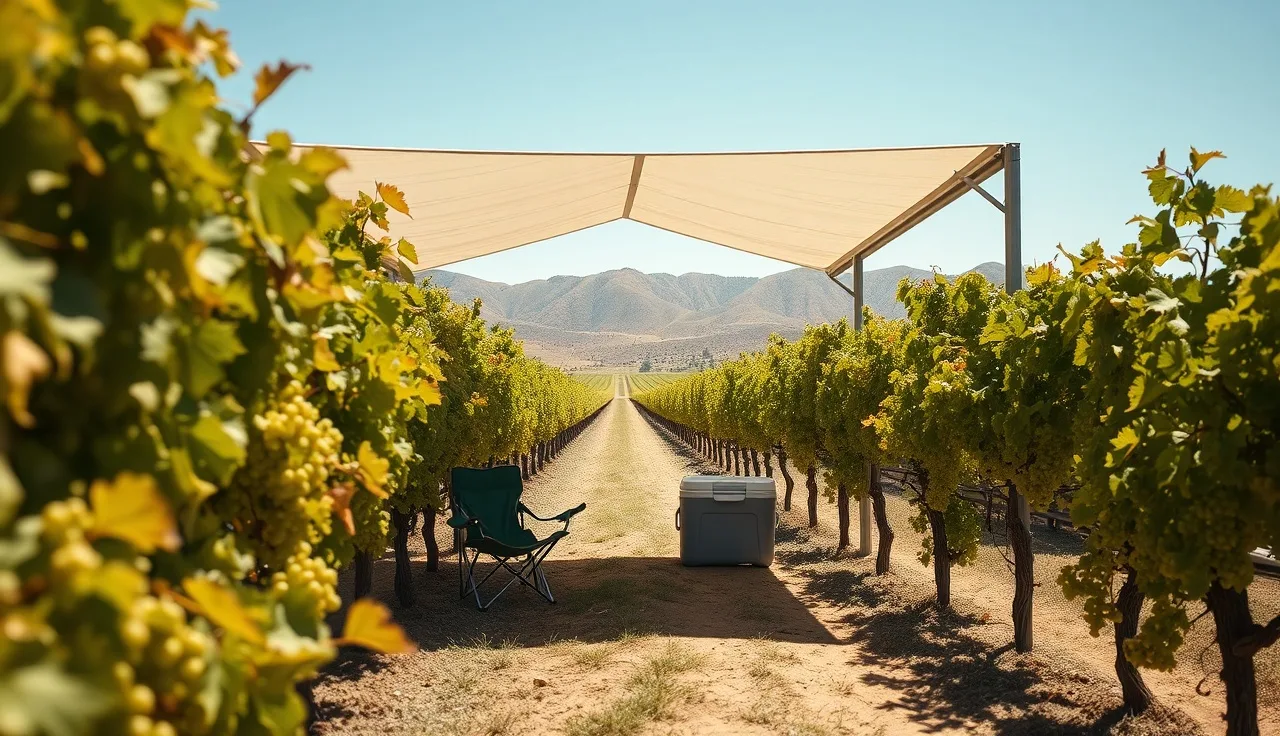
The standard says shade has to be "open to the air" to the extent feasible, or mechanically ventilated if enclosed [1]. A solid-wall trailer with no airflow is not compliant shade. A pop-up canopy with open sides is. The area under an equipment trailer works too, as long as it's big enough. The rule wants enough shade to seat every worker on break at the same time, so you size it off your break rotation. A crew of twelve taking staggered breaks of four at a time needs shade for four. If six rest at once, you need shade for six.
Shade also has to sit as close as practicable to where the crew is working [1]. That phrase is a judgment call, and inspectors apply common sense. A canopy in the parking lot while your crew prunes a block half a mile off is not going to pass.
Mobile shade works well out here. A utility trailer with a roll-up awning, or a purpose-built shade wagon towed between blocks, keeps shade near the work and satisfies the standard. Plenty of growers run contractor-grade pop-up canopies (roughly $150 to $500 at a hardware store) and move them twice a day as the crew moves. That's fine. What matters is that shade is up when the thermometer reads 80°F, not when someone starts looking flushed.
What counts as compliant drinking water at harvest, and how do you document it?
Water has to be potable, suitably cool, and free to workers [3]. Suitably cool means below ambient air temperature in practice, which any cooler and a bag of ice handles. The one-quart-per-worker-per-hour minimum is a floor, not a target. On a 95°F day in Paso Robles or the San Joaquin Valley, a worker doing physical labor can sweat out a liter an hour, so real demand runs past the legal minimum.
Individual water bottles meet the standard if you hand out enough of them. A shared cooler with single-use or sanitizable cups works too. Water has to be accessible, meaning nobody should have to walk more than five minutes from their work location to drink.
Document at least this much: the date, the temperature when water was set out, who's responsible for restocking, and confirmation the water was cool and potable. A paper log or a field notes entry in a records app like VitiScribe gives you a defensible trail if an inspection or a workers' comp claim ever lands on your desk.
One detail growers overlook. Shared water containers have to be individually marked or labeled, and the supply has to be protected from contamination. A lidded cooler with a spigot, parked in the shade, is the standard fix. If you run five-gallon jugs on a dispenser, store them off the ground and well away from any pesticide storage.
What does a rest area need to include beyond shade and water?
California's rule requires shade in the rest area, but it doesn't demand chairs, tables, or other amenities. Workers just have to be able to sit. A bare tarp on the ground doesn't let a worker sit in a way that helps heat illness recovery, so most compliance-minded operations put out folding camp chairs or a shaded bench anyway.
The fuller rest area package during harvest includes a few more pieces.
Toilet facilities at one per twenty workers, within a quarter mile or five minutes' travel of the worksite [3]. Portable units count. Permanent restrooms count if the crew can actually reach them.
Hand-washing water at one gallon per worker per day, with soap and single-use towels or a hand dryer [3]. This is separate from drinking water. You cannot point workers at the drinking cooler and call it hand-washing water.
First aid access is not spelled out in the heat illness standard itself, but OSHA's general first aid rule at 29 CFR 1910.151 applies, and Cal/OSHA reads it as requiring first aid materials reachable within about four minutes of any worksite [12].
A clear emergency contact system. In California, the heat illness standard requires supervisors to have a way to contact emergency services and to know the location and fastest route to the nearest emergency medical facility [1]. Post that at the rest area or lock it into the pre-shift meeting.
What does the checklist itself look like, and what format works best in the field?
The best compliance checklist is the one your foreman can actually run at 6 a.m. before the crew hits the vines. One page. Large font. Laminated if you can swing it, with a box to check and a line to initial.
Here's the core structure:
Pre-shift (before work begins each day)
- Current temperature checked and recorded
- Shade deployed or confirmed available if temp is forecast to reach 80°F
- Water supply stocked (minimum quantity = number of workers x hours of shift x 1 quart)
- Water temperature confirmed cool
- Toilets confirmed accessible and stocked with paper
- Hand-washing station stocked with soap and towels
- First aid kit present and stocked
- Emergency contact info on hand (nearest hospital, supervisor cell)
- Pre-shift heat illness meeting conducted (required at 95°F or above; good practice always)
- New workers identified for acclimatization observation (first 14 days)
Midday check (around 11 a.m. or when temp crosses 80°F)
- Shade confirmed positioned near active work blocks
- Water supply restocked as needed
- Temperature re-checked and logged
- All workers observed for heat illness symptoms
End-of-day
- Water containers cleaned and stored
- Portable toilets confirmed serviced or scheduled
- Any incidents or near-misses documented
- Checklist signed and filed
The daily log stays simple. Date, temperature at start and midday, supervisor initials, and a note on any issues. UC Agriculture and Natural Resources recommends keeping heat illness prevention records for at least three years [6]. That lines up with California's statute of limitations for most labor claims.
How do you handle compliance when you're using labor contractors or H-2A workers?
This is where small vineyards get tripped up. If you use a farm labor contractor (FLC), the contractor is the employer of record for their crew and carries primary responsibility for heat illness prevention and field sanitation. But California law makes the agricultural employer (that's you, the grower) jointly liable when the FLC falls short [1].
Joint liability means you can't hand off responsibility and walk away. Get written confirmation, ideally before harvest starts, that the FLC's heat illness prevention plan meets Title 8 CCR 3395. Ask to see it. If it doesn't exist, or it's a generic form with no site-specific detail, that becomes your problem the day an inspector shows up.
For H-2A workers, the federal program sets housing and transportation standards, but heat illness prevention during fieldwork still runs through OSHA's general duty clause in non-Cal/OSHA states, or Title 8 in California [7]. Acclimatization matters most for H-2A crews arriving from cooler climates. Cal/OSHA's guidance says workers new to outdoor heat face the highest risk during their first four to fourteen days on the job [1].
The safest move is one compliance system for everyone in your blocks, no matter whose name is on the paycheck. One checklist, one water station, one shade setup, one emergency contact posted in the rest area. Two tiers of documentation is two things to reconcile when something goes wrong.
What records do you need to keep, and for how long?
California's heat illness standard sets no mandatory retention period, but plan on three years minimum given the general OSHA inspection and litigation window. The EPA's Worker Protection Standard requires pesticide application records (a separate but related obligation) for two years [2].
Here's what to keep.
Your written Heat Illness Prevention Plan. Title 8 CCR 3395 requires it in writing, available at the worksite, and in a language the crew understands [1]. This is not a daily checklist. It's a standing document that describes your procedures.
Daily field logs recording temperature, shade deployment, water supply status, and supervisor sign-off.
Training records showing when and how workers and supervisors got their heat illness training. The standard requires training before outdoor work begins each year.
Incident reports for any heat illness symptoms or events, even the minor ones.
If you keep records digitally, a platform like VitiScribe timestamps field logs automatically and lets you attach photos, which is harder to challenge in an inspection than a handwritten note.
Storing physical documents in the vineyard office or the farm's admin files is fine. What you can't do is leave them only on someone's personal phone or in a shared cloud folder nobody controls. Inspectors expect to see records within a reasonable time of asking.
How do you train supervisors and workers on heat illness and rest area procedures?
Training is not optional under Title 8 CCR 3395. Workers have to learn the environmental and personal risk factors for heat illness, the procedures for first aid access, the right to call for emergency services, and how to spot the signs of heat exhaustion and heat stroke [1]. Supervisors need more: how to monitor workers, how to respond to symptoms, and how the acclimatization schedule works for new hires.
Training has to cover at least this:
- Environmental and personal risk factors for heat illness
- The importance of drinking water often, before thirst hits
- The right to take a preventive cool-down rest without retaliation
- Early warning signs of heat exhaustion (heavy sweating, weakness, cold/pale/clammy skin, fast/weak pulse, nausea)
- Signs of heat stroke (high body temp, hot/red/dry skin, rapid/strong pulse, possible unconsciousness) and the need to call 911 right away
- The acclimatization schedule: close observation of new workers in their first 14 days
WSU Extension has a Spanish-language heat illness training resource built for agricultural workers in the Pacific Northwest [4]. UC Agriculture and Natural Resources offers training materials for California operations [6]. Cornell's farmworker health programs cover the northeastern regions [5].
Pre-shift tailgate meetings are the most practical delivery format in a vineyard. Five minutes before work, in the language your crew speaks, covering that day's forecast and water locations. That meets the daily communication requirement and builds a crew that feels safe asking for a break.
What do Cal/OSHA inspectors actually look for when they visit during harvest?
Cal/OSHA's Heat Illness Prevention enforcement priorities are public, and the inspection pattern is no secret [1]. Inspectors typically hit five things, roughly in order.
First, they check whether your written Heat Illness Prevention Plan exists and is site-specific. A downloaded template with no mention of your blocks, crew size, or emergency routing will not impress anyone.
Second, they look at the physical setup: shade present (at 80°F or above), water quantity and temperature, and proximity to active work. They may measure the actual distance from where workers are working to the water and shade.
Third, they question supervisors and workers. This is the part growers fear, and for good reason. If your foreman can't explain the five-minute cool-down rest, or if workers say they never got heat illness training, you're looking at a serious violation even when the physical setup is perfect.
Fourth, they check training records.
Fifth, at 95°F or above, they verify the high-heat protocol is running: the pre-shift meeting happened, a buddy system or equivalent observation is in place, and a communication system exists.
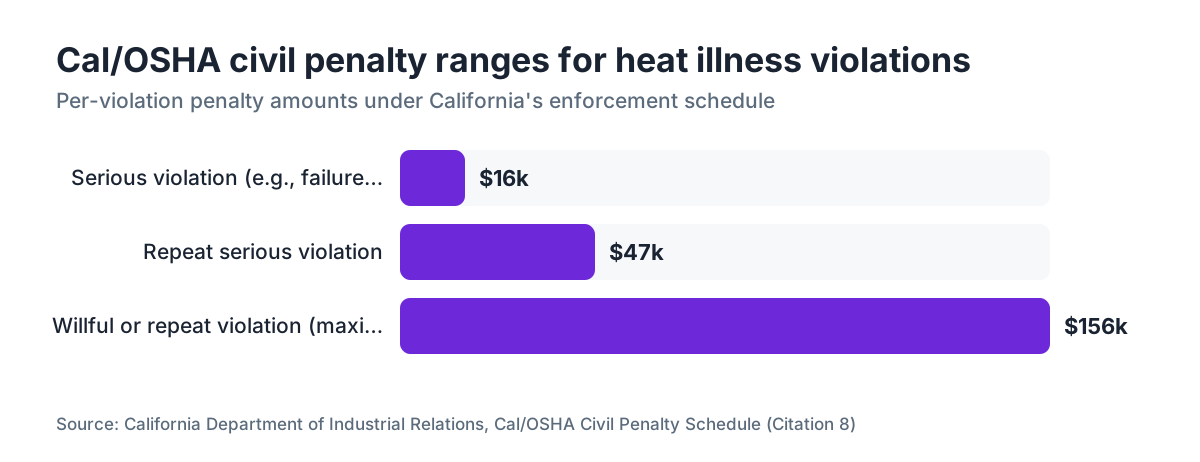
Cal/OSHA penalties for heat illness violations can reach $15,625 per serious violation [8]. Willful or repeated violations can hit $156,259. The schedule lives on Cal/OSHA's website and updates periodically. A citation for failing to provide shade to fifteen pickers on a 90°F day is not a paperwork problem. It's a financial one.
Are there differences in requirements for small vineyards or family operations?
No. California's heat illness prevention standard applies to every employer, regardless of size [1]. A two-person family operation harvesting its own estate fruit sits outside some labor rules because no employees are present. Hire one worker, including a family member who gets paid, and the standard applies.
Federal OSHA's field sanitation rule at 29 CFR 1928.110 applies to agricultural employers with eleven or more workers doing hand labor in the field [3]. Ten or fewer workers, and the federal toilet and hand-washing requirements technically don't reach you under that rule. But California's version at Title 8 CCR Section 3457 applies at any size, so California growers get no carve-out [11].
Small vineyards in non-California states with fewer than eleven hand-labor workers have the narrowest exposure under the federal field sanitation rule. The general duty clause still requires a workplace free from recognized hazards, though, and heat illness is a recognized hazard. OSHA has cited employers under the general duty clause for heat incidents even where no specific standard applied [10]. "Technically exempt" is not the same as "safe to ignore."
Run a compliant operation regardless of size. The paperwork for a ten-person crew is almost nothing. The cost of a heat stroke event is not.
How do you keep the checklist current as regulations change?
Cal/OSHA has amended Title 8 CCR 3395 several times since it took effect in 2005, most recently adding an indoor heat illness standard in 2023 [1]. The core outdoor provisions have held steady, but details move. Check the Cal/OSHA website at the start of each growing season and subscribe to its rulemaking newsletter if you operate in California.
For WPS updates, EPA's agricultural worker protection pages are the primary source [2]. WSU Extension's pesticide management resources are a reliable secondary source for western states [4]. Cornell's PALS program covers the Northeast [5].
Review your written Heat Illness Prevention Plan every January, before the season starts. Update it for changes in crew size, work locations, or supervisor contacts. Date the revision on the face of the document. If Cal/OSHA sees a plan last touched four years ago, that alone tells the inspector your program isn't actively managed.
One structural tip. Fold the annual plan review into your winter off-season list alongside equipment maintenance and spray program planning. It takes under an hour when your base document is solid. The alternative is scrambling to update it the morning an inspector rolls into your driveway during crush.
Frequently asked questions
At exactly what temperature does shade become legally required in California vineyards?
California's Title 8 CCR Section 3395 requires shade whenever ambient temperature equals or exceeds 80°F. The shade has to be in place before workers need it, not after the temperature climbs. If you're harvesting early and temps are forecast to hit 80°F by 9 a.m., shade should be accessible before work begins, not thrown up mid-morning.
How much water do I need to have on site per worker during harvest?
Both California and federal OSHA require at least one quart of drinking water per worker per hour of work. For a ten-person crew on an eight-hour shift, that's 80 quarts minimum, or about 20 gallons. On hot days, actual consumption runs higher. The water has to be suitably cool, potable, and free. A lidded cooler with ice and a spigot is the standard field solution.
Can workers use their own water bottles instead of a shared cooler?
Yes, individual water bottles satisfy the standard as long as you supply enough water to meet the one-quart-per-hour-per-worker minimum and the water is cool and potable. You're still responsible for providing the water, more than the bottles. Workers cannot be required to bring their own. Employer-provided water is a legal requirement, not a courtesy.
What is a preventive cool-down rest, and can workers be penalized for taking one?
California law requires employers to allow any worker who feels overheated to take a preventive cool-down rest of at least five minutes in shade. Workers cannot be disciplined, retaliated against, or discouraged from taking these breaks. The cool-down rest is separate from the scheduled rest breaks required under California wage law. Discouraging a cool-down rest is a direct violation of Title 8 CCR 3395.
How close does the shade area need to be to where my pickers are working?
California's standard says shade has to sit as close as practicable to where employees work. There's no exact distance in the regulation, but inspectors apply a reasonableness test. Shade in a parking area while pickers are a half-mile into a block will not pass. Most compliance consultants use within five minutes' walking distance, which mirrors the water access guideline in the WPS.
Does the heat illness standard apply to unpaid family members helping with harvest?
If no employment relationship exists, the Cal/OSHA heat illness standard technically does not apply. The moment compensation changes hands, including room and board, an employment relationship likely exists and the standard kicks in. Family members who receive any compensation for harvest work are employees under California law. When in doubt, treat everyone as a covered employee for compliance.
What is the high-heat protocol and when does it kick in?
California's high-heat protocol activates at 95°F or above. It requires a pre-shift meeting on heat illness symptoms and the day's procedures, a buddy system or equivalent so supervisors can observe all workers, regular communication check-ins, and a designated supervisor with authority to call for emergency services. The protocol lives in Title 8 CCR 3395(e) and sits on top of the baseline shade, water, and rest requirements.
How many portable toilets do I need for my harvest crew?
Both California (Title 8 CCR 3457) and federal OSHA (29 CFR 1928.110) require one toilet for every twenty workers doing hand labor. For a crew of thirty, that's two. They have to be accessible within a quarter mile or five minutes' travel of the work area and stocked with paper. Toilets must be serviced often enough to stay sanitary.
What training do supervisors need beyond what regular workers receive?
Supervisors need all the worker topics plus more: how to monitor for early signs of heat illness, what to do when a worker shows symptoms (move to shade, provide cool water, call 911 for heat stroke), the acclimatization schedule for new employees (close observation in the first 14 days), and how to run the high-heat protocol. Document this training with date, content summary, and signature.
Do EPA Worker Protection Standard requirements overlap with Cal/OSHA heat rules in the vineyard?
Yes, they overlap and both apply at once. The WPS (40 CFR Part 170) governs field sanitation specifically around pesticide exposure risk, requiring potable water, toilets, and hand-washing water within a quarter mile of workers. Cal/OSHA's heat illness and field sanitation standards apply to all outdoor agricultural work regardless of pesticide exposure. You satisfy both frameworks independently during harvest.
What are the fines for violating the heat illness prevention standard in California?
Cal/OSHA can assess up to $15,625 per serious violation and up to $156,259 per willful or repeat violation under 2024 penalty schedules. Failure to provide shade, water, or a written Heat Illness Prevention Plan are each citable as separate serious violations. A single inspection of a non-compliant harvest operation can produce multiple citations totaling tens of thousands of dollars, plus abatement costs.
How long do I need to keep heat illness prevention records?
California's heat illness standard sets no retention period, but the general OSHA inspection window and California's statute of limitations for most labor claims run three years. Keep your written Heat Illness Prevention Plan, daily field logs, training records, and incident reports for at least three years. The EPA's Worker Protection Standard requires pesticide application records for two years, a separate but related obligation.
Do the same rules apply to grape harvest in Washington and Oregon as in California?
Washington and Oregon don't have rules as specific as California's Title 8 CCR 3395, but both adopted outdoor heat illness rules through their state OSHA plans. Washington L&I's rule at WAC 296-62-095 mirrors many California provisions, with temperature triggers for shade and water requirements [9]. Oregon adopted a similar rule in 2021. WSU Extension resources cover the Washington specifics in detail.
Sources
- California Department of Industrial Relations, Cal/OSHA - Heat Illness Prevention in Outdoor Places of Employment (Title 8 CCR Section 3395): California requires shade when ambient temperature reaches 80°F, one quart of water per worker per hour, a five-minute preventive cool-down rest on request, and a high-heat protocol at 95°F including a buddy system and pre-shift meetings; joint liability applies to agricultural employers using farm labor contractors.
- U.S. EPA - Worker Protection Standard for Agricultural Pesticides (40 CFR Part 170): The EPA Worker Protection Standard requires potable water, toilet facilities, and hand-washing water within a quarter mile or five minutes' travel of workers, and pesticide application records must be retained for two years.
- U.S. Department of Labor, OSHA - Field Sanitation Standard (29 CFR 1928.110): Federal OSHA's field sanitation standard requires one quart of drinking water per worker per hour, one toilet and hand-washing facility per twenty workers, and applies to agricultural employers with eleven or more hand-labor workers in the field.
- Washington State University Extension - Pesticide Management and Worker Safety Resources: WSU Extension provides Spanish-language heat illness training resources and plain-language guides mapping federal OSHA general duty clause requirements onto vineyard and agricultural work in Washington state.
- Cornell University - Agricultural Workforce Development and Farmworker Health Programs: Cornell's agricultural workplace health and PALS programs provide heat illness prevention and Worker Protection Standard compliance training resources for northeastern agricultural employers including vineyards.
- UC Agriculture and Natural Resources (UC ANR) - Heat Illness Prevention: UC Agriculture and Natural Resources recommends retaining heat illness prevention records for at least three years and offers training materials for California agricultural operations covering heat illness symptoms, acclimatization, and field sanitation.
- U.S. Department of Labor, Employment and Training Administration - H-2A Temporary Agricultural Workers Program: H-2A program regulations govern housing and transportation standards for temporary agricultural workers; heat illness prevention during fieldwork remains governed by OSHA's general duty clause in non-Cal/OSHA states or by Title 8 CCR 3395 in California.
- California Department of Industrial Relations, Cal/OSHA - Civil Penalty Schedule: Cal/OSHA can assess up to $15,625 per serious violation and up to $156,259 per willful or repeat violation of workplace safety standards, including heat illness prevention requirements, under its published penalty schedule.
- Washington State Department of Labor and Industries - Outdoor Heat Exposure Rule (WAC 296-62-095): Washington's outdoor heat illness rule sets temperature thresholds triggering shade and water requirements, mirroring many provisions of California's Title 8 CCR 3395.
- U.S. Department of Labor, OSHA - General Duty Clause (Section 5(a)(1) of the OSH Act): OSHA's general duty clause requires employers to provide a workplace free from recognized hazards causing or likely to cause death or serious physical harm; OSHA has cited agricultural employers for heat-related hazards under this clause even in the absence of a specific heat standard.
- California Department of Industrial Relations - Title 8 CCR Section 3457 Field Sanitation: California's field sanitation standard (Title 8 CCR Section 3457) requires toilet facilities and hand-washing water for agricultural employees regardless of employer size, applying stricter coverage than the federal field sanitation rule which applies only to employers with eleven or more hand-labor workers.
- U.S. OSHA - First Aid and Medical Services (29 CFR 1910.151): OSHA's general first aid standard requires first aid materials to be reachable within a reasonable time from any worksite; Cal/OSHA guidance interprets this as within four minutes for agricultural field operations.
Last updated 2026-07-10