Agricultural water testing requirements under the FSMA produce safety rule
TL;DR
- Under FSMA's Produce Safety Rule, most covered farms must test agricultural water for generic E.
- coli.
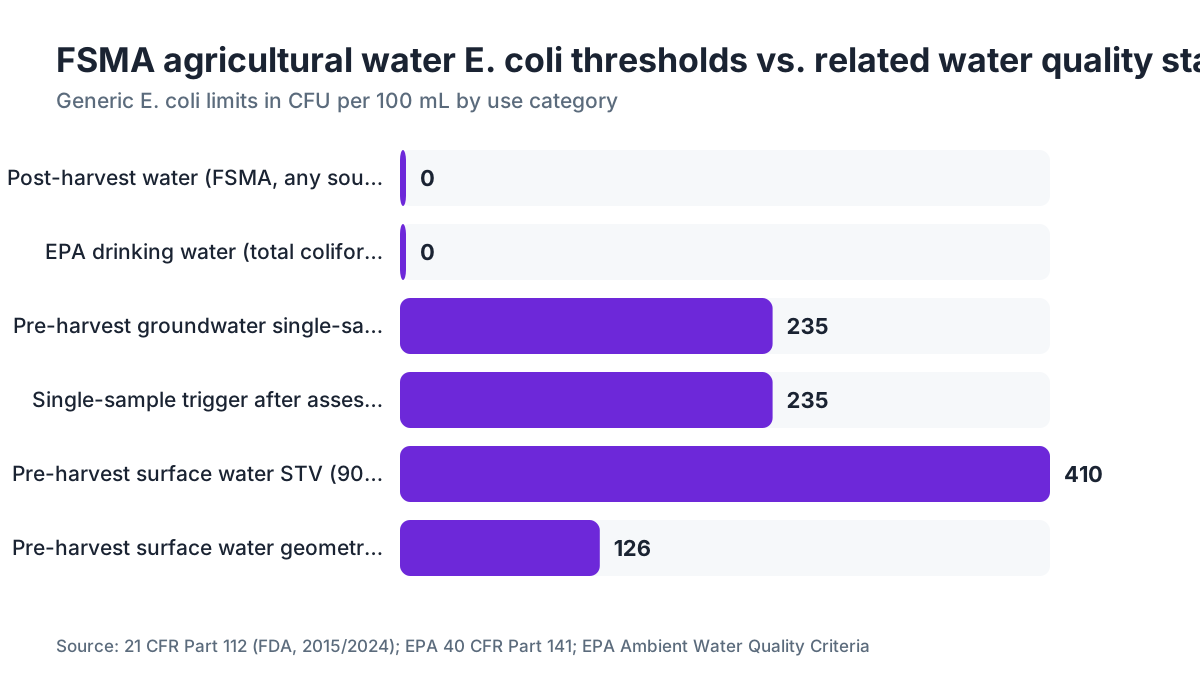
- Pre-harvest surface water requires 20 samples over 2-4 years to build a microbial profile, with a geometric mean threshold of 126 CFU/100 mL and a statistical threshold value (STV) of 410 CFU/100 mL.
- FDA's May 2024 rule replaced that numerical profile with annual system assessments for most pre-harvest water.
What is the FSMA produce safety rule and who does it cover?
The FDA Food Safety Modernization Act (FSMA) Produce Safety Rule (21 CFR Part 112) is the first federal regulation setting enforceable, science-based standards for growing, harvesting, packing, and holding produce eaten raw. FDA published the original final rule in November 2015. [1]
The rule covers farms that grow, harvest, pack, or hold covered produce and that have average annual produce sales above $25,000 (adjusted for inflation). Farms earning more than $25,000 but no more than $500,000 in produce sales count as "very small farms" and get a later compliance deadline. Farms under $25,000 in produce sales are exempt. [1]
For vineyard and winery operators, this matters if you grow table grapes or any other covered raw produce. Wine grapes are technically covered produce. But FDA has said in guidance that produce "rarely consumed raw" may qualify for an exemption under 21 CFR 112.2(a)(1), and because wine grapes go through fermentation, most winery operators treat them as rarely consumed raw. If you also grow table grapes or hand out clusters at agritourism fresh-eating events, get legal counsel before you assume an exemption applies. [2]
The biggest compliance burden for most covered farms is the agricultural water testing program. That's what the rest of this article covers.
What counts as agricultural water under FSMA?
Agricultural water is any water that contacts covered produce or food-contact surfaces during growing or harvesting. FDA splits it into two buckets with very different rules: pre-harvest water and post-harvest water. [1]
Pre-harvest water includes irrigation water applied in ways that touch the edible part of a crop, like overhead sprinklers and furrow irrigation that splashes onto leaves or fruit. It also covers water used to apply pesticides, crop protection agents, or liquid soil amendments.
Post-harvest water is water used after harvest for washing, cooling, or packing produce. This category faces stricter standards, because contamination close to consumption carries higher risk.
Water used only for activities that never touch produce (frost protection by flooding the soil between rows, say) may be excluded, but you have to document the specific use carefully. Sources matter too. Municipal water and water from a public system that meets EPA drinking water standards generally skips microbial testing if you have documentation from the utility. Groundwater from your own well usually requires testing. Surface water, including ponds, rivers, ditches, and reservoirs fed by open sources, gets the most intensive testing. [1][3]
What are the microbial thresholds for agricultural water testing?
FDA picked generic E. coli (not E. coli O157:H7 specifically) as the indicator organism for pre-harvest water testing. The logic is simple: generic E. coli is cheap and easy to measure, and elevated counts flag the kind of fecal contamination that could carry pathogens. [1]
For pre-harvest surface water, the original 2015 rule set two thresholds:
| Metric | Threshold |
|---|---|
| Geometric mean (GM) | 126 CFU/100 mL |
| Statistical threshold value (STV) | 410 CFU/100 mL |
The geometric mean comes from a dataset of at least 20 samples collected over 2 to 4 years. The STV represents the 90th percentile of the data distribution. To stay in compliance, your water profile has to meet both thresholds at once. [1]
For pre-harvest groundwater, the original rule required one sample a year per source, with a single-sample limit of 235 CFU/100 mL generic E. coli.
For post-harvest water, the standard is much stricter: no detectable generic E. coli in 100 mL. That's effectively the EPA drinking water standard for total coliforms applied to E. coli. Municipal water already meeting EPA standards satisfies this with utility documentation. [3]
These numbers trace back to EPA recreational water quality criteria, which FDA adopted as a proxy for produce safety. The science linking recreational water criteria to produce safety risk is contested. FDA acknowledged that in its own regulatory history, but concluded the criteria were the best available reference point at the time.
How did FDA's 2024 rule update change agricultural water testing?
FDA published a major revision to the agricultural water provisions in May 2024, called the "Agricultural Water Final Rule." [4] It replaced the numerical profile approach for pre-harvest water on produce other than sprouts with a new framework built on systems-based inspections and targeted microbial testing.
Here's the headline change. For pre-harvest agricultural water on most covered produce (sprouts keep the original numerical framework), farms now conduct annual pre-harvest agricultural water assessments. These assessments look at the entire water system, including the source, the distribution system, and how water contacts the crop, instead of just running a numerical E. coli profile.
FDA also added tiered testing triggers. If your assessment turns up conditions that suggest contamination risk, you test. If the assessment is clean, testing frequency can drop. The rule created an allowance for farms to use alternative testing approaches under certain conditions, with FDA approval. [4]
Compliance dates for the 2024 update depend on farm size. Very large farms (over $1 million in average annual produce sales) had compliance dates beginning in the 2025 growing season. Large farms ($250,001 to $1 million) follow in 2026. Very small farms (up to $250,000) have until 2027. These deadlines shift for farms still collecting full datasets, so check the current FDA guidance page directly, since FDA has extended deadlines before. [4]
Sprouts keep the original stricter framework. Sprout operations test each lot of irrigation water for generic E. coli and for pathogens (Salmonella and E. coli O157:H7 or other STECs). [1]
How often do you have to test agricultural water?
Testing frequency has always been one of the more confusing parts of this rule, and the 2024 revision added another layer.
Under the original framework, still applicable to sprouts and to farms working through their initial dataset:
- Surface water needs a minimum of 20 samples over 2 to 4 years to build an initial microbial profile, then at least 5 samples per year to maintain it. If any annual subset exceeds thresholds, you recalculate.
- Groundwater needs at least 1 sample per year per source.
Under the 2024 update for most pre-harvest water on non-sprout produce:
- You conduct a documented water system inspection and assessment at least once a year, before the growing season or at the start of the harvest window.
- Microbial testing happens when your assessment finds conditions that could introduce contamination risk, or when there's a known contamination event (flooding, runoff from a nearby animal operation, equipment failure).
- Testing after a concern is identified uses a single-sample result checked against a threshold of 235 CFU/100 mL generic E. coli. [4]
Post-harvest water testing works differently. FDA doesn't set a fixed testing frequency for post-harvest water from a public water system, but you must keep documentation showing the source meets standards. For well or surface water used post-harvest, the no-detectable-E.-coli standard applies, and you should test often enough to verify compliance, especially at the start of each season. University extension programs from WSU and Cornell generally recommend at least twice-seasonal testing for post-harvest well water. [5][6]
What sampling methods and labs are required?
FDA doesn't spell out a single sampling protocol in the rule text, but the agency backs the Produce Safety Alliance Grower Training curriculum through Cornell University, which covers best practices in detail. [6] The general requirements in 21 CFR Part 112 Subpart E say samples must be collected, handled, and tested in a way consistent with the nature of your water source and water use.
In practice, that means:
- Collect samples at the point of use, meaning where water contacts the crop or food-contact surfaces, rather than at the well head or main pump.
- Use sterile sampling containers. Most certified labs supply these.
- Follow the lab's chain-of-custody requirements and get samples to the lab within the hold time specified (typically 6 hours for microbial samples, though some methods allow up to 30 hours with ice cooling).
- Use a lab accredited under a recognized standard. NELAC/TNI accreditation is the most common benchmark. Your state department of agriculture may keep a list of approved labs.
Test methods matter too. FDA references EPA Method 1603 (mTEC agar, membrane filtration) and Colilert (IDEXX) as acceptable for generic E. coli. Many labs also use Colilert-18. If your lab uses something else, ask them to confirm it's EPA-accepted for drinking water or recreational water testing, since those are the methodological references FDA imported. [3]
Costs vary by region and lab, but as of 2024 a single generic E. coli test runs roughly $20 to $50 per sample at most certified labs. Collecting 20 samples over a season to build a surface water profile means $400 to $1,000 in lab fees alone, plus your labor time. That's not a big line item, but it adds up if you have several water sources.
What do you do if your water tests exceed the thresholds?
Exceeding a threshold isn't automatically a violation. It triggers a required response, and what you do next sets your compliance status. [1]
For the original numerical profile framework (pre-harvest surface water): if your annual geometric mean or STV is exceeded, you have three paths. Take a corrective action to address the contamination source, document it, and retest. Or apply a time interval between last water application and harvest, long enough to allow microbial die-off (FDA gives a calculation in Appendix A to Subpart E in 21 CFR Part 112 that factors in the degree of exceedance). Or treat the water to bring it into compliance before use.
For the 2024 framework: if a single-sample test after an identified risk exceeds 235 CFU/100 mL, you have to take corrective action before that water touches covered produce again. Acceptable actions include finding and eliminating the contamination source, switching water sources, or treating the water. Then you retest before resuming use. [4]
Water treatment options FDA recognizes include filtration, UV treatment, and chemical treatment such as chlorination. The treatment has to fit the water source and use case, and you need documentation that it works. Ask your county extension office or a certified crop advisor whether a given method suits your situation before you spend money.
FDA guidance through the Produce Safety Alliance (hosted by Cornell) walks through the corrective action documentation in detail. [6] Keep every corrective action record for at least two years. That's the minimum records retention period in 21 CFR 112.161.
What records do you need to keep for agricultural water testing?
Records are where a lot of farms fall short in FDA inspections, not the testing itself. The rule in 21 CFR Part 112 Subpart O says covered farms must keep:
- Copies of all laboratory test results for agricultural water.
- Documentation of any corrective actions taken.
- Records of water source inspections and assessments (under the 2024 rule, the annual assessment must be documented).
- Records showing that water used for post-harvest activities from a public water system meets applicable standards (usually utility bills or water quality reports from your municipality).
The minimum retention period is 2 years for most records. Records tied to longer-term processes, like the multi-year microbial profile dataset, must be kept for the life of the dataset plus 2 years. [1]
Records can be electronic. FDA inspectors can request physical copies during an inspection, so you need to print or export them on demand. Many operations run a simple spreadsheet. Others use field record systems. If you already track spray applications, equipment calibrations, and worker training in a system like VitiScribe, adding water test results to the same platform keeps everything in one place and makes inspection prep far less stressful.
You don't submit records to FDA proactively. You keep them on-farm and present them during an inspection. FDA's current inspection approach for produce safety leads with education and voluntary compliance, but that doesn't make records optional.
Does the rule apply differently to groundwater vs. surface water?
Yes, and the difference is big in practice.
Surface water (rivers, ponds, reservoirs, irrigation canals, ditches fed by open sources) gets the most intensive treatment under the rule because it's more open to fecal contamination from wildlife, livestock runoff, and flooding. Under both the original and 2024 frameworks, surface water triggers more frequent inspection, heavier testing requirements, and more conservative thresholds. [1]
Groundwater (wells, springs with verified underground sources) is generally considered lower-risk because the subsurface filters out many contaminants. Under the original framework, groundwater required only one sample per year. Under the 2024 update, groundwater is still treated more leniently, though it's included in the annual assessment requirement.
The distinction gets complicated for vineyards and farms that use a mix of sources. Drip irrigation fed by a well is different from a system that blends well water with recaptured runoff in a pond. Mixed or recirculated systems that incorporate surface water are typically treated as surface water for testing purposes.
If you draw from an irrigation district or water authority, check whether the authority provides microbial testing data. Some do, and FDA has acknowledged in guidance that farms can use supplier-provided data to satisfy some testing requirements if the documentation is adequate. UC Davis extension has published practical guidance on working with irrigation district water for produce safety compliance. [7]
How does this intersect with EPA worker protection and pesticide records?
The FSMA Produce Safety Rule and the EPA Worker Protection Standard (WPS, 40 CFR Part 170) are separate regulations run by separate agencies, but they overlap on your farm. [8] Both require record-keeping, both require water use documentation for pesticide applications, and both can trigger separate inspections.
For water used to mix pesticide applications, the FSMA agricultural water rule applies if that water contacts the edible portion of covered produce. The WPS focuses on worker exposure to pesticides, including application equipment sanitation and water for decontamination, not on produce contamination itself. But the records you keep for one often support compliance with the other.
If your state department of agriculture inspects for both WPS and FSMA produce safety in the same visit (which increasingly happens), having your water test records in order saves time. Keep water source identification (what source, GPS coordinates or a farm map reference), test dates, test results, and any corrective actions in a format you can hand to an inspector without scrambling.
The EPA's WPS also requires that mixing water for pesticide application be appropriate for the intended use. There's no explicit E. coli threshold for pesticide mixing water under WPS, but contaminated water used in applications that contact produce could create a FSMA problem. This is one of those areas where the regulations don't fully talk to each other, so document your water source for each application regardless.
Are there exemptions or qualified exemptions that might apply to your operation?
Several exemptions could take you partly or fully out of FSMA produce safety rule requirements. Whether they apply to a vineyard or small winery depends on your sales, markets, and production practices.
The qualified exemption (QE) under 21 CFR 112.5 applies to farms with average annual food sales of $500,000 or less for the previous three years AND that sell the majority of their covered produce directly to qualified end-users (consumers, or restaurants and retailers in the same state or within 275 miles). Qualified-exempt farms still must disclose their name and address on labels or at the point of sale, and they must keep modified documentation, but they're exempt from most of the rule's substantive requirements, including the water testing provisions. [1]
The "rarely consumed raw" produce exemption under 21 CFR 112.2(a)(1) could apply to wine grapes, as noted earlier. This exemption is self-determined, meaning FDA doesn't pre-approve it, but you should document your reasoning.
Farms that grow only produce commercially processed to kill pathogens (a "kill step") can also be exempt if they have a written disclosure from the processor. [1]
Small and very small farms have extended compliance deadlines but are not exempt from eventual compliance with most provisions. FDA's farm size categories use a three-year average of produce sales (not total farm revenue), a detail that trips up a lot of mixed operations.
WSU Extension has published a decision tree for Washington growers to work through which exemption, if any, fits their operation. [9] UC Davis has similar resources for California growers. [7] These are worth downloading before you call an attorney, because they'll help you frame the right questions.
What practical steps should you take now to get into compliance?
If you haven't started, step one is figuring out whether you're covered. Use FDA's FSMA Produce Safety Rule coverage self-assessment or your state extension decision tree.
If you're covered, map every agricultural water source on your farm. List the source type (municipal, well, surface, irrigation district), what it's used for (pre-harvest irrigation, pesticide mixing, post-harvest washing), and whether it contacts the edible portion of covered produce. That map is the foundation of your annual assessment under the 2024 rule.
Find a NELAC/TNI-accredited lab near you and ask for their sampling instructions, sample containers, hold time requirements, and turnaround time for generic E. coli results. Schedule your first samples to reach the lab at least two weeks before you start irrigation or first water contact with covered produce.
Take the Produce Safety Alliance Grower Training if you haven't already. At least one person per covered farm has to complete it under 21 CFR 112.22(c), and it covers the water testing requirements in practical detail. Cornell hosts the curriculum and keeps a list of trainers by state. [6]
Build a records system now, even a simple folder on your computer with subfolders for each water source, each year, and each corrective action. If your operation already tracks vineyard field records in software (applications, equipment, certifications), see whether adding a water testing log there makes sense. VitiScribe, for example, lets operators log compliance records alongside spray applications and field observations, which keeps inspection-ready documentation from getting scattered across paper binders, email attachments, and random spreadsheets.
Last, know your state's lead agency. Most states have a designated Produce Safety Regulatory Authority that handles FDA FSMA inspections under a cooperative agreement. In California it's CDFA, in Washington it's WSDA, in New York it's NYSDAM. Your state agency will have guidance that supplements FDA's federal requirements, and first inspections in most states are educational visits. [10]
Frequently asked questions
Do wine grapes have to comply with FSMA agricultural water testing?
Most wine grape operations treat wine grapes as 'rarely consumed raw' under 21 CFR 112.2(a)(1), which exempts them from the produce safety rule. FDA has not explicitly excluded wine grapes in rule text, so if you make any fresh-eating claims (agritourism tasting events, on-site sampling), document your reasoning for the exemption carefully or consult an attorney. Table grapes are covered.
What is the geometric mean threshold for pre-harvest surface water under FSMA?
The geometric mean threshold for generic E. coli in pre-harvest agricultural surface water is 126 CFU/100 mL, calculated from a dataset of at least 20 samples collected over 2 to 4 growing seasons. This threshold, along with the statistical threshold value of 410 CFU/100 mL, comes directly from 21 CFR Part 112 Subpart E and mirrors EPA recreational water quality criteria.
How many water samples do I need to collect to build a surface water profile?
Under the original FSMA framework (still applicable to sprouts and farms building initial datasets), you need at least 20 samples from each surface water source collected over 2 to 4 years. After establishing the profile, you must collect at least 5 samples per year to maintain it. Each sample must be taken during the growing season when water contacts covered produce, per 21 CFR Part 112.
Can I use municipal water without testing it?
Yes, if the municipal or public water system provides documentation showing it meets EPA National Primary Drinking Water Regulations (40 CFR Part 141). You must keep that documentation on file. You don't need to conduct your own microbial testing if the utility documentation is current and covers the period of use. This applies to both pre-harvest and post-harvest uses of municipal water.
What changed in the FDA 2024 agricultural water update?
The May 2024 update replaced the numerical microbial profile requirement for most pre-harvest water (excluding sprout operations) with an annual systems-based inspection and assessment. Testing is now triggered by findings from that assessment rather than required on a fixed schedule. A single-sample threshold of 235 CFU/100 mL applies when testing is triggered. Compliance dates for very large, large, and very small farms are 2025, 2026, and 2027 respectively.
How long do I need to keep agricultural water test records?
The minimum records retention period under 21 CFR 112.161 is two years for most agricultural water records including lab test results, corrective action documentation, and inspection records. Multi-year microbial profile datasets must be kept for the life of the profile plus two years. Records can be electronic but must be producible in hard copy during an FDA or state inspection.
What lab method should I use to test for generic E. coli in irrigation water?
FDA references EPA Method 1603 (membrane filtration with mTEC agar) and IDEXX Colilert or Colilert-18 as acceptable methods for generic E. coli in agricultural water. Use a lab with NELAC/TNI accreditation. Collect samples in sterile containers supplied by the lab, transport on ice, and deliver within the lab's specified hold time, typically 6 to 30 hours depending on the method.
What do I do if my water test result exceeds the FSMA threshold?
An exceedance triggers required corrective action, not an automatic violation. You must identify and address the contamination source, document the action taken, and retest before using that water on covered produce again. Alternatively, you can apply a harvest interval calculated using FDA's die-off formula in 21 CFR Part 112 Appendix A, or treat the water to bring it into compliance. Keep all documentation.
Is my farm exempt from FSMA produce safety if my sales are under $25,000?
Yes. Farms with average annual produce sales of $25,000 or less (inflation-adjusted from 2011 dollars) are exempt from the FSMA Produce Safety Rule including the agricultural water testing provisions, per 21 CFR 112.4. The calculation uses only produce sales, not total farm revenue. Keep documentation of your sales average in case your status is questioned during an inspection.
Does FSMA require water testing for the water I use to mix pesticides?
If the pesticide application contacts the edible portion of covered produce, the water used for mixing is considered agricultural water under FSMA and is subject to the testing requirements. Water used only for applications that don't contact edible portions (soil-incorporated applications, for example) may be excluded, but the exclusion requires clear documentation of the specific use at the time of application.
What is the Produce Safety Alliance and where do I find their grower training?
The Produce Safety Alliance (PSA) is a collaboration between Cornell University and FDA that developed standardized FSMA grower training. The curriculum covers agricultural water testing in detail. At least one responsible party per covered farm must complete PSA training, per 21 CFR 112.22(c). Cornell hosts a trainer directory and training schedule at producesafetyalliance.cornell.edu.
Do irrigation district water sources need to be tested by the farm?
Sometimes you can use water quality data provided by the irrigation district itself, but only if the documentation covers the point of use on your farm and meets FDA's requirements for the relevant source type. Surface water from an irrigation district is still treated as surface water for testing purposes unless the district treats it to drinking water standards and provides documentation. UC Davis extension has guidance on irrigation district water for California growers.
Who inspects farms for FSMA produce safety compliance?
Most inspections are conducted by state departments of agriculture operating under cooperative agreements with FDA. In California, CDFA handles inspections. In Washington, it's WSDA. In New York, it's NYSDAM. FDA conducts some inspections directly, particularly for larger operations or when a foodborne illness event triggers follow-up. Most initial inspections are educational in nature, focusing on helping farms understand requirements rather than issuing citations.
How does the FSMA water testing rule interact with EPA Worker Protection Standard water requirements?
The EPA WPS (40 CFR Part 170) and FSMA produce safety rule are separate regulations. WPS focuses on worker exposure and requires water for decontamination stations meet certain standards. FSMA focuses on produce contamination. Water used for pesticide mixing that contacts covered produce falls under FSMA water rules. Keep records of your water source for each application to satisfy both programs simultaneously.
Sources
- FDA, Standards for the Growing, Harvesting, Packing, and Holding of Produce for Human Consumption (21 CFR Part 112): Core rule text: thresholds (GM 126 CFU/100 mL, STV 410 CFU/100 mL), 20-sample requirement, records retention of 2 years, qualified exemption parameters, rarely-consumed-raw exemption, trainer requirement at 112.22(c)
- EPA, National Primary Drinking Water Regulations (40 CFR Part 141): EPA drinking water standards that municipal water must meet to satisfy FSMA post-harvest water documentation requirements; no detectable E. coli threshold
- FDA, Agricultural Water Final Rule (May 2024), Federal Register Vol. 89: 2024 update replacing numerical microbial profile with annual assessment framework for pre-harvest water; single-sample 235 CFU/100 mL trigger threshold; compliance dates 2025/2026/2027 by farm size
- Washington State University Extension, FSMA Produce Safety Resources: WSU Extension recommendation for at least twice-seasonal testing of post-harvest well water and decision tree resources for Washington growers on exemption status
- Cornell University, Produce Safety Alliance Grower Training Curriculum: PSA curriculum covering agricultural water testing in detail; FDA-required trainer directory; at least one responsible party per covered farm must complete PSA training per 21 CFR 112.22(c)
- UC Davis, California Cooperative Extension, FSMA Produce Safety Resources: UC Davis extension guidance on working with irrigation district water for produce safety compliance; California-specific FSMA resources for growers
- EPA, Worker Protection Standard for Agricultural Pesticides (40 CFR Part 170): EPA Worker Protection Standard requirements for water used in pesticide applications and worker decontamination; separate from FSMA but overlapping on-farm
- WSU Extension, FSMA Produce Safety Rule Exemption Decision Tool: Decision tree published by WSU Extension to help Washington growers determine which FSMA exemptions apply to their operation
Last updated 2026-07-10