How to document a grape purchase agreement amendment mid-season

TL;DR
- A mid-season grape purchase agreement amendment needs a written addendum that names the original contract by date and parties, states exactly what changes (price, tonnage, delivery timing, quality specs), gets both signatures before the change takes effect, and stays filed with the original.
- Verbal adjustments made under harvest pressure cause most post-crush payment disputes.
Why do grape purchase agreements need mid-season amendments?
Grape purchase agreements get signed months before harvest, sometimes during dormancy. A lot changes between February and September. Frost, mildew pressure, or an irrigation cutback shifts the crop. Quality specs that read fine in spring look wrong when a heat spike compresses the ripening window. Fuel and labor costs move. The buyer's tank space disappears because another block came in heavy.
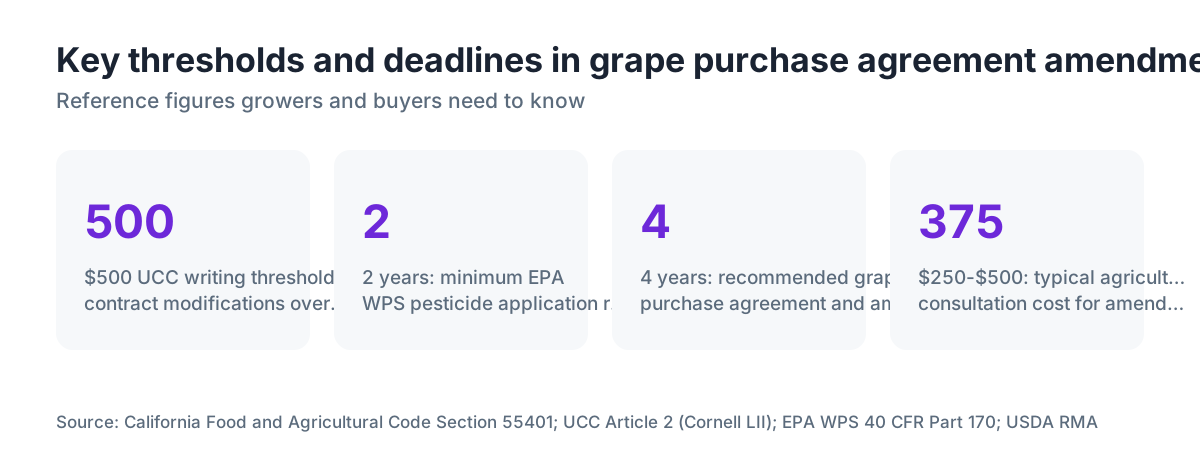
The agreement you signed in spring was a forecast, not a promise. Both parties know that. But "we'll figure it out at harvest" is not a legal position. Without a documented amendment, you're relying on an oral modification to a written contract, and courts in most wine states treat that with real skepticism. California's statute of frauds requires modifications to contracts for the sale of goods over $500 to be in writing [1]. Washington and Oregon have parallel provisions under their versions of the Uniform Commercial Code [2]. The grapes are worth far more than $500. The oral deal may not hold.
There's a second reason to document carefully. Your accountant, your crop insurance adjuster, and any lender holding a crop lien all need a paper trail that matches what actually happened. An amendment nobody wrote down is an audit problem waiting to surface.
What should a grape purchase agreement amendment include?
A valid amendment doesn't have to be long. It has to be complete. Here's the minimum.
First, identify the original contract. Name both parties exactly as they appear in the original, the date the original was signed, and the block or vineyard it covers. Something like: "This addendum modifies the Grape Purchase Agreement dated April 14, 2025 between [Grower Name], hereafter Grower, and [Winery Name], hereafter Buyer."
Second, state exactly what changes. Don't write "price adjusted to reflect market conditions." Write: "Section 4.2 of the original agreement is amended to change the purchase price from $2,400 per ton to $2,650 per ton for all Cabernet Sauvignon fruit delivered from Block 7." Vague language is where disputes start.
Third, state what is NOT changing. One sentence does real work here: "All other terms and conditions of the original agreement remain in full force and effect." That closes the argument that a price change somehow reopened the delivery schedule or payment terms.
Fourth, set the effective date. Is the amendment retroactive to a crop inspection on a specific date? Does it apply only to tonnage harvested after a certain day? Say so.
Fifth, get both signatures, with printed names, titles, and dates. If a party is a business entity, the signer needs authority to bind the entity. Electronic signatures are valid in California under the Uniform Electronic Transactions Act [3] and in most other states, so DocuSign or a similar platform is fine.
When the amendment touches quality thresholds, Brix targets, or defect tolerance, attach the new spec sheet as Exhibit A and reference it in the body. Don't describe a Brix range in contract prose. Attach the table.
What are the most common reasons growers and wineries amend agreements mid-season?
Price is the most common trigger. Spot market prices in most regions move hard between contract signing and harvest. The 2022 and 2023 California bulk wine swings showed how fast that happens. Growers holding fixed-price contracts from early 2022 found themselves well below spot by harvest, and buyers on the other side of the 2023 oversupply held contracts above market. Neither side enjoyed it. If both parties want to keep the relationship, a price amendment beats either one walking away.
Tonnage adjustments come second. A block projected at 4 tons per acre might come in at 2.5 after a dry spring. The winery contracted for volume it can't get, or the grower has more fruit than the buyer can take. An amendment that resets the contracted tonnage range, or explicitly releases the buyer from taking above a set tonnage, is far cleaner than a side conversation.
Delivery timing changes hit constantly during compressed harvests. A heat event pushes a block to optimal Brix four days early, the crush pad is full, and both parties need the agreed delay or the alternate pickup date in writing.
Quality spec changes are less common and higher stakes. Relaxing a defect tolerance or moving the Brix minimum needs to be in writing with real care, because it drives what the grower gets paid and whether fruit can be rejected at the scale.
Some amendments handle force majeure: smoke taint from a nearby wildfire, a water curtailment that forces an early pick, a disease outbreak. Those are harder to negotiate and more important to document, because they often involve partial crop abandonment or price cuts with contested causation.
What is the right format: a formal addendum, a letter agreement, or an email exchange?
A formal addendum titled something like "First Amendment to Grape Purchase Agreement" is the strongest option. It reads like a contract, it looks like a contract, and nobody argues about whether it was meant to change anything.
A letter agreement signed by both parties is nearly as good. Reference the original contract in the first paragraph and use the same structure: what changes, what stays, effective date, signatures.
An email exchange is the weakest form. Some courts have found that a clear email exchange with explicit agreement on terms can bind a modification [4], but the case law is spotty and fact-specific. If you're going to rely on email, have one party send a summary that says "This email confirms our agreement to amend the April 14 contract as follows: [specific terms]," and have the other party reply with explicit written agreement. Not "sounds good." Save those emails in a folder labeled with the contract date and the counterparty name.
A PDF addendum run through a free e-signature platform takes about ten minutes to prepare and gives you a timestamped, audit-quality record. Given what an acre of premium Napa or Paso Robles fruit is worth, ten minutes is cheap insurance. One disputed ton at $3,000 dwarfs the cost of a clean amendment.
Growers juggling multiple buyers or blocks save more time with a simple template they fill in each time. Cornell's viticulture and enology program publishes guidance on grape purchase agreement structure that works as a starting point [5].
How do you track amendments alongside your original agreement?
Paper in a filing cabinet works, but it fails in predictable ways: documents get misfiled, one party holds a version the other doesn't, or the amendment turns up and the original doesn't. The practical standard now is a single PDF holding the original agreement followed by each amendment in chronological order. Some growers call it a consolidated agreement and update it after each signature.
If you run vineyard management software, your agreement records belong in the same system as your spray records and harvest logs, not in an email folder nobody opens. VitiScribe is one tool built for vineyard record-keeping that lets you attach contract documents to block-level records, so the agreement and the harvest data for that block sit together when you need them at year-end.
Whatever your system, keep a version-control habit. Name files with dates: "GPA_BlockSeven_2025_Original.pdf", "GPA_BlockSeven_2025_Amendment1_20250808.pdf". Never overwrite the original. If your buyer shows up with a different version, you want the full history ready.
One more thing: tell your accountant. A price-per-ton change moves your projected revenue and can shift your estimated tax. A price finalized in August has a September 15 estimated tax deadline right behind it.
When does an amendment need an attorney to review it?
Most straightforward price or tonnage amendments don't need legal review when both parties understand the terms and the relationship is solid. A clean addendum that changes one number in one section is not a complex document.
Get an attorney involved on force majeure claims. These get genuinely contested in agriculture, and how you document the triggering event matters a lot. Wildfire smoke, frost, and drought-driven water curtailments have all landed in litigation [6], and an attorney who handles agricultural contracts can tell you whether your state's case law leans toward growers or buyers.
Bring in a lawyer if the amendment cuts total contract value by a large amount, if one party is claiming the other caused the crop loss or quality problem, or if the original agreement had an arbitration or mediation clause and you're unsure whether the price amendment touches its scope.
A one-hour agricultural attorney consult in most wine regions runs roughly $250 to $500. Real money, but a fraction of what a collections fight or arbitration over a $30,000 load costs.
How do amendment documentation requirements differ by state?
California, Oregon, Washington, and New York are where this question comes up most.
California's Food and Agricultural Code (Section 55401 et seq.) requires grape purchase agreements to be in writing and signed by both parties [7]. The code doesn't address amendments directly, but the same writing requirement follows from the statute of frauds for goods contracts over $500 [1]. California also runs the Grape Crush Report through CDFA, so your final contracted tonnage and price become reported data, and any amendment that changes those figures needs to be in your records when the report is due [12].
Washington's Agricultural Commodity Dealer statute covers grape buyers holding dealer licenses, and WSU Extension publishes resources on grower rights under these agreements [8]. Washington's UCC (RCW Title 62A) requires written modifications to goods contracts over $500 [2].
Oregon is similar. The Oregon Department of Agriculture's commodity dealer regulations set record-keeping requirements that effectively mean any price or tonnage amendment needs a paper trail.
New York's framework is less prescriptive at the state level, but Cornell Cooperative Extension recommends written amendments as standard practice for every grape purchase agreement modification [5].
Here's the quick comparison:
| State | Writing required for contract? | UCC writing req. for modification? | Grape-specific statute? |
|---|---|---|---|
| California | Yes (CFAC 55401) | Yes (>$500) | Yes |
| Washington | Yes (dealer license rules) | Yes (RCW 62A) | Partial |
| Oregon | Yes (ODA dealer rules) | Yes | Partial |
| New York | Best practice per Cornell | Yes | No |
No matter the state, a written amendment is the defensible position. The only variable is how much legal pressure you face if you skip it.
What happens if one party signed but the other didn't before fruit was delivered?
This happens more than anyone admits. Harvest moves fast, and fruit gets picked and delivered on amended terms that were discussed but never fully executed. Courts generally look at two things: whether there was a meeting of the minds on the new terms, and whether the parties behaved consistently with them.
If the buyer paid at the amended price and the grower accepted that payment, a court may find the amendment enforceable even without a signed document. That's a bet both parties are making. If the buyer paid at the old price and claims the amendment was never finalized, the grower has a harder road.
The practical answer: don't deliver fruit on unexecuted amended terms. If the amendment isn't signed and harvest timing is pushing you, send a text or email that says, explicitly, "We are delivering this fruit under the terms discussed on [date], including price of $X per ton, and request you confirm in writing before or at the time of delivery." Not perfect, but it creates a record.
Some growers now keep simple fillable PDF forms for exactly this, ones they can send from a phone and get signed before the truck leaves the vineyard.
How should you document changes to spray or chemical use requirements in an amendment?
Some grape purchase agreements spell out permitted pesticides, pre-harvest intervals (PHIs), and organic or sustainable certification requirements. These carry weight for compliance, and a mid-season change here reaches past the contract itself.
If a buyer's amendment tells the grower to add or drop a specific spray treatment, that change has to line up with current pesticide label requirements and EPA Worker Protection Standard rules [9]. The WPS requires pesticide application records to be kept for at least two years [9], and those records need to match your spray logs. If your amendment says you'll switch to a specific chemistry at the buyer's request, document both the amendment and the matching spray-record change.
For buyers requiring certified organic fruit, an amendment that tries to change organic status mid-season is more than a contract question. It's a certifier question. Any spray applied to certified organic fruit, even at a buyer's request, can decertify the crop if it's not on the approved materials list. Get your certifier involved before you sign anything that touches spray protocol.
WSU Extension's integrated pest management resources for wine grapes cover PHI compliance and record-keeping that apply directly here [8].
If you keep this in a vineyard records system, link the amendment to the spray-log entries for the affected block. An auditor reviewing your WPS compliance or organic certification records wants those records to agree with each other.
What's a realistic timeline for getting an amendment executed mid-harvest?
This is the honest operational question. In theory you discuss the change, draft the amendment, send it, get it signed, and file it. In practice, one party is driving a tractor at 6 AM and the other is cleaning tanks at midnight.
Here's a timeline that actually works for a straightforward price or tonnage amendment:
Day 1: One party spots the need and sends a short email or text with the proposed change. Not a formal document, just: "We think we need to move the Block 7 price to $2,650 per ton because of reduced tonnage. Do you agree in principle?"
Day 2: The other party responds with any counterproposal. Both reach verbal agreement.
Day 2 or 3: One party drafts the written amendment. Fifteen to thirty minutes from a template. Sends it with an e-signature request.
Day 3 or 4: Both parties sign electronically. Filed.
Total: under four days, and most of that is waiting for the other party to check email. Delivering in 10 days? You have room. Delivering in 48 hours? You're tight, but an e-signature platform like DocuSign or HelloSign can close it in hours.
The mistake most growers make is treating the amendment as an after-harvest chore. By then both parties have moved on, memories differ on what got agreed, and the relationship is strained. Do it before the fruit moves.
Are there amendment documentation templates or resources growers can use?
Yes, several good starting points exist.
UC Davis's viticulture and enology extension publishes grape growing and winery business resources that include contract guidance [6]. Their agricultural economics group also puts out business and contract material for California operations [10]. Neither publishes a fill-in amendment form specifically, but both give you the frame.
Cornell Cooperative Extension's viticulture resources include materials on grower-winery relationships and contract terms [5]. Cornell's New York State Agricultural Experiment Station has produced plain-language material on what grape purchase agreements should contain.
WSU Extension's wine grape publications address commercial relationships between growers and wineries in Washington's context [8].
For an actual template, the most useful move is to take your original agreement, find the section numbers that change, and build a short addendum around them. A one-page price amendment has four parts: recitals (who the parties are, what the original contract is), the operative change ("Section X is amended to read: ..."), the savings clause (all other terms unchanged), and signature blocks. Any paralegal or legal template service can produce that in under an hour.
To keep everything in one place, a vineyard operations platform like VitiScribe stores signed amendments next to your spray records and block data, so the compliance file for each block is complete in one spot when you need it for an audit or a dispute.
Frequently asked questions
Can a verbal agreement count as a valid grape purchase agreement amendment?
Usually no. California's Food and Agricultural Code requires grape purchase agreements to be in writing, and UCC provisions in most states require written modifications to goods contracts over $500. A verbal amendment may carry no legal force. Courts sometimes look at how the parties actually behaved after the verbal change, but relying on that is a gamble. Put it in writing before fruit is delivered.
Does a grape purchase agreement amendment need to be notarized?
No. Standard grape purchase agreement amendments don't require notarization. Signatures from both parties, with printed names, titles, and dates, are enough. Electronic signatures through platforms like DocuSign are valid under the Uniform Electronic Transactions Act, adopted in California, Washington, Oregon, New York, and most other states. Notarization is for recorded instruments like deeds, not commercial contracts.
What if the winery refuses to sign an amendment but verbally agreed to a price change?
Document your version immediately. Send a written summary to the winery by email or certified letter stating the date and terms of the verbal agreement and asking them to confirm or correct within a set period. Keep delivery receipts. If the winery accepts delivery at the amended price without objection, that may count as implied acceptance. Consult an agricultural attorney before delivering fruit if there's a dispute.
How do I amend a tonnage range in a grape purchase agreement mid-season?
State the original contracted range and the new range explicitly: "Section 3.1 is amended to change the estimated tonnage from 40-50 tons to 28-35 tons for the 2025 harvest season." Say whether the change affects the buyer's obligation to purchase, the grower's obligation to deliver, or both. If the reduction affects payment minimums, address that in the same amendment rather than leaving it to implication.
Can I use email to amend a grape purchase agreement?
An email exchange can satisfy the writing requirement in some circumstances, but it's the weakest form of documentation. To work, the email must state the amended terms clearly and get an explicit written response confirming agreement. A vague reply doesn't cut it. A formal addendum sent by email and signed electronically is far better practice and takes almost the same amount of time.
What records do I need to keep with a grape purchase agreement amendment for California compliance?
Under California Food and Agricultural Code Section 55401 et seq., the written agreement itself is the core document. Keep the signed original, all amendments, and any quality inspection records or Brix reports the contract references. CDFA's Grape Crush Report reflects final contracted tonnage and price, so your amendment needs to match what you report. Retain records for at least four years as a best practice.
How does smoke taint affect a grape purchase agreement mid-season, and how do I document it?
Smoke taint from wildfires falls into force majeure territory. If your buyer wants to reject or discount smoke-affected fruit, document it as a written amendment that references specific test results or inspection reports, states the agreed adjusted price or rejection terms, and specifies who paid for testing. Don't accept a verbal rejection or reduction. Smoke taint disputes have driven significant litigation in California.
Does amending a grape contract affect my crop insurance payout?
It can. If your USDA Risk Management Agency policy covers revenue or price, the insurable value usually rests on your contracted price. A mid-season amendment that changes the price should go to your crop insurance agent promptly. Some policies require notice of material contract changes within a set window. Check your policy documents and call your agent before signing an amendment that changes value significantly.
What is the difference between an amendment and an addendum to a grape purchase agreement?
In common usage, an amendment modifies existing contract language and an addendum adds new terms the original didn't cover. In practice, lawyers and growers use both words interchangeably for mid-season changes. What matters is that the document clearly identifies the original contract, specifies what changes, confirms everything else stays the same, and is signed by both parties. The title matters less than the content.
How many amendments can a grape purchase agreement have in a single season?
There's no legal limit. If you need three in one season (tonnage in June, price in August, delivery timing in September), number them: First Amendment, Second Amendment, Third Amendment. Each one should confirm that all prior amendments stay in effect except as modified. After harvest, it's good practice to build a single consolidated document with all amendments appended in order.
Do I need to notify CDFA or any state agency when I amend a grape purchase agreement?
California does not require direct notice to CDFA when you amend a contract, but your final Grape Crush Report must reflect the actual contracted price and tonnage, which should match your final executed amendment. Washington's agricultural commodity dealer rules require licensed dealers to keep accurate contract records but don't require amendment-by-amendment reporting. Check with your state department of agriculture if you're unsure about reporting in your state.
What should a grower do if a buyer sends an amendment they don't agree with?
Don't sign under pressure. Send a written response (email is fine) saying you received the proposed amendment, that you do not agree with the current terms, and that you want to discuss specific points. Counter-propose in writing. If negotiations fail, you're still operating under the original agreement. Consult an agricultural attorney before any deadline if the stakes are significant. Never sign an amendment you don't understand.
How do organic certification requirements change when amending spray protocol in a grape contract?
A contract amendment cannot override your organic certification requirements. If a buyer requests a spray change involving a non-approved material under your program, that request cannot legally be honored without decertifying the fruit. Any amendment touching spray protocol needs review against your certifier's approved materials list and your certification agreement. Notify your certifier of any material change to your production practices during the certification period.
Is there a standard template for a grape purchase agreement amendment?
No single industry-standard template exists. UC Davis, Cornell Cooperative Extension, and WSU Extension publish general guidance on grape purchase agreement structure. The practical approach is to use your original contract's section numbering as the scaffold, write the amendment to reference those sections, add a savings clause, and attach a signature block. A one-page amendment for a simple price change is entirely adequate.
Sources
- California Legislative Information, Commercial Code Section 2209: California's UCC statute of frauds requires that modifications to contracts for goods over $500 be in writing to be enforceable.
- Washington State Legislature, RCW Title 62A (Uniform Commercial Code): Washington's UCC provisions require written modifications to contracts for goods over $500.
- California Legislative Information, Civil Code Section 1633.1 (Uniform Electronic Transactions Act): California's UETA validates electronic signatures as legally equivalent to handwritten signatures for commercial contracts.
- Cornell Law School Legal Information Institute, UCC Article 2: Under UCC Article 2, an email exchange may satisfy the writing requirement for a modification if it clearly states the amended terms and both parties confirm agreement.
- Cornell Cooperative Extension, Viticulture and Enology Resources: Cornell's viticulture extension program publishes guidance on grape purchase agreement structures and grower-winery contract terms.
- UC Davis Department of Viticulture and Enology: UC Davis viticulture and enology extension covers grape growing and winery business resources including contract guidance for California growers.
- California Legislative Information, Food and Agricultural Code Section 55401: California Food and Agricultural Code Section 55401 et seq. requires grape purchase agreements to be in writing and signed by both parties.
- Washington State University Extension, Wine Grape Publications: WSU Extension publishes resources on commercial grower-winery relationships, agricultural commodity dealer rules, and integrated pest management for wine grapes in Washington.
- U.S. Environmental Protection Agency, Agricultural Worker Protection Standard: The EPA Worker Protection Standard (40 CFR Part 170) requires pesticide application records to be maintained for at least two years.
- UC Davis Agricultural and Resource Economics, Viticulture Extension: UC Davis agricultural and resource economics department provides business and contract resources for California viticulture operations.
- USDA Risk Management Agency, Crop Insurance Policies: USDA RMA crop insurance policies covering revenue or price may require notification of material changes to underlying contracts; insurable value is often tied to contracted price.
- California Department of Food and Agriculture, Grape Crush Report: CDFA's annual Grape Crush Report requires reporting of final contracted tonnage and price, which must be consistent with executed amendments to grape purchase agreements.
Last updated 2026-07-11