How to document a spray restriction required by a winery purchase agreement

TL;DR
- A winery purchase agreement that bans or limits certain pesticides has to show up in three places: your written spray program, your individual application records, and a dated pre-season communication file.
- That setup proves contract compliance, survives a harvest audit, and satisfies EPA Worker Protection Standard recordkeeping at the same time.
- Building it takes one afternoon.
What exactly is a winery-required spray restriction, and where does it live in a purchase agreement?
A winery-required spray restriction is a contract clause, usually sitting in the grape purchase agreement (GPA) or a viticulture addendum, that tells you which pesticides you can't use, which need pre-approval, or which trigger a waiting period longer than the label's pre-harvest interval (PHI). It is not a label requirement. It is not a state regulation. It is a private contract term, and that difference drives everything about how you document it.
These clauses usually read something like "Grower shall not apply any pesticide not listed on Winery's Approved Chemical List, a current copy of which is attached as Exhibit A." Some buyers push further: maximum residue limits (MRLs) tied to export markets, a flat ban on specific active ingredients regardless of label status, or a 30-to-60-day pre-harvest notification window for any foliar spray.
The restriction lives in the contract, but the version you sign each season often points to an Exhibit or a separately kept approved-chemical list that changes annually. Pull both. If your winery rep emails you a revised list in March, print it, date it, and staple it to your GPA copy. Oral updates don't survive an audit.
This sits separate from your state pesticide application records and your EPA Worker Protection Standard [1] obligations, but it has to coexist with them. You'll end up keeping one record that satisfies all three. You just have to design it that way on purpose.
Why does this need its own documentation system rather than a note in the spray log?
A single line in the spray log like "restricted per winery" feels like enough. It isn't. Three reasons.
The spray log proves what you applied, not what you were told not to apply. If an auditor or the winery's quality manager wants to confirm you honored a ban on chlorpyrifos or a specific fungicide, they need to see the source of that restriction, more than its absence from your records. Absence of a record is not proof of compliance.
Winery contracts change. The 2022 approved-chemical list may look nothing like the 2025 one. If you ever end up arguing over whether a compound was restricted in a specific vintage, your only defense is a dated copy of the contract and the exhibit that was in force during that growing season.
Many hands touch your records. Applicators, farm managers, agronomists, harvest crews. They all need to know the restriction exists before a decision, not after. A note buried in the spray log is invisible to the person making a purchase recommendation in January.
For vineyards selling to wineries with premium or export programs, like those at Paso Robles wineries or South Coast Winery operations with international distribution, MRL compliance can mean residue testing at harvest. Your documentation is the legal backstop if a lot gets rejected.
What records do you actually need to create and maintain?
You need four distinct record components. They can live in paper binders, a spreadsheet, or a purpose-built platform, but they have to be four separate, findable things.
1. The contract file. A dated copy of the signed GPA and every exhibit or addendum that names restricted compounds, approved lists, or PHI changes. If the winery issues an annual updated list, the file gets a new dated copy each season. Keep these at least three years, which matches California's requirement for pesticide application records [2] and clears the EPA WPS two-year floor [1].
2. The restricted-substance master list. A one-page (or one-tab) document you pull straight from the contract, listing every prohibited or pre-approval-required active ingredient by common name and EPA registration number where you can find it. Update it before the first spray decision each season. This is the sheet your applicators actually reference.
3. The spray program annotation. Your seasonal program, whether that's a written IPM plan or a block-by-block schedule, needs a flagged section noting that Block X or the whole ranch is under winery contract restrictions, with a pointer to the master list. That puts the constraint upstream of any application decision.
4. The spray application record itself. Every state requires records for restricted-use pesticides, and most require them for all pesticides [3]. California's Pesticide Use Report, New York's DEC records, and Washington's WSDA requirements all share a common core: date, location, applicator, product, rate, and target pest [4]. Add one field: "Contract restriction status: compliant / pre-approved / N/A" plus the name of the winery contract in force. That single field turns a regulatory record into a contract compliance record at the same time.
Managing multiple blocks under different buyer contracts gets error-prone fast. A tool like VitiScribe can assign contract restrictions at the block level so the right approved-chemical list fires when you log a spray event. That kills the most common mistake: applying a correct-for-one-buyer compound to a block sold to a stricter buyer.
How do you structure the spray log entry itself for a restricted compound?
A spray log entry on a contract-restricted block needs a handful of fields beyond whatever your state mandates. Here's a practical field list.
| Field | What to record | Example |
|---|---|---|
| Application date | Date spray was applied | 2025-06-14 |
| Block/APN | Legal parcel or named block | Hillside Block 3, APN 012-345-678 |
| Applicator name + cert number | Required by most states [3] | Jane Doe, CA QAL 12345 |
| Product name + EPA reg number | From the label | Manzate Pro-Stick, EPA Reg 61842-18 |
| Active ingredient + rate | Per label and contract check | Mancozeb 75WDG, 3.0 lb/A |
| Target pest / disease | As labeled and justified | Downy mildew, disease threshold exceeded |
| PHI (label) | Days from application to harvest | 66 days |
| Contract PHI or restriction status | From winery exhibit | Buyer A approved list, Exhibit A 2025, compliant |
| Pre-approval obtained | Y/N and contact name if required | N/A (compound on approved list) |
The last two fields are what turn a standard application record into contract documentation. They take ten seconds to fill in. They have saved growers from rejected lots.
For compounds that needed pre-approval, note the approval date, the name of the winery contact who gave it, and the method (email, phone, written). Scan the email if there is one. Chase verbal approvals in writing: send a short email summary to the rep confirming what you discussed. That email is your record.
How do EPA Worker Protection Standard records connect to contract documentation?
The EPA Worker Protection Standard, 40 CFR Part 170 [1], requires agricultural employers to keep application records for all pesticides applied to agricultural establishments, hold those records for two years, and make them available to workers and handlers on request. The required data includes product name, EPA registration number, active ingredient, amount applied, date and time, location, and the restricted-entry interval (REI).
WPS records and contract compliance records overlap almost completely. The only things WPS asks for that a basic spray log doesn't already carry are the REI and the trained handler's name. The only things the contract record adds are the contract reference and approval status. You aren't building two systems. You're building one system with two extra fields.
WPS also requires that the central posting at the establishment carry pesticide application information for the preceding 30 days [1]. If workers and handlers are present on your winery-restricted blocks, that display has to stay current. Update it every time you close out a spray log entry instead of batching it weekly.
EPA's Agricultural Worker Protection Standard training materials state that agricultural employers must keep records of pesticide applications for two years and provide that information to workers who request it. That sets your minimum retention floor. Your winery contract may demand longer; read the dispute resolution clause before you toss anything.
What should the pre-season communication file look like?
Before your first spray of the season on a contract-restricted block, you want a written pre-season communication on file showing that everyone who makes spray decisions understands the restriction.
This doesn't have to be formal. An email chain works. The chain should show three things:
- The winery's approved-chemical list or restriction notice was received, with a date
- You (or your farm manager) acknowledged it and passed it to your applicators and any PCAs writing recommendations for those blocks
- Any edge-case questions got asked and answered in writing
If you use a licensed PCA (pest control adviser) for spray recommendations, California law requires the PCA to account for site-specific restrictions [5]. The PCA's written recommendation should note the contract restriction the same way your application record does. A PCA who recommends a prohibited compound isn't doing the job, but if they never knew the restriction existed, that's on you.
For operations selling to multiple buyers with different approved lists, this step is where mistakes get caught. Picture a vineyard selling Cabernet from one block to Buyer A and from an adjacent block to Buyer B, where A allows compound X and B bans it. The applicator has to know which is which before the tractor starts, not after.
How do you handle mid-season spray decisions when a compound isn't on the approved list?
Disease and pest pressure don't check your approved-chemical list before they show up. Powdery mildew or grape leafhopper can demand a tool the winery never pre-approved.
Here's the sequence, in order:
- Check whether the compound is flat-out prohibited or just requires pre-approval. These are different problems. Prohibited means no. Pre-approval required means make the call now.
- If pre-approval is required, phone your winery rep right away. Have the product name, EPA registration number, active ingredient, proposed application date, and estimated harvest date in front of you. Ask for written confirmation of approval or denial.
- If you get verbal approval, send a confirming email the same day: "Confirming our phone call at 2:30 PM today, you approved application of [product] to [block] at [rate] on approximately [date]. Estimated harvest is [date], which is beyond the label PHI of [X] days."
- Log the approval reference in your spray application record before the application happens, not after.
- If the winery says no and the disease or pest situation is bad enough that skipping treatment will do real damage, document that too. A short note: "Application of [compound] not authorized by [winery] per purchase agreement. Block treated instead with [approved alternative] at [rate]." That shows you sought the right tool, got denied, and chose a compliant fallback. It shields you from later claims that you mismanaged the block.
No approval process should drag past 24 hours. If your contact goes dark and the treatment is urgent, go up the chain. The agreement usually names a contract administrator or quality manager. Use those names.
Which states have specific rules about pesticide recordkeeping that affect how you structure contract compliance records?
Federal law (EPA WPS, FIFRA [6]) sets the floor. States build on top of it, often in more detail.
California requires written pesticide application records for all pesticides applied to agricultural commodities, reported to the county agricultural commissioner (monthly for most uses, and for restricted materials on a tighter schedule) [2]. The Department of Pesticide Regulation runs the CalPIP database. Add your contract compliance fields to your internal copy of the record. You don't send those fields to the commissioner, but you keep them in your own file.
Washington State requires application records for all pesticide applications and inspects them through the WSDA Pesticide Management Division [4]. WSU Extension's viticulture team has published practical recordkeeping guidance for wine grape growers that maps neatly onto contract documentation needs [7].
New York requires applicator records under 6 NYCRR Part 325 and points growers toward three-year retention rather than the federal two-year minimum [3]. Cornell's viticulture and enology program recommends folding buyer-specific requirements into block management records from the start of the season [8].
Oregon requires pesticide application records kept for two years under OAR 603-057-0400, with some records reported to ODA [9].
Whichever state you're in, the shape is the same: your state record satisfies the regulator, and you add contract reference fields to your own retained copy. The submitted copy is for the government. The retained copy is for the winery and for your own protection.
What does a compliant documentation system look like at harvest audit time?
Some wineries, especially those with export programs or sustainability certifications, run pre-harvest audits. A rep may ask to see your spray records for the season. Here's what a clean file looks like.
One binder or folder per block (or per contract) holding:
- Signed purchase agreement and all exhibits, dated
- Current-season approved-chemical list from the winery
- Pre-season communication showing distribution to applicators and PCA
- Spray application records for the season, in date order, with contract compliance fields filled in
- Any pre-approval correspondence for non-listed compounds
- Any weather or equipment records the label demands (some fungicides carry within-X-hours application windows)
The auditor wants to pull a record and trace it: product applied on this date, to this block, either on the approved list or pre-approved by this person on this date. That trace should take under two minutes per application event.
Managing records digitally with a platform like VitiScribe makes exporting a season's spray records for one block, filtered by buyer contract, straightforward. On paper, a divider tab per block with records in date order does the same job. Format is secondary. Completeness and traceability are what carry the day.
At operations like Gervasi Vineyard or Ponte Winery, where the same property grows grapes and runs a tasting room or event space, the public-facing side raises the stakes on clean records. Buyers know it, and sometimes negotiate stricter contract terms because of it.
How long do you need to keep winery contract spray documentation?
Keep it longer than you think you need to.
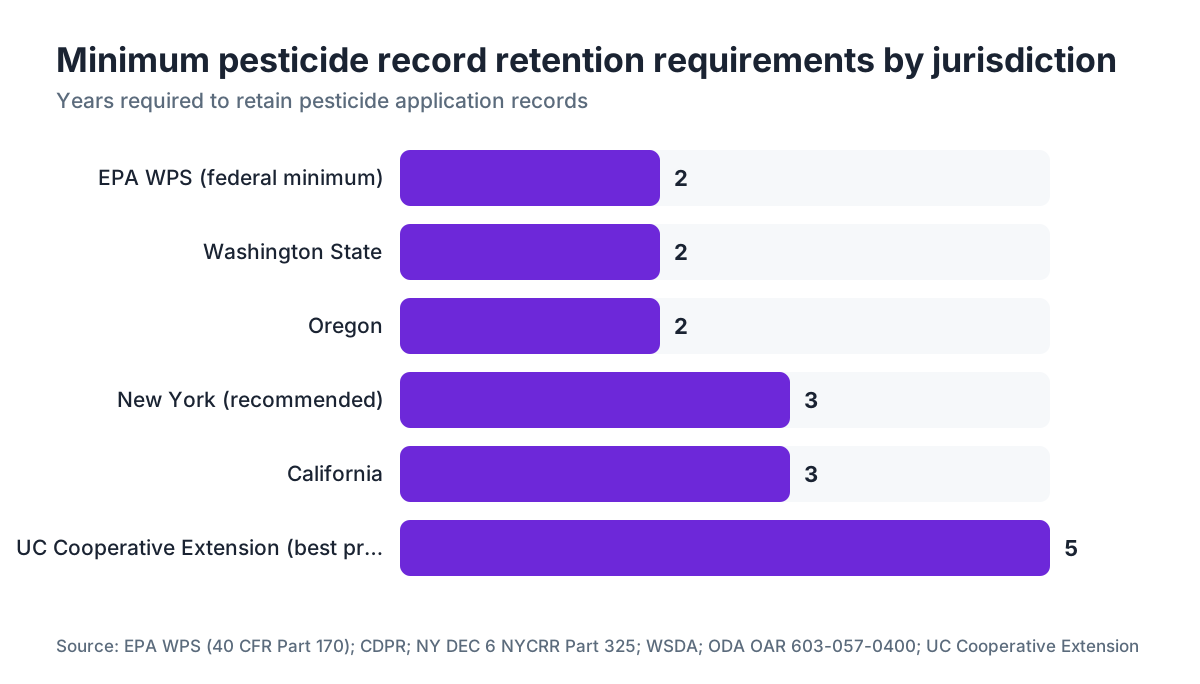
The federal WPS minimum is two years [1]. California's requirement for pesticide application records is three years from the application date [2]. New York points to three [3]. Washington requires two [4].
The winery contract can carry longer dispute windows. Commercial contract statutes of limitations in most states run four to six years. A rejected lot, a residue test failure, or a certification audit can surface two to three years after harvest. Dump your records at the two-year mark and get hit with a dispute in year three, and you have nothing to defend yourself with.
The practical answer: hold spray records, contract files, and correspondence for five years. Storage costs almost nothing. Binders take a little shelf space. Digital files are effectively free. Early disposal risk far outweighs the cost of keeping them.
UC Cooperative Extension guidance for California wine grape operations recommends keeping harvest-related documentation, spray records and buyer contracts included, for at least five years when you operate under a third-party certification program (Lodi Rules, SIP Certified, CCOF, and the like) [10]. Even if you're not certified, that five-year standard is a sound default.
Are there template forms or extension resources you can start with?
Yes. You don't have to build this from scratch.
UC Cooperative Extension has published pesticide application recordkeeping templates and IPM planning worksheets for wine grape vineyards [10]. They cover the state-required fields and take contract restriction fields easily.
WSU Extension's wine grape production guides carry recordkeeping sections that address buyer requirement documentation inside sustainable winegrowing programs [7].
Cornell's viticulture and enology program has block management record templates and spray program worksheets used by New York growers, many of whom sell under Finger Lakes and Long Island winery purchase agreements with specific compound restrictions [8].
EPA's Worker Protection Standard training materials include sample application record formats [1].
The approved-chemical list itself has no single standard template. Ask your buyer whether they have a preferred format. Some larger wineries run a standardized Exhibit A format with every grower. If yours does, use it. If not, build your own one-page table: active ingredient, trade name examples, EPA registration number, status (approved / prohibited / pre-approval required), and the list's effective date.
The vineyard recordkeeping baseline in most extension programs is built for regulatory compliance, and adding buyer contract fields is a small stretch of an existing system, not a new one.
Frequently asked questions
Does a winery-required spray restriction override the pesticide label?
No. The label is federal law under FIFRA and sets the minimum you must meet regardless of the contract. A winery contract can be more restrictive than the label (shorter PHI window, banned compounds) but can never authorize you to apply a product in a way the label prohibits. Follow the label first, then stack any additional contract restrictions on top.
What happens if I apply a restricted compound by mistake?
Document it immediately and honestly. Write a corrective incident note with the date, compound, block, and what went wrong. Notify your winery rep as soon as you can; most contracts carry a notification clause for violations. Prompt, documented disclosure almost always lands better than discovered noncompliance. Depending on the compound and timing, the winery may ask for residue testing before accepting the lot.
Can a winery legally reject a lot just because you applied an approved compound too close to harvest?
Yes, if the contract specifies a pre-harvest application window or requires written pre-approval for late-season sprays. The contract is the controlling document for acceptance, not the label PHI. This is exactly why your pre-season communication with the winery should spell out late-season spray scenarios before you land in one.
Do I need to submit my contract compliance spray records to the county agricultural commissioner?
No. Your state-required pesticide application records go to the commissioner on the state's schedule. The contract compliance fields you add (buyer name, approved list reference, pre-approval status) stay in your own retained file. Never send regulators more than the form requires, and keep private contract details out of government submissions.
What if the winery's approved-chemical list conflicts with my PCA's spray recommendation?
Your PCA may not know about the restriction if you haven't shared it. Send the current approved-chemical list to your PCA at the start of each season in writing. In California, a PCA must account for site-specific constraints in recommendations. If the PCA has the list and still recommends a prohibited compound, ask for written justification and call the winery before applying anything.
How do organic certification spray records relate to winery contract documentation?
They overlap a lot. Certified organic operations already keep approved-input records through their certifier, and those cover most of what a winery contract wants. The main addition is cross-referencing the winery's approved list against your organic system plan inputs every year, since the two lists can differ. A compound your certifier approves may still be banned by the winery contract for export MRL reasons.
How should I handle spray documentation for a block sold to multiple buyers under different restrictions?
The safest move is block-level assignment with the most restrictive buyer's approved list controlling that block for the season. If you can't physically separate the blocks, apply the strictest standard across all of them. If the blocks are separate, your spray records must clearly say which block got each application, because audit traceability depends on block-level detail.
What's the minimum a very small operation needs to keep for contract spray documentation?
At minimum: a dated copy of the contract and any approved-chemical list exhibit, plus a spray log for every application showing product name, date, block, rate, and a note that it complied with or was pre-approved under the named contract. Two documents, kept consistently, cover most audit scenarios for a small vineyard.
Does the EPA Worker Protection Standard require documentation of compounds you chose not to apply?
No. WPS recordkeeping covers actual applications, not decisions to skip one. The contract side of negative documentation (proving you didn't apply a prohibited compound) comes from your spray log's completeness: every application on a block is logged, and the prohibited compound simply never shows up. A complete, unbroken spray log is your proof of absence.
Can I use a simple spreadsheet instead of dedicated software for this documentation?
Yes. A well-structured spreadsheet with separate tabs for the contract file index, restricted-substance master list, and spray application records works fine. Format matters less than consistency, completeness, and a reliable backup. A spreadsheet living only on one laptop with no backup is a real risk. Cloud storage or a printed copy at season end fixes it.
How do winery residue testing requirements change the documentation approach?
If your contract includes pre-harvest residue testing, document the testing protocol next to your spray records: which compounds are tested, the MRL thresholds, who runs the testing, and where samples go. If a lot fails, you need your full spray records to trace when each compound was applied and whether it complied with contract terms. This is when complete, dated records decide whether you get paid.
What's the difference between a PHI and a winery-required pre-harvest application interval?
The PHI (pre-harvest interval) is the minimum waiting period on the pesticide label, set by EPA to keep residues under tolerance at harvest. A winery-required pre-harvest interval is a private contract term that may run longer than the label PHI for market or quality reasons. Both are minimums from their own sources. You comply with both, so the longer of the two controls your last application date.
Sources
- EPA, Agricultural Worker Protection Standard (40 CFR Part 170): WPS requires agricultural employers to keep pesticide application records for two years and make them available to workers upon request
- California Department of Pesticide Regulation, Pesticide Use Reporting: California requires written pesticide application records for all pesticides applied to agricultural commodities, retained for three years
- New York State Department of Environmental Conservation, Pesticides Program (6 NYCRR Part 325): New York requires pesticide application records under 6 NYCRR Part 325 and recommends three-year retention
- Washington State Department of Agriculture, Pesticides Program: Washington requires pesticide application records for all pesticide applications and retains them for two years
- California Department of Pesticide Regulation, Licensing and Certification Program: California licensed PCAs must provide recommendations that account for site-specific constraints including buyer contract restrictions
- EPA, Federal Insecticide, Fungicide, and Rodenticide Act (FIFRA): FIFRA establishes that the pesticide label is federal law and sets minimum requirements for application that no contract can supersede
- Washington State University Extension: WSU Extension viticulture program provides recordkeeping guidance for wine grape growers that addresses buyer-requirement documentation
- Cornell University College of Agriculture and Life Sciences, Viticulture and Enology: Cornell's viticulture program provides block management record templates and spray program worksheets used by New York growers selling under winery purchase agreements
- Oregon Department of Agriculture, Pesticides Program (OAR 603-057-0400): Oregon requires pesticide application records to be kept for two years under OAR 603-057-0400 with some records submitted to ODA
- University of California Agriculture and Natural Resources, Statewide IPM Program: UC Cooperative Extension recommends retaining all harvest-related documentation including spray records and buyer contracts for a minimum of five years under third-party certification programs
Last updated 2026-07-10