How to document maximum annual use rate tracking across the spray season

TL;DR
- Federal law (FIFRA) makes you keep pesticide application records for two years minimum, and many state programs push that to five.
- Tracking maximum annual use rates means running a cumulative tally of active ingredient applied per acre after every spray, then checking it against the label ceiling before you mix the next load.
- A simple spreadsheet or field log does this fine if you build it right.
Why maximum annual use rate tracking matters for compliance
The pesticide label is the law. That phrase gets repeated until it sounds like a bumper sticker, but it has teeth. Applying a product above its label maximum is a federal violation under the Federal Insecticide, Fungicide, and Rodenticide Act (FIFRA), specifically 7 U.S.C. § 136j, which prohibits use "inconsistent with its labeling" [1]. State ag departments stack their own penalties on top. One overage caught in an audit can mean a civil penalty in the thousands, loss of your restricted-use pesticide license, and in bad cases a criminal referral.
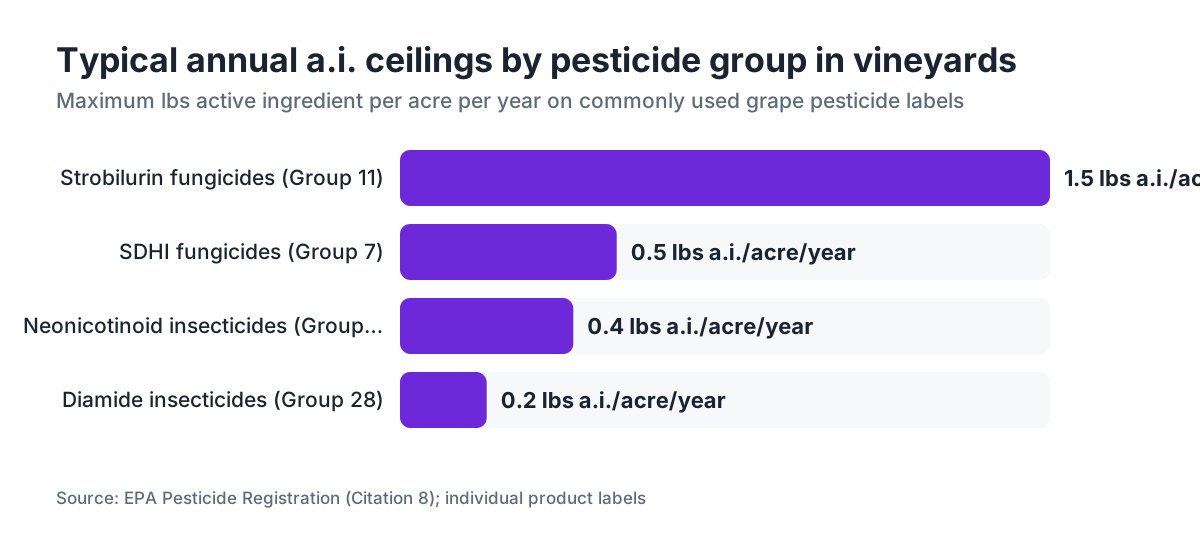
Most spray programs watch the single-application rate. That's the obvious number. But plenty of active ingredients carry a second, harder ceiling: the maximum you can put down in a full calendar year (or per season, per rotation, per crop). Strobilurin fungicides often cap at 1.0 to 1.5 lbs of active ingredient per acre per year. Some neonicotinoids cap at 0.4 lbs a.i./acre/year. Miss the running math across five or six spray events and you sail past the ceiling without knowing it.
The damage isn't only regulatory. Annual ceilings exist mostly to slow resistance and cut groundwater loading. Blow past one and you're selecting for resistance in your own vineyard, which costs more over time than any fine.
Small operations carry the most risk. When one person writes the work orders and runs the sprayer, nobody checks the running total, because nobody set one up.
What federal law actually requires you to record for pesticide applications
FIFRA Section 8 (7 U.S.C. § 136f) requires records for certified applicators using restricted-use pesticides [1]. The EPA's implementing regulation at 40 C.F.R. Part 171 spells out what those records must hold. For commercial and private applicators, the required fields are: brand name and EPA registration number, total amount applied, location of application, date, and crop or site treated [2].
The EPA Worker Protection Standard (WPS), revised at 40 C.F.R. Part 170 and effective January 2, 2017, adds a separate layer. Treated area information has to be available to workers and handlers, and application records must be kept for two years [3]. Join any USDA program or hold a state commercial license and your state may push that to three or five years. California requires Pesticide Use Reports filed with the County Agricultural Commissioner within seven days of application under California Food and Agricultural Code Section 12979, and those records must be kept at least two years by the applicator [4].
Here's the gap. None of these rules explicitly require a cumulative annual use tally. That's on you. The label demands it implicitly, since you're the one responsible for staying under it, but no regulation hands you a form.
What the bare minimum federal record has to capture:
| Field | Source requirement |
|---|---|
| Pesticide brand name | FIFRA § 8 [1] |
| EPA registration number | 40 C.F.R. Part 171 [2] |
| Total amount of product applied | FIFRA § 8 |
| Application date | FIFRA § 8 |
| Location / field block | FIFRA § 8 |
| Crop treated | FIFRA § 8 |
| Applicator name and certification number | State programs vary |
Add three columns yourself: rate per acre (lbs a.i.), acres treated, and cumulative a.i. per acre year-to-date. That's the tracking layer the regulation skips but the label expects.
How do you calculate active ingredient per acre from a product label?
This is where most errors happen. The label gives you the maximum in lbs of active ingredient per acre, but the product sits in the jug measured in fluid ounces or pounds of formulation. You have to convert.
Start with the product's a.i. concentration, printed on the label. A product reading "4 lb a.i./gallon" holds 4 lbs of active ingredient in each gallon. Say your label allows up to 12 fl oz of product per acre. Convert: 12 fl oz divided by 128 fl oz per gallon = 0.09375 gallons per acre. Multiply by 4 lbs a.i./gallon = 0.375 lbs a.i./acre per application. If the annual ceiling is 1.0 lb a.i./acre, you get about 2.6 full-rate passes before you hit it, which means the third full-rate application puts you over.
Dry formulations state a.i. as a percentage. A 50 WDG (wettable dispersible granule at 50% active ingredient) applied at 8 oz/acre delivers 4 oz of a.i./acre, or 0.25 lbs a.i./acre.
Washington State University's Pesticide Education Program templates build both conversions into their downloadable spray record spreadsheets [5]. Cornell's grape IPM resources walk through the same math in their spray log guidance for New York growers [6]. UC Davis IPM covers California-specific label reading and record requirements in its online grape pest management guides [7].
The formula to memorize:
lbs a.i. applied per acre = (fl oz product per acre ÷ 128) × (lbs a.i. per gallon of product)
Run this for every application event, log the result, and add it to a running column. That column is your annual use rate tracker.
What does a working annual use rate tracking system look like?
You need three pieces: a master product list, a per-block application log, and a summary view that aggregates by active ingredient and block across the season.
The master product list is a one-time setup. List every product in your spray shed. For each, record brand name, EPA reg number, active ingredient name, a.i. concentration (lbs/gallon or %), and the label's maximum annual rate in lbs a.i./acre. Some products carry different ceilings by crop or region, so pull the California or Pacific Northwest label specifically if that's where you farm.
The per-block application log is your daily record. After each spray event, log the date, block name and acres, product name, product rate (oz or lbs per acre), gallons of water per acre for the tank mix record, applicator, and an equipment calibration reference. Then add the calculated a.i./acre column from above.
The summary view is what saves you. Build a pivot table (Excel or Google Sheets) that sums a.i./acre by block and by active ingredient. Before you mix the next load, glance at the running total for that a.i. in that block. If you're at 0.85 lbs a.i./acre and the ceiling is 1.0, you can't run a full rate next time without doing the math first.
A paper ledger works too, if that's how your operation runs. Format doesn't matter. What matters is that the cumulative column exists and gets updated before the next application, not after.
Software built for vineyard compliance, like VitiScribe, can run the cumulative tally across blocks and flag products nearing their annual ceiling, which takes a lot of mental load off you during a busy spray window.
How should you organize spray records by block or vineyard unit?
Pesticide labels set rates per acre, so your record system has to match the ground. A 40-acre vineyard tracked as one unit can't tell you whether Block 3 (which got an extra protectant pass in June) is closing on its ceiling while Block 7 still has room.
Break records down to the smallest unit that gets scheduled on its own. For most California or Washington vineyards, that's individual blocks or water districts. Estate operations with more than one variety or vine age usually run different spray schedules per variety block, so those need separate logs.
Use one naming convention and stick to it. "Block 4" or "Estate-N" or "River Block" all work, as long as the same name shows up in every record all season. Inconsistent naming is the single most common reason a block's cumulative log looks incomplete in an audit.
Map your blocks once at the start of the season and note planted acres for each. Acres drive the total product used (which state reporting needs) and they convert your per-application total back to lbs a.i./acre. Keep a copy of that map in the binder or folder with your spray records. California County Agricultural Commissioner audits often start by comparing reported acreage to the assessed parcel, so having your own map speeds that part along.
Farming multiple sites? A separate log per property beats one master log with site columns. Cross-property audits happen when a single license covers multiple addresses.
Which active ingredients have annual use rate ceilings you're most likely to hit in a vineyard?
Not every product has a seasonal ceiling. Sulfur, copper, and many biorationals carry no annual cap. But the products growers reach for most in a vineyard often do. Here are the categories worth watching closely [7][8]:
| Active ingredient class | Example products | Typical annual ceiling |
|---|---|---|
| SDHI fungicides (Group 7) | Flint Extra, Luna Experience | 0.4 to 0.5 lbs a.i./acre/year |
| Strobilurin fungicides (Group 11) | Abound, Pristine | 1.0 to 1.5 lbs a.i./acre/year |
| Neonicotinoid insecticides (Group 4A) | Admire Pro, Belay | 0.2 to 0.4 lbs a.i./acre/year |
| Diamide insecticides (Group 28) | Delegate, Altacor | 0.2 lbs a.i./acre/year for some |
| Carbamate fungicides (EBDC group) | Manzate, Dithane | annual limits vary by label |
Strobilurins catch people most. They're used for powdery mildew and Botrytis at overlapping points in the season. A tank mix of a strobilurin plus an SDHI (Pristine, say, which holds both boscalid and pyraclostrobin) moves both a.i. totals at once. Track each active ingredient on its own even when they come in one bottle.
Neonicotinoid ceilings exist partly for pollinator protection and partly because EPA registration review has added cumulative limits in recent years [9]. These are among the ceilings most actively checked in audits right now.
Check your specific labels. These ranges are typical, not universal, and labels change at re-registration.
When should you update your running use rate tally across the spray season?
Same day you spray. That's the rule. Wait until the weekend or the end of the month and you risk spraying again before you've logged the last pass.
The workflow that holds up: fill out the spray record in the field (or from the cab if you have a tablet), calculate the a.i./acre for that event, and add it to the cumulative total before you park the sprayer. Some operations keep a whiteboard in the shop with running totals by active ingredient, updated after every spray. Low-tech, and it works.
At minimum, update before you start mixing for the next application of that product. That's your hard cutoff. You need the current cumulative total in hand before you measure product into the tank.
Reset cumulative totals to zero at the start of each season. Annual ceilings reset January 1 in most label language, though some labels say "per season" or "per crop" instead of per year. Read your label closely here, because "season" and "calendar year" are not the same thing if you run two crops or have a late harvest.
WSU's Pesticide Education Program recommends a mid-season review of all spray records, usually around bloom or fruit set, to catch products nearing their ceiling before the back half of the season [5]. Good practice. Do it in writing so there's a record that you checked.
What records do you need ready for a state or county pesticide audit?
In California, the County Agricultural Commissioner (CAC) runs routine and complaint-triggered inspections. The CAC can ask to see applications going back two years. They check that your Pesticide Use Reports (PURs) match your field records and that neither exceeds label maximums [4]. A gap between what you reported to the CAC and what your field log shows gets treated as evidence of under-reporting.
Washington's Department of Agriculture, Pesticide Management Division, runs similar record reviews. Washington's agricultural pesticide recordkeeping rules sit at WAC 16-228, which requires records within seven days of application and retention for at least seven years for commercial applicators [10].
Oregon requires commercial applicators to keep records under OAR 603-057-0400, a three-year retention window, available within 24 hours of an inspector's request [11].
Have ready: your spray log (paper or printed), your master product list with EPA numbers, your block map with acreage, applicator license copies, and a summary of cumulative a.i. per block per product. That summary is something you build. The state doesn't hand you a form for it. If an auditor asks "did you exceed the annual rate for azoxystrobin on Block 4?" and you pull a column of numbers that answers it in 30 seconds, the inspection goes smooth. Reconstruct the math on the spot and you're already behind.
Keep paper records in a water-resistant binder in the shop. Keep a digital backup too. Spray records are not worth losing in a shop fire.
How do you handle tank mix records when multiple active ingredients are in one application?
A tank mix is one spray event and multiple active ingredient tracking entries. Log it as one row in your application log, but calculate and update the cumulative a.i. for each active ingredient on its own.
Example: you tank-mix Pristine (boscalid 12.8% + pyraclostrobin 25.2%) with an insecticide. One spray event updates three a.i. running totals: boscalid, pyraclostrobin, and whatever the insecticide's active ingredient is. Check current state registrations for any product you add, since some older insecticides face use restrictions that vary by state.
The most common mistake with premix products is treating the formulation as a single active ingredient for ceiling purposes. A premix label states annual limits for each a.i. separately, often with language like "do not apply more than X lbs a.i. of [compound name] per acre per year from all sources." That phrase "from all sources" matters. If pyraclostrobin shows up in two different products you use, both applications count toward the same ceiling.
Keep a column for each active ingredient in your summary tab. When you add a new product mid-season, go back and check whether any of its a.i.s already appear in products you've applied, then confirm the cumulative total is still under the ceiling.
Managing this by hand? UC Davis IPM's online resources include product tables listing active ingredient names for common grape pesticides [7]. Cross-reference there when a label isn't clear on what's in the formulation.
How can you set up early warning thresholds before you hit the annual ceiling?
Don't wait until you're at 100% of the ceiling. Set a flag at 75% and a planning stop at 90%.
The 75% threshold triggers a review. How many spray events are left in the season, and does your remaining a.i. budget cover them at full rate? If it doesn't, you have time to switch to a different mode of action (which resistance management wants anyway) or trim the rate on remaining passes.
The 90% threshold means your next application of that product has to be a reduced-rate spray, or you document exactly why you believe you still have headroom. This is where you re-read the label math instead of trusting memory.
In a spreadsheet, that's a conditional formatting rule: flag any cell in the cumulative column above 75% of the annual ceiling in yellow, above 90% in red. Five minutes to set up, and it does its job quietly all season. Cornell's grape IPM resources note that proactive threshold tracking cuts the risk of late-season resistance-breaking sprays applied above ceiling rates, a pattern they see in records from high-pressure disease years [6].
Want it automated? VitiScribe builds this warning layer into its spray record module, alerting the manager when any product nears its label ceiling on any tracked block. The reason that helps during a heavy disease year is plain: you're spraying more often and the math is moving fast.
What should a spray season closeout review include for annual use rate compliance?
At the end of the season, before records go into storage, run a closeout check. It takes an hour and catches errors while the details are still fresh.
Generate a summary by block: each active ingredient used, total lbs a.i./acre applied across all events, the label annual ceiling, and the percentage of ceiling used. For most operations that's a one-page table. Any line over 100% is a problem to investigate and document before the file gets closed.
Find an overage and the first move is to pull the individual event records and verify the math. Usually the cause is a transcription error (wrong rate entered, wrong acreage used) rather than a real overage. Correct clerical errors with a note in the file showing the correction, the original entry, and your name. Never erase or delete the original entry.
If the math confirms a real overage, call your state's department of agriculture before the next inspection cycle. Voluntary disclosure gets treated very differently from a discovered violation in most states. An ag attorney or your county farm advisor can walk you through the process.
File the closeout summary with your spray records. When an auditor shows up two years out, you'll have already done the analysis they were going to ask for.
WSU's Pesticide Education Program guides recommend a similar end-of-season reconciliation and suggest stapling the product label summaries (or the relevant printed label pages) to the closeout document, so the ceiling figures sit right beside the cumulative totals [5].
What are the most common record-keeping mistakes that lead to annual use rate violations?
Missing application events is the biggest one. A spray happens, the log never gets filled out, and the cumulative total reads lower than reality. This shows up most during harvest crunch, or when a fill-in applicator runs the sprayer without instructions to complete the log.
Wrong acreage is close behind. Spray 8 acres but log it as 6 and your calculated a.i./acre reads lower than it should. Your per-acre number is wrong even when the total product used is recorded correctly.
Confusing product rate with active ingredient rate. Some growers log "12 oz/acre" as the rate and never convert to lbs a.i. Their cumulative column ends up in fluid ounces of formulation, which can't be compared to a label ceiling stated in lbs a.i.
Ignoring the "from all sources" language on premix labels. Two products with overlapping active ingredients, each tracked on its own, can both read under ceiling while the combined total sits over.
Not resetting the cumulative total at the start of a new season. This one surfaces in multi-year audits, when a carryover total from December bleeds into January.
And not keeping records at all for general-use pesticides. FIFRA's recordkeeping requirement technically covers only restricted-use pesticides for private applicators [1]. But state rules often reach general-use products too, and the label compliance obligation applies no matter what. If you applied it, log it.
Frequently asked questions
Do you have to track annual use rates for general-use pesticides or only restricted-use?
FIFRA Section 8 requires recordkeeping for certified applicators using restricted-use pesticides. General-use products aren't federally mandated, but many state programs (California, Washington, Oregon) require records for all agricultural pesticide applications. More to the point, the label's annual ceiling applies no matter the RUP status. If a general-use product has an annual a.i. limit, you're legally bound to stay under it whether you keep records or not.
How long do I have to keep pesticide application records?
Federal EPA WPS regulations require two years. California requires Pesticide Use Reports for two years at the applicator level. Washington WAC 16-228 sets seven years for commercial applicators, and Oregon OAR 603-057-0400 sets three. If you're in any USDA program or hold a commercial applicator license, check your state's specific rule, since retention windows vary. Keep them longer if you can. Storage is cheap, and audits can come late.
What happens if I accidentally exceed a label's annual use rate?
Exceeding a label rate is a FIFRA violation. Penalties run from a written warning for a first-time minor clerical overage up to civil fines of $1,000 to $5,000 per violation for private applicators, with higher amounts for commercial applicators. In California, the County Ag Commissioner can suspend your pesticide license. Voluntary self-disclosure before an inspection usually gets lighter treatment. Document the math error, correct the records with a note, and contact your state ag department if the overage was real.
Can I split an active ingredient's annual ceiling across multiple blocks independently?
Yes. Annual ceilings on most labels are stated per acre, not per farm total. Block A can sit at 0.9 lbs a.i./acre while Block B is at 0.3, and neither has broken the ceiling. This is exactly why block-level tracking matters. A farm-wide aggregate hides a block-level overage in one direction and makes a compliant operation look over the line in the other.
How do I find the annual use rate ceiling on a pesticide label?
Look under "Directions for Use" and then the section for your crop (grapes or vineyard). Annual ceilings usually sit near the maximum single application rate, phrased as "do not apply more than X lbs a.i. per acre per crop year" or "annual maximum is X lbs a.i./acre from all applications." You can download any registered product's label from the CDMS label database. Always use the label version registered in your state.
Do tank mix records need to list every active ingredient separately?
Yes, for compliance. Your spray log entry can be one row per tank mix event, but your cumulative tracking has to update each active ingredient on its own. Premix products holding two or more a.i.s move multiple ceilings at once. The phrase "from all sources" on many Group 7 and Group 11 fungicide labels means you add together every product that contains that a.i., beyond just the dominant formulation.
What's the difference between a seasonal ceiling and a calendar-year ceiling on a label?
A calendar-year ceiling resets January 1 regardless of crop or growing cycle. A seasonal or per-crop ceiling resets with the crop rotation or at harvest. For single-harvest perennial crops like wine grapes, these often land in the same place, but not always. If you farm a late-harvest variety into December, a seasonal ceiling may not reset until after a January spray you assumed was under a fresh annual cap. Read the exact label language and note which type applies.
Is there a standard spray log form I can download for annual use rate tracking?
WSU's Pesticide Education Program publishes application record forms for Washington commercial applicators that include a.i. calculation columns. Cornell's grape IPM program offers spray record templates built for New York's DEC requirements. UC Davis IPM online resources include California-compliant log formats. None of these calculate cumulative totals for you, so you'll add that column manually or move to a spreadsheet. EPA does not mandate a specific form. Content is what matters.
How do I document a re-entry interval alongside annual use rate records?
Restricted Entry Intervals (REIs) are part of your WPS obligation under 40 C.F.R. Part 170 and are separate from annual rate tracking, though they live in the same record set. Log the REI for each product applied, the date and time of application, and the earliest re-entry date and time. Post the required WPS information at a central location in the vineyard. Many growers keep REI records in the same binder as the spray log, with a separate REI summary sheet updated after each event.
Do organic vineyards need to track annual use rates the same way?
Yes, and then some. Certified organic operations must comply with FIFRA label requirements for every product they use, including OMRI-listed materials that carry annual ceilings. Copper, for one, has EPA-registered labels with annual use limits plus the National Organic Program's own accumulated copper restrictions under 7 C.F.R. Part 205. Your organic certifier reviews spray records annually. A clean cumulative a.i. log is exactly what they want, and missing records can trigger a certification review.
How do I handle a partial application where I didn't spray an entire block?
Log the actual acreage treated, not the block total. If Block 6 is 10 acres and you sprayed 6 acres at the north end, record 6 acres and calculate a.i. per acre on that 6. Spray the other 4 acres later and that's a separate row. Your cumulative total per acre for the full block is the weighted average across events. This matters most when partial blocks catch extra sprays for disease hotspots and one sub-block ends up with more passes than the rest.
Can I use a spreadsheet instead of purpose-built software for annual use rate tracking?
Absolutely, and plenty of growers do it well with a Google Sheet or Excel workbook. Build one tab as a master product list with a.i. concentrations and annual ceilings, one tab as the spray log with a calculated a.i./acre column, and one tab as a pivot summary by block and active ingredient. The catch is you have to update it yourself and remember to check it before mixing. Software automates the flag. A spreadsheet only works if the person mixing also opens the spreadsheet.
What do I do if I inherit a vineyard mid-season and don't have the previous applicator's spray records?
Contact the previous owner or manager in writing and request all pesticide application records for the current calendar year. If they're unreachable, check with the County Agricultural Commissioner (in California) for filed Pesticide Use Reports, which are public records. For the rest of the season, apply conservatively and document every event. In your own records, note your operational start date and that prior records aren't in your possession, along with the steps you took to get them. That protects you in an audit.
Sources
- EPA, Summary of the Federal Insecticide, Fungicide, and Rodenticide Act (FIFRA): FIFRA Section 8 (7 U.S.C. § 136f) requires certified applicators to keep pesticide application records; Section 136j prohibits use inconsistent with labeling.
- EPA, 40 C.F.R. Part 171 Certification of Pesticide Applicators: 40 C.F.R. Part 171 specifies required record fields including EPA registration number, amount applied, location, date, and crop treated.
- EPA, Agricultural Worker Protection Standard (WPS), 40 C.F.R. Part 170: WPS revised rule effective January 2, 2017 requires treated area information and application records retained for two years.
- California Department of Pesticide Regulation, Pesticide Use Reporting: California Food and Agricultural Code Section 12979 requires Pesticide Use Reports filed with the County Agricultural Commissioner within seven days of application, retained by applicator for two years.
- Washington State University, Pesticide Education Program: WSU Pesticide Education Program publishes spray record templates with a.i. calculation columns and recommends a mid-season review at bloom or fruit set to catch products approaching annual ceilings.
- Cornell University, New York State Integrated Pest Management Program (grape resources): Cornell IPM resources provide spray log guidance for New York growers and note that proactive threshold tracking reduces late-season above-ceiling applications during high disease pressure years.
- UC Statewide Integrated Pest Management Program, Grape Pest Management: UC IPM online resources include California-compliant log formats and product tables listing active ingredient names for common grape pesticides.
- EPA, Pesticide Registration (resistance management and labeling): Annual rate ceilings for SDHI and strobilurin fungicides exist to manage resistance; Group 7 and Group 11 products typically carry 0.4 to 1.5 lbs a.i./acre/year ceilings.
- EPA, Pollinator Protection: EPA registration review for neonicotinoids has added cumulative annual use limits partly for pollinator protection; these ceilings are among the most actively checked in compliance audits.
- Washington State Department of Agriculture, Pesticides (WAC 16-228): Washington WAC 16-228 requires pesticide application records within seven days of application and retention for seven years for commercial applicators.
- Oregon Department of Agriculture, Pesticides Program (OAR 603-057-0400): Oregon OAR 603-057-0400 requires commercial applicator records with three-year retention, available within 24 hours of an inspector's request.
- CDMS, Pesticide Label Database: Pesticide labels with annual use rate ceilings can be downloaded from the CDMS label database for any registered product.
Last updated 2026-07-09